

Intuceo moved a legacy SQL Server measure engine for Merit-based Incentive Payment System (MIPS) reporting onto an Observational Medical Outcomes Partnership (OMOP) Common Data Model (CDM) lakehouse on Amazon Web Services (AWS), Databricks, and Delta Lake, designed to avoid disrupting live Centers for Medicare & Medicaid Services (CMS) reporting for 15 health-system clients.
- Industry Healthcare data and analytics
- Client type MIPS and QCDR quality-reporting provider
- Engagement Measure-engine modernization and data standardization
- Core stack AWS Simple Storage Service (S3), Databricks, Delta Lake, Unity Catalog, OMOP CDM v5.4
15
Health-system
clients in scope
26/105
Unique health
systems/sites
16
Qualified Clinical Data
Registry (QCDR) and MIPS
measures re-engineered
5
Electronic health record
(EHR) sources unified,
including Cerner and Epic

Client Overview
A quality-reporting provider serving 15 health systems
The client is a healthcare data analytics organization that delivers MIPS and QCDR quality
reporting to health systems. The engagement covered 15 health-system clients, 26 unique
health systems and 105 sites, with clinical data arriving from five EHR sources, including Cerner
and Epic.
MIPS results feed CMS reporting, so the measure output these health systems rely on is
compliance-critical. The modernization had to proceed without disrupting that live reporting.
The Challenge
A legacy measure engine had reached the limits of its design
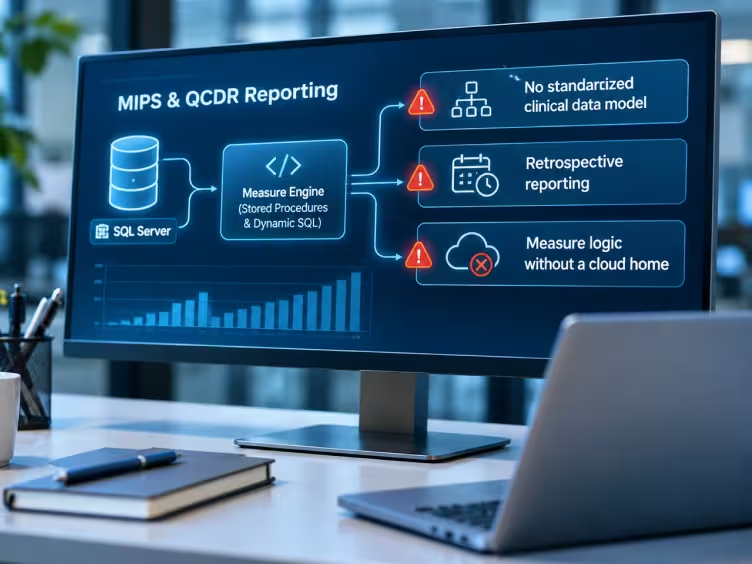
The client’s MIPS and QCDR reporting engine ran on Microsoft SQL Server as a set of stored
procedures and dynamic Structured Query Language (SQL). It was reaching the limits of what it
could scale to, and three further gaps sat alongside the scaling problem.
- No standardized clinical data model: Every new EHR source required custom, one-off logic before its data could feed the measures.
- Retrospective reporting: Care gaps surfaced only after it was too late to close them.
- Measure logic without a cloud home: A parallel cloud migration of the client’s data lake was already underway, but the MIPS measure logic had no place in it yet.
The Solution
Measure computation rebuilt on the OMOP Common Data Model
Intuceo rebuilt the measurement pipeline around the published OMOP CDM v5.4 specification, deployed natively on AWS S3, Databricks, and Delta Lake. The new environment was added alongside the client’s existing systems rather than replacing them in a single cutover.
- Automated vocabulary pipeline: An Athena vocabulary pipeline unifies International Classification of Diseases, Tenth Revision (ICD-10), Current Procedural Terminology (CPT), Systematized Nomenclature of Medicine (SNOMED), Logical Observation Identifiers Names and Codes (LOINC), and RxNorm codes across more than 8 million concepts.
- Format-agnostic measure framework: Each measure is expressed as a YAML Ain’t Markup Language (YAML) and SQL template that runs as PySpark against OMOP tables.
- Phased rollout with full cross-validation: Every step of the rollout is cross-validated against legacy output.
Technology used
The solution moves from siloed source data through correlation
into fault notifications and savings
| Layer | Technology | Role in this engagement |
|---|---|---|
| Legacy engine | Microsoft SQL Server stored procedures and dynamic SQL | Original MIPS and QCDR measure logic, used as the validation baseline |
| Storage | AWS S3, Delta Lake | Cloud-native storage for the OMOP data |
| Compute | Databricks, Databricks SQL, PySpark | Execution of the re-engineered measures |
| Catalog | Databricks Unity Catalog | Hosts the OMOP CDM v5.4 schema |
| Data model | OMOP CDM v5.4 | Standard clinical model for all 15 clients’ data |
| Vocabularies | Athena: ICD-10, CPT, SNOMED, LOINC, RxNorm | Unified terminology, more than 8 million concepts |
| Measure logic | YAML and SQL templates | Format-agnostic measure definitions and site onboarding configuration |
| Sources | Five EHR systems, including Cerner and Epic | Clinical data feeding the OMOP tables |
OMOP foundation
The CDM v5.4 schema is live in Databricks
Unity Catalog, with data from all 15 clients
standardized to it.
Measure migration
All 16 measures were re-engineered from
stored procedures into tested Databricks
SQL and PySpark.
Validation parity
An automated suite cross-validates
legacy and new measure output against a
concordance target of 99% or higher.
Reusable onboarding
A configuration-driven, YAML-based
framework is in place for adding future
sites and data sources.
Results and outcomes
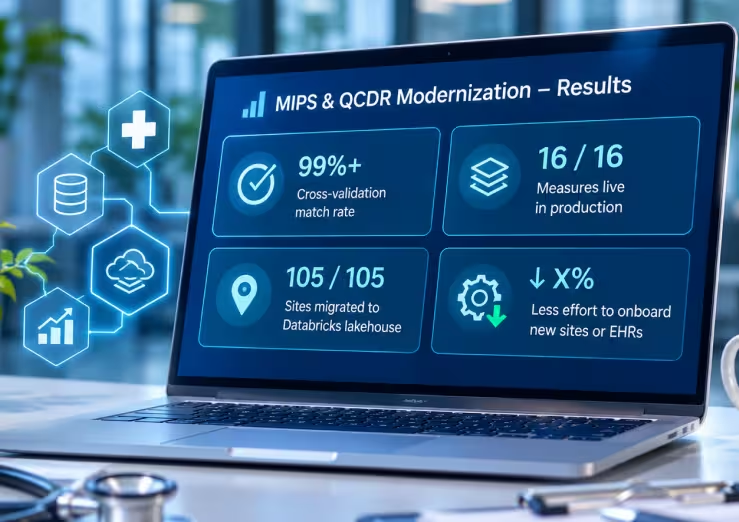
The OMOP foundation and all 16 re-engineered measures are in place
- [X]% Cross-validation match rate between legacy and modernized measure output, against a target of 99% or higher
- [X] of 16 QCDR and MIPS measures live in production on the new lakehouse
- [X] of 105 Sites migrated to the Databricks lakehouse
- [X]% Reduction in effort to onboard a new site or EHR source compared with the legacy custom-build process
Move compliance-critical measure logic onto a standards-based cloud foundation
Intuceo partners with healthcare data and analytics organizations to modernize legacy
reporting infrastructure onto scalable, standards-based cloud environments, without
disrupting the compliance-critical reporting their clients depend on.