




Key Takeaways
- Zero-shot segmentation produces object masks from a prompt, with no task-specific training on your images.
- It is strongest for locating and isolating parts, regions, and larger visual features.
- It is weakest on fine, low-contrast defects, which are often exactly what inspection needs to catch.
- The most reliable production role today is as a labeling and localization assistant, paired with a model or rule that makes the accept-or-reject call.
What zero-shot segmentation means in industrial inspection
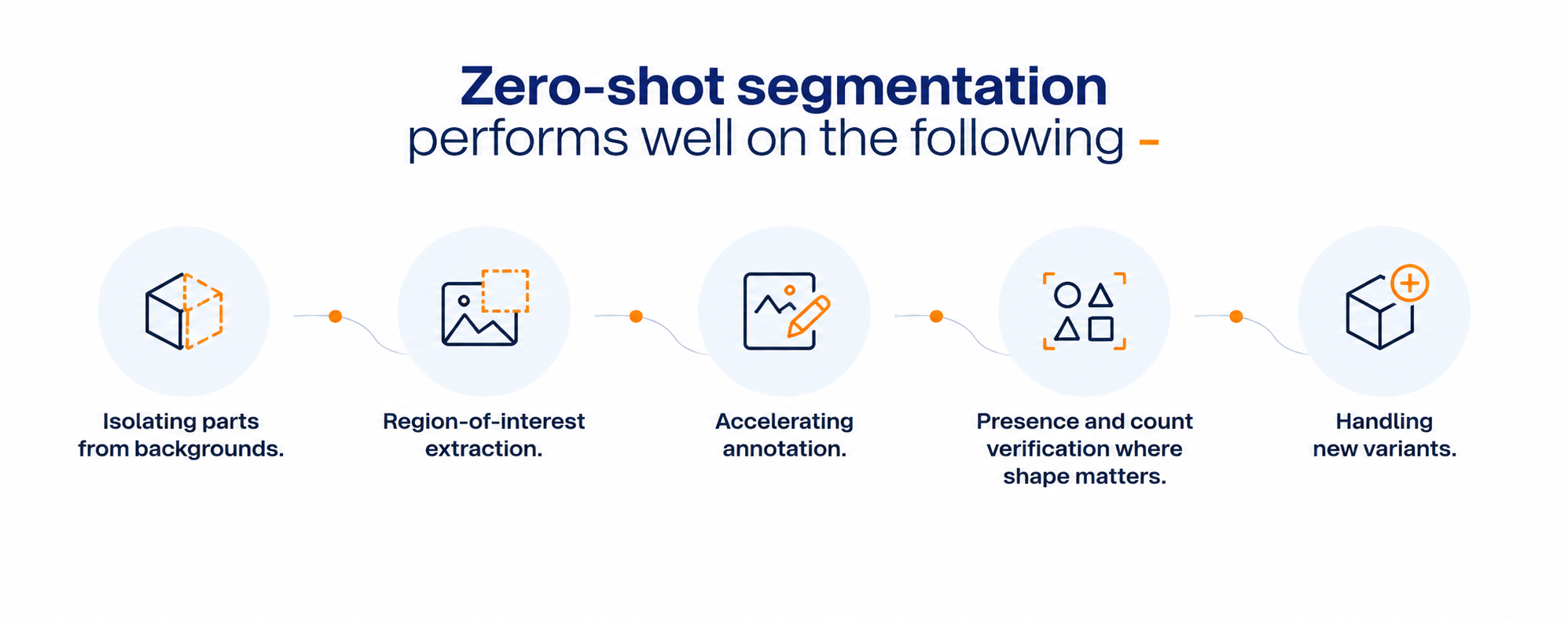
Where zero-shot segmentation performs well
- Isolating parts from backgrounds: Separating a component from a conveyor, fixture, or tray so a downstream check only examines relevant pixels.
- Region-of-interest extraction: Cropping labels, connectors, welds, or fasteners so a smaller specialist model can inspect them.
- Accelerating annotation : Generating first-draft masks that quality engineers correct, rather than drawing every outline from scratch.
- Presence and count verification where shape matters : Confirming that subcomponents appear and occupy the expected area, in cases where a bounding box alone would not settle it.
- Handling new variants:Producing usable masks on a part the system has never seen, before any retraining is scheduled.
Where zero-shot segmentation is unreliable
Fine and low-contrast defects
Acceptance criteria
Consistency across imaging conditions
Speed at line rate
Zero-shot detection vs. segmentation: which does your inspection need?
| Aspect | Zero-shot detection | Zero-shot segmentation |
|---|---|---|
| Output | A box and a label | A pixel-level outline (mask) |
| Best for | Presence, position, and counting | Shape, area, and boundary precision |
| Compute cost | Lower | Higher |
| Example | Confirming a part is present | Measuring a coating gap or defect extent |
Where does the Segment Anything Model (SAM) fit in manufacturing workflows?
How do vision-language models and segmentation models work together?
How do you test zero-shot segmentation on your production line? 7 steps
- Assemble a hard evaluation set: Include your subtle defects, reflective parts, and worst lighting, not only clear examples.
- Define success in operational terms: Mask overlap scores are useful, but the decisive question is whether the mask would lead to the right part disposition: accept, rework, or reject.
- Compare prompt types: Points, boxes, and text prompts behave differently. Test the one you would actually use in production.
- Measure speed on target hardware: Benchmark on the device that would sit near the line, not a research workstation.
- Repeat across shifts and variants: Run the same prompts on images from different shifts, operators, lighting states, and a recent part variant, to see whether performance holds without adjustment.
- Record how it fails, not only how often: A model that misses in predictable ways is easier to manage than one that fails at random, and a clear list of what it misses is as valuable as an accuracy score.
- Check review time and traceability: If reviewing uncertain masks takes longer than manual inspection, the workflow needs redesign. Record model version, prompt, and image for each output so decisions can be audited later, a standard practice in production MLOps pipelines.
When should you move from zero-shot to a fine-tuned model?
How Intuceo approaches segmentation work
Intuceo starts with the inspection decision the business needs, then works backward to whether segmentation, detection, or a simpler rule is the right tool. Scope your inspection use case with an AI architect.
Two capabilities carry most of the delivery on vision work. High-fidelity visual inspection applies image segmentation, sub-pixel anomaly detection, and automated feature extraction to sub-millimeter defects, including precision medical optics, where surface anomalies, edge irregularities, and contaminants have to be caught at production speed. Multi-modal vision intelligence brings video, image, and metadata streams together so inspection results arrive alongside line system signals rather than in a separate console.
Deployment is the part that has to survive audit. Intuceo delivers in on-premise, private cloud, and air-gapped environments, driven by PhD-led engineering teams with prior deployments in regulated and high-precision environments. See how this applies across AI-driven advanced manufacturing and to the ML and computer vision capability built for it.