



A model that classifies adverse event reports or stratifies patient risk becomes a regulated computerized system the day it goes live, with one complication that conventional validation never had to absorb: its performance depends on data it has not seen yet. The records it produces still carry the same integrity, traceability, and privacy obligations as a batch record or a claims file. MLOps in healthcare and pharma is the discipline that keeps those two facts aligned, so that every model in production can be reproduced, explained, and defended at inspection.
Machine learning operations (MLOps) already gives teams the raw mechanics: pipelines, experiment tracking, model registries, and monitoring. This guide covers what healthcare and pharma teams add on top of those mechanics, stage by stage, building on our broader guide to MLOps for regulated industries.
What is MLOps in healthcare and pharma?
MLOps in healthcare and pharma is the practice of running machine learning pipelines so every production model can be reproduced, explained, and defended at inspection. It adds regulated controls to standard MLOps: validated releases, Part 11 audit trails, HIPAA safeguards, and change control that is approved before retraining begins.
Key Takeaways
- Part 11 and HIPAA are binding today, while FDA, EMA, and EU Annex 22 AI guidance shapes the evidence inspectors expect to see.
- A model’s context of use and risk rating set how deep its validation needs to go.
- Each pipeline stage, from data preparation to change control, should generate its own evidence automatically.
- Retraining protocols, including triggers, acceptance criteria, and rollback, are approved before the first deployment.
- Accountability for AI-assisted decisions stays with named people, backed by review queues and logged overrides.
Which Regulations Apply to MLOps in Healthcare and Pharma?
No single regulation governs machine learning (ML) in healthcare and life sciences. Teams assemble their obligations from records rules, privacy law, the good practice regulations collectively known as GxP (manufacturing, clinical, laboratory, and pharmacovigilance), and artificial intelligence (AI) guidance that is still maturing. The documents below carry the most weight for models in production.
| Source | Status | What it asks of the pipeline |
|---|---|---|
| 21 CFR Part 11 (Code of Federal Regulations) | Binding regulation | Validated systems, secure time-stamped audit trails for record creation, modification, and deletion, and change control over systems documentation[1] |
| Health Insurance Portability and Accountability Act (HIPAA) Security Rule, 45 CFR 164.312 | Binding regulation | Access control, integrity safeguards, and audit controls that record and examine activity in systems holding electronic protected health information (ePHI)[2] |
| U.S. Food and Drug Administration (FDA) guidance on AI for drug and biological decision-making, January 2025 | Draft, nonbinding | A risk-based credibility assessment for a defined context of use, with life cycle maintenance after deployment[3] |
| FDA and European Medicines Agency (EMA) Guiding Principles of Good AI Practice, January 2026 | Joint principles | Traceable data provenance in line with GxP, risk-based performance assessment, and scheduled monitoring for issues such as data drift[4] |
| FDA Predetermined Change Control Plan (PCCP) guidance for AI-enabled device software | Final, nonbinding | Pre-specified modifications, a protocol to develop, validate, and implement them, and an impact assessment[5] |
| European Union (EU) Good Manufacturing Practice (GMP) Annex 22, Artificial Intelligence | Consultation draft | Continuous oversight of AI systems, including change control, performance monitoring, and human review procedures[6] |
The practical reading of the table is that Part 11 and HIPAA are enforceable today, while the AI-specific documents describe the evidence inspectors will increasingly expect to see. FDA AI compliance in 2026 therefore means satisfying binding records and privacy rules with evidence organized the way the AI guidance describes it.
How Does FDA’s Context of Use Shape AI Model Validation?
FDA’s draft guidance anchors validation to a defined question and a context of use (COU), then rates model risk on two factors. Model influence is the weight the model’s output carries in the decision relative to other evidence. Decision consequence is the significance of an adverse outcome if that decision turns out to be wrong.[3]
The guidance’s own example of high risk on both counts is a model used to decide which trial participants can skip inpatient monitoring after dosing. A model that ranks literature for a human reviewer would sit far lower, and its credibility plan can be lighter in proportion.
This framing answers how FDA expects AI models to be validated and monitored in clinical settings: through evidence scaled to risk, defined before deployment, and maintained for as long as the model is in use. Operationally, the COU statement, risk rating, and acceptance criteria belong in the model registry as metadata on every version. When an inspector asks why a model was validated the way it was, the answer then travels with the model rather than sitting in a document nobody can locate.
How to Govern MLOps in Healthcare and Pharma, Stage by Stage
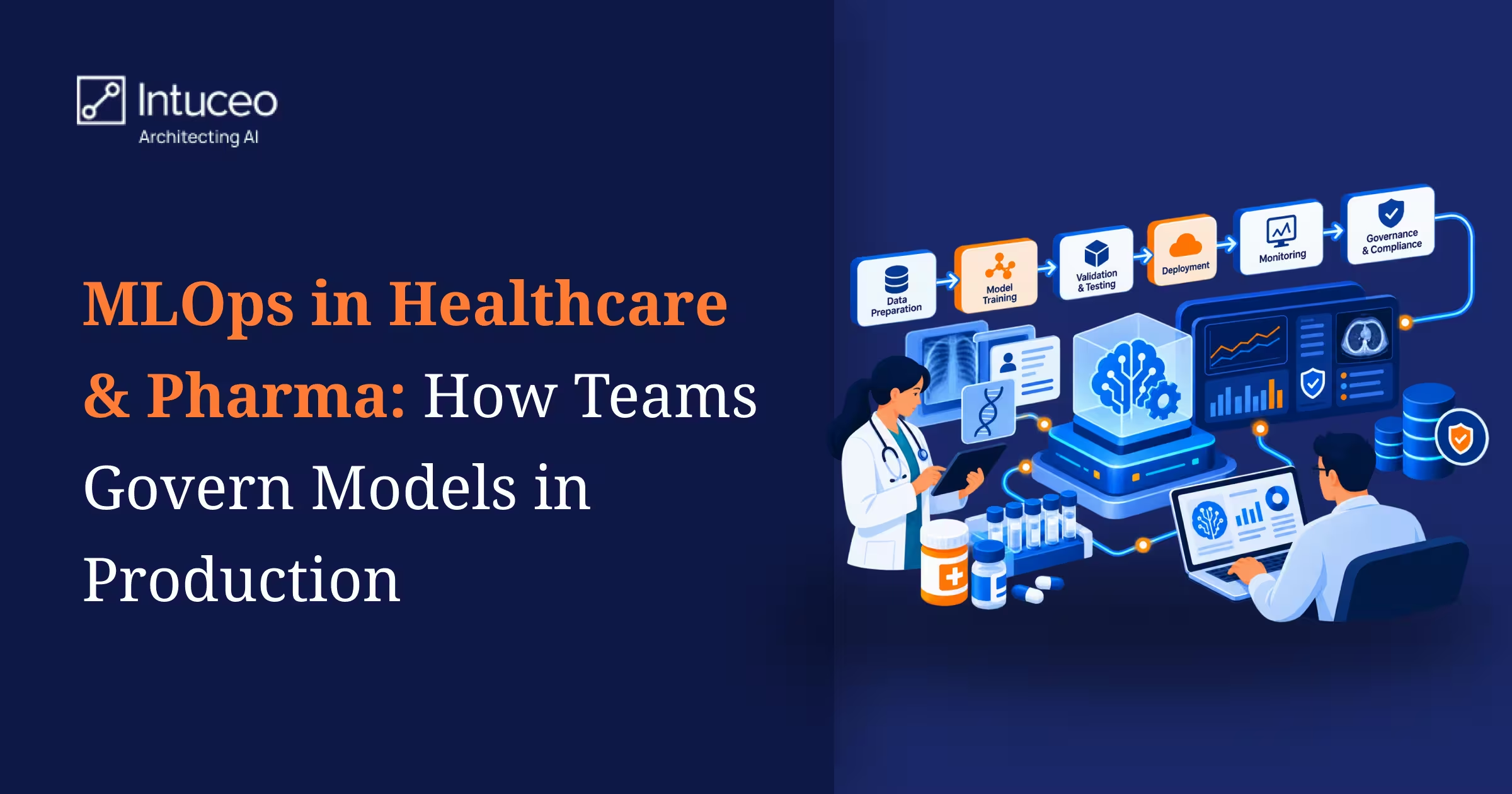
Implementing MLOps in healthcare and pharma comes down to deciding what evidence each stage must produce, then making the pipeline produce it automatically.
How Is MLOps in Healthcare Different From Standard MLOps?
Standard MLOps and its regulated form share the same tooling. The difference is the evidence each step has to leave behind.
| Area | Standard MLOps | MLOps in healthcare and pharma |
|---|---|---|
| Data | Versioned datasets | Immutable, hashed snapshots linked to each model version, with ePHI kept in access-controlled zones and de-identified before experimentation |
| Validation | Metrics reviewed after training | Acceptance criteria fixed before training, tested on held-out data, with the report assembled from pipeline metadata |
| Release | Automated promotion to production | An approval signature bound to a specific model version, with a Part 11 audit trail of who approved what and when |
| Monitoring | Drift alerts | Thresholds set by the COU risk rating; a breach opens a quality investigation with documented root cause |
| Retraining | Scheduled or triggered automatically | A retraining protocol or PCCP, approved in advance, covering triggers, data windows, acceptance criteria, and rollback |
| Accountability | The ML team | A named owner, risk tier, and review date in a model inventory, with human review of AI outputs that inform regulated decisions |
Stage 1: Data Preparation and Provenance
The FDA and EMA principles ask that data provenance, processing steps, and analytical decisions be documented in a traceable, verifiable manner consistent with GxP.[4] In practice, every training set becomes an immutable, hashed snapshot that a model version points to, so retraining on identical data is always possible. A HIPAA-compliant ML pipeline adds two controls at this stage: ePHI stays inside access-controlled zones with logged activity, and data is de-identified before it reaches experimentation environments that have no need for identifiers.
Stage 2: Training and Validation
GxP MLOps for pharma uses the same automation as conventional MLOps, operated under a risk-based quality system so the automation itself generates the evidence. Each training run captures the code commit, container image, parameters, and dataset version without manual entry. Performance is tested against acceptance criteria fixed before training, on held-out data the team did not tune against, and the validation report is assembled from pipeline metadata instead of being written after the fact.
Stage 3: Release and Approval Under Part 11
Promotion from staging to production is where 21 CFR Part 11 AI validation concentrates, starting with validation of the systems involved (§11.10(a)). The promotion is an electronic record: it needs an approval signature bound to a specific model version (§11.70), and an audit trail showing who approved what and when (§11.10(e)). Part 11 also requires change control over systems documentation (§11.10(k)), which in an MLOps setting extends to pipeline definitions and infrastructure code.[1]
Stage 4: Production Monitoring and Drift
Monitoring covers three signals: shifts in input distributions, shifts in output distributions, and realized performance once ground truth arrives, such as adjudicated adverse event cases or confirmed readmissions. In healthcare MLOps, alert thresholds should follow the COU risk rating. A breach opens an investigation under the quality system with documented root cause, which keeps automatic retraining from silently masking a problem. Prediction logs are records in their own right and need retention periods aligned with the underlying regulation.
Stage 5: Change Control and Retraining
Every retrained model is a new version, and the pharma AI model lifecycle depends on deciding in advance how much revalidation each type of change requires. For AI-enabled medical devices, a PCCP lets manufacturers describe planned modifications, the methodology to develop, validate, and implement them, and an assessment of their impact, so pre-authorized changes do not each need a new marketing submission.[5] The draft EU Annex 22 points in the same direction for manufacturing, pairing change control with ongoing performance monitoring.[6] The retraining protocol, covering triggers, data windows, acceptance criteria, and rollback, should be approved before the first deployment rather than drafted during the first incident.
Evidence Each Stage Must Produce
The table below summarizes what the pipeline should generate at each stage, and which requirement drives it.
| Stage | Evidence the pipeline must produce | Main driver |
|---|---|---|
| Data preparation | Hashed, immutable training data snapshots tied to each model version, logged ePHI access, and de-identified data for experimentation | FDA and EMA principles; HIPAA Security Rule |
| Training and validation | Code commit, container image, parameters, and dataset version for every run, plus results against pre-set acceptance criteria | GxP risk-based quality system |
| Release and approval | An approval signature bound to the model version, an audit trail of approvals, and change control over pipeline and infrastructure code | 21 CFR Part 11 |
| Production monitoring | Input, output, and performance monitoring records, investigation records for threshold breaches, and retained prediction logs | FDA draft AI guidance; FDA and EMA principles |
| Change control | An approved retraining protocol or PCCP, and revalidation evidence for every new model version | FDA PCCP guidance; draft EU Annex 22 |
Why Is Human Oversight Required for AI in GxP Settings?
In an April 2026 warning letter, FDA stated that when a manufacturer uses AI to help with current good manufacturing practice (CGMP) activities, any output or recommendation from an AI agent must be reviewed and cleared by an authorized human representative of the firm’s quality unit.[7] That case involved AI-drafted specifications and procedures rather than a deployed predictive model, yet the principle carries over directly: accountability for an AI-assisted decision stays with named people.
The FDA and EMA principles reinforce this by asking that performance assessment cover the complete system, including human and AI interaction.[4] For MLOps teams, that translates into review queues for low-confidence outputs, explanations surfaced at the point of review, overrides captured in the audit trail, and override rates tracked as a monitoring signal in their own right. Sound model governance for healthcare AI wraps these controls in a model inventory that records an accountable owner, a risk tier, and a periodic review date for every model in service.
How Intuceo supports governed MLOps
Intuceo is a PhD-led AI, ML, and data analytics services firm whose life sciences work includes Janssen, Ferring Pharmaceuticals, and Bausch & Lomb. Its MLOps engagements build compliance into the pipeline from the first commit, so audit logs, lineage, and validation evidence accumulate through normal operation. Deployed models carry drift monitoring, controlled retraining loops, and interpretability views designed for the reviewers who sign off on outputs.
Explainability, bias checks, and model documentation are reviewed by Intuceo’s PhD-led Board of Science & Innovation, and the iPDLC™ delivery framework places PhD-led quality gates at every transition from development to production. Teams work across MLflow, Kubeflow, and Amazon SageMaker, so governance fits the stack a client already runs instead of forcing a migration.
Running models in production ahead of an inspection or a submission? Get a governance gap review that maps each model to its context of use, audit trail coverage, and change control readiness.
Frequently Asked Questions
1.How do pharma companies govern machine learning models under 21 CFR Part 11?
Pharma companies govern ML models under Part 11 by first scoping which ML artifacts count as regulated records. FDA’s Part 11 scope and application guidance ties the rule to records that other regulations, known as predicate rules, already require. It also describes enforcement discretion for certain Part 11 requirements, while predicate rule obligations stay fully in force.[8] Pharma teams therefore classify ML artifacts individually. Model outputs that feed a GxP decision, validation reports, release approvals, and training data cited in a submission are typically treated as regulated records. Exploratory notebooks stay outside scope until their results become the basis for a regulated decision.
2.What does MLOps look like in a GxP-regulated environment?
It looks like a validated computerized system whose validation never fully closes. The International Society for Pharmaceutical Engineering (ISPE) Good Automated Manufacturing Practice (GAMP®) Guide: Artificial Intelligence was published in July 2025 for use alongside GAMP 5 (Second Edition). It covers the AI-enabled system life cycle, the responsibilities of internal and external suppliers, and ongoing monitoring and maintenance.[9] Two practical consequences follow. Cloud ML services used in GxP work need supplier assessment and infrastructure qualification. GxP and non-GxP workspaces should also be kept separate, so exploratory work cannot reach production without passing through change control.
3.How do healthcare organizations maintain HIPAA compliance in their ML pipelines?
Healthcare organizations keep ML pipelines HIPAA-compliant by de-identifying data, scrubbing identifiers from ML outputs, and holding business associate agreements (BAAs) with vendors. Most start by deciding which de-identification route applies. HIPAA recognizes two: removing a specified list of identifiers, or a formal determination by a qualified expert applying statistical and scientific methods.[10]
Beyond that, the most common leak path in healthcare MLOps is incidental. Identifiers get written into experiment logs, prediction logs, feature store snapshots, or error traces. Most of the gaps teams find in audits close with three steps: scrubbing those outputs, keeping features to the minimum the model needs, and holding BAAs with any vendor that touches ePHI.
4.What tools are used for model version control and audit logging in pharma AI?
A typical pharma MLOps stack has five layers:
- Git for code and pipeline definitions.
- A data versioning layer such as Data Version Control (DVC), lakeFS, or Delta Lake time travel.
- An experiment tracker and model registry such as MLflow or the Amazon SageMaker Model Registry.
- An orchestrator such as Kubeflow Pipelines or Apache Airflow.
- Write-once storage for audit logs.
Whatever tools you choose, the configured system, including its procedures, access controls, and retention settings, must be validated. That is why tool selection should follow the governance design rather than come before it.
5.What is a Predetermined Change Control Plan (PCCP) in AI governance?
A PCCP lets makers of AI-enabled medical devices pre-specify planned model modifications, the protocol to develop, validate, and implement them, and an assessment of their impact. Once FDA authorizes the plan, changes made within it do not each need a new marketing submission.[5] For MLOps teams, the PCCP becomes the approved rulebook for retraining.