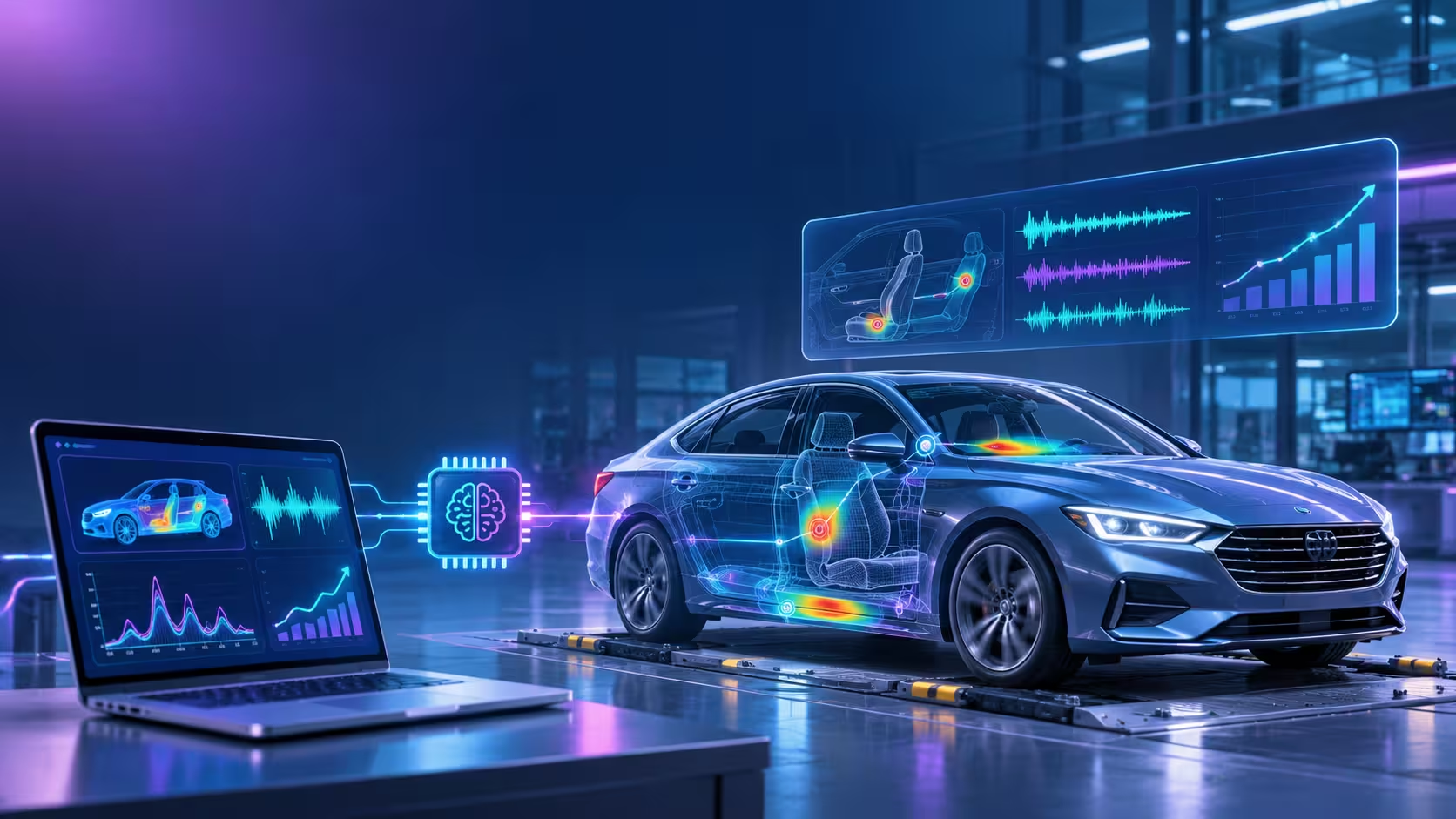
Intuceo built an AI solution that reads unstructured buzz, squeak and rattle (BSR) complaints, maps them to vehicle zones, subsystems and components, and suggests root causes with confidence scores. Generative AI interprets the complaints and AI agents classify and prioritize them, cutting diagnosis cycles from weeks to hours.
- Industry Automotive and engineering
- Client type Automaker managing BSR complaints across vehicle programs
- Engagement AI-driven complaint classification and root cause suggestion
- Core stack Python, Azure Functions, Azure AI Foundry (generative and agentic AI), scikit-learn
4
Faster BSR cycle time
90%
Less manual analysis
80%
Less manual effort through NLP and machine learning
Weeks to hours
Reduction in diagnosis cycles

Client Overview
An automaker losing time and money to BSR complaints
BSR issues are among the noises and vibrations drivers notice and report. For automakers,
these complaints cost millions each year in diagnosis effort, warranty claims and recalls. The
client needed a faster, more consistent way to turn complaint text into engineering action across
its vehicle programs.
The Challenge
Slow, manual diagnosis with no way to measure fixes
The client’s BSR process depended on engineers reading complaints and analyzing them by
hand. The result was delay, cost and declining customer trust.
- Slow diagnosis cycles: Investigations took weeks.
- Manual, error-prone analysis: Results varied from one analyst to the next.
- No quick way to measure design fixes: Teams could not easily confirm whether a fix reduced complaints.
- Rising warranty claims and recalls: Unresolved issues carried growing financial impact. risk.

The Solution
Generative and agentic AI that turns complaint text into root cause suggestions
Intuceo built a solution that combines generative AI, agentic AI and classical machine learning
(ML) on Microsoft Azure.
- Generative AI: Understands unstructured complaint text and maps it to vehicle components.
- Agentic AI: Classifies and prioritizes complaints and suggests probable root causes.
- Natural language processing (NLP) and ML: Cut manual effort by 80% and track fix effectiveness using cosine similarity between complaints before and after a design change.
- Accurate classification: Issues are classified by zone, subsystem and component.
- Confidence-based suggestions: Each root cause suggestion carries a confidence score, so engineers know where to look first.
Technology used
| Layer | Technology | Role in this engagement |
|---|---|---|
| Language | Python | Core development language for the data and model pipeline |
| Compute | Azure Functions | Serverless execution of processing steps |
| Generative and agentic AI | Azure AI Foundry | Complaint understanding, classification, prioritization and root cause suggestion |
| Machine learning | scikit-learn | Classification support and cosine similarity tracking of fix effectiveness |
Advantages
- Speed: Diagnosis cycles cut from weeks to hours.
- Accuracy: AI applies the same logic to every complaint, removing analyst bias.
- Cost savings: Faster resolution helps reduce warranty claims and recalls.
- Scalability: The approach works across all vehicle models and programs.
- Continuous learning: The solution improves with each new complaint.
Results and outcomes
BSR resolution in hours, not weeks
- 40% faster cycle time
- 90% less manual analysis
- Accurate issue classification by zone, subsystem and component
- Confidence-based root cause suggestions for engineering teams
- Warranty impact: [X]% reduction in BSR-related warranty claims, to be confirmed