




Four Fortune 500 companies, five Fortune 1000 companies, and more than 150 corporate, regional, and divisional headquarters operate out of the Jacksonville region.[1] That concentration generates a particular kind of enterprise data. It is freight manifests and rail movements, claims files and policy records, clinical documentation, shipyard maintenance logs, and distribution schedules, produced at volume by organizations that run physical operations rather than software businesses.
Buyers searching for AI & data analytics consulting services in Jacksonville are almost always working on that data, and seldom starting from a clean slate. The estate usually includes a data warehouse that has outlived the assumptions it was built on, reporting that different functions read differently, and source records carrying compliance obligations that predate any analytics plan. This guide covers what the work involves, why Jacksonville presents a different problem from Atlanta or Charlotte, how the firms in this market actually differ, and which questions separate a credible proposal from a confident one.
Key Takeaways
- Jacksonville's enterprise base is built on freight, claims, policy records, clinical documentation, and maintenance logs. The analytics problem here is operational before it is algorithmic.
- Local occupational data shows a workforce concentrated in administrative, transportation, and sales roles, which makes an in-house build slower and more expensive than most business cases assume.
- The market splits into four types of firm: national consultancies, staffing shops, marketing-led boutiques, and specialist services firms. They fail in different ways.
- Regulated and public sector buyers in Florida should test for data residency, delivery history in regulated environments, and a usable contract vehicle before testing for technical depth.
- Intuceo is headquartered in Jacksonville and has delivered for Florida Blue, GuideWell Health, UF Health, Mission Health, and CSX, with a State of Florida term contract and a GSA Schedule already in place.
What AI and data analytics consulting covers in this market
Firms in this market apply the same category label to very different work. In practice, the enterprise AI services available in Jacksonville, FL fall into six areas, and most engagements combine two or three of them rather than starting with the headline capability the buyer came in asking about.
A policy states intent. A framework assigns owners, sets review gates, and defines what happens when a model behaves unexpectedly. An AI center of excellence governance framework turns scattered plans into a repeatable operating model, which matters most when auditors, regulators, or customers start asking who signed off on a given decision.
What an AI Center of Excellence governance framework actually covers
An AI Center of Excellence (CoE) is the group that sets standards for how AI is built and run across an organization. Its governance framework is the structure that the group operates by. A working version covers several connected areas rather than a single checklist:
Data engineering and integration
Consolidating records that currently live in an Enterprise Resource Planning (ERP) system, a Transportation Management System (TMS), an Electronic Health Record (EHR), a claims processor, and several spreadsheets that a long-tenured analyst maintains personally. This includes pipeline construction, schema design, master data management, and reconciling identifiers that were never designed to match across systems. It is the least glamorous part of the work and routinely the largest.
Analytics and business intelligence
Building the reporting and self-service layer that decision makers actually open. The technical challenge is usually less about the visualization tooling and more about establishing which definition of a metric is authoritative when finance, operations, and the line of business each maintain their own.
Predictive and machine learning work
Demand forecasting, equipment failure prediction, claim denial prediction, risk stratification, and network optimization. These models depend entirely on the integration work underneath them, which is why engagements that begin at this layer so often stall.
Document and language intelligence
Extracting structure from contracts, clinical notes, regulatory correspondence, bills of lading, and inspection reports. Retrieval-augmented generation and Natural Language Processing (NLP) techniques sit here, applied to the unstructured records that most Jacksonville operations produce in quantity.
AI governance and compliance engineering
Model documentation, audit trails, access control, explainability, and the review process that determines whether a model is allowed into a decision that affects a patient, a claim, or a federal contract. For regulated buyers, this is not an add-on to the engagement. It determines whether the output can be used at all.
Managed analytics and run support
Ongoing operation of pipelines and models after the project team leaves, including monitoring, retraining, and incident response. Buyers who skip this line item tend to discover its necessity eight months later.
The sequencing between these six areas is what most proposals get wrong. Firms selling AI & data analytics consulting services in Jacksonville will frequently lead with the predictive or generative capability, because that is what the buying committee was asked about. The work that determines whether the engagement succeeds sits one or two layers below it. A useful proposal says so plainly and prices the integration honestly, even when that makes the first invoice less appealing than a competitor’s.
Why Jacksonville is a different analytics problem
Proximity is the obvious reason to search locally and the least important one. Four structural conditions in this region change the shape of the work itself, and each one tends to surface as scheduled risk when a delivery team has not met it before.
The data is operational before it is digital
Jacksonville’s core enterprises move physical things. CSX runs one of the country’s largest rail networks from a headquarters here. Southeast Toyota processes vehicles through the port. BAE Systems repairs naval vessels on the St. Johns River. Around that core sits a dense layer of distribution, warehousing, and third-party logistics.
Every movement leaves a record, and the records are messy in specific, predictable ways. Timestamps come from systems that were never synchronized against each other. The same customer appears under three spellings across three source tables. Exception codes were written for a dispatcher to read at speed, not for a model to consume. Weights and counts get re-keyed by hand at transfer points. None of this is exotic, and all of it has to be resolved before a forecast means anything. A team that has only worked with clean transactional data will underestimate the normalization effort by a wide margin, and the schedule slips before any modelling begins.
A finance, insurance, and health base that runs on records
Jacksonville supports more than 53,300 financial services workers and hosts over twenty institutions from the Fortune Global 500 list.[2] Alongside that sits one of the state’s heaviest concentrations of health plan and provider operations, from Florida Blue and GuideWell to Mayo Clinic, Baptist Health, and UF Health Jacksonville.
These organizations generate documentation as their primary output. That means the analytics opportunity is real and the constraint is real at the same time. Claims data, member data, and Protected Health Information (PHI) carry obligations under the Health Insurance Portability and Accountability Act (HIPAA) that shape where data can sit, who can query it, and what a model is permitted to influence. Those are pipeline design decisions, settled at ingestion rather than adjusted afterwards, which is why the choice of data analytics consultant Jacksonville health organizations work with matters more than the tooling on the proposal.
The talent math rarely supports an in-house build
This is the condition most business cases get wrong. Workers in the Jacksonville metropolitan area earned an average hourly wage of $31.59 in May 2025, below the national average of $33.54. Office and administrative support occupations accounted for 12.6 percent of area employment, followed by transportation and material moving at 9.9 percent, sales at 9.8 percent, and food preparation and serving at 9.4 percent. Computer and mathematical occupations, meanwhile, carried a local mean hourly wage of $51.30, placing them among the highest paid groups in the metro.[3]
Read those figures together, and the picture is clear. Jacksonville’s employment base is weighted toward operations, administration, and distribution. Technical talent is comparatively scarce and priced at a premium against the local wage floor, while competing for the same candidates as remote employers paying national rates. An organization that decides to build a data science function internally is not simply choosing between two costs. It is entering a hiring market where the roles it needs are the least represented and the most expensive relative to everything else it pays for, and where a single departure can idle a programme for a quarter.
That does not make an in-house team wrong. It makes the sequencing matter. Most Jacksonville enterprises get further by having an external team build and prove the first pipelines and models, then transferring operation to a smaller internal group that maintains rather than invents.
A regulated and federal overlay sits across the whole region
Naval Air Station Jacksonville and Naval Station Mayport anchor one of the larger military concentrations in the country, and the contractor base around them carries federal security obligations. Add the health plans, the provider systems, and the state agencies purchasing through Florida vehicles, and a large share of the region’s enterprise data arrives with rules attached before anyone writes a line of transformation logic.
This is the condition that most reliably separates firms in this market. Handling regulated data is not primarily a technical skill. It is knowing which questions the compliance function will ask, at what point in the delivery cycle they will ask them, and what evidence satisfies an auditor rather than a stakeholder. Teams that have done it before design around those checkpoints from the start. Teams that have not treated each one as a surprise, and the schedule absorbs the difference.
Who competes for this work, and how each type fails
Anyone asking which are the best AI consulting companies in Jacksonville, Florida is really asking a comparison question, and the honest answer is that the market contains four different business models wearing similar language. The useful distinction is not which firm is strongest in the abstract, but which failure mode a given buyer can least afford.
| Type of firm | What they do well | Where engagements break down |
|---|---|---|
| National and global consultancies | Scale, methodology, brand comfort for a board, deep benches for very large programmes | Senior people who won the work are rarely the people who deliver it. Florida-specific regulatory and residency conditions are treated as an edge case. Cost structures assume a programme, not a first project. |
| IT staffing and augmentation shops | Fast placement of individual skills, low commercial friction, flexible ramp | They supply people, not outcomes. Core design decisions default to whoever is on the bench that month. Accountability for the result stays with the buyer. |
| Local digital and marketing-led boutiques | Proximity, responsiveness, strong dashboard and web delivery | Depth stops at the reporting layer. Regulated data handling, model governance, and production engineering are outside their practised range. |
| Specialist AI and data services firms | Practitioner-led delivery, reusable assets from prior engagements, regulated-industry history | Smaller benches mean scheduling constraints. Buyers must verify the claimed depth is real rather than a well-written capability statement. |
So the question of which is the best enterprise AI company in Jacksonville has to offer has no answer in the abstract. The choice turns on which failure mode a given buyer can survive. Brand size offers no protection when the exposure is regulatory. A staffing model returns the hardest problem to the internal team exactly when the estate is too fragile to absorb it.
How to evaluate an AI consulting firm Florida enterprises can deploy with
Six checks separate proposals that survive contact with production from proposals that merely read well. Work through them with your shortlist of AI consulting firms in Florida and note where the hedging starts.
- Named delivery history in a regulated environment :Not a logo wall. Ask which specific engagement most resembles yours, what the data estate looked like at the start, and what broke. A firm that cannot describe a failure has either not delivered enough or is not being candid.
- Data residency answered before the technical conversation: Florida healthcare buyers in particular operate under restrictions on where patient records may be stored and who may access them. A firm that treats this as a procurement formality has not delivered here.
- The people in the room are the people on the project :Ask for the delivery team by name and role, and ask what proportion of their time is committed. Then write it into the statement of work.
- Reusable assets, honestly described: Firms that have solved a problem before should bring accelerators that shorten the path. The question to ask is what the accelerator actually does, what it replaces, and what still has to be configured for your environment. Anything described as working out of the box in a regulated estate deserves scepticism.
- A contract vehicle that matches how you buy :For state agencies, health systems with public funding, and federal contractors, the procurement route determines timeline more often than technical scope does.
- A written handover plan : Who operates this in month nine? What documentation is delivered? What does retraining cost? If the answer is a follow-on proposal, the engagement was designed to create dependency.
Where demand concentrates across Northeast Florida
Demand for AI & data analytics consulting services in Jacksonville is not spread evenly. It clusters in five places, and each cluster asks for a different combination of the six service areas described earlier.
Health plans and provider systems
The question of which AI consultants work with Florida healthcare companies comes up constantly, because the buyer set is dense and the compliance bar is high. Payer-side work centres on quality measure tracking, member risk stratification, avoidable event analysis, and claim denial prediction. Provider-side work centres on clinical data consolidation across EHRs, care gap identification, revenue cycle analysis, and reducing coding error rates. Both depend on interoperability standards such as Health Level Seven (HL7) and Fast Healthcare Interoperability Resources (FHIR) being handled properly at ingestion.
Supply chain and transportation
Route and network optimization, freight consolidation, predictive maintenance on rolling stock and handling equipment, dwell time analysis, and exception management. Given the port and rail concentration described earlier, this is the region’s most distinctive analytics demand and the one national firms most frequently underestimate.
Financial services and insurance
Fraud and anomaly detection, servicing analytics, document processing across policy and title records, and model risk documentation. The volume is substantial, and the regulatory overlay is unforgiving.
Advanced manufacturing and defense
Asset performance analytics, quality prediction, and shop floor data consolidation, with a defense-adjacent layer around Naval Air Station Jacksonville and Naval Station Mayport that brings federal security requirements including the Federal Information Security Management Act (FISMA) into scope.
State and local government
Case management analytics, fiscal transparency reporting, and compliance processing, where the constraint is usually procurement rather than technology.
Procurement: the layer that decides your timeline
For public sector and publicly funded buyers, the contract vehicle frequently matters more than the proposal. The State of Florida’s Information Technology Staff Augmentation Services term contract, number 80101507-23-STC-ITSA, runs from October 1, 2023 through September 30, 2027 and lets eligible agencies, educational institutions, and other authorized users engage prequalified vendors without a fresh competitive solicitation.[4] At the federal level, the General Services Administration Multiple Award Schedule performs the same function.
The practical effect is measured in months. A firm already on the vehicle can start discovery while a firm that is not is still assembling a response. Any Jacksonville buyer working with public money should confirm vehicle status in the first conversation, because no amount of technical fit compensates for a procurement path that adds two quarters.
Where Intuceo fits in Northeast Florida
Intuceo is headquartered at 4110 Southpoint Boulevard in Jacksonville, and Jacksonville is the operational centre of the firm rather than a sales office attached to delivery somewhere else. For anyone asking whether a local AI and data analytics firm is serving Northeast Florida with genuine depth, that distinction is the one worth testing.
The Florida engagement history is the more useful credential. Intuceo teams have delivered for Florida Blue, GuideWell Health, UF Health, Mission Health, and d2i on the payer and provider side, and for CSX and Magnit on the operational and workforce side. Those are the exact conditions described throughout this guide: regulated records, fragmented source systems, and operational data that resists tidy modelling.
What the delivery team brings to the first engagement
Rather than beginning every project from a blank repository, Intuceo practitioners configure a set of accelerators drawn from prior regulated engagements:
- Intuceo-Ax for predictive and augmented analytics work, built on U.S. patented methods for surfacing and ranking patterns in complex datasets
- Intuceo-Ix for semantic and enterprise search across unstructured records, which is where most clinical, contract, and logistics documentation sits
- Intuceo-Dx for document and vision intelligence applied to forms, scans, and inspection records
- iPDLC, the delivery lifecycle used to structure engagements from discovery to production, with practitioner review gates at each transition
These are assets a services team brings and configures against a client’s estate. They shorten the path through work that has been solved before so senior effort goes to the parts that are specific to the client. They are not something a client licenses and operates alone.
The credentials that shorten a Florida engagement
- State of Florida DMS term contract 80101507-23-STC-ITSA and GSA Multiple Award Schedule 47QTCA24D00EH, both already in place
- Delivery aligned to HIPAA, FISMA, and 21 CFR Part 11, with ISO 9001:2015 certified engineering practice
- A PhD-led science and innovation board that reviews modelling decisions rather than appearing only in the proposal
- Onshore delivery from Jacksonville, with additional capacity through London and India centres where a client's residency requirements permit it
Engagement models and realistic timelines
Three models cover most of this market, and choosing the wrong one is a common and expensive error.
- Fixed-outcome projects suit well-defined work with a clear finish line: a specific pipeline, a defined model, a consolidated reporting layer.
- Team augmentation suits organizations with a functioning internal capability that needs specific skills for a period.
- Managed service statements of work suit organizations that want the capability operated for them on a continuing basis.
On timelines, an honest sequence for a mid-sized Jacksonville enterprise looks roughly like this: a discovery and data assessment phase measured in weeks rather than months, a first production-grade deliverable in the following quarter, and a decision point after that on whether to expand scope or transfer operation internally. Any firm promising a production model in six weeks without having examined the source systems is describing a demonstration, not a deployment.
Five failure patterns worth designing around
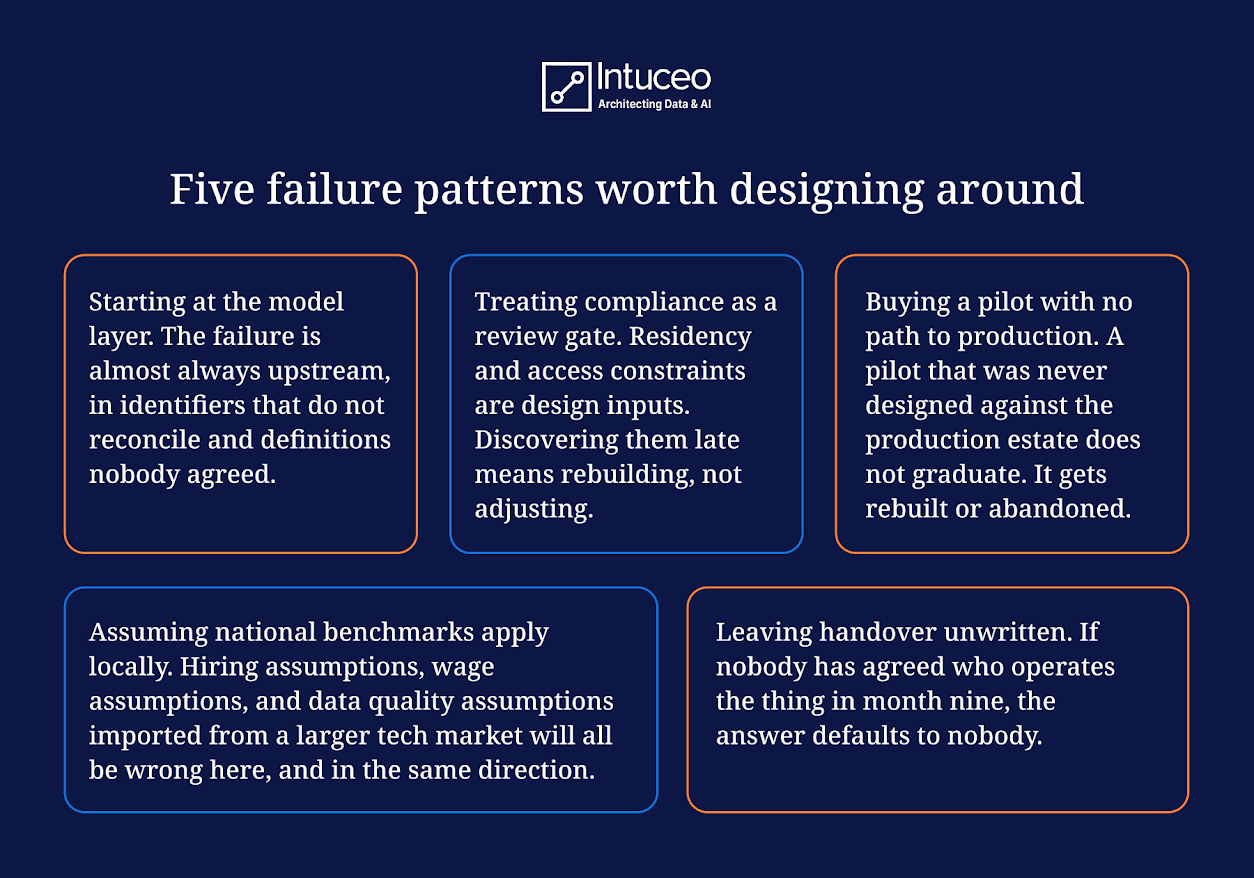
- Starting at the model layer : The failure is almost always upstream, in identifiers that do not reconcile and definitions nobody agreed.
- Treating compliance as a review gate :Residency and access constraints are design inputs. Discovering them late means rebuilding, not adjusting.
- Buying a pilot with no path to production : A pilot that was never designed against the production estate does not graduate. It gets rebuilt or abandoned.
- Assuming national benchmarks apply locally :Hiring assumptions, wage assumptions, and data quality assumptions imported from a larger tech market will all be wrong here, and in the same direction.
- Leaving the handover unwritten : If nobody has agreed who operates the thing in month nine, the answer defaults to nobody.
Start with an assessment of what you actually have
Most Jacksonville organizations do not need a strategy deck. They need someone to look at the source systems, say plainly which use case is reachable from the current data and which is not, and put a number and a sequence against it.
Intuceo runs a scoped data and AI readiness assessment for Northeast Florida enterprises: a review of your source estate, a shortlist of use cases ranked by feasibility rather than ambition, and the compliance constraints that will shape delivery. It is run by the practitioners who would do the work.
Frequently Asked Questions
1.Does Intuceo have a physical presence in Jacksonville, FL?
Yes. Intuceo is headquartered at 4110 Southpoint Boulevard, Suite 124, Jacksonville, FL 32216. Jacksonville is the firm’s strategic and operational centre, not a regional sales office. Additional centres in London and in Bangalore and Hyderabad provide extended coverage where a client’s data residency and security requirements allow it.
2.What industries does Intuceo serve in Jacksonville?
Healthcare and health plans, life sciences, supply chain and transportation, advanced manufacturing and engineering, financial and professional services, and the public sector. The Florida engagement history is concentrated in healthcare and logistics, which matches where enterprise demand in this region is heaviest.
3.How is Intuceo different from national AI consultancies?
Three differences matter in practice. The team that scopes the engagement is the team that delivers it, rather than a separate bench introduced after signature. Florida-specific conditions, including data residency rules and state procurement routes, are treated as design inputs from the first conversation instead of exceptions handled late. And the state and federal contract vehicles are already in place, which removes the procurement lead time that national firms often absorb into the schedule.
4.Can Jacksonville-based companies get on-site engagement?
Yes. Local headquarters means practitioners can be on-site for discovery workshops, source system reviews, stakeholder alignment sessions, and go-live support without travel scheduling becoming a project constraint. On-site presence tends to matter most during discovery and during the transition to production, and engagements are typically structured with that in mind.
5.What is the typical project timeline for a Jacksonville client?
It depends on the state of the source data far more than on the use case. Discovery and data assessment generally run in weeks. A first production-grade deliverable typically lands in the quarter that follows, assuming source system access is granted promptly. Access delays and undocumented legacy systems are the two factors that most often extend a schedule, which is why the assessment phase exists.
6.Does Intuceo hold any Florida state contracts?
Yes. Intuceo is a prequalified vendor on the State of Florida Department of Management Services Information Technology Staff Augmentation Services term contract, number 80101507-23-STC-ITSA, which runs through September 30, 2027. At the federal level, Intuceo holds GSA Multiple Award Schedule contract 47QTCA24D00EH covering Information Technology Professional Services and cloud-related IT professional services. Both allow eligible agencies to engage without running a fresh competitive solicitation.