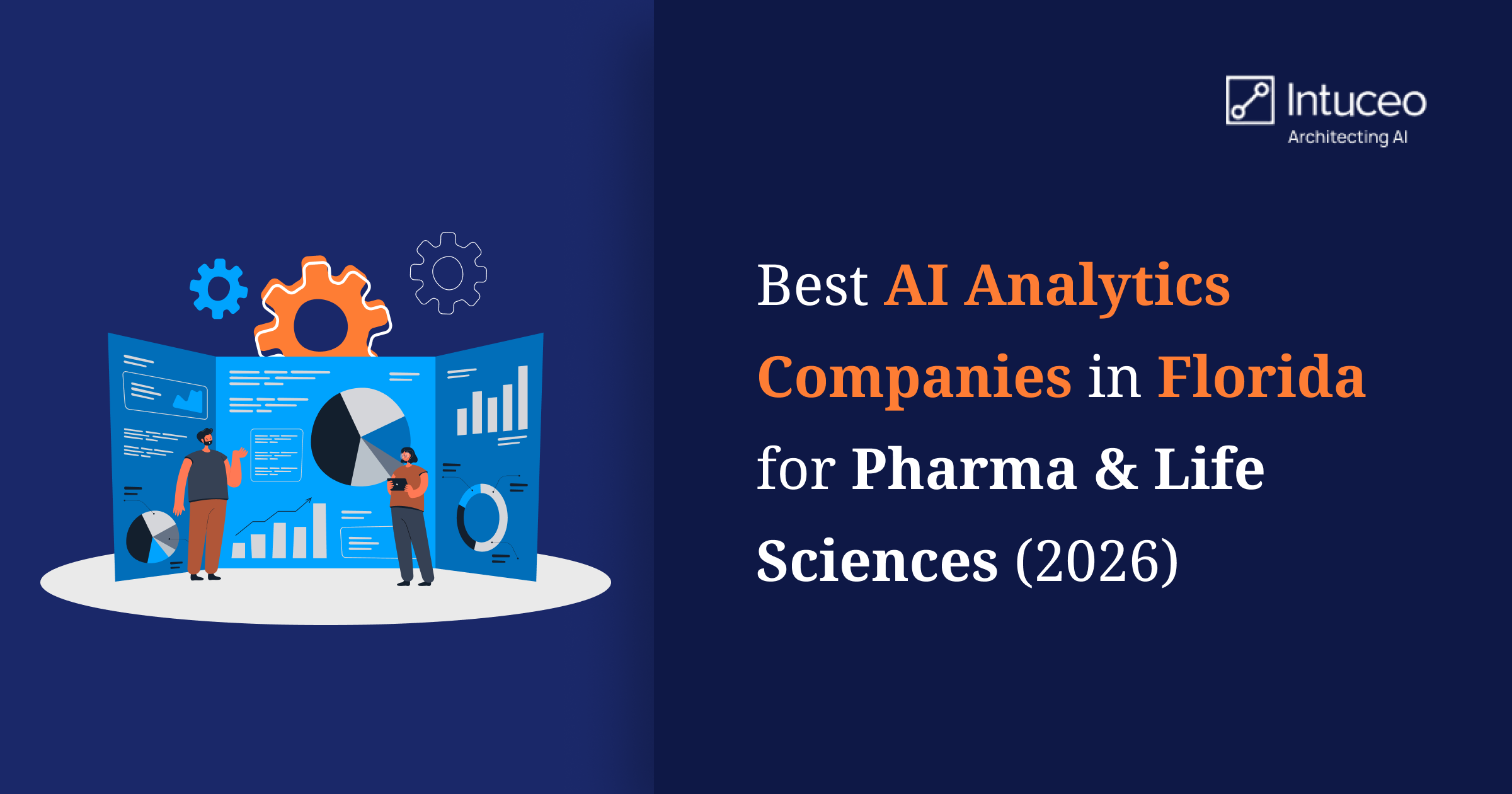





Teams searching for an analytics partner in Florida usually have a specific problem in hand. Trial enrollment is behind. Adverse event review is still manual. Research data sits across systems nobody can search. The useful question for any team evaluating pharma AI analytics companies in Florida is not who claims to do artificial intelligence (AI), but which nearby firms have actually shipped inside a regulated environment.
There are more credible answers than a few years ago. Florida’s bioscience workforce reached 116,635 employees across 9,481 companies in 2023, an 18.7% increase since 2019 and faster than national life sciences employment growth[1]. A base that size now sustains its own AI and analytics supply chain. The guide below covers how to evaluate a partner and the best AI analytics companies in Florida for pharma and life sciences teams heading into 2026.
Key Takeaways
- Florida’s life sciences cluster spans Tampa oncology research, Fort Myers precision diagnostics, Orlando biometrics and South Florida real-world data.
- Regulatory fluency is the sharpest dividing line between generic analytics shops and specialists.
- The firms below are grouped by what they are built to do, not ranked, because the categories are not interchangeable.
- Intuceo is the option for sponsors who need custom engineering across research, clinical, and quality workflows rather than a dataset or a single study function.
How AI is used in pharma data analytics in 2026
The regulatory record is a useful proxy for how far this has traveled. FDA’s Center for Drug Evaluation and Research reports more than 500 drug submissions containing AI components between 2016 and 2023, spanning non-clinical, clinical, postmarketing, and manufacturing phases[2]. In January 2026, the FDA and the European Medicines Agency published ten joint guiding principles for good AI practice in drug development, an unusual signal of how quickly the two agencies expect sponsors to standardize.
Operationally, this is narrower than the marketing suggests. Most current pharma data analytics in Florida falls into four buckets: knowledge retrieval across research documents and regulatory filings; cohort identification and site feasibility work in AI for clinical trials; automated classification and triage in pharmacovigilance; and yield, defect and release analytics in manufacturing. Discovery-stage generative chemistry gets the headlines; the recurring budget sits in those four areas.
How to Evaluate Pharma AI Analytics Companies: 5 Checks That Separate Specialists from Generalists
Evaluation usually stalls on one question: how do you separate a competent analytics consultancy from one that has shipped in a validated environment? Five checks do most of the work when assessing life sciences AI vendors in 2026.
- Credibility framework fluency. FDA’s draft guidance sets out a risk-based credibility assessment tied to a defined context of use. A partner who cannot describe the context of use in their own words has not worked inside a submission.
- Explainability, not just accuracy. A binary prediction is unusable in an adverse event file without documented rationale behind it.
- Validation and traceability by default. 21 CFR Part 11 audit trails, versioned models and immutable lineage need to be in the build plan, not retrofitted before an inspection.
- Therapeutic and functional depth. Oncology real-world data, ophthalmology endpoints and pharmacovigilance case processing are separate disciplines with separate failure modes.
- Engagement shape. Fixed-bid statements of work suit defined deliverables; embedded teams suit multi-year capability building. Mismatching the two drives overrun.
The Best Pharma AI Analytics Companies in Florida (2026)
These five were selected on verifiable life sciences delivery, substantive Florida presence, and distinct capability, so the list is comparative rather than five versions of the same offer. They are not ranked against each other.
1. Intuceo - Jacksonville
Custom AI and data engineering for regulated life sciences | PhD-led delivery
Intuceo is the option on this list built for sponsors who need engineering rather than access to somebody else’s dataset. The firm works across the pharma value chain: research knowledge retrieval, generative AI patient matching for trial enrollment, site performance analytics, pharmacovigilance classification, and quality and manufacturing analytics in Good Practice (GxP) regulated environments. Named pharma and medtech engagements include Janssen Pharma, Ferring Pharma, and Bausch & Lomb.
Three things separate it from a general analytics consultancy. First, delivery is PhD-led, with a Board of Science that reviews model design and scientific validity rather than leaving that judgement to a delivery manager. Second, Intuceo brings named accelerators to compress build time: Intuceo-Ax™ for augmented analytics, Intuceo-Ix™ for neural search across fragmented research repositories, and Intuceo-Dx™ for document and vision intelligence. These are starting points drawn from prior regulated engagements, not licensed software, and are adapted to the sponsor’s validation and data estate.
Third, and most relevant to anyone who has been through an inspection, Intuceo builds explainable AI into adverse event work. The classification and the evidence-based rationale supporting it are generated together, which is the difference between a model that saves reviewer hours and one that creates them. Its iPDLC™ delivery framework carries the quality gates, traceability, and documentation that FDA 21 CFR Part 11, HIPAA, and GxP reviewers expect.
The firm is headquartered in Jacksonville, with a certified engineering bench and a Florida client history across research and healthcare. That buys same-time-zone working, on-site workshops, and accountability that survives the first difficult quarter.
Best for: sponsors and contract research organizations (CROs) needing custom, validated AI built across research, clinical and quality workflows.
2. Aster Insights - Tampa
Oncology real-world data and clinical intelligence
Aster Insights, a subsidiary of Moffitt Cancer Center[4], leads the Oncology Research Information Exchange Network (ORIEN), a consortium of leading US cancer centers. Its Avatar dataset pairs clinical, molecular, and digital pathology imaging data, and ORIEN members participate in the Total Cancer Care study, which has accrued over 400,000 patients[5]. For biopharma running oncology programs, that lifetime-consented, multimodal cohort supports external control arms, biomarker research and translational work that is slow to assemble independently.
Best for: oncology sponsors needing consented multimodal real-world evidence and academic research partnerships.
3. NeoGenomics - Fort Myers
Precision oncology testing, informatics and biopharma services
NeoGenomics runs laboratories accredited by the College of American Pathologists and certified under the Clinical Laboratory Improvement Amendments from a Fort Myers base, serving pharma clients through its biopharma services group. On the data side, it makes over 2.5 million digital pathology images available for machine learning model development and training, paired with patient and clinical history, and identifies trial-eligible patients from a pool of more than two million profiles[6]. It is the closest thing in Florida to an integrated route from assay to algorithm-ready imaging corpus.
Best for: teams building imaging-based models or needing biomarker testing and trial recruitment under one contract.
4. Intego Clinical - Orlando
Biometrics CRO: biostatistics, statistical programming, data management
Intego Clinical is a biometrics CRO headquartered in Orlando, with delivery centers in Central Florida, Poland, Ukraine, and Costa Rica. Its work is the unglamorous foundation everything else depends on: datasets conforming to Clinical Data Interchange Standards Consortium models, submission-ready statistical output, and clinical data management across ophthalmology, oncology, neurology and virology[7]. Team continuity is a stated strength, with 85% of staff bringing more than five years of experience[8], which matters on studies that outlast most vendor relationships.
Best for: sponsors outsourcing trial biometrics and needing standards-compliant datasets for submission.
5. ModMed - Boca Raton
Specialty real-world data for evidence generation and outcomes research
Best known as a specialty practice technology firm, ModMed’s Boca Raton real-world data group is now a serious option for life sciences researchers. Because clinical detail is captured in structured fields at the point of care rather than free text, the datasets arrive analysis-ready. Its dermatology network covers over 98 million patients and 481 million encounters, with a separate ophthalmology network of over 18 million patients[9]. For dermatology and ophthalmology indications specifically, that depth of structured outcome measures is difficult to source elsewhere.
Best for: health economics and outcomes research teams working in dermatology or ophthalmology.
Matching the firm to the stage of work
Treating these five pharma AI analytics companies in Florida as one shortlist is how procurement ends up comparing a data licence against an engineering statement of work. If the gap is evidence, Aster Insights, NeoGenomics and ModMed supply data assets in oncology, imaging and specialty care. If the gap is trial execution, Intego Clinical covers biometrics. If internal systems cannot support life sciences AI analytics at all, because research knowledge sits in unsearchable repositories or adverse event review is still manual, the requirement is engineering, and that points to Intuceo.
One caution for vendor calls: a firm that answers every capability question affirmatively is describing a sales position, not a delivery record. Ask for the regulated engagement closest to yours, and who on their team wrote its validation documentation.
Scoping a regulated AI program in Florida?
Intuceo’s PhD-led team works with pharma, biotech, and medtech sponsors on clinical trial matching, research knowledge retrieval, adverse event classification, and GxP manufacturing analytics. Bring the workflow that is stuck, and we will map what a validated build requires.
Frequently Asked Questions
1. What regulatory considerations apply to AI analytics in pharma?
The central requirement is model credibility for a defined context of use. FDA’s draft guidance on AI supporting regulatory decision-making sets out a risk-based credibility assessment framework covering nonclinical, clinical, postmarketing and manufacturing uses[3]. Alongside it, GxP expectations and 21 CFR Part 11 govern electronic records and signatures, meaning audit trails, access controls, versioning and documented change management apply to models as they do to any other regulated system. Where a model output informs a safety or efficacy conclusion, the reasoning behind that output has to be reconstructable, not just the result.
2. How does AI support clinical trial data analysis?
Four uses are well established. Cohort identification screens structured and unstructured records against inclusion and exclusion criteria far faster than manual chart review. Site feasibility modeling uses historical enrollment patterns to flag sites likely to underperform before contracts are signed. Risk-based monitoring surfaces anomalous data patterns across sites during conduct rather than at database lock. Natural language processing extracts endpoints and adverse events from narrative fields. In each case, the model narrows the field for human reviewers; it does not replace the statistical analysis plan or the medical monitor.
3. What experience does Intuceo have with life sciences or pharma clients?
Intuceo has delivered engagements for Janssen Pharma, Ferring Pharma and Bausch & Lomb, spanning research knowledge retrieval, clinical trial patient matching, adverse event detection and manufacturing quality analytics. Work is delivered under the iPDLC™ framework with PhD-led scientific review, and draws on accelerators including Intuceo-Ax™ for augmented analytics, Intuceo-Ix™ for neural search across research repositories, and Intuceo-Dx™ for document and vision intelligence. Engagements are structured as fixed-bid statements of work or embedded teams depending on whether the deliverable is defined or the goal is building internal capability.
4. What is the difference between generic analytics vendors and life-sciences-specialized ones?
Technical skill is broadly comparable. The difference is what the team assumes without being told. A specialist knows that a model touching a submission needs a credibility argument, that adverse event classification requires documented rationale rather than a probability score, and that changing a feature set mid-study has consequences for the statistical analysis plan. A generalist learns these things during your engagement, on your timeline, at your cost. The gap shows up as rework and inspection risk rather than as a lower day rate.