




Many teams approach LLM infrastructure solutions the way someone buys a vehicle before knowing the commute selecting a general-purpose setup before the real workload arrives with requirements nobody planned for.
A general-purpose setup gets provisioned, budgets get signed off, and then the real workload arrives carrying requirements nobody planned for: a model too large for the reserved memory, latency targets the serving layer cannot meet, or regulated data that legally cannot travel to the chosen endpoint. What follows is either idle capacity quietly burning money or a rushed rebuild a few months later.
This is why LLM infrastructure solutions are not a single blueprint. The right setup depends on how large the model is, how fast and how often it needs to respond, what it costs to run at volume, and where the underlying data is permitted to sit.
Getting those LLM infrastructure requirements straight before committing to hardware is the difference between a setup that scales and one that has to be torn out and rebuilt within a year.
Key Takeaways
- There is no universal setup for large language models. Model size, response speed, cost, and where data is allowed to live each pull the decision in a different direction.
- Memory is the hard constraint. A 70-billion-parameter model needs roughly 140 GB of memory just for its weights, forcing it across multiple accelerators, while a small model runs on a single card.
- Inference costs are falling fast, which rewards setups designed for flexibility and penalizes rigid, single-vendor commitments.
- For regulated industries, compliance often settles the infrastructure question before performance is even discussed.
- Compute gets the attention, but the data layer feeding the model usually decides whether the whole setup holds up in production.
Why LLM Infrastructure Solutions Are Never One-Size-Fits-All
The clearest reason is memory. Model weights must sit in fast memory to serve responses at a usable speed, and that requirement scales directly with the number of parameters. Stored in half-precision (FP16, or 16-bit floating-point), each parameter takes roughly two bytes. A 70-billion-parameter model therefore needs about 140 gigabytes of video memory (VRAM) just to hold its weights. That already exceeds a single 80 GB accelerator and forces the model across at least two high-end graphics processing units (GPUs), or around six consumer-grade cards.1 A two-billion-parameter model, by contrast, fits comfortably on one modest GPU.
That single fact reshapes everything downstream. A small model can run on a single card, sometimes even on a central processing unit (CPU), while a frontier-scale model may need a coordinated cluster with high-speed interconnects between chips.
The LLM infrastructure requirements for a lightweight classification assistant and for a 500-billion-parameter reasoning system are not different by degree; they are different in kind. Provisioning both from the same template guarantees waste at one end and failure at the other.
Quantization changes the arithmetic but does not remove the decision. Compressing weights to lower precision can shrink that same 70B model to a fraction of its footprint, letting it run on far less hardware at some cost to output quality. Whether that trade is acceptable depends entirely on the use case, which is exactly why the sizing conversation has to happen before anything is bought.
The Four Variables That Define LLM Infrastructure Requirements
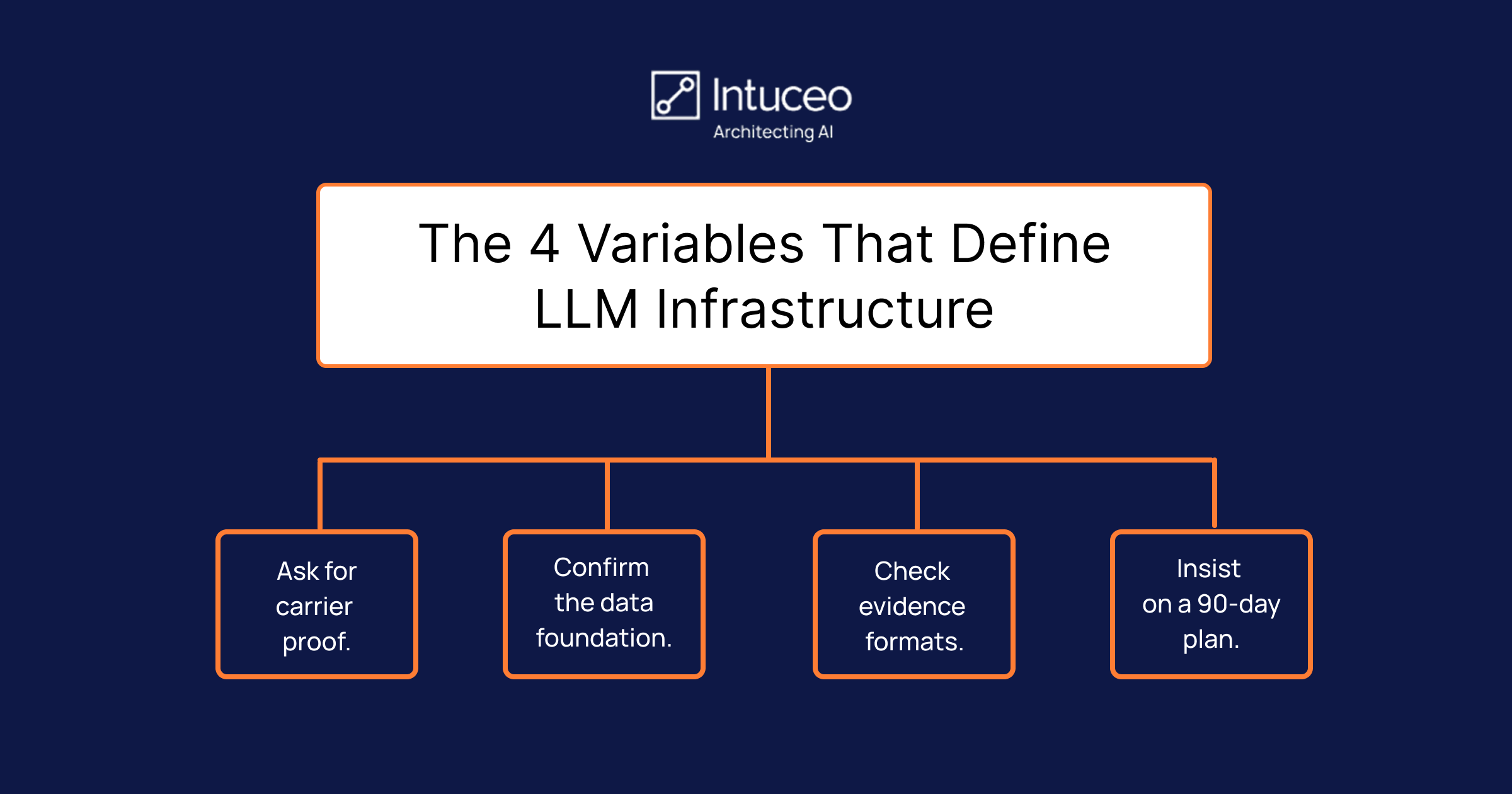
Defining LLM infrastructure requirements starts with four variables : model size, throughput and latency, inference cost, and compliance. Model size is the first lever. Three others matter just as much.
Throughput and latency
A batch job that summarizes documents overnight tolerates slow responses and heavy batching. A customer-facing assistant expected to reply in under a second does not.
The same model can call for very different serving setups depending on how many concurrent requests it fields and how quickly each one has to return. Under-provision here and the system buckles at peak load; over-provision and expensive accelerators sit idle most of the day.
Cost, which moves faster than most budgets assume
For a model of equivalent performance, the price of running inference has been falling by roughly 10x per year, dropping from about $60 per million tokens in 2021 to near $0.06 for a comparable-quality model three years later.
That trajectory rewards flexibility and punishes lock-in. A setup optimized around today’s model at today’s prices can turn uneconomical within a year, and a rigid, single-vendor footprint often costs more over its life than a design built to swap models as cheaper, better options appear.
Compliance
For regulated organizations, this fourth lever frequently overrides the other three. Where data is allowed to be processed can rule out otherwise sensible options entirely, which is worth treating on its own terms.
What Does an LLM Infrastructure Stack Include?
It helps to see the whole picture, because the LLM infrastructure stack is far more than the GPUs everyone talks about. It runs from the compute and serving layer that hosts the model, through an orchestration layer that routes and scales requests, to the data layer that supplies the model with current, trustworthy context, and finally a security and governance layer that controls who can see what.
In a retrieval-augmented setup, the data layer does as much to determine answer quality as the model does – a trade-off explored in depth in RAG vs. Fine-Tuning: How Enterprise Teams Should Actually Decide.
Teams that fixate on the compute layer tend to meet the rest of the stack the hard way. A pilot works cleanly in a demo, then stalls the moment it hits real data volumes, real access rules, and real audit expectations. The compute was never the part most likely to break.
How Compliance Requirements Shape LLM Infrastructure Solutions for Regulated Industries
For pharmaceutical and life sciences organizations, healthcare systems, financial firms, and public-sector agencies, the question of where data can go often settles the infrastructure question before performance enters the conversation. Regulated data cannot simply be pointed at whatever endpoint is cheapest.
Protected health information under the Health Insurance Portability and Accountability Act (HIPAA), records governed by 21 CFR Part 11, and systems under the Federal Information Security Management Act (FISMA) each constrain where processing may happen and who may access it.
The concern is widespread, not niche. In Deloitte’s 2026 State of AI in the Enterprise survey, data privacy and security ranked as the most cited AI risk, named by 73% of the leaders polled.
Once data residency and sovereignty enter the picture, a public interface sitting in the wrong jurisdiction stops being an option, and the field narrows to controlled cloud, on-premises, hybrid, or air-gapped setups. Retrofitting those controls after a system is live is almost always slower and costlier than designing for them from the outset – a principle at the core of AI governance for regulated industries.
Why the Data Layer Determines LLM Infrastructure Success
Compute gets the headlines, but the data foundation quietly decides the outcome. A perfectly sized cluster still returns unreliable output if the pipelines feeding it are fragmented, stale, or impossible to trace. In regulated settings, every input and output usually has to carry a lineage a reviewer can follow, which is a data-engineering problem long before it is a hardware one. This is the layer where most infrastructure plans succeed or come apart.
How Intuceo Delivers LLM Infrastructure Solutions for Regulated Enterprises
This is the part of an infrastructure solution that Intuceo is set up to handle. Its DataOps and Engineering practice concentrates on the layer that determines whether an LLM setup holds up in production: hardened ingestion and transformation pipelines with automated quality testing, full data lineage for GxP, HIPAA, and federal audits, and secure infrastructure configured across cloud, on-premises, or hybrid environments with controls such as virtual private cloud (VPC) isolation and customer-managed encryption keys.
Rather than installing a fixed toolset, Intuceo works as a services partner, bringing accelerators drawn from prior regulated engagements to speed up deployment and configuring the pipeline to the constraints an organization already operates under. The compute can be right-sized later; the data foundation has to be sound first.
That foundation still rests on getting the hardware decision right – the exact problem the DARWIN Infrastructure planning session addresses by working through the LLM infrastructure solutions trade-off for your specific model, budget, and regulatory reality.
The session uses the Infrastructure dimension of the DARWIN planning framework to work through the real cost and performance trade-offs, from GPU versus CPU choices to sizing questions as concrete as whether a workload needs a dozen servers for a 500-billion-parameter model or a single GPU for a two-billion-parameter one.
It is built for the data, engineering, compliance, and executive leaders who own those calls, and it answers the question most infrastructure discussions skip: how to choose a setup that fits the model, the budget, and the regulatory reality at the same time.
Size your setup before you commit to it
Join the Intuceo AI Dream Session to work through the cost, performance, and compliance trade-offs behind your LLM infrastructure, with worked examples from regulated deployments.
Frequently Asked Questions
1. What are the main LLM infrastructure requirements to plan for?
Sound LLM infrastructure requirements planning weighs four factors together: model size, which sets memory and GPU count; throughput and latency, which shape the serving setup; running cost at volume; and compliance, which governs where data can be processed
Sound LLM infrastructure requirements planning weighs all four together rather than optimizing for one and discovering the others later.
2. Does every LLM need expensive GPUs?
No. Small models can run on a single modest GPU or even a CPU, while large models need multiple high-end accelerators working together. Matching the hardware to the model, instead of defaulting to the largest option, is often where the biggest savings sit.
3. What sits inside an LLM infrastructure stack beyond compute?
A complete LLM infrastructure stack includes the compute and serving layer, an orchestration layer for routing and scaling, a data layer that supplies context and retrieval, and a security and governance layer for access control and auditability. The data and governance layers are where regulated deployments most often succeed or stall.
4. How does compliance change LLM infrastructure solutions?
It depends on the data and the workload. Cloud offers elasticity, on-premises offers control, and hybrid balances the two. For sensitive data with residency or sovereignty constraints, the deciding factor is usually where processing is legally allowed to happen, not raw performance.