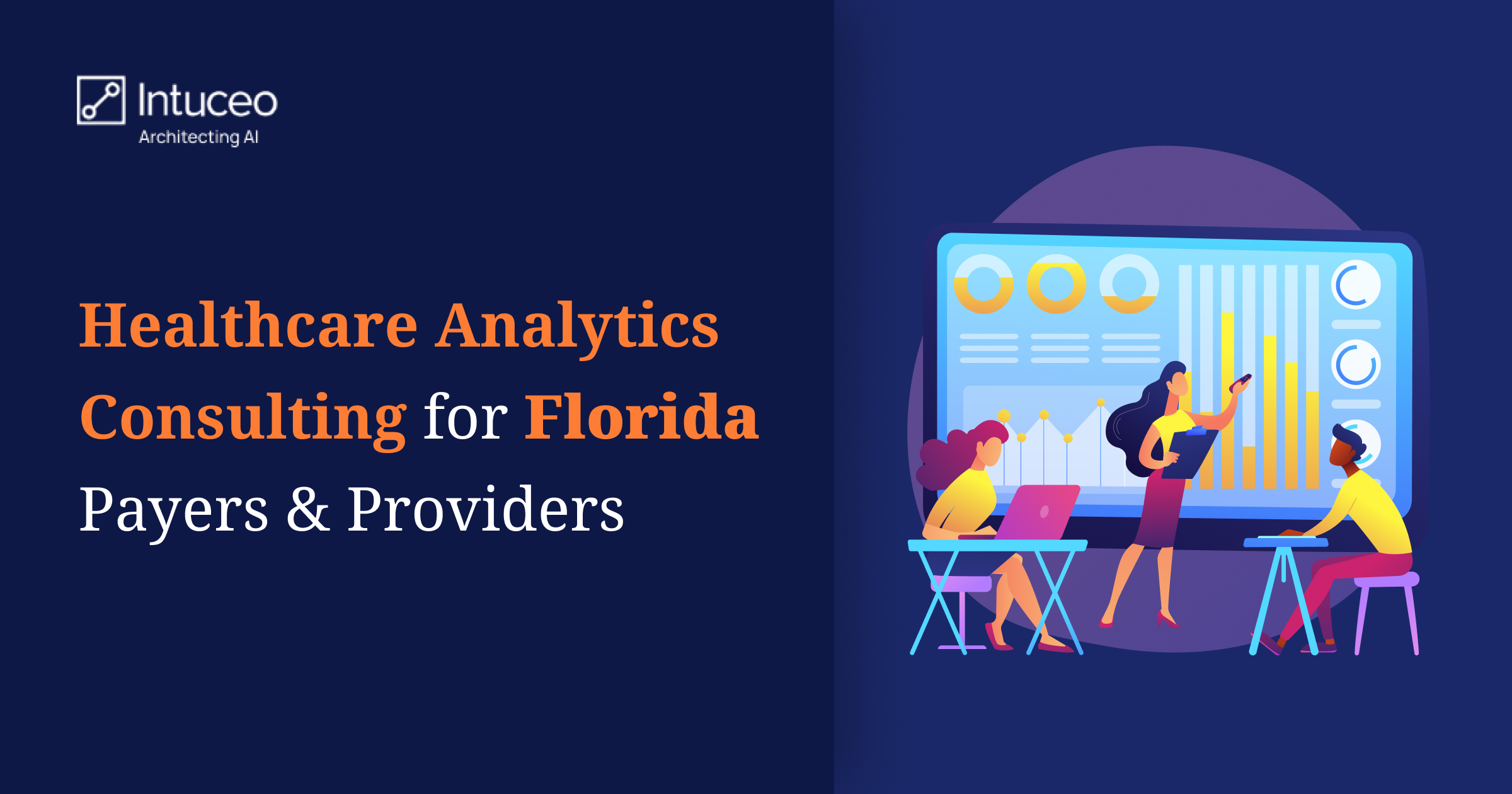





Intuceo is a Jacksonville-based firm delivering healthcare analytics consulting to Florida health plans and health systems. Engagements cover quality measurement, revenue cycle performance, and member risk, each built on encrypted, HIPAA-compliant data environments suited to regulated health data.
- HEDIS analytics for Florida health plans: measure production on an audit-ready data lineage, with gap-in-care analysis and Star Ratings reporting built on the same source
- RCM analytics for Florida hospitals: denial prediction and coding validation that reduces days in accounts receivable before claims leave the building
- Member risk stratification analytics using Clinical Risk Group (CRG) classification across claims, pharmacy, and encounter data
For Florida health plans and health systems navigating these changes, Intuceo’s healthcare analytics consulting team provides the data remediation and analytical infrastructure to move forward, governed by the iPDLC delivery lifecycle from scoping through production handoff.
Request a scoping call
Engage Intuceo through
State of Florida
DMS term contract 80101507-23-STC-ITSA, valid through September 2027
Federal agencies
GSA Multiple Award Schedule 47QTCA24D00EH
Commercial
Direct master services agreements with health plans and health systems
Healthcare organizations Intuceo has delivered for
- Florida Blue
- GuideWell Health
- UF Health
- Mission Health
- d2i
- Aon
Why Florida Payers and Providers Are Turning to Healthcare Analytics Consulting
Florida Medicaid analytics and quality reporting work is being bought as remediation rather than experimentation. The measure logic and the regional reporting history both moved, and most reporting environments were never built to absorb either change.
7 measures added, 2 retired
Quality measure specifications were rewritten for 2026
HEDIS Measurement Year 2026 also moved four measures into Electronic Clinical Data Systems reporting and reissued specifications in a format aligned to the Fast Healthcare Interoperability Resources (FHIR) data standard.
Measure logic hard-coded over the last decade now needs re-validation.
11 regions to 9
Florida redrew its Medicaid reporting geography
Florida Medicaid analytics work changed materially when the state moved Statewide Medicaid Managed Care to nine lettered regions, A through I, in February 2025.[2]
Regional trend lines break mid-history without a county-level crosswalk.
$21 billion
Administrative work remains largely manual
The 2025 CAQH Index puts the remaining industry savings opportunity from fully automating manual and partially manual administrative transactions at USD 21 billion.[3]
Most of that opportunity sits in eligibility, authorization, and denials.
How Healthcare Analytics Consulting Is Scoped for Payers vs. Providers
Health plans and health systems ask different questions of different data, so the two are scoped independently. Intuceo has delivered on both sides, which matters as Florida payers and providers increasingly have to reconcile data with each other.
HEDIS and Star Ratings production
HEDIS analytics Florida work starts with measure calculation on a defensible data lineage – the same foundation Intuceo has built for Florida Blue, GuideWell Health, and UF Health – with the audit trail a certified compliance auditor will ask for already in place. Gap-in-care analysis runs off the same lineage, not a parallel extract.
Quality of care oversight
Predictive models rank which open care gaps are still closable inside the measurement period and which members are reachable, so outreach spend lands where it moves at a rate.
Member high-utilizer analytics
Clinical Risk Group classification across claims, pharmacy, and encounter data separates members with a single expensive year from complex chronic cohorts whose trajectory is still movable.
Potentially preventable events
Tracking of preventable admissions, readmissions, and complications to isolate where avoidable cost is generated and inform provider contracting. See how this works in our healthcare analytics consulting guide.
Encounter data validation
Validation and leakage detection for self-funded employers and labor funds, with reporting that holds up when a trustee asks how a number was produced.
Hospitals and health systems Margin, capacity, and clinical risk
Denial prediction
Revenue cycle management (RCM) scoring in the pre-submission window, so claims likely to be rejected get corrected before they leave. RCM analytics Florida engagements are judged on days in accounts receivable, not dashboard adoption.
Coding validation
Assisted review against clinical documentation to catch specificity errors and mismatches that create audit exposure and slow reimbursement.
Chronic condition risk trajectories
Models that flag escalation early enough for intervention to change an outcome, with diabetes and cardiovascular cohorts dominating in this region.
Unified clinical view
Intuceo-Ix™ – part of Intuceo’s Modular AI accelerator suite – supports retrieval across electronic health records, home care documentation, and social determinants of health data, so a clinician view is assembled rather than rebuilt by hand.
Administrative workload reduction
Eligibility verification, authorization packet assembly from the record, and coding queries routed only where documentation is genuinely ambiguous.
What Is the Data Engineering Foundation for Healthcare Analytics?
Most analytics failures in this sector are ingestion and identity failures wearing a different label, which is why healthcare data engineering in Jacksonville work usually precedes any modelling. FHIR alignment carries more weight now that the HEDIS specification format has moved toward the same standard.
Real-time clinical pipelines
Ingestion of Health Level Seven (HL7) and FHIR claims and clinical streams as they arrive.
Identity resolution
Member and patient matching across claims, clinical, pharmacy, and eligibility sources.
Master data management
A consolidated record that quality reporting and revenue cycle models both draw from.
Regional crosswalks
County-level mapping between the eleven-region and nine-region structures so trend history reconciles.
How Intuceo Applies HIPAA, FISMA, and NIST 800-53 to Healthcare Engagements
Intuceo delivers HIPAA-compliant healthcare analytics to health plans and health systems under HIPAA, HITECH, FISMA, and NIST 800-53 requirements, with federal health work handled under the same security controls.
HIPAA | HITECH | FISMA | NIST 800-53 | SOC 2 TYPE II | ISO 9001:2015 | 21 CFR PART 11
What the controls look like in practice
Encrypted cloud and on-premise environments, role-based access control, automated audit logging, virtual private cloud flow logging, encryption at rest and in transit, and business associate agreements executed before Protected Health Information moves.
Questions worth asking your vendor
Who holds production access, how model inputs are logged, and what happens to Protected Health Information in a development environment. The answers separate delivery discipline from a page on a website.
Why Florida Health Plans and Health Systems Choose Intuceo for Analytics Consulting
A services firm, based in Jacksonville
Delivered from Jacksonville
Headquartered locally, with healthcare work delivered for Florida Blue, GuideWell Health, UF Health, and Mission Health.
PhD-led delivery teams
Delivery led by PhD-qualified data scientists, which is why teams get pulled into measure validation and model explainability questions.
Accelerators configured to your data
Intuceo-Ax™, Intuceo-Ix™, and Intuceo-Dx™ are configured against an organization’s own data to shorten deployment.
A governed delivery lifecycle
The iPDLC™ lifecycle framework governs how each engagement is scoped, delivered, and handed over to internal teams. Engagements are led by PhD-qualified data scientists with direct delivery history in Florida’s payer and provider markets, not advisory-layer consultants handing off to junior teams.
Four common starting points for a first engagement
The first deliverable in every engagement is a structured assessment rather than an installation. Solutions carried across from prior regulated engagements are adapted to the organization that is buying them.
| Starting point | First phase | What changes |
|---|---|---|
| HEDIS MY 2026 readiness | Measure logic and value set review against the reissued specifications | Re-validated measure production with an audit trail before the reporting window |
| Broken regional reporting | County-level crosswalk across the region restructure | Trend reporting that survives comparisons spanning February 2025 |
| Denial and A/R pressure | Denial history consolidation and pre-submission scoring on the highest-volume payer | Corrections made before submission instead of appeals afterward |
| Fragmented records | Identity resolution and consolidated record build | One record that quality and revenue cycle work can both rely on |
Find out what your data will support before you commit a budget
Most engagements begin with a problem an internal team has already tried to solve twice: a measure that will not reconcile, a denial rate that has not moved, or a regional trend line that broke in February 2025. Intuceo’s healthcare team will assess what your data can actually support, and say plainly where it falls short, before proposing any scope of work. Read how we approach healthcare analytics consulting.
Frequently Asked Questions
1. Does Intuceo deliver healthcare analytics consulting for both health plans and health systems?
Yes. Engagements span health plans, managed funds, and self-funded employers on the payer side, and hospitals and health systems on the provider side, including Florida Blue, GuideWell Health, UF Health, Mission Health, and d2i. The two are scoped separately because they ask different questions of different data.
2. What is HEDIS benchmarking, and why does it matter?
The Healthcare Effectiveness Data and Information Set is a standardized set of performance measures maintained by the National Committee for Quality Assurance, specifying exactly how a plan collects, audits, and reports clinical quality and member experience results. Identical specifications across plans are what make comparison possible. It matters commercially because results feed accreditation, Star Ratings, and quality-based incentives, and operationally because a measure calculated from an undocumented extract will not survive an audit regardless of how good the underlying care was.
3. How does Intuceo ensure HIPAA compliance?
Through delivery controls rather than a certification alone: encrypted environments, role-based access control, automated audit logging, encryption at rest and in transit, and multi-factor authentication. Business associate agreements are executed before any Protected Health Information is accessed, development work uses de-identified or synthetic data where the task allows it, and access is scoped to named individuals for the engagement duration.
4. Has Intuceo worked with Florida Blue or BCBS Florida?
Yes. Florida Blue and its parent organization GuideWell Health are both named among Intuceo’s healthcare clients. Florida Blue is the Blue Cross and Blue Shield licensee for Florida, so it is the same organization referred to as BCBS Florida. Engagement specifics are covered by client confidentiality and discussed under a non-disclosure agreement.
5. Can AI and analytics help reduce administrative costs for hospitals?
Payer analytics focuses on health plan performance: HEDIS measure production, Star Ratings optimization, member risk stratification using Clinical Risk Group (CRG) classification, and cost containment through Potentially Preventable Event (PPE) tracking. Provider analytics focuses on hospital and health system performance: revenue cycle management, denial prediction, clinical coding validation, and chronic condition risk trajectories. Both require a shared data engineering foundation, including HL7 and FHIR ingestion, identity resolution, and master data management, but each asks different questions of different data.