




A litigation team preparing for trial may hold hundreds of thousands of files: depositions, contracts, emails, scanned exhibits, expert reports, and prior filings. Boolean and keyword tools were built to match strings, not meaning, so a search for “termination” can miss a document that describes the same event as “ending the agreement” or “winding down the relationship.” Semantic search for trial documents closes that gap by retrieving based on meaning rather than exact words. However, meaning-based retrieval, powered by Artificial Intelligence (AI), introduces its own risk. When researchers tested general-purpose Large Language Models (LLMs) on specific legal questions, hallucination rates ran from 69% to 88%.[1] That is why the legal document semantic search built for trial work has to clear a higher bar than a consumer chatbot. The nine capabilities below are what separate a dependable approach from a risky one.
Key Takeaways
- Keyword and Boolean search match words; trial preparation needs retrieval that matches meaning and legal context.
- Entity extraction, jargon handling, and vector retrieval turn a pile of documents into searchable facts.
- Grounded answers with citations to source documents are the main control against fabricated results.
- Scale, privilege protection, and security are capabilities, not afterthoughts.
- A defensible process needs an audit trail and explainable ranking, not just speed.
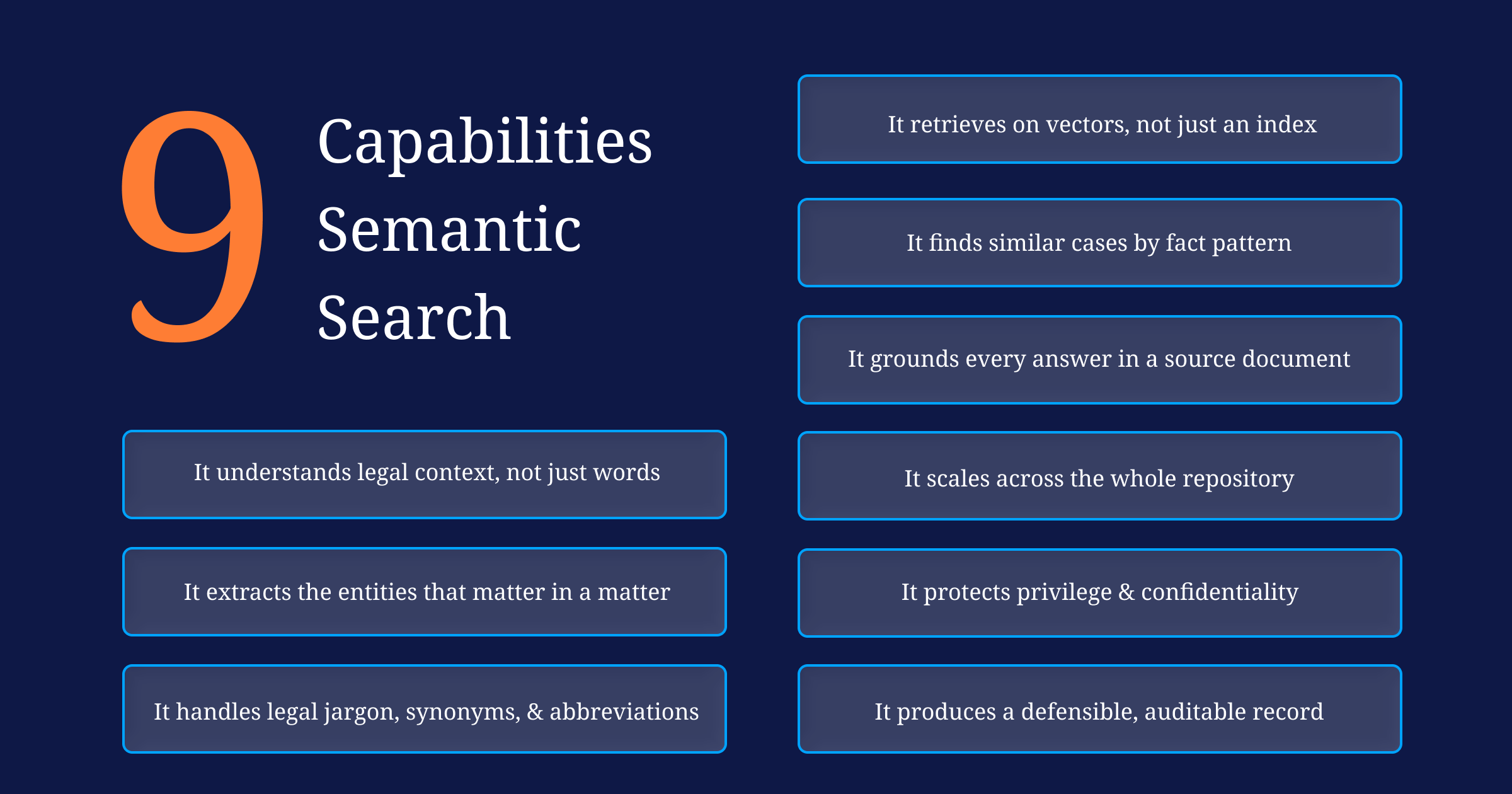
1. It understands legal context, not just words
Keyword search treats a query as a string to find. A trial document set, though, expresses the same fact in many ways: “force majeure,” “act of God,” and “circumstances beyond reasonable control” can all point to the same defense. Contextual legal search reads the surrounding language and returns passages that mean the same thing even when the wording differs. This is not a new idea in litigation. A study found that technology-assisted review reached recall and precision at least equal to, and in cases better than, exhaustive manual review by attorneys.[2] The first requirement is retrieval of reasons about meaning rather than counting term matches.
2. It extracts the entities that matter in a matter
Facts in litigation turn on specifics: who signed, on what date, under which clause, for how much, and in which jurisdiction. Legal entity extraction AI uses Named Entity Recognition (NER) to tag parties, dates, monetary amounts, statutes, case citations, and contractual obligations, then links them so a reviewer can trace every mention of a party across thousands of files. The same capability powers contract review AI search, where a team needs to surface every indemnification or limitation-of-liability clause across an agreement portfolio. Without reliable entity extraction, a search returns documents but leaves the reviewer to hunt for the operative facts by hand.
3. It handles legal jargon, synonyms, and abbreviations
Trial documents are dense with shorthand. “SJ” stands for summary judgment, “MSA” can mean a master services agreement or a metropolitan statistical area, depending on context, and Latin terms sit beside informal email phrasing. Legal NLP search tools that apply Natural Language Processing (NLP) trained on legal language resolve these abbreviations and synonyms in context rather than treating them as unrelated tokens. The system should recognize that “the court below” and “the trial court” point to the same entity, and that “P” and “Plaintiff” are the same party in a brief. Handling this variation is what lets a single query reach every relevant passage instead of the small fraction that happened to use the searcher’s exact phrasing.
4. It retrieves on vectors, not just an index
Meaning-based retrieval works by converting text into numerical representations called embeddings, then finding passages whose vectors sit close together in that space. Vector search for legal documents is what allows a query about “a manager pressuring a subordinate to alter figures” to surface an email that never uses those words but describes the conduct. Any AI document review software intended for trial preparation should support vector retrieval alongside traditional filters, so that reviewers can combine a conceptual search with hard constraints such as date range, custodian, or privilege status. Vectors find the candidates; metadata filters keep the result set scoped and defensible.
5. It finds similar cases by fact pattern
Precedent turns on facts, not just legal issues. A team arguing a non-compete dispute wants prior matters with comparable employment terms, geography, and conduct, not every case that mentions non-competes. Case law similarity search compares the fact pattern of the current matter against a body of decisions and a firm’s prior work, ranking by genuine similarity rather than shared keywords. Used well, AI-powered legal research of this kind shortens the path from a new set of facts to the closest analogous authority and to the arguments that succeeded or failed on those facts. The capability extends to a firm’s own closed matters, where similar past work is often the most useful starting point.
6. It grounds every answer in a source document
A summary that a reviewer cannot trace back to a source is a liability. Legal RAG (retrieval-augmented generation) addresses this by retrieving the relevant passages first, then asking the model to answer only from those passages, with a citation to each source document. This grounding is the main defense against fabrication in LLM legal document analysis. It is not a complete one. When Stanford researchers tested purpose-built legal research tools that already use retrieval-augmented generation, those tools still produced incorrect information more than 17% of the time, roughly one query in six.[3] The requirement is twofold: retrieval that grounds answers in real documents, and an interface that shows the cited passage so a person can verify it before relying on it.
7. It scales across the whole repository
Trial preparation rarely involves a tidy folder. A litigation document search tool has to run across email archives, document management systems, scanned bankers’ boxes, and prior productions in electronic discovery (e-discovery), often totaling millions of items. E-discovery semantic search has to hold sub-second response and consistent ranking at that volume, not just on a sample. The same engine should also serve ongoing legal knowledge base search across a firm’s accumulated briefs, memos, and templates, so institutional knowledge stays reachable rather than buried. Performance at scale is a capability in its own right: an approach that works on ten thousand documents and degrades on ten million is not suited to law firm document repositories of realistic size.
8. It protects privilege and confidentiality
Trial documents contain privileged communications, trade secrets, and personal data. A search approach that sends those documents to a public model, or that lets any user retrieve any file, creates exposure that can outweigh the efficiency gain. The capability here is control: role-based access so reviewers see only what they are cleared to see, privilege tagging that keeps protected material out of a production set, and deployment that keeps data inside the organization’s own environment. For many matters, this means an on-premise or private-cloud setup where document content is never used to train external models. Confidentiality is not a setting added later; it is a requirement the architecture has to satisfy from the start.
9. It produces a defensible, auditable record
A review process that cannot be explained to a court is hard to defend. The final capability is transparency: a log of what was searched, which documents were retrieved and reviewed, how relevance was decided, and which model version produced a given result. When opposing counsel or a judge asks how a production was assembled, the team needs an answer grounded in records rather than recollection. Explainable ranking matters too; a reviewer should be able to see why a document surfaced. Together, the audit trail and explainability turn a fast search into one that a firm can stand behind.
Leverage AI-powered semantic search for high-stakes document sets
Intuceo is a services firm specializing in Artificial Intelligence, Machine Learning (ML), and data analytics for regulated industries. Rather than handing a team a tool to operate, Intuceo’s engineers run a scoped engagement and bring proven accelerators they configure to the document set in front of them.
Intuceo-Ix™ and Intuceo-Dx™
Two of those accelerators map directly to the capabilities above. Intuceo-Ix™ provides neural semantic search and Natural Language Processing across fragmented repositories, retrieving on meaning rather than matched terms. Intuceo-Dx™ handles document and vision intelligence, converting scanned exhibits, contracts, and handwritten notes into structured, searchable records that conventional Optical Character Recognition (OCR) leaves behind, and supports retrieval that traces every answer back to its source document.
Grounded, sovereign, and auditable by design
Two design choices make the approach suited to litigation and regulatory review. Retrieval is fact-grounded, with a clear line from each answer to the cited document, and deployment can be air-gapped or private-cloud, so confidential material never trains a public model. Immutable lineage supports the audit trail a defensible process requires. This work comes out of regulated engagements for organizations such as Janssen Pharma, Ferring Pharma, UF Health, and Florida Blue, where document confidentiality, traceability, and compliance with HIPAA, 21 CFR Part 11, and SOC2 Type II are not optional. Across those projects, Intuceo has indexed more than five million documents, and its iPDLC™ framework moves an engagement from discovery to a governed, production-ready capability.
Scope a focused engagement
Teams evaluating semantic search for an active matter or a standing repository can start small. Intuceo’s engineers take a representative slice of a document set, configure Intuceo-Ix™ and Intuceo-Dx™ around the matter’s facts and privilege rules, and show retrieval quality and traceability on documents the team already knows. From there, the engagement scales to the full repository under the iPDLC™ framework.
Frequently Asked Questions
1.Can AI and large language models actually understand legal context, not just match keywords?
To a useful degree, yes, but with limits. Semantic models retrieve on meaning, so they can connect “termination” with “ending the agreement” and surface conduct described in different words. They do not reason like a lawyer, and general-purpose models are unreliable on specific legal questions. The dependable pattern is meaning-based retrieval that grounds every answer in a cited source that a person verifies.
2.How accurate is AI-based document review compared to traditional keyword e-discovery?
Technology-assisted review has been studied for more than a decade and can reach recall and precision at least as high as exhaustive manual review, at far less effort. A keyword-only review tends to miss documents that describe the same fact in a different language. Accuracy still depends on careful configuration, sampling, and human oversight, not on the technology alone.
3.What are the risks of AI hallucination in legal document retrieval?
A model can assert facts, cite cases, or summarize documents that do not exist or that it misreads. In a risk-acute trial work, because a fabricated citation can reach a filing. Retrieval-augmented generation reduces the problem by answering only from retrieved passages, but it does not remove it. Every answer should be traceable to a source document and checked before use.
4.Can semantic search identify similar past cases based on fact patterns?
Yes. Fact-pattern matching compares the facts of the current matter against prior decisions and a firm’s closed work, ranking by genuine similarity rather than shared terms. This surfaces analogous authority and prior arguments that a keyword search for legal issues alone would miss.
5.How does legal RAG work for legal document analysis?
It retrieves the most relevant passages from a trusted document set first, then asks the model to answer using only those passages, attaching a citation to each. The model’s general knowledge is constrained by the retrieved evidence, which keeps answers grounded in the matter’s own documents and makes each statement checkable against its source.