




In the era of value-based care, the hospital discharge is no longer the “finish line” – it is a critical transition point. For healthcare providers, the challenge has always been identifying which patients are likely to return within 30 days. Traditionally, this was a guessing game based on clinical intuition or static scoring systems.
Today, predictive analytics in healthcare is changing the narrative. By leveraging AI-driven insights before a patient even leaves the hospital, providers are moving toward a “preventative discharge” model, effectively reducing readmission rates and ensuring long-term patient recovery.
The High Stakes of 30-Day Readmissions
Hospital readmissions are a multi-billion-dollar challenge. Under the CMS Hospital Readmissions Reduction Program (HRRP), hospitals face significant financial penalties if their 30-day readmission rates for conditions like heart failure or pneumonia exceed national averages.
The stakes are highest in chronic disease management. Across various clinical studies, up to 86% of heart failure rehospitalizations could potentially be prevented through timely medical and social interventions.
However, beyond heart failure, readmission risks exist across the board:
- Post-Surgical Complications: Identifying patients likely to develop site infections or pulmonary embolisms.
- Oncology: Predicting which patients will suffer severe side effects from chemotherapy that require re-hospitalization.
- General Medicine: Managing pneumonia and COPD patients who may struggle with medication adherence.
The gap lies in the hospital’s ability to identify exactly which interventions are needed for which patient after their discharge.
The Strategic Role of Predictive Analytics in Modern Healthcare
Before diving into the mechanics of readmissions, it is essential to understand the broader shift predictive analytics represents. In the past, healthcare data was mainly used for backward-looking analysis, focusing on metrics from the previous month or quarter.
Predictive analytics flips the script by using historical data to forecast future events. It is an “early warning system” – by synthesizing massive volumes of data from Electronic Health Records (EHRs), wearable devices, and genomic sequences, predictive tools can identify subtle patterns that the human eye might miss. This shift enables:
- Proactive Intervention: Catching a potential complication - like sepsis or acute kidney injury - hours or days before clinical symptoms manifest.
- Precision Resource Allocation: Ensuring that intensive care resources, such as specialized nursing staff or expensive diagnostic equipment, are directed toward the patients with the highest statistical need.
- Personalized Care Pathways: Moving away from "one-size-fits-all" medicine toward treatment plans tailored to a patient’s unique risk profile and social circumstances.
By serving as a foundation for decision support, predictive analytics allows healthcare organizations to transition from a volume-based “fee-for-service” model to a value-based model centered on quality and efficiency.
It is important to note that these predictive tools do not replace clinical judgment; rather, they function as advanced Clinical Decision Support (CDS). By providing a clear evidence base for risk, AI empowers the multidisciplinary team to make the final call on a patient’s readiness for discharge, ensuring that technology serves as a co-pilot in the care journey.
How Predictive Analytics Identifies High-Risk Patients
The power of hospital readmission prediction today lies in its ability to process massive, disparate datasets in real-time. Traditional methods, such as the LACE index, focused on a narrow set of variables: length of stay, acuity, comorbidities, and emergency visits. Though useful, these models often lack the context of a patient’s life outside the hospital.
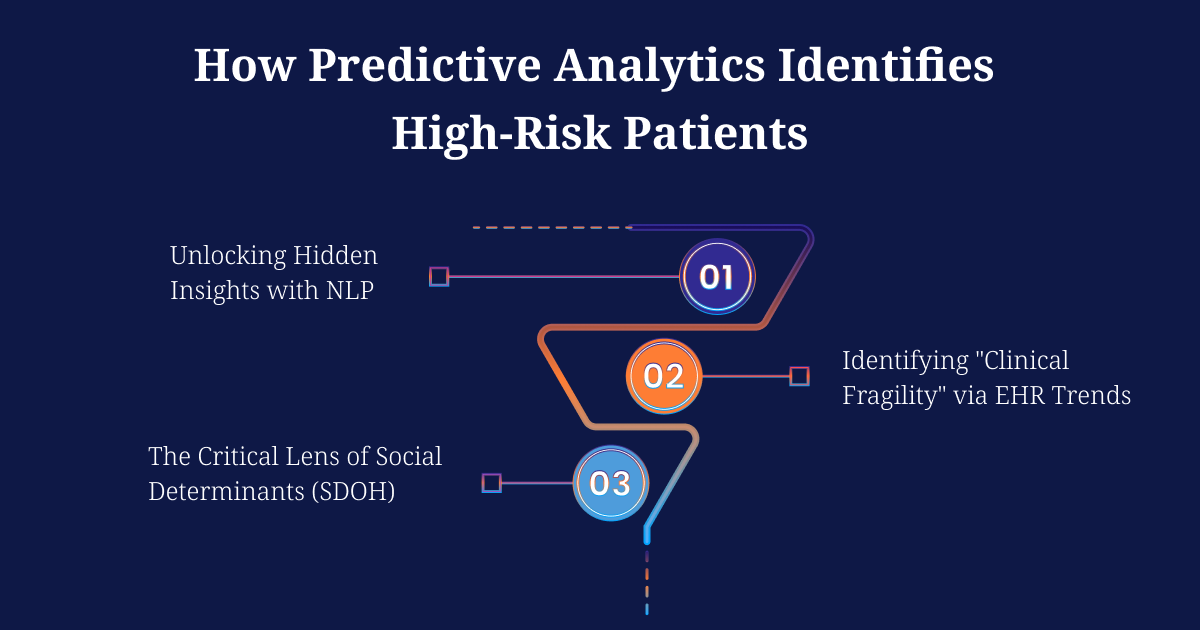
1. Unlocking Hidden Insights with NLP
Much of the most valuable patient data is “trapped” in unstructured clinical notes – the narrative observations made by nurses, social workers, and therapists. Machine learning readmission models now use Natural Language Processing (NLP) to scan these notes for red flags that structured data misses, such as mentions of cognitive decline, lack of caregiver support at home, or history of non-adherence. Predictive models synthesize narrative data to provide a multidimensional view of risk that far exceeds traditional scoring.
2. Identifying "Clinical Fragility" via EHR Trends
Rather than looking at a single lab result, AI models look at the velocity of change.
- The Pointer: A model might flag a patient whose creatinine levels are "within normal range" but are trending upward at an accelerating rate over the last 48 hours. This suggests impending kidney stress that could cause a readmission 10 days after discharge.
3. The Critical Lens of Social Determinants (SDOH)
A patient’s recovery is often dictated by social and environmental factors beyond the clinic – access to healthy food, transportation to follow-up appointments, and housing stability. SDOH-informed models integrate these external variables into the clinical risk profile.
- The Impact: Recent research has shown that while traditional clinical-only models often plateau, integrating SDOH data (captured via ICD-10 Z-codes) allows ensemble models like XGBoost to reach an ROC-AUC of 0.79, with some high-performing configurations hitting as high as 0.82. This allows hospitals to trigger social work interventions before the patient is wheeled out the door.
Precision in Practice: The Intervention Framework
The 30-day window is historically difficult to manage because hospitals often enter a ‘data vacuum’ the moment a patient leaves the building. Predictive analytics bridges this gap by identifying which patients are most likely to face complications on Day 10 or Day 20, allowing providers to extend their clinical ‘line of sight’ into the home and prevent the silent relapses that drive readmissions.
To tackle readmissions, providers are using a three-tiered predictive approach that triggers specific clinical actions regardless of the primary diagnosis.
1. The Pre-Discharge Stability Check
AI models analyze real-time hemodynamics and lab trends. If the model identifies “subclinical instability” – where the patient looks fine but data suggests physiological stress – the system alerts the care team to delay discharge by 24 hours for further observation.
2. The Social Safety Net
For patients flagged as high-risk due to social factors (ROC-AUC 0.79–0.82), the system automatically triggers a “Transition of Care” (TOC) bundle. This includes “Meds to Beds” delivery and a confirmed home-health visit within 48 hours.
3. Predictive Resource Prioritization
Not every patient needs a daily follow-up call. Predictive models identify the top 10% of “ultra-high-risk” patients. By focusing labor-intensive monitoring on these individuals, hospitals maximize their resources while ensuring the most vulnerable have a digital safety net.
Real-Time Risk Scoring at Discharge: A Strategic ROI
Implementing real-time readmission risk scoring isn’t just a clinical win; it’s a strategic financial move.
Calculating the ROI
When hospitals deploy predictive tools to cut readmissions by 30-50%, the Return on Investment (ROI) is realized through:
- Penalty Mitigation: Avoiding the CMS HRRP payment adjustment, which can reach up to 3% of total Medicare reimbursements. For a high-volume health system, this 'payment adjustment factor' represents millions of dollars in at-risk revenue that can be preserved through better risk stratification.
- Measured Clinical Impact: Mount Sinai Health System implemented an AI model that flags high-risk patients directly within the EHR. By proactively addressing these high-risk cases with targeted discharge plans, they achieved a 20% reduction in 30-day readmission rates
- Continuous Clinical Safety Nets: By embedding models directly into the EHR, hospitals can intervene before a patient’s condition necessitates a return. A prime example is UC San Diego Health, which integrated a deep learning model to detect sepsis in real-time. By analyzing hundreds of variables simultaneously, the system flags high-risk patients for immediate review, significantly reducing sepsis mortality rates and preventing the complications that lead to readmission .
- Operational Efficiency: Identifying high-risk patients allows staff to focus "Transitional Care Management" (TCM) resources where they are needed most, rather than calling every discharged patient.
The Intuceo Advantage: Turning Data into Action
At Intuceo, we understand that a prediction is only valuable if it is actionable. Our Augmented BI technology is designed to bridge the gap between “big data” and “bedside care.”
- Explainable AI: We don't just provide a risk score; we show why a patient is high-risk. Whether it’s a specific lab trend or a social factor, our platform provides the "root cause" so clinicians can tailor the discharge plan.
- Rapid Preprocessing: Our DataSharp™ engine reduces the time needed to clean and prepare complex EHR data, ensuring risk scores are available in real-time, not hours after the patient has gone home.
- Scenario Planning: With Insight Explorer™, hospital administrators can conduct "what-if" analyses to see how specific interventions - like providing home health visits - might impact overall readmission rates across different patient segments.
Conclusion: Predictive Care is the Future
The transition from retrospective management to predictive foresight is more than a technological upgrade – it is a fundamental reimagining of the hospital’s role in a patient’s life. In the traditional model, patient discharge was treated as a conclusion; however, in this digital-first world, it is an informed handoff supported by a continuous clinical safety net.
Reducing readmission rate is a complex puzzle with clinical, social, and behavioral pieces. However, by leveraging predictive analytics in healthcare, providers can finally visualize the “invisible” risks, from subtle lab velocity shifts and hidden social determinants to the nuances buried in clinical notes, that lead to relapse.
For Intuceo, the objective is to ensure that “big data” never loses its human context. By transforming raw Electronic Health Record data into actionable bedside intelligence, we empower providers to ensure that when a patient is discharged, they aren’t just leaving a facility – they are entering a managed recovery ecosystem. The future of healthcare isn’t defined by the events that occur within the hospital walls, but by the clinical intelligence that keeps patients healthy, at home, and on a definitive path to long-term wellness.
Ready to transform your discharge process from a guessing game into a managed recovery?
Frequently Asked Questions
1.How does predictive analytics differ from the traditional LACE index for readmission risk?
The LACE index is a static, backward-looking tool that relies on only four variables. Predictive analytics, however, uses machine learning to analyze hundreds of real-time data points simultaneously—including “velocity of change” in labs and social determinants (SDOH). This allows AI to identify high-risk patients that the LACE index frequently misses, such as those who are clinically stable but socially fragile.
2.Does the AI make the final decision on when to discharge a patient?
No. These tools function as Clinical Decision Support (CDS) systems. They act as a “co-pilot” for the clinical team by providing a data-driven risk score and explaining the underlying causes of that risk. The final decision to discharge remains with the physician and the multidisciplinary care team.
3.Can predictive models really capture information from unstructured clinical notes?
Yes. Through Natural Language Processing (NLP), predictive models can “read” the narrative notes written by nurses, therapists, and social workers. It identifies red flags like “patient expressed confusion about discharge instructions” or “home environment lacks caregiver support.” This converts subjective observations into objective risk data.
4.How do ML models handle "Data Drift" as clinical guidelines change?
Machine learning models are not “set and forget.” As medical standards evolve (e.g., new heart failure protocols), the model must undergo periodic retraining. Advanced platforms use Continuous Learning loops to monitor if the model’s performance is dipping, ensuring that the risk scoring remains aligned with current clinical outcomes and the specific demographics of your local patient population.
5.Is it difficult to integrate predictive analytics into our existing EHR system?
Solutions like Intuceo’s DataSharp™ engine are designed to automate the preprocessing of complex EHR data. By embedding risk scores and insights directly into the existing clinical workflow, these tools provide real-time alerts without requiring clinicians to log into a separate platform.