




A brand manager wants to know why prescription volume dipped in two territories last month. In many pharmaceutical organizations, that question becomes a ticket, the ticket joins a queue, and the answer arrives three weeks later, after the decision it was meant to inform has already been made. The appetite for change is visible in the market: the global self-service business intelligence market reached $12.44 billion in 2025 and is projected to hit $28.85 billion by 2030
For pharma, the stakes go beyond convenience. McKinsey estimates that scaling advanced analytics in pharma can deliver operating efficiencies of 15 to 30 % of EBITDA over five years.2 Capturing that value requires insight to reach the people who act on it: field teams, medical affairs, market access, supply planners. This guide covers how to build self-service analytics in pharma that is fast for users and defensible for regulators.
Key Takeaways
- Self-service analytics in pharma succeeds or fails on governance design, not tool selection.
- A certified data foundation with documented lineage is the prerequisite for compliant self-service under GxP and 21 CFR Part 11.
- A semantic layer that standardizes metric definitions is the most effective defense against dashboard sprawl and conflicting numbers.
- Natural language and AI-assisted querying extend access to users who will never write SQL, provided every answer traces back to governed data.
- Adoption is an operating-model question: training, certified content, and clear ownership matter as much as the technology.
Why Self-Service Stalls in Pharmaceutical Organizations
Pharmaceutical companies face a structural tension that most industries do not. The same datasets that fuel commercial analytics pharma teams rely on, such as prescription claims, CRM activity, patient services data, and real-world evidence, sit under privacy, promotional-compliance, and validation obligations. Opening access without controls invites regulatory exposure. Locking everything behind an analyst team invites the three-week ticket queue.
Three failure patterns appear repeatedly:
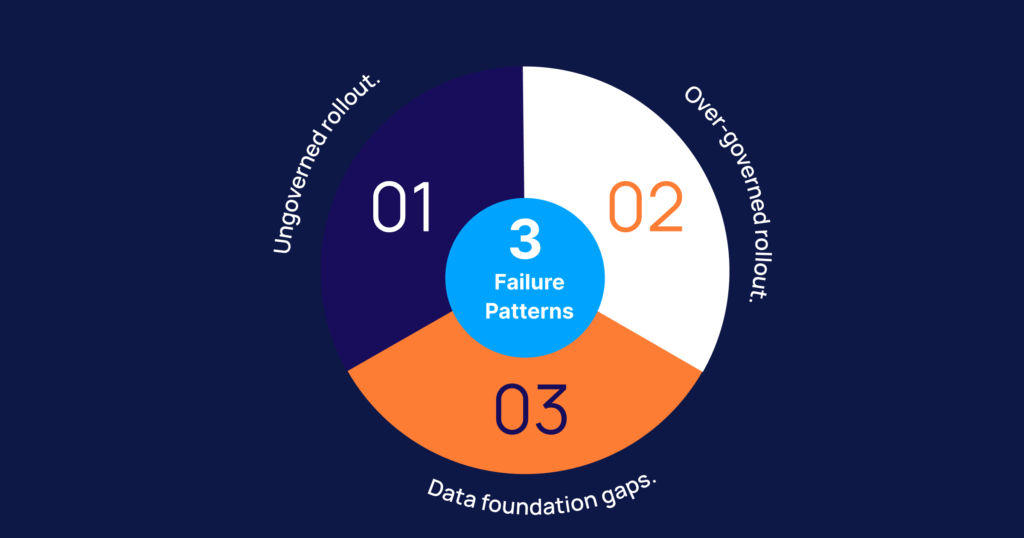
- Ungoverned rollout : Licenses are distributed broadly, every team builds its own extracts, and within a year, hundreds of dashboards report different versions of the same KPI.
- Over-governed rollout: Every new view requires a validation sign-off designed for clinical systems, so users quietly return to spreadsheets, which are less compliant than the system they replaced.
- Data foundation gaps: Self-service tools are pointed at sources that were never reconciled, so users get speed without trust. The first conflicting number in a leadership meeting ends the initiative.
The pattern across all three is the same : governed self-service analytics requires deliberate decisions about who owns data, who certifies content, and what rules govern access. When a company buys the software but skips those decisions, the rules get set anyway, informally, by whoever builds dashboards first.
The Governance Foundation: Freedom Inside Guardrails
Effective pharmaceutical data governance for self-service does not mean approving every chart. It means certifying the inputs so the outputs can be trusted by default. Practical building blocks include:
- Tiered access zones: A certified zone for validated, shared content; a workspace zone for exploration; and a clear promotion path between them.
- Certified data domains: Curated, governed datasets for commercial, medical, clinical operations, and supply chain, each with a named owner, refresh SLA, and documented lineage.
- Compliance mapped to data class : Not all pharma data is born equal. While commercial performance and aggregate market share data carry lighter data-privacy and promotional compliance controls, clinical operations data and patient-level outcomes inherit strict GxP-aligned guardrails, HIPAA privacy controls, and audit trails that satisfy 21 CFR Part 11. Applying clinical-level validation to a commercial brand dashboard kills speed; treating clinical data like commercial data invites regulatory findings.
Confidence here is rarer than executives assume. A Gartner survey of IT leaders in the second quarter of 2025 found that only 23% were very confident in their organization’s ability to manage security and governance when deploying generative AI tools.[3] Companies that codify these guardrails early avoid retrofitting them after an audit finding.
The Data Foundation Self-Service Depends On
Behind every successful self-service pharma analytics program sits an unglamorous integration effort. Pharma data lives in dozens of systems: CRM, ERP, claims feeds, specialty pharmacy data, CTMS, LIMS, safety databases. A workable foundation includes:
- A consolidated analytical store, commonly a cloud lakehouse, where source data is landed, conformed, and historized with full lineage capture.
- Master data alignment for the entities pharma cares about most: HCPs, accounts, products, geographies, and studies. Without it, no two dashboards will agree on territory counts.
- Automated quality monitoring that profiles volume, schema drift, and distribution shifts before bad data reaches a dashboard, rather than after a field director spots it.
- A semantic layer sitting between the warehouse and the BI tools, which deserves its own section.
The Semantic Layer: One Definition of the Truth
Most metric disputes in pharma are definition disputes. Does “active HCP” mean prescribed in 90 days or 180? Is market share based on TRx or NRx? When each dashboard hard-codes its own answer, the organization argues about numbers instead of decisions.
Semantic layer analytics resolves this by defining every business metric once, centrally, with its filters, hierarchies, and security rules, and serving that definition to every tool downstream. The benefits compound in regulated settings:
- Metric logic is documented and version-controlled, which strengthens the audit position.
- Row-level security travels with the data, so a regional manager and a global brand lead can use the same dashboard and see only what each is entitled to see.
- Dashboard sprawl drops because builders assemble views from governed metrics instead of rebuilding logic in every workbook.
For pharmaceutical KPI dashboards, this is the difference between fifty dashboards that disagree and fifty views of one governed model. It is also what makes AI-assisted querying safe.
Where AI and LLMs Fit: Analytics Without SQL
The most consequential shift in pharma business intelligence is natural language access. A medical affairs lead can now ask, in plain English, how enrollment is tracking against plan by site, and receive a governed answer with the underlying data exposed. Large language models translate the question; the semantic layer guarantees the answer uses the certified definition of “enrollment” rather than an improvised query.
This pairing matters because ungoverned pharma AI analytics is a massive liability. In a standard Text-to-SQL or Retrieval-Augmented Generation (RAG) setup, an LLM querying raw database tables directly can produce fluent, highly confident, and completely wrong answers. By using the semantic layer as the single source of truth, the AI queries the metrics, not the raw data. Gartner echoes this shift toward automated guardrails, predicting that by 2030, half of organizations will use autonomous AI agents to translate governance policies into machine-verifiable data contracts.
Beyond querying, AI extends self-service into predictive analytics in pharma: demand forecasts surfaced inside the planner’s view, anomaly alerts on field activity, and next-best-action suggestions embedded in governed pharma reporting dashboards where commercial teams already work, instead of asking the user to come to a data science team.
A Practical Build Sequence
Organizations that get this right tend to follow a similar order of operations:
- Pick one decision domain, such as commercial performance for a single brand, and inventory the questions users actually ask.
- Certify the data behind those questions: integrate the sources, align master data, and publish lineage.
- Define the metrics in a semantic layer, with business and compliance owners signing off on each definition once.
- Launch governed self-service in tools the organization already knows, with certified content clearly badged.
- Add natural language and predictive features only after users trust the certified numbers.
- Operate it : usage telemetry, content retirement, definition change control, quarterly training, and shared pharma data visualization standards to keep quality high as authorship spreads.
Sequencing the work this way pays off in adoption. Teams that see trustworthy numbers from day one keep using the environment, ask harder questions, and pull their colleagues in; teams burned by an early bad number rarely come back. The organizations that compound this trust quarter after quarter are the ones for whom speed of insight becomes a competitive variable in life sciences analytics, not an IT metric.
How Intuceo Helps Pharma Teams Get There Faster
Intuceo is a PhD-led AI, ML, and data analytics services firm that has spent years building governed analytics environments for regulated clients, including engagements with many reputed organizations. The team designs the full path described above: integrating fragmented commercial and clinical sources, establishing pharmaceutical data governance with lineage that stands up to GxP-aligned validation and 21 CFR Part 11 scrutiny, and delivering governed self-service analytics in tools like Tableau, Qlik, and Spotfire that business teams already trust.
Two assets shorten the timeline. Intuceo-Ax™, an augmented analytics accelerator refined across prior regulated engagements, lets Intuceo’s consultants stand up conversational, three-clicks-to-insight access for non-technical users without starting from a blank page. iPDLC™, the firm’s AI delivery framework, sequences discovery, validation, and rollout so governance sign-offs happen alongside the build rather than after it. The result is a self-service BI capability configured to your data, your compliance posture, and your users, delivered as a service engagement with the accountability that implies.
Turn the Three-Week Ticket Queue Into a Three-Click Answer
If your analysts are buried in report requests while your business teams wait for numbers, the gap is fixable. Talk to Intuceo’s data and AI specialists about a governed self-service assessment for your organization.
Frequently Asked Questions
1.How can pharma companies implement self-service analytics without creating data governance issues?
Certify a small set of governed datasets with named owners and documented lineage, then separate certified content from exploratory workspaces. Governance applied at the data and metric level gives users freedom without sacrificing control.
2.How can business users access advanced analytics without SQL knowledge?
Through curated dashboards, drag-and-drop exploration on governed datasets, and natural language interfaces backed by a semantic layer, which ensures a plain-English question is answered using certified metric definitions rather than improvised query logic.
3.How do semantic layers improve self-service analytics adoption?
They eliminate the conflicting-numbers problem that destroys user trust. When every tool draws from one set of governed metric definitions, users stop second-guessing dashboards and adoption compounds instead of stalling after the first dispute.
4.How do pharma organizations prevent dashboard sprawl and inconsistent metrics?
Combine a semantic layer for centralized definitions with a content lifecycle: certification badges for trusted dashboards, usage telemetry to find duplicates, and scheduled retirement of stale content.
5.How do pharma teams ensure regulatory compliance while enabling self-service reporting?
Map controls to data classification. Patient-level and clinical data inherit HIPAA and GxP-aligned controls with full audit trails, while aggregated commercial data moves with lighter governance. Role-based security and immutable lineage keep regulated content defensible.