




Eighty percent of clinical trials face delays because of recruitment shortfalls and patient dropout, and as many as 20% are terminated outright due to insufficient enrollment.At the same time, case processing in pharmacovigilance can consume up to two-thirds of a company’s entire safety budget.These are not edge cases. They represent the operational reality that clinical teams face every quarter.
The root cause is consistent: fragmented data, manual processes, and disconnected systems that slow down decisions at every stage of the clinical lifecycle. This is where big data analytics in pharma is changing the equation. By unifying diverse data streams and applying AI-driven models, pharma organizations are turning raw clinical information into actionable intelligence, right inside the workflows where it matters.
Why Clinical Workflows Need an Analytics-First Approach
The pharmaceutical analytics market was valued at USD 28.83 billion in 2025 and is projected to reach USD 132.77 billion by 2035, with the descriptive analytics segment capturing the largest market share, driven by the increasing adoption of big data analytics.
According to an ICON survey, 49% of pharma and biotech companies now employ AI and big data in their programs – a 10 percentage point increase from 2019 – with 88% of respondents expecting to increase investment further.
These growth figures signal a clear shift: clinical teams are no longer treating analytics as a support function. It is becoming the operational backbone of trial planning, patient safety, and regulatory compliance.
Unfortunately, the plans for massive financial investment in the segment outpace the existing infrastructure. While companies are eager to deploy advanced analytics, a persistent execution gap remains: collecting data is not the same as extracting value from it. The industry is currently flush with information but starved for insights because data remains siloed and inconsistent across clinical operations, R&D, and medical affairs. Bridging this gap through clinical data integration is therefore no longer just a technical preference – it is the foundational step required to realize the ROI of these billion-dollar investments.
Key Use Cases: Where Big Data Analytics Creates Measurable Impact
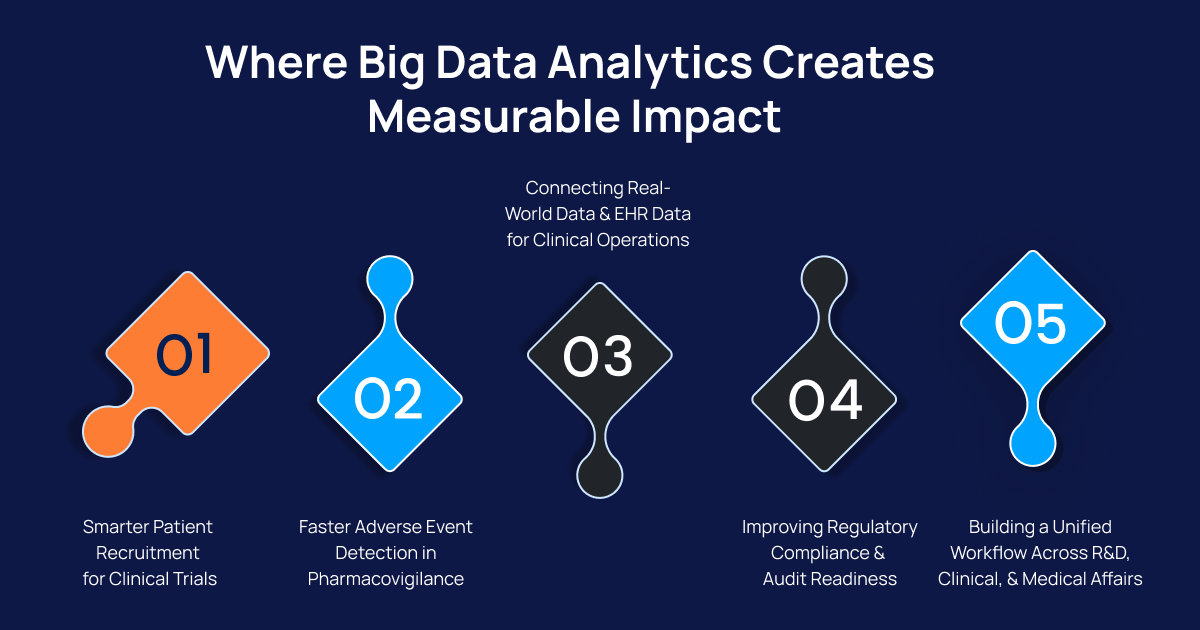
1. Smarter Patient Recruitment for Clinical Trials
Slow enrollment remains one of the most persistent and expensive problems in drug development. An estimated 86% of international clinical trials do not meet their patient recruitment targets within the planned timeframe. Patient recruitment delays cost sponsors between $600,000 and $8 million per day in lost revenue due to postponed market entry.
Patient recruitment analytics addresses this by mining electronic health records, genetic profiles, pharmacy histories, and claims data to identify eligible cohorts with greater precision. Instead of relying on manual chart reviews, clinical teams can use predictive analytics in clinical trials to match patients to specific protocol criteria, reducing screen failure rates and accelerating enrollment timelines.
2. Faster Adverse Event Detection in Pharmacovigilance
Pharmacovigilance teams operate under strict regulatory timelines for adverse event detection. Yet, some marketing authorization holders process over one million safety-related transactions every year, including individual case safety reports, medication error reports, and product quality complaints. The volume alone makes manual review unsustainable.
Pharmacovigilance analytics powered by NLP and machine learning can extract relevant safety information from unstructured sources, including clinician notes, patient forums, and call center logs, then classify and triage events automatically. AI models trained on historical safety databases can flag potential signals that traditional statistical methods often miss, enabling proactive rather than reactive safety monitoring. For pharma companies that need to satisfy GxP standards and 21 CFR Part 11 requirements, this kind of pharma workflow automation directly reduces compliance risk while reclaiming expert hours for higher-value scientific analysis.
3. Connecting Real-World Data and EHR Data for Clinical Operations
Approximately 76% of pharmaceutical labs are shifting toward real-world data (RWD) for clinical insights. Real-world evidence drawn from EHRs, claims databases, patient registries, and wearable devices provides a view of treatment outcomes that controlled trial environments cannot replicate on their own.
EHR data integration allows clinical operations teams to assess site performance in real time, monitor patient safety across geographies, and feed post-market surveillance systems with continuous, structured data. When combined with clinical trial analytics, this data supports adaptive trial designs where researchers can modify study parameters, such as dosage or cohort sizes, based on interim analysis rather than waiting until the study concludes.
4. Improving Regulatory Compliance and Audit Readiness
More than 82% of healthcare organizations report improved diagnostic accuracy through real-time big data analytics. This real-time capability also applies to regulatory compliance in pharma. Automated compliance reporting reduces human error, accelerates audit preparation, and ensures that safety data submissions meet FDA and EMA timelines.
Life sciences data analytics platforms that maintain immutable audit trails, full data lineage, and automated documentation satisfy the stringent requirements of HIPAA, GDPR, and GxP frameworks. For organizations in regulated industries, this is not a nice-to-have; it is a prerequisite for operational continuity.
5. Building a Unified Workflow Across R&D, Clinical, and Medical Affairs
One of the most significant barriers to clinical workflow optimization is the disconnect between R&D, clinical operations, and medical affairs teams. Each function generates and consumes data, but often through separate systems with incompatible formats.
Pharma data analytics platforms that establish a shared data layer, combining trial data, post-market surveillance, and commercial intelligence, enable cross-functional visibility. When R&D teams can see real-time enrollment metrics and medical affairs can access safety signals as they emerge, decisions happen faster and with better context. This unified approach breaks down data silos in healthcare and creates a single source of truth that everyone can act on.
Challenges in Adopting Big Data Analytics in Clinical Workflows
Despite the momentum, integration is not without friction. Around 61% of healthcare providers identify data interoperability and integration challenges as their primary barrier.[8] Legacy systems, inconsistent data standards (HL7, FHIR, CDISC), and siloed architectures slow down migration timelines. Regulatory complexity across geographies further adds to the challenge: a data governance model that works for FDA compliance may need significant adaptation for EMA or PMDA requirements.
Talent gaps are equally real. Most pharma companies lack internal workforce programs that bridge clinical domain expertise with advanced analytics skills. Without cross-trained teams, even the most capable platform risks underutilization. And for organizations working with AI-based classification models, the “explainability gap” presents a distinct challenge: regulators do not accept binary predictions without evidence-based rationale to justify them.
How Intuceo Helps Pharma Teams Operationalize Analytics in Clinical Workflows
Intuceo specializes in life sciences data analytics solutions built for the complexities of regulated pharma environments. From AI-driven patient matching for clinical trials (using GenAI to identify eligible cohorts from vast, disparate datasets) to Explainable AI (XAI) frameworks for adverse event reporting that do not just predict but justify, Intuceo’s PhD-led engineering teams architect solutions that satisfy GxP, 21 CFR Part 11, and HIPAA requirements.
Intuceo’s proprietary Intuceo-Ix (Neural Search) platform creates a unified knowledge layer across disconnected research silos, indexing millions of pages of clinical documentation, FDA filings, and patents to reduce manual data synthesis.
Whether you need to accelerate trial enrollment, automate pharmacovigilance case processing, or build a cross-functional analytics layer connecting R&D, clinical, and medical affairs, Intuceo delivers hardened, compliance-ready solutions.
Frequently Asked Questions
1.How can clinical teams use analytics to improve patient recruitment?
Clinical teams use patient recruitment analytics to mine EHRs, genetic data, and claims records to identify patients who meet specific trial criteria. This reduces reliance on manual chart reviews, lowers screen failure rates, and accelerates enrollment timelines significantly.
2.What data sources should pharma companies connect for clinical trial analytics?
Effective clinical trial analytics requires connecting electronic health records, claims databases, lab information systems (LIMS), genomic data, patient registries, and real-world evidence sources such as wearable devices and patient-reported outcomes. The key is establishing interoperability across these sources through standardized data pipelines.
3.How do you reduce manual work in pharmacovigilance with AI and analytics?
AI-powered NLP models can extract and classify adverse event information from unstructured sources automatically, while robotic process automation handles data entry and report generation. This combination of pharmacovigilance analytics and automation reduces manual processing time and lowers compliance risk.
4.What are the biggest challenges in integrating siloed clinical data?
The primary challenges include inconsistent data standards across systems (HL7, FHIR, CDISC), legacy infrastructure that resists modern integration, regulatory complexity across jurisdictions, and a shortage of professionals who combine clinical domain knowledge with analytics expertise.
5.How do pharma teams detect adverse events faster using data analytics?
Teams use machine learning models trained on historical safety databases to identify patterns and signals across large volumes of case reports. NLP parses unstructured data from clinician notes, social media, and patient forums. Together, these tools enable proactive adverse event detection rather than waiting for manual case-by-case review.