
Enterprises are pushing AI into production faster than they are building the structures to oversee it. The AI Incident Database recorded 362 documented AI incidents in 2025, up from 233 the year before, a rise that tracks closely with how quickly models are moving from pilots into customer-facing work.[1]
For organizations in regulated sectors, an unmanaged model is not only a technical risk. It carries compliance, reputational, and financial exposure. Closing that gap is the job of an AI center of excellence governance framework: a defined structure that decides who approves what, how models are watched, and where accountability sits before a system goes live.
Why an AI center of excellence governance framework matters now
Most companies have written down rules for AI. Far fewer have built the machinery to enforce them. In a 2025 survey of 351 organizations, 75% reported having AI usage policies, yet only 59% had a dedicated governance role or office, and just 54% maintained an incident response playbook.[2]
A policy states intent. A framework assigns owners, sets review gates, and defines what happens when a model behaves unexpectedly. An AI center of excellence governance framework turns scattered plans into a repeatable operating model, which matters most when auditors, regulators, or customers start asking who signed off on a given decision.
What an AI Center of Excellence governance framework actually covers
An AI Center of Excellence (CoE) is the group that sets standards for how AI is built and run across an organization. Its governance framework is the structure that the group operates by. A working version covers several connected areas rather than a single checklist:
- Roles and accountability : who owns a model, who approves its release, and who answers for it when it fails.
- Review gates : the specific checkpoints a project passes before moving from prototype to production.
- Risk classification : sorting use cases by potential harm so oversight scales with impact instead of treating every project the same.
- Monitoring and response : how models are watched in production for accuracy, drift, and misuse, and what the escalation path is.
- Compliance mapping : connecting each control to the standards that apply, whether the Health Insurance Portability and Accountability Act (HIPAA), 21 CFR Part 11, the Federal Information Security Management Act (FISMA), or the NIST AI Risk Management Framework.
The aim is coverage without duplication. When a framework spells out these areas, teams can move quickly on low-risk work and apply real scrutiny where it counts.
Governance isn't one thing: Separating data governance from model and workflow governance
One reason AI oversight stalls is that teams treat governance as a single mandate. It is at least two distinct disciplines. Data governance asks whether the inputs are accurate, complete, permissioned, and free of bias. Model and workflow governance asks a different set of questions: is the model performing as expected in production, can its outputs be explained, who is allowed to act on them, and what stops it from drifting.
The distinction is not academic. IBM’s 2025 Cost of a Data Breach report found that 13% of organizations had experienced a breach of an AI model or application, and 97% of those lacked proper AI access controls.[3] Clean data does not protect a model that anyone can query without oversight. Yet many organizations still stop at data controls: fewer than half monitor their production AI systems for accuracy, drift, and misuse.[2] An AI center of excellence governance framework works precisely because it names these layers separately and gives each its own owners and checks.
Who needs an AI center of excellence governance framework
This is not a concern reserved for the largest enterprises. According to the IAPP’s 2025 AI Governance Profession Report, 77% of organizations are actively building or refining AI governance programs, a figure that climbs to nearly 90% among those already using AI.[4] The teams that feel the gap most acutely tend to be:
- Data and analytics leaders asked to scale AI without a clear approval path.
- Compliance and risk officers accountable for outcomes they cannot yet see inside a model.
- Engineering leads caught between delivery pressure and unwritten oversight expectations.
- Executives who own the reputational and regulatory consequences when something goes wrong.
The common thread across these roles is exposure without a clear line of accountability. A shared framework gives each of them the same reference point for what is approved, what is monitored, and who answers for it when a model behaves unexpectedly.
How the DARWIN framework keeps oversight from blocking delivery
Governance earns a bad reputation when it becomes a queue. Nearly 45% of respondents and 56% of technical leaders cite the pressure to prioritize speed to market over oversight as the single biggest barrier to AI governance.[2] When controls are unclear or heavy, teams route around them. The answer is not less governance. It is governance calibrated to risk, so that a low-stakes internal tool does not face the same gauntlet as a patient-facing model.
That calibration is what the DARWIN framework is built to provide. It structures AI planning and oversight across the dimensions that decide whether a project should proceed:
- Data: evaluating bias, completeness, and data governance before a model is trained.
- Architecture: planning the evolution from prototype to minimum viable product (MVP) so decisions are staged, not front-loaded.
- Responsibility: aligning the work with economics, compliance, application governance, and clearly defined stakeholders
- Workflow: setting performance metrics and making sure outputs are explainable and consumable for the people who use them.
- Infrastructure and security: making cost and performance decisions, such as graphics processing unit (GPU) versus central processing unit (CPU) usage, and protecting a model's inputs, outputs, and behavior, not only the surrounding application.
Because each dimension carries its own criteria, teams get a clear read on where a project stands and what it still needs. Oversight then moves in step with delivery instead of stopping it.
How Intuceo structures oversight in its AI Dream Session
This is the approach Intuceo brings to its AI Dream Session. Intuceo treats governance as an engagement shaped by prior client experiences, not a set of controls installed and left to run. Its accelerators, drawn from earlier projects in healthcare, life sciences, defense, and the public sector, speed up deployment while keeping the DARWIN checkpoints intact.
The examples are concrete. In one compliance engagement, Intuceo automated the review of more than 30,000 paragraphs across defense documents, reducing review cycles from months to days at over 90% accuracy. In life sciences, it built agentic solutions for high-volume production lines that cut the number of defective products reaching customers. The sessions are led by a team that includes PhD mentors and more than 150 certified engineers who have delivered over 250 solutions across two decades of work with Fortune 1000 and federal clients.
The session is built for the roles that carry this responsibility day to day: data and analytics leaders, compliance and risk officers, engineering leads, and the executives accountable when something goes wrong. It works through their real question, how to put controls in place without stalling the work those controls are meant to protect, using worked examples from regulated deployments rather than generic theory. In keeping with its “Architecting AI” positioning, the focus stays on structuring oversight that fits an organization’s scale and risk, so an AI center of excellence governance framework becomes something teams can actually run rather than a document that sits on a shelf.
A short governance checklist teams can use
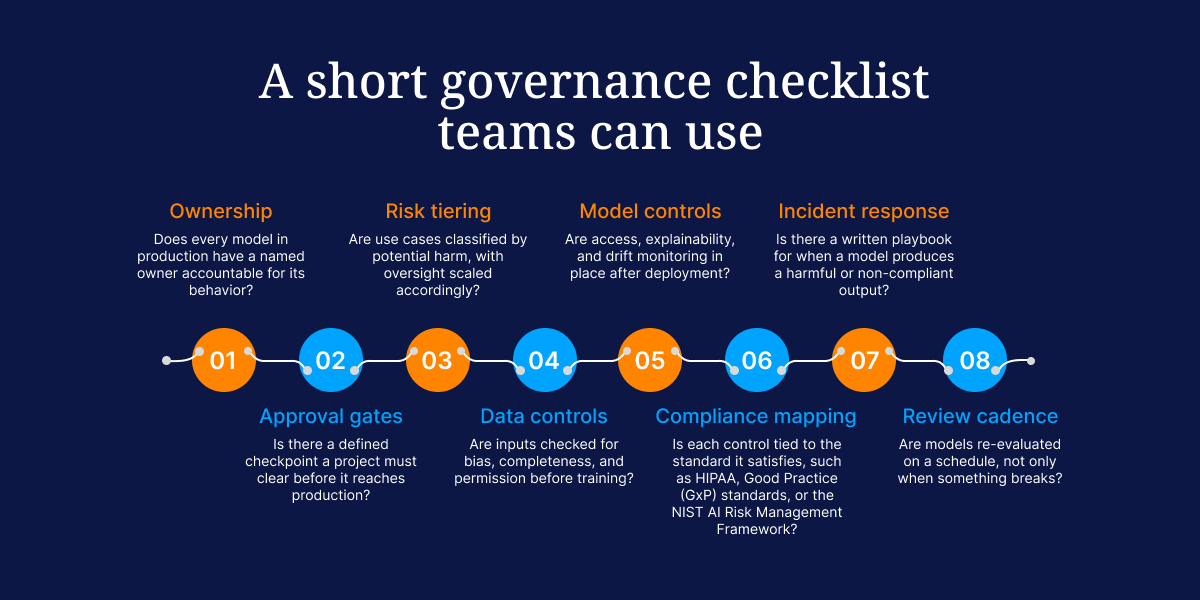
Teams building or auditing this kind of framework can start with these questions:
- Ownership: Does every model in production have a named owner accountable for its behavior?
- Approval gates: Is there a defined checkpoint a project must clear before it reaches production?
- Risk tiering: Are use cases classified by potential harm, with oversight scaled accordingly?
- Data controls: Are inputs checked for bias, completeness, and permission before training?
- Model controls: Are access, explainability, and drift monitoring in place after deployment?
- Compliance mapping: Is each control tied to the standard it satisfies, such as HIPAA, Good Practice (GxP) standards, or the NIST AI Risk Management Framework?
- Incident response: Is there a written playbook for when a model produces a harmful or non-compliant output?
- Review cadence: Are models re-evaluated on a schedule, not only when something breaks?
If a team cannot answer most of these clearly, the gap does not lie in tooling. It is structured.
See the DARWIN framework in action
Intuceo’s AI Dream Session shows how the DARWIN framework turns AI ambition into a governed, deployable plan, using examples from regulated engagements. Reserve a place to see how an AI center of excellence governance framework can be built to fit your organization’s scale and risk.
Frequently Asked Questions
1.What is an AI center of excellence governance framework?
It is a structure that centralizes how an organization oversees AI. An AI center of excellence governance framework defines roles, approval gates, risk tiers, monitoring, and compliance mapping, so models are built and deployed under consistent accountability rather than case by case.
2.How is data governance different from model governance?
Data governance concerns the quality, completeness, permission, and bias of the inputs. Model and workflow governance concern how a deployed model performs, whether its outputs are explainable, who can act on them, and how drift and misuse are caught. A complete framework covers both, with separate owners for each.
3.Does an AI governance framework slow down delivery?
Not when it is calibrated to risk. A well-designed governance framework applies light checks to low-risk work and real scrutiny to high-impact models, which keeps oversight moving alongside delivery instead of blocking it.
4.Which standards should an AI governance framework map to?
It depends on the sector. Regulated organizations commonly map controls to HIPAA, 21 CFR Part 11, FISMA, HITRUST, SOC 2, and the NIST AI Risk Management Framework, connecting each control to the obligation it satisfies.
5.Who should own AI governance in an organization?
Ownership works best when it is shared and explicit. Data and analytics leaders, compliance and risk officers, engineering leads, and executive sponsors each hold a defined part, coordinated through the framework rather than left to one team.