Live AI Dream Session, Vol. 3: Trustworthy AI in Practice with Sarath Kuravi and Dr. Shonraj Ballae • Nov 10 | 11:00 AM EST Reserve Your Seat Claim Free Seat

Reserve Your Seat

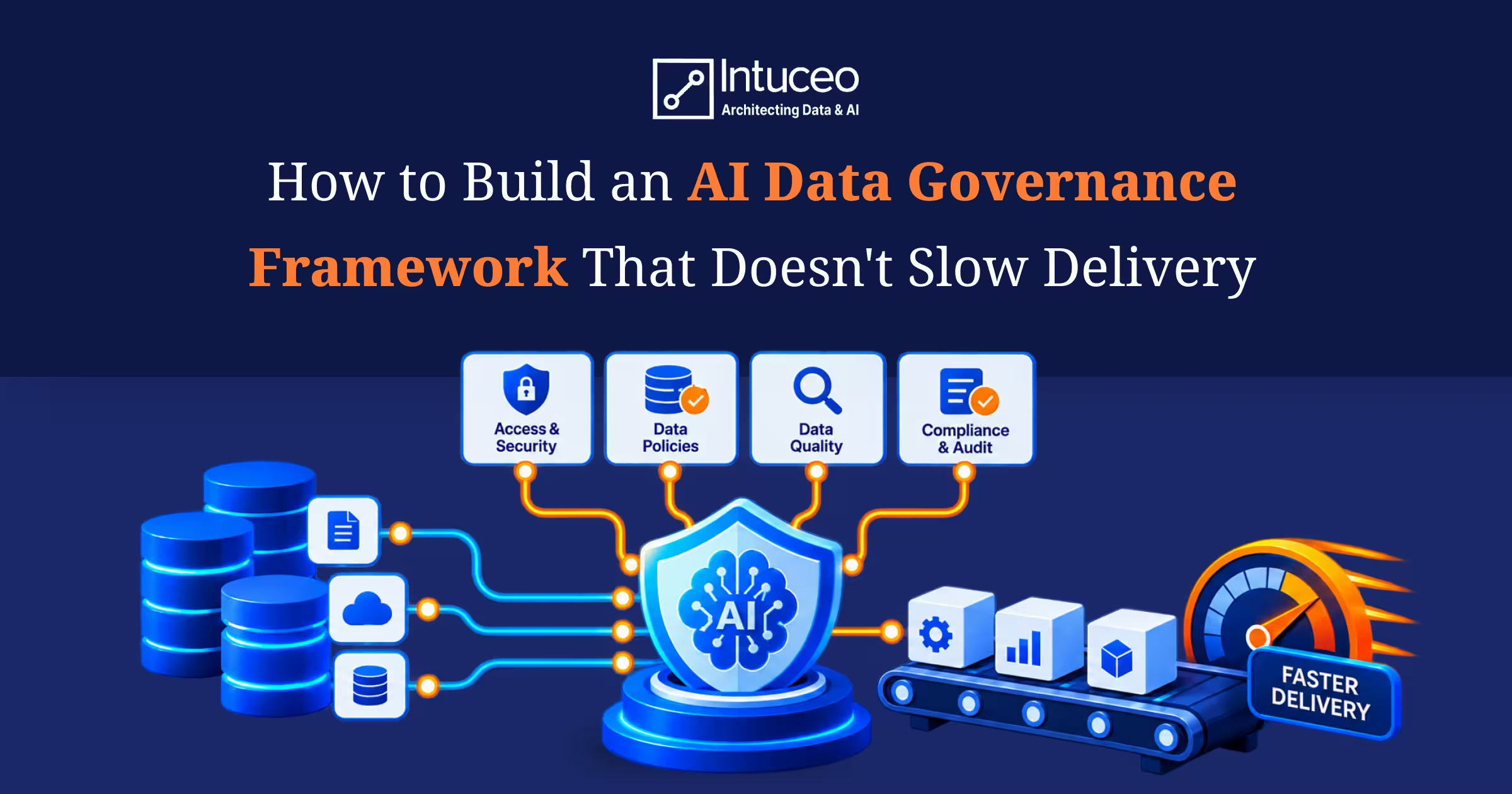
How to Build an AI Data Governance Framework That Doesn’t Slow Delivery

Informatica’s 2025 global survey of data leaders found that two-thirds had not moved even half of their generative artificial intelligence (AI) pilots into production. Asked what made business value hard to demonstrate, respondents cited cybersecurity and privacy compliance (46%), uncertainty over responsible use of AI (45%), reliability of results (43%), and lack of trust in data quality (38%).[1] Each of these is a question an AI data governance framework exists to answer: who may use the data, for what purpose, at what level of quality, and with what evidence.
A framework designed around certified reports can confirm who may view a table, but it may have no record of whether that table may train a model. The practical task is to build a data governance framework that enterprise AI teams can work within, one that settles access, quality, and accountability at the pace AI delivery requires.

Key Takeaways

What Is an AI Data Governance Framework?

An AI data governance framework is the set of decision rights, policies, controls, and roles that determines which data may train, ground, or feed an AI model, at what quality, and with what evidence. It extends traditional data governance from tables and reports to training datasets, features, prompts, and model outputs.

What Is the Difference Between Data Governance and Data Management?

Data governance decides who may use data and for what purpose, while data management carries out the work. The data governance vs data management distinction matters for AI programs because it determines who can say yes to a request. Data management is the execution work: building pipelines, maintaining storage, running quality checks, and securing systems. Data governance sets the decision rights that direct that work, covering who owns a dataset, who may use it and for what purpose, what quality threshold it must meet, and who resolves disputes. When those rights are undefined, an AI team asking for training data has no one with clear authority to approve the request, and it stalls in review.
The Data Management Association’s Data Management Body of Knowledge (DAMA-DMBOK), a framework AI teams can build on, reflects this relationship by placing data governance at the center of its wheel, with 11 knowledge areas such as data quality, metadata, and data security arranged around it.[2] DAMA International states that the body of knowledge is not prescriptive and must be adapted to each organization’s environment.[3] For AI programs, adaptation means extending each knowledge area to new assets, such as training datasets and model outputs, and to new questions, such as whether a dataset is fit for a specific model purpose.

How Is Data Governance for AI Different From Traditional BI Governance?

Business intelligence (BI) governance is organized around curated tables, metrics, and certified reports that analysts review before acting. Data governance for AI extends that scope in the following ways.
Dimension Traditional BI AI workloads
Governed assets Tables, metrics, and reports Training, validation, and test datasets, features, embeddings, prompts, and model outputs
Quality standard Accurate and consistent with business definitions Also representative of the population and context in which the model will operate
Lineage depth Source system to dashboard Source system to dataset version, model version, and individual output
Rate of change Periodic schema and definition updates Frequent retraining, new sources, and drift in production data
Consumers Analysts who review outputs Models and agents, which can act on outputs without a person reviewing each one
Usage questions Who may view the data Who may view it, and whether it may train or ground a model
The final row has legal weight. Under the General Data Protection Regulation (GDPR), personal data must be collected for specified, explicit, and legitimate purposes and not further processed in a manner incompatible with those purposes.[4] A customer service dataset approved for operational reporting therefore does not carry automatic permission to train a churn or pricing model. When the catalog records each dataset’s collection purpose and approved uses, that check becomes a lookup instead of a fresh legal review.

What Are the Core Components of an AI Data Governance Framework?

The AI data governance best practices below are organized as six components, each tied to a question an AI team must be able to answer before a model reaches production. Scope each one first to the data that active AI use cases touch, then extend it to the wider data estate.

How Do You Keep Data Governance From Slowing AI Delivery?

The components define what an AI data governance framework covers. The operating model governs how long a request waits, and four design choices address the points where an AI request can queue: approval, experimentation, documentation, and measurement.

Approve by default within defined rules

Requests for general data access, dataset creation, or ingestion that carry a valid business purpose should be approved automatically, or by the data owner within a stated service level agreement (SLA). Board review is reserved for exceptions such as personal or restricted data. Reviewers can grant partial or conditional approval where outright approval is not possible.

Separate discovery from production

Model development involves testing candidate datasets that may never reach production. A governed discovery space with masked or sampled data and lighter controls lets teams prototype quickly. Full controls apply at the point of promotion into a controlled production space, where datasets are certified, versioned, and documented. Governance effort then concentrates at the point where data begins to influence production decisions.

Generate evidence automatically

Approval workflows, quality results, lineage, and access logs should be captured by the systems doing the work. Records captured as actions occur are timestamped and attributable, so an auditor’s question about who approved a training dataset can be answered directly from the log.

Measure governance as a service

Track request turnaround against SLA, the share of requests resolved without escalation, and the number of production incidents traced to data issues. Together, these measures show where governance adds protection and where it only adds delay. To see where your own requests wait, benchmark your governance approval flow with Intuceo’s team.

What Does a Data Steward Do in an AI-First Organization?

The data stewardship that enterprise teams already run for reporting covers definitions, reference data, and quality issues. AI use cases add checks that regulation now names explicitly: the European Union (EU) Artificial Intelligence Act, for example, expects high-risk system providers to examine training data for possible biases and to identify data gaps.[5] Unless a role owns these checks, they fall between data and model teams. Assigning them to stewards means writing four duties into the role:

Why Is Data Governance the Foundation of Responsible AI in Regulated Industries?

In regulated sectors, data governance for responsible AI works by producing evidence that a model was built on appropriate data. The EU Artificial Intelligence Act makes this explicit for high-risk systems. Article 10 requires training, validation, and testing datasets to be subject to governance practices covering data collection and origin, preparation operations, examination of possible biases, and identification of data gaps. It also requires those datasets to be relevant, sufficiently representative, and, to the best extent possible, free of errors and complete for the system’s intended purpose.[5]
United States banking supervisors set a comparable expectation for predictive models. The revised interagency guidance on model risk management, issued in April 2026 by the Federal Reserve, Office of the Comptroller of the Currency (OCC), and Federal Deposit Insurance Corporation (FDIC) as SR 26-2, describes model testing as including a critical assessment of data quality, relevance, and inputs. It places generative and agentic AI outside its scope, leaving controls for those models to each organization’s own governance practices.[6]
For banks running both kinds of models, internal data governance is therefore part of how controls for generative AI get defined. Lineage, dataset versions, quality results, and approval records captured as they occur provide the documentation both regimes expect.

How to Roll Out an AI Data Governance Framework in Four Steps

How Intuceo Builds AI Data Governance Into Delivery

Intuceo designs AI data governance programs alongside the use cases they protect. Engagements cover data cataloguing and lineage, automated PII and PHI scanning, compliance monitoring, and consent management, delivered through an operating model that defaults to approval for well-defined requests and routes exceptions to an SLA-bound governance board.
PhD-led teams apply this structure through Intuceo’s iPDLC™ delivery methodology, so data controls are defined during each project and are in place before a model reaches production. If governance reviews are holding back models that are otherwise ready, an assessment of your current approval flow and data controls can show where clearer decision rights and automation can shorten the path to production.

Frequently Asked Questions

Scope the first phase to the data your active AI use cases need, publish default approval rules with SLAs, and reserve committee review for personal, restricted, or novel uses. Measure request turnaround from the first week, so that slow steps can be identified and fixed individually instead of being attributed to governance as a whole.
Ownership and decision rights, a catalog enriched with AI context, automated quality rules, lineage through to model outputs, privacy and consent controls, and an AI-specific usage policy. The usage policy deserves early attention because it answers a question reporting-oriented programs were not designed to ask: whether data collected to deliver a service may also be used to train a model.
BI governance protects curated tables and reports that a person reviews before acting. AI governance also covers training datasets, features, prompts, and outputs that may drive automated decisions, and it adds representativeness as a quality criterion. Unstructured content raises a further difference: documents used to ground generative AI responses need classification and access control at the document level, so that a retrieval step cannot surface content the requesting user is not permitted to see.
Stewards certify datasets for specific model uses, maintain AI-relevant metadata, triage quality alerts, and resolve routine access requests within the owner’s rules. Judging representativeness and labeling quality requires some familiarity with model development, so pairing each domain steward with a named contact in the AI delivery team that consumes the domain’s data gives both sides a direct line for resolving issues.
AI data governance controls the data that trains, grounds, and feeds AI models: who owns it, whether it may be used, and whether it is fit for purpose. AI governance is broader. It adds model approval, performance monitoring, explainability, and accountability for outputs. A complete program needs both, with separate owners.
Most programs start from DAMA-DMBOK for core data disciplines. They then map AI-specific risk to the NIST AI Risk Management Framework, whose four functions are Govern, Map, Measure, and Manage. Organizations that want a certifiable management system can add ISO/IEC 42001, the international standard for AI management systems.
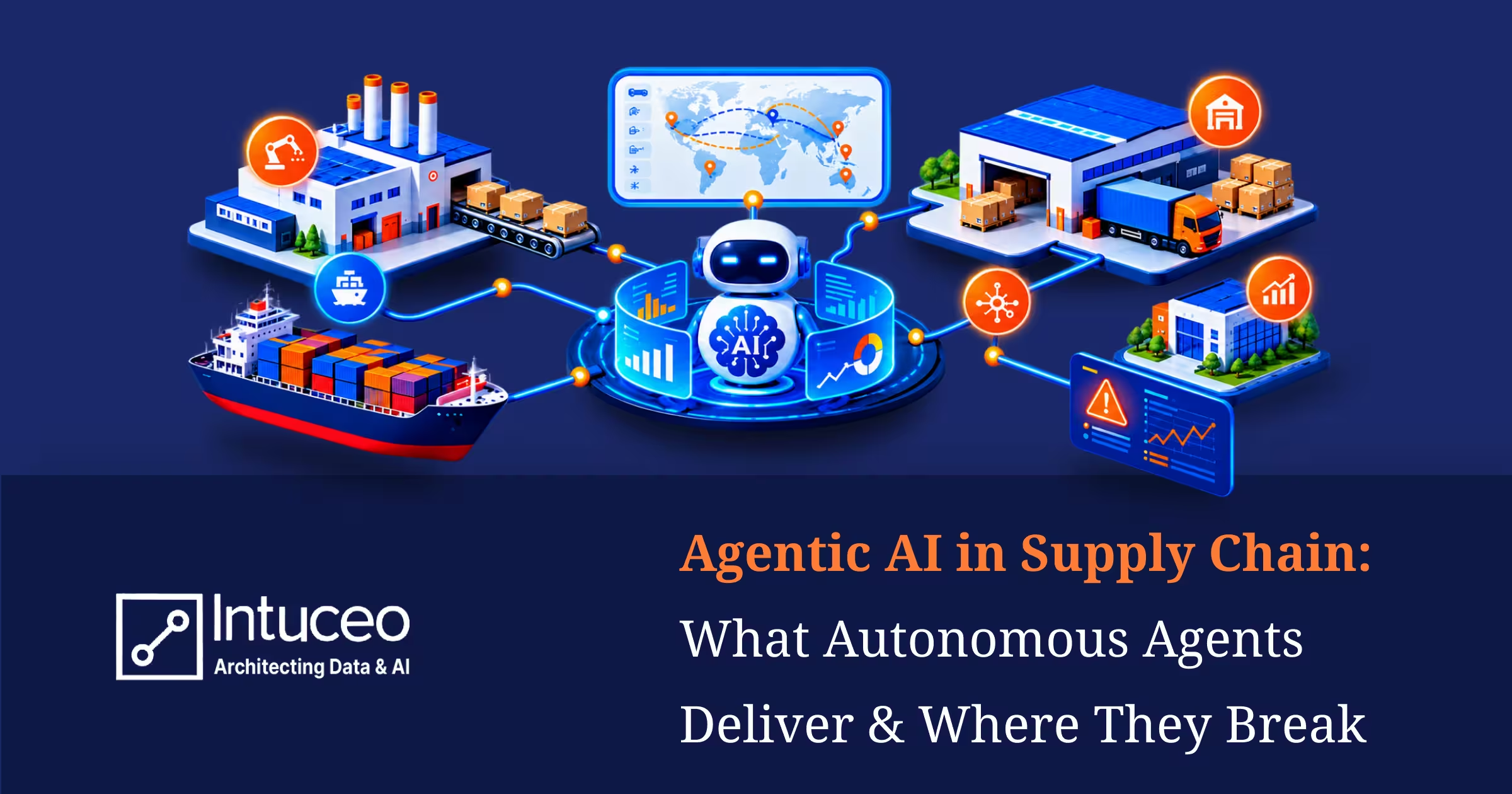
Agentic AI in Supply Chain: What Autonomous Agents Deliver and Where They Break

Agentic artificial intelligence (AI) in supply chain has moved quickly from vendor roadmaps into software selection criteria. Gartner reports that AI agents are now a common requirement when enterprises select supply chain management (SCM) software, and predicts that 60% of enterprises using SCM software will have adopted agentic AI features by 2030, up from 5% in 2025. The same analysis expects enterprise deployments to trail vendor availability, because data management, operations management, and workforce readiness have not kept pace with the technology.1
That gap decides whether an agentic AI supply chain program produces measurable results or stalls after the pilot. For operations and technology leaders, the useful question is narrower than whether to adopt AI agents in supply chain operations. It is which decisions an agent can be trusted to make, under what conditions, and how the organization will know when the agent is wrong.

Key Takeaways

What Is Agentic AI in Supply Chain Operations?

Agentic AI in supply chain operations refers to AI agents that execute defined decisions, such as re-tendering a load or adjusting a reorder point, within limits the business sets, rather than only recommending them.
Most supply chain teams already work with some form of AI assistance.
Copilots, the conversational assistants now built into many planning and transportation tools, interpret data, summarize options, and recommend a course of action, and a person then carries it out.
An agentic system goes a step further. It observes an operational state, selects an action against a defined goal, executes that action through connected systems, and checks the result. That added step determines who is accountable, how failures surface, and which controls a buyer needs.

Copilot vs. Agentic AI in Supply Chain: Key Differences

Dimension Copilot Agentic system
Who acts A planner, after reviewing a recommendation The agent, within delegated limits
Typical scope Queries, summaries and scenario comparisons Multi-step workflows across transportation, warehouse and enterprise systems
Primary risk Poor advice that a reviewer may catch An incorrect action written into a system of record
Controls required Output review Thresholds, audit trails, rollback and escalation paths
Gartner observes that most agentic features now offered in supply chain planning improve the user experience through query interpretation, recommendations and conversational support, without materially changing decision quality or how decisions are made.2 While this is useful, it carries different economics from delegated execution, and buyers should price it accordingly.

Which Agentic AI Supply Chain Use Cases Deliver Value Today?

The defensible answer to how agentic AI is used in supply chain operations today is narrow: in high-volume decisions with clear rules, measurable outcomes, and a low cost of error. Gartner cites touchless forecasting for stable stock-keeping units (SKUs) and automated changes to replenishment parameters as examples of that profile.2
The strongest agentic AI supply chain use cases for enterprise operations share that shape.
Each of these decisions can be checked against a clear rule and corrected quickly if the agent makes a mistake. Reversibility is what makes them a credible first tier for agentic AI in logistics.

Where Does Agentic AI in Supply Chain Break Down?

The risks of deploying AI agents in logistics seldom appear in a controlled demonstration. They emerge under volume, variation, and competing objectives, and they tend to fall into five patterns.

Trade-offs that depend on commercial judgment

Gartner identifies cross-enterprise negotiation, dynamic cost trade-offs, and ethical judgment as poor candidates for agentic AI before 2027.2 Whether to pay for premium freight to protect a strategic account, or accept a late delivery to protect margin, depends on relationship context and commercial priorities that rarely exist in structured data.

Inconsistency across repeated runs

Single-run accuracy overstates readiness for production. The authors of τ-bench, a peer-reviewed benchmark that tests tool-using agents against written business policies, measured how often an agent succeeds on every one of several attempts at the same task. At publication, the strongest function-calling agent tested succeeded on fewer than half of all tasks, and its success rate on eight consecutive attempts fell below 25% in the retail scenarios.3
Models have improved since, but the measurement principle holds. An operation that processes the same exception type thousands of times a week needs evidence of consistency, because small error rates compound at that volume.

Coordination failures between agents

Multi-agent systems in supply chain designs typically assign separate agents to demand, inventory, transportation, and procurement, then rely on them to coordinate. Research led by the University of California, Berkeley, which analyzed more than 1,600 annotated execution traces across seven multi-agent frameworks, identified 14 failure modes grouped into system design issues, inter-agent misalignment, and task verification.4
These categories translate directly into supply chain terms. An inventory agent holds stock to protect service levels while a transportation agent consolidates loads to reduce cost, and neither asks which objective takes precedence. A workflow closes an exception without confirming that the carrier actually accepted the re-tender. Both failures originate in design choices about roles, hand-offs and verification, so model upgrades alone will not resolve them.

Stale or inconsistent data

An agent acts with the same confidence whether its ETA feed is current or six hours old, and whether units of measure agree between the enterprise resource planning (ERP) system and the warehouse management system. Experienced planners often sense when data looks wrong. Agents need that sense written in as explicit data-confidence checks, built on governed data pipelines with lineage and freshness monitoring, that pause execution and escalate.

Agent washing: capability claims that exceed the software

Gartner warns that agent washing, the relabeling of conventional automation as agentic, raises the risk of misaligned investment and long-term lock-in, and notes that many current offerings cannot independently re-sequence objectives, negotiate trade-offs or adapt execution logic.2
A practical test during evaluation is to ask a vendor to run an exception the system was not configured for and observe what the agent does.
The table below summarizes the five failure patterns, how each one typically shows up, and the control that addresses it.
Failure pattern Typical symptom Control
Commercial trade-offs The agent expedites freight without weighing account priority or margin Keep these decisions at the Recommend tier
Inconsistency at volume The same exception is resolved differently across repeated runs Test repeated-trial consistency before go-live
Multi-agent coordination Inventory and transportation agents pursue competing objectives Define objective precedence and verified hand-offs
Stale or inconsistent data Action is taken on an outdated ETA or mismatched units of measure Add data-confidence checks that pause and escalate
Agent washing A rules engine is sold as agentic Ask the vendor to run an exception the system was not configured for

How Do You Set the Decision Boundary for Agentic AI Exception Management?

In agentic AI exception management, autonomy works best as a graded set of permissions assigned to each decision class, with escalation designed as carefully as execution.
Tier Agent role Suitable when
Execute autonomously Acts and records the action Rule-bound, reversible, low financial exposure
Execute and notify Acts, informs the owner, and allows a rollback window Moderate exposure, clear policy, high volume
Recommend Prepares the action with its rationale for approval Material cost, customer or supplier impact
Escalate Assembles context and routes the case to the right owner Policy conflict, low data confidence or an unfamiliar scenario
Within an AI governance framework, four criteria set the tier: whether the action can be reversed, the financial exposure per decision, the effect on customers or suppliers, and confidence in the underlying data.
Tiers should change with evidence. A decision class earns more autonomy once its override and reversal rates stay stable over a defined period, and it returns to a lower tier when a disruption shifts the conditions it was calibrated for.

How Do You Measure Supply Chain AI ROI at the Decision Level?

Aggregate efficiency claims are difficult to audit. Supply chain AI return on investment (ROI) is easier to defend when it is measured for each decision class against a baseline captured before deployment.

How Intuceo Builds AI Agents for Transportation Management

Intuceo delivers agentic AI in supply chain operations through its supply chain and transportation practice, beginning with the decision classes a client’s data and policies can support. That practice draws on transportation work for operators including CSX, MTA Long Island Rail Road (LIRR) and National Air Cargo. Its iTMS™ accelerator, an AI transportation management system, places a Supervisor Agent across three modules: iForesee for demand forecasting, iPlan for procurement and execution planning, and iSee and iVerify for multi-modal visibility and delivery verification. The agent monitors all three for bottlenecks, and when it detects a disruption, it simulates alternative routes and presents the options to planners.
Every recommendation from iForesee and iPlan carries a rationalization layer that shows which variables, such as cost, time, carbon, or risk, shaped it. That record gives reviewers the audit trail a graded autonomy model depends on, a core principle of explainable, production-grade AI. iTMS connects to existing ERP systems and carrier networks without replacing them, and Intuceo’s advisory team uses digital twin modeling to simulate the effect on a client’s network before go-live, so autonomy thresholds are tested before they touch live freight. Through Intuceo’s iPDLC™ delivery framework, iTMS deployments typically reach a live pilot with measurable ROI in about 90 days.

Identify which supply chain decisions are ready for autonomy

Intuceo’s Supply Chain Diagnostic maps your exception volumes, data quality and decision rules to a tiered autonomy plan, so the first agents you deploy are the ones most likely to perform reliably in production.

Frequently Asked Questions

It executes defined decisions on behalf of planners. In an agentic AI supply chain deployment, agents typically triage transportation exceptions, maintain replenishment parameters for stable items, follow up on purchase order confirmations and reconcile freight invoices. They act within thresholds the organization sets, record each action and escalate cases that fall outside policy or rely on data the agent cannot verify.
Failures cluster in five areas: decisions that require commercial judgment, inconsistent results when the same task repeats at volume, poor coordination between multiple agents with competing objectives, actions taken on stale or mismatched data, and vendor claims that present conventional automation as agentic. Most of these are design and governance issues that can be addressed before deployment.
Well-designed agents classify each exception, gather the relevant shipment, order and contract context, and then act according to the autonomy tier assigned to that exception type. Low-risk, reversible cases are resolved directly. Higher-exposure cases are prepared as recommendations for approval, and cases involving policy conflicts or low data confidence are routed to the appropriate owner with context attached.
A copilot interprets data and recommends actions, and a person executes them. An agentic system executes actions itself through connected transportation, warehouse and enterprise systems, within delegated limits. The shift moves accountability for individual actions from the planner to the controls around the agent, which is why thresholds, audit trails and rollback paths become mandatory.
For a narrow set of decisions, yes. Agents perform reliably on high-volume, rule-bound and reversible tasks such as exception triage, replenishment parameter updates and freight audit. Decisions that depend on commercial judgment or cross-enterprise negotiation are better kept as recommendations with human approval, a sequence Gartner also advises.
Measure it for each decision class against a pre-deployment baseline. Track touchless rate, override and reversal rate, time to resolution, cost per resolved exception including premium freight, and consistency across repeated occurrences. A rising override rate signals that autonomy has been set too high.

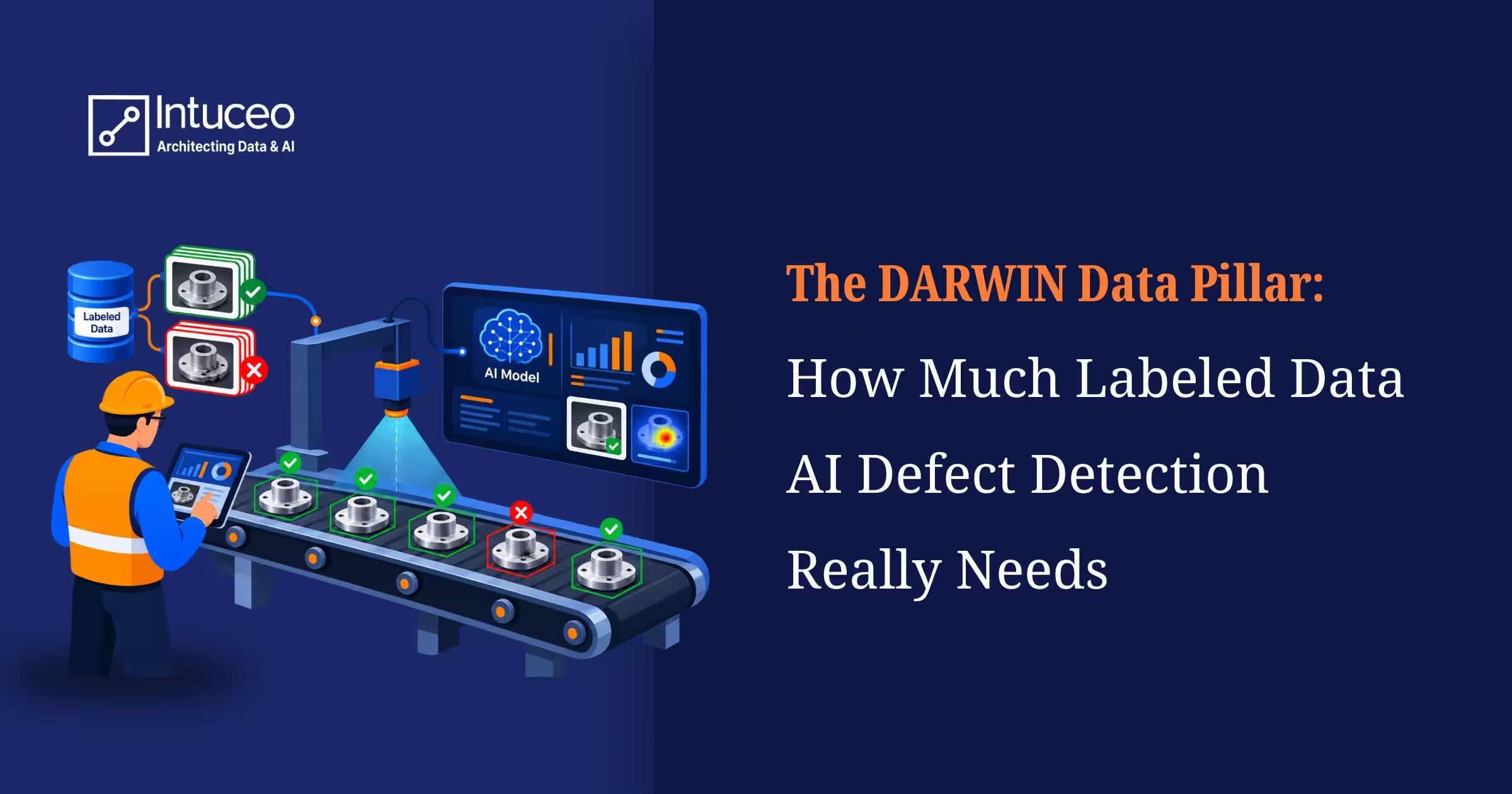
The DARWIN Data Pillar: How Much Labeled Data AI Defect Detection Really Needs

For years, the first question in any vision project was how many labeled images it would take. The answer was usually uncomfortable: thousands per defect class, drawn by people whose time was already committed elsewhere. That single estimate stalled many computer vision inspection projects before they began.
Newer models reduce how much labeled data AI defect detection needs in certain use cases, while other use cases still require the full effort. The Data pillar of the DARWIN™ Framework exists to separate the two before a budget is set.
This article explains how pillar sizes labeled data for AI defect detection within the DARWIN AI framework and what it means for manufacturing teams.

Key Takeaways

What Is the DARWIN™ Framework?

The DARWIN™ Framework is Intuceo AI Labs’ method for judging whether an AI initiative is ready for production across five dimensions: data, architecture, responsibility, workflow, and infrastructure and security. Intuceo AI Labs introduced it to help enterprises evaluate AI initiatives before committing to a build, asking whether each dimension is ready. The goal is a decision that can hold up after the pilot.
AI Dream Session, Vol. 1 set out the strategic question: what does an AI initiative need to move from idea to production? Vol. 2 applies that thinking to computer vision, where data questions tend to dominate.

What Does the DARWIN Data Pillar Ask Before Any Labeling Starts?

The Data pillar reframes the labeled data conversation around four questions.
Answering these before choosing a model prevents a common failure: collecting and labeling a large dataset for a problem that did not need one, or under-investing in a problem that did.

How Much Labeled Data Does AI Defect Detection Need?

Labeled data needs for AI defect detection depend on the decision the model supports. Presence checks and obvious anomalies may need only a small labeled evaluation set. Rare or surface defects can often start from images of good parts. Fine, low-contrast defects with tight tolerances still need substantial labeled examples per defect class.
There is no universal number, and anyone quoting one without seeing images is guessing. Published vendor guidance ranges from a few dozen to several hundred labeled images per defect class, a spread that reflects how differently use cases behave. What has changed is the range of workable starting points.
Broadly, manufacturing vision use cases now fall into three data profiles.
Data profile Typical use cases Labeled data needed
Zero-shot or prompted Part presence, region isolation, counting, obvious anomalies Small evaluation set only, to confirm performance
Few-shot or normal-only Rare defects, new variants, surface anomalies Images of good parts plus a modest labeled evaluation set
Fully supervised Fine, low-contrast defects with tight tolerances and strict acceptance criteria Substantial labeled examples per defect class
The middle row is where much of the change has happened. Research on anomaly detection shows how far performance can go with very little labeled data. WinCLIP, a method built on a vision-language model, reports 91.8% area under the receiver operating characteristic curve (AUROC) for zero-shot anomaly classification on the MVTec AD industrial benchmark, rising to 93.1% for its variant using a single normal image[1].
Treat that as proof of direction, not a promise. On VisA, a second industrial benchmark, the same method scores 78.1% AUROC zero-shot, a reminder that results move with the data[1]. Benchmark images are cleaner and more consistent than most plants. Your results depend on your parts, defects, and imaging conditions.

Why Labeled Data for AI Defect Detection Shrinks but Never Disappears

Labeled data reduction is real. Elimination is not. Even the most data-efficient approach needs labels in three places:
The shift is in proportion. Instead of labeling thousands of training images upfront, teams increasingly treat labeled data for AI defect detection as a smaller, sharper set that proves performance and tracks it over time.

Which Data-Efficient AI Models Reduce Labeling for Defect Detection?

Data-efficient AI models reduce labeling in several ways, each suited to different situations:
Choosing among them is a Data pillar decision because it depends on what data exists, how rare the defects are and how precise the decision must be.

What Makes Training Data for AI Defect Detection Reliable?

When training data for AI defect detection is needed, quality consistently matters more than volume, a pattern we see across AI deployments in advanced manufacturing. A few practical principles apply:

Why Does Data Governance Matter More for Lean Vision Datasets?

Smaller datasets carry less redundancy, so data governance for vision AI matters more, not less. Governance for vision work covers who owns image data, how labels are reviewed and approved, how long images are retained, and how changes on the line trigger revalidation. In regulated environments such as life sciences manufacturing, it also covers traceability and audit readiness.
One caution: a reduced labeling plan without a drift monitoring plan simply moves the risk from build time to run time.

How Do You Know If Your Labeling Plan Is Too Big or Too Small?

The Data pillar also helps teams spot a mismatch between effort and need, and shows where it is safe to reduce labeled data for defect detection. Watch for these signals.

Likely oversized

Likely undersized

Undersized plans tend to show up as disappointing pilots. Oversized plans show up as projects that never start. Both are expensive, which is why the Data pillar treats labeling as a decision to justify rather than a default.

How to Build a Labeled Data Plan for Manufacturing Vision AI in Six Steps

A practical plan for labeled data requirements in manufacturing vision AI starts small and grows with evidence:
1. Inventory archived images, reject records, and existing defect definitions.
2. Match each use case to a data profile: zero-shot, few-shot, or fully supervised.
3. Build a labeled evaluation set first, before any training data.
4. Test the lightest viable approach against that set.
5. Add labeling effort only where results fall short of acceptance criteria.
6. Put monitoring and governance in place before production, not after.
Want a second view on your labeling plan? Scope your vision use case with an AI architect.

How Intuceo supports the data work

Intuceo’s DataOps and engineering team prepares, versions and governs the data that vision models depend on, while Intuceo AI Labs applies the DARWIN™ Framework to decide how much of it a use case genuinely requires. In Intuceo’s lens defect detection work for precision optics, the vision model reduced manual QA workload by up to 30%.

Watch: Computer Vision Reimagined, On Demand

AI Dream Session, Vol. 2: Computer Vision Reimagined is a 45-minute session with Intuceo AI Labs on how newer vision models reduce dependence on large labeled datasets, and where they do not. It is now available on demand.

Frequently Asked Questions

The DARWIN™ Framework is Intuceo AI Labs’ method for judging whether an AI initiative is ready for production across five dimensions: data, architecture, responsibility, workflow, and infrastructure and security. It was introduced in AI Dream Session, Vol. 1, and Vol. 2 applies it to computer vision.
It matches each use case to the lightest viable data approach before any labeling begins, then adds effort only where testing against acceptance criteria shows it is needed, rather than committing to a large training set by default.
There is no reliable universal minimum of labeled data for AI defect detection. The one constant is a labeled evaluation set from your own line to validate performance; beyond that, requirements scale with how fine and tightly toleranced the defects are.
Validate against a labeled evaluation set first, then reach for the data-efficient approaches above before committing to full supervision. Keep the hardest examples in the set and monitor for drift so the leaner dataset stays trustworthy.
Often, yes, for rare or surface defects. Normal-only anomaly detection learns from good parts and flags departures. You still need a small labeled evaluation set from your own line to confirm it meets acceptance criteria.

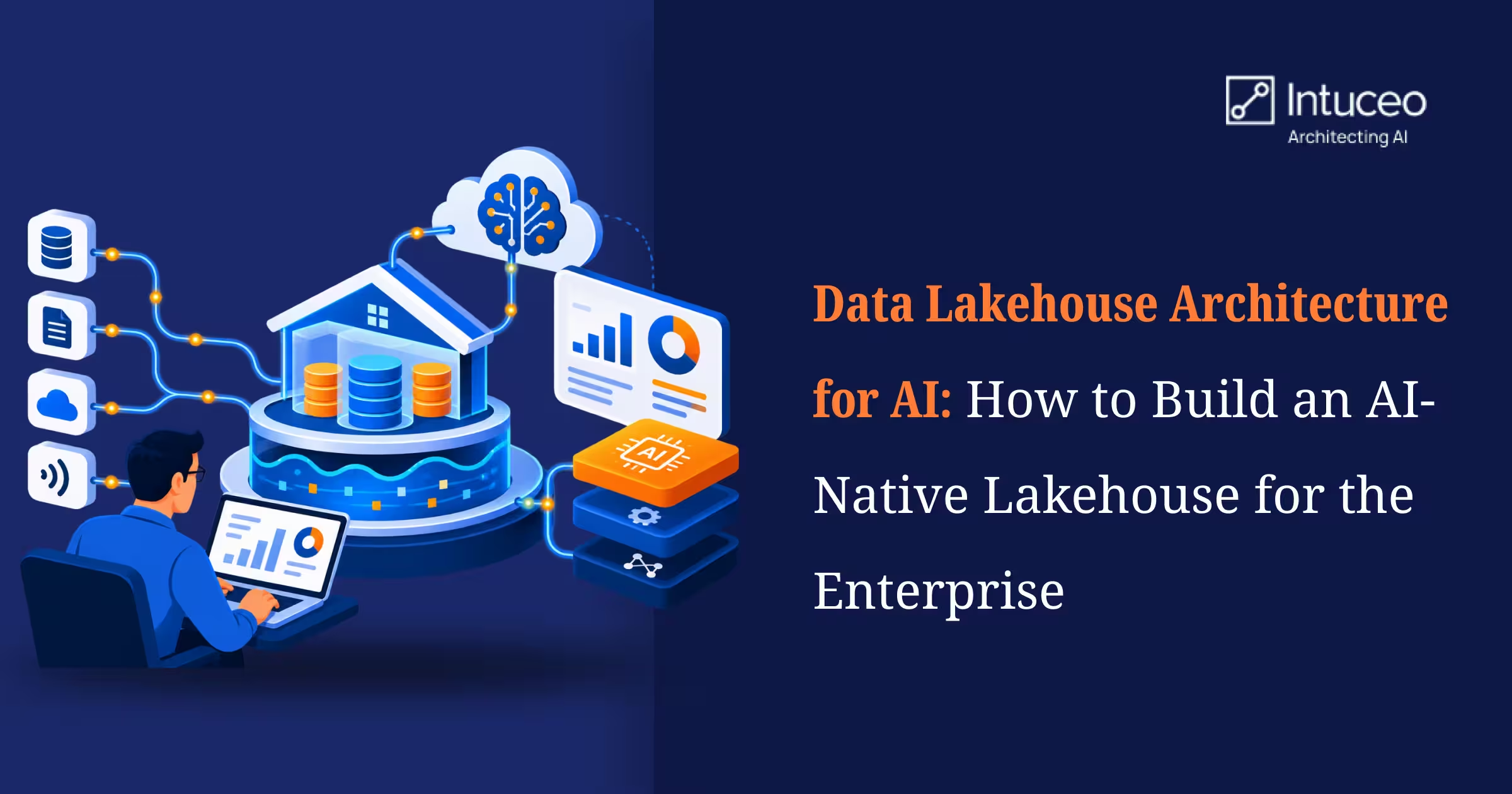
Data Lakehouse Architecture for AI: How to Build an AI-Native Lakehouse for the Enterprise

Enterprise data teams are being asked to deliver two things from one stack: trusted business intelligence for finance and operations, and reliable training data, features, and retrieval context for machine learning and generative AI. The warehouse-plus-lake split that most organizations inherited was never designed to carry both. In practice, that shows up as duplicated data across systems, governance scattered across tools, and compute spend climbing faster than the model teams it is supposed to serve.
An AI-native lakehouse is a data lakehouse architecture for AI that treats machine learning (ML), feature engineering, and large language model (LLM) retrieval as first-class workloads from day one, built on the same storage, catalog, and lineage that serve traditional analytics.
This guide walks through what makes an enterprise data lakehouse architecture AI-native, a reference layering model, the choice between Databricks and Snowflake for enterprise AI, how MLOps on a lakehouse works, and how to migrate without stalling existing reporting.

Key Takeaways

What Is an AI-Native Data Lakehouse?

An AI-native data lakehouse, sometimes called an AI-ready data lakehouse, is a lakehouse built so analytics, model training, feature serving, and LLM retrieval run on one governed copy of data. It stores open table formats such as Delta Lake or Apache Iceberg on object storage and adds vector search, a feature store, and unified catalog governance.

Data Lakehouse vs Data Warehouse: What Makes a Lakehouse AI-Native?

The data lakehouse vs data warehouse comparison usually gets reduced to a cost argument. The bigger difference matters more for AI. A warehouse is built for curated, structured data queried through SQL. A lake accepts everything, but without transactional guarantees or consistent schema, it rarely produces training sets a data scientist could trust twice in a row.
The lakehouse pattern consolidates both using an open table format, Delta Lake, Apache Iceberg, or Apache Hudi, on top of cheap object storage. That gives data teams ACID (atomicity, consistency, isolation, durability) transactions, schema evolution, and time travel against the same files that feed Python notebooks, SQL dashboards, and Spark jobs.
Calling it AI-native adds four things to that foundation:
The table below summarizes how the three architectures compare for AI workloads.
Capability Data warehouse Data lake AI-native lakehouse
Data types Structured All types All types
Transactions ACID None by default ACID through open table formats
ML and GenAI readiness Requires export Raw, often unreliable Native features, vectors, and models
Governance Strong, warehouse-only Fragmented One catalog for data and AI assets
Reproducibility Limited Weak Time travel on training data
Gartner analyst Prasad Pore reports 65% lakehouse adoption among Gartner’s client base, which positions the pattern as the default substrate for new AI workloads rather than a parallel experiment.[1]

Data Lakehouse Architecture for AI: A Six-Layer Reference Model

A workable reference design has six layers. Each has its own failure modes, so each needs its own ownership and controls.

1. Storage Layer: Open Table Formats on Object Storage

Object storage, Amazon S3, Azure Data Lake Storage, or Google Cloud Storage, holding Parquet files under an open table format. Delta Lake and Iceberg are the two formats most enterprise teams converge on. Both give ACID semantics; the choice usually comes down to the compute engine already in play.

2. Catalog and Governance Layer: One Control Plane for Data and AI

Unity Catalog (Databricks’ governance layer), Snowflake Horizon (Snowflake’s governance layer), or an open equivalent such as Apache Polaris (an open Iceberg catalog). This layer carries access control, lineage, and audit for every object the AI stack will touch. Data lakehouse governance decisions made here propagate to features, models, and prompts without re-implementation.

3. Transformation and Quality Layer: The Medallion Pattern

A medallion pattern of Bronze (raw ingest), Silver (cleaned and conformed), and Gold (business-ready) tables, built with Spark, dbt, or SQL. Data quality checks run as pipeline tests, not as a downstream dashboard.

4. Feature and Model Layer: Reproducible Training Data

Feature store, model registry, and experiment tracking. MLflow is the open reference. Features reference the Silver and Gold tables by version, so a training set from last quarter can be rebuilt exactly.

5. Serving and Retrieval Layer: RAG, Features, and Agents

Vector indexes for retrieval-augmented generation (RAG), online feature serving for low-latency inference, and model endpoints for both batch and real-time. For agentic AI workloads, this layer also exposes governed data to the Model Context Protocol or equivalent connectors.

6. Observability Layer: Drift, Health, and Cost

Pipeline health, data drift, model performance, and cost telemetry in one view. Without it, the lakehouse quietly degrades into another cost center.

How Do You Build a Data Lakehouse for AI Workloads?

The answer resolves at the catalog and feature layers. Those two carry the governance and reproducibility that separate production AI from disposable prototypes.

When Should You Choose a Big 4 Firm or Large Integrator for AI?

Databricks vs Snowflake for enterprise AI comes down to starting point: Databricks fits engineering- and ML-heavy teams building models and agents on open formats, while Snowflake fits SQL- and BI-heavy teams adding AI to governed analytics.
Databricks is a Spark-native environment with Delta Lake and Unity Catalog at its core. It appeals to organizations with heavy data engineering and ML workloads, deep Python usage, and a preference for notebook-driven development. MLflow, Model Serving, Vector Search, and Agent Bricks sit on the same catalog as the raw tables. For teams building retrieval pipelines, fine-tuned models, or multi-agent systems against proprietary data, this consolidation is the main argument.
Snowflake began as a SQL-first warehouse and extended into the lakehouse pattern through Iceberg table support, Snowpark for Python and ML, Cortex for LLM features, and Horizon for governance. It suits organizations with substantial SQL and BI investment that want to add AI workloads without rebuilding the analytics layer.
Factor Databricks Snowflake
Origin Spark-native lakehouse SQL-first warehouse
Default table format Delta Lake Native tables plus Iceberg
Governance Unity Catalog Horizon
ML and GenAI tooling MLflow, Model Serving, Vector Search, Agent Bricks Snowpark, Cortex
Best fit Heavy data engineering, Python, custom models, agents Heavy SQL and BI investment, AI added to analytics
Delta Lake deserves a note of its own for enterprise AI. As an open table format, Delta Lake runs under both Databricks and increasingly outside it, including through Iceberg interoperability. Time travel, schema enforcement, and change data feed are the properties that make reproducible training sets and auditable model lineage practical rather than aspirational.
The best data lakehouse architecture for AI, in practice, is the one aligned with the organization’s existing skills, cloud footprint, and governance maturity. The decision rarely turns on a feature matrix. It turns on how much of the current stack can carry forward, which is the first thing an Intuceo lakehouse readiness assessment maps.

How Does MLOps Work on a Data Lakehouse?

MLOps on a lakehouse keeps features, training sets, models, and serving endpoints under the same catalog as the source tables that produced them. That matters for three reasons.
First, reproducibility. Time travel on the underlying Delta or Iceberg tables lets a team retrain a model on the exact data version it was first trained on, which is often what regulators and internal audit actually ask for.
Second, lineage. When a model drifts, the engineering team can trace from the serving endpoint back through the feature, the Gold table, the Silver transformation, and the raw Bronze ingest, inside one lineage graph.
Third, governance. Databricks’ 2026 State of AI Agents report, based on telemetry from more than 20,000 organizations, found that companies using AI governance tools put 12 times more AI projects into production than those without.[2] On a lakehouse, that governance is applied once at the catalog layer and inherited by every downstream model, feature, and agent, the principle behind Intuceo’s DARWIN AI governance approach.
For generative AI specifically, the lakehouse also serves as the retrieval substrate for enterprise LLM infrastructure. Vector indexes sit alongside structured tables, so RAG pipelines and agents can combine semantic search with precise filters against the same governed data without copying it into a separate store.

How to Migrate From a Data Warehouse to a Lakehouse Without Breaking Reporting

A full lift-and-shift data warehouse to lakehouse migration rarely succeeds and rarely pays back inside a budget cycle. A workload-first migration does: move the jobs the warehouse handles poorly first, dual-run reporting during cutover, and retire warehouse workloads only once their replacements are proven.
Migrations that follow this pattern deliver AI workloads first, which is what justified the move in the first place, and let BI follow once the lakehouse has proven itself on harder problems.

How Intuceo Builds AI-Native Lakehouses for Regulated Industries

Intuceo designs and builds AI-native lakehouses on Databricks and Snowflake for regulated industries, including healthcare, life sciences, and the federal space, with Unity Catalog or Horizon governance applied from day one and MLflow-based model lineage tied to the underlying Delta or Iceberg tables.
Where Intuceo’s delivery differs from a generic data engineering engagement: a reference medallion design hardened across prior client engagements including Florida Blue, GuideWell Health, UF Health, Janssen Pharma, and Bausch & Lomb; accelerators such as Intuceo-Ax™ for explainable classification workloads and iPDLC™ for faster AI delivery; and a 20-year track record engineering compliant data environments for Fortune 1000 and federal clients.
Get a lakehouse readiness assessment of your current stack and a 90-day plan to serve your highest-value AI workload from a governed foundation.

Frequently Asked Questions

Compliance belongs in the catalog and storage layers, not in each downstream tool. Unity Catalog or Horizon enforces access control, row and column masking, audit logging, and lineage once, and every feature, model, and agent that reads governed tables inherits those controls. For regulated workloads such as HIPAA-compliant healthcare analytics, pair that with pipeline-level de-identification and tokenization of personally identifiable information (PII) and protected health information (PHI) so sensitive fields never reach training sets or vector stores unless an approved use case explicitly requires them. Audit evidence then flows from the catalog itself rather than from a parallel compliance report.
Both open table formats offer ACID guarantees, schema evolution, and time travel on object storage. Iceberg has broader cross-engine support across Snowflake, Trino, Spark, Flink, and DuckDB, which makes it the stronger choice when the compute strategy is multi-vendor or likely to shift. Delta Lake has deeper feature maturity on Databricks-centric stacks, including Change Data Feed, Deletion Vectors, and tighter integration with MLflow and Unity Catalog. Interoperability layers such as Delta UniForm now let teams write in one format and read through the other, which reduces the need to pick permanently on day one.
Lock-in exposure on a lakehouse is lower than on a warehouse because the data sits in open file and table formats on commodity object storage. Keep the storage layer and the chosen table format decoupled from the compute engine, treat the catalog as a governed abstraction rather than a vendor contract, and avoid encoding critical business logic in proprietary stored procedures or notebook-specific features. Portability becomes a design choice rather than a vendor feature. A lakehouse built this way can be read by multiple engines concurrently and migrated to a different compute vendor without moving the underlying data.
Agents need their own identities, scoped credentials, and audit trails distinct from the human users who deploy them. Grant least-privilege access through the catalog so an agent sees only the tables, columns, or rows its task actually requires, and route inference traffic through a gateway that enforces rate limits, prompt filtering, and output guardrails. For sensitive data, prefer a retrieval interface over direct table access: the agent requests information through a governed endpoint and never reads raw rows it has no business touching.
For most AI workloads, yes. A lakehouse stores structured and unstructured data together, adds ACID transactions through open table formats, and lets features, models, and vector indexes share one catalog with the source tables. A warehouse still suits curated SQL reporting, which is why many enterprises dual-run both during migration.
Six layers: object storage with an open table format, a catalog for governance and lineage, a transformation layer using the Bronze/Silver/Gold medallion pattern, a feature and model layer, a serving and retrieval layer for RAG and agents, and an observability layer for drift, pipeline health, and cost.

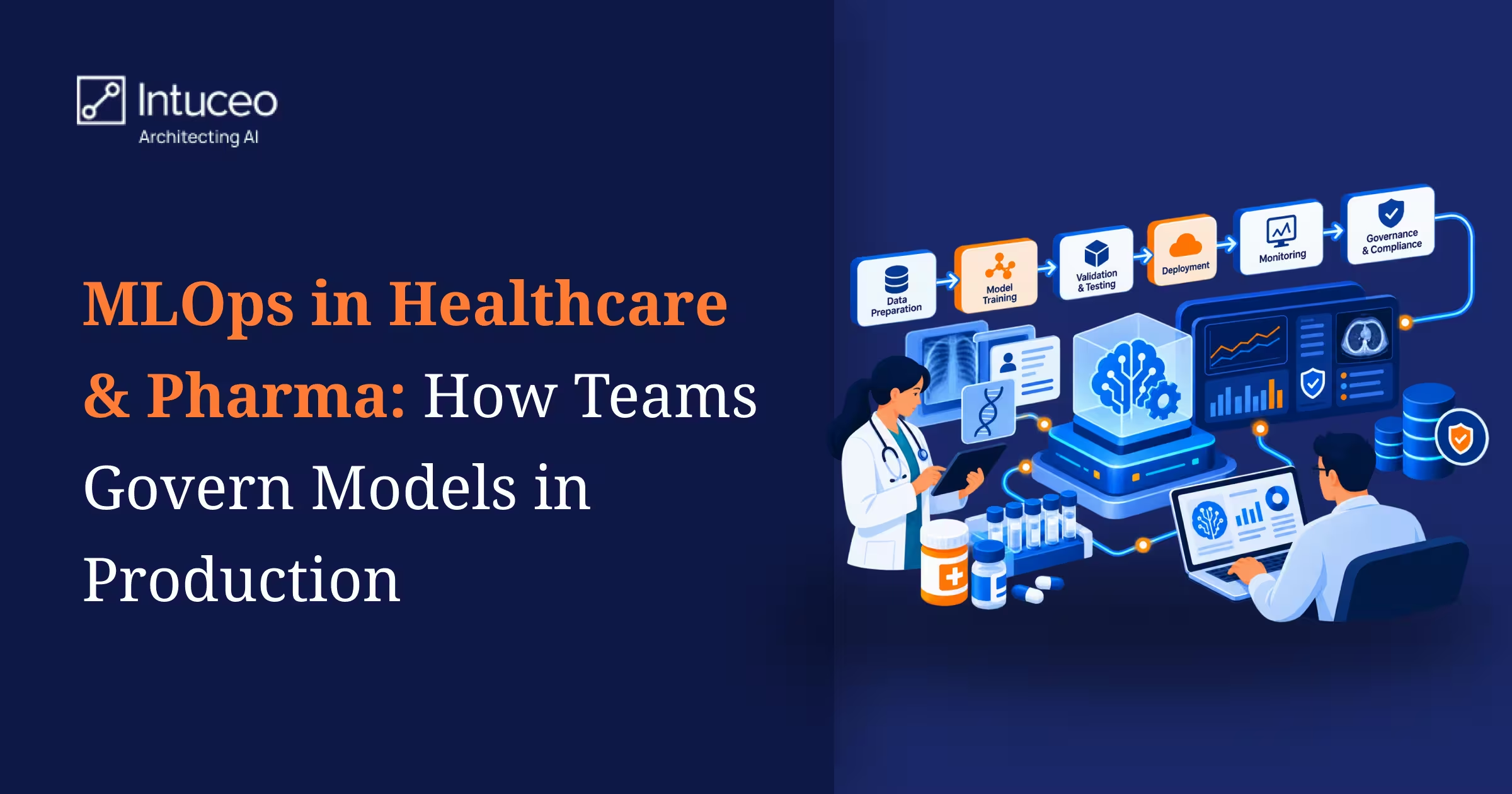
MLOps in Healthcare and Pharma: How Teams Govern Models in Production

A model that classifies adverse event reports or stratifies patient risk becomes a regulated computerized system the day it goes live, with one complication that conventional validation never had to absorb: its performance depends on data it has not seen yet. The records it produces still carry the same integrity, traceability, and privacy obligations as a batch record or a claims file. MLOps in healthcare and pharma is the discipline that keeps those two facts aligned, so that every model in production can be reproduced, explained, and defended at inspection.
Machine learning operations (MLOps) already gives teams the raw mechanics: pipelines, experiment tracking, model registries, and monitoring. This guide covers what healthcare and pharma teams add on top of those mechanics, stage by stage, building on our broader guide to MLOps for regulated industries.
What is MLOps in healthcare and pharma?
MLOps in healthcare and pharma is the practice of running machine learning pipelines so every production model can be reproduced, explained, and defended at inspection. It adds regulated controls to standard MLOps: validated releases, Part 11 audit trails, HIPAA safeguards, and change control that is approved before retraining begins.

Key Takeaways

Which Regulations Apply to MLOps in Healthcare and Pharma?

No single regulation governs machine learning (ML) in healthcare and life sciences. Teams assemble their obligations from records rules, privacy law, the good practice regulations collectively known as GxP (manufacturing, clinical, laboratory, and pharmacovigilance), and artificial intelligence (AI) guidance that is still maturing. The documents below carry the most weight for models in production.
Source Status What it asks of the pipeline
21 CFR Part 11 (Code of Federal Regulations) Binding regulation Validated systems, secure time-stamped audit trails for record creation, modification, and deletion, and change control over systems documentation[1]
Health Insurance Portability and Accountability Act (HIPAA) Security Rule, 45 CFR 164.312 Binding regulation Access control, integrity safeguards, and audit controls that record and examine activity in systems holding electronic protected health information (ePHI)[2]
U.S. Food and Drug Administration (FDA) guidance on AI for drug and biological decision-making, January 2025 Draft, nonbinding A risk-based credibility assessment for a defined context of use, with life cycle maintenance after deployment[3]
FDA and European Medicines Agency (EMA) Guiding Principles of Good AI Practice, January 2026 Joint principles Traceable data provenance in line with GxP, risk-based performance assessment, and scheduled monitoring for issues such as data drift[4]
FDA Predetermined Change Control Plan (PCCP) guidance for AI-enabled device software Final, nonbinding Pre-specified modifications, a protocol to develop, validate, and implement them, and an impact assessment[5]
European Union (EU) Good Manufacturing Practice (GMP) Annex 22, Artificial Intelligence Consultation draft Continuous oversight of AI systems, including change control, performance monitoring, and human review procedures[6]
The practical reading of the table is that Part 11 and HIPAA are enforceable today, while the AI-specific documents describe the evidence inspectors will increasingly expect to see. FDA AI compliance in 2026 therefore means satisfying binding records and privacy rules with evidence organized the way the AI guidance describes it.

How Does FDA’s Context of Use Shape AI Model Validation?

FDA’s draft guidance anchors validation to a defined question and a context of use (COU), then rates model risk on two factors. Model influence is the weight the model’s output carries in the decision relative to other evidence. Decision consequence is the significance of an adverse outcome if that decision turns out to be wrong.[3]
The guidance’s own example of high risk on both counts is a model used to decide which trial participants can skip inpatient monitoring after dosing. A model that ranks literature for a human reviewer would sit far lower, and its credibility plan can be lighter in proportion.
This framing answers how FDA expects AI models to be validated and monitored in clinical settings: through evidence scaled to risk, defined before deployment, and maintained for as long as the model is in use. Operationally, the COU statement, risk rating, and acceptance criteria belong in the model registry as metadata on every version. When an inspector asks why a model was validated the way it was, the answer then travels with the model rather than sitting in a document nobody can locate.

How to Govern MLOps in Healthcare and Pharma, Stage by Stage

Implementing MLOps in healthcare and pharma comes down to deciding what evidence each stage must produce, then making the pipeline produce it automatically.

How Is MLOps in Healthcare Different From Standard MLOps?

Standard MLOps and its regulated form share the same tooling. The difference is the evidence each step has to leave behind.
Area Standard MLOps MLOps in healthcare and pharma
Data Versioned datasets Immutable, hashed snapshots linked to each model version, with ePHI kept in access-controlled zones and de-identified before experimentation
Validation Metrics reviewed after training Acceptance criteria fixed before training, tested on held-out data, with the report assembled from pipeline metadata
Release Automated promotion to production An approval signature bound to a specific model version, with a Part 11 audit trail of who approved what and when
Monitoring Drift alerts Thresholds set by the COU risk rating; a breach opens a quality investigation with documented root cause
Retraining Scheduled or triggered automatically A retraining protocol or PCCP, approved in advance, covering triggers, data windows, acceptance criteria, and rollback
Accountability The ML team A named owner, risk tier, and review date in a model inventory, with human review of AI outputs that inform regulated decisions

Stage 1: Data Preparation and Provenance

The FDA and EMA principles ask that data provenance, processing steps, and analytical decisions be documented in a traceable, verifiable manner consistent with GxP.[4] In practice, every training set becomes an immutable, hashed snapshot that a model version points to, so retraining on identical data is always possible. A HIPAA-compliant ML pipeline adds two controls at this stage: ePHI stays inside access-controlled zones with logged activity, and data is de-identified before it reaches experimentation environments that have no need for identifiers.

Stage 2: Training and Validation

GxP MLOps for pharma uses the same automation as conventional MLOps, operated under a risk-based quality system so the automation itself generates the evidence. Each training run captures the code commit, container image, parameters, and dataset version without manual entry. Performance is tested against acceptance criteria fixed before training, on held-out data the team did not tune against, and the validation report is assembled from pipeline metadata instead of being written after the fact.

Stage 3: Release and Approval Under Part 11

Promotion from staging to production is where 21 CFR Part 11 AI validation concentrates, starting with validation of the systems involved (§11.10(a)). The promotion is an electronic record: it needs an approval signature bound to a specific model version (§11.70), and an audit trail showing who approved what and when (§11.10(e)). Part 11 also requires change control over systems documentation (§11.10(k)), which in an MLOps setting extends to pipeline definitions and infrastructure code.[1]

Stage 4: Production Monitoring and Drift

Monitoring covers three signals: shifts in input distributions, shifts in output distributions, and realized performance once ground truth arrives, such as adjudicated adverse event cases or confirmed readmissions. In healthcare MLOps, alert thresholds should follow the COU risk rating. A breach opens an investigation under the quality system with documented root cause, which keeps automatic retraining from silently masking a problem. Prediction logs are records in their own right and need retention periods aligned with the underlying regulation.

Stage 5: Change Control and Retraining

Every retrained model is a new version, and the pharma AI model lifecycle depends on deciding in advance how much revalidation each type of change requires. For AI-enabled medical devices, a PCCP lets manufacturers describe planned modifications, the methodology to develop, validate, and implement them, and an assessment of their impact, so pre-authorized changes do not each need a new marketing submission.[5] The draft EU Annex 22 points in the same direction for manufacturing, pairing change control with ongoing performance monitoring.[6] The retraining protocol, covering triggers, data windows, acceptance criteria, and rollback, should be approved before the first deployment rather than drafted during the first incident.

Evidence Each Stage Must Produce

The table below summarizes what the pipeline should generate at each stage, and which requirement drives it.
Stage Evidence the pipeline must produce Main driver
Data preparation Hashed, immutable training data snapshots tied to each model version, logged ePHI access, and de-identified data for experimentation FDA and EMA principles; HIPAA Security Rule
Training and validation Code commit, container image, parameters, and dataset version for every run, plus results against pre-set acceptance criteria GxP risk-based quality system
Release and approval An approval signature bound to the model version, an audit trail of approvals, and change control over pipeline and infrastructure code 21 CFR Part 11
Production monitoring Input, output, and performance monitoring records, investigation records for threshold breaches, and retained prediction logs FDA draft AI guidance; FDA and EMA principles
Change control An approved retraining protocol or PCCP, and revalidation evidence for every new model version FDA PCCP guidance; draft EU Annex 22
Not sure your retraining protocol would hold up at inspection? Book a governance gap review.

Why Is Human Oversight Required for AI in GxP Settings?

In an April 2026 warning letter, FDA stated that when a manufacturer uses AI to help with current good manufacturing practice (CGMP) activities, any output or recommendation from an AI agent must be reviewed and cleared by an authorized human representative of the firm’s quality unit.[7] That case involved AI-drafted specifications and procedures rather than a deployed predictive model, yet the principle carries over directly: accountability for an AI-assisted decision stays with named people.
The FDA and EMA principles reinforce this by asking that performance assessment cover the complete system, including human and AI interaction.[4] For MLOps teams, that translates into review queues for low-confidence outputs, explanations surfaced at the point of review, overrides captured in the audit trail, and override rates tracked as a monitoring signal in their own right. Sound model governance for healthcare AI wraps these controls in a model inventory that records an accountable owner, a risk tier, and a periodic review date for every model in service.

How Intuceo supports governed MLOps

Intuceo is a PhD-led AI, ML, and data analytics services firm whose life sciences work includes Janssen, Ferring Pharmaceuticals, and Bausch & Lomb. Its MLOps engagements build compliance into the pipeline from the first commit, so audit logs, lineage, and validation evidence accumulate through normal operation. Deployed models carry drift monitoring, controlled retraining loops, and interpretability views designed for the reviewers who sign off on outputs.
Explainability, bias checks, and model documentation are reviewed by Intuceo’s PhD-led Board of Science & Innovation, and the iPDLC™ delivery framework places PhD-led quality gates at every transition from development to production. Teams work across MLflow, Kubeflow, and Amazon SageMaker, so governance fits the stack a client already runs instead of forcing a migration.
Running models in production ahead of an inspection or a submission? Get a governance gap review that maps each model to its context of use, audit trail coverage, and change control readiness.

Frequently Asked Questions

Pharma companies govern ML models under Part 11 by first scoping which ML artifacts count as regulated records. FDA’s Part 11 scope and application guidance ties the rule to records that other regulations, known as predicate rules, already require. It also describes enforcement discretion for certain Part 11 requirements, while predicate rule obligations stay fully in force.[8] Pharma teams therefore classify ML artifacts individually. Model outputs that feed a GxP decision, validation reports, release approvals, and training data cited in a submission are typically treated as regulated records. Exploratory notebooks stay outside scope until their results become the basis for a regulated decision.
It looks like a validated computerized system whose validation never fully closes. The International Society for Pharmaceutical Engineering (ISPE) Good Automated Manufacturing Practice (GAMP®) Guide: Artificial Intelligence was published in July 2025 for use alongside GAMP 5 (Second Edition). It covers the AI-enabled system life cycle, the responsibilities of internal and external suppliers, and ongoing monitoring and maintenance.[9] Two practical consequences follow. Cloud ML services used in GxP work need supplier assessment and infrastructure qualification. GxP and non-GxP workspaces should also be kept separate, so exploratory work cannot reach production without passing through change control.
Healthcare organizations keep ML pipelines HIPAA-compliant by de-identifying data, scrubbing identifiers from ML outputs, and holding business associate agreements (BAAs) with vendors. Most start by deciding which de-identification route applies. HIPAA recognizes two: removing a specified list of identifiers, or a formal determination by a qualified expert applying statistical and scientific methods.[10]
Beyond that, the most common leak path in healthcare MLOps is incidental. Identifiers get written into experiment logs, prediction logs, feature store snapshots, or error traces. Most of the gaps teams find in audits close with three steps: scrubbing those outputs, keeping features to the minimum the model needs, and holding BAAs with any vendor that touches ePHI.
A typical pharma MLOps stack has five layers:
Whatever tools you choose, the configured system, including its procedures, access controls, and retention settings, must be validated. That is why tool selection should follow the governance design rather than come before it.
A PCCP lets makers of AI-enabled medical devices pre-specify planned model modifications, the protocol to develop, validate, and implement them, and an assessment of their impact. Once FDA authorizes the plan, changes made within it do not each need a new marketing submission.[5] For MLOps teams, the PCCP becomes the approved rulebook for retraining.

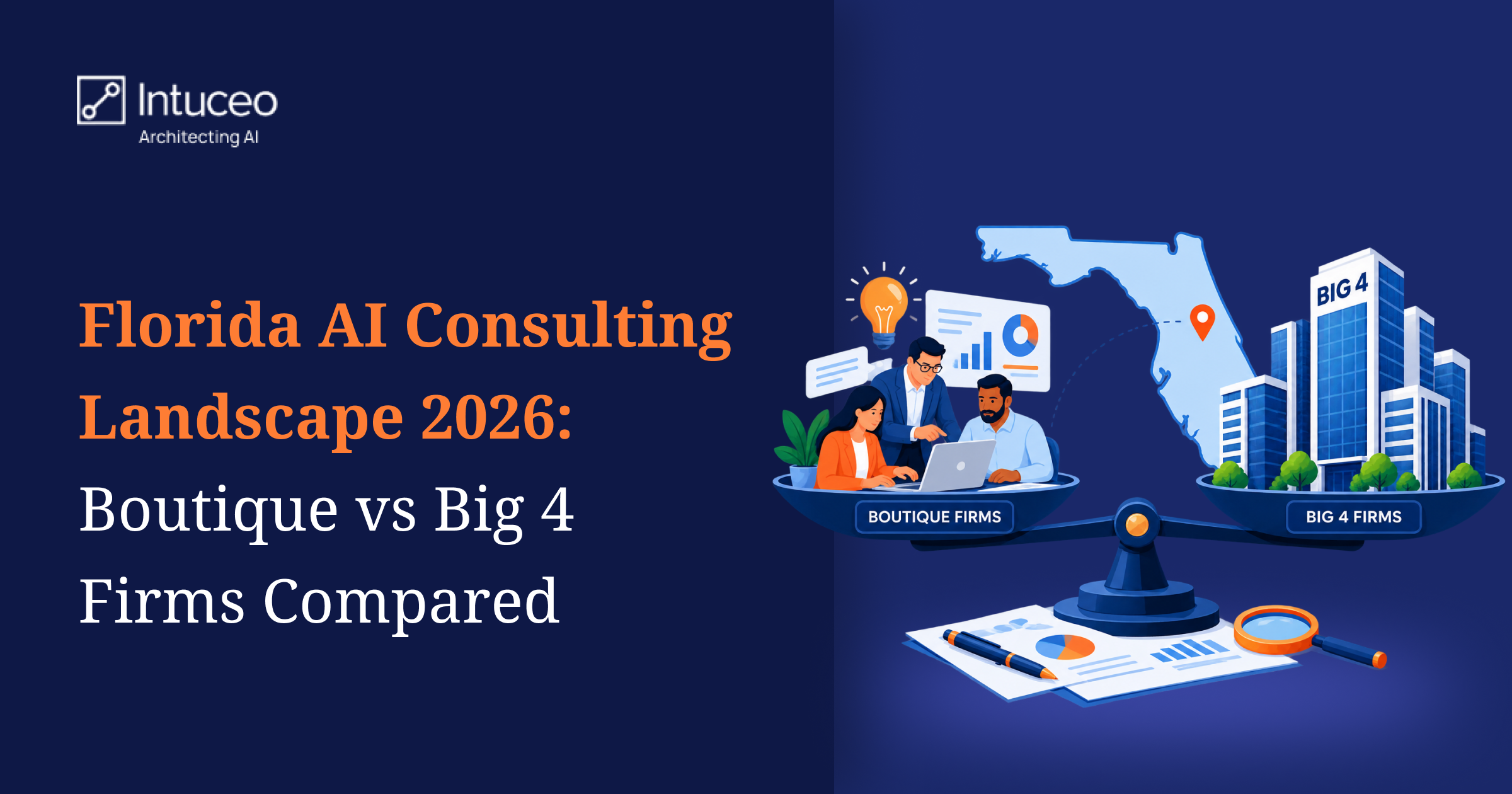
Florida AI Consulting Landscape 2026: Boutique vs Big 4 Firms Compared

In the Florida AI consulting landscape, the choice comes down to the shape of the work. Big 4 firms and large integrators such as Accenture fit broad, multi-function programs that need scale, adjacent services, and brand assurance. Boutique AI consulting firms fit defined, technically hard problems where senior specialists, speed, and lower overhead decide whether the model reaches production.
A Florida enterprise with a real artificial intelligence (AI) problem to solve (a claims model headed for production, a demand forecast that has to hold under pressure, a clinical dataset that has to stay compliant) usually puts the same brief in front of two very different kinds of firms. One is a global advisory house or system integrator with thousands of consultants. The other is a specialist shop built around a narrow band of AI and data work. Both will say yes, and that split defines the Florida AI consulting landscape in 2026.
Only one is the right fit for a given situation, and the cost of choosing wrong is real. By some estimates, more than 80% of AI projects fail, twice the failure rate of technology projects that do not involve AI. [1] Any serious comparison of AI consulting firms in Florida starts by separating what each model is built to do from how each one sells.

Key Takeaways

Who Competes in the Florida AI Consulting Landscape?

A shortlist in the AI consulting market in Florida tends to draw from two brackets. The first is the large global firms: the Big Four advisory houses, Deloitte, PwC, EY, and KPMG, alongside scaled system integrators such as Accenture, which is not one of the Big Four but competes for the same enterprise work. Deloitte staffs an office in downtown Jacksonville, [2] and Accenture runs delivery operations across the state.[3]
The second bracket is the specialist firms: smaller, focused practices that do AI, data engineering, and analytics and little else. When someone asks what the best enterprise AI consulting firms in Florida are, there is no single answer that survives contact with a real project. The firm that is right for a two-year, multi-function transformation is rarely the firm that is right for a hard, well-defined modeling problem. The useful question is which model fits the work in front of you.

Boutique vs Big 4 AI Consulting: How the Two Models Differ

The differences that matter to a buyer are structural. They come from how each type of firm is staffed, priced, and organized, not from marketing.
Decision factor Big 4 firms and large integrators Boutique AI specialists
Scale and surge capacity Deep benches; can staff large, parallel workstreams and multi-country rollouts quickly. Smaller teams; capacity is finite and often booked around a few senior people.
Services beyond AI Strategy, change management, tax, audit, and industry practices under one roof. Concentrated on AI, data, and analytics; other needs are partnered or referred out.
Board and audit assurance A recognized name that satisfies boards, auditors, and risk committees. Credibility rests on named references and demonstrable work rather than brand.
Depth in a specific problem Broad coverage; deep specialists exist but may not be assigned to your account. Built around a narrow set of problems, so the specialists are the firm.
Who does the delivery Partners sell; delivery often runs through junior consultants on a staffing pyramid. Senior data scientists and engineers tend to stay on the work from start to finish.
Speed and flexibility Formal process and heavier governance can slow changes in scope. Shorter decision paths; scope and priorities shift with less friction.
Cost Premium rates reflecting overhead, brand, and bench. Lower overhead usually means lower rates for comparable senior effort.
Local presence and procurement Offices in Florida metros and national contract vehicles. Varies; a Florida-based firm can add local access and state and local contract routes.
Best fit Broad, multi-function programs. Defined, technically hard problems.
A large firm carries advantages a small one cannot replicate, and a specialist carries advantages that scale tends to dilute. The decision turns on the shape of the problem, the constraints around it, and who has to be convinced.

When Should You Choose a Big 4 Firm or Large Integrator for AI?

The large firms earn their premium in specific conditions, including :
For an initiative of that scope, a Deloitte data analytics engagement in Florida or an Accenture AI program in Florida brings coordination, bench depth, and brand assurance that a small firm cannot match. If your problem looks like this, the size is the feature.

When Is a Boutique AI Consulting Firm the Better Fit?

A boutique AI consulting firm is a specialist practice focused on AI, data engineering, and analytics, where the senior people who scope the work also deliver it.
A specialist earns its place when the problem is defined and technically hard, and depth matters more than breadth. That covers a forecasting model that has to improve a real decision, a document-extraction pipeline that has to work on messy inputs, or a clinical data problem that has to stay compliant while it runs.
In those cases, boutique AI consulting firms in Florida tend to win on the factors that decide whether the work reaches production: senior people who stay on the engagement, prices focused on engineering rather than brand, and the freedom to change direction without a change-order cycle. Local access and continuity add to the case, and for public sector or regulated buyers, state and local contract routes can matter as much as capability.

What Does a Boutique AI Consulting Firm in Florida Look Like?

A buyer weighing the specialist route would, for example, look at firms such as Intuceo, a Jacksonville-based data and AI services firm with PhD-led engineering teams, patented automated machine learning (ML) accelerators, and the iPDLC delivery framework it uses to move work from prototype to production. Intuceo reports more than two decades of delivery and over 250 solutions shipped, and it carries procurement access through a State of Florida Department of Management Services term contract and a federal General Services Administration (GSA) Multiple Award Schedule.
When considering a boutique vendor, a buyer should confirm that the firm has the bench to sustain the work and references to prove it has solved the same class of problem before.

How Do You Write an AI Consulting RFP in Florida?

Most AI failures trace back to problem framing, data readiness, domain understanding, and delivery discipline rather than to firm size. [1] A good evaluation tests for those directly. That is the core of how to choose an AI consulting firm: the request for proposal (RFP) and the questions you ask do more work than any vendor list.

What Should an AI Consulting RFP Include?

An AI consulting RFP from a Florida buyer should state the business problem and the outcome you are paying for, not a pre-baked solution. At a minimum, it should specify :
Sound enterprise AI vendor selection in Florida rests on scoring every proposal against the same criteria. That is how to evaluate AI consulting proposals on merit rather than reputation.

What Questions Should You Ask an AI Consulting Firm Before Signing?

Before signing, the questions to ask an AI consulting firm are the same regardless of firm size:
If you want a second view before you issue the RFP, define your success metric with our team.

Navigating the Florida AI Consulting Landscape: Size the Firm to the Work

In the Florida AI consulting landscape, sizing the firm to the work is the whole decision. A broad, multi-function program rewards scale, adjacent services, and brand assurance. A defined, technically demanding problem rewards depth, senior attention, and speed. Decide which one you are actually running before you shortlist, and the comparison gets much shorter.
A third route is building an in-house team, which suits AI that is core to your product but takes longer to staff. Many enterprises start with a partner and hand the work to an internal team once the model is in production.

Define the problem before you compare firms

Intuceo runs a scoping session where we help you frame the business problem, test whether your data can support it, and define the success metric your proposals should be measured against.

Frequently Asked Questions

The Florida AI consulting landscape splits into two brackets. Global firms, including the Big Four and large integrators such as Accenture, compete for broad, multi-function programs. Specialist boutiques focused on AI, data engineering, and analytics compete for defined, technically hard problems. The right choice depends on the shape of the work, not the size of the firm.
In boutique vs Big 4 AI consulting, the clearest difference shows up after the contract is signed. At a boutique, the senior people who scoped the work usually deliver it, and pricing is built around a defined problem, so a single well-scoped project can cost a fraction of a large-firm program.
Big Four firms staff from a deeper bench, which lets them run several workstreams at once and absorb scope changes a smaller firm cannot. One practical way to separate them during selection is to ask each to name the individuals who will be on your project and how long they have been with the firm. A boutique can usually name them; a large firm often assigns people later, from whoever is available.
Accenture is strongest when AI has to be wired into large existing systems, when several vendors or business units need coordinating, or when the work spans strategy, build, and ongoing support. That integration capacity is hard to replicate. A specialized firm is strongest on a single, well-bounded problem where you want the senior modelers and engineers on the work rather than a program to manage. The concrete tradeoff: with Accenture you pay for coordination and capacity you may not fully use on a contained problem; with a specialist you get depth and a lower rate, but less room to absorb a program that keeps widening.
State the business problem and the success metric rather than a solution. Specify data ownership and readiness, the seniority of who will staff the work, code and intellectual property ownership, the production and handover plan, Florida compliance requirements such as HIPAA, FISMA, and Section 282.318 where they apply, and an outcome-based pricing model where the work allows it.

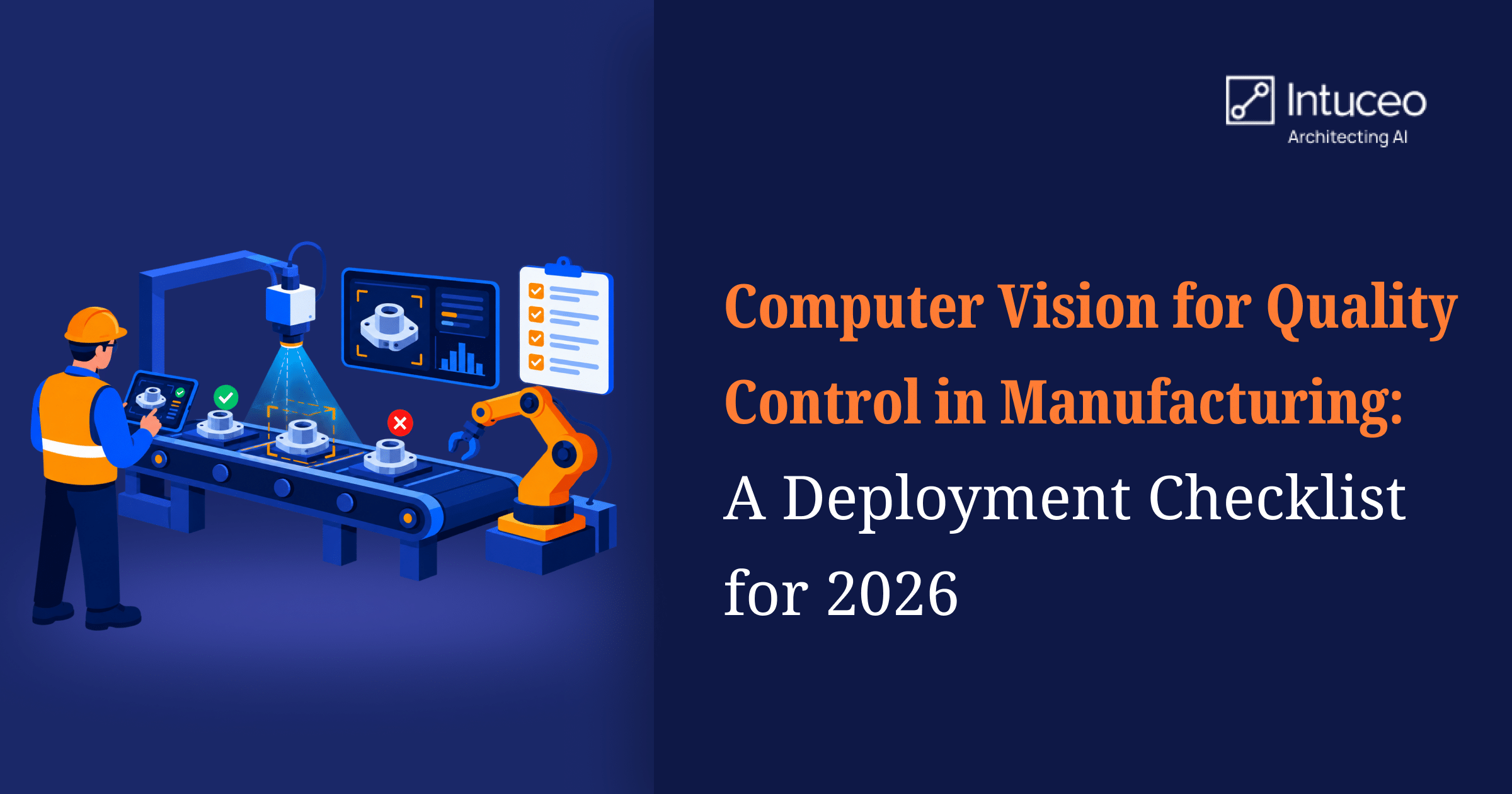
Computer Vision for Quality Control in Manufacturing: A Deployment Checklist for 2026

Quality escapes rarely announce themselves on the inspection line. They surface later as returns, warranty claims, containment actions, and a customer relationship that cools a degree at a time. For manufacturers running high-mix lines across Florida’s aerospace, defense, medical device, electronics, and marine sectors, catching defects earlier has moved computer vision quality control from pilot curiosity to a line-of-business decision.
The state gives the question real weight. Florida employed roughly 430,000 people in manufacturing as of mid-2026, [1] much of it in small and mid-sized plants where a poorly run rollout is a costly detour. For those operations, the discipline of the deployment matters more than the brand of camera on the bracket.
What follows is a working computer vision quality control checklist. A buyer can use it to run a deployment and to judge a vendor’s rigor; a vendor can treat it as a delivery standard.

Key Takeaways

What Is Computer Vision Quality Control, and What Does It Change?

Computer vision quality control is the use of cameras, controlled lighting, and trained Artificial Intelligence (AI) models to inspect every part on a line and trigger a pass, reject, or alert in real time. An AI visual inspection system does not replace a quality program; it changes where and how consistently the program catches problems. A camera captures each part, a trained model scores it against the definition of a good unit, and the line acts on that score in real time rather than at a sampling gate hours later.
The value is consistency. Trained human inspectors are estimated to miss defects in 20 to 30 percent of cases, with performance varying by experience, fatigue, and how often a given defect actually appears. [2]
Automated visual inspection holds one standard across every part and every shift, and it produces a record of each decision that a manual gate cannot.
Two capabilities carry most of the load on the floor.
Defect detection AI trained on labeled examples handles the faults you can describe and show, while anomaly-based models flag parts that simply deviate from normal, including defect types no one has catalogued yet. Together they give machine vision quality assurance a reach that rule-based optical inspection, manually tuned for each condition, struggles to match. Classical Automated Optical Inspection (AOI) still fits stable, well-lit, unchanging parts, but it needs manual reprogramming whenever a part or a defect shifts, which is precisely where trained models earn their place on mixed lines.
The table below compares the three approaches on a production line.
Dimension Retrospective approach AI-led approach
Timing Year-end chart chase Year-round, starting early in the measurement year
Prioritization All open gaps treated alike Gaps ranked by how likely they are to close
Data used Claims and a sample of charts Claims, clinical notes, lab results, and health information exchange feeds
Outreach Generic reminders Member-specific, in the member’s language
Audit readiness Manual reconstruction Lineage from source to measure

How to Deploy Computer Vision Quality Control: A Six-Step Checklist

Most stalled computer vision quality control deployments fail on fundamentals set in the first two weeks, not on model choice. Work the sequence in order.

Step 1: Define the Defect and the Cost of Missing It

Write down what pass and fail mean in physical terms, and attach a cost to each escape. A scratch that fails a medical housing and a scratch that fails a boat fitting are not the same decision, and the model is only as clear as that definition.

Step 2 : Fix the Imaging Before the Model

Resolution, lens, working distance, and above all lighting decide whether a defect is visible to the sensor at all. Controlled lighting and consistent part presentation remove more error than any later algorithm tuning, so settle the optics and fixturing first.

Step 3 : Build a Labeled Dataset That Reflects the Line

Collect images of good and defective parts across the real range of shifts, materials, and lighting, and label them with the people who own the quality standard. Rare defects are the hardest to gather and the most expensive to miss, so plan deliberate collection rather than waiting for them to appear.

Step 4 : Choose the Model Approach and Where It Runs

Match the method to the problem, using supervised detection for known, describable defects and anomaly detection where faults are rare or ill-defined, and score parts at the line for speed and data control. On-line scoring keeps pace with production and keeps sensitive part data inside the plant.

Step 5 : Integrate With the Line and Business Systems

A pass or fail signal is only useful if it drives an action, whether a reject arm, an operator alert, or a logged record. Wiring results into the Manufacturing Execution System (MES) and the Enterprise Resource Planning (ERP) system turns inspection into traceable quality data and ties a defect back to the batch, machine, and shift that produced it.

Step 6 : Validate, Monitor, and Plan to Retrain

Prove the system against known samples before it gates real production, then watch for drift as parts, materials, and cameras change over time. A model that was accurate at go-live decays quietly without monitoring and periodic retraining.
On the high-mix, lower-volume lines common in Florida aerospace and medical device work, steps three and six carry the most weight, since every new part variant reopens the dataset and validation questions.

How to Calculate Computer Vision ROI in Manufacturing

The computer vision ROI (Return on Investment) in a manufacturing setting comes from a few specific places, and it helps to name them rather than quote a single payback figure.
The largest is usually the cost of escapes avoided : the returns, warranty exposure, and containment events a missed defect sets in motion downstream. Earlier detection reduces scrap and rework, because a fault caught at the station that created it wastes far less material and labor than one caught at final assembly. In most rollouts, the first recovered cost is the drop in escaped defects on the highest-value parts, followed by scrap savings once detection moves upstream to the station of origin.
Two further effects show up over time. Inspectors move from repetitive scanning to handling the genuinely ambiguous cases the model flags, a better use of scarce skilled labor. And the decision record the system produces becomes an audit trail that carries real weight in regulated Florida sectors such as medical devices and aerospace.
ROI tracks the cost of your defects and your production volume, so the honest first move is to model your own numbers against the checklist above before committing to a line-wide rollout.
Price the deployment over its life rather than at go-live alone, since labeling, revalidation, and periodic retraining are recurring costs a fair proposal names up front. That same modeling answers the tool question: the right system for defect detection in 2026 is the one that fits your defect, your throughput, and your integration reality, not the one with the longest feature list.

What Should Florida Manufacturers Look for in a Computer Vision Partner?

The most challenging aspects of a deployment are imaging, labeled data, and the integration into systems that were never meant to receive a vision signal.
This is where a services partner earns its place, and where evaluation criteria matter more than a spec sheet: relevant defect and sector experience, a clear labeling and validation method, and the ability to connect inspection to MES and ERP rather than leaving a camera stranded on the line.
Intuceo, a Jacksonville-based AI and data engineering services firm, helps businesses with computer vision as one capability inside a broader manufacturing and data practice. Its work applies machine learning to MES and sensor data to identify process variances and defect signatures before parts are produced, which places inspection inside the wider quality picture rather than only at the end of it. In Intuceo’s lens defect detection work, high-speed vision models reduced manual QA workload by up to 30 percent while increasing inspection accuracy.[3] Those systems run on Intuceo-Dx, its pre-built computer vision and document intelligence accelerator within the Modular AI suite.
For Florida manufacturers weighing a first computer vision quality control deployment or a wider rollout, the practical next step is a scoped assessment of one line against the checklist above.

Scope your first inspection line, not a year-long program

Map one line to a deployment plan: defect definition, imaging, data, integration, and a defensible ROI case, before you commit capital across the floor.

Frequently Asked Questions

The ROI of computer vision quality control comes mainly from escapes avoided, meaning the returns, warranty exposure, and containment costs a missed defect triggers downstream, plus reduced scrap and rework from catching faults at the station that caused them, and a better use of skilled inspectors. No single payback figure transfers across plants, so the sound approach is to model one line against your own defect costs and volume before scaling.
Deploy a computer vision inspection system in six steps: define pass and fail in physical terms, fix the imaging and lighting, build a labeled dataset that reflects your real production range, choose a model approach suited to your defects, integrate results into the line and your MES and ERP systems, then validate against known samples and monitor for drift. The imaging and data steps decide most outcomes, so resist starting with the model.
The best sensor is the one that makes your specific defect visible, which is a function of defect size, surface, and line speed rather than raw megapixels. Area-scan cameras suit discrete parts, line-scan suits continuous or cylindrical material, and 3D or specialized sensors handle depth, gloss, or sub-surface issues. Lighting and lens choice usually matter more than the camera body.
Computer vision integrates with MES and ERP systems by passing each inspection result as structured data to the Manufacturing Execution System, which links each pass or fail to the batch, machine, and shift, and onward to the ERP system for quality, traceability, and cost reporting. Integration usually runs through the MES layer or an intermediate connector, and it is what converts a camera’s verdict into quality data the business can act on.
It is more consistent. Trained inspectors are estimated to miss 20 to 30 percent of defects depending on experience and fatigue, while an automated system applies one standard to every part and every shift and logs each decision. Accuracy still depends on imaging, labeled data, and ongoing monitoring.

HEDIS Care Gap Closure in Florida: How Payers Use AI to Improve Star Ratings

Every open care gap in a Florida health plan carries two costs at once. One is clinical: a member who missed a screening or a chronic-care check. The other is financial: a quality measure that slips below its threshold and pulls down a rating tied to millions in federal payments.
Both costs come due at the same moment. When the measurement year closes, the numbers lock, and the window for HEDIS care gap closure shuts with them. The Healthcare Effectiveness Data and Information Set (HEDIS), maintained by the National Committee for Quality Assurance (NCQA), defines most of those measures. Its results feed the Medicare Advantage (MA) Star Ratings, and those ratings decide quality bonus dollars.
Florida concentrates the problem more than most states. It carries one of the country’s largest Medicare Advantage populations. It runs a Medicaid managed care program that holds plans for their own quality reporting. And its membership spreads across languages and part-year residency. Each trait widens the gap between when care happens and when it gets recorded. Closing that gap is the work analytics does.

Key Takeaways

What Is a HEDIS Care Gap?

A HEDIS care gap is a recommended service, such as a cancer screening or a diabetes check, that a member was eligible for but has no record of receiving during the measurement year. Closing it means delivering that care, or finding and submitting evidence that it already happened, before the year ends. Gaps count against a plan’s quality rates and, through those rates, its Star Ratings.

How Does AI Improve HEDIS Care Gap Closure for Florida Health Plans?

The old approach to gap closure was retrospective. Teams pulled charts near year-end, chased missing records, and confirmed care that had already happened. That model finds gaps too late to close them. It also spends the most effort on the cases with the least to gain.
Using AI for HEDIS care gaps moves the work earlier in the year and narrows it to what will pay off. Four methods do most of the lifting:
Automated reminders then reach members in their own language, which matters across Florida’s diverse membership.

Retrospective vs. AI-Led Care Gap Closure

Dimension Retrospective approach AI-led approach
Timing Year-end chart chase Year-round, starting early in the measurement year
Prioritization All open gaps treated alike Gaps ranked by how likely they are to close
Data used Claims and a sample of charts Claims, clinical notes, lab results, and health information exchange feeds
Outreach Generic reminders Member-specific, in the member’s language
Audit readiness Manual reconstruction Lineage from source to measure

How Does HEDIS Analytics Improve Medicare Advantage Star Ratings?

Star Ratings have grown harder to hold. The Centers for Medicare & Medicaid Services (CMS) recalculates the cut points each year, so a plan can hold steady on clinical performance and still lose a star because the bar moved. In 2026, 207 of 516 rated contracts, roughly 40%, earned four stars or more, down from 261 a year earlier. Only contracts at that level qualify for quality bonus payments.
Ratings draw on about 40 measures. They include cancer screenings, annual flu vaccinations, and whether members with chronic conditions receive recommended services, many of them measures HEDIS defines. [1] CMS’s  final rule for contract year 2027 removes 11 Star Ratings measures starting with the 2029 ratings, which shifts more of the overall score onto HEDIS and member experience measures.
Medicare Advantage Star Ratings analytics earns its place by making that math visible during the year rather than after it. Modeling a plan’s position against likely cut points, a core part of HEDIS and Star Ratings analytics, shows which few measures will swing the overall rating, so quality teams concentrate budget and staff on the gaps that move the number.
For a Florida plan near the four-star line, that focus decides whether it qualifies for a bonus. Member experience scores count too, and they move slowly, which makes early, targeted intervention the only realistic lever inside a rating year. The bonus of a four-star rating earns funds for the extra benefits that keep members enrolled. Analytics that protects the rating protects growth as well. If your contract sits near that line, talk to Intuceo to model your plan against this year’s cut points.

What Does Digital HEDIS Reporting Mean for Florida Health Plans?

For a Northeast Florida operation, inbound automotive and industrial cargo often clears the Port of Jacksonville (JAXPORT). Applying AI to port and yard data aligns berth and gate signals with production demand, so parts arrive against the build schedule instead of piling into buffer stock.
The manual chart chase that many plans still lean on is being retired. NCQA plans to phase out the hybrid reporting method by measurement year 2029. That method combines claims with medical-record review on a sample of members. The goal is fully digital HEDIS reporting by measurement year 2030.[2] NCQA adjusted several measure-level pathways in January 2026 but kept the 2029 endpoint for retiring hybrid reporting.
Measures are moving to Electronic Clinical Data Systems (ECDS) reporting. ECDS draws on data from electronic health records, health information exchanges, and registries, formatted to the Fast Healthcare Interoperability Resources (FHIR) standard. [2]
Once sampling and manual retrieval fall away, rates depend on how cleanly a plan’s clinical data flows into measure logic across the full population. That turns a reporting task into a data task. It hits Florida Medicaid HEDIS reporting, which managed care plans submit to the state, as hard as it hits Medicare Advantage contracts.
AI can automate much of that pipeline. It normalizes incoming data, maps it to measure specifications, flags open gaps, and drafts abstractions for review. The submitted result still passes through the HEDIS Compliance Audit. Getting there means treating supplemental clinical data as a governed asset, not a year-end collection effort. Clear lineage from source to measure lets an auditor trace any rate back to its evidence. Plans that build that lineage now avoid a scramble when the hybrid method retires.

Does Florida Regulate How Health Plans Use AI?

Not through a dedicated statute yet. Florida proposed AI rules for insurers in 2025 and 2026, but none of the insurance-specific bills became law in the 2026 session. Today, NCQA audits and contract terms do most of the governance work.
Florida is drawing lines around AI in insurance while payers adopt it for quality work. In December 2025, Governor Ron DeSantis proposed a Citizen Bill of Rights for Artificial Intelligence. It would bar insurers from using AI as the sole basis to adjust or deny a claim, require them to detail how they use it, and let the Office of Insurance Regulation (OIR) inspect the models to confirm they do not violate fair insurance trade practices. [3]
The Florida House pushed the same line in 2026, passing HB 527 by a vote of 108 to 0 to require a qualified human professional behind every claim denial, but the bill died in the Senate. Other states have pushed similar rules: a qualified person must own coverage denials, and any AI used in utilization review must reflect a member’s individual clinical circumstances.4 Florida’s proposal reaches beyond claims. It would require notice when a consumer interacts with AI, which covers member-facing chatbots and outreach. A companion measure on AI data centers signals how closely the state means to watch the technology’s footprint.
These proposals target adverse coverage decisions. Closing care gaps is a different activity. It finds members who need care and prompts outreach, which the proposals would not restrict. The governance expectation still carries over. Any model that touches a member or a provider should be transparent, explainable, and auditable, with a human owning consequential decisions.
For vendors and enterprises building AI for the Florida market, that changes what a solution has to prove. Documented model behavior, retained audit trails, and human review are becoming conditions of doing business, not features to add later. A plan choosing an analytics approach should assume both OIR scrutiny and an NCQA audit will examine how the models work.

How Should Florida Payers Choose a HEDIS Care Gap Closure Partner?

The best-performing approach to HEDIS care gap closure for Florida health plans is not a single tool. Star and HEDIS results come from three things working together :
In a Florida context, that also means Health Insurance Portability and Accountability Act (HIPAA) aligned handling, explainable models, and experience with the fragmented records a seasonal population creates.
Intuceo supports HEDIS care gap closure for Florida health plans and health systems from its base in Jacksonville. It delivers through reusable accelerators, Intuceo-Ax, Intuceo-Ix, and Intuceo-Dx, together with AgentCare AI, inside its iPDLC delivery approach. The accelerators carry forward patterns from earlier Florida healthcare work, so an engagement does not start from a blank slate. The AI is built to be explainable and auditable, with people in the decision loop.

Frequently Asked Questions

HEDIS is NCQA’s set of standardized quality measures that health plans report. Medicare Star Ratings are CMS’s one-to-five-star scores for Medicare Advantage and Part D contracts, built from about 40 measures, many of them defined by HEDIS. Contracts rated four stars or higher qualify for quality bonus payments.
They use predictive models to rank which member gaps are open and closable now. Natural language processing reads notes, discharge summaries, and scanned results for care that happened but was never coded. Automated, language-aware outreach then reaches the members and providers who can close those gaps before the measurement year ends.
Three kinds of work move ratings. Cut-point modeling shows where a plan stands against this year’s thresholds. Gap prioritization concentrates effort on the measures likely to swing the overall score. Clinical-data integration keeps rates accurate. Because CMS resets cut points every year, the value comes from running this analysis through the year, not after results are final.
Begin with one defect-critical line that already generates inspection images or has cameras in place, so the model has history to learn from. Confirm the data-residency and CUI boundary before choosing where the model will run, then pilot it at the line, so decisions stay on-site and at production speed. Once escape and rework rates improve on that line, extend the approach to adjacent processes.
Yes, if the subcontract involves federal contract information or controlled unclassified information. CMMC requirements flow down to subcontractors at every tier, and any system that processes, stores, or transmits that data, including an AI model and its training pipeline, falls inside the assessment scope.
Yes. Vision and anomaly-detection models can run on edge hardware at the production line or on on-premise servers, so images and sensor data never leave the plant. This is often the default for aerospace and defense work that involves CUI or ITAR-controlled data.

Manufacturing AI in Florida: A Practical Playbook for Aerospace, Defense, and Industrial Manufacturers

Florida holds one of the country’s densest concentrations of precision manufacturing, which makes manufacturing AI in Florida a practical operating decision rather than a future bet. The state is the second-largest aerospace cluster in the United States, with more than 833 aerospace establishments recorded as of 2024. [1] Much of that activity sits in aerospace, defense, and heavy industrial production, where a single escaped defect or an unplanned line stoppage carries consequences most sectors rarely face.
For operators here, the useful question about artificial intelligence (AI) is narrower than much of the market conversation implies: which processes justify it, and under what constraints. A serious approach to AI for aerospace and defense manufacturers begins with understanding that discipline.
Two facts specific to the state shape the answer. Much of the work involves controlled or export-restricted data, which dictates where models and data can physically reside. And most plants sit inside port-based supply chains, so the value of factory-floor intelligence compounds only when it reaches the movement of materials in and out. Both points come after the use cases that consistently repay the investment.

Key Takeaways

Where Does Manufacturing AI in Florida Pay Off First?

What is manufacturing AI? Manufacturing AI is the use of machine learning, computer vision, and natural language processing on production data to detect defects, predict equipment failure, and find the causes of downtime. In Florida’s aerospace and defense plants, it usually runs on-premise or at the production line to meet CMMC and ITAR requirements.
Three categories of work account for most successful AI deployments in advanced manufacturing across aerospace, defense, and industrial plants.

Computer Vision Quality Control at Line Speed

High-frame-rate cameras paired with vision models inspect parts as they move, catching surface flaws, dimensional drift, and contamination that manual checks miss at line speed. In defect-critical production, computer vision inspection shifts quality checks from periodic sampling to continuous coverage.
When the model runs on edge AI hardware at the line rather than in the cloud, the decision stays on-site, and a defective part is pulled in a fraction of a second. For plants where visual inspection ties up skilled labor, the savings are measurable: in Intuceo’s lens defect detection work for precision optics, the vision model reduced manual QA workload by up to 30%.

Predictive Maintenance for Florida Defense Contractors

Vibration, temperature, and acoustic signals from machinery feed predictive maintenance models that estimate remaining useful life (RUL) and forecast failure before it stops a line. For defense contractors running high-value tooling or fleet assets, this converts maintenance from a fixed calendar into a condition-based schedule, which matters most where one asset failure cascades across a program.

Operational Intelligence From Maintenance Logs and Downtime Data

Natural language processing (NLP) applied to technician logs and shift reports surfaces recurring root causes that sensor data alone cannot see, such as procedural drift or environmental factors. Downtime analytics then isolate the sub-processes that quietly erode overall equipment effectiveness (OEE), which is usually where the recoverable margin sits.
The table below summarizes what each use case needs and where it typically runs.
Use case Data it needs Typical deployment under CMMC/ITAR Metric it moves
Computer vision quality control Inspection images, defect labels At the line or on-premise Escape rate, scrap, rework
Predictive maintenance Vibration, temperature, and acoustic data, maintenance history On-premise or FedRAMP Moderate-equivalent cloud Unplanned downtime, maintenance cost
Operational intelligence Technician logs, shift reports, downtime codes On-premise or compliant cloud OEE, repeat failures

How Do CMMC and ITAR Decide Where a Manufacturing AI Model Can Run?

CMMC and ITAR decide where a manufacturing AI model can run, because any system that holds CUI or export-controlled data falls inside the compliance boundary.
Aerospace and defense manufacturers work with two data types that constrain the deployment before any model is built: controlled unclassified information (CUI) such as drawings and specifications, and export-controlled technical data governed by the International Traffic in Arms Regulations (ITAR).
The Cybersecurity Maturity Model Certification (CMMC) program rule took effect on December 16, 2024. It requires defense contractors and subcontractors to safeguard federal contract information (FCI) and CUI, and those requirements flow down through every tier of the supply chain.2
For manufacturing AI in Florida’s defense supply base, the effect is direct. When a vision model trains on part geometry, or a maintenance model ingests telemetry tied to a defense article, the environment holding that data falls inside the assessment boundary.
Cloud services that touch CUI must meet a Federal Risk and Authorization Management Program (FedRAMP) moderate baseline or its equivalent, and export-controlled technical data cannot be shared with foreign persons, in the U.S. or abroad, without export authorization. For many Florida operators, a CMMC-compliant AI deployment therefore means on-premise systems, processing at the line itself, or a sovereign cloud environment rather than a general commercial service.
The flow-down reach matters in this state in particular. Many Florida plants are second- or third-tier suppliers to the primes concentrated on the Space Coast, and a supplier can inherit a certification requirement through its contract without ever selling to the Department of Defense directly. A manufacturing AI program that overlooks that inheritance risks a costly redesign the moment such a clause appears in a contract.
State policy adds a lighter but real layer. Florida has not enacted a broad statute governing private-sector AI use, but its Government Technology Modernization Council, created under section 282.802 of the Florida Statutes, is charged with recommending how the state procures and regulates these systems. [3] For a manufacturer that also sells to state agencies, or that expects federal program scrutiny, the direction favors documentation and explainability that can withstand a procurement review, as covered in our guide to AI compliance for Florida government contractors.
This is where deployments most often go wrong. A team builds a capable model, then discovers only afterward that its data path breaches a flow-down obligation, and the rebuild that follows is expensive. Scoping the compliance boundary first, then deciding where the model will run, avoids that cost. Teams that want a second view before building can map their compliance boundary with our team.
A firm evaluating manufacturing AI consulting partners should weight demonstrated experience operating inside controlled environments, including sovereign, explainable AI deployments.
Intuceo, a Jacksonville-based AI and data analytics services firm, has delivered predictive analytics on federal defense work and builds on-premise systems at the production line and in FedRAMP-aligned cloud environments, which is the relevant qualification when the data cannot leave a controlled boundary. It also holds a State of Florida term contract through the Department of Management Services (DMS), a practical convenience for state-adjacent buyers.

How Does Manufacturing AI Connect to Florida Ports and Freight?

Factory-floor intelligence stops paying off at the plant wall unless it connects to what moves in and out. Aerospace and industrial plants in Florida draw materials through the state’s seaports and feed finished goods into distribution networks, so a production schedule is only as reliable as the inbound parts feeding it. This is where supply chain AI in Florida extends a manufacturing program.
For a Northeast Florida operation, inbound automotive and industrial cargo often clears the Port of Jacksonville (JAXPORT). Applying AI to port and yard data aligns berth and gate signals with production demand, so parts arrive against the build schedule instead of piling into buffer stock.
Transportation analytics applied to outbound freight does the reverse, matching finished-goods dispatch to carrier capacity and lane cost. Inside the warehouse, distribution center analytics govern slotting, replenishment, and labor against real order patterns.
Intuceo connects these through its iTMS intelligent transportation management system, whose supply chain modules link production and demand signals to inbound freight and outbound distribution. Its planning modules forecast demand and position inventory, its execution modules optimize procurement and routing, and its verification modules close the loop on delivery. For a manufacturer, that means production and freight decisions draw on the same data, from the machine to the loading dock.

How Do You Take Manufacturing AI in Florida From Pilot to Production?

Start with one process that already has a measured cost and existing data, set the compliance boundary, then pilot on a single line.
The plants that see a return start with a narrow scope. They choose one process where defects or downtime already carry a measured cost and where data is already being captured, because a vision or maintenance model needs history to learn from. Before that, they draw the CUI and export-control boundary, since it decides whether the model runs on-premise, at the production line, or in a compliant cloud, and moving it later is expensive.
Return is measured against the metrics operators already track, such as OEE, yield, scrap, and unplanned downtime, rather than model accuracy in isolation. A vision deployment justifies itself when escape rates and rework fall. A maintenance deployment justifies itself when a line stops on schedule rather than unexpectedly.
Intuceo runs these engagements through its iPDLC delivery method, which moves from a scoped pilot to production on a defined path rather than an open-ended research effort, and usually proves value on a single line or asset class before extending to the logistics interface.

Find the first process worth automating

If you run an aerospace, defense, or industrial operation in Florida, the fastest route to a defensible result is to identify one defect-critical or downtime-critical process and scope it against your compliance boundary. Intuceo’s team will map that first use case with you and show what a controlled deployment looks like on your floor.

Frequently Asked Questions

The recurring ones are computer vision for quality control, predictive maintenance built on remaining useful life models, and natural language processing applied to maintenance logs for root-cause and downtime analysis. Because aerospace work involves controlled and export-controlled data, these are typically deployed on-site or in compliant environments, and often extended into inbound and outbound logistics through a supply-chain system such as Intuceo’s iTMS.
Sensors capture vibration, temperature, and acoustic data from high-value tooling or fleet assets, and models estimate remaining useful life to flag failures before they occur. This replaces calendar-based servicing with condition-based maintenance. For defense work, the models and telemetry must run inside a CMMC-compliant environment, since the data can qualify as controlled unclassified information.
Return shows up in the metrics a plant already tracks, such as overall equipment effectiveness, yield, scrap, and unplanned downtime, not in model accuracy alone. The strongest cases start where defects or stoppages already carry a measured cost and where usable data already exists, which shortens the path to a result that operations leaders can verify.
Begin with one defect-critical line that already generates inspection images or has cameras in place, so the model has history to learn from. Confirm the data-residency and CUI boundary before choosing where the model will run, then pilot it at the line, so decisions stay on-site and at production speed. Once escape and rework rates improve on that line, extend the approach to adjacent processes.
Yes, if the subcontract involves federal contract information or controlled unclassified information. CMMC requirements flow down to subcontractors at every tier, and any system that processes, stores, or transmits that data, including an AI model and its training pipeline, falls inside the assessment scope.
Yes. Vision and anomaly-detection models can run on edge hardware at the production line or on on-premise servers, so images and sensor data never leave the plant. This is often the default for aerospace and defense work that involves CUI or ITAR-controlled data.

Edge AI Visual Inspection: Why the Fastest Line Decisions Still Belong to Small Trained Models

Generative AI vision models can describe defects they have never seen, segment parts with a single click, and adapt to new variants without retraining. None of that helps if the answer arrives after the part has already moved to the next station. On a production line, a correct decision that arrives late has the same operational effect as a wrong one.
That is why, in edge AI visual inspection, small trained models still own the decision at the point of action. This is not a verdict against foundation models. It is a question of placement. This article explains where time is actually spent in an inspection decision, why compact models fit the fast path, and how larger models can still add value without sitting in the way.

Key Takeaways

What Is Edge AI Visual Inspection?

Edge AI visual inspection runs a computer vision model on hardware next to the camera, such as an industrial PC or embedded accelerator, to accept, reject, or divert parts without sending images to a remote server. It is built for decisions that must land within a single machine cycle.

How Much Time Does an Inline Inspection Decision Have?

Every inline inspection has a deadline set by physics. A part enters the camera’s field of view, gets imaged, and must be accepted, rejected, or diverted before it reaches the reject mechanism. That window depends on conveyor speed, spacing, and station layout.
Inference is only one slice of that window. The full chain includes:
When engineers discuss edge AI inspection latency, they mean the entire chain. A fast model sitting behind a slow network link still produces a slow decision.

Why Small Trained Models Fit Edge AI Visual Inspection

A small model trained for one inspection task does less work per image by design. It does not carry general knowledge about the world. It carries only what’s needed to separate good parts from bad on a specific station. That narrowness brings practical advantages :
The tradeoff is familiar. A small trained model knows only what it was taught. Change the part, supplier, or defect type, and it may need new examples and retraining.

Why Are Foundation Models Slower for Inline Inspection?

Foundation models earn their flexibility through size. Larger image encoders process more parameters for every frame, and many setups run additional language or decoding steps on top. That work takes compute and time, and the published numbers make the scale of it concrete.
The MobileSAM authors distilled the heavy image encoder of the original Segment Anything Model into a lightweight one. On a single graphics processing unit (GPU), the original encoder took 452 milliseconds per image against 8 milliseconds for the replacement, and the full MobileSAM pipeline runs at roughly 10 milliseconds per image. [1]
Two things follow :

Edge AI vs Cloud AI for Visual Inspection: Which Decisions Go Where?

The edge AI vs cloud AI question for visual inspection usually resolves by decision type rather than preference.
Decision type Best location Timing tolerance
Accept or reject within a machine cycle Edge, next to the station Milliseconds, with no network risk
Diverting a suspect part for review Edge or on-site server A short delay is acceptable
Describing an unusual defect for an engineer On-site server or cloud Seconds are fine
Labeling new images and retraining Cloud or data center No live timing constraint
Trend analysis across shifts and plants Cloud or data center Batch processing suits the task
The pattern is consistent. The closer a decision sits to physical action on the line, the more it belongs at the edge on a compact model. Academic work on edge-cloud co-inference supports the same split, with a small edge model handling routine inputs and a large vision model taking the hard cases. [2]

What Does Real-Time Visual Inspection Mean on a Production Line?

Real-time visual inspection means the decision reliably arrives before the latest moment the line can act on it, on every frame, including the slowest ones. Average inference speed hides variance, and a model that is usually fast but occasionally stalls will pass defective parts on exactly those occasions.
Sub-second defect detection sounds quick, and for offline or sampling checks it often is. On high-speed lines the available window can be a small fraction of a second once capture, transfer, and the reject signal are subtracted, so sub-second is a description rather than a standard. The only meaningful threshold is the one your own station geometry produces.

Where Do Foundation Models Add Value in Manufacturing Inspection?

How Do You Measure the Latency Budget of an Inspection Station?

Before choosing any model, work out how much time the line actually allows. A short exercise with operations and controls engineers usually answers it.
What remains is the real budget for inference. Many teams find it tighter than expected, which is why compact models remain the default for AI visual inspection in manufacturing at the point of action.
For example, if a conveyor moves at 1 meter per second and the reject gate sits 0.3 meters past the camera, the window is 300 milliseconds. Subtract capture, transfer, preprocessing, decision logic, PLC signaling, and a safety margin, and the inference budget may be well under 100 milliseconds. These figures are illustrative, so use your own station measurements.
To see where infrastructure and deployment still set these limits in production, watch the AI Dream Session, Vol. 2 recording.

What Is Model Distillation for Visual Inspection?

Model distillation is a training method that teaches a small model to reproduce a larger model’s outputs on a specific task. For inspection, a foundation model can help create the knowledge while a compact model delivers it at line speed. The small model inherits the teacher’s blind spots and still needs validation on real parts, but distillation remains one of the more practical bridges between flexibility and speed.
A vendor latency figure quoted without its conditions is worth little here. Ask what hardware it was measured on, at what image resolution, and whether it covers the full decision chain or inference alone.

How Intuceo Designs Edge AI Visual Inspection Systems

In every edge AI visual inspection project, Intuceo works backward from the decision deadline. The station geometry and the reject window set the constraint, and the model, hardware, and data flow are chosen to meet it, and not the other way round.
Two parts of that approach matter for latency work. Deployment is infrastructure-agnostic, spanning on-premise, edge, hybrid, and air-gapped environments, so a model can sit where the timing requires rather than where a vendor’s hosting model dictates.
The systems are maintained through production-grade MLOps practices built for regulated settings: containerized serving with shadow deployment and canary rollouts, so a candidate model can be timed against the incumbent on live line data before it is given authority, plus drift monitoring with automated retraining triggers for when parts and conditions move.
That combination is how Intuceo supports real-time defect root cause analysis without impeding the production line. See how this applies across advanced manufacturing and to the DataOps and AI/ML Ops capability  behind it.

Watch : Computer Vision Reimagined, On Demand

AI Dream Session, Vol. 2: Computer Vision Reimagined is a 45-minute session with Intuceo AI Labs, now available on demand. It covers how infrastructure and deployment still shape what computer vision can do in production, building on the DARWIN Framework from Vol. 1.

Frequently Asked Questions

It is the use of a compact computer vision model running beside the camera on a production line, so accept, reject, or divert decisions happen locally within the machine cycle, with no network dependency. Larger models can still support slower tasks such as exception review and labeling.
Sometimes, but often not at the point of action on a fast line. Large generative AI vision models perform more computation per image, and many inspection windows are short once image capture, transfer, and the reject signal are included. Lighter distilled derivatives are closing the gap, so the answer depends on measuring worst-case timing on your own hardware at production resolution.
Use a small trained model when the decision must happen within a machine cycle, the defect list is stable, image volumes are high, and the system must keep running without a network. Foundation models suit slower tasks such as exception review, labeling, handling new variants, and offline analysis.
Edge deployment removes network delay and dependency but limits how much compute is available, which favors compact models. Foundation models can run on larger on-site servers or in the cloud, gaining flexibility but adding transfer time and more computation per image. Many plants place fast accept-or-reject decisions at the edge and route uncertain cases to larger models.
Generative AI is more flexible, not universally better. On a fixed inspection task, the qualities that decide deployment are speed, timing consistency, cost per image, and how straightforward the model is to validate for an auditor. Recognizing unfamiliar objects matters less at the point of action than meeting the deadline every time. The strongest systems combine both.
Measure the travel time between the camera and the reject point, then subtract capture, transfer, preprocessing, decision logic, and PLC delays, and keep a safety margin. What remains is the inference budget, which should be tested against worst-case timing rather than averages.