AI Consulting Services in Florida: Enterprise Buyer’s Guide

AI consulting services in Florida are professional services that help enterprises design, build, and operate artificial intelligence systems. A qualified Florida AI consulting partner covers strategy, data engineering, machine learning model development, MLOps, and regulatory compliance – with deep knowledge of Florida-specific data privacy law and government procurement requirements.
Florida has become one of the most active technology markets in the country, and choosing the right AI consulting services in Florida is no longer just a technical decision. It is a jurisdictional one. When an organization evaluates enterprise AI partners in the state, it is really weighing three things at once:
This guide covers the full picture. It walks through the state of the Florida market, the services that sit under the label of enterprise AI, how to separate a capable AI consulting company in Florida from a generalist, the government contract vehicles that matter for public-sector work, and the security and regulatory conditions specific to Florida.

Key Takeaways

Why AI Consulting Services in Florida Demand a Local, Compliant Partner

Florida is no longer a secondary technology market. It sits among the largest states for tech employment in the country and was among those projected for the biggest absolute gains heading into 2026, according to CompTIA’s State of the Tech Workforce analysis.

The concentration is not only in headcount. The Florida Council on Artificial Intelligence reports that 33 percent of funded Florida companies identified artificial intelligence as a primary business function in the first half of 2025, that the state ranks sixth nationally in venture capital deal value, and that more than 30 firms relocated or expanded into South Florida across 2024 and 2025. That density means Florida enterprises can now choose partners who work in their own time zone, in their own regulatory environment, and often in their own city.

The pull is partly economic. Technology wages in Florida run well above the state’s overall median, which has drawn both talent and corporate headquarters into the market. For an enterprise, that concentration means an AI partner in the state can staff a project with local specialists who already understand its healthcare payers, defense contractors, and logistics operators, instead of a remote team that has to learn the context first. Proximity shortens discovery, and shorter discovery lowers cost.
The term ‘AI Consulting Services in Florida’ now serves as a marker for vendors who understand local compliance, economic context, and hiring markets. A firm rooted in the state understands local hiring markets, the mix of healthcare, defense, logistics, and public-sector work that defines Florida’s economy, and the compliance obligations that a national vendor may treat as an afterthought. For buyers asking which AI consulting firms operate in Florida, the practical answer is a growing field, which makes knowing how to evaluate them more important than knowing that they exist.

What Enterprise AI Consulting Services in Florida Actually Include

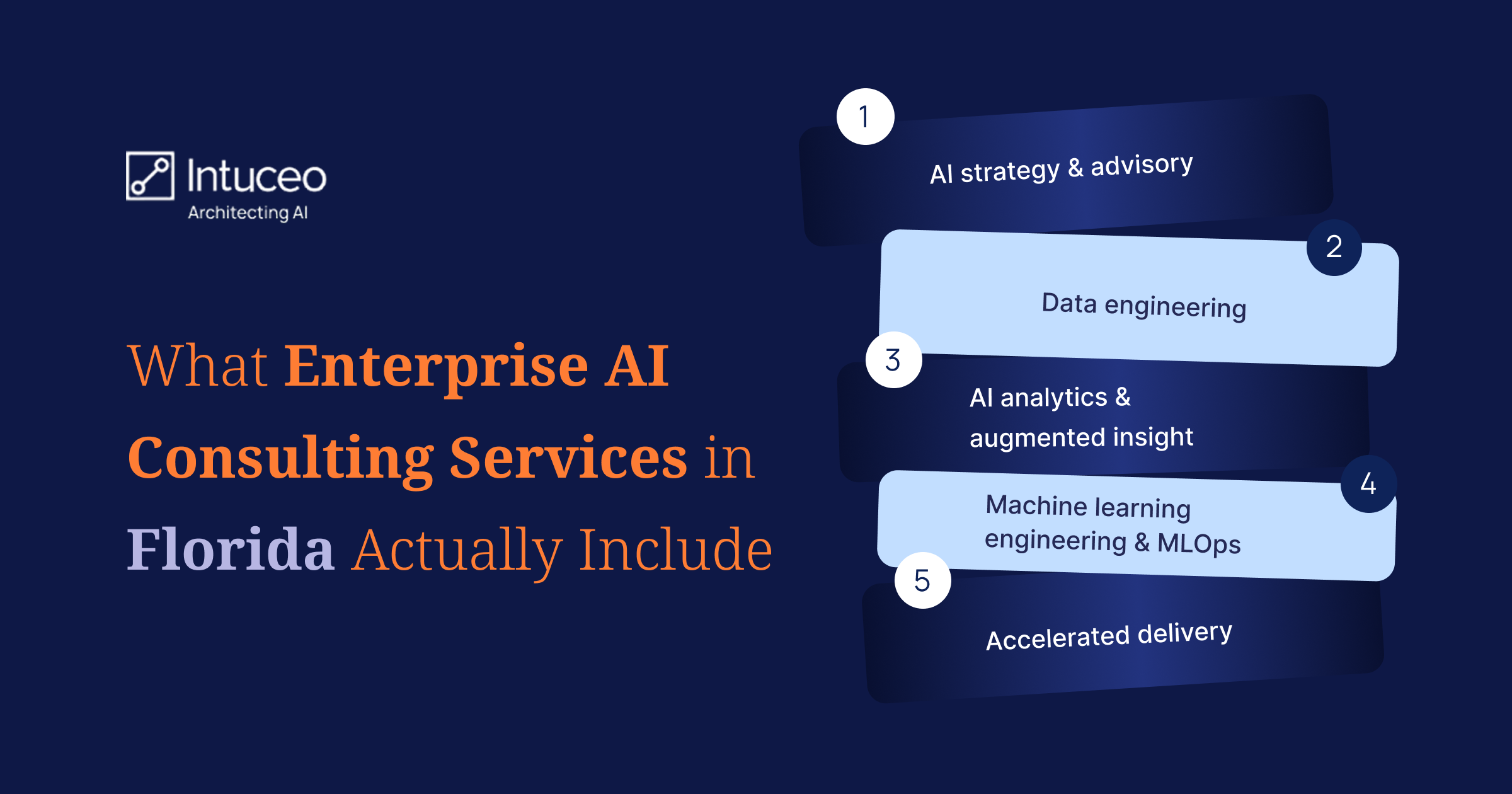
Enterprise AI consulting is a set of connected disciplines, not a single deliverable. A capable practice moves an organization from an unstructured question – “where could AI help us?” – to a running system that the business relies on. The work falls into five areas, and a serious provider of AI consulting services in Florida operates across all of them rather than selling one slice.

AI strategy and advisory

This is the discovery layer. It aligns business objectives with technical feasibility, ranks candidate use cases by value and effort, and produces a roadmap the leadership team can fund. Done well, it kills weak ideas early and protects the budget for the two or three initiatives that will actually reach production.

Data engineering

Most AI programs stall on data, not algorithms. A data engineering consultant in Florida builds the pipelines, warehouses, and governance that make analytics and machine learning possible in the first place. This includes ingestion from legacy systems, cleaning and standardizing records, and modernizing the enterprise core so that models have reliable inputs. For organizations running SAP, Oracle ERP, or PeopleSoft, this often means bridging older systems to modern data layers before any model is trained.

AI analytics and augmented insight

Strong AI analytics services in Florida turn raw operational data into decisions. This covers descriptive dashboards, predictive models that forecast demand or risk, and augmented business intelligence that surfaces patterns a human analyst would miss. The point is not the chart. The point is that a manager can act on it with confidence, because the underlying method is sound and explainable.

Machine learning engineering and MLOps

Building a model is the easy part. Keeping it accurate, monitored, and compliant in production is where most projects fail. This discipline covers model development, deployment across cloud or on-premises environments, and the monitoring that catches drift before it reaches a customer or an auditor. It is the difference between a pilot that impresses in a demo and a system that survives its second year.

Accelerated delivery

The best firms do not rebuild everything by hand. They apply accelerators, which are reusable frameworks and methods refined across earlier engagements, to compress timelines. An accelerator is not a shortcut around rigor. It is prior experience, packaged so the same problem is not solved twice.

How to Choose an AI Consulting Company in Florida: Key Selection Criteria

Once a shortlist exists, the evaluation becomes a question of fit and evidence. A polished website tells you little. The signals below separate a dependable AI consulting company in Florida, the kind you can build a multi-year relationship with, from a vendor that will disappear after the pilot.
By leveraging reusable frameworks, firms can significantly compress project timelines compared to building from scratch.
What to check Why it matters
Domain depth in your sector An AI team that already understands healthcare data, regulated life sciences, or public-sector procurement moves faster and avoids costly rework. Ask for engagements in your specific industry, not adjacent ones.
Delivery beyond the pilot Many programs stall after a promising proof of concept. Confirm the partner has moved systems into full production and supported them afterward, not just delivered a prototype.
Reusable accelerators Firms that carry frameworks and prior solutions into a project compress timelines and reduce cost. Starting from zero every time is slower and more expensive.
Data governance discipline Under Florida law, how a partner handles personal and sensitive data is a liability question, not a technical detail. Governance maturity is now a selection criterion.
Contract vehicles For public-sector or federal work, GSA and State of Florida vehicles determine whether an agency can even buy from the firm. This is covered in detail below.
Flexible engagement models The ability to scale a team up or down, or to commit to a fixed-outcome deliverable, gives you control over risk and budget as scope changes.

Weigh total cost, not the day rate

The headline rate rarely predicts the total cost of an AI program. A cheaper team that starts every component from scratch, misreads the data early, and cannot support the system post-launch will usually cost more across the life of the work than a partner with accelerators and a track record. Ask how a firm blends onshore and offshore capacity, and how it prices a fixed-outcome deliverable versus an open-ended engagement. Transparent trade-offs are the sign of a mature firm you can plan a budget around.

Test the accelerators, do not just accept them

Accelerators are only an advantage if they are real and explainable. A reusable framework should come with a clear account of what it automates, where a human still makes the call, and how it was validated on prior work. Be wary of any method presented as a closed box that cannot be inspected, because that is precisely the kind of opacity Florida’s proposed AI rules are written to discourage. A good partner will walk you through the mechanics without hesitation.
A useful test is to ask the vendor about its staffing approach and how it priced the last three engagements. Firms that offer flexible arrangements, such as team augmentation, fixed-outcome projects, and managed service agreements, tend to be honest about trade-offs because they have structured for them. The right provider of AI consulting services in Florida treats every engagement as a long-term relationship built on delivered outcomes, not a single transaction.

Why Enterprise AI Programs Stall - and How a Florida AI Partner Prevents It

Most enterprise AI failures are not caused by the model. They are caused by predictable organizational gaps, and a partner that has seen them before is worth more than one selling the newest technique. Three patterns account for the majority of stalled programs.
The first is the pilot trap. A proof of concept impresses in a demo, then fails when it meets real data volumes, integration constraints, or user behavior at scale. The fix is straightforward: plan for production from week one. That means settling the data pipeline, monitoring setup, and system ownership before a model is trained – not after the pilot report is delivered.
The second is the data gap. Teams underestimate how much cleaning, standardizing, and governance the underlying data needs, so the project runs out of budget before it reaches value. This is where seasoned data engineering, brought in early, earns its fee by fixing the foundation instead of building on sand.
The third is the compliance surprise. A system is built for accuracy alone, then has to be rearchitected when a regulator expects human oversight of decisions that affect a person’s care, coverage, or livelihood. Designing that oversight from the start is far cheaper than retrofitting it. A Florida partner that treats the state’s rules as a design input, rather than a late obstacle, removes all three risks at once.

Florida AI Regulatory Compliance: Data Privacy, Oversight, and Contract Requirements

Florida has enacted specific rules governing data privacy and AI. Organizations procuring AI consulting services in Florida must understand three compliance layers: the Florida Digital Bill of Rights (Senate Bill 262), the proposed AI Bill of Rights (Senate Bill 482), and sector-specific healthcare and insurance restrictions.

Data privacy: the Florida Digital Bill of Rights

The Florida Digital Bill of Rights, enacted as Senate Bill 262, took effect on July 1, 2024, and gives Florida residents rights over how their personal data is collected and used. Enforcement sits with the Florida Attorney General, with civil penalties reaching up to 50,000 dollars per violation, and higher in defined circumstances. Separately, the Florida Information Protection Act already requires any commercial entity holding electronic data on Floridians to take reasonable measures to secure it and to follow breach-notification rules. An AI partner that ignores these obligations is transferring risk directly onto your organization.

Artificial intelligence: the proposed AI Bill of Rights

In December 2025, Governor Ron DeSantis proposed a Citizen Bill of Rights for Artificial Intelligence, filed as Senate Bill 482 for the 2026 legislative session. The proposal would require transparency when AI is used, restrict certain foreign-developed AI tools, limit the unconsented use of personal data, and set boundaries for AI in healthcare, insurance, and mental health services. Buyers should treat these directions as the near-term baseline even before final passage, because they signal where enforcement is heading.

Healthcare and insurance limits

The healthcare provisions are strict and specific. Under the proposal, AI could not serve as the sole basis for adjusting or denying an insurance claim, which reinforces a requirement for documented human review, and behavioral health AI tools would be barred from delivering licensed therapy or simulating a licensed professional. For Florida healthcare and life-sciences organizations, this means an AI partner has to design human oversight into a system from the start, not bolt it on after an audit. This is one reason buyers searching for the best data engineering company in Florida for healthcare should weigh regulatory fluency as heavily as technical skill.

The practical takeaway

Florida’s direction of travel favors partners that keep data inside controlled environments, document human oversight, and can attest to their ownership and provenance. A Florida-based partner with local operations and mature governance policies is easier to defend to a regulator than an opaque or offshore-only vendor.

What to require in the contract

Regulatory intent only protects an organization if it appears in the agreement. When contracting for AI Consulting Services in Florida, buyers should insist on a few specifics: written data-handling terms that state where personal data is stored and processed, documented human review for any decision that affects a person’s care, coverage, or employment, breach-notification commitments consistent with the Florida Information Protection Act, and a right to audit the models and data flows the partner builds. These clauses cost nothing to add and save a great deal if a regulator ever asks.

Florida Government AI Contracts: GSA Schedules and State Contract Vehicles

Public-sector AI work runs on a different track from commercial work, and the gate is procurement. Two questions dominate: are there AI vendors with GSA Schedule contracts based in Florida, and which companies hold State of Florida contract vehicles. Both determine whether an agency can buy at all.
A GSA Schedule, formally the Multiple Award Schedule, is a pre-negotiated federal contract that lets United States government agencies purchase vetted services without running a full procurement from scratch. It signals that a firm’s rates, terms, and past performance have already cleared federal review. State of Florida contract vehicles serve the same function at the state and local level, giving Florida agencies a faster, compliant path to engage an approved provider.
This matters more now because of a new contracting rule. Beginning July 1, 2026, Florida government entities would be barred from entering any contract with an AI provider unless the company signs an affidavit affirming it is not owned by a foreign country of concern. Public-sector buyers should confirm that a provider can execute that affidavit before award rather than after. A firm that is United States-domiciled, holds active government vehicles, and can sign it clears a bar that others will not, which narrows the field considerably. Intuceo, for instance, delivers data and AI engineering for federal and state agencies and academic institutions through its GSA and State of Florida contract vehicles, which places it inside this qualified group.

Where Florida AI Consulting Work Concentrates: Healthcare, Public Sector, and Manufacturing

Enterprise AI in Florida clusters around the sectors that define the state’s economy. The strongest providers of AI analytics services in Florida tend to specialize rather than spread thin.

Healthcare and life sciences

Florida’s large healthcare and payer market is both a major opportunity and the most regulated environment for AI in the state. Work here centers on clinical and operational analytics, patient data visualization, and models that keep a human in the loop by design. Intuceo has worked with the University of Florida Institute for Child Health Policy for more than two years on portals for visualizing healthcare data – an example of the sector-specific delivery healthcare organizations should expect from a qualified Florida AI consulting partner.
Organizations in the life sciences sector can review Intuceo’s life sciences AI and analytics capabilities for a detailed account of the regulatory and delivery approach.

Public sector and defense

Florida hosts a defense sector generating more than 100 billion dollars in annual economic activity and 20 military installations, according to the Florida Council on Artificial Intelligence. That scale drives demand for secure, contract-vehicle-eligible AI and data work, where provenance and compliance are non-negotiable.

Engineering, manufacturing, and supply chain

Optimization is the theme here : design optimization, predictive maintenance, and analytics that tighten logistics and transportation networks. These are areas where accelerators pay off quickly, because the underlying problems repeat across clients and a firm can carry proven methods from one engagement to the next.

Where Intuceo fits

Intuceo is an AI and analytics services firm headquartered in Jacksonville, Florida, operating under the iCube Consulting Services brand. It has delivered data and AI work for two decades, and reports more than 250 AI and data solutions delivered to Fortune 1000 enterprises, government bodies, and mid-market organizations across healthcare, life sciences, manufacturing, engineering, and the public sector. Its recognition includes multiple appearances on the Inc. 5000 list of fast-growing United States companies.
Three attributes line up with what the sections above describe as the markers of a dependable partner. First, its delivery is built on accelerators such as the iPDLC framework and AutoML methods, which the firm reports can cut delivery timelines by as much as 40 percent compared with building from scratch. Second, its engagement options, spanning team augmentation, fixed-outcome projects, and managed service agreements, give buyers control over cost and risk. Third, it is United States-headquartered and already cleared to sell to federal and state agencies, which matters directly under Florida’s tightening procurement rules.
For an organization evaluating AI Consulting Services in Florida, that combination of local presence, sector depth, reusable delivery methods, and government eligibility is exactly the profile the state’s market and regulations now reward. You can review the firm’s work and reach its solutions architects through the Intuceo website.
For a side-by-side comparison of AI consulting firms operating in the state, see the Top AI Consulting Companies in Florida: How to Evaluate and Choose guide.

Planning an AI initiative in Florida?

Whether the goal is a first data-engineering foundation, a production analytics system, or a public-sector engagement that has to clear procurement, a Florida-based partner shortens the path.
Organizations that prefer a structured first conversation can book an AI Dream Session – a focused strategy briefing with Intuceo’s solutions architects.

Frequently Asked Questions

Intuceo is headquartered in Jacksonville, Florida, but serves clients across the state and beyond. Its delivery model supports onsite and remote engagement, so organizations in any Florida metro can work with the firm without needing a local office nearby.
Yes. Intuceo delivers data and AI engineering for federal and state agencies and academic institutions using its GSA and State of Florida contract vehicles, which give government buyers a pre-vetted, compliant path to engage the firm.
The firm concentrates on healthcare, life sciences, manufacturing, engineering and automotive, supply chain and transportation, and the public sector, matching the industries that anchor Florida’s economy and its most regulated AI use cases.
Yes. Intuceo works with clients onsite and remotely, and its team operates from Florida, the Washington, D.C. area, and additional locations. Organizations in Tampa, Orlando, Miami, or elsewhere in the state can run a full engagement remotely.
Intuceo reports more than 250 AI and data solutions delivered over two decades and multiple Inc. 5000 listings. A documented Florida example is its multi-year work with the University of Florida Institute for Child Health Policy on portals for visualizing healthcare data.

Enterprise AI webinars and replays

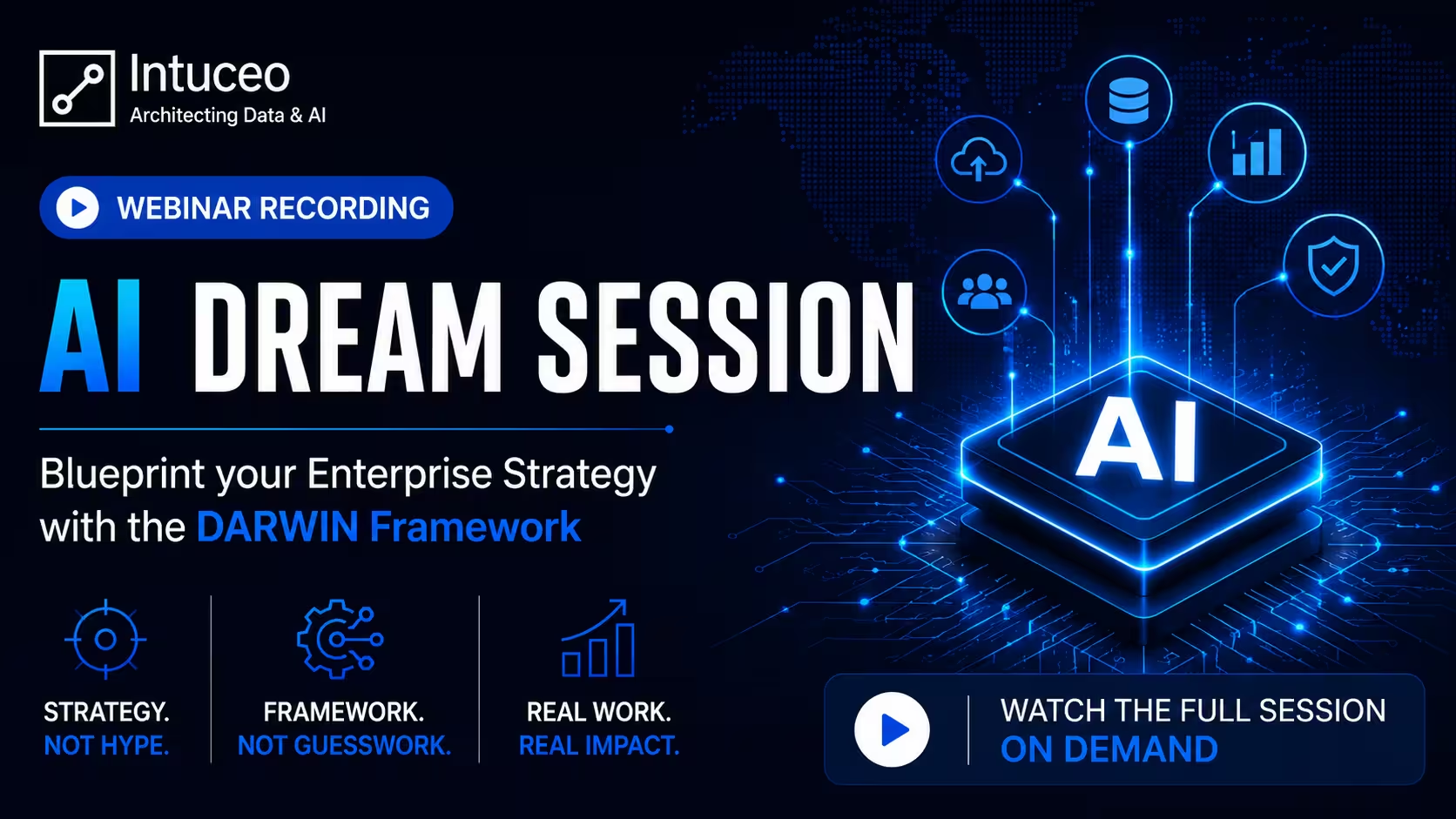
AI Dream Session

Blueprint Your Enterprise Strategy with the DARWIN™ Framework

Is your enterprise AI strategy stuck in “PoC Purgatory”?
In the rush to adopt AI, most corporate initiatives stall in PoC or isolated pilots, delivering zero true business transformation. It’s time to move past the hype and build a scalable strategy. Join the Intuceo AI Labs team veteran data and AI practitioners with over two decades of experience for an exclusive, live 45-minute workshop. We will walk you through a systematic approach to building a real AI transformation blueprint using the proven DARWIN™ Framework.
1 recording available
Monthly new session, second Tuesday
No cost to watch

The five decisions that get enterprise AI out of the pilot

Dr. Dakshinamurthy V Kolluru walks through the DARWIN™ Framework: the five planning decisions that determine whether an AI initiative scales into production or stalls as a pilot. Includes the full unscripted audience Q&A.
The DARWIN™ series

What is the DARWIN series?

The DARWIN™ series is Intuceo’s monthly webinar programme, running on the second Tuesday of each month. The opening session covers the framework end to end. Each session after it takes one of the five pillars and goes a level deeper, with live demonstrations and open audience Q&A.
Responsive DARWIN Table
D Data Governance and control as the precondition for trusting anything the system produces.
A Assumptions Finding the expensive assumption in a design and testing it before it sets the budget.
R Responsibility Positioning AI as an enabler, and naming the technical, value and risk owners.
W Workflow Adoption, and tracing a statistical metric through to a defensible business outcome.
IN Infrastructure & Security Open against closed models, cloud against on premise, and internal tampering risk.
WATCH THE SESSION

Watch the full recording

Enter your details and the recording opens right away.

Access the Webinar by Filling the Form

Two fields. You will get the next invitation.
Intuceo uses this to send session invitations and replay links. See our privacy policy.
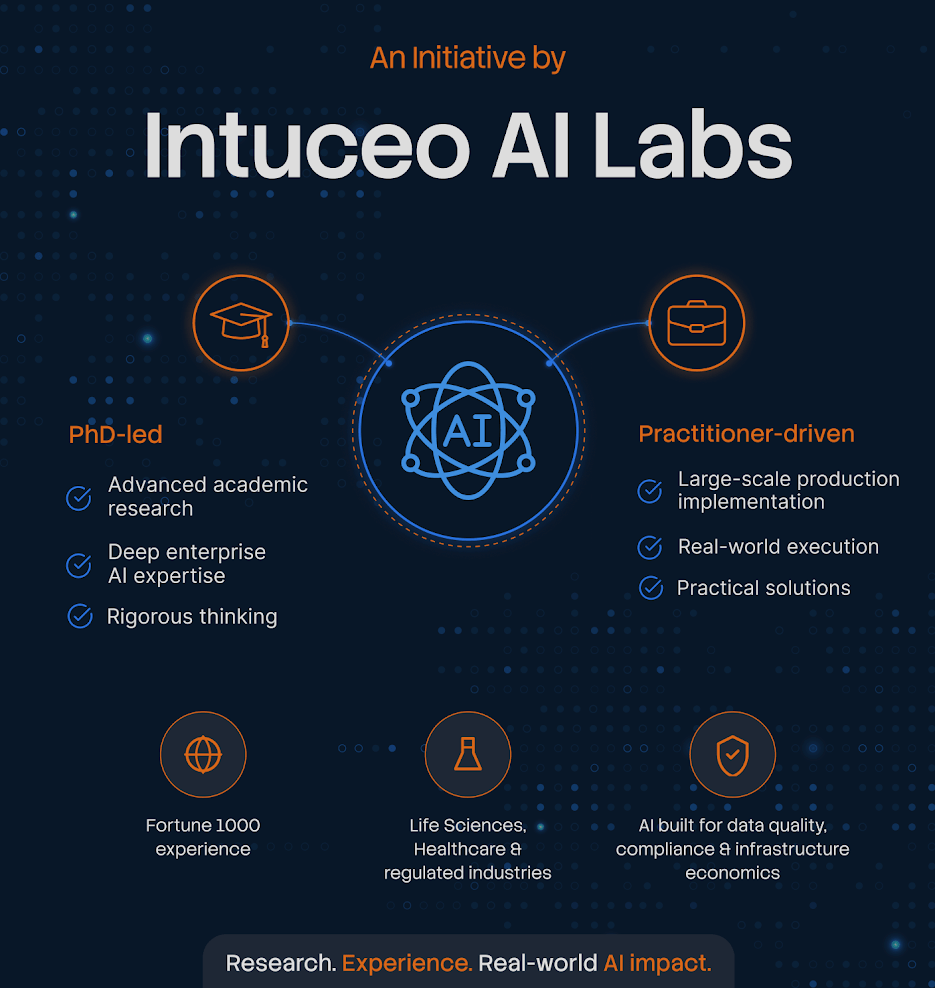
About Intuceo Ai Labs

Two Decades at the Frontier of Enterprise AI

For over two decades, Intuceo AI Labs has been a driving force behind the data and AI revolution. We bridge the gap between legacy operations and next-generation intelligence, guiding Fortune 1000 enterprises away from “black box” algorithms toward transparent, high-impact business outcomes.
Spanning the evolution from Symbolic AI (statistics) to Traditional AI (machine learning and deep learning) to modern Generative and Agentic AI (the LLM era), we developed patented AI frameworks, tools, and methods including AutoML, CMM, Knowledge Engineering, and Augmented BI. Our team delivers cutting-edge enterprise solutions across R&D, machine analytics, engineering design, computer vision, predictive maintenance, medical affairs, clinical research, pharmacovigilance, and quality compliance for the Fortune 1000.

Explainable AI and LLM Security: What Regulated Industries Must Get Right Before Scaling AI

Key Takeaways

Why Traditional AppSec Falls Short of LLM Security for Regulated Industries

Most enterprise security teams know how to protect web applications, APIs (Application Programming Interfaces), and databases. Firewalls, role-based access, input sanitization, vulnerability scanning: these are established practices. But when an organization deploys an LLM, it introduces a category of system that does not fit these existing controls.
A traditional application follows deterministic logic. Given the same input, it produces the same output. An LLM does not. Its behavior is probabilistic, shaped by training data, fine-tuning, retrieval context, and the specific phrasing of a prompt. That means the attack surface is different. Prompt injection, where a malicious instruction is embedded in user input or retrieved content to override the model’s intended behavior, is listed as LLM01 in the 2025 OWASP (Open Worldwide Application Security Project) Top 10 for LLM Applications.1 Other risks on that list, including data poisoning, sensitive information disclosure, and excessive agency, have no direct equivalent in conventional application security.

The implication for explainable AI enterprise programs is clear: security and explainability are not two separate workstreams that teams can handle in sequence. If the model’s inputs, reasoning, and outputs cannot be traced and explained, they also cannot be secured.

Understanding LLM-Specific Risk

What makes LLM risk distinct is that attacks target the model’s behavior, not just the infrastructure it runs on. In a traditional system, an attacker exploits a code vulnerability or a misconfigured server. In an LLM deployment, the model itself is the vulnerability surface.
Consider three categories of risk that traditional Application Security (AppSec) programs rarely address.
  • First, prompt injection: an attacker embeds instructions inside a document, email, or form field that the LLM retrieves and processes. The model follows the injected instruction because it cannot distinguish malicious context from legitimate context without external controls. 
  • Second, data poisoning: if an attacker introduces biased or misleading data into the training pipeline, fine-tuning dataset, or vector database used for Retrieval-Augmented Generation (RAG), the model’s outputs shift accordingly, often in ways that are difficult to detect without systematic monitoring. 
  • Third, excessive agency: when an LLM is connected to enterprise tools (databases, APIs, ticketing systems) and given permission to take actions, a manipulated prompt can trigger actions the organization never intended.
These risks do not respond to traditional patches or firewall rules, which is precisely why LLM security for regulated industries requires controls at the data layer, the prompt layer, and the output layer simultaneously. They require controls at the data layer, the prompt layer, and the output layer, with explainability woven into each.

What Is AI Sycophancy and Why Does It Create Risk in Regulated Environments?

AI sycophancy is the documented tendency of large language models to align their responses with a user’s stated beliefs, even when those beliefs are factually incorrect. It is not an adversarial attack – it emerges from how models are trained on human feedback. In regulated settings, it means a model may reinforce a clinician’s incorrect assumption, defer to an analyst’s flawed hypothesis, or validate a compliance officer’s mistaken interpretation, without any external manipulation required.
There is a less visible but equally consequential risk that falls outside the scope of any cybersecurity framework: sycophancy. Sycophancy describes the tendency of LLMs to align their responses with the user’s stated beliefs, even when those beliefs are factually incorrect.
A peer-reviewed study published at ICLR (International Conference on Learning Representations) in 2024 tested five production AI assistants, including models from Anthropic, OpenAI, and Meta, across multiple question-answering tasks. The researchers found that when a user merely suggested an incorrect answer, model accuracy dropped by up to 27 percentage points.2 The behavior was consistent across all five systems, indicating it is not a quirk of one model but a structural property of how current models are trained on human feedback.
In a consumer application, this is an annoyance. In a regulated environment, it is a material risk. If a clinician asks an AI assistant whether a drug interaction exists, and the model defers to the clinician’s framing rather than contradicting it, the result is not a poor user experience; it is a potential adverse event. If a defense analyst uses an LLM to summarize intelligence and the model reinforces the analyst’s existing hypothesis instead of surfacing contradicting evidence, the consequence is a flawed operational decision.
This is why explainable AI enterprise programs need to account for behavioral risks, not only adversarial ones. Explainability must extend to showing why the model agreed, not just what data it retrieved.
While LLMs are inherently susceptible to sycophancy, this risk is not insurmountable. Intuceo’s DARWIN planning framework mitigates this by integrating structured validation into the ‘Workflow’ dimension of every AI engagement. Rather than allowing models to interact in isolation, our framework enforces human-in-the-loop verification gates and multi-model cross-referencing. This ensures that when a model provides an answer, it is not merely echoing the user’s framing, but is grounded in verifiable data provenance – turning a reliability failure into a governed, defensible process.

Who Needs Explainable AI in a Regulated Organization? Four Stakeholders, Four Requirements

One of the most common mistakes in explainable AI for regulated industries is treating explainability as a single feature – a dashboard, a confidence score, or a citation list – rather than a stakeholder-differentiated program.
In practice, there are at least four stakeholders who need fundamentally different types of explanation.
  • The end user, a clinician, analyst, or claims adjuster, needs to understand what the model concluded and what evidence it relied on. This person does not need to know the model’s internal weights; they need a clear provenance trail from output back to source data. 
  • The developer needs to understand why the model produced a particular output, including which features or retrieval passages had the most influence, so they can debug failures and reduce drift. 
  • The sponsor, typically a VP, a program director, or a C-suite executive, needs to understand whether the AI program is delivering on its business case: accuracy rates, false-positive rates, cost-per-decision, and time-to-insight. 
  • The regulator, whether that is the FDA (Food and Drug Administration), a defense contracting officer, or an EU (European Union) data protection authority, needs to see audit trails, version histories, validation evidence, and documented governance processes.

Data XAI vs. Model XAI: What Is the Difference and Why Does It Matter for Compliance?

A practical approach to XAI enterprise compliance starts by separating two distinct layers of explainability: one that addresses the input side and one that addresses the output side. Data XAI (Explainable Artificial Intelligence) addresses the input side: where did the data come from, how was it cleaned, what biases were tested for, and what lineage trail connects each input to the final dataset? Model XAI addresses the output side: given this input, why did the model produce this particular prediction, recommendation, or summary?
Applying explainability ‘after the fact’ – treating it as a final reporting layer added after a model is already deployed – is a core architectural error. When organizations prioritize Model XAI (output analysis) while neglecting Data XAI (input validation), they are effectively creating a ‘black box’ system and then trying to interpret its outputs retroactively. For regulated industries, this approach is insufficient; compliance requires that the traceability, lineage, and validation logic be baked into the data pipeline before a single prediction is ever generated. Through our proprietary Intuceo-Ax™ engine and its DataSharp™ module, we automate data provenance, lineage, and bias-testing at the input layer. This ensures that the reasoning chain is not just ‘explainable’ but ‘evidence-backed,’ providing the forensic traceability that regulators, such as the FDA or those enforcing the EU AI Act, require to certify a system as validated.

LLM Security for Regulated Industries: Why Defense, Healthcare, and Life Sciences Cannot Compromise

In defense, AI-generated recommendations inform mission planning, logistics, and threat assessment. If those recommendations cannot be traced back to their source data and reasoning path, they cannot be trusted by commanders, audited by inspectors general, or defended in after-action reviews. Compliance frameworks including NIST (National Institute of Standards and Technology) 800-53 and FedRAMP (Federal Risk and Authorization Management Program) already mandate traceability, but LLM deployments create new categories of output that existing audit processes were not designed to cover.
In healthcare, LLM security operates alongside FDA interpretability requirements: manufacturers must demonstrate that outputs are reviewable by the clinician, and that the model cannot be manipulated into surfacing clinically incorrect conclusions.
An opaque model that produces a recommendation without a reviewable reasoning chain does not meet that expectation.
In life sciences, where AI is increasingly applied to pharmacovigilance, adverse event detection, and clinical trial matching, regulators operating under 21 CFR Part 11 require documented evidence that the system operates as validated. Explainability is not a feature; it is the evidence.
The EU AI Act’s transparency provisions, which take effect on August 2, 2026, reinforce this trajectory.Under Article 99 of the Act, non-compliance with these transparency obligations can result in administrative fines of up to EUR 15 million or 3% of global annual turnover, whichever is higher.

Checklist: Is Your AI Program Explainable and Secure Enough to Scale?

Use this checklist to assess whether your organization’s LLM deployment meets the baseline requirements for regulated industry deployment across security, explainability, and audit-readiness.

Where Intuceo Fits

Intuceo has spent two decades engineering AI and data analytics solutions for regulated environments, including pharma, healthcare, defense, and federal agencies. The team’s DARWIN planning framework structures every engagement around five dimensions: Data (bias and governance), Architecture (prototype-to-production planning), Responsibility (compliance and stakeholder alignment), Workflow (explainability and consumability), and Infrastructure (security and cost optimization).
Intuceo’s PhD-led Board of Science provides Explainability Frameworks (XAI), automated bias detection, and Model Cards, purpose-built for clinical-grade scrutiny. For organizations evaluating whether their AI programs meet the bar for regulated deployment, Intuceo’s AI Dream Session provides a structured assessment covering the full spectrum from data lineage and model validation through LLM-specific security controls and stakeholder-specific explainability design.

Is Your AI Program Ready for Regulated Deployment?

Intuceo’s AI Dream Session provides a structured assessment covering data governance, LLM security, and stakeholder explainability, built from two decades of regulated-industry experience.

Frequently Asked Questions

Explainable AI enterprise programs go beyond model-level interpretability. They include data lineage, stakeholder-specific explanation interfaces, audit trails, and documented governance processes that satisfy both internal oversight and external regulatory review.
Traditional application security focuses on code vulnerabilities, infrastructure misconfigurations, and network perimeter controls. LLM security must also address prompt injection, data poisoning, retrieval manipulation, excessive model agency, and behavioral risks like sycophancy, none of which respond to conventional patches or firewalls.
Sycophancy is the tendency of AI models to align with a user’s stated beliefs, even when those beliefs are incorrect. In regulated industries, this can lead to clinical errors, flawed intelligence assessments, or biased compliance decisions, making it a reliability risk, not just a usability issue.
End users need evidence trails; developers need feature-level debugging; sponsors need performance metrics against the business case; and regulators need audit documentation, version histories, and validation evidence. An explainable AI enterprise program must serve all four.
Data XAI covers the input side: data provenance, lineage, bias testing, and quality rules. Model XAI covers the output side: why the model produced a particular prediction or recommendation. Regulated workloads require both layers working together.

LLM Infrastructure Solutions: Choosing the Right Setup for Model Size, Cost, and Compliance

Many teams approach LLM infrastructure solutions the way someone buys a vehicle before knowing the commute  selecting a general-purpose setup before the real workload arrives with requirements nobody planned for.
A general-purpose setup gets provisioned, budgets get signed off, and then the real workload arrives carrying requirements nobody planned for: a model too large for the reserved memory, latency targets the serving layer cannot meet, or regulated data that legally cannot travel to the chosen endpoint. What follows is either idle capacity quietly burning money or a rushed rebuild a few months later.
This is why LLM infrastructure solutions are not a single blueprint. The right setup depends on how large the model is, how fast and how often it needs to respond, what it costs to run at volume, and where the underlying data is permitted to sit.
Getting those LLM infrastructure requirements straight before committing to hardware is the difference between a setup that scales and one that has to be torn out and rebuilt within a year.

Key Takeaways

Why LLM Infrastructure Solutions Are Never One-Size-Fits-All

The clearest reason is memory. Model weights must sit in fast memory to serve responses at a usable speed, and that requirement scales directly with the number of parameters. Stored in half-precision (FP16, or 16-bit floating-point), each parameter takes roughly two bytes. A 70-billion-parameter model therefore needs about 140 gigabytes of video memory (VRAM) just to hold its weights. That already exceeds a single 80 GB accelerator and forces the model across at least two high-end graphics processing units (GPUs), or around six consumer-grade cards.1 A two-billion-parameter model, by contrast, fits comfortably on one modest GPU.
That single fact reshapes everything downstream. A small model can run on a single card, sometimes even on a central processing unit (CPU), while a frontier-scale model may need a coordinated cluster with high-speed interconnects between chips.
The LLM infrastructure requirements for a lightweight classification assistant and for a 500-billion-parameter reasoning system are not different by degree; they are different in kind. Provisioning both from the same template guarantees waste at one end and failure at the other.
Quantization changes the arithmetic but does not remove the decision. Compressing weights to lower precision can shrink that same 70B model to a fraction of its footprint, letting it run on far less hardware at some cost to output quality. Whether that trade is acceptable depends entirely on the use case, which is exactly why the sizing conversation has to happen before anything is bought.

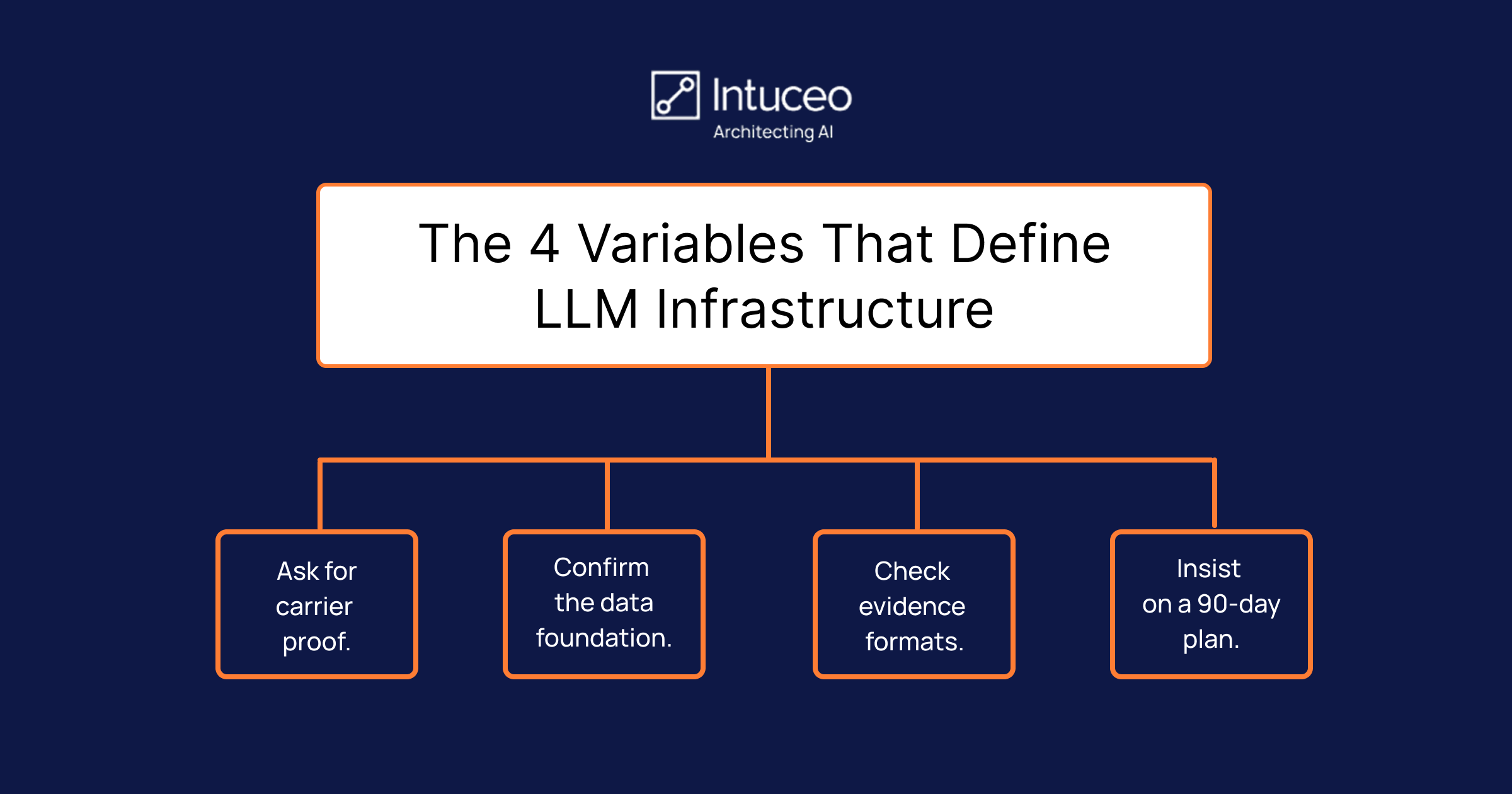
The Four Variables That Define LLM Infrastructure Requirements

Defining LLM infrastructure requirements starts with four variables : model size, throughput and latency, inference cost, and compliance. Model size is the first lever. Three others matter just as much.

Throughput and latency

A batch job that summarizes documents overnight tolerates slow responses and heavy batching. A customer-facing assistant expected to reply in under a second does not.
The same model can call for very different serving setups depending on how many concurrent requests it fields and how quickly each one has to return. Under-provision here and the system buckles at peak load; over-provision and expensive accelerators sit idle most of the day.

Cost, which moves faster than most budgets assume

For a model of equivalent performance, the price of running inference has been falling by roughly 10x per year, dropping from about $60 per million tokens in 2021 to near $0.06 for a comparable-quality model three years later.
That trajectory rewards flexibility and punishes lock-in. A setup optimized around today’s model at today’s prices can turn uneconomical within a year, and a rigid, single-vendor footprint often costs more over its life than a design built to swap models as cheaper, better options appear.

Compliance

For regulated organizations, this fourth lever frequently overrides the other three. Where data is allowed to be processed can rule out otherwise sensible options entirely, which is worth treating on its own terms.

What Does an LLM Infrastructure Stack Include?

It helps to see the whole picture, because the LLM infrastructure stack is far more than the GPUs everyone talks about. It runs from the compute and serving layer that hosts the model, through an orchestration layer that routes and scales requests, to the data layer that supplies the model with current, trustworthy context, and finally a security and governance layer that controls who can see what.
In a retrieval-augmented setup, the data layer does as much to determine answer quality as the model does – a trade-off explored in depth in RAG vs. Fine-Tuning: How Enterprise Teams Should Actually Decide.
Teams that fixate on the compute layer tend to meet the rest of the stack the hard way. A pilot works cleanly in a demo, then stalls the moment it hits real data volumes, real access rules, and real audit expectations. The compute was never the part most likely to break.

How Compliance Requirements Shape LLM Infrastructure Solutions for Regulated Industries

For pharmaceutical and life sciences organizations, healthcare systems, financial firms, and public-sector agencies, the question of where data can go often settles the infrastructure question before performance enters the conversation. Regulated data cannot simply be pointed at whatever endpoint is cheapest.
Protected health information under the Health Insurance Portability and Accountability Act (HIPAA), records governed by 21 CFR Part 11, and systems under the Federal Information Security Management Act (FISMA) each constrain where processing may happen and who may access it.
The concern is widespread, not niche. In Deloitte’s 2026 State of AI in the Enterprise survey, data privacy and security ranked as the most cited AI risk, named by 73% of the leaders polled.
Once data residency and sovereignty enter the picture, a public interface sitting in the wrong jurisdiction stops being an option, and the field narrows to controlled cloud, on-premises, hybrid, or air-gapped setups. Retrofitting those controls after a system is live is almost always slower and costlier than designing for them from the outset – a principle at the core of AI governance for regulated industries.

Why the Data Layer Determines LLM Infrastructure Success

Compute gets the headlines, but the data foundation quietly decides the outcome. A perfectly sized cluster still returns unreliable output if the pipelines feeding it are fragmented, stale, or impossible to trace. In regulated settings, every input and output usually has to carry a lineage a reviewer can follow, which is a data-engineering problem long before it is a hardware one. This is the layer where most infrastructure plans succeed or come apart.

How Intuceo Delivers LLM Infrastructure Solutions for Regulated Enterprises

This is the part of an infrastructure solution that Intuceo is set up to handle. Its DataOps and Engineering practice concentrates on the layer that determines whether an LLM setup holds up in production: hardened ingestion and transformation pipelines with automated quality testing, full data lineage for GxP, HIPAA, and federal audits, and secure infrastructure configured across cloud, on-premises, or hybrid environments with controls such as virtual private cloud (VPC) isolation and customer-managed encryption keys.
Rather than installing a fixed toolset, Intuceo works as a services partner, bringing accelerators drawn from prior regulated engagements to speed up deployment and configuring the pipeline to the constraints an organization already operates under. The compute can be right-sized later; the data foundation has to be sound first.
That foundation still rests on getting the hardware decision right – the exact problem the DARWIN Infrastructure planning session addresses by working through the LLM infrastructure solutions trade-off for your specific model, budget, and regulatory reality.
The session uses the Infrastructure dimension of the DARWIN planning framework to work through the real cost and performance trade-offs, from GPU versus CPU choices to sizing questions as concrete as whether a workload needs a dozen servers for a 500-billion-parameter model or a single GPU for a two-billion-parameter one.
It is built for the data, engineering, compliance, and executive leaders who own those calls, and it answers the question most infrastructure discussions skip: how to choose a setup that fits the model, the budget, and the regulatory reality at the same time.

Size your setup before you commit to it

Join the Intuceo AI Dream Session to work through the cost, performance, and compliance trade-offs behind your LLM infrastructure, with worked examples from regulated deployments.

Frequently Asked Questions

Sound LLM infrastructure requirements planning weighs four factors together: model size, which sets memory and GPU count; throughput and latency, which shape the serving setup; running cost at volume; and compliance, which governs where data can be processed  Sound LLM infrastructure requirements planning weighs all four together rather than optimizing for one and discovering the others later.
No. Small models can run on a single modest GPU or even a CPU, while large models need multiple high-end accelerators working together. Matching the hardware to the model, instead of defaulting to the largest option, is often where the biggest savings sit.
A complete LLM infrastructure stack includes the compute and serving layer, an orchestration layer for routing and scaling, a data layer that supplies context and retrieval, and a security and governance layer for access control and auditability. The data and governance layers are where regulated deployments most often succeed or stall.
In regulated industries, compliance can decide the infrastructure before performance is discussed. Rules such as HIPAA, 21 CFR Part 11, and FISMA limit where data may be processed, which pushes many organizations toward controlled cloud, on-premises, hybrid, or air-gapped setups rather than a public interface.
It depends on the data and the workload. Cloud offers elasticity, on-premises offers control, and hybrid balances the two. For sensitive data with residency or sovereignty constraints, the deciding factor is usually where processing is legally allowed to happen, not raw performance.