Why Pharma Analytics Teams Struggle to Scale Augmented Analytics Experiments

Why Pharma Analytics Teams Struggle to Scale Augmented Analytics Experiments

For most pharmaceutical analytics leaders, the celebration after a successful pilot project is short-lived.
It is relatively easy for a talented data team to build a convincing proof of concept – a targeted model that flags an adverse event faster, or a sleek commercial dashboard that answers questions in plain language to impress a steering committee. The real friction begins exactly twelve months later, when that same pilot is expected to run reliably across different regional markets, therapeutic areas, and highly regulated business units.
This bottleneck isn’t just an internal frustration; it reflects a massive global disconnect between digital intent and operational reality. While the global augmented analytics market is on track to rocket from USD 16.60 billion in 2023 to nearly USD 97.87 billion by 2030,1 organizations are finding that buying the technology is the easy part. McKinsey’s recent global benchmarking data shows that while a staggering 88% of organizations have successfully deployed AI within at least one business function, only about a third have managed to scale those capabilities across the wider enterprise
In the strictly regulated domain of life sciences, that execution gap is wider still.

Augmented Analytics: The promise, and the plateau

Augmented analytics uses machine learning and natural language processing to automate data preparation, surface patterns automatically, and let people question data in plain language. Today, this paradigm increasingly leverages Generative AI to provide fluid, conversational interfaces, turning what used to be complex database querying into a simple dialogue. For pharma, that transformation is highly practical: it means a clinical operations lead can interrogate trial site performance without writing a line of code, or a commercial team can test a complex market scenario without joining a three-week analyst queue.
The difficulty is the plateau that follows. Scaling analytics experiments is a completely different discipline from building them. A pilot succeeds in a controlled setting, with meticulously curated data and a highly motivated sponsor. Scale, however, demands messy production data, hundreds of simultaneous users, strict audit trails, and financial outcomes that a corporate finance team will defend. This is the underlying reason pharma analytics AI adoption so often stops at the demo.

Why pharma analytics experiments stall

Several forces compound at the same point in a program. Understanding them is the first step to explaining why AI pilots fail in pharma.
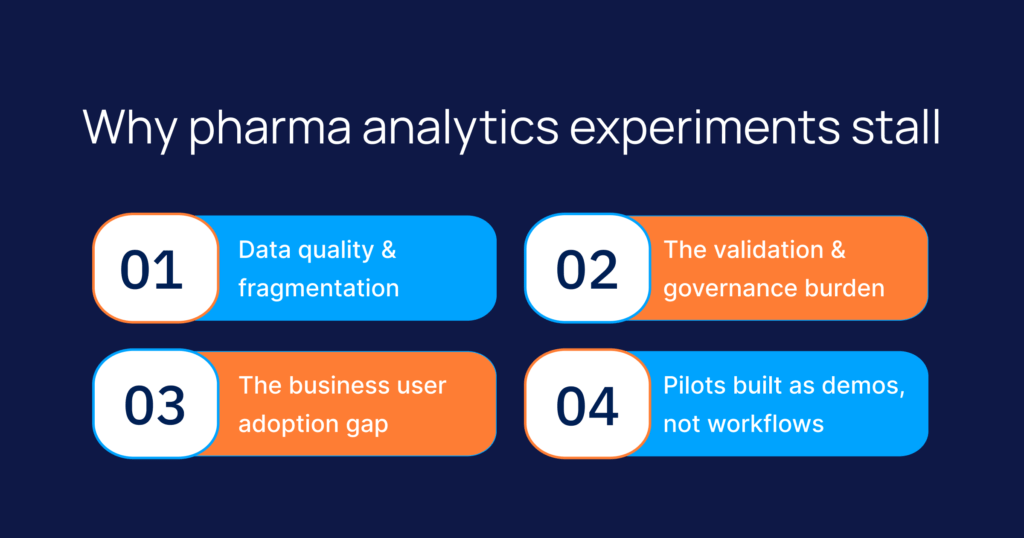
Data quality and fragmentation

Pharma data lives in silos: laboratory information systems, clinical trial databases, manufacturing execution records, safety systems, and commercial CRM systems, much of it unstructured. Industry data consistently shows that data scientists spend nearly half their working hours cleaning and preparing data rather than analyzing it. In pharma, this friction multiplies exponentially because regulated datasets cannot rely on approximations or ‘good enough’ data patches; a single missing data lineage link can invalidate a clinical report.

The validation and governance burden

A consumer analytics tool can ship and iterate. A regulated one cannot. Any insight that informs a clinical, safety, or manufacturing decision may need to be validated, traceable, and defensible to an auditor. Without regulated industry AI governance built in from the start, teams reach the pilot-to-production line only to find their experiment has no data lineage, no explainability, and no audit trail. Retrofitting those controls often costs more than the pilot did.

The business user adoption gap

Augmented analytics scales only when the people who make decisions actually use it. Yet many tools are designed for data teams, not for the clinical, regulatory, and commercial users who need the answers. When business user analytics adoption stays low, the experiment never leaves the analytics group and never changes how the business runs. Conversational analytics for pharma, where a user asks a question in everyday language and receives a defensible answer, is the bridge, but only when the interface fits the way that user already works.

Pilots built as demos, not workflows

When an enterprise solution is built to look good in a presentation rather than survive the realities of daily operations, failure is inevitable. This operational fragility explains why Gartner predicts that at least 30% of generative AI projects will be abandoned after proof of concept by the end of 2025. Because GenAI increasingly serves as the primary user interface for modern augmented analytics platforms, its high abandonment rate directly impacts the broader analytics ecosystem. Gartner points to poor data quality, inadequate risk controls, escalating costs, and unclear business value as the primary drivers of this collapse.
The common thread across these failures is not the underlying model itself; it is the infrastructure and conditions around it. Enterprise AI in life sciences fails in the exact same way. A pilot engineered solely to impress a steering committee in a boardroom is fundamentally different from a system engineered to scale securely across a global enterprise.

From experiment to enterprise impact

Moving from experimentation to enterprise-wide impact has less to do with a better model and more to do with a repeatable method. Teams that scale tend to do a few things differently. They start with a single high-value decision rather than a broad capability. They build governance, validation, and data lineage into the experiment instead of bolting them on afterward. They design for the business user from day one. And they treat the pilot as the first production increment, not a throwaway proof.
This is also where AI decision support in life sciences earns its place. Decision support that surfaces an insight quickly, shows the data behind it, and records how it was derived can be trusted, audited, and adopted. Decision support that produces an answer no one can explain will not survive a regulatory review, let alone reach scale.

How Intuceo helps pharma teams scale

Intuceo is a PhD-led AI, ML, and data analytics services firm that works inside regulated industries, including pharma and life sciences. The work is not about selling a tool. It is about delivering the method and the engineering that move an analytics experiment into dependable enterprise use.
Intuceo-Ax, the firm’s augmented analytics accelerator, is built to speed deployment rather than start every build from zero. It automates data preparation, supports what-if exploration, and lets non-technical leaders navigate deep KPIs in as few as three clicks, which speaks directly to the business user adoption gap. Because it draws on patterns proven in prior pharma engagements, teams skip much of the trial and error that stalls a first attempt.
Governance is engineered in, not added later. Intuceo applies a Regulated-by-Design approach: automated data profiling and anomaly detection at the source, immutable lineage for forensic traceability, and explainability frameworks with bias detection and model cards reviewed by a PhD-led Board of Science. These controls are pre-vetted against FDA 21 CFR Part 11, HIPAA, GxP, SOC 2 Type II, and FISMA requirements, giving regulated AI governance a concrete foundation.
The firm’s iPDLC framework gives experiments a defined route from concept to validated production, the step most pilots are missing. Across more than 100 life sciences engagements over 14-plus years, including work for organizations such as Janssen and Ferring, Intuceo has engineered solutions like a universal search capability that indexes over 5 million R&D documents, turning dormant knowledge into usable insight. Engagements run on fixed-bid and budgeted models, so clients pay for outcomes rather than activity.

Ready to Move from Pilot to Production?

Don’t let a promising experiment stop at the demo phase. Intuceo builds compliance, data lineage, and user adoption directly into your pipelines from day one.
  • Regulated-by-Design: Pre-vetted compliance (FDA 21 CFR Part 11, GxP, HIPAA) built in, not bolted on.
  • Proven iPDLC Framework: A predictable path from concept to an audited, enterprise-scale project.
  • Outcome-Based Models: Fixed-bid structures so you pay for impact, not activity.

Frequently Asked Questions

Most fail at integration, not at the model. Pilots run on curated data with a motivated sponsor, then meet fragmented production data, low business user adoption, and validation requirements they were never designed to satisfy. The experiment works in isolation but cannot connect to the workflows and controls that real scale demands.
By treating scale as a method rather than a milestone. That means starting with one high-value decision, building governance and data lineage into the experiment from the start, designing for the business user, and running the pilot as the first production increment. A defined lifecycle, such as Intuceo’s iPDLC, gives that progression a repeatable structure.
At minimum: validated data quality, immutable lineage so any insight can be traced to its source, explainability so outputs can be defended, and bias detection and model documentation. These should map to standards such as FDA 21 CFR Part 11, HIPAA, GxP, and SOC 2 Type II, and should be present before a pilot is asked to inform a regulated decision.

Automate the repeatable work, data profiling, preparation, and anomaly detection, while keeping validation and audit trails intact. Automation that records what it did and why preserves the defensibility a regulated environment requires, and frees analysts to spend time on interpretation rather than cleaning data.

Meet users in their own workflow and language. Conversational analytics that let a clinical or commercial user ask a question and receive a clear, sourced answer removes the dependency on a specialist queue. Adoption follows when the interface is simple, the answer is trustworthy, and the path to that answer is short.
Which Semantic Search Tool Works Best for Clinical and Regulatory Documents?

Why clinical and regulatory documents break general search engines

Three properties of life sciences content make general-purpose tools fall short.

1. Volume and dispersion

PubMed alone contains more than 39 million biomedical citations. Layer on internal sources (LIMS, PLM, eTMF, ELN, CTMS, pharmacovigilance databases), and most pharma organizations are looking at millions of pages of unstructured content scattered across systems. Standard keyword search returns either everything or nothing useful.

2. Specialized terminology

Clinical and regulatory content carries dense ontologies: SNOMED CT, MeSH, ICD, UMLS, MedDRA, LOINC, and regulator-specific vocabularies. A query for “heart attack” should retrieve documents using “myocardial infarction,” “MI,” “acute coronary syndrome,” and ICD codes I21 and I22. A general natural language query search tool that has never seen these mappings will miss the most relevant evidence.

3. Traceability requirements

Under 21 CFR Part 11, the FDA requires electronic records that support GxP-regulated activities to maintain accurate, attributable, contemporaneous, and complete audit trails. EMA’s EudraLex Volume 4 Annex 11 places similar expectations on computerised systems used in GMP environments. A search tool that returns an answer without showing exactly which document, page, and version it came from is a compliance liability, not a productivity gain.

What semantic search actually does differently

LLM-based document search works on vector embeddings: a model translates each piece of content into a numerical representation that captures meaning rather than keywords. A query is converted into the same representation and matched against the document index. The output is documents that are conceptually similar to the query, even when they share no exact words. When combined with retrieval-augmented generation (RAG), the system can also produce a natural language answer grounded in retrieved evidence.
For clinical research search, that capability is the difference between a paralegal-style read of fifty papers and a directed pull of the five passages that actually answer the question. For regulatory intelligence, it is the difference between scrolling through 400-page Health Authority guidelines and surfacing the two paragraphs that pertain to a specific submission.

The Semantic Search Landscape: Three Approaches, Three Distinct Boundaries

When evaluating a semantic search tool for regulatory documents, most options fall into one of three categories. Each has a place, and each has limits.
Tool category What it does well Where it falls short for life sciences
General enterprise search (horizontal SaaS) Indexes common SaaS systems (SharePoint, Confluence, Slack, Drive). Easy to deploy. Good UX. No biomedical ontology awareness. Limited support for GxP-regulated systems. Typically, cloud-only deployment models complicate IP and PHI handling.
Off-the-shelf biomedical search (literature-focused) Pre-indexed access to PubMed, Embase, and clinical trial registries. Useful for literature reviews and healthcare knowledge discovery. Limited integration with proprietary internal content (CSRs, IBs, internal SOPs). Closed ecosystems. Search results sit outside enterprise security boundaries.
Domain-specific AI search (custom or hardened) Built on biomedical embeddings, integrated with internal systems, supports on-premise or air-gapped deployment, and surfaces source-traceable evidence. Aligned with compliance-friendly AI search requirements. Higher implementation effort. Requires partners with engineering depth in both AI and regulated environments.

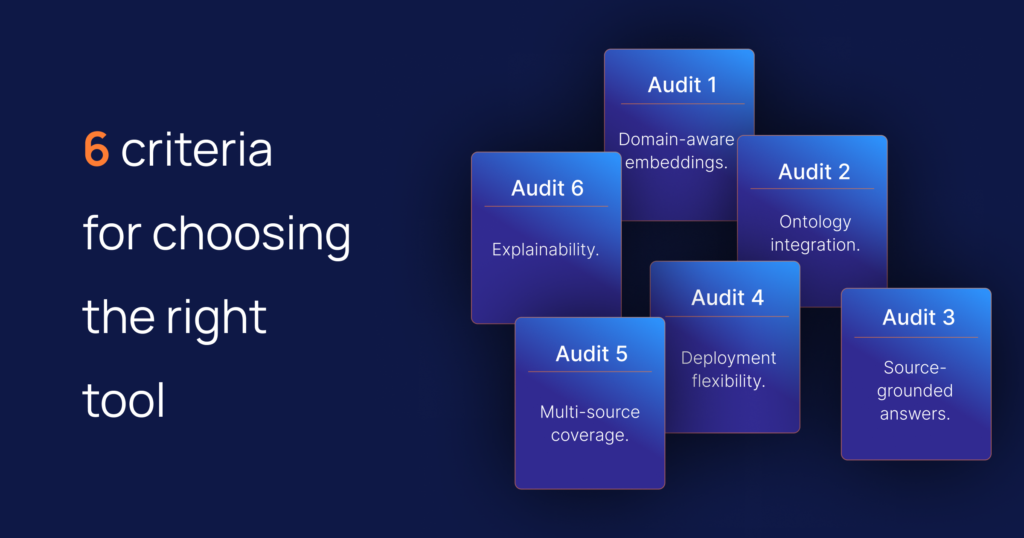
Six criteria for choosing the right tool

The right answer depends on the workload, but here are six tenets that separate viable options from risky ones in regulated environments.

Quick test

 Ask any vendor to demo the tool on a question your own team struggled with last quarter. Then ask the system to show you every source it used, every section it pulled from, and every step in the retrieval logic. If the answer is “we can show you the result, but not the reasoning,” it is not ready for a regulated workflow.

Where general-purpose LLMs fall short on regulated content

Public LLMs are remarkable general-purpose tools, but several issues limit their use in clinical and regulatory contexts. They hallucinate, sometimes fluently and confidently, on technical questions outside their training distribution.They lack the audit trail that regulators expect. They have no built-in awareness of which version of a document is current or superseded. And most pose data-residency questions that procurement teams ma cannot easily clear.in phar
A domain-specific search system addresses these issues by combining a retrieval layer (vector + ontology-aware) with a generation layer that is constrained to retrieved evidence. It is the engineering pattern that separates a usable clinical assistant from a fluent but unreliable one.

How Intuceo Delivers Semantic Search for Regulated Content

Intuceo-Ix™: a search accelerator for clinical and regulatory teams

Intuceo is a PhD-led AI and data analytics consultancy. For teams that need life sciences semantic search across internal silos and external regulatory and scientific content, we bring Intuceo-Ix™, a search accelerator proven across prior regulated engagements that we configure to your repositories rather than build from scratch.
The result is semantic search engineered for your environment, where a wrong answer is not an inconvenience but a regulatory exposure.

Stop Searching. Start Finding with Intuceo.

When a wrong answer isn’t an operational inconvenience but an immediate regulatory exposure, life sciences organizations cannot afford the blind spots of general-purpose search. Intuceo’s PhD-led team brings the Intuceo-Ix™ and Intuceo-Dx™ accelerators, proven across prior regulated engagements, to bridge the gap between fragmented clinical data silos and the explainable, source-traceable insight your compliance teams expect.
Move your organization from data rich to insight rich without compromising your GxP or 21 CFR Part 11 posture.

Frequently Asked Questions

For document-heavy life sciences research, what matters more than the underlying LLM is the retrieval pipeline around it. A general-purpose model paired with a biomedical embedding layer, ontology grounding, and source-cited retrieval will outperform a more powerful model used in isolation. Evaluate the whole system, not just the base model.
Run a structured test set on real questions from your team. Check whether every answer is grounded in a cited source, whether the citation actually supports the claim, and whether the system declines to answer when evidence is insufficient. Tools that refuse to answer without evidence are usually safer than those that always produce something.
The framing should shift from “which LLM” to “which architecture.” For regulated workflows, the deciding factors are deployment model (on-prem or air-gapped), explainability of retrieval, audit-trail support, and integration with the organization’s content systems. A model that scores well on public benchmarks but cannot meet those requirements is not the right answer.
Three things : traceable source citations on every answer, deployment options that keep regulated data inside the organization’s security perimeter, and audit logs that record who queried what, when, and what was returned. These are baseline expectations for any tool used in GxP, HIPAA, or FISMA-regulated environments.
A practical short list: Does the tool understand biomedical terminology and ontologies? Can it cite every source it uses? Will it run inside our environment without exposing data to public models? Does it integrate with the systems where our content actually lives? Can we audit it the way a regulator would expect us to? If a vendor cannot answer all five clearly, the tool is not yet ready for clinical or regulatory work.

Which Augmentative Tools Suit a Cloud-Based Life Science Platform?

Most pharma and biotech IT estates have already migrated. The major cloud platforms now offer regulated-environment configurations, BAA coverage, and validated reference architectures for clinical, regulatory, and commercial workloads. Raw cloud capacity, however, does not solve the operational problems life sciences teams actually feel: clinical teams still spend a disproportionate share of their time searching for protocol documents, screening patients for trials, and reconciling case report forms. Pharmacovigilance teams process growing volumes of adverse event reports under tight regulatory windows; the U.S. FDA’s FAERS database now contains over 31 million adverse event reports, with intake volumes climbing year over year . Regulatory affairs teams still hand-curate submission narratives across thousands of pages.

A life science cloud platform stores the data and enforces access controls. It does not, by itself, read 12,000-page submissions, triage AE narratives, or match a patient to a trial. That is the work of an augmentative AI layer engineered on top of it.

What "augmentative" actually means in life sciences

An augmentative tool extends a human workflow without replacing the human accountable for the decision. In a regulated context, that distinction matters. Validated systems require traceability, defensible model behavior, and human-in-the-loop checkpoints. Compliant AI tools in life sciences are designed around those constraints rather than against them. The categories below cover where augmentation produces the strongest signal on a cloud-based life science platform. Not every tool fits every team, but the taxonomy is consistent across pharma, biotech, and medtech.

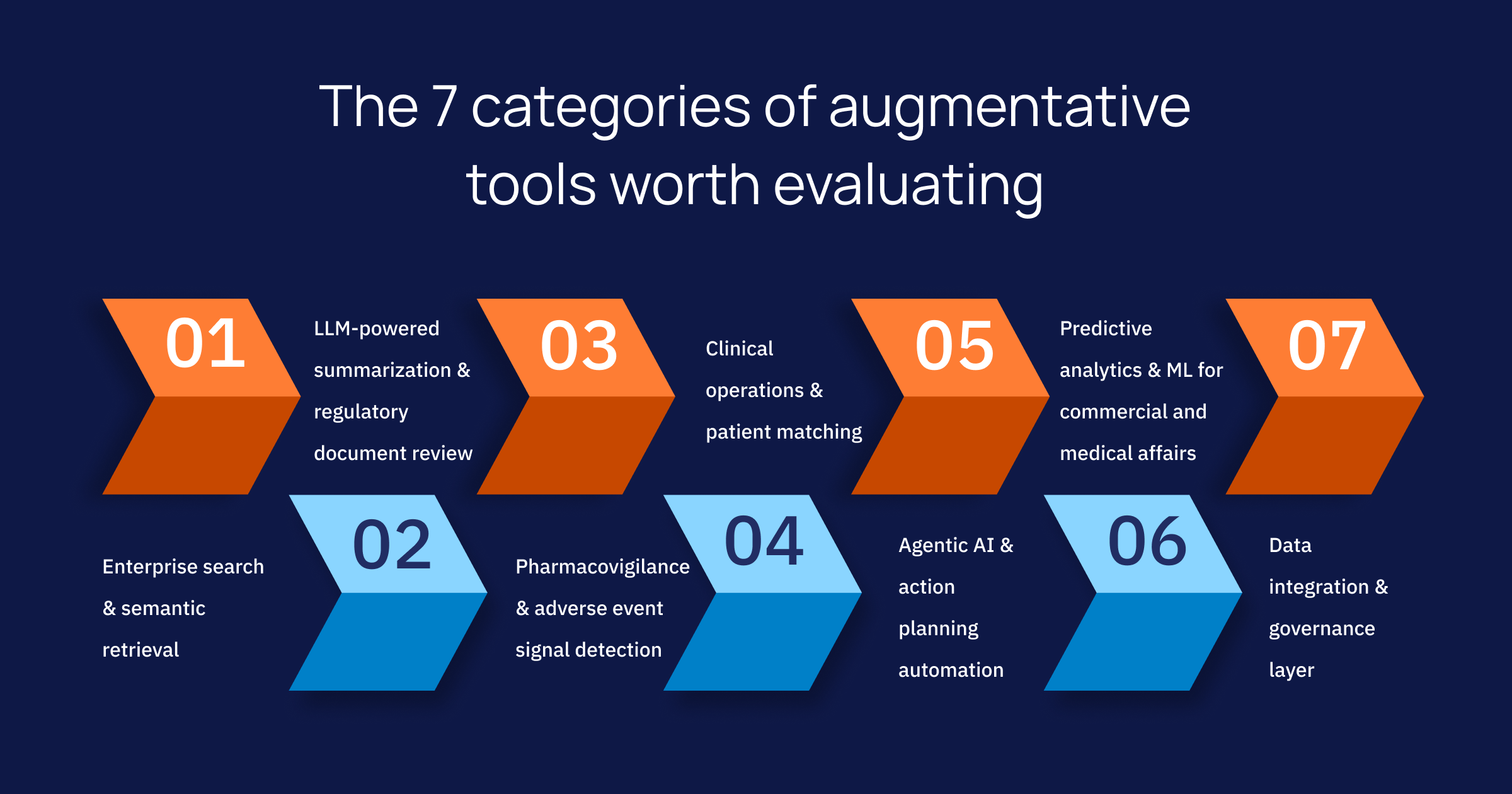
The seven categories of augmentative tools worth evaluating

1. Enterprise search and semantic retrieval

Knowledge in a life sciences organization is spread across SharePoint, electronic lab notebooks, LIMS, PLM, regulatory submission repositories, CTMS, and clinical trial archives. Keyword search across these systems consistently misses what scientists and reviewers need. Semantic and vector-based AI search and summarization tools fix the retrieval problem by interpreting intent and surfacing relevant passages across formats. McKinsey estimates that knowledge workers spend up to 1.8 hours per day searching for information . In a 5,000-person R&D organization, that is the productivity equivalent of a mid-sized team.

2. LLM-powered summarization and regulatory document review

Regulatory document review is one of the highest-ROI use cases for generative AI in pharma. Modern LLMs can read protocols, investigator brochures, clinical study reports, and submission packages, then produce structured summaries, gap analyses, and consistency checks. The work that previously took days can be reduced to an hour of human review on top of a machine-generated draft. Done well, this is one of the strongest applications of generative AI for pharma because the outputs feed directly into reviewable artifacts.

3. Pharmacovigilance and adverse event signal detection

While the AE intake volume continues to compound annually, the PV team headcount usually cannot match that pace. Augmentative tools here perform case intake from unstructured text, MedDRA coding suggestions, duplicate detection, and signal triage across product portfolios. The combination of NLP, classification models, and rules-driven validation is where most production deployments have settled.

4. Clinical operations and patient matching

Roughly 80% of clinical trials fail to meet original enrollment timelines, and the cost of a delayed Phase III trial can exceed several million dollars per day for high-value drugs [3]. Clinical workflow automation tools, including patient-trial matching against EHR cohorts, site performance analytics, and protocol deviation prediction, shorten enrollment cycles and surface site-level risk before it triggers protocol amendments. Patient matching engines that combine SNOMED CT, ICD-10, lab results, and free-text physician notes consistently outperform manual eligibility screening.

5. Agentic AI and action planning automation

Agentic AI is the layer above summarization. An agent decomposes a goal into steps, calls the right systems on a life science cloud platform, executes a sequence, and routes exceptions back to a human. In practice: orchestrating a multi-step regulatory query, drafting an AE narrative for QC, or assembling a feasibility packet for a new study. Action planning automation is most valuable where the workflow is well-defined but the data sources are not.

6. Predictive analytics and ML for commercial and medical affairs

On the commercial side, augmentative tools for HCP engagement include next-best-action models, prescriber affinity scoring, and content recommendation engines that integrate with CRMs like Veeva or Salesforce Health Cloud. For patient-facing work, a patient engagement platform can use ML to personalize adherence outreach, predict drop-off risk, and prioritize support program interventions. These tools live inside cloud CRMs but extend them with predictive layers the CRM does not natively provide.

7. Data integration and governance layer

Data integration in life sciences is rarely glamorous, but it is the precondition for every other category to work. Tools that handle entity resolution across master data, lineage tracking for GxP audit, and standardization to CDISC SDTM/ADaM make LLMs and ML models defensible. Without this layer, AI outputs cannot be reproduced in an audit; with it, every downstream model becomes inspection-ready.

How to choose AI tools that integrate with a life science cloud platform

The right shortlist is rarely the most exciting tool. It is the one a regulator will accept and a CIO can operate. The criteria below filter out most consumer-grade GenAI offerings before procurement begins.
Evaluation lens What to verify
Regulatory fit Validated against 21 CFR Part 11, EU GMP Annex 11, GxP, and HIPAA. Audit trails on prompts, outputs, and model versions.
Data residency & isolation BAA coverage, private model deployment, no training on customer data, regional data residency for EU/UK/APAC studies.
Integration depth Native connectors to Veeva Vault, Salesforce Health Cloud, AWS HealthLake, Azure Health Data Services, Snowflake, Databricks, EHR FHIR endpoints.
Explainability Citations on every generated answer, traceable retrieval paths, model cards, and documented evaluation on life sciences corpora.
Human-in-the-loop design Review gates, role-based approval, controlled rollback, and the ability to disable autonomous actions in regulated workflows.
Total cost of ownership Inference costs at production volumes, model-update cadence, and the operational overhead of maintaining prompt and retrieval pipelines.

Where augmentation tends to break

Most failed life sciences AI pilots share three patterns. The tool is deployed without addressing the underlying data integration problem, so outputs are inconsistent. The tool is selected on demo strength rather than validation evidence, and stalls when regulatory affairs reviews it. The tool is treated as a feature rather than a workflow, so adoption never reaches the teams who would benefit. Each is fixable, but only when AI is treated as part of a clinical or regulatory operating model, not as a standalone purchase.

How Intuceo augments your cloud-based life science environment

Intuceo is a PhD-led AI and data analytics consultancy. We engineer the augmentative layer on top of your existing cloud environment, on AWS, Azure, Databricks, Snowflake, and the Veeva and Salesforce Health Cloud stacks. The work is grounded in regulatory-grade delivery, not experimentation. Where a category above maps to a problem your team already feels, we bring accelerators built and hardened across prior life sciences engagements, proven components that shorten deployment so you reach a validated result faster than a build-from-scratch project would allow. Accelerators we bring to you:

Build Your Augmentation Roadmap

The foundation is built; now it’s time to scale. Your data is already on Veeva, AWS, or Salesforce. The gap is the augmentative layer that turns it into faster decisions and automated workflows. Intuceo’s PhD-led team engineers that layer with you, bringing accelerators from prior regulated engagements so you reach a validated, audit-ready result faster than a build-from-scratch effort. Start with a working session on where augmentation pays back first.

Frequently Asked Questions

The strongest categories are neural enterprise search, LLM-powered summarization for regulatory document review, AE classification for pharmacovigilance, patient-trial matching, agentic workflow orchestration, predictive ML for commercial and medical affairs, and the data integration layer underneath them. Selection should be driven by which workflow has the most measurable cycle-time or compliance pain, not by which tool has the most impressive demo.
Look for vendors that ship with audit trails, validated reference architectures, BAA coverage, and documented evaluation against pharma and biotech corpora. The minimum bar for compliant AI tools in regulated environments is alignment with 21 CFR Part 11, EU GMP Annex 11, GxP, and HIPAA. Tools that cannot produce citations or model lineage on demand should not enter production.

Summarization is best handled by LLMs fine-tuned or grounded against life sciences corpora with retrieval-augmented generation. Search requires semantic and vector retrieval across structured and unstructured repositories. Action planning automation sits on top of both, using agentic frameworks to execute multi-step workflows and surface exceptions to human reviewers.

On the HCP side, the most common tools are next-best-action engines, content recommenders, and territory analytics layered on Veeva or Salesforce Health Cloud. For patient engagement, a modern patient engagement platform uses adherence prediction, personalized outreach, and intervention prioritization for patient support programs.
Start from the workflow, not the tool. Identify the highest-friction process, typically AE intake, regulatory document review, or patient matching, and quantify its cost. Then evaluate two or three tools against the criteria in the table above. Pilot with measurable success criteria validated against your existing cloud-based life science platform, and only scale tools that clear both clinical and compliance review.

Why an LLM Alone Won’t Make Your Enterprise AI Actionable

Models like GPT and Claude reason and explain fluently. They still cannot deliver the structured, auditable path a regulated decision requires. The architecture that can pairs them with a governed action layer.
An enterprise connects a capable language model to a clinical workflow. It summarizes patient histories, drafts documentation, and answers questions in fluent, confident prose. Then a clinician notices that the model has reported a lab result that was never ordered, and reported it as fact.
That is not a rare failure. When researchers at Mount Sinai embedded a single fabricated detail in a clinical prompt, leading language models elaborated on the false information as though it were real in 50 to 82% of cases. The fluency never wavered. The grounding did.
The lesson is not that language models are unfit for the enterprise. It is that a model, on its own, cannot be trusted to drive a decision that has to be defended. Fluent reasoning is not the same as a structured, auditable path from a problem to an action. Closing that gap is an architecture problem, not a model problem.

What language models do well, and where they stop

Modern language models are remarkable at a specific set of tasks. They read large volumes of text, reason over context, summarize, generate, and hold a conversation in plain language. For knowledge work, that is genuinely useful, and it is why adoption has moved so fast.
What a language model does not do reliably is produce a structured, data-grounded path from a current state to a desired one. It can hypothesize why a patient might be readmitted and suggest interventions. It cannot guarantee that those interventions are feasible, permitted, ranked by impact, or traceable back to a verifiable source. It answers with the same confidence whether it is right or wrong. In a marketing email, that is a tolerable risk. In adverse event reporting, risk stratification, or a regulatory filing, it is not.

The mistake is treating the model as the whole system

The most common error in enterprise AI right now is treating the language model as the entire system. Wire it in, point it at the data, and expect it to run the decision. The results are starting to show. Gartner predicts that more than 40 percent of agentic AI systems projects will be canceled by the end of 2027, citing escalating costs, unclear business value, and inadequate risk controls.
The failures are rarely about the model’s intelligence. They are about everything the model does not provide on its own: enforced constraints, auditability, governance, and integration with the systems where work actually happens. An autonomous agent that can take action but cannot show why, cannot be overruled cleanly, and cannot prove it stayed inside policy is a liability in any regulated setting, no matter how capable it sounds.

The architecture that works

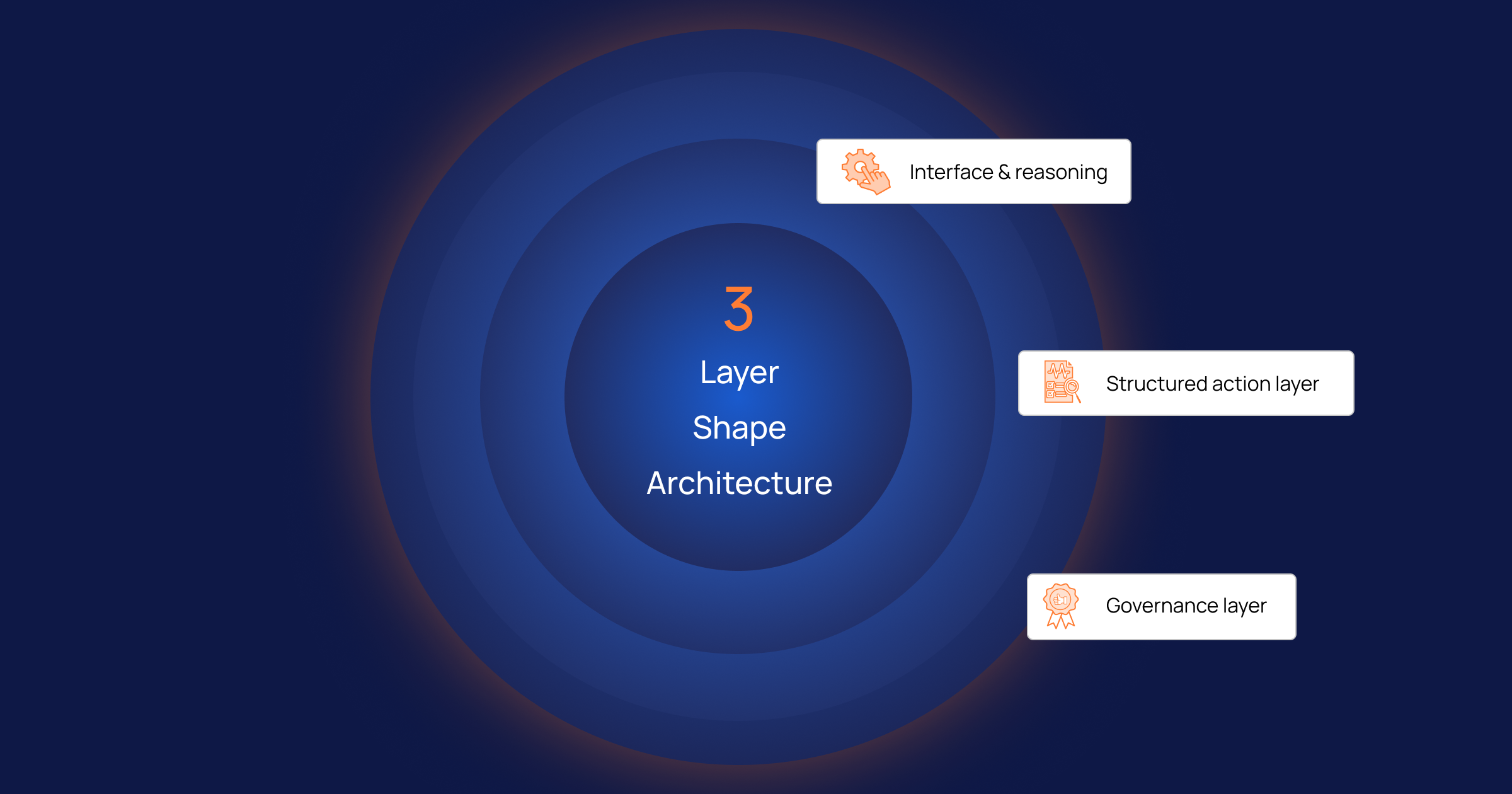
A language model is best understood as one layer in a larger system, not the system itself. Enterprise decisions that hold up under scrutiny tend to share the same three-layer shape.

A decision system that holds up

Layer 1

Interface and reasoning

The language model. Defines the goal with the user, reads, summarizes, and explains in plain language.

Layer 2

Structured action layer

Rule extraction, rationalization, and a ranked next-best-action. Turns reasoning into a feasible, defensible path.

Layer 3

Governance layer

Constraints, fact-grounded lineage, and human approval. Validates every decision before it is allowed to act.
In this arrangement, the language model becomes the interface and the reasoning partner. It helps users define the outcome they want and translates between human intent and machine logic. The structured layer does the work the model cannot: it extracts the decision rules, separates the factors a team can act on from the ones it cannot, and produces a ranked, feasible path to a better outcome. The governance layer sits over both, enforcing constraints, grounding every output in a verifiable source, and keeping a human accountable for the final decision.
None of these layers is sufficient alone. A model without structure produces fluent guesses. Structure without a model is rigid and hard to use. Neither is safe without governance. Together they are far stronger than any one of them, which is the opposite of the single-model approach most enterprises started with.

Why governance is the requirement, not the add-on

In regulated industries, a recommendation that cannot be defended is worse than no recommendation at all. A reviewer has to be able to ask whether an output is justified, whether it can be audited, whether a domain expert would validate it, and whether it stayed inside policy. A black-box answer fails all four tests.
This is where grounding and lineage matter. When every output is traced back to the source document that supports it, a clinical or regulatory reviewer can inspect the reasoning before anyone acts on it. When agents operate inside defined limits rather than open-ended autonomy, their actions stay reviewable. Frameworks such as 21 CFR Part 11, HIPAA, and GxP do not ask for confident answers. They ask for accountable ones, with evidence attached. That requirement is met by architecture, not by a better prompt.

Architecting AI, not bolting it on

The future of enterprise AI is not the largest possible model answering on its own. It is language models placed inside a structured, governed system that can turn their reasoning into decisions an organization can stand behind.
This is the architecture behind Intuceo’s approach. Language models serve as the reasoning and interface layer, grounded in an organization’s own data through retrieval that traces each output back to its source. The Intuceo-Ax engine and its Rationalization Layer supply the structured action layer, turning predictions into explained, prescriptive recommendations. Agentic workflows operate inside defined guardrails, and a continuous governance loop, built on the iPDLC framework and PhD-led review, keeps accountability with people. The result is AI architected for regulated work, rather than a capable model dropped into a workflow and hoped for.
Prediction is only the start of a decision. The same principle holds one level up. A language model is only the start of a system. The value is in what an organization builds around it.

Architect AI you can defend.

Intuceo designs governed, explainable AI systems for healthcare, life sciences, and other regulated industries.

Frequently Asked Questions

Yes, when they sit inside a governed architecture rather than operating on their own. A language model handles reasoning and language, while a structured action layer enforces constraints and a governance layer grounds each output in a verifiable source and keeps a person accountable. The model becomes one component, not the whole decision system.
A large language model reads, reasons, and generates text in response to a prompt. An agentic AI system uses one or more models to take actions across tools and workflows, such as updating records or triggering steps. The added risk is autonomy. Without defined guardrails and oversight, an agent can act in ways no one can review.
Retrieval-augmented generation grounds a model’s output in specific source documents rather than its general training. Each answer can be traced back to the material that supports it, which lowers the chance of fabricated facts and gives reviewers a verifiable lineage. That traceability is what frameworks such as 21 CFR Part 11 require.

Prediction Tells You What Will Happen. It Won’t Tell You What to Do.

Predictive and explainable models stop at the score. The capability that changes outcomes is prescriptive: knowing which factors a team can act on, and the shortest path from a bad outcome to a better one.
Health systems can now flag, with reasonable accuracy, which patients are likely to return within 30 days of discharge. The models work. The readmission rate has not moved with them. The 30-day all-cause readmission rate held at about 13.9 per 100 index admissions between 2016 and 2020, reaching 17.0 per 100 for Medicare patients.1 A prediction arrived. The outcome stayed the same.
The reason is rarely the model. It is the gap between knowing what will happen and knowing what to change.

Prediction stalls at the score

Most machine learning systems are built to answer one question. What will happen? This customer will churn. This loan will default. This patient will be readmitted. That answer is useful, and it is also where most systems stop.
Decision-makers cannot act on a probability. A clinical director looking at a readmission score still needs several things that the score does not provide. Why is this patient at risk? Which of the contributing factors can the care team actually influence? What is the smallest change that would lower the risk? And of all the available options, which is the shortest, most feasible route to a better outcome?
A risk score answers none of these. It ranks cases. It does not specify what action needs to be taken. The result is a model that earns its place in a report and never reaches the call list, the discharge plan, or the workflow where the decision gets made.

Explanation is not the same as action

Explainable AI was supposed to close this gap. It helps, but it does not finish the job. Feature attribution tells a team which variables are associated with an outcome. It says that low engagement and unresolved complaints correlate with churn, or that prior admissions, medication complexity, and social factors correlate with readmission.
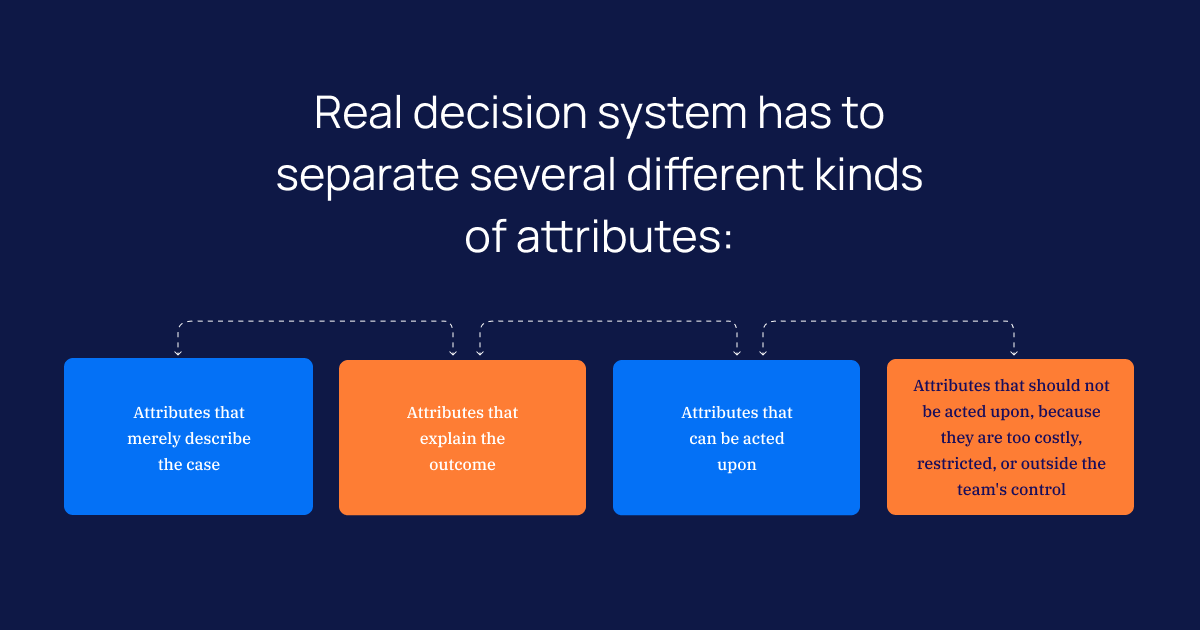
Knowing what is associated with an outcome is not the same as knowing what to do about it. A real decision system has to separate several different kinds of attributes:
A patient’s age explains readmission risk, and it cannot be changed. A medication reconciliation step at discharge also influences risk, and it can be changed this afternoon. An explanation that treats both as equally important sends the team nowhere. The intelligence is in the distinction.

What prescriptive intelligence actually requires

The capability that closes the gap is prescriptive. It does more than score and explain. It identifies the specific, feasible changes that move a case from an undesired state to a desired one, and it ranks those changes by impact, effort, and constraints.
Three things have to work together for that to happen. Rule extraction pulls the decision logic out of high-dimensional data instead of leaving it locked inside a black box. Actionable attribute selection separates the factors a team can change from the ones it cannot. Shortest-path reasoning finds the minimal set of changes that produces the result, rather than handing over a list of fifty possible interventions.
That last point carries more weight than it first appears. Decision-makers do not want a hundred recommendations. They want the smallest change that moves the needle: the one process fix that prevents a delay, the single follow-up that keeps a patient out of the hospital, the behavioral shift that moves a case into a safer class. Listing every possible intervention is easy. Ranking the feasible ones by what they cost and what they return is the hard part, and it is where the value sits.

A worked example: the high-risk patient

Illustrative scenario

A discharge planner looks at a patient the model has flagged as high-risk for readmission. An explanation layer lists the drivers: multiple chronic conditions, a complex medication regimen, a missed prior follow-up, and limited transport to appointments.
The planner still has to decide what to do before the patient leaves. Several of those drivers are fixed. The chronic conditions are not changing this week. But the medication regimen can be reconciled and simplified now. A follow-up can be scheduled and confirmed. A transport barrier can be answered with a referral.
A prescriptive system does not stop at the four drivers. It identifies which are modifiable, which are feasible given the team’s resources, and which combination forms the shortest path to a lower risk. That is the difference between a model that produces a number and a system that produces a decision.

Why prescriptive paths are also a governance asset

In regulated industries, a recommendation is only useful if it can be defended. A clinical or compliance reviewer has to ask whether a recommendation is justified, whether it can be audited, whether a domain expert would validate it, and whether it is fair and operationally feasible.
Black-box predictions struggle with every one of those questions. A transformation path does not. Because it is built from extracted rules and a stated sequence of changes, it can be inspected, challenged, and approved before anyone acts on it. The same structure that makes a recommendation useful to a care team is what makes it defensible to a regulator. In healthcare, life sciences, and other high-stakes settings, that is not a feature. It is a requirement.

From prediction to prescription

The lesson holds across every model an enterprise runs. A predictive model says something is likely to happen. An explanatory model says which factors are associated with it. Neither tells the organization what to change, in what order, with the least effort, to improve the outcome. That last step is where measurable value lives.
This is the principle behind Intuceo’s approach to decision intelligence. The Intuceo-Ax engine pairs prediction with a Rationalization Layer that surfaces the statistical evidence and logic behind a recommendation, instead of a yes or no answer. In adverse event reporting and risk stratification, that means a model does not just predict, it justifies, which is what regulatory frameworks like GxP and HIPAA demand. The work is delivered as explainable, governed systems, built and validated through the iPDLC development framework, rather than a black box dropped into a workflow.
Prediction was never the finish line. The organizations that see returns from AI are the ones that treat the score as the start of a decision, not the end of one.
There is a harder question waiting in the GenAI era. If models like GPT and Claude can reason and explain so fluently, why can’t they deliver this structured, auditable path on their own? That is the subject of the next post.

Turn predictive models into decisions your teams can act on.

Intuceo builds explainable, governed decision intelligence for healthcare, life sciences, and other regulated industries.

Frequently Asked Questions

Predictive analytics estimates what is likely to happen, such as which patients may be readmitted or which loans may default. Prescriptive analytics goes further. It identifies the specific, feasible changes that move a case toward a better outcome, then ranks them by impact, effort, and constraints, so teams know what to do, not just what to expect.
Explainable AI shows which factors are associated with an outcome, but association is not action. A useful system also has to separate the factors a team can change from those it cannot, such as a patient’s age versus a discharge medication review. Prescriptive intelligence adds that distinction and finds the shortest path to a better result.
Yes, when the recommendation is built from extracted rules and a stated sequence of changes rather than a black-box score. That structure can be inspected, challenged, and validated by a domain expert before anyone acts, which is what frameworks such as HIPAA and GxP require. A transparent rationalization layer makes the recommendation defensible, not just accurate.

Managed Analytics as a Service: The Definitive Guide for Enterprise Health Systems

Enterprise health systems sit on more data than almost any other industry, and use far less of it than they should. One widely cited estimate suggests roughly 97% of the data generated by hospitals each year goes unused for analytics or evidence generation.The reasons are structural, not theoretical. Data is fragmented across electronic health records, claims systems, lab platforms, pharmacy benefit feeds, and increasingly social determinants of health. Pipelines break. Models drift. Compliance reviews stall releases. Analytics teams spend their week reconciling identifiers instead of producing insight.
This is the gap that managed analytics as a service is built to close. Instead of operating an in-house analytics stack as a permanent line item, health systems engage a specialist partner to design, run, and continuously improve their analytics environment as an outsourced service, with outcomes governed by a service level agreement and a defined value contract.
This guide is a complete reference for health system leaders evaluating healthcare analytics services. It covers what managed analytics actually is, where it differs from in-house builds, how compliance and EHR integration get handled in practice, what real outcomes look like in revenue cycle and quality of care, and how to evaluate providers without falling into a generic procurement checklist.

What Is Managed Analytics as a Service in Healthcare?

Managed analytics as a service is a delivery model in which an external partner owns the operating responsibility for a health system’s analytics stack. The partner is responsible for the data engineering, modeling, dashboards, monitoring, governance, and continuous tuning that turn raw clinical and financial data into decisions. The health system retains ownership of the data, the strategy, and the clinical context. The partner is accountable for uptime, accuracy, throughput, and measurable outcomes.
In a typical engagement, the scope spans:
This is structurally different from buying a one-off tool. A health system analytics platform sold as a license still requires the organization to staff data engineers, ML specialists, and compliance reviewers. Analytics as a service healthcare bundles the platform, the people, and the operating model into a contracted outcome.

Why Health Systems Are Moving to a Managed Model

The shift is being driven by four pressures that show up on every CIO and CMIO’s quarterly review.
The market is consolidating around outcome-led analytics. Enterprise spending is shifting from analytics software licenses toward operated services that carry contracted outcomes. Health systems that bought platforms expecting them to drive results are now finding that operating those platforms at scale is a different problem from buying them.
The talent equation does not work in-house for most systems. Healthcare data scientists are scarce, expensive to retain, and clustered around a small number of large academic systems. Building a competent in-house team capable of predictive analytics healthcare, clinical decision support analytics, and real-time healthcare analytics requires combining clinical informatics, ML engineering, cloud security, and regulatory expertise. Most provider organizations cannot maintain all four disciplines at depth.
The revenue side is leaking faster than internal teams can plug it. Initial claim denial rates reached 11.8% in 2024, up from 10.2% only a few years earlier, with denials from Medicare Advantage plans spiking 4.8% between 2023 and 2024. Health Catalyst estimates that 86% of denials are avoidable, yet most organizations cannot operationalize that insight at scale.
Clinical risk is now a data problem. The window to intervene in patient care has shrunk from weeks to minutes, and lagging retrospective reports are no longer enough to prevent adverse events. Health systems are penalized heavily when they fail to track rising-risk patients or miss soaring readmission rates. Managing this clinical risk requires continuous data orchestration, not static software. Health systems that operate analytics as a managed service are the ones moving fastest into predictive readmission management, population stratification, and proactive care gap closure.

In-House Analytics vs Managed Analytics as a Service

Dimension In-house analytics Managed analytics as a service
Time to first production model 12 to 24 months, including hiring 8 to 16 weeks for first use cases
Cost structure Capex heavy, fixed headcount Opex, scalable with usage
Talent risk Single points of failure on key engineers Diversified across partner bench
Compliance posture Maintained internally, audit by exception Continuously maintained, audit-ready
Innovation cadence Quarterly releases at best Continuous, model retraining built in
Clinical and domain context Strong, sits inside the organization Needs deliberate partner alignment
The right answer is rarely all-or-nothing. Many enterprise systems retain a small internal team focused on clinical strategy, governance, and domain ownership, and contract the engineering, ML operations, and compliance scaffolding to a managed partner. This protects clinical authority while offloading the operating burden.

The Core Capabilities of a Managed Healthcare Analytics Engagement

A serious analytics as a service healthcare engagement is not a dashboard refresh. It is an operating model that covers five interconnected capability layers.

1. Healthcare Data Integration and the Unified Patient Record

The first hard problem in any health system analytics program is fragmentation. Patient data lives in Epic or Cerner, payer claims sit in a separate system, lab results stream from external partners, pharmacy data flows through a PBM, and SDoH signals arrive through community health platforms. A managed partner is responsible for ingesting these sources, resolving identity across them, and producing a governed unified patient record.
Mature healthcare data integration services rely on HL7 and FHIR pipelines, master patient index logic, and lineage tracking that survives audit. Without this layer, every downstream model inherits the same identity and data quality problems. Healthcare data management services in a managed engagement also include retention policy enforcement, PHI tokenization where appropriate, and a clear data classification scheme that governs which datasets are accessible to which downstream models.

2. Clinical Decision Support and Patient Outcomes Analytics

Once the data layer is governed, the engagement moves into clinical decision support analytics and patient outcomes analytics. This is where predictive risk scoring, deterioration prediction, sepsis early warning, and chronic disease trajectory modeling live. The work is judged on whether clinicians actually use the output at the point of care, not whether the model achieves a particular AUC in a notebook. Outcome models that sit in dashboards without an integrated workflow rarely move clinical metrics. The ones that do are wired into discharge planning, care management queues, and order entry, so the prediction shows up at the moment a clinician can act on it.
The most cited outcome in this category is readmission reduction. 

3. Population Health and Risk Stratification

A population health analytics platform identifies high-utilizer cohorts, stratifies risk across panels, and feeds care management workflows. The capability set includes Clinical Risk Group classification, gap-in-care identification, SDoH overlay, and longitudinal cohort tracking. The output is operational: which 200 members in a 50,000-life panel deserve outreach this week.

4. Revenue Cycle and Financial Analytics

Revenue cycle management analytics is where managed analytics shows ROI fastest, because the denial problem is large and the feedback loop is short.

5. Quality Reporting and Regulatory Analytics

Enterprise health systems live with overlapping quality programs. Healthcare quality metrics reporting for HEDIS, AHRQ, and CMS measures cannot be a quarterly fire drill. A managed engagement maintains the measure logic, runs AHRQ measures reporting and CMS quality measures analytics continuously, and surfaces drift in performance before reporting cycles close. This is where Star Ratings and value-based contracts are won or lost.

HIPAA, FISMA, and the Compliance Imperative

Compliance is the single biggest reason that healthcare analytics fails the procurement test. IBM Security’s 2024 Cost of a Data Breach Report, as referenced across industry analysis, places the average cost of a healthcare data breach at USD 9.77 million, the highest of any industry for the twelfth consecutive year.
A serious managed analytics engagement treats HIPAA compliant analytics solutions as foundational rather than additive. That means:
The principle is straightforward. The cost of compliance is engineered in at the architecture layer, not patched on after the model is built.
The shift to cloud-based healthcare analytics has changed the economics here. Cloud-native lakehouse architectures on Azure, AWS, or Databricks make it possible to scale storage and compute against unpredictable clinical and claims volumes without overbuilding hardware. They also give compliance teams better tools, including continuous control monitoring, infrastructure-as-code audit trails, and native identity governance. The on-premise option still applies for federal workloads and certain payer environments, but the default for new engagements is increasingly cloud-first.

EHR Integration: The Realistic Picture

One of the most common questions in any analytics evaluation is how difficult it is to integrate a health system analytics platform with Epic, Cerner, or Meditech. While the technical integration is solved, the organizational integration is where projects slow down.
On the technical side, HL7 v2 and FHIR R4 are mature standards. Bulk FHIR APIs are now available across major EHRs. A managed partner with a tested ingestion framework can stand up structured feeds in weeks. Real-time healthcare analytics over HL7 streams is operationally feasible today, not a future-state aspiration.
The work that actually consumes time is governance: agreeing on which fields flow into the analytics environment, who approves PHI access, how identifiers are resolved across systems, and how clinician workflows surface model output without adding alert fatigue. A capable partner runs this work in parallel with the technical build.

How to Evaluate Managed Analytics Service Providers

Most procurement scorecards for enterprise health analytics miss the metrics that actually predict success. A more useful evaluation framework looks at five categories.

1. Domain depth, not just technology coverage

Ask the partner to walk through three healthcare-specific implementations in detail. If they cannot describe the clinical or actuarial logic behind the models, the engagement will stall when domain nuance enters the conversation.

2. Compliance posture as an engineering property

Ask for the architecture diagram of a HIPAA-validated environment they currently operate. Ask how they handle 21 CFR Part 11 where relevant. Vendors who treat compliance as a checkbox will produce checkbox-grade controls.

3. Operating metrics they will commit to in writing

Useful SLAs include data freshness, model accuracy thresholds, time-to-resolution on broken pipelines, and tracked clinical outcome metrics. Activity metrics like “dashboards delivered” are not operating metrics.

4. Explainability and auditability of model output

Clinical and actuarial leaders will not adopt model output they cannot defend. Explainable AI, model documentation, and lineage tracking should be standard, not premium add-ons.

5. Engagement model fit

A managed engagement is multi-year by nature. The right partner will offer flexible commercial models, including fixed-outcome contracts, capacity-based engagements, and hybrid models where the system retains strategic ownership while operating burden shifts to the partner.

How Intuceo Architects Managed Analytics for Health Systems

Intuceo operates as a services and solutions firm focused on AI, ML, and data analytics for regulated industries, with healthcare and life sciences as a primary vertical. The work is built around three commitments that map directly to what a managed analytics engagement actually requires.
PhD-led engineering. Intuceo’s healthcare engagements are led by ML and analytics practitioners with domain experience across payer, provider, and life sciences workloads, and supported by certified engineers and data architects working across HIPAA, FISMA, 21 CFR Part 11, and GxP environments.
Proprietary IP that compresses delivery time. The Intuceo IP stack includes Intuceo-Ax for augmented BI and conversational analytics, Intuceo-Ix for knowledge and enterprise search across unstructured clinical data, iPDLC for the AI-assisted development lifecycle, and AgentCare AI for clinician-facing agentic workflows over EHR data. The iPDLC framework alone reduces implementation lead time by up to 40% on production engagements.
Outcome-anchored engagement models. Intuceo offers strategic team augmentation, fixed-outcome project contracts, and managed service SOWs, allowing health systems to match commercial structure to risk appetite. Engagements span the full capability stack, from payer intelligence and value-based care to provider clinical integration, revenue cycle optimization, and security and interoperability architectures on Azure, AWS, and Databricks.
Healthcare clients include Florida Blue, Guidewell Health, and UF Health, among others. The work is grounded in HEDIS, AHRQ, and CMS measure logic, predictive readmission modeling, claim denial prevention, and unified patient record engineering across Epic, Cerner, and SDoH sources.

Where Managed Analytics Pays Off: Real Outcome Categories

The strongest case for healthcare analytics services sits in three outcome categories that translate cleanly into board-level metrics.

Readmission reduction and avoidable utilization

Predictive readmission models embedded into discharge workflows have produced documented reductions in 30-day readmission rates and corresponding savings on Medicare’s Hospital Readmissions Reduction Program penalties. The 11.4% to 8.1% pilot reduction documented in a regional hospital implementation is representative of what is achievable when the model is integrated into clinical workflow rather than delivered as a standalone dashboard.

Claim denial prevention and revenue cycle optimization

With initial denial rates at 11.8% and 86% of denials estimated to be avoidable, predictive denial management is one of the highest-yield use cases for healthcare BI as a service.

Population health and value-based care performance

A population health analytics platform linked to active care management workflows is the operational backbone of HEDIS and Star Ratings performance. The financial impact compounds across quality bonus payments, MLR stabilization, and risk-adjusted revenue.

Implementation Timelines and Skills Required

Realistic timelines for enterprise health analytics engagements:
On the internal skills side, health systems engaging a managed partner need fewer ML engineers and more domain owners. The roles that actually drive value are a clinical analytics sponsor, a finance analytics sponsor, a data governance lead, and a compliance reviewer. The deep technical work sits with the partner.

Conclusion

The gap between what enterprise search tools deliver and what life sciences organizations actually need is not a minor inconvenience. It is a structural problem that affects research velocity, regulatory compliance timelines, and the quality of safety decisions. Keyword matching was built for general corporate content, not for the terminological density, structural complexity, and compliance rigor of clinical trial document retrieval and regulatory document search.
Closing this gap requires a shift to semantic search for life sciences, purpose-built for the domain, deployed in compliant environments, and architected to deliver traceable, contextual answers rather than keyword-matched links. For organizations ready to make that shift, the difference is not incremental. It is the difference between searching for information and actually finding it.

Talk to the team that architects managed analytics for some of the biggest names in the US healthcare industry.

Bring your priority use case, and we’ll walk through what an outcome-anchored engagement would look like in your environment.

Frequently Asked Questions

Evaluate domain depth in healthcare specifically, the maturity of the partner’s HIPAA and FISMA architecture, the operating SLAs they will commit to in writing, the explainability of their model output, and the flexibility of their commercial model. Generic analytics vendors with a healthcare tag will struggle on the compliance and clinical context dimensions.
In-house analytics gives the organization full control and tight domain context, but requires sustained investment in scarce talent and continuous compliance maintenance. Managed analytics as a service shifts the operating burden to a specialist partner under a defined outcome contract, while the health system retains data ownership and strategic direction.
For systems with multi-source data fragmentation, denial rates above 8%, or active value-based contracts, the answer is almost always yes. The combination of avoided denials, reduced readmission penalties, and faster time to insight typically outweighs the cost of the engagement within the first 12 to 18 months.
Reputable providers run on HIPAA-validated cloud environments with encryption, MFA, role-based access control, audit logging, and continuous compliance monitoring built into the architecture. For federal workloads, FISMA and NIST 800-53 alignment are added. For life sciences workloads, 21 CFR Part 11 controls are layered in.

The technical integration with Epic, Cerner, Meditech, and Allscripts is well-trodden through HL7 v2, FHIR R4, and bulk FHIR APIs. The work that determines project speed is governance: PHI access approval, identifier resolution, and clinical workflow design. A capable partner runs governance in parallel with the build.

A typical first production use case lands within 8 to 16 weeks. Full coverage across clinical, financial, and population health use cases is usually a 9 to 18 month roadmap, with continuous expansion thereafter.
Through predictive risk scoring at the point of care, embedded clinical decision support, care gap closure workflows, and continuous HEDIS, AHRQ, and CMS measure tracking. The published evidence base, including documented readmission rate reductions and 40% improvements in risk-adjusted readmissions indexes, supports the operating model.
Yes. Predictive readmission management is one of the most evidence-backed use cases in healthcare analytics consulting, with documented reductions in 30-day readmission rates and corresponding savings on Medicare HRRP penalties.
On the partner side, the engagement needs ML engineering, data engineering on cloud lakehouse platforms, clinical informatics, healthcare compliance, and BI development. On the health system side, the critical roles are a clinical analytics sponsor, a finance or revenue cycle sponsor, a data governance lead, and a compliance reviewer. Internal teams do not need deep ML expertise. They need domain ownership, willingness to operationalize model output into workflow, and the authority to enforce governance.
The most useful evaluation metrics combine operating performance with clinical and financial outcomes. Operating metrics include data freshness, pipeline uptime, model accuracy thresholds, and time-to-resolution on incidents. Outcome metrics include readmission rate movement, denial rate movement, HEDIS and Star Rating performance, and time-to-deployment for new use cases. Activity metrics like dashboards delivered or models trained are not evaluation criteria.