Zero-Shot Segmentation in Manufacturing: What It Can and Cannot Do

Segmentation has long been one of the most labor-intensive steps in a vision project. Every defect, component edge, or region of interest had to be outlined by hand, pixel by pixel, often across thousands of images.
Promptable foundation models changed that cost structure, at least in principle. An object can now be pointed at, or described, and a mask returned without task-specific training.
The question for quality and engineering teams is how much of that holds up on a real line. While zero-shot segmentation in manufacturing is useful for a defined set of jobs, it is unsuitable for others. This guide separates the two, explains why, and sets out a practical way to test it before anyone commits budget.

Key Takeaways

What zero-shot segmentation means in industrial inspection

Segmentation assigns each pixel in an image to a region: this area is the part, that area is a scratch, the rest is background. Traditional segmentation models learn those regions from hand-drawn masks on the exact task they will perform.
Zero-shot segmentation skips that task-specific training. A foundation model pretrained on a very large, general dataset is prompted at runtime with a point, a bounding box, or, in some setups, a text description, and returns a mask. The best-known example is Meta AI Research’s Segment Anything Model (SAM). Its authors assembled a dataset of over 1 billion masks on 11 million licensed images and trained the model to be promptable so that it transfers zero-shot to new image distributions and tasks.
That scale is the reason the approach generalizes. It is also the reason for caution. None of those images were taken on your line, under your lighting, of your product parts.

Where zero-shot segmentation performs well

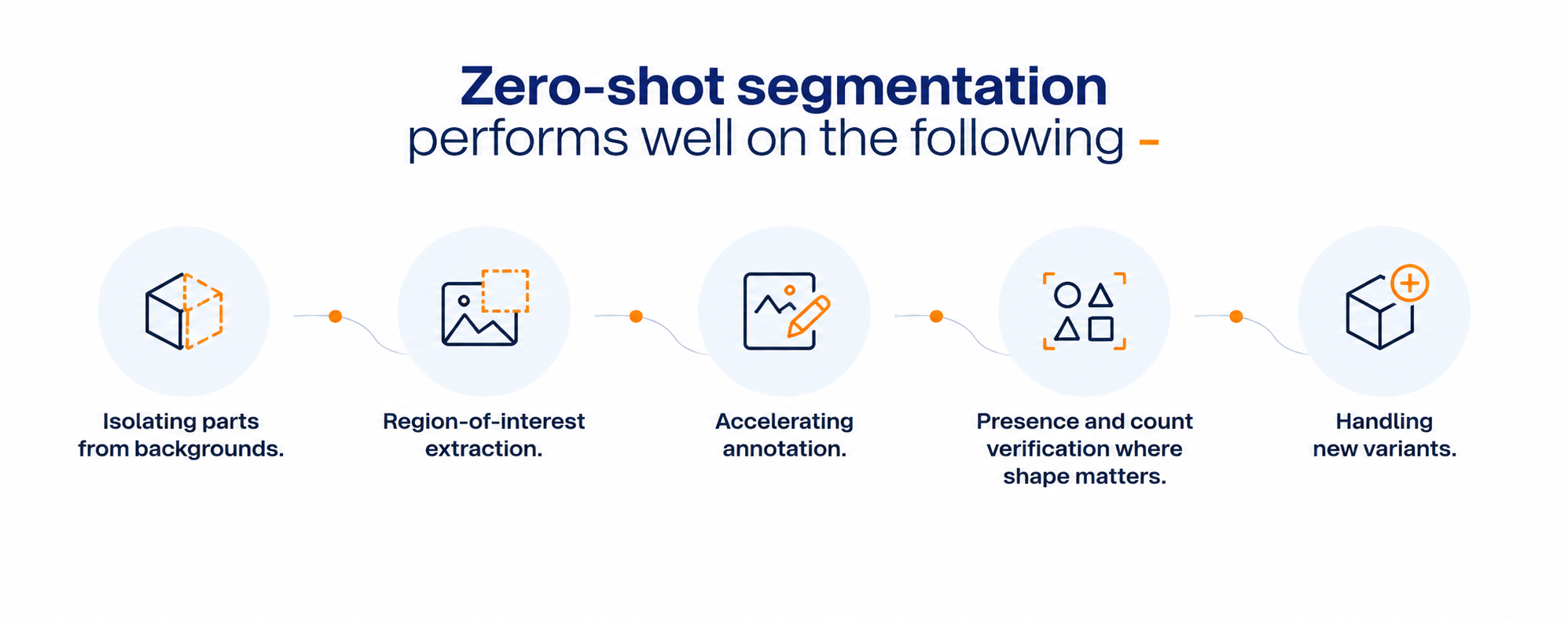
The strongest fits share one trait: the region being segmented is visually distinct from its surroundings.
In each case, the model performs localization. It reports where something is. A separate step decides whether that something is acceptable.

Where zero-shot segmentation is unreliable

The limitations map closely onto the defect types manufacturers care about most.

Fine and low-contrast defects

Hairline cracks, micro-scratches, faint discoloration, and subtle porosity often lack clear edges. The SAM authors state that the model can miss fine structures, sometimes generates small disconnected components, and does not produce boundaries as crisply as more computationally intensive methods.[1] On a production line, a missed hairline crack is not a small error to be overlooked.

Acceptance criteria

A mask is not a verdict. The model can outline a mark on a surface without any sense of whether that mark is cosmetic, within tolerance, or cause for rejection. Acceptance criteria live in your quality system, not in a general-purpose model.

Consistency across imaging conditions

Glare, reflective metal, transparent packaging, and shifting ambient light can change results from one frame to the next. The absence of task-specific training does not reduce a model’s sensitivity to imaging conditions.

Speed at line rate

Large foundation models are computationally heavy. Where a decision must be made inside a single machine cycle, the full model may not keep pace without dedicated hardware or a lighter distilled version.

Zero-shot detection vs. segmentation: which does your inspection need?

The two terms are often blended, and the difference affects system design. Zero-shot detection in industrial inspection draws a box around a candidate and assigns a label. Zero-shot segmentation draws the outline. Detection is usually sufficient for presence, position, and counting, and it costs less to run. Segmentation earns its additional compute when shape, area, or boundary precision matters, such as measuring a coating gap or the extent of a surface defect.
Aspect Zero-shot detection Zero-shot segmentation
Output A box and a label A pixel-level outline (mask)
Best for Presence, position, and counting Shape, area, and boundary precision
Compute cost Lower Higher
Example Confirming a part is present Measuring a coating gap or defect extent
Teams often chain the two. An open-vocabulary detection model locates candidate regions from a text prompt in production, and a segmentation model outlines what sits inside each box.

Where does the Segment Anything Model (SAM) fit in manufacturing workflows?

The roles above differ mainly in how much human judgment sits between the mask and the decision, and that is what should order a SAM manufacturing rollout. Exploratory analysis of archived images carries no line risk, because nothing reaches production. Annotation assistance comes next, because an engineer approves every mask before it becomes training data. Preprocessing follows, since a trained classifier still makes the call on the cropped region.
A fourth role, treating the model as the final accept-or-reject authority, is where most disappointment occurs. It is rarely the right starting point.

How do vision-language models and segmentation models work together?

Foundation models for visual inspection increasingly work as a set rather than alone. A vision-language model can be asked whether an image shows anything unusual and to describe it. A segmentation model then outlines the region it points to. That pattern is behind most current interest in vision-language models for defect detection, particularly for unfamiliar anomalies. It also stacks two sources of uncertainty, so validation on your own images matters more.

How do you test zero-shot segmentation on your production line? 7 steps

A short, structured test answers most questions before a full project starts. Seven steps cover the ground.
  1. Assemble a hard evaluation set: Include your subtle defects, reflective parts, and worst lighting, not only clear examples.
  2. Define success in operational terms: Mask overlap scores are useful, but the decisive question is whether the mask would lead to the right part disposition: accept, rework, or reject.
  3. Compare prompt types: Points, boxes, and text prompts behave differently. Test the one you would actually use in production.
  4. Measure speed on target hardware: Benchmark on the device that would sit near the line, not a research workstation.
  5. Repeat across shifts and variants: Run the same prompts on images from different shifts, operators, lighting states, and a recent part variant, to see whether performance holds without adjustment.
  6. Record how it fails, not only how often: A model that misses in predictable ways is easier to manage than one that fails at random, and a clear list of what it misses is as valuable as an accuracy score.
  7. Check review time and traceability: If reviewing uncertain masks takes longer than manual inspection, the workflow needs redesign. Record model version, prompt, and image for each output so decisions can be audited later, a standard practice in production MLOps pipelines.
If a zero-shot model performs well only after heavy prompt tuning on a handful of images, run the same prompts on a fresh batch before trusting the result. Overfitting prompts is easier than it looks.

When should you move from zero-shot to a fine-tuned model?

Move beyond zero-shot when fine defects dominate, tolerances are tight, or decisions must be made within a machine cycle. Zero-shot segmentation for industrial inspection is often the fastest way to learn whether a computer vision inspection project is tractable, but it is not always the final answer. In those cases, the usual next step is fine-tuning on a modest set of your own images or distilling results into a smaller model.

How Intuceo approaches segmentation work

Intuceo starts with the inspection decision the business needs, then works backward to whether segmentation, detection, or a simpler rule is the right tool. Scope your inspection use case with an AI architect.

Two capabilities carry most of the delivery on vision work. High-fidelity visual inspection applies image segmentation, sub-pixel anomaly detection, and automated feature extraction to sub-millimeter defects, including precision medical optics, where surface anomalies, edge irregularities, and contaminants have to be caught at production speed. Multi-modal vision intelligence brings video, image, and metadata streams together so inspection results arrive alongside line system signals rather than in a separate console.

Deployment is the part that has to survive audit. Intuceo delivers in on-premise, private cloud, and air-gapped environments, driven by PhD-led engineering teams with prior deployments in regulated and high-precision environments. See how this applies across AI-driven advanced manufacturing and to the ML and computer vision capability built for it.

Join AI Dream Session, Vol. 2: Computer Vision Reimagined

AI Dream Session, Vol. 2: Computer Vision Reimagined is a 45-minute live session with Intuceo on Thursday, September 24, 2026, at 11:00 AM ET. It covers how newer vision models reduce dependence on large labeled datasets, and where accuracy and production conditions still create hard problems.

Frequently Asked Questions

It is the ability to outline objects or regions in an image using a pretrained foundation model, guided by a prompt such as a point, box, or text description, without training on your specific parts. In inspection, it is most often used to isolate components, extract regions of interest, and speed up labeling, rather than to make final quality decisions on its own.
Not entirely. They can sharply reduce the labeling needed to get started and can pre-label images for engineers to correct. You still need a labeled evaluation set from your own line to confirm performance, and many subtle defect types still benefit from fine-tuning on examples specific to your process.
Four limits dominate: weak performance on fine or low-contrast defects, no built-in understanding of acceptance criteria, sensitivity to glare and lighting changes, and heavy compute requirements for large models.
Yes, in well-chosen roles: annotation assistance, preprocessing that isolates parts or regions, and exploration of archived images. Using them as the sole accept-or-reject authority is riskier.
Not always. Large foundation models are computationally heavy, so decisions inside a single machine cycle may need dedicated hardware or a smaller distilled model.

AI Compliance for Florida Government Contractors: What GSA Vendors and State Agencies Must Know in 2026

For most of the last two years, the conversation around AI compliance for Florida government contractors stayed at the level of study groups and advisory reports. That is changing.
Two threads are shaping what a compliant deployment actually looks like: a body of Florida AI legislation that has moved from monitoring emerging technology to restricting who the state can contract with, and a security regime that predates the AI debate but governs every system an agency runs. A vendor that understands one without the other will struggle to close and deliver.
This blog maps the legal picture for 2026, separates the federal contracting channel from the Florida one, and sets out what agencies and their suppliers should be preparing to prove.
AI compliance for Florida government contractors means satisfying two separate regulatory regimes: federal requirements (FISMA, FedRAMP, and GSA contract terms for agencies using federal funds) and Florida state requirements (the State Cybersecurity Act under Section 282.318 and DMS procurement rules). These are independent channels a GSA MAS contract does not automatically qualify a vendor for Florida state work. Vendors operating in both must carry separate qualifications and design their AI delivery to meet both sets of controls.

Florida AI Regulations for Government Agencies: From Advisory Council to Contracting Rules

Florida’s first substantive move came in 2024, when Senate Bill 1680 created the Government Technology Modernization Council inside the Department of Management Services (DMS) to study and monitor how artificial intelligence is developed and deployed across state government and the private sector. That law set up an advisory function.
However, it does not impose conditions on how agencies buy AI. The 2026 session covers that aspect.
The measure known as the Artificial Intelligence Bill of Rights, filed as Senate Bill 482 and sponsored by Sen. Tom Leek moves the state from observation to enforceable obligation. Governor Ron DeSantis named AI guardrails a priority for the session, and the bill advanced through committee with bipartisan support. Its provisions reach directly into procurement and delivery for anyone selling Florida state government AI capabilities:
Read together, Senate Bill 1680 and Senate Bill 482 answer the core question behind Florida AI regulations for government agencies in 2026: an advisory council studying the technology, layered with contracting restrictions, data-handling limits, and disclosure duties that a vendor must satisfy in the solution it delivers, not only in its contract paperwork.

How Florida AI Contracting Rules Reshape a Vendor's Proposal and RFP Response

The obligations in the Artificial Intelligence Bill of Rights change what an agency will expect to see in a Request for Proposal (RFP) response and in the system delivered.
Ownership and supply-chain provenance move to the front of the evaluation. A vendor should be ready to show where its models, data, and infrastructure originate and to attest that no part of the delivery runs through an entity the statute would exclude.
Data handling becomes a design requirement rather than a policy attachment: if personal information cannot be disclosed unless de-identified, then de-identification, minimization, and retention controls have to be built into the pipeline and documented.
Transparency cannot be treated as a mere marketing claim. When a system speaks to a resident, the disclosure obligation has to be present in the interface, logged, and testable during acceptance.
The restrictions apply at renewal and extension. So, an incumbent supplier faces the same screening as a new bidder. A change in a subcontractor’s ownership, or a data-handling gap surfaced during a review, can put a sitting contract’s renewal at risk.

GSA MAS vs. Florida DMS: Why Federal and State AI Procurement Are Different Channels

A recurring error in vendor strategy is assuming a federal contract vehicle carries into state work. It does not, and the distinction matters for how a supplier reaches Florida agencies.
On the federal side, the General Services Administration (GSA) has made buying AI markedly easier. In August 2025, it added the leading commercial AI systems to its GSA MAS AI contract vehicle, giving civilian federal agencies pre-negotiated terms through a single channel.
Holding a GSA MAS AI contract is a credential for selling to federal buyers. However, it is not a route into Florida state procurement.
A GSA MAS award covers federal agencies and does not- by default- extend to state or local buyers. Florida agencies purchase through the state’s own vehicles, chiefly the DMS state term contracts and the MyFloridaMarketPlace system, under Florida procurement law. Hence, a supplier that wants to serve both markets must have two separate qualifications.
This is how AI compliance for Florida government contractors works in practice: the GSA relationship earns the federal work, and a distinct state-side qualification and security posture earns the Florida work.

What Cybersecurity Standards Govern AI Deployments for Florida State Agencies?

The Federal Information Security Modernization Act (FISMA) sits behind a common misconception about FISMA AI compliance in Florida. FISMA governs federal information systems and the contractors that handle federal data. It is not the standard a Florida state agency applies to its own systems.
Florida deployments answer to the State Cybersecurity Act, codified at Section 282.318 of the Florida Statutes, which names the Florida Digital Service inside DMS as the lead entity for state cybersecurity standards and requires those standards to track the National Institute of Standards and Technology (NIST) Cybersecurity Framework.
Agencies inventory their systems and vendors, run periodic risk assessments, and report significant incidents on defined timelines. The detailed controls live in the Florida Cybersecurity Standards at Chapter 60GG-2 of the Florida Administrative Code (F.A.C.).

The practical takeaway for suppliers

A vendor can bid on and win Florida state technology work without a FISMA authorization, because FISMA governs federal systems rather than state ones. What the vendor must satisfy is Florida’s NIST-aligned standard under Section 282.318, and, for cloud delivery, whatever authorization the agency specifies, often referencing the Federal Risk and Authorization Management Program (FedRAMP) or its state-focused equivalent. A supplier serving federal agencies through GSA and Florida agencies through DMS is answering to both regimes at once, which is manageable only when the underlying controls are designed to serve both.

Public Sector Data Analytics in Florida: How Governance Requirements Are Reshaping AI Delivery

The direction of travel for public sector data analytics in Florida follows from the same rules. The state’s cloud-first policy pushes agencies toward hosted delivery, its cybersecurity standards demand provenance and auditability, and the proposed AI Bill of Rights would have added de-identification and disclosure on top. Analytics engagement for a state health program, a revenue agency, or a public-safety function now has to carry those controls from the first data ingestion and pipeline design rather than retrofitting them before an audit.
That reshapes how services firms should package what they sell. The winning form is a use-case solution with governance built into it: defined data lineage, de-identification applied where the statute requires it, model behavior that can be explained and logged, and an audit trail an agency reviewer can follow.
Modern customers are not interested in buying a capability in the abstract; they look to buy delivery models that will survive the Florida Digital Service’s standards and the contracting conditions attached to it.
This is the frame Intuceo’s public sector AI practice, a Jacksonville-based artificial intelligence and data analytics services firm with over two decades of public sector delivery experience, works within. Its public sector delivery pairs enterprise AI and data engineering with the governance controls Florida’s standards demand, reaching federal agencies through its GSA MAS qualification and Florida agencies through the DMS state term contract as separate, properly credentialed channels. Compliance is part of the solution design  a standard Intuceo applies across AI consulting engagements in Florida.

What AI vendors selling to Florida state agencies must satisfy

Take a compliance-ready path into Florida's public sector

See how a governance-first delivery, qualified for both federal and Florida state buying, shortens the distance between an RFP and a system that passes review.

Frequently Asked Questions

Two instruments define the 2026 picture. Senate Bill 1680 (2024) created the Government Technology Modernization Council within DMS to study and monitor AI across state government. Senate Bill 482, the Artificial Intelligence Bill of Rights, passed the Florida Senate in March 2026 but died in the House before becoming law. Had it passed, it would have added enforceable rules: restrictions on contracting with providers tied to a foreign country of concern, limits on selling or disclosing personal data unless de-identified, disclosure when a system is AI rather than human, and protections for minors. The bill is expected to be reintroduced in the 2027 session. Separately, every state system must meet the cybersecurity standards under Section 282.318 of the Florida Statutes.

SB 1680 itself does not impose contracting restrictions. It created the Government Technology Modernization Council to advise the Governor and Legislature on how AI is used across state government and the private sector. The procurement-facing conditions, including the ban on contracting with certain foreign-linked providers, come from the 2026 Artificial Intelligence Bill of Rights, Senate Bill 482.  

A GSA MAS award qualifies a contractor to sell to federal agencies, which brings federal obligations such as FISMA and, for cloud, FedRAMP.3 That award does not carry into Florida state work. To serve Florida agencies, the same contractor qualifies through DMS procurement and meets Florida’s cybersecurity standards under Section 282.318. Vendors should also monitor the 2027 session for reintroduction of AI-specific contracting obligations.

Yes. FISMA governs federal information systems, not Florida state ones. A vendor can bid on and win Florida state work without a FISMA authorization, provided it meets Florida’s NIST-aligned standards under the State Cybersecurity Act, Section 282.318 of the Florida Statutes. For cloud delivery, an agency may still require FedRAMP or a state-focused equivalent.

A Decision Framework for Revisiting Shelved Computer Vision Inspection Projects in Manufacturing (2026)

Many plants carry at least one computer vision inspection initiative that cleared a pilot and then went quiet. The reasons were usually sound. The defect was too rare to build a training set. Parts changed faster than the model could be retrained. The labeling bill outgrew the savings, or integration with the line took longer than anyone had budgeted.
Vision models have moved on since then, and some of the constraints that stopped a computer vision inspection program in manufacturing have loosened-while others have not. For operations and quality leaders, the task is sorting shelved computer vision projects into three groups: the ones newer AI makes worth a revisit, the ones that need a scoped test first, and the ones that should stay exactly where they are. This framework is built for that sort.
KEY TAKEAWAYS

Why Computer Vision Inspection Projects in Manufacturing Get Shelved

Before scoring anything, name the real reason each project stopped. Most paused AI projects in manufacturing trace back to one of six causes:
The first three are data problems. The next two are engineering and operating problems. The last has nothing to do with technology at all. That distinction decides which projects newer models can realistically help.

What Has Changed in Manufacturing Computer Vision-and What Hasn’t

Foundation models pretrained on broad image collections have reduced the labeled data required by certain inspection use cases. Zero-shot and open-vocabulary approaches let teams describe what to look for rather than training a separate model for every defect category from scratch. 
Modern AI defect detection in manufacturing now includes these foundation models, which reduce the labeled data required for industrial inspection across a wider range of part types and defect categories.
Industrial anomaly detection also has a standard reference point. The MVTec Anomaly Detection benchmark, built specifically for industrial inspection, provides defect-free training images for each category and a test set containing both defective and defect-free images, with pixel-precise annotations of the anomalies. It holds more than 5,000 high-resolution images across fifteen object and texture categories. [1] 
That setup mirrors a common plant reality: plenty of good parts, very few bad ones. For manufacturing plants where visual inspection AI programs stalled because defects were rare, anomaly detection methods built around defect-free training images are worth a fresh look.

What has not changed

Better models do not fix optics. Poor lighting, glare, vibration, and inconsistent part positioning still break inspection. Large models can still be too slow for decisions inside a single machine cycle. Integration with manufacturing execution systems (MES) and programmable logic controllers (PLCs) still takes engineering effort. And a project without a clear owner on the plant floor will stall again, whatever model sits underneath.

Six Criteria for Evaluating a Paused Computer Vision Pilot

Use the table below to score each shelved project. It is designed to be completed in a working session with quality, operations, and data teams in the same room.
Criterion Question to ask Signal to revisit Signal to leave shelved
Original blocker Why did the project stop? Data scarcity, variation or labeling cost Business context changed or no owner
Value today Is the machine vision quality control gap still costing money in escapes, scrap or inspector hours? Escapes, scrap or inspector hours persist Line retired or defect designed out
Data on hand Do archived images still exist? Images and some confirmed defects available Nothing retained from the pilot
Speed requirement How fast must a decision happen? Seconds or sampled inspection is acceptable Hard real-time at very high line speed
Integration path Can results reach the line? Clear route to MES, PLC, or operator screen No path, and no budget to build one
Ownership Who will run it in production? Named quality or operations owner Only a data team champion
Score each row as a clear yes, partial, or no. Projects with strong answers on original blocker, value, and ownership are the best candidates, even if the other rows need work.

Sorting projects into three groups

Reopen now

These projects stopped because of data scarcity, part variation, or labeling cost, but still address a live problem and have a named owner. Archived images exist. Speed requirements are manageable. For these, zero-shot inspection or anomaly detection trained on good parts can often be tested within a short, contained assessment.

Reassess with a scoped test

Here the value is real, but one or two rows are uncertain. The line may run fast, or integration may have been the original sticking point. Run a focused test that answers the uncertain question directly, such as whether the model can meet cycle time on the current hardware, before committing to a restart.

Leave on the shelf

Some projects should stay paused. If the line was retired, the defect was designed out, or nobody in operations will own the result, better models change nothing. Closing these formally clears space for the candidates that matter.

A practical reassessment sequence

Deciding when to restart vision AI work is easier with a fixed sequence. The steps below keep the reassessment small and evidence-based.

Common mistakes when reopening a shelved project

Teams that restart vision work too quickly tend to repeat common errors. Watching for them saves a second shelving.

How to Rebuild the AI Visual Inspection Business Case for 2026

Old business cases carry old assumptions. Rebuilding AI inspection ROI for 2026 means checking which inputs have actually moved since the original approval:
One caution: a shelved project that looks attractive only because the new model was tested on easy images has been re-pitched rather than reassessed. Insist on the same difficult cases that stopped it the first time. Manufacturing defect detection AI that clears those, at production line speed and under production lighting, has earned a restart budget. Anything less has earned another test.

How Intuceo Approaches Computer Vision Inspection Reassessments

Reassessments run on the same structure Intuceo uses to judge any AI initiative before it reaches production. The DARWIN AI governance framework separates the question into dimensions that can each be answered independently:
A project can pass on model accuracy and still fail on three of those four, which is why the judgment is never made on a model alone.
For vision work, two capabilities carry most of the delivery. High-fidelity visual inspection applies image segmentation and sub-pixel anomaly detection to sub-millimeter defects, including precision medical optics, where surface anomalies, edge irregularities, and contaminants have to be caught at production speed. Intuceo’s multi-modal vision intelligence capability brings video, image, and metadata streams together so an inspection result lands alongside line system signals instead of a separate console-see how this is applied across our advanced manufacturing AI solutions.
Deployment is half of a reassessment that has to survive audit-a challenge Intuceo addressed directly in its advanced ML inspection pipeline case study. Intuceo delivers in on-premise, private cloud, and air-gapped environments, and client data is not used to train public models. For a plant that cannot accept a hosted model changing behavior between validation runs, that removes the variable rather than managing around it.
PhD-led engineering teams with prior deployments in regulated and high-precision environments deliver solutions to fit your unique needs. See how that applies across our advanced manufacturing AI solutions and to our computer vision and AI capabilities built for it.

Have a vision project sitting on the shelf?

AI Dream Session, Vol. 2: Computer Vision Reimagined is a 45-minute live session with Intuceo on Thursday, September 24, 2026, at 11:00 AM ET. It covers which previously rejected use cases may now be viable, where limitations still hold in production, and the questions worth asking before any project is reopened.
Get the reassessment questions before your next project review

Frequently Asked Questions

A shelved vision project is worth revisiting if it originally failed due to data scarcity, part variation, or labeling cost-not due to line speed limits, integration barriers, or lack of ownership. Start with the reason it stopped. If the blocker was too few defect examples, frequent part variation, or labeling cost, newer vision AI models may help. Then test on archived images from the original pilot, measured against the original acceptance criteria. If the blocker was line speed, integration, or lack of ownership, better models alone are unlikely to change the outcome.

Six criteria determine whether a paused computer vision project is worth restarting in manufacturing:
(1) original blocker,
(2) current cost of the problem, (3) availability of archived images,
(4) line speed requirements,
(5) integration path to MES or PLC, and
(6) named operational ownership. Projects that score well on blocker, value, and ownership are usually the strongest candidates.

Four inputs in an old computer vision inspection business case are worth re-checking in 2026: labeling effort (often lower for foundation model use cases), retraining frequency (potentially less frequent where models generalize across part variants), compute cost per image (potentially higher with larger models at the line), and the value of catching a defect (unchanged-set by your process, not by the model). Re-check the first three against your own parts before any approval, and leave the fourth where the original case had it.

Revisit the ones canceled for data or variation reasons, where the underlying problem still exists, and a plant owner is ready to run the result. Leave closed the projects whose lines were retired, whose defects were designed out, or that lacked operational ownership. A short, documented reassessment is the fastest way to tell the difference.

Jacksonville’s Enterprise AI Ecosystem: Growth, Key Players, and Economic Impact

Northeast Florida’s artificial intelligence (AI) activity is concentrated where enterprise value is realized: in production systems at large, regulated employers. The Jacksonville AI ecosystem is taking shape around that demand, anchored by financial technology and healthcare organizations applying AI to regulated workflows.
Financial technology and healthcare organizations based in Jacksonville are applying AI to financial crimes investigation and clinical data, and a network of services firms, universities and public agencies is developing around that demand. Together they form the Jacksonville enterprise AI ecosystem, which is beginning to shape where the region invests, hires and builds.
Brookings Metro’s 2025 assessment of U.S. metro areas reflects this profile, identifying notable enterprise AI adoption in Jacksonville and metros in its tier.[1]
This article examines the enterprises leading adoption, the capability forming around them, how Jacksonville compares with Tampa and Miami, and what the pattern means for Northeast Florida’s economy.

Key Takeaways

Which Regulated Enterprises Are Leading AI Adoption in Jacksonville?

Brookings’ guidance for metros in Jacksonville’s tier is to build AI capability around the needs of the region’s largest employers, prioritizing focused deployments that address recurring challenges in government, manufacturing and health care.[1] Jacksonville is well positioned to follow that model, with employers such as Fidelity National Information Services (FIS) and Mayo Clinic already applying AI in regulated settings.
FIS, headquartered in Jacksonville, announced in May 2026 that it is working with Anthropic on a Financial Crimes AI Agent. The agent is designed to assemble evidence across a bank’s core systems for anti-money-laundering (AML) investigations, with BMO and Amalgamated Bank among the first institutions in development. FIS has stated that every agent decision will be traceable and auditable, with investigators retaining control, and has placed credit decisioning, customer onboarding and fraud prevention on the same roadmap.[2]
Healthcare institutions in Jacksonville are building comparable capability, consistent with the broader trend Intuceo has observed in its healthcare AI engagements across the region. In April 2026, Mayo Clinic’s Jacksonville campus hosted the latest edition of its Datathon and Data Summit, which began in 2025. The event brought healthcare professionals together with computer scientists, engineers and mathematicians to address clinical problems using real-world datasets, followed by sessions on AI and data sharing.[3]

Jacksonville’s AI Services Ecosystem: Firms Supporting Enterprise Adoption

Production AI in regulated environments depends on partners that can integrate models with legacy data, security controls and compliance obligations.
Several AI companies in Jacksonville provide that capability, and global services firms are investing in it. In May 2026, Infosys completed its acquisition of Optimum Healthcare IT, a Jacksonville Beach healthcare digital transformation and consulting firm, positioning the combined business around AI-driven cloud and data transformation for health systems.[4]
The table below maps Jacksonville AI companies contributing to each layer of the regional ecosystem.
Role Examples Contribution
Enterprise adopters FIS; Mayo Clinic’s Jacksonville campus AI applied to financial crimes investigation and clinical data
AI and data services firms NLP Logix; Intuceo; Optimum Healthcare IT (now part of Infosys) Model development, data engineering and integration for regulated clients
Public sector Jacksonville Transportation Authority Autonomous shuttle service in downtown Jacksonville
Talent institutions University of North Florida; University of Florida Workforce AI literacy and planned graduate programs in AI and data analytics

Public Sector AI: Jacksonville’s Autonomous Vehicle Initiative and What It Signals

Jacksonville’s public sector is applying autonomous technology in day-to-day operations. In June 2025, the Jacksonville Transportation Authority (JTA) launched Neighborhood Autonomous Vehicle Innovation (NAVI), which it describes as the first public transportation service in the United States powered by autonomous vehicles.
NAVI operates along the 3.5-mile Bay Street Innovation Corridor between Pearl Street and EverBank Stadium, linking residential areas and the downtown business core with the Sports and Entertainment District.[5]
For regional economic development, the service establishes operating experience that remains rare among U.S. public agencies: running autonomous vehicles on a published schedule, with the operations, maintenance and oversight functions that entails.

How Jacksonville Universities Are Building the Region’s AI Talent Pipeline

Sustaining enterprise adoption will require a broader base of AI practitioners, and two institutions are developing it at different levels.
The University of North Florida (UNF) launched its AI for Work and Life certificate in fall 2025, sponsored by Jacksonville-based NLP Logix. UNF reports more than 47,000 registrants, representing more than 12,000 businesses across Northeast Florida.[6] Programs at this scale build the AI literacy employers need for responsible adoption across their workforces.
Specialist capability is the complementary requirement. The University of Florida (UF) opened its graduate campus near the Prime F. Osborn III Convention Center in Jacksonville in September 2026. UF’s program plans include a Master’s in Computer Science with concentrations in AI and cybersecurity, a Master’s in Engineering Management with a data analytics concentration, and a Master’s in AI in Biomedical and Health Sciences. These programs align closely with the region’s financial technology and healthcare demands.

Jacksonville vs. Tampa vs. Miami: How Florida’s AI Markets Compare

Brookings’ 2025 AI metro ranking provides a consistent basis for comparing which Florida cities are leading in AI and where Jacksonville currently stands.[1]
Metro area Brookings tier What the tier indicates
Miami Star Hub Balanced strength across talent, innovation, and adoption
Gainesville Star Hub Strength across all three pillars, with UF as a major research driver
Tampa Emerging Center Top-tier talent and adoption, with innovation still developing
Tallahassee Focused Mover One clear strength in adoption, with solid footing elsewhere
Jacksonville Nascent Adopter Mid-level standing across talent, innovation, and adoption
Each market reflects a different mix of strengths. Miami and Gainesville combine talent, research and adoption, and Tampa pairs talent with adoption. Jacksonville’s distinguishing strength is concentrated enterprise demand. Talent and research measures, such as computer science graduates and AI research output, are where metros in its tier have the most room to grow, and the graduate programs described above address that directly.
The Florida High Tech Corridor serves a 23-county region, and its Northeast Florida area comprises Flagler and Putnam counties.[8]
Jacksonville’s role in the broader Florida tech corridor has developed independently of that initiative, anchored by corporate headquarters and health systems.
For a deeper look at how Intuceo’s two-decade Jacksonville history shaped its regulated-industry focus, see Why Intuceo Is Based in Jacksonville.

What Jacksonville’s AI Ecosystem Means for Northeast Florida’s Economic Growth

Jacksonville’s contribution to Florida’s AI economy is an established base of enterprises running AI within regulated operations. That demand supports regional growth through three channels.
For Jacksonville tech companies operating within this AI ecosystem, the most substantial opportunity lies in regulated delivery: financial crimes, clinical data, public-sector operations and industrial analytics, where enterprises require explainable systems and partners who remain accountable after deployment.
The same lens applies to any Northeast Florida AI adoption strategy. Progress is best measured by the number of AI systems in production at regional employers, the share of that work delivered by regional firms, and the number of residents qualified to deliver it.

Where Intuceo fits in the Jacksonville enterprise AI ecosystem

Intuceo is headquartered in Jacksonville and delivers AI, machine learning, and data engineering for enterprises in healthcare, life sciences, manufacturing, and the public sector. Its PhD-led teams apply accelerators developed across two decades of engagements, including Intuceo-Ax™, Intuceo-Ix™, Intuceo-Dx™, and the iPDLC™ delivery framework, to shorten the path from a defined use case to a governed production system. Florida state agencies can engage Intuceo through its Department of Management Services (DMS) term contract. Learn more about Intuceo’s public sector AI work.

Move a priority AI use case into governed production

Intuceo works with Jacksonville enterprises to assess the feasibility, data readiness and compliance requirements of a defined use case, and to set out a clear path to a governed production system that meets regulatory and audit expectations.

Frequently Asked Questions

Adoption is led by large employers applying AI to regulated work, including FIS in financial crimes investigation and Mayo Clinic’s Jacksonville campus in clinical data. They are supported by AI and data services firms such as NLP Logix, Intuceo, and Optimum Healthcare IT, which Infosys acquired in 2026.

Brookings ranks Miami as a Star Hub and Tampa as an Emerging Center, and places Jacksonville in its Nascent Adopter tier. Jacksonville’s growth is driven primarily by AI adoption at large regulated employers, while Miami and Tampa currently show greater depth in talent and research. Programs at UNF and UF are expanding that depth locally.

Current examples include FIS’s work with Anthropic on an AI agent for anti-money-laundering investigations, JTA’s autonomous NAVI shuttle service in downtown Jacksonville, Mayo Clinic’s Datathon and Data Summit, and UF’s graduate programs in AI and data analytics.

Jacksonville’s specialist AI talent base is developing alongside enterprise demand. Gainesville draws on UF’s research strength, and Tampa pairs strong talent with adoption. In Jacksonville, UNF’s AI certificate has extended AI literacy across the regional workforce, and UF’s graduate programs in AI and data analytics focus on specialist roles.

Jacksonville offers enterprise buyers across financial services, healthcare, and logistics, a cost-competitive operating environment, and growing specialist AI talent through UNF and UF’s downtown campus. It is best suited for regulated-industry AI firms that need proximity to large employer clients rather than a deep early-stage startup ecosystem.

GenAI Vision vs Classical Computer Vision: An Honest Cost Comparison for Manufacturers

Most cost comparisons between generative AI (GenAI) vision and classical computer vision stop at the model, which is usually the smallest line on the bill. The bigger numbers sit in labeling, retraining every time a part changes, compute at the edge or in the cloud, and the engineering hours it takes to make any model behave under real plant lighting.
Plant and quality leaders weighing GenAI vision vs classical computer vision for manufacturing are rarely choosing between old and new technology. The real choice is where the money goes: upfront into data, or ongoing into compute and supervision. This guide breaks down both cost profiles, shows where each approach earns its place, and explains why many inspection programs end up running both.

Key Takeaways

What each approach actually is

In this guide, classical computer vision means a model built for one defined job and trained on your own parts. It might be a rules-based machine vision setup or a trained deep learning model, typically a convolutional neural network, that learns to find scratches on one specific housing from labeled examples. Inside that scope, it is fast and accurate; outside it, the model sees nothing.
GenAI vision relies on foundation models pretrained on very large, broad image and text collections. These models can be prompted to locate or describe things they were never specifically trained to find. Open-set detectors such as Grounding DINO accept category names or plain-language descriptions as input, and the largest variant reported in the original research reaches 52.5 average precision (AP) on the Common Objects in Context (COCO) zero-shot transfer benchmark without using any COCO training images.
That figure comes from a research benchmark built on everyday objects, which proves the approach works in principle but says nothing about your defect types.

The cost of classical computer vision, line by line

Classical projects spend most of their budget before the first production image is scored. The main cost lines look like this:
Classical vision is expensive at the start and again at every changeover, then cheap to operate in between. Stable, high-volume lines with a known defect list absorb that profile well, while high-mix lines feel the retraining cost repeatedly.

The cost of GenAI vision, line by line

GenAI vision moves the spend rather than removing it. The cost lines change shape:
GenAI vision costs less to reach a first result, stays flatter when parts change, and carries a steadier running bill that grows with inspection volume.

Zero-shot detection vs trained model: where the break-even sits

The useful comparison of zero-shot detection vs. a trained model is not about accuracy in the abstract. It is about which operating conditions make each cost profile cheaper over time. Here are the core deciding factors:
Factor Favors a classical trained model Favors GenAI vision
Part variety Few, stable part numbers Many variants or frequent revisions
Defect frequency Common and well documented Rare or hard to collect in volume
Decision speed Must decide within a machine cycle Can wait seconds or run offline
Image volume Very high and continuous Lower volume or sampled inspection
Defect definition Stable and measurable Descriptive or still evolving
Compute location Isolated line, edge only On-site GPU servers or reliable network
If most of your answers land in the left column, a trained model is likely the cheaper long-run option, even with its labeling bill. If most land on the right, GenAI vision deserves a serious look. Mixed answers usually point to the hybrid pattern described below.

Vision AI total cost of ownership over three years

A single project quote rarely captures vision AI total cost of ownership. A more honest view spreads cost across three phases and asks the same questions of both approaches.

Year one: build and validate

Classical projects carry the heaviest year one bill because collection and labeling happen here. GenAI projects usually reach a working prototype faster, but they should budget real time for an evaluation set and for the prompt and threshold work that turns a demonstration into something a quality manager will sign off on.

Years two and three: run and change

This is where the curves separate. Classical vision stays cheap to run but spikes at every part change or new defect type. GenAI vision absorbs change more gracefully but carries a steady compute and review cost. Plants that change parts often tend to see GenAI costs flatten over time, while plants that run the same parts for years often see classical vision win on cost.

The costs both approaches share

Camera and lighting design, integration with manufacturing execution systems (MES) and programmable logic controllers (PLCs), operator training, and change control apply to both. Ignore them and every comparison will look better than reality.

The hybrid pattern many programs land on

Many inspection programs stop treating this as an either-or decision. A common pattern uses each approach where it is cheapest:
The hybrid pattern does not remove labeling or compute; it places each where it costs the least.

Computer vision return on investment in manufacturing: what to measure

Credible computer vision ROI in manufacturing comes from operating metrics, not model scores. Five measures cover most business cases :
One caution before any vendor call: a quote that covers the model but leaves out labeling, validation, compute, and change management accounts for one line of an AI inspection cost estimate, not the whole of it.

Where Intuceo fits

Intuceo works with manufacturers on inspection problems where the choice between approaches is genuinely unclear. The starting point is the operating conditions on the line rather than a preferred model family: part variety, defect rarity, cycle time, and how often the process changes.
Two capabilities carry most of that work. High-fidelity visual inspection applies image segmentation and sub-pixel anomaly detection for sub-millimeter defect recognition, including precision medical optics, where surface anomalies, edge irregularities, and contaminants have to be caught at production speed. Multi-modal vision intelligence fuses video, image, and metadata streams. So, inspection results sit alongside MES signals instead of in a separate system, which is what makes defect prediction possible before a variance becomes a downstream failure.
On the model versioning cost described earlier, Intuceo deploys in on-premise, private cloud, and air-gapped environments, and client data is never used to train public models. For plants that cannot accept a hosted model changing behavior between validation runs, that removes the variable rather than managing around it.
The work is delivered by PhD-led engineering teams with more than 250 enterprise data and AI deployments behind them. See how that applies across manufacturing and to the Modular AI Assets built for reuse across engagements.

Deciding whether a stalled vision project is worth reopening

Join AI Dream Session, Vol. 2: Computer Vision Reimagined – a live 45-minute session with Intuceo AI Labs on Thursday, September 24, 2026, at 11:00 AM Eastern.
You will see what has genuinely changed in computer vision, where infrastructure and deployment costs still matter, and how to decide which use cases deserve a second look.

Frequently Asked Questions

It depends on where you look. GenAI vision is usually cheaper to reach a first working result because it needs far less labeled training data. Classical computer vision is usually cheaper to run per image once trained, especially at high volume on an edge device. Over several years, the cheaper option is often decided by how frequently your parts and defect types change.

Zero-shot detection tends to win when defects are rare, part variants change often, or the team needs a feasibility answer before investing in labeling. A trained model tends to win when the defect list is stable, examples are plentiful, and decisions must be made within tight cycle times. In every case, results should be confirmed on your own images before any production decision.

Yes. Buyers asking what enterprise AI firms are based in Jacksonville will find several with genuine enterprise delivery records, spanning applied machine learning, computer vision, generative AI, and the data engineering foundations underneath them. The more useful screen is depth in your industry and the seniority of the people assigned, since enterprise AI work in healthcare, financial services, or manufacturing depends far more on domain understanding than on general modelling skill.

There is no reliable single figure, and any published average should be treated with caution. Cost is driven by the number of part variants, defect rarity, required inspection speed, camera and lighting work, integration with line systems, and how often the process changes. A scoped assessment against those drivers gives a far more dependable estimate than a benchmark number.

Data Engineering Firms in Jacksonville, FL: What Enterprise Buyers Need to Know Before Signing

By the time a statement of work (SOW) reaches signature, the selection is effectively over. The vendor is chosen, the budget is approved, and the document gets treated as paperwork. That is usually where the real cost of the engagement is set.
Ambiguity in that document has a long tail. A deliverable nobody can test, a dependency nobody owns, a line of pipeline code whose ownership was never settled: each surfaces months later as a change order, a stalled sign-off, or a handover that leaves you dependent on the firm you were trying to exit.
This guide is for enterprise buyers in Northeast Florida who are past the shortlist and now reading a draft contract. It covers what to tighten in the document, and the regional conditions a generic legal review may miss.

What Types of Data Engineering Firms Operate in Jacksonville, FL?

Data engineering firms in Jacksonville, FL fall into four categories: national consultancies with local sales presence, specialist analytics and AI consultancies headquartered locally, vertical specialists (primarily healthcare), and staffing-led firms that fill roles rather than deliver outcomes.
A search for data engineering firms in Jacksonville, FL returns four quite different types of business under one label, and the contractual risk is not the same across them.
Buyers usually open by asking which data engineering firms in Jacksonville, FL are the best fit for their project a question that has no useful answer until the category is settled, because a legacy warehouse migration, a regulated reporting build, and a staff augmentation gap are three different purchases. The fourth type of firm will accept an SOW written for the second without objection.

Which SOW Clauses Carry the Most Risk in a Data Engineering Engagement?

Deliverables defined as artifacts, with acceptance criteria

A deliverable described as designing and implementing data pipelines is an activity. It cannot be accepted or rejected. An artifact can: a named set of ingestion jobs, a documented data model, a defined number of validated tables, a monitoring dashboard, a runbook.
Attach acceptance criteria to each one, and state who signs off and within how many business days. Silence on acceptance timelines is the most common reason a project that finished on schedule still gets invoiced as though it ran late.

Key personnel commitments under Florida's restrictive covenant rules

Ask for named key personnel with a minimum allocation and a replacement clause requiring equivalent seniority and your written approval. Then read that clause against Florida law, which is unusually permissive here.
The state’s CHOICE Act, in Chapter 542 of the Florida Statutes, treats noncompete and garden leave agreements of up to four years as enforceable for employees and individual contractors earning more than twice the annual mean wage of the Florida county where the employer’s principal place of business sits. For a firm headquartered in Jacksonville, that benchmark is Duval County’s.
This cuts both ways. A local vendor can credibly commit a specific senior engineer for the life of a multi-year programme, which national firms often will not do. It also means that if you later want to hire that engineer directly, a common outcome on long engagements, the restriction may be enforceable for years. Check the non-solicitation and hire-away terms in your SOW against what the vendor holds over its own staff.

Dependency scheduling and delay attribution

Nearly every delayed data engineering project stalls waiting on source system credentials, a security review, or a database administrator’s time. The SOW should name each dependency, name the person responsible on your side, and state what happens when one slips: a defined re-planning window, a rate for idle time, or a documented pause.
Vendors that raise this in negotiation are not difficult. Vendors that stay quiet on it are usually planning to raise a change order instead.

Intellectual property boundaries

Most experienced firms bring accelerators, meaning pre-built frameworks and code assets developed on prior engagements that shorten delivery. That is a good thing, and you should not expect to own them. What you must own outright is everything built for you: pipeline code, transformation logic, data models, orchestration configuration, and documentation.
Get the SOW to list the vendor’s pre-existing assets by name, grant you a perpetual licence to use them within the delivered work, and assign everything else to you on payment. An SOW devoid of these leaves the boundary to be argued after the invoices are paid, when you have nothing left to negotiate with.

Handover and exit provisions

Ask what you receive on the last day: repository access, environment credentials, a runbook, a knowledge transfer schedule with named attendees, and a defined support tail. For enterprise data engineering Florida buyers running regulated workloads, add data return and deletion certification to that list. A firm that cannot describe its handover in specifics has not done many.

Florida-Specific Contract Conditions for Data Engineering Engagements

Public records obligations extend to your vendor

Florida’s public records law (Chapter 119, Florida Statutes) requires that service contracts with public agencies include specific records-custodian language and obliges vendors to maintain or transfer public records when a contract ends.
If you are contracting on behalf of JEA, the City of Jacksonville, Duval County Public Schools, or the Jacksonville Transportation Authority, Florida’s public records law reaches your vendor directly.
Section 119.0701 of the Florida Statutes requires public agency service contracts to carry specific public records language, including the records custodian’s contact details in 14-point boldface type, and obliges the contractor either to transfer all public records to the agency at no cost when the contract ends or to keep and maintain the records the agency needs. A contractor that fails to produce records on request may face penalties, and a court can award enforcement costs and attorney fees against it.

The practical consequence is that a vendor unfamiliar with Chapter 119 will scope and price as though its working notes, tickets, and design documents are private. Confirm whether the firm has delivered under these terms before.

Federal contract vehicles do not cover municipal purchases

Vendors often list a General Services Administration (GSA) Multiple Award Schedule as evidence of public sector standing. That vehicle covers federal agencies. It does not, on its own, let a city or county buy through it.
If you are a state or local buyer, ask instead about a Florida Department of Management Services state term contract or your own agency’s approved vendor list. Among Jacksonville technology vendors pitching public work, this distinction separates the firms that have delivered locally from those quoting a credential that does not apply to you.

Delivery location versus registered address

A Jacksonville address can mean a headquarters, a delivery centre, or two salespeople in a serviced office. None of those is disqualifying, but each changes the SOW. Ask where the engineers physically sit, what hours they overlap with yours, how many onsite days are included rather than billable, and who attends your stand-ups.
If delivery runs partly offshore, that can be an advantage on cost and coverage, but the handoff points belong in the document rather than in a reassurance on a call.

Compliance regimes priced into scope

The three primary compliance regimes affecting enterprise data engineering engagements in Florida are: HIPAA (healthcare and claims data), the Gramm-Leach-Bliley Act or GLBA (financial services), and PCI DSS (cardholder data).

The region’s enterprise data sits heavily in healthcare, financial services, and logistics. Each carries a different regime: protected health information under the Health Insurance Portability and Accountability Act (HIPAA), customer financial data under the Gramm-Leach-Bliley Act, cardholder data under the Payment Card Industry Data Security Standard (PCI DSS).

Enterprise data engineering firms in Florida that buyers can rely on will write the applicable compliance standard into scope and price the controls, audit logging, lineage, and access restrictions that come with it. Compliance that appears only in a boilerplate annex has not been priced into the engagement, and it will surface as a change order at the first audit.

How to Evaluate a Data Engineering Partner in Jacksonville Before You Sign

How do I choose a data analytics partner in Jacksonville is a question best answered backwards, from the document rather than the pitch. Seven questions decide it:
Enterprise buyers evaluating data engineering firms in Jacksonville, FL can shortlist any vendor, but these seven questions determine which one to sign with.

How Intuceo Answers the Enterprise Buyer’s Checklist

Intuceo delivers data engineering and applied AI from Jacksonville, largely in regulated settings: life sciences, healthcare, manufacturing, and federal work. That shapes how the firm contracts. Engagements are led by named senior PhD practitioners, rather than staffed through a delivery pyramid.
Reusable assets built over prior engagements, such as the Dx data accelerators and the iPDLC delivery framework, are listed as pre-existing IP in the SOW so the boundary against your build is explicit from the start.
Public sector buyers should note the distinction drawn above: the firm’s federal schedule covers federal agencies, and state or municipal purchases run through separate vehicles.
The seven questions above are worth asking of every firm on your shortlist. How specifically a vendor can answer them, in a documented format rather than on a call, is the most reliable signal you will get before the work starts.


Review the scope before you commit.

Intuceo’s Jacksonville team reviews scope, dependencies, and ownership terms with enterprise buyers before they sign, including SOWs drafted by other firms. You get a written read on where the scope is ambiguous and what that ambiguity is likely to cost you later. Engagements that start with a validated data strategy move faster once the SOW is in place.

Frequently Asked Questions

The Jacksonville market for data analytics companies includes firms ranging from specialist AI and data engineering consultancies to healthcare-focused practices and staffing-led providers. The named local firms include Intuceo, which delivers data engineering and applied artificial intelligence work for regulated industries from its Jacksonville base; NLP Logix, a machine learning consultancy; Clearsense, focused on healthcare data; Urban SDK, working in transportation and government analytics; and SGS Technologie, a general information technology and analytics services firm. 

Several national consultancies also staff Jacksonville engagements from offices elsewhere in Florida, which is worth confirming before you assume local delivery.

Evaluate on three things beyond technical fit. First, delivery proximity: where the engineers actually sit and how many onsite days you get. Second, regulatory fluency in your specific vertical, evidenced by named engagements rather than a certifications list. 

Third, contractual specificity: whether the firm will commit named people, artifact-level deliverables, and a defined handover in writing. The third is the strongest signal, because it is the one a firm without relevant delivery history cannot fake.

Yes. Buyers asking what enterprise AI firms are based in Jacksonville will find several with genuine enterprise delivery records, spanning applied machine learning, computer vision, generative AI, and the data engineering foundations underneath them. The more useful screen is depth in your industry and the seniority of the people assigned, since enterprise AI work in healthcare, financial services, or manufacturing depends far more on domain understanding than on general modelling skill.

Six clauses carry most of the risk: artifact-level deliverables with acceptance criteria and sign-off timelines; named key personnel with a replacement standard; a dependency schedule stating what happens when your side slips; intellectual property terms separating your build from the vendor’s pre-existing assets; a compliance standard written into scope rather than annexed; and a handover specification covering code, credentials, documentation, and post-go-live support. Change control and the rate card for out-of-scope work sit just behind those.