Explainable AI and LLM Security: What Regulated Industries Must Get Right Before Scaling AI

Key Takeaways

Why Traditional AppSec Falls Short of LLM Security for Regulated Industries

Most enterprise security teams know how to protect web applications, APIs (Application Programming Interfaces), and databases. Firewalls, role-based access, input sanitization, vulnerability scanning: these are established practices. But when an organization deploys an LLM, it introduces a category of system that does not fit these existing controls.
A traditional application follows deterministic logic. Given the same input, it produces the same output. An LLM does not. Its behavior is probabilistic, shaped by training data, fine-tuning, retrieval context, and the specific phrasing of a prompt. That means the attack surface is different. Prompt injection, where a malicious instruction is embedded in user input or retrieved content to override the model’s intended behavior, is listed as LLM01 in the 2025 OWASP (Open Worldwide Application Security Project) Top 10 for LLM Applications.1 Other risks on that list, including data poisoning, sensitive information disclosure, and excessive agency, have no direct equivalent in conventional application security.

The implication for explainable AI enterprise programs is clear: security and explainability are not two separate workstreams that teams can handle in sequence. If the model’s inputs, reasoning, and outputs cannot be traced and explained, they also cannot be secured.

Understanding LLM-Specific Risk

What makes LLM risk distinct is that attacks target the model’s behavior, not just the infrastructure it runs on. In a traditional system, an attacker exploits a code vulnerability or a misconfigured server. In an LLM deployment, the model itself is the vulnerability surface.
Consider three categories of risk that traditional Application Security (AppSec) programs rarely address.
  • First, prompt injection: an attacker embeds instructions inside a document, email, or form field that the LLM retrieves and processes. The model follows the injected instruction because it cannot distinguish malicious context from legitimate context without external controls. 
  • Second, data poisoning: if an attacker introduces biased or misleading data into the training pipeline, fine-tuning dataset, or vector database used for Retrieval-Augmented Generation (RAG), the model’s outputs shift accordingly, often in ways that are difficult to detect without systematic monitoring. 
  • Third, excessive agency: when an LLM is connected to enterprise tools (databases, APIs, ticketing systems) and given permission to take actions, a manipulated prompt can trigger actions the organization never intended.
These risks do not respond to traditional patches or firewall rules, which is precisely why LLM security for regulated industries requires controls at the data layer, the prompt layer, and the output layer simultaneously. They require controls at the data layer, the prompt layer, and the output layer, with explainability woven into each.

What Is AI Sycophancy and Why Does It Create Risk in Regulated Environments?

AI sycophancy is the documented tendency of large language models to align their responses with a user’s stated beliefs, even when those beliefs are factually incorrect. It is not an adversarial attack – it emerges from how models are trained on human feedback. In regulated settings, it means a model may reinforce a clinician’s incorrect assumption, defer to an analyst’s flawed hypothesis, or validate a compliance officer’s mistaken interpretation, without any external manipulation required.
There is a less visible but equally consequential risk that falls outside the scope of any cybersecurity framework: sycophancy. Sycophancy describes the tendency of LLMs to align their responses with the user’s stated beliefs, even when those beliefs are factually incorrect.
A peer-reviewed study published at ICLR (International Conference on Learning Representations) in 2024 tested five production AI assistants, including models from Anthropic, OpenAI, and Meta, across multiple question-answering tasks. The researchers found that when a user merely suggested an incorrect answer, model accuracy dropped by up to 27 percentage points.2 The behavior was consistent across all five systems, indicating it is not a quirk of one model but a structural property of how current models are trained on human feedback.
In a consumer application, this is an annoyance. In a regulated environment, it is a material risk. If a clinician asks an AI assistant whether a drug interaction exists, and the model defers to the clinician’s framing rather than contradicting it, the result is not a poor user experience; it is a potential adverse event. If a defense analyst uses an LLM to summarize intelligence and the model reinforces the analyst’s existing hypothesis instead of surfacing contradicting evidence, the consequence is a flawed operational decision.
This is why explainable AI enterprise programs need to account for behavioral risks, not only adversarial ones. Explainability must extend to showing why the model agreed, not just what data it retrieved.
While LLMs are inherently susceptible to sycophancy, this risk is not insurmountable. Intuceo’s DARWIN planning framework mitigates this by integrating structured validation into the ‘Workflow’ dimension of every AI engagement. Rather than allowing models to interact in isolation, our framework enforces human-in-the-loop verification gates and multi-model cross-referencing. This ensures that when a model provides an answer, it is not merely echoing the user’s framing, but is grounded in verifiable data provenance – turning a reliability failure into a governed, defensible process.

Who Needs Explainable AI in a Regulated Organization? Four Stakeholders, Four Requirements

One of the most common mistakes in explainable AI for regulated industries is treating explainability as a single feature – a dashboard, a confidence score, or a citation list – rather than a stakeholder-differentiated program.
In practice, there are at least four stakeholders who need fundamentally different types of explanation.
  • The end user, a clinician, analyst, or claims adjuster, needs to understand what the model concluded and what evidence it relied on. This person does not need to know the model’s internal weights; they need a clear provenance trail from output back to source data. 
  • The developer needs to understand why the model produced a particular output, including which features or retrieval passages had the most influence, so they can debug failures and reduce drift. 
  • The sponsor, typically a VP, a program director, or a C-suite executive, needs to understand whether the AI program is delivering on its business case: accuracy rates, false-positive rates, cost-per-decision, and time-to-insight. 
  • The regulator, whether that is the FDA (Food and Drug Administration), a defense contracting officer, or an EU (European Union) data protection authority, needs to see audit trails, version histories, validation evidence, and documented governance processes.

Data XAI vs. Model XAI: What Is the Difference and Why Does It Matter for Compliance?

A practical approach to XAI enterprise compliance starts by separating two distinct layers of explainability: one that addresses the input side and one that addresses the output side. Data XAI (Explainable Artificial Intelligence) addresses the input side: where did the data come from, how was it cleaned, what biases were tested for, and what lineage trail connects each input to the final dataset? Model XAI addresses the output side: given this input, why did the model produce this particular prediction, recommendation, or summary?
Applying explainability ‘after the fact’ – treating it as a final reporting layer added after a model is already deployed – is a core architectural error. When organizations prioritize Model XAI (output analysis) while neglecting Data XAI (input validation), they are effectively creating a ‘black box’ system and then trying to interpret its outputs retroactively. For regulated industries, this approach is insufficient; compliance requires that the traceability, lineage, and validation logic be baked into the data pipeline before a single prediction is ever generated. Through our proprietary Intuceo-Ax™ engine and its DataSharp™ module, we automate data provenance, lineage, and bias-testing at the input layer. This ensures that the reasoning chain is not just ‘explainable’ but ‘evidence-backed,’ providing the forensic traceability that regulators, such as the FDA or those enforcing the EU AI Act, require to certify a system as validated.

LLM Security for Regulated Industries: Why Defense, Healthcare, and Life Sciences Cannot Compromise

In defense, AI-generated recommendations inform mission planning, logistics, and threat assessment. If those recommendations cannot be traced back to their source data and reasoning path, they cannot be trusted by commanders, audited by inspectors general, or defended in after-action reviews. Compliance frameworks including NIST (National Institute of Standards and Technology) 800-53 and FedRAMP (Federal Risk and Authorization Management Program) already mandate traceability, but LLM deployments create new categories of output that existing audit processes were not designed to cover.
In healthcare, LLM security operates alongside FDA interpretability requirements: manufacturers must demonstrate that outputs are reviewable by the clinician, and that the model cannot be manipulated into surfacing clinically incorrect conclusions.
An opaque model that produces a recommendation without a reviewable reasoning chain does not meet that expectation.
In life sciences, where AI is increasingly applied to pharmacovigilance, adverse event detection, and clinical trial matching, regulators operating under 21 CFR Part 11 require documented evidence that the system operates as validated. Explainability is not a feature; it is the evidence.
The EU AI Act’s transparency provisions, which take effect on August 2, 2026, reinforce this trajectory.Under Article 99 of the Act, non-compliance with these transparency obligations can result in administrative fines of up to EUR 15 million or 3% of global annual turnover, whichever is higher.

Checklist: Is Your AI Program Explainable and Secure Enough to Scale?

Use this checklist to assess whether your organization’s LLM deployment meets the baseline requirements for regulated industry deployment across security, explainability, and audit-readiness.

Where Intuceo Fits

Intuceo has spent two decades engineering AI and data analytics solutions for regulated environments, including pharma, healthcare, defense, and federal agencies. The team’s DARWIN planning framework structures every engagement around five dimensions: Data (bias and governance), Architecture (prototype-to-production planning), Responsibility (compliance and stakeholder alignment), Workflow (explainability and consumability), and Infrastructure (security and cost optimization).
Intuceo’s PhD-led Board of Science provides Explainability Frameworks (XAI), automated bias detection, and Model Cards, purpose-built for clinical-grade scrutiny. For organizations evaluating whether their AI programs meet the bar for regulated deployment, Intuceo’s AI Dream Session provides a structured assessment covering the full spectrum from data lineage and model validation through LLM-specific security controls and stakeholder-specific explainability design.

Is Your AI Program Ready for Regulated Deployment?

Intuceo’s AI Dream Session provides a structured assessment covering data governance, LLM security, and stakeholder explainability, built from two decades of regulated-industry experience.

Frequently Asked Questions

Explainable AI enterprise programs go beyond model-level interpretability. They include data lineage, stakeholder-specific explanation interfaces, audit trails, and documented governance processes that satisfy both internal oversight and external regulatory review.
Traditional application security focuses on code vulnerabilities, infrastructure misconfigurations, and network perimeter controls. LLM security must also address prompt injection, data poisoning, retrieval manipulation, excessive model agency, and behavioral risks like sycophancy, none of which respond to conventional patches or firewalls.
Sycophancy is the tendency of AI models to align with a user’s stated beliefs, even when those beliefs are incorrect. In regulated industries, this can lead to clinical errors, flawed intelligence assessments, or biased compliance decisions, making it a reliability risk, not just a usability issue.
End users need evidence trails; developers need feature-level debugging; sponsors need performance metrics against the business case; and regulators need audit documentation, version histories, and validation evidence. An explainable AI enterprise program must serve all four.
Data XAI covers the input side: data provenance, lineage, bias testing, and quality rules. Model XAI covers the output side: why the model produced a particular prediction or recommendation. Regulated workloads require both layers working together.

AI Center of Excellence Governance Framework: The DARWIN Approach to Structuring AI Oversight

Enterprises are pushing AI into production faster than they are building the structures to oversee it. The AI Incident Database recorded 362 documented AI incidents in 2025, up from 233 the year before, a rise that tracks closely with how quickly models are moving from pilots into customer-facing work.[1]
For organizations in regulated sectors, an unmanaged model is not only a technical risk. It carries compliance, reputational, and financial exposure. Closing that gap is the job of an AI center of excellence governance framework: a defined structure that decides who approves what, how models are watched, and where accountability sits before a system goes live.

Why an AI center of excellence governance framework matters now

Most companies have written down rules for AI. Far fewer have built the machinery to enforce them. In a 2025 survey of 351 organizations, 75% reported having AI usage policies, yet only 59% had a dedicated governance role or office, and just 54% maintained an incident response playbook.[2]
A policy states intent. A framework assigns owners, sets review gates, and defines what happens when a model behaves unexpectedly. An AI center of excellence governance framework turns scattered plans into a repeatable operating model, which matters most when auditors, regulators, or customers start asking who signed off on a given decision.

What an AI Center of Excellence governance framework actually covers

An AI Center of Excellence (CoE) is the group that sets standards for how AI is built and run across an organization. Its governance framework is the structure that the group operates by. A working version covers several connected areas rather than a single checklist:
The aim is coverage without duplication. When a framework spells out these areas, teams can move quickly on low-risk work and apply real scrutiny where it counts.

Governance isn't one thing: Separating data governance from model and workflow governance

One reason AI oversight stalls is that teams treat governance as a single mandate. It is at least two distinct disciplines. Data governance asks whether the inputs are accurate, complete, permissioned, and free of bias. Model and workflow governance asks a different set of questions: is the model performing as expected in production, can its outputs be explained, who is allowed to act on them, and what stops it from drifting.
The distinction is not academic. IBM’s 2025 Cost of a Data Breach report found that 13% of organizations had experienced a breach of an AI model or application, and 97% of those lacked proper AI access controls.[3] Clean data does not protect a model that anyone can query without oversight. Yet many organizations still stop at data controls: fewer than half monitor their production AI systems for accuracy, drift, and misuse.[2] An AI center of excellence governance framework works precisely because it names these layers separately and gives each its own owners and checks.

Who needs an AI center of excellence governance framework

This is not a concern reserved for the largest enterprises. According to the IAPP’s 2025 AI Governance Profession Report, 77% of organizations are actively building or refining AI governance programs, a figure that climbs to nearly 90% among those already using AI.[4] The teams that feel the gap most acutely tend to be:
The common thread across these roles is exposure without a clear line of accountability. A shared framework gives each of them the same reference point for what is approved, what is monitored, and who answers for it when a model behaves unexpectedly.

How the DARWIN framework keeps oversight from blocking delivery

Governance earns a bad reputation when it becomes a queue. Nearly 45% of respondents and 56% of technical leaders cite the pressure to prioritize speed to market over oversight as the single biggest barrier to AI governance.[2] When controls are unclear or heavy, teams route around them. The answer is not less governance. It is governance calibrated to risk, so that a low-stakes internal tool does not face the same gauntlet as a patient-facing model.
That calibration is what the DARWIN framework is built to provide. It structures AI planning and oversight across the dimensions that decide whether a project should proceed:
Because each dimension carries its own criteria, teams get a clear read on where a project stands and what it still needs. Oversight then moves in step with delivery instead of stopping it.

How Intuceo structures oversight in its AI Dream Session

This is the approach Intuceo brings to its AI Dream Session. Intuceo treats governance as an engagement shaped by prior client experiences, not a set of controls installed and left to run. Its accelerators, drawn from earlier projects in healthcare, life sciences, defense, and the public sector, speed up deployment while keeping the DARWIN checkpoints intact.
The examples are concrete. In one compliance engagement, Intuceo automated the review of more than 30,000 paragraphs across defense documents, reducing review cycles from months to days at over 90% accuracy. In life sciences, it built agentic solutions for high-volume production lines that cut the number of defective products reaching customers. The sessions are led by a team that includes PhD mentors and more than 150 certified engineers who have delivered over 250 solutions across two decades of work with Fortune 1000 and federal clients.
The session is built for the roles that carry this responsibility day to day: data and analytics leaders, compliance and risk officers, engineering leads, and the executives accountable when something goes wrong. It works through their real question, how to put controls in place without stalling the work those controls are meant to protect, using worked examples from regulated deployments rather than generic theory. In keeping with its “Architecting AI” positioning, the focus stays on structuring oversight that fits an organization’s scale and risk, so an AI center of excellence governance framework becomes something teams can actually run rather than a document that sits on a shelf.

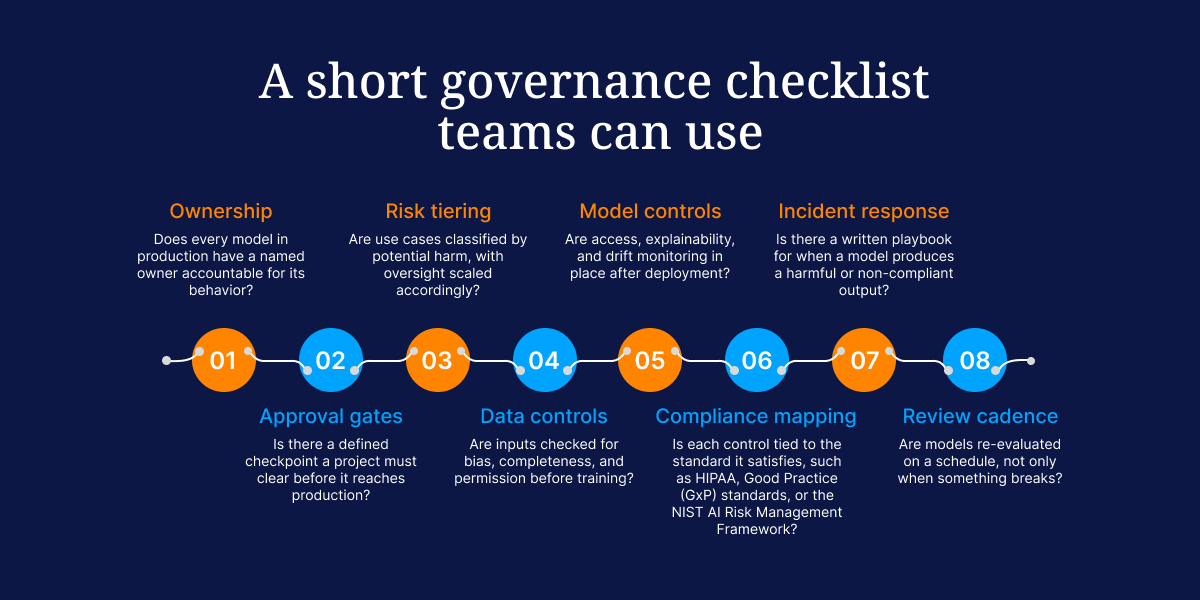
A short governance checklist teams can use

Teams building or auditing this kind of framework can start with these questions:
If a team cannot answer most of these clearly, the gap does not lie in tooling. It is structured.

See the DARWIN framework in action

Intuceo’s AI Dream Session shows how the DARWIN framework turns AI ambition into a governed, deployable plan, using examples from regulated engagements. Reserve a place to see how an AI center of excellence governance framework can be built to fit your organization’s scale and risk.

Frequently Asked Questions

It is a structure that centralizes how an organization oversees AI. An AI center of excellence governance framework defines roles, approval gates, risk tiers, monitoring, and compliance mapping, so models are built and deployed under consistent accountability rather than case by case.
Data governance concerns the quality, completeness, permission, and bias of the inputs. Model and workflow governance concern how a deployed model performs, whether its outputs are explainable, who can act on them, and how drift and misuse are caught. A complete framework covers both, with separate owners for each.
Not when it is calibrated to risk. A well-designed governance framework applies light checks to low-risk work and real scrutiny to high-impact models, which keeps oversight moving alongside delivery instead of blocking it.
It depends on the sector. Regulated organizations commonly map controls to HIPAA, 21 CFR Part 11, FISMA, HITRUST, SOC 2, and the NIST AI Risk Management Framework, connecting each control to the obligation it satisfies.
Ownership works best when it is shared and explicit. Data and analytics leaders, compliance and risk officers, engineering leads, and executive sponsors each hold a defined part, coordinated through the framework rather than left to one team.

Why AI Dream Session: Strategic Deep-Dive to Transition from being “Data Rich” to “Insight Rich”

An AI Dream Session is a strategic deep-dive designed to help your organization transition from being “Data Rich” to “Insight Rich”. While many companies have vast amounts of data, they often lack the planning required to turn that data into a competitive advantage.
Here is why you need this session:

Build a Custom AI Roadmap

The session helps you move beyond the hype of Large Language Models (LLMs) to understand the full spectrum of AI, including Symbolic AI, Machine Learning, and Deep Learning. It uses the DARWIN Framework to ensure every project is grounded in reality:

Solve Expensive Business Bottlenecks

Intuceo uses these sessions to identify high-value use cases that deliver measurable ROI. Proven examples include:

Strategic Hardware & Security Planning

AI implementation often fails due to unforeseen costs or security risks. This session provides a rough understanding of the hardware required for your specific scale:

Access to Elite Expertise

You gain access to a boutique firm with 20 years of experience serving Fortune 1000 and Federal clients. The session is led by a team that includes Ph.D. mentors and over 150 certified engineers who have delivered more than 250 successful solutions.

Frequently Asked Questions

An AI Dream Session is a strategic deep-dive consultation offered by Intuceo, designed to help organizations transition from being ‘Data Rich’ to ‘Insight Rich.’ It is designed for business leaders, technology executives, and decision-makers who have accumulated significant data assets but lack a structured, actionable plan to turn that data into measurable competitive advantage. The session is especially valuable for organizations that have attempted AI pilots but have struggled to scale them into production-grade business outcomes.

The DARWIN Framework is Intuceo’s structured methodology used during the AI Dream Session to ensure every proposed AI project is grounded in operational and commercial reality rather than hype. Each letter represents a key evaluation dimension: Data (assessing bias, completeness, and governance of available data), Architecture (planning the evolution from prototype to Minimum Viable Product), Responsibility (aligning AI with economics, compliance, and stakeholder needs), Workflow (ensuring AI tools are consumable and explainable for the intended team), and Infrastructure (making critical cost and performance decisions such as GPU versus CPU requirements).

Most AI conversations today default immediately to LLMs and Generative AI. The AI Dream Session deliberately moves beyond that hype to explore the full spectrum of AI disciplines relevant to an organization’s specific challenges, including Symbolic AI for deterministic rule-based logic, traditional Machine Learning for predictive modeling, and Deep Learning for complex pattern recognition. This breadth ensures that the roadmap recommends the right AI type for each use case, not just the most fashionable one.

The AI Dream Session is specifically structured to surface high-value use cases with clear, measurable ROI. Proven examples from Intuceo’s engagements include: in the Compliance space, automating the review of 30,000 or more paragraphs in defense procurement documents—reducing review cycles from months to days with over 90% accuracy; and in Life Sciences, building agentic AI solutions for high-volume pharmaceutical production lines with billions of units in capacity, significantly reducing the number of defective products that reach customers.

AI projects frequently fail or exceed budgets due to unforeseen hardware and infrastructure costs. The AI Dream Session provides a realistic assessment of the compute requirements for an organization’s specific scale and use case. This includes determining whether a use case requires 12 servers to run a 500-billion-parameter model or whether a single GPU running a 2-billion-parameter model is sufficient. This right-sizing analysis prevents the costly over-engineering that commonly derails enterprise AI programs.