Key Takeaways
- SAP and Oracle ship the AI : The enterprise owns the data that AI reasons over.
- With ECC mainstream maintenance ending in 2027, data design belongs inside the S/4HANA migration scope.
- Start with two or three use cases, and fix definitions, master data, pipelines, and access for that scope only.
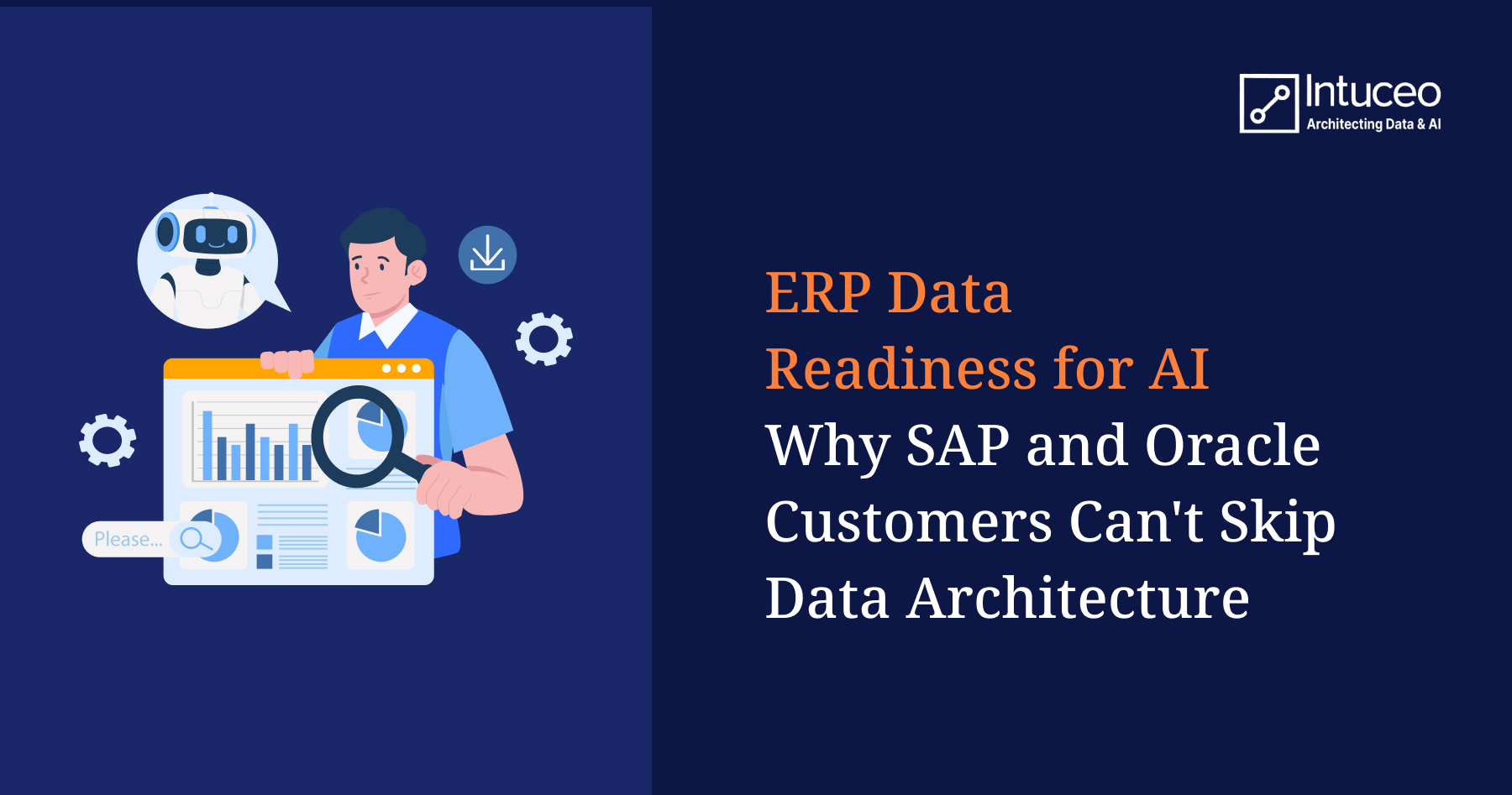
SAP and Oracle are now building artificial intelligence (AI) directly into their enterprise resource planning (ERP) suites. SAP launched Business Data Cloud alongside ready-to-use Joule agents for finance, service, and sales,1 and Oracle has made its AI Data Platform generally available, with tailored versions planned for Fusion and NetSuite.2 The models and agents arrive on the vendors’ schedule. The data they reason over belongs to the enterprise, so ERP data readiness for AI comes down to years of configuration choices, custom tables, duplicated master records, and business rules written into application code.
That makes ERP modernization for AI across SAP and Oracle estates a data question first. An AI-first operating model asks ERP data to explain itself to systems that were never part of the original design, including forecasting models, retrieval pipelines, and agents that act on what they read. When the data cannot carry its own meaning, outputs become inconsistent, and every new use case restarts the same integration work.
What Is ERP Data Readiness for AI?
ERP data readiness for AI is the state in which SAP or Oracle data carries its own business meaning outside the application, through shared definitions, consolidated master data, governed pipelines with lineage, and access controls that travel with it. Readiness is built use case by use case, not across the whole estate at once.
Why Isn't Transactional ERP Data Ready for AI?
ERP systems were built to record transactions correctly and enforce process rules at the point of entry. The meaning of a record often lives in the application around it. In SAP ERP Central Component (ECC), a customer’s credit position can depend on custom tables and code logic that no standard extract captures. In Oracle E-Business Suite (EBS), descriptive flexfields hold critical attributes whose usage often differs from one business unit to the next.
Reports tolerate this because analysts know the workarounds. Models have no such knowledge. A demand forecast trained on a material duplicated across three plants learns three partial histories. A generative assistant answering a margin question retrieves whichever definition of margin it finds first.
The correction sits upstream of the model : ERP data readiness for AI means consistent definitions, consolidated master data, and pipelines that preserve business context as data leaves the ERP. SAP positions Business Data Cloud around data products that retain their original business context and semantics without costly extraction.1 Data held in custom tables, older releases, or non-SAP systems still needs the same semantic work before it becomes AI-ready ERP data.
How Does the SAP ECC Maintenance Deadline Affect AI Plans?
SAP will provide mainstream maintenance for core SAP Business Suite 7 applications, including SAP ERP 6.0, until the end of 2027, followed by optional extended maintenance through 2030. At the end of 2024, Gartner estimated that only about 39% of the roughly 35,000 ECC customers had moved to S/4HANA.
For the majority still on ECC, the S/4HANA migration and the AI program now compete for the same budget, the same SAP specialists, and the same data. A brownfield conversion that moves data as it stands carries duplicate vendors, obsolete material masters, and inconsistent hierarchies into S/4HANA, where every AI initiative inherits them.
Including data design in the migration scope prevents the enterprise from paying twice, once to convert the data and again to repair it for AI. That is the central decision in any legacy ERP AI migration.
What Does ERP Data Readiness for AI Require?
The following changes apply to SAP and Oracle estates alike. Each can be scoped to the business domains that feed the first AI use cases.
- Shared business definitions : a governed semantic layer that fixes what customer, material, net revenue, and on-time delivery mean across instances, so every model and dashboard calculates them the same way.
- Consolidated master data : a single trusted record for customers, suppliers, and materials, with survivorship rules agreed by the business owners who will stand behind the numbers.
- Pipelines built for AI consumption : an ERP-to-AI data pipeline uses change data capture (CDC) for freshness, records lineage from source table to model input, and serves both structured features and the documents that retrieval-augmented generation (RAG) depends on.
- Authorization that travels with the data : ERP role restrictions do not follow data into a lakehouse or vector store, so access policies have to be rebuilt at the data layer to stop an assistant from surfacing figures a user cannot see in the source system.
- A clean core : custom logic moved into side-by-side extensions keeps the ERP upgradeable and gives AI services stable interfaces in place of modified standard code.
How ERP Data Architecture for AI Differs in SAP and Oracle
SAP AI Readiness : What Runs in HANA vs the Lakehouse
A sound SAP AI integration data architecture starts with a placement decision. SAP has made the SAP HANA Cloud vector engine generally available and describes HANA Cloud as the default database in its generative AI strategy. HANA is therefore a natural home for SAP HANA AI workloads that need live transactional context, such as retrieval over open orders or agent actions inside a process.
Model training over long histories and non-SAP sources is often better placed in a lakehouse fed from S/4HANA or ECC. Settling which workloads sit where before building avoids multiple copies of the same data running on different refresh cycles.
Oracle ERP AI Readiness : Fusion Cloud vs E-Business Suite
Oracle ERP AI readiness depends on the estate in place : Fusion Cloud customers can draw on the curated data in Oracle Fusion Data Intelligence, which Oracle makes available within its AI Data Platform. EBS customers running on-premises have more groundwork: customizations and flexfield usage must be mapped to business definitions, and data extracted into a governed store, before it can support AI.
Organizations running both SAP and Oracle after acquisitions need a neutral data layer that reconciles the two, since each vendor’s AI tooling is built around its own applications.
The table below summarizes the preparation each estate needs before AI.
| Estate | Main data work before AI | Where AI workloads fit |
|---|---|---|
| SAP ECC | Map custom tables and code logic, and consolidate master data before conversion | Lakehouse for training on long histories |
| SAP S/4HANA | Extend Business Data Cloud semantics to non-SAP sources | HANA Cloud vector engine for live transactional context |
| Oracle Fusion Cloud | Add sources Fusion lacks, and carry security into the data layer | Fusion Data Intelligence within the AI Data Platform |
| Oracle EBS (on-premises) | Map flexfields and customizations to definitions, and extract with CDC and lineage | Governed store outside EBS |
| Mixed SAP and Oracle | Reconcile both estates on shared definitions | Neutral data layer |
How to Build ERP Data Readiness for AI in Five Steps
For leaders working out how SAP customers prepare for AI adoption, the most dependable route to enterprise data modernization before AI lets a short list of use cases set the scope.
- Select two or three use cases : each needs a business owner and a decision it will change, such as working capital forecasting or supplier risk scoring.
- Trace the data back to source: map every input to its ERP tables, custom objects, and external feeds, then profile its quality and ownership.
- Resolve definitions and master data for that scope : settle conflicts with the business owners before any model is trained.
- Build the pipeline and governance once : design lineage, access policies, and monitoring for reuse by the next use case.
- Deploy, measure, and extend by domain : later use cases start from governed data instead of raw tables.
This sequence can run alongside an S/4HANA or Fusion migration, and the definitions and master data it produces carry directly into the conversion.
How to Evaluate an ERP Modernization Partner for AI
Buyers comparing consulting firms for SAP modernization before AI can test each one against four questions.
- Data scope : does the migration plan include master data and semantic design, or does it assume data moves as it stands?
- Delivery evidence : can the firm show production AI built on ERP data, alongside its migration work?
- Security model : how will ERP authorizations be enforced once data leaves the application?
- Reuse : what will the second use case inherit from the first?
- Deploy, measure, and extend by domain : later use cases start from governed data instead of raw tables.
If you want an outside view on these four questions, Intuceo can map the ERP data behind your first AI use cases and show where the gaps sit.
How Intuceo Prepares SAP and Oracle Data for AI
Intuceo’s S/4HANA engagements follow a data-first migration protocol in which legacy data is cleansed, governed, and structured before go-live. Custom requirements are built as side-by-side extensions so the SAP core stays clean, and the same approach adds AI-driven intelligence layers to PeopleSoft and Oracle environments without disturbing the core system.
Across the estate, Intuceo builds a unified gold record that gives models consistent, governed inputs. Its augmented business intelligence (BI) layered onto SAP and Oracle ERPs has identified more than $4M in annual savings for clients through automated financial reconciliation. Engagements are PhD-led, overseen by senior architects, and delivered under the iPDLC™ (Intelligent Product Development Lifecycle) framework.
See what your first AI use cases need from your ERP data
Intuceo will map the SAP or Oracle data behind your priority use cases, identify the definition and master data gaps, and deliver a sequenced plan that fits your migration timeline.
Frequently Asked Questions
1.How do I know if my ERP data is ready for AI??
Your ERP data is ready for AI when five conditions hold for the use cases you plan to run: business terms such as customer, material, and net revenue each have one governed definition; master data has a single trusted record; pipelines deliver fresh data with lineage; access policies follow the data out of the ERP; and custom logic sits in side-by-side extensions rather than modified core code.
2.Can I implement AI on top of my existing SAP system without data architecture changes?
Often yes for narrow use cases inside the suite, because SAP’s embedded AI works on data already structured within its applications. Use cases that span ECC history, custom tables, or non-SAP sources need data work first: shared definitions, consolidated master data, and governed pipelines. Without them, outputs vary depending on which table a model draws from.
3.What data architecture changes are needed before an organization can go AI-first with Oracle?
Start by confirming the estate. On Fusion Cloud, the priority is adding the sources Fusion does not hold and carrying security policies into the data layer. On EBS, customizations and flexfields need mapping to business definitions, master data needs consolidation, and data needs a governed extraction path with CDC and lineage before it can feed AI.
4.How do I migrate from an SAP ERP to a cloud-native AI data platform?
The ERP stays in place, and its data is replicated. Select the domains your first use cases need, extract with a method your SAP license supports, land the data through CDC in a governed store, rebuild business definitions and access policies there, and expose it to models through monitored pipelines. Then extend domain by domain.
5.What is the typical timeline for SAP data architecture modernization before AI deployment?
Full ECC to S/4HANA programs vary widely, and Gartner has worked with clients anticipating projects of three to seven years.4 Data modernization for AI does not need to wait for that program to finish. Scoped to the domains behind the first two or three use cases, it can run in parallel, and its outputs carry into the conversion.