Live AI Dream Session, Vol. 3: Trustworthy AI in Practice with Sarath Kuravi and Dr. Shonraj Ballae • Nov 10 | 11:00 AM EST Reserve Your Seat Claim Free Seat

Reserve Your Seat

Trustworthy AI in Practice: Governance, Guardrails, and Compliance-v2

Trustworthy AI in Practice: Governance, Guardrails, and Compliance

What does AI governance look like when it has to keep up with delivery, not just look good on paper?
Governance is often seen as the thing that slows AI down. Done badly, it does.
Pilots wait in review. Controls arrive after the model is already live. Teams end up choosing between moving fast and staying compliant.
In this fireside chat, Sarath Kuravi and Dr. Shonraj Ballae, an AI Practitioner who has contributed to a regulatory-approved AI Software as a Medical Device, work through how to govern AI that’s already in use. Expect industry examples and candid answers about what works and what doesn’t.

Date

Tuesday, November 10, 2026

Time

11:00 AM EST

Format

60 minutes: 45-minute fireside chat followed by 15 minutes of audience Q&A · Microsoft Teams

Reserve Your Seat by Filling the Form

Tuesday, November 10, 2026 | 11:00 AM EST | 60 minutes on Microsoft Teams
By registering, you agree to receive event communications from Intuceo. You can unsubscribe at any time. See our Privacy Policy.
Why Attend

What's in It for Me?

Four benefit points in Dr. Shonraj’s words

01

What trustworthy AI means in real-world regulated and enterprise environments

02

Practical guardrails for privacy, security, reliability, human oversight, and compliance

03

Industry use cases, including regulated and high-impact AI applications

04

How leaders can scale responsible AI without slowing innovation

You will leave with a clearer view of which guardrails your AI needs, where governance tends to stall delivery, and how other organizations are handling it.
The Cost of Sitting This Out

What Will I Miss If I Don't Attend?

The biggest risk is governance that shows up after the AI is already live.
When controls arrive after launch, a model in production can drift, expose sensitive data, or make decisions nobody reviewed.
Not every AI system needs the same level of review. Matching effort to risk is what keeps delivery moving.
Generative AI and agents raise the stakes, because they take actions, not just give answers.
This conversation will help you see how leaders build trust into AI systems and scale responsible AI without slowing innovation.
The Session

What We'll Cover

A live fireside chat, not a slide deck. Sarath guides Dr. Shonraj through four to five practical questions.

Fireside chat (about 45 minutes)

01

Identifying AI Risk

How to find and assess the risks in AI systems that are already in use.
02

Building Trust Into the System

Practical guardrails for privacy, security, reliability, human oversight and compliance.
03

Compliance Without Stalling Delivery

How to meet emerging compliance needs while keeping AI delivery on track.
04

Your Questions, Answered (15 minutes)

15 minutes of open audience Q&A.
The Audience

Who Should Attend?

This session is designed for:

CXOs, CDOs, CIOs, and senior executives

Chief Risk, Compliance, Privacy, and Information Security leaders

AI and data governance leads; legal and regulatory affairs

Quality and compliance leaders across industries

Data Science, ML, and AI engineering leaders

AI and Digital Transformation program leads

If you are responsible for approving, building or auditing AI, this session is for you.
From AI Strategy to AI in Practice

How Vol. 3 Connects to the DARWIN™ Framework

In AI Dream Session, Vol. 1, we introduced the DARWIN™ Framework to help enterprises evaluate AI initiatives across Data, Architecture, Responsibility, Workflow, Infrastructure and Security. Vol. 2 applied that thinking to a real use case in computer vision.
This session continues the AI Dream Session series, drawing on the Data and Responsibility pillars of the DARWIN™ Framework. Once an AI system is live, how do you keep its data and its decisions trustworthy?
D Data
A Architecture
R Responsibility
W Workflow
IN Infrastructure and Security
Vol. 3 focus: Data and Responsibility

Missed Vol. 1?

Watch AI Dream Session, Vol. 1: Blueprint Your Enterprise Strategy with the DARWIN™ Framework on demand.

Missed Vol. 2?

Watch AI Dream Session, Vol. 2: Computer Vision Reimagined on demand.
Meet Your Hosts

Who You Will Be Hearing From

Co-Founder and EVP, Intuceo
Sarath Kuravi is Co-Founder and EVP of Intuceo, with over 20 years delivering 50+ Data and AI solutions for Fortune 500 clients across Life Sciences, Healthcare, and Manufacturing. He leads Intuceo’s Global Delivery organization, turning ambitious AI and data initiatives into practical, measurable outcomes built for adoption.
Shonraj Ballae Ganeshrao
Principal AI Scientist
Dr. Shonraj Ballae is a Principal AI Scientist with over 15 years of experience in AI, healthcare innovation, and applied research. He holds a Ph.D. in Computational Vision Science. His work focuses on trustworthy AI, AI governance, and turning emerging AI into practical business outcomes.
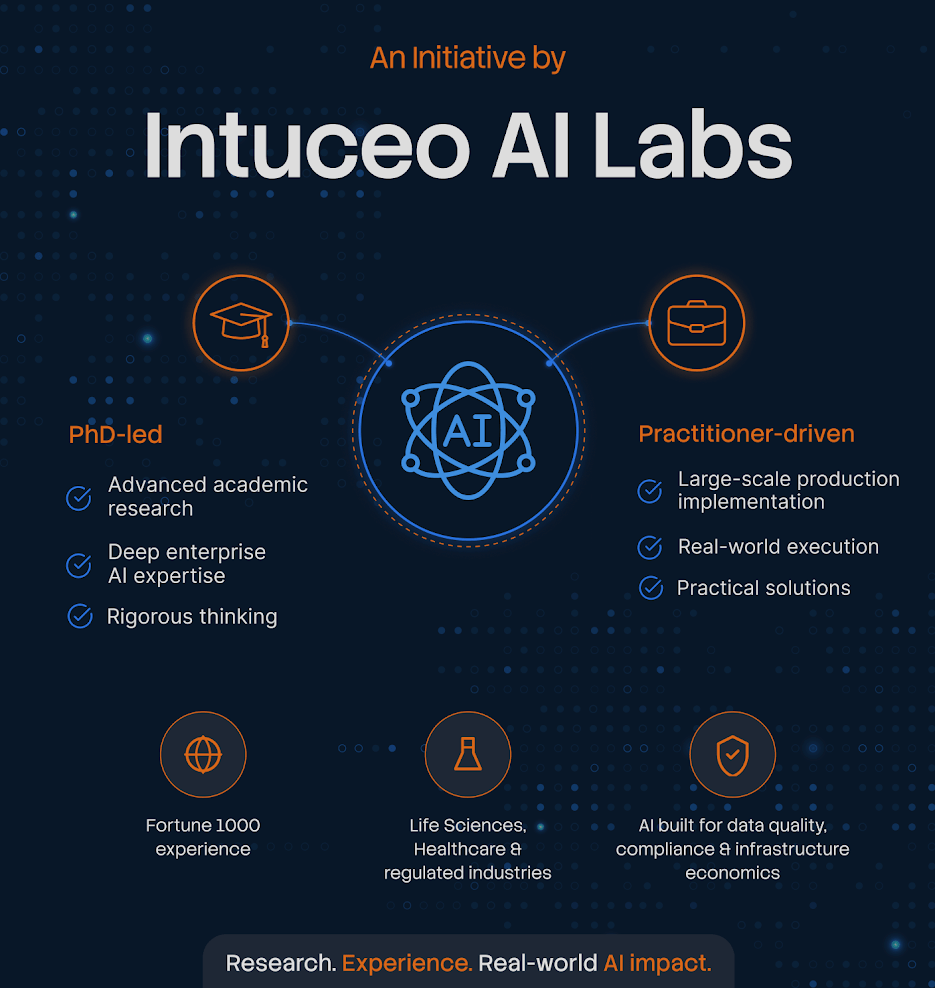
About Intuceo AI Labs

Research That Has to Survive Production

Intuceo AI Labs focuses on one question: how do advances in AI translate into systems that actually work inside an enterprise?
The Labs brings together AI research and real-world implementation experience across computer vision, machine intelligence and enterprise AI.
The focus is not just on what a model can do in a demo, but what it takes to make AI practical, reliable and usable in real operating environments.
Intuceo AI Labs overview

Can You Scale AI Without Governance Becoming the Bottleneck?

You can.
It starts with building trust into the system, not around it.
Join AI Dream Session, Vol. 3 to hear how.

Trustworthy AI in Practice: Governance, Guardrails, and Compliance-v1

Trustworthy AI in Practice: Governance, Guardrails, and Compliance

What does AI governance look like when it has to work in production, not just on paper?
Most organizations don’t lack an AI policy. They lack proof it works once the model is live.
In this fireside chat, Sarath Kuravi and Dr. Shonraj Ballae, an AI Practitioner who has contributed to a regulatory-approved AI Software as a Medical Device, work through how to govern AI that’s already in use. Expect industry examples and candid answers about what works and what doesn’t.

Date

Tuesday, November 10, 2026

Time

11:00 AM EST

Format

60 minutes: 45-minute fireside chat followed by 15 minutes of audience Q&A · Microsoft Teams

Reserve Your Seat by Filling the Form

Tuesday, November 10, 2026 | 11:00 AM EST | 60 minutes on Microsoft Teams
By registering, you agree to receive event communications from Intuceo. You can unsubscribe at any time. See our Privacy Policy.
Why Attend

What's in It for Me?

01

What trustworthy AI means in real-world regulated and enterprise environments

02

Practical guardrails for privacy, security, reliability, human oversight, and compliance

03

Industry use cases, including regulated and high-impact AI applications

04

How leaders can scale responsible AI without slowing innovation

You will leave with a clearer view of which guardrails your AI needs, where governance tends to stall delivery, and how other organizations are handling it.
The Cost of Sitting This Out

What Will I Miss If I Don't Attend?

The biggest risk is assuming a written policy means your AI is governed.
A policy can say all the right things while a model in production drifts, exposes sensitive data or makes decisions nobody reviewed.
Regulators, auditors and customers are starting to ask for evidence, not intent.
Generative AI and agents add new risks, and as they move into real workflows the gap between what a policy says and what a system does gets harder to see.
This conversation will help you see where governance has to live inside the system itself, and what that looks like in practice.
The Session

What We'll Cover

A live fireside chat, not a slide deck. Sarath guides Dr. Shonraj through four to five practical questions.

Fireside chat (about 45 minutes)

01

Identifying AI Risk

How to find and assess the risks in AI systems that are already in use.
02

Building Trust Into the System

Practical guardrails for privacy, security, reliability, human oversight and compliance.
03

Compliance Without Stalling Delivery

How to meet emerging compliance needs while keeping AI delivery on track.
04

Your Questions, Answered (15 minutes)

15 minutes of open audience Q&A.
The Audience

Who Should Attend?

This session is designed for:

CXOs, CDOs, CIOs, and Senior executives

Chief Risk, Compliance, Privacy, and Information Security leaders

AI and data governance leads; legal and regulatory affairs

Quality and compliance leaders across industries

Data Science, ML, and AI engineering leaders

AI and Digital Transformation program leads

If you are responsible for approving, building or auditing AI, this session is for you.
From AI Strategy to AI in Practice

How Vol. 3 Connects to the DARWIN™ Framework

In AI Dream Session, Vol. 1, we introduced the DARWIN™ Framework to help enterprises evaluate AI initiatives across Data, Architecture, Responsibility, Workflow, Infrastructure and Security. Vol. 2 applied that thinking to a real use case in computer vision.
This session continues the AI Dream Session series, drawing on the Data and Responsibility pillars of the DARWIN™ Framework. Once an AI system is live, how do you keep its data and its decisions trustworthy?
D Data
A Architecture
R Responsibility
W Workflow
IN Infrastructure and Security
Vol. 3 focus: Data and Responsibility

Missed Vol. 1?

Watch AI Dream Session, Vol. 1: Blueprint Your Enterprise Strategy with the DARWIN™ Framework on demand.

Missed Vol. 2?

Watch AI Dream Session, Vol. 2: Computer Vision Reimagined on demand.
Meet Your Hosts

Who You Will Be Hearing From

Co-Founder and EVP, Intuceo
Sarath Kuravi is Co-Founder and EVP of Intuceo, with over 20 years delivering 50+ Data and AI solutions for Fortune 500 clients across Life Sciences, Healthcare, and Manufacturing. He leads Intuceo’s Global Delivery organization, turning ambitious AI and data initiatives into practical, measurable outcomes built for adoption.
Shonraj Ballae Ganeshrao
Principal AI Scientist
Dr. Shonraj Ballae is a Principal AI Scientist with over 15 years of experience in AI, healthcare innovation, and applied research. He holds a Ph.D. in Computational Vision Science. His work focuses on trustworthy AI, AI governance, and turning emerging AI into practical business outcomes.
About Intuceo AI Labs

Research That Has to Survive Production

Intuceo AI Labs focuses on one question: how do advances in AI translate into systems that actually work inside an enterprise?
The Labs brings together AI research and real-world implementation experience across computer vision, machine intelligence and enterprise AI.
The focus is not just on what a model can do in a demo, but what it takes to make AI practical, reliable and usable in real operating environments.
Intuceo AI Labs overview

Is Your AI Governed on Paper, or in Production?

A policy is a starting point.
Proof is what holds up.
Join AI Dream Session, Vol. 3 to hear what it takes.

HEDIS Care Gap Closure in Florida: How Payers Use AI to Improve Star Ratings

Every open care gap in a Florida health plan carries two costs at once. One is clinical: a member who missed a screening or a chronic-care check. The other is financial: a quality measure that slips below its threshold and pulls down a rating tied to millions in federal payments.
Both costs come due at the same moment. When the measurement year closes, the numbers lock, and the window for HEDIS care gap closure shuts with them. The Healthcare Effectiveness Data and Information Set (HEDIS), maintained by the National Committee for Quality Assurance (NCQA), defines most of those measures. Its results feed the Medicare Advantage (MA) Star Ratings, and those ratings decide quality bonus dollars.
Florida concentrates the problem more than most states. It carries one of the country’s largest Medicare Advantage populations. It runs a Medicaid managed care program that holds plans for their own quality reporting. And its membership spreads across languages and part-year residency. Each trait widens the gap between when care happens and when it gets recorded. Closing that gap is the work analytics does.

Key Takeaways

What Is a HEDIS Care Gap?

A HEDIS care gap is a recommended service, such as a cancer screening or a diabetes check, that a member was eligible for but has no record of receiving during the measurement year. Closing it means delivering that care, or finding and submitting evidence that it already happened, before the year ends. Gaps count against a plan’s quality rates and, through those rates, its Star Ratings.

How Does AI Improve HEDIS Care Gap Closure for Florida Health Plans?

The old approach to gap closure was retrospective. Teams pulled charts near year-end, chased missing records, and confirmed care that had already happened. That model finds gaps too late to close them. It also spends the most effort on the cases with the least to gain.
Using AI for HEDIS care gaps moves the work earlier in the year and narrows it to what will pay off. Four methods do most of the lifting:
Automated reminders then reach members in their own language, which matters across Florida’s diverse membership.

Retrospective vs. AI-Led Care Gap Closure

Dimension Retrospective approach AI-led approach
Timing Year-end chart chase Year-round, starting early in the measurement year
Prioritization All open gaps treated alike Gaps ranked by how likely they are to close
Data used Claims and a sample of charts Claims, clinical notes, lab results, and health information exchange feeds
Outreach Generic reminders Member-specific, in the member’s language
Audit readiness Manual reconstruction Lineage from source to measure

How Does HEDIS Analytics Improve Medicare Advantage Star Ratings?

Star Ratings have grown harder to hold. The Centers for Medicare & Medicaid Services (CMS) recalculates the cut points each year, so a plan can hold steady on clinical performance and still lose a star because the bar moved. In 2026, 207 of 516 rated contracts, roughly 40%, earned four stars or more, down from 261 a year earlier. Only contracts at that level qualify for quality bonus payments.
Ratings draw on about 40 measures. They include cancer screenings, annual flu vaccinations, and whether members with chronic conditions receive recommended services, many of them measures HEDIS defines. [1] CMS’s  final rule for contract year 2027 removes 11 Star Ratings measures starting with the 2029 ratings, which shifts more of the overall score onto HEDIS and member experience measures.
Medicare Advantage Star Ratings analytics earns its place by making that math visible during the year rather than after it. Modeling a plan’s position against likely cut points, a core part of HEDIS and Star Ratings analytics, shows which few measures will swing the overall rating, so quality teams concentrate budget and staff on the gaps that move the number.
For a Florida plan near the four-star line, that focus decides whether it qualifies for a bonus. Member experience scores count too, and they move slowly, which makes early, targeted intervention the only realistic lever inside a rating year. The bonus of a four-star rating earns funds for the extra benefits that keep members enrolled. Analytics that protects the rating protects growth as well. If your contract sits near that line, talk to Intuceo to model your plan against this year’s cut points.

What Does Digital HEDIS Reporting Mean for Florida Health Plans?

For a Northeast Florida operation, inbound automotive and industrial cargo often clears the Port of Jacksonville (JAXPORT). Applying AI to port and yard data aligns berth and gate signals with production demand, so parts arrive against the build schedule instead of piling into buffer stock.
The manual chart chase that many plans still lean on is being retired. NCQA plans to phase out the hybrid reporting method by measurement year 2029. That method combines claims with medical-record review on a sample of members. The goal is fully digital HEDIS reporting by measurement year 2030.[2] NCQA adjusted several measure-level pathways in January 2026 but kept the 2029 endpoint for retiring hybrid reporting.
Measures are moving to Electronic Clinical Data Systems (ECDS) reporting. ECDS draws on data from electronic health records, health information exchanges, and registries, formatted to the Fast Healthcare Interoperability Resources (FHIR) standard. [2]
Once sampling and manual retrieval fall away, rates depend on how cleanly a plan’s clinical data flows into measure logic across the full population. That turns a reporting task into a data task. It hits Florida Medicaid HEDIS reporting, which managed care plans submit to the state, as hard as it hits Medicare Advantage contracts.
AI can automate much of that pipeline. It normalizes incoming data, maps it to measure specifications, flags open gaps, and drafts abstractions for review. The submitted result still passes through the HEDIS Compliance Audit. Getting there means treating supplemental clinical data as a governed asset, not a year-end collection effort. Clear lineage from source to measure lets an auditor trace any rate back to its evidence. Plans that build that lineage now avoid a scramble when the hybrid method retires.

Does Florida Regulate How Health Plans Use AI?

Not through a dedicated statute yet. Florida proposed AI rules for insurers in 2025 and 2026, but none of the insurance-specific bills became law in the 2026 session. Today, NCQA audits and contract terms do most of the governance work.
Florida is drawing lines around AI in insurance while payers adopt it for quality work. In December 2025, Governor Ron DeSantis proposed a Citizen Bill of Rights for Artificial Intelligence. It would bar insurers from using AI as the sole basis to adjust or deny a claim, require them to detail how they use it, and let the Office of Insurance Regulation (OIR) inspect the models to confirm they do not violate fair insurance trade practices. [3]
The Florida House pushed the same line in 2026, passing HB 527 by a vote of 108 to 0 to require a qualified human professional behind every claim denial, but the bill died in the Senate. Other states have pushed similar rules: a qualified person must own coverage denials, and any AI used in utilization review must reflect a member’s individual clinical circumstances.4 Florida’s proposal reaches beyond claims. It would require notice when a consumer interacts with AI, which covers member-facing chatbots and outreach. A companion measure on AI data centers signals how closely the state means to watch the technology’s footprint.
These proposals target adverse coverage decisions. Closing care gaps is a different activity. It finds members who need care and prompts outreach, which the proposals would not restrict. The governance expectation still carries over. Any model that touches a member or a provider should be transparent, explainable, and auditable, with a human owning consequential decisions.
For vendors and enterprises building AI for the Florida market, that changes what a solution has to prove. Documented model behavior, retained audit trails, and human review are becoming conditions of doing business, not features to add later. A plan choosing an analytics approach should assume both OIR scrutiny and an NCQA audit will examine how the models work.

How Should Florida Payers Choose a HEDIS Care Gap Closure Partner?

The best-performing approach to HEDIS care gap closure for Florida health plans is not a single tool. Star and HEDIS results come from three things working together :

In a Florida context, that also means Health Insurance Portability and Accountability Act (HIPAA) aligned handling, explainable models, and experience with the fragmented records a seasonal population creates.
Intuceo supports HEDIS care gap closure for Florida health plans and health systems from its base in Jacksonville. It delivers through reusable accelerators, Intuceo-Ax, Intuceo-Ix, and Intuceo-Dx, together with AgentCare AI, inside its iPDLC delivery approach. The accelerators carry forward patterns from earlier Florida healthcare work, so an engagement does not start from a blank slate. The AI is built to be explainable and auditable, with people in the decision loop.

Frequently Asked Questions

HEDIS is NCQA’s set of standardized quality measures that health plans report. Medicare Star Ratings are CMS’s one-to-five-star scores for Medicare Advantage and Part D contracts, built from about 40 measures, many of them defined by HEDIS. Contracts rated four stars or higher qualify for quality bonus payments.
They use predictive models to rank which member gaps are open and closable now. Natural language processing reads notes, discharge summaries, and scanned results for care that happened but was never coded. Automated, language-aware outreach then reaches the members and providers who can close those gaps before the measurement year ends.
Three kinds of work move ratings. Cut-point modeling shows where a plan stands against this year’s thresholds. Gap prioritization concentrates effort on the measures likely to swing the overall score. Clinical-data integration keeps rates accurate. Because CMS resets cut points every year, the value comes from running this analysis through the year, not after results are final.
Begin with one defect-critical line that already generates inspection images or has cameras in place, so the model has history to learn from. Confirm the data-residency and CUI boundary before choosing where the model will run, then pilot it at the line, so decisions stay on-site and at production speed. Once escape and rework rates improve on that line, extend the approach to adjacent processes.
Yes, if the subcontract involves federal contract information or controlled unclassified information. CMMC requirements flow down to subcontractors at every tier, and any system that processes, stores, or transmits that data, including an AI model and its training pipeline, falls inside the assessment scope.
Yes. Vision and anomaly-detection models can run on edge hardware at the production line or on on-premise servers, so images and sensor data never leave the plant. This is often the default for aerospace and defense work that involves CUI or ITAR-controlled data.