What Are the Best AI Development Lifecycle Frameworks for Regulated Analytics?

An estimated 80% of enterprise AI projects fail to deliver their intended business value, according to RAND Corporation’s 2025 analysis. In regulated industries like life sciences and healthcare, the stakes are even higher. A flawed model does not just waste budget; it can trigger compliance violations, endanger patient safety, or invalidate years of clinical research.
The core issue goes beyond the algorithm; it is the absence of a structured AI development lifecycle framework that governs how models are built, validated, monitored, and retired. Traditional SDLC processes assume deterministic outputs. AI systems produce probabilistic results that require fundamentally different governance, from data provenance to drift detection to explainability. For life sciences organizations operating under FDA 21 CFR Part 11, HIPAA, and GxP, choosing the right AI lifecycle framework is foundational.

Key Requirements When Evaluating an AI Development Lifecycle Framework for Regulated Analytics

Before comparing specific frameworks, it helps to define what “regulated-ready” demands. These are the non-negotiable considerations for any AI lifecycle framework used in life sciences or healthcare analytics.
Requirement Why It Matters in Regulated Analytics
Audit-ready documentation FDA and GxP audits require immutable records of data lineage, model decisions, and validation steps at every stage.
Explainability (XAI) Regulators and clinicians need to understand why a model made a specific prediction, particularly in pharmacovigilance and clinical trial matching.
Hallucination and drift detection LLM outputs and ML predictions degrade over time. Production AI monitoring must detect statistical drift, output toxicity, and hallucination before they affect decisions.
Model version control Every model iteration, training dataset, and hyperparameter change must be versioned and traceable for 21 CFR Part 11 compliance.
Human-in-the-loop validation Non-deterministic AI outputs require expert review gates, especially where patient safety or regulatory submissions are involved.
Cross-regulation alignment A single framework should map to multiple mandates: HIPAA, FISMA, NIST 800-53, GxP, and GDPR simultaneously.
With these criteria established, which AI development lifecycle frameworks meet these standards?

Top AI Development Lifecycle Frameworks for Regulated Analytics: A Comparative View

1. NIST AI Risk Management Framework (AI RMF 1.0)

Released in January 2023, the NIST AI RMF has become the de facto AI governance standard in the United States, organized around four functions: Govern, Map, Measure, and Manage. NIST expanded it in July 2024 with a Generative AI Profile (AI 600-1) adding over 200 actions for LLM-specific risks.FDA and other sector regulators increasingly reference its principles.
Strengths
Limitations
Best for: Enterprises needing regulatory alignment across multiple mandates (HIPAA, FISMA, GxP) without being locked into a single vendor ecosystem.

2. CRISP-DM (Cross Industry Standard Process for Data Mining)

CRISP-DM has been the most widely adopted data science methodology since 1999. Its six-phase cycle (Business Understanding, Data Understanding, Data Preparation, Modeling, Evaluation, Deployment) provides a structured, iterative approach. Comparative research found CRISP-DM showed the highest alignment with ISO/IEC 29110 standards among the frameworks analyzed.
Strengths
Limitations
Best for: Teams needing a proven analytical workflow structure, supplemented with separate governance and MLOps layers for regulated environments.

3. Microsoft TDSP (Team Data Science Process)

TDSP extends CRISP-DM with a five-stage lifecycle and adds standardized deliverables, role definitions, and collaboration templates. Its customer acceptance phase and prescribed documentation make it more enterprise-ready than CRISP-DM.
Strengths
Limitations
Best for: Organizations already operating within the Azure/Microsoft ecosystem that need standardized data science workflows across large teams.

4. MLOps (ML Operations Lifecycle)

MLOps applies DevOps principles (CI/CD, infrastructure-as-code, automated testing) to machine learning. It emphasizes continuous integration, delivery, and monitoring of ML models in production, extending traditional frameworks with automated testing, version control, and drift detection.
Strengths
Limitations
Best for: Technically mature organizations that need to scale production AI monitoring and model governance across multiple deployed models.

5. iPDLC™ (Intelligent Product Development Lifecycle) by Intuceo

Where the frameworks above address parts of the AI lifecycle, Intuceo’s proprietary iPDLC™ was purpose-built for regulated, high-stakes environments. It integrates AI-augmented engineering with PhD-led quality gates at every milestone, governing the full lifecycle from intelligent discovery through hardened production to continuous governance.
iPDLC operates across five pillars: Intelligent Discovery and Requirement Synthesis, Architectural Blueprinting, Logic-Driven Test Engineering, Hardened Production Engineering, and Observability with Continuous Governance. Each pillar includes a mandatory Human-in-the-Loop checkpoint validated by Intuceo’s Board of Science, ensuring mathematical soundness and audit readiness.
Strengths
Limitations
Best for: Life sciences, healthcare, and public sector organizations that need a compliance-first AI lifecycle framework with built-in scientific oversight and production-grade reliability.

Framework Comparison at a Glance

Capability NIST AI RMF CRISP-DM TDSP MLOps iPDLC™
Regulatory compliance (native) Partial No No No Yes
Audit-ready documentation Guidance only No Templates Tool-dependent Automated
Explainability / XAI Recommended No No Add-on Built-in (PhD-led)
Drift detection & monitoring Recommended No No Yes Yes (self-healing)
LLM / GenAI evaluation Yes (AI 600-1) No No Emerging Yes
Human-in-the-loop gates Recommended Informal Customer acceptance Optional Mandatory (every pillar)
Vendor lock-in None None Microsoft Tool-dependent Cloud-agnostic

Need a Compliance-First AI Lifecycle for Life Sciences?

Intuceo’s iPDLC™ framework delivers production-grade AI with PhD-led oversight, automated audit trails, and native compliance for 21 CFR Part 11, HIPAA, and GxP environments. Reduce implementation timelines by up to 40% without compromising scientific rigor.

Frequently Asked Questions

A traditional SDLC assumes deterministic software outputs: identical inputs produce identical results. An AI development lifecycle must account for probabilistic outputs, continuous model retraining, data drift, and ongoing validation after deployment. Regulated environments add further layers of documentation, explainability, and version control that standard SDLC processes do not address.
Primary challenges include maintaining audit-ready documentation across model iterations, ensuring explainability for clinical reviewers, detecting drift and hallucinations in production, and aligning a single AI governance framework with overlapping mandates (HIPAA, GxP, 21 CFR Part 11, GDPR). Gartner predicts 60% of AI projects lacking AI-ready data will be abandoned through 2026.
Validation requires statistical testing, human-in-the-loop expert review, automated regression benchmarks, and continuous drift monitoring. In regulated analytics, every validation step must produce an immutable record. NIST AI RMF recommends ongoing measurement across trustworthiness attributes including reliability, safety, fairness, and explainability.
Evaluation starts with baseline benchmarks during development, followed by automated production monitoring. Drift detection compares statistical distributions of inputs and outputs over time. Hallucination evaluation uses ground-truth comparison and retrieval-augmented verification. Toxicity is measured through classifier-based filters and human review. NIST’s Generative AI Profile (AI 600-1) provides over 200 specific actions for managing these LLM risks.
For life sciences, a combination approach works well: NIST AI RMF for governance structure, MLOps tooling for production monitoring, and a compliance-native methodology like iPDLC™ that embeds regulatory checkpoints into every stage. No single open framework currently covers the full spectrum from discovery through governed production in regulated environments.

Cloud Analytics on AWS vs. Azure: Which Platform Wins for HIPAA-Compliant Healthcare Data?

In April 2025, Blue Shield of California disclosed that the protected health information of 4.7 million members had been exposed. The culprit wasn’t a cloud platform failure; it was a misconfigured Google Analytics tag that had been silently routing visitor data to third-party advertising systems for nearly three years. That is the uncomfortable truth most “AWS vs. Azure” debates miss.
For health systems, payers, and life sciences firms running analytics on PHI, the real question is not “which cloud is HIPAA compliant.” Both can be. The real question is which platform fits the workload, the data estate, and the team operating it. Also, don’t mistake infrastructure compliance for system-wide compliance. A cloud provider’s HIPAA certification covers the foundation, but your architectural choices determine whether your environment remains compliant.
This piece breaks down where AWS and Azure each pull ahead for HIPAA-compliant healthcare data analytics, what the shared responsibility model actually shifts onto your team, and how to make a defensible architecture decision.

The Shared Responsibility Model: Where HIPAA Compliance Actually Lives

A common misconception is that simply signing a Business Associate Agreement (BAA) renders a cloud workload HIPAA compliant. It does not. The BAA validates the foundation, but the responsibility for the structural integrity – configuring services, encrypting data, managing access, and providing audit evidence – remains with the customer.
The data backs this up. American Hospital Association analysis of recent OCR-reported breaches found that over 80% of stolen PHI records came from third-party vendors and business associates rather than hospitals directly, and 100% of the hacked data was not encrypted at the point of compromise. Misconfigurations, stale access, missing encryption-at-rest, and unmonitored data flows are doing the damage, not the cloud platform itself.
That makes the AWS-vs-Azure decision less about compliance posture and more about which platform makes correct configuration easier for your specific healthcare data span style=”font-weight: 400;”> workload.

AWS for HIPAA-Compliant Healthcare Analytics

AWS publishes a designated list of HIPAA-eligible services that can store, process, or transmit ePHI under a signed BAA, and the company states that its healthcare infrastructure is backed by 166+ HIPAA-eligible services along with HITRUST, GDPR, ENS High, HDS, and C5 certifications. The list expands continually; AWS PCS (high-performance computing for genomics and clinical research) became HIPAA-eligible in November 2025, and Amazon Bedrock (generative AI) was added to the list in early 2026.
For analytics workloads specifically, AWS offers a tightly integrated stack: Amazon HealthLake provides a managed FHIR R4 data store with built-in medical NLP, SMART on FHIR authorization, and Bulk Data Access APIs that align with ONC and CMS interoperability rules. Once data is normalized into FHIR, teams can query it with Amazon Athena, build dashboards in Amazon QuickSight, and train predictive models in Amazon SageMaker, all within HIPAA-eligible scope.
Where AWS pulls ahead:
The trade-off is that the AWS healthcare stack assumes you will assemble it. There is no single “Healthcare Cloud” SKU. Architects choose the building blocks, define encryption with AWS KMS, lock down identity with IAM and AWS Organizations, and demonstrate control with CloudTrail and Config.

Azure for HIPAA-Compliant Healthcare Analytics

Microsoft takes a different posture. The HIPAA BAA is not a separate contract; it is incorporated by default into the Microsoft Products and Services Data Protection Addendum and applies to any qualifying customer using a designated Online Service. For hospitals already running Microsoft 365, Teams, and Active Directory, that procurement simplicity is meaningful.
Azure’s healthcare-specific layer is Azure Health Data Services, a managed PaaS that bundles an FHIR service, DICOM service, MedTech service for device data, and a de-identification service into a single workspace. The platform is HITRUST CSF certified for HIPAA and GDPR alignment; it supports SMART on FHIR, role-based access through Microsoft Entra ID, and connectors to Azure Synapse Analytics, Azure Machine Learning, and Power BI.
Where Azure pulls ahead:
The trade-off: Azure HIPAA eligibility is service-specific, not blanket. Preview features are typically out of scope for PHI, and Marketplace solutions often require their own separate BAAs. Architects must validate the compliance status of each service before introducing PHI.

AWS vs. Azure: Side-by-Side for HIPAA-Compliant Analytics

Dimension AWS Azure
BAA mechanism Signed via AWS Artifact for designated HIPAA accounts Auto-included in Microsoft Product Terms for qualifying customers
HIPAA-eligible services 166+ services across compute, storage, AI, analytics Service-level eligibility, validated per workload in Product Terms
Native healthcare data layer Amazon HealthLake (managed FHIR R4 + medical NLP) Azure Health Data Services (FHIR + DICOM + MedTech in one workspace)
Analytics engine Athena, Redshift, EMR, SageMaker, QuickSight Synapse Analytics, Databricks, Azure ML, Power BI
Identity backbone AWS IAM, Identity Center, KMS Microsoft Entra ID, Conditional Access, Azure Key Vault
Federal healthcare AWS GovCloud (US), FedRAMP High Azure Government, FedRAMP High, IL5
Best fit for Greenfield FHIR-first analytics, custom ML pipelines, federal health agencies Microsoft-shop hospitals, imaging-heavy workloads, integrated BI on existing M365 estates

Compliance by Design: Moving Beyond Infrastructure to Architectural Integrity

Healthcare data breaches keep climbing in cost. The average healthcare breach now runs $7.42 million per incident, the highest of any industry, and the average time to identify and contain a breach in healthcare reached 241 days in 2025. The OCR breach portal recorded 725 large breaches in 2024 affecting over 275 million records.
Most of those incidents trace back to controls that were missing, misconfigured, or unmonitored, not to the cloud provider’s infrastructure.
That is where the buying decision should center. Either platform can host a HIPAA-compliant analytics environment; the true differentiator is the team’s ability to:

How Intuceo Architects HIPAA-Compliant Cloud Analytics on AWS and Azure

Intuceo deploys HIPAA-validated cloud environments on both AWS and Azure, configured for total PHI protection rather than baseline compliance. The reference architecture combines automated audit logging, VPC flow logs, at-rest and in-transit encryption, BAA-aligned protocols, and fine-grained role-based access control through Microsoft Entra ID or AWS IAM. Real-time HL7 and FHIR orchestration pipelines feed downstream analytics, and continuous compliance monitoring keeps the environment aligned with evolving HIPAA, HITECH, and HITRUST standards.
The work is grounded in healthcare experience: Intuceo’s PhD-led teams have delivered data platforms for Florida Blue, Guidewell Health, UF Health, Janssen Pharma, and Bausch & Lomb, layering Explainable AI and a rationalization layer on top of the cloud-native foundation. For organizations weighing AWS vs. Azure for HIPAA-compliant healthcare analytics, the more useful conversation is rarely about the logo. It is about which platform, configured correctly, will support the next ten years of regulatory, clinical, and AI workloads on your data.

Stop Building by Accident. Start Building by Design.

Compliance isn’t a checkbox—it’s an architectural requirement. The difference between a breach and a secure, high-performance analytics environment isn’t the cloud logo on your invoice; it’s the rigor of your design.
Don’t wait for your next audit or a security incident to uncover architectural gaps. Partner with the team that built the platforms for winning companies in the US.

Frequently Asked Questions

Both can support HIPAA-compliant workloads under a BAA. AWS tends to fit greenfield FHIR-first analytics and federal health workloads through GovCloud. Azure typically fits hospitals already standardized on Microsoft 365, Teams, and Power BI, with DICOM imaging consolidated in the same workspace as FHIR.
Yes. Microsoft’s HIPAA BAA is incorporated into the Microsoft Product Terms by default for qualifying customers, and Azure Health Data Services is HITRUST CSF certified for HIPAA and GDPR alignment. Coverage is service-level, so each service must be validated for PHI use.
AWS lists 166+ HIPAA-eligible services, including S3, EC2, RDS, Lambda, KMS, CloudTrail, HealthLake, Comprehend Medical, SageMaker, Glue, Redshift, Athena, and Amazon Bedrock. The full list is maintained by AWS and updated as new services qualify.
Most of the operational HIPAA burden lives on the customer. The provider secures the cloud; the customer secures everything in it, including encryption, IAM, network segmentation, and audit logging. Recent OCR-reported breaches show that nearly all stolen PHI was unencrypted at the point of compromise.
Yes. AWS SageMaker and Amazon Bedrock are HIPAA-eligible, and HealthLake supports FHIR-based analytics with SQL on FHIR. Azure Machine Learning, Azure Synapse Analytics, and Azure Databricks (with the compliance security profile enabled) support HIPAA-aligned analytics and AI workloads.

Data Engineering for Healthcare: Why Your EHR Data Is Stuck and What to Do About It

Your core electronic health record (EHR) systems hold a decade’s worth of patient encounters. Your auxiliary platforms house claims and lab results going back even further. Yet, your data warehouse likely remains starved of both – because moving clinical data from where it is captured to where it can be analyzed is not a configuration problem. It is an architectural one.
This is the reality for most health systems today. EHRs were designed as “systems of record” to facilitate documentation at the point of care, not as “systems of insight” for analytics. The result? Organizations with massive digital footprints still cannot answer basic population health questions without weeks of manual data extraction, brittle interface work, or API calls that behave inconsistently across different legacy environments.
The data exists. However, research from the HIMSS Global Health Conference reveals that 57% of physicians identify interoperability as their primary obstacle in maximizing the value of health information technology. Transforming raw, proprietary records into a stream that is clean, standardized, and HIPAA-defensible is where most healthcare data engineering efforts break down.
This article explains exactly why that happens and what a properly designed healthcare data pipeline looks like.

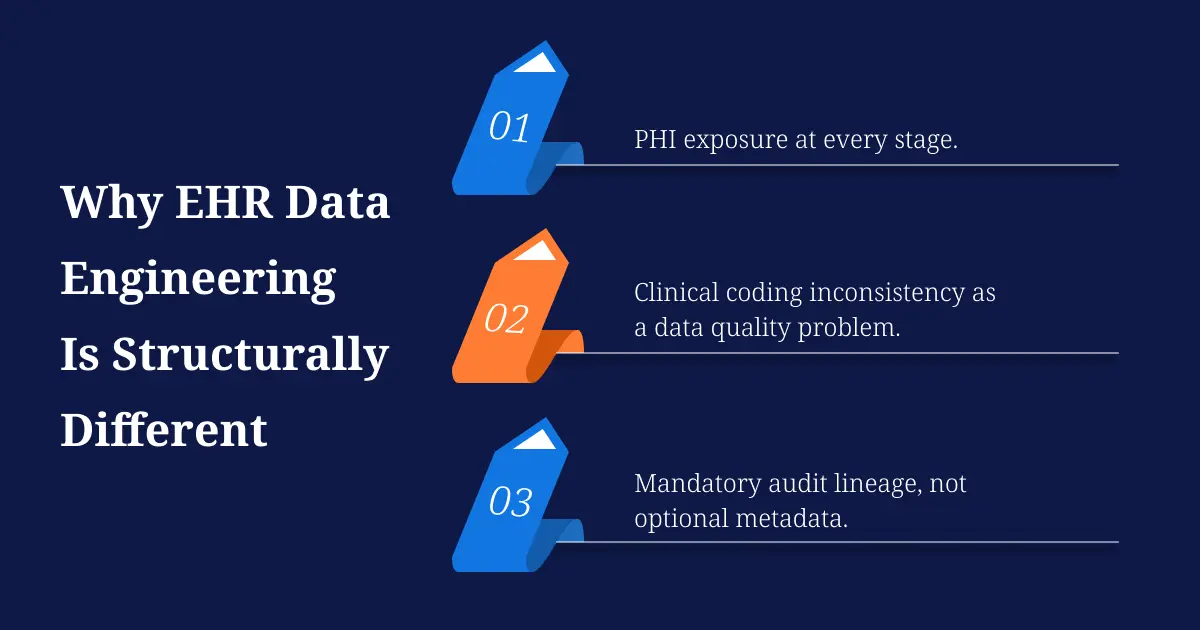
Why EHR Data Engineering Is Structurally Different

Standard data engineering solves for schema drift, pipeline latency, and system reliability. Healthcare data engineering inherits all of that and adds three layers that have no equivalent in most other industries.
PHI exposure at every stage. In a typical SaaS data pipeline, sensitive fields are a small subset of the total data. In a clinical pipeline, nearly every field is a potential HIPAA identifier: patient name, date of birth, admission date, diagnosis code, and provider ID. An EHR data pipeline design that treats PHI handling as a transformation step rather than an architectural constraint will produce audit failures before it ever reaches production. HIPAA-compliant data engineering means encryption in transit and at rest, fine-grained role-based access controls, automated audit logging, and VPC-isolated compute, all engineered at the infrastructure layer, not the application layer.
Clinical coding inconsistency as a data quality problem. Clinical data routinely arrives with incomplete, outdated, or duplicate entries, with inconsistently applied terminologies that create ambiguity across systems. Labs arrive coded in LOINC, but not always with the same LOINC version. Diagnoses reference ICD-10 codes, but many clinicians enter free-text descriptions that bypass structured coding entirely. Medications reference RxNorm in some systems and NDC codes in others. Before any clinical data analytics workload can run reliably, a normalization layer must resolve these conflicts as a deterministic pipeline step, not a manual remediation task.
Mandatory audit lineage, not optional metadata. In GxP-regulated environments used in life sciences and pharma, 21 CFR Part 11 requires validated, traceable data lineage for every transformation applied to a dataset. HIPAA adds access logging requirements. These are not post-processing tasks. A pipeline without automated lineage tracking built in is not audit-ready, regardless of how well the transformation logic performs.

The Dual-Standard Problem: HL7 v2 and FHIR Running Side by Side

One of the most misunderstood aspects of EHR data integration is that FHIR R4 did not replace HL7 v2. In most production health systems, both run simultaneously and serve different functions.
HL7 v2 message feeds handle real-time clinical events: ADT (admission, discharge, transfer) notifications, lab results via ORU messages, and clinical documentation via MDM messages. These feeds have been running in hospitals for decades and are deeply embedded in clinical workflows. FHIR R4 APIs serve newer use cases: patient-facing app access, payer-to-provider data exchange, and more recent analytics integrations. Hospitals will still have HL7 v2 interfaces and batch reports for some time, and a well-designed pipeline architecture acknowledges this. Think of HL7 v2 as a reliable ‘telegraph’ for real-time events and FHIR as a modern ‘webpage’ for data exchange; a robust pipeline must speak both languages simultaneously.
The engineering challenge this creates: HL7 v2 messages are event-driven and arrive as positional pipe-delimited text. FHIR R4 resources are RESTful JSON objects structured around clinical resource types. Parsing, validating, and routing both into the same raw data zone requires separate ingestion logic, but a unified schema downstream. Organizations that build separate pipelines for each create a massive reconciliation risk, frequently resulting in fragmented patient identities where a single clinical encounter appears as two disconnected records.
The practical solution is an event-streaming layer, typically Kafka, that accepts both HL7 v2 feeds and FHIR API payloads as distinct topics, normalizes them through separate parser services, and lands both into a common staging zone before any transformation logic runs. This is how you handle FHIR and HL7 simultaneously without breaking existing clinical interfaces.

The Clinical Data Normalization Problem

Raw EHR data extracted from Epic or Cerner cannot go directly into a data warehouse and be used for analytics. It needs a normalization layer that most EHR-to-analytics migration projects underestimate.
As the clinical research paradigm shifts toward data centricity, the need for quality control in the secondary use of EHR data has become increasingly critical, with standardized quality control methods and automation identified as necessary foundations for reliable secondary use.
In practice, this means three specific engineering problems:
Terminology mapping. Labs extracted from one Epic instance may use LOINC 2.69. Labs extracted from a Cerner instance used by an affiliated clinic may reference local codes with no LOINC equivalent. Before these datasets can be queried together, every coded field needs a deterministic mapping applied in the transformation layer. Attempting to resolve this at the analytics layer, in SQL queries or BI tools, produces inconsistency at scale.
Free-text extraction. A significant volume of clinically meaningful information lives in progress notes, discharge summaries, and radiology reads. None of this enters a structured warehouse field without an NLP preprocessing step. Clinical NLP is not general-purpose NLP: negation detection (“no evidence of pneumonia”), temporal reasoning (“history of”), and clinical abbreviation resolution require models trained on medical corpora, not general text.
Deduplication across systems. The same patient exists across emergency department records, outpatient visits, lab systems, pharmacy databases, and insurance claims, often represented differently in each system. A Master Patient Index is not optional in a multi-EHR environment. Without patient identity resolution upstream, every downstream model and report produces results that cannot be trusted.

What a Production-Ready EHR Data Pipeline Architecture Looks Like

A functioning EHR data engineering solution addresses ingestion, normalization, compliance, and analytics readiness as a connected pipeline, not sequential phases handed off between teams.

Ingestion layer

Kafka handles both real-time HL7 v2 event streams and FHIR R4 API pulls as separate topics landing in a raw zone. No transformation happens here. The raw zone preserves source fidelity for audit and reprocessing.

Transformation and normalization layer

Spark handles distributed transformation at scale. This is where LOINC mappings, RxNorm normalization, ICD-10 validation, and free-text NLP extraction run as automated pipeline steps. Records with unresolvable codes are quarantined for review, not silently passed downstream as nulls.

Compliance layer

PHI tokenization and de-identification run as pipeline-level processes before data reaches the analytics zone. Automated lineage tracking generates audit logs as a byproduct of transformation, not as a separate process. This keeps the pipeline HIPAA-compliant and GxP-ready without slowing transformation throughput.

Analytics and serving layer

Research comparing clinical data warehouses, data lakes, and data lakehouses found that the lakehouse architecture best balances robust data governance with the flexibility required for advanced analytics workloads. This ‘Lakehouse’ approach ensures that your data is no longer stuck in a ‘read-only’ warehouse. By balancing governance with flexibility, systems like Databricks or Snowflake allow you to run standard financial reports and advanced clinical AI models simultaneously from the same source of truth, eliminating the need for redundant, costly data silos.

The Intuceo Approach to Healthcare Data Engineering

Intuceo’s healthcare data engineering practice is built on one principle: compliance and performance are not tradeoffs in clinical data pipelines. They are both requirements, and the architecture must satisfy both from the start.
Intuceo engineers HIPAA-validated, FISMA-compliant data environments on Azure and AWS that handle real-time HL7 and FHIR orchestration at production scale. Every pipeline is built with automated audit logging, PHI tokenization at the infrastructure layer, and real-time data quality monitoring to prevent normalization failures from reaching model training or reporting. The firm’s Explainable AI (XAI) layer ensures that clinical ML outputs carry the evidence trail required for regulatory review, not just a prediction score.
Intuceo has built production clinical data platforms for Florida Blue, GuideWell Health, and UF Health, moving raw EHR extracts through normalization, compliance, and into analytics-ready “Gold Record” status. The output is a single, unified patient record that consolidates EHR data, claims, and social determinants of health into one source of truth, ready for population health queries, predictive modeling, and HEDIS or STAR measure reporting.

Ready to move from data-rich to insight-rich?

Whether you’re navigating payer-side HEDIS optimization, provider-side denial management, or building a population health program for a value-based care contract, our healthcare analytics team is ready to design your roadmap.

Frequently Asked Questions

HL7 v2 interfaces are brittle because they depend on positional field parsing. When a source EHR vendor changes a message segment, downstream parsers fail silently or produce incorrect mappings. The fix is schema-versioned parser logic with automated regression testing on interface updates, not manual fixes each time a vendor releases a patch.
PHI de-identification and tokenization need to run at the pipeline level, within a HIPAA-validated infrastructure environment, before data reaches the analytics zone. Compliance overhead belongs on the infrastructure layer, not inside transformation logic. When built this way, compliance does not add latency to the data path.
Apply terminology mappings (LOINC, RxNorm, ICD-10/SNOMED-CT) as deterministic transformation steps inside the pipeline, before data reaches the warehouse. Quarantine records with unmapped or conflicting codes for domain expert review. Any ML model trained on unnormalized clinical codes will degrade as source system coding practices change over time.
Three patterns repeat consistently: loading raw EHR data without clinical coding normalization, treating PHI handling as a query-layer concern rather than a pipeline-level design decision, and building separate infrastructure for real-time HL7 feeds and batch analytics instead of a unified lakehouse that serves both.
The safest approach is a parallel-run strategy: stand up the new cloud pipeline to ingest and process data alongside the legacy system before cutover. This validates data fidelity and normalization accuracy without creating a dependency on the new pipeline until it is production-proven. Cutover becomes a routing switch, not a migration event.

Healthcare Analytics Consulting: The Complete Guide for Health System Leaders

Most health system leaders are aware that their organizations are drowning in data but starving for actionable insights. The challenge isn’t the volume of information – it’s the lack of decision velocity. When clinical and financial leaders operate from competing versions of a single metric, ‘truth’ becomes subjective. Whether the discrepancy lies in readmission rates, denial volumes, or ACO quality scores, the cost is more than just internal friction; it is the silent erosion of margins, delayed patient interventions, and quality performance that drifts dangerously below contract thresholds.
That gap between data abundance and decision confidence is exactly where healthcare analytics consulting creates its value. As you evaluate consulting services or select vendors, understanding the anatomy of a credible engagement – from kick-off to measurable outcome – is essential. The following sections are written for CIOs, CMIOs, CFOs, and VP-level operations leaders seeking clarity on this process.
This is not a vendor pitch list. It is a structured review of the decisions, tradeoffs, technical considerations, and realistic benchmarks that health system leaders need to navigate before, during, and after a healthcare analytics consulting engagement.

Healthcare Analytics Consulting: Why Does Timing Now Matter?

Healthcare analytics consulting refers to the practice of designing, implementing, and operationalizing data analytics capabilities inside health systems, payer organizations, and clinical networks. A healthcare analytics consulting firm may focus on a single workstream, such as clinical analytics, population health, or revenue cycle, or operate across the full data lifecycle from pipeline engineering to predictive model deployment to executive dashboard delivery.
Three forces are making 2025 a particularly consequential year for health system leaders to act on analytics:
A health system analytics consulting partner provides the architecture, expertise, and methodology to close those gaps faster than internal teams can build from scratch.

The Analytics Spectrum: Descriptive, Predictive, and Prescriptive Analytics in Healthcare

Before engaging a healthcare analytics consulting firm, health system leaders should understand the three tiers of analytics maturity and what each tier can realistically deliver.

Descriptive Analytics: What Happened?

Descriptive analytics summarizes historical data through dashboards, utilization reports, length-of-stay trends, and payer mix analyses. It held approximately 45.9% of the healthcare analytics market share in 2024, making it the largest segment by type, because it is the entry point for most organizations . It is foundational but insufficient on its own for driving the proactive interventions that move quality metrics or financial performance.

Predictive Analytics: What Is Likely to Happen?

Predictive analytics uses statistical models, machine learning, and historical patterns to anticipate outcomes before they occur. Examples include 30-day readmission risk scores, sepsis early-warning models, surgical complication prediction, and claim denial probability scoring. Predictive analytics is the fastest-growing segment in the healthcare market, with an expected CAGR of 26.5% through 2030.

Prescriptive Analytics: What Should We Do?

Prescriptive analytics goes beyond prediction to recommend or automate actions. Examples include care coordination pathway routing for high-risk patients, dynamic bed management recommendations, and prior authorization optimization. Prescriptive models require the highest data maturity and operational readiness. Organizations that attempt to skip the foundational tiers and jump directly to prescriptive AI consistently encounter failure.
The practical implication for health system leaders: assess your current data infrastructure honestly before defining the scope of a consulting engagement. A healthcare data analytics consulting firm that promises prescriptive AI outcomes without first auditing your data quality and governance posture is a red flag.

The Data Quality Problem: What Health System Leaders Need to Watch For

Poor data quality is the most common reason analytics initiatives underperform. Studies indicate that healthcare data quality issues contribute to nearly 30% of adverse medical events . In analytics terms, the consequences manifest as model drift, dashboard contradictions, and credibility erosion among clinical leaders.
Health system leaders should watch for four specific patterns:

Forward-Propagated Errors in EHR Documentation

Physicians using copy-and-paste templating in EHR workflows inadvertently carry outdated or incorrect data forward across multiple encounters. For instance, a medication listed from a 2021 hospitalization may still appear as active in 2025 if not explicitly closed. Models trained on such data inherit these errors at scale.

Missing Data Not at Random

EHR data gaps rarely appear randomly. They reflect structural access inequities, documentation habits tied to billing incentives, and population-specific care utilization patterns. When an ML model is trained on data with non-random missingness, it may perform accurately on the training cohort but fail for the underserved populations whose data is most sparse.

Siloed Data Across Clinical and Financial Systems

Most health systems operate with disconnected claims databases, EHR platforms, pharmacy systems, and laboratory information systems. Integration failures at the pipeline layer mean that analytics outputs represent only a partial picture of patient and operational reality.

Coding Inconsistency and Downstream Effects

ICD-10 coding errors, Diagnosis-Related Group (DRG) miscapture, and documentation gaps create compounding problems across both clinical analytics and revenue cycle modeling. Clinical risk scores are only as accurate as the diagnoses entered at the encounter level.
The discipline to address these issues is data governance for healthcare analytics, which includes master data management, data stewardship roles, and pipeline validation processes. Any credible healthcare data quality improvement consulting engagement begins with a data quality audit rather than jumping to model development.

Predictive Analytics for Hospitals: Reducing Readmissions and ED Overcrowding

Hospital readmissions and emergency department overcrowding carry both quality and financial penalties. For Medicare patients, nearly 20% are readmitted within 30 days of discharge. Preventing even 10% of those readmissions could save Medicare approximately $1 billion annually .
Predictive analytics for hospitals addresses this through risk-stratification models applied at or before the point of discharge. The clinical data inputs typically include prior admissions history, diagnosis complexity, medication adherence patterns, insurance status, and, increasingly, social determinants of health such as housing stability, food insecurity, and transportation access.
Here are a few real-world implementations showcasing this:
For ED overcrowding, predictive models are applied to patient census forecasting, boarding time prediction, and triage prioritization. The same architecture applied to readmissions can anticipate ED surge periods 24 to 72 hours in advance, allowing staffing adjustments and diversion management decisions to be made proactively rather than reactively.
The technology alone does not reduce readmissions. The model must be embedded in redesigned clinical workflows, adopted by case managers, and tied to specific care coordination protocols. Vendors that sell a risk score without accountability for workflow change are selling an incomplete solution.

What Metrics Should CIOs and CMIOs Track in Hospital Analytics Dashboards?

Healthcare analytics dashboard best practices distinguish high-performing health systems from average ones. Hospital analytics dashboards fail clinicians and executives when they present too many metrics with too little context, or when the metrics tracked do not connect to the decisions being made.
The following framework reflects what experienced CIOs and CMIOs prioritize across three domains.

Clinical Quality and Safety Metrics

Operational and Capacity Metrics

Financial and Revenue Cycle Metrics

Three design principles separate high-performing dashboards from those that get ignored: every metric is actionable, not just informational; every metric links to an owner and a response protocol; and dashboards refresh frequently enough to support the decision cycles they are meant to inform.

Revenue Cycle Analytics: Where Clinical and Financial Operations Converge

Revenue cycle analytics consulting for healthcare has emerged as one of the highest-ROI segments within health system analytics because the financial stakes are immediate and measurable. Healthcare administrative costs, including revenue cycle operations, account for 15 – 25% of total healthcare expenditures. Organizations using advanced analytics in revenue cycle management report up to 40% fewer denials and first-pass claim rates of 93% .
The connection between clinical and financial operations is the central problem that many health systems fail to close. Clinical documentation quality directly determines coding accuracy. Coding accuracy determines DRG assignment, which further determines reimbursement. When clinical and financial data systems are siloed, and the people who manage them operate independently without shared accountability, revenue leakage is inevitable.

Predictive Denial Management

Machine learning models trained on historical claims data can score new claims for denial probability before submission, allowing coding and billing teams to correct documentation upstream. Health systems that have implemented this capability report reductions in A/R days by nearly 11 days.

Under-Coding and Over-Coding Detection

A 2024 survey found that 84% of revenue cycle executives want analytics to identify under-coding, and 68% want the same capability for over-coding . Both represent risk – one financial and one compliance.

Value-Based Payment Alignment

As health systems take on more risk through ACO and bundled payment arrangements, the revenue cycle must track not just fee-for-service billing performance but quality-adjusted financial outcomes. Linking clinical analytics consulting services to claims analytics platforms enables this view. Organizations that treat revenue cycle analytics as a stand-alone back-office function, rather than a clinical-financial integration challenge, consistently recover less revenue and carry more administrative waste.

HIPAA-Compliant Use of LLMs on EHR Data: What Health Leaders Need to Understand

The interest in applying large language models to clinical documentation, clinical decision support, and patient record summarization is substantial and growing. The questions health system leaders need answered before approving any LLM deployment on the EHR data center in three areas: de-identification, data governance, and model accountability.

Safe Harbor Approach Is Not Optional

To comply with HIPAA, health systems must ensure patient data is anonymous before sharing it with an external AI model. This typically happens through two paths: Safe Harbor, which involves stripping 18 specific identifiers (like names, phone numbers, SSNs, etc.), or Expert Determination, where a statistician certifies that the risk of re-identification is minimal. Any LLM vendor handling raw patient data without these protections or a signed Business Associate Agreement (BAA) puts the health system at serious legal and regulatory risk.

Business Associate Agreements Define the Compliance Boundary

A vendor that processes PHI on behalf of a covered entity is a Business Associate under HIPAA. The BAA specifies permissible uses, data retention rules, breach notification obligations, and subcontractor controls. Before any LLM is connected to EHR data in a non-de-identified pipeline, the BAA must be signed and reviewed by legal counsel.

Model Governance Applies After Deployment Too

HIPAA-compliant healthcare analytics consulting requires ongoing monitoring for output accuracy, bias in clinical recommendations, and performance drift as patient populations or documentation practices change. A model that summarizes clinical notes accurately in November may produce clinically misleading summaries in March if the documentation conventions it was trained on shift. Regulated healthcare analytics consulting requires a rationalization layer between model outputs and clinical decision workflows to catch and contain these errors.
Healthcare organizations should distinguish between models deployed entirely within their own HIPAA-compliant cloud environment (Azure or AWS HIPAA-validated architectures) and models that route data through third-party inference APIs. The former is substantially more controllable than the latter, though it demands significantly more infrastructure investment.

Healthcare Analytics for Rural and Resource-Constrained Hospitals

Not every meaningful analytics initiative requires a large IT team, a data lake, and a multimillion-dollar consulting engagement. Rural hospitals and smaller health systems face a version of the same analytics problems that large health systems face, but with less budget, less IT staff, and less tolerance for extended implementation timelines that do not deliver near-term results.
Several approaches make operational analytics for hospitals accessible for resource-constrained organizations:

The Most Common Mistakes Health Systems Make in Analytics Consulting Projects

Healthcare analytics consulting implementations fail at a higher rate than they should, and the failure modes are consistent enough to be predictable.

Treating It as a Technology Project

The single most common mistake is confining the project to IT and expecting clinical and operational leaders to adopt the outputs without structured change management. Analytics does not change clinical behavior. Successful adoption requires a respected physician or nurse leader who bridges the gap between the data science team and the frontline staff. Without a peer-level advocate to validate that “the data makes sense,” even the most accurate models face cultural rejection.

Underinvesting in Data Engineering Before Model Development

Organizations frequently want to start with the predictive model and work backward to data quality. This approach is built to fail. A readmission risk model trained on incomplete or inconsistently coded data will produce unreliable risk scores, and clinicians who receive two or three inaccurate alerts will stop trusting the system entirely. Healthcare data quality improvement consulting is not a cost; it is the prerequisite.

Selecting Vendors Based on Demo Performance Rather Than Implementation Evidence

Vendors that excel at product demonstrations sometimes fail significantly in production environments where legacy systems, customized EHR configurations, and institutional data quirks introduce complexity that the demo never surfaced. Before selecting a healthcare analytics consulting firm, health system leaders should ask for reference conversations with peer institutions that have completed implementations of comparable complexity, not pilot programs or proof-of-concept engagements.

Defining Success as Deployment Rather Than Adoption

Going live is not the endpoint of a healthcare analytics implementation consulting engagement. Adoption, defined as the percentage of intended users who access and act on analytics outputs regularly, is the actual success metric. Health systems that do not define adoption targets in the contract and track them post-go-live routinely overpay for tools their clinical staff ignore.

Failing to Connect Analytics Outputs to the Governance Structure

Analytics findings that do not route to the correct committee, the correct executive, or the correct care team are operationally inert. Data governance for healthcare analytics includes not just data quality rules and lineage documentation but the organizational processes that ensure insights become decisions.

How to Evaluate Healthcare Analytics Vendors: What AI-Powered Claims Require Real Scrutiny

The healthcare BI and analytics consulting vendor market is crowded, and marketing language has converged to the point where differentiation requires active due diligence.
Healthcare leaders evaluating AI-driven healthcare analytics vendors should assess these dimensions:

What Realistic ROI Looks Like for Healthcare Analytics Consulting Engagements

Health system leaders are frequently presented with ROI projections at the high end of possibility during vendor selection. Understanding what verified outcomes actually look like helps calibrate expectations and contract structures.
Use Case Break-Even Timeline Verified Outcome
Revenue Cycle Analytics 12–24 months 200%–500% ROI; $10–$12M incremental net cash per client [11]; 5–15% lost revenue recovered within 12 months .
Readmission Reduction 18–36 months 472% ROI over three years (Allina Health); $3.7M in variable cost reduction on $890K investment .
Operational Efficiency 6–12 months Direct, measurable savings against current operational costs; fastest ROI category .
AI-Driven RCM 12–18 months 63% of healthcare organizations integrated AI RCM in 2024; 48% adoption rate in coding and documentation .

What the data shows consistently: ROI is higher when the engagement is scoped to a defined use case with a clear financial or quality metric attached, when the consulting firm is accountable for post-implementation adoption, and when the health system has completed baseline data quality work before model deployment begins.

How Intuceo Approaches Healthcare Analytics Consulting

Intuceo is a Florida-based AI, machine learning, and data analytics consulting firm with a practice built specifically for regulated healthcare environments. We serve payers, provider systems, and integrated delivery networks where HIPAA compliance, data governance rigor, and explainability are non-negotiable requirements.
We operate under a PhD-led model, meaning the analytical frameworks and model architectures that underpin its healthcare engagements are designed by doctoral-level data scientists, not adapted from generic enterprise AI toolkits.
Our proprietary technology stack includes:

Intuceo-Ax™

AI acceleration engine enabling faster model iteration and validation in clinical environments, built for production-grade healthcare analytics workflows.

Intuceo-Ix™

Integration engine that creates a unified patient intelligence layer from fragmented EHR (Epic, Cerner), claims, pharmacy, and Social Determinants of Health data sources.

iPDLC™

A proprietary development lifecycle framework that builds compliance, explainability, and auditability into analytics products from inception, not as an afterthought.

AgentCare AI

Agentic AI layer for healthcare, enabling proactive, workflow-embedded intelligence for care coordination and clinical operations at health system scale.
We deploy within HIPAA and FISMA-compliant cloud architectures on both AWS and Azure, with automated audit logging, VPC flow controls, and real-time compliance monitoring as standard infrastructure components. Our healthcare practice covers payer analytics (HEDIS, STAR ratings, Medical Loss Ratio management, member stratification), provider system analytics (predictive diagnostics, 360-degree patient insight via Intuceo-Ix, revenue cycle optimization), and security and interoperability engineering (HL7/FHIR real-time data orchestration, master data management).

Ready to move from data-rich to insight-rich?

Whether you’re navigating payer-side HEDIS optimization, provider-side denial management, or building a population health program for a value-based care contract, our healthcare analytics team is ready to design your roadmap.

Frequently Asked Questions

The four most common problems are copy-paste EHR errors that carry incorrect data forward, non-random data gaps that skew model performance for underserved populations, siloed clinical and financial systems that can’t be reliably joined, and ICD-10 coding inconsistencies that distort both risk models and revenue cycle outputs. A data quality audit before engagement starts is non-negotiable.
Descriptive answers what happened. Predictive answers what is likely to happen, using models to flag risk before it escalates. Prescriptive goes further, recommending or automating the action to take. Each tier requires the previous one to be stable before it can work reliably.
Break-even timelines range from 6 to 12 months for operational efficiency use cases to 18 to 36 months for readmission reduction. ROI is higher when the engagement is scoped to a specific metric, the consulting firm is accountable for adoption post-go-live, and data quality work is completed before model development begins.
Three requirements apply before any inference begins: de-identification under HIPAA Safe Harbor or Expert Determination, a signed Business Associate Agreement with every vendor touching PHI, and deployment within an AWS or Azure HIPAA-validated environment. Ongoing output monitoring for accuracy and bias drift is required after deployment, not just at launch.
Prioritize explainability of model outputs, documented HIPAA BAA and HITRUST status, certified EHR integration, and references from peer-sized organizations. Contractual accountability for post-go-live outcomes, not just delivery, is the most important and most commonly omitted criterion.
Building in-house gives you organizational ownership and long-term institutional knowledge, but it takes 12 to 24 months to hire and ramp a competent team, and healthcare data science talent is expensive and competitive. A consulting firm compresses that timeline significantly and brings pre-built frameworks, compliance infrastructure, and domain experience. The practical path for most health systems is a hybrid: engage a consulting firm to build and validate the initial capabilities, then transfer operational ownership to an internal team once the models and pipelines are stable.

What Healthcare Analytics Consulting Actually Delivers: Beyond Dashboards And Data Dumps

Every 24 hours, the average 500-bed hospital generates roughly 137 terabytes of data, yet nearly 80% of that information remains unstructured, untapped, and functionally invisible to the people who need it most. For a Chief Medical Officer or a Head of Patient Experience, the “data revolution” has not provided a clearer path to patient care, instead, it has created a persistent crisis of signal versus noise.

The problem is structural. Most of this data sits in siloed systems with no shared governance framework, leaving clinical and operational teams without a clear path from raw data to decisions. When a payer cannot reconcile claims data with pharmacy records, or when a provider’s EHR does not communicate with home care records, the result is reactive care, avoidable cost, and missed quality incentives.
“From Data Rich to Insight Rich.” This is the principle that drives every Intuceo healthcare engagement. The real competitive advantage in healthcare today is not the volume of data an organization holds, it is the speed and precision with which that data becomes a decision.
The industry has reached a tipping point. True healthcare analytics consulting is not about delivering a PDF of charts or a “data dump” of Excel sheets. It is about building a sustainable, insight-driven ecosystem across both the Payer and Provider ecosystems, one that is engineered to evolve as organizational priorities shift. This is where the industry is moving toward Managed Analytics as a Service (MAaaS): a model that prioritizes outcomes over outputs.

The Reporting Trap: Why Dashboards Are Not Solving Clinical Problems

Most healthcare data analytics projects start with the tools and work backward. A vendor recommends a platform, builds a few dashboards, runs a training session, and exits. Months later, the dashboards are stale, clinical staff have found workarounds, and leadership is asking the same questions they asked before the engagement started.
The flaw is treating analytics as a reporting exercise. Dashboards show what happened. What healthcare organizations actually need is insight into what is likely to happen, why, and what to do next.

The limitations of traditional data dumps:

The Analytics Maturity Journey

Level Type What It Answers Healthcare Application
1 Descriptive What happened? Admission trends, claims volume
2 Diagnostic Why did it happen? Root cause of readmission spikes
3 Predictive What will likely happen? Patient risk stratification, CRG scoring
4 Prescriptive What should we do? Clinical decision support, care gap closure

What Real Healthcare Analytics Consulting Delivers Beyond Reports

Effective healthcare analytics consulting transforms data from a liability, a storage cost and security risk, into a strategic asset. Here is what a mature engagement, delivered by a firm with the clinical, technical, and regulatory depth to execute, actually produces:

1. Unified Data Infrastructure

Before any predictive model can run, the data feeding it must be clean, governed, and trustworthy. This begins with building a unified data platform that standardizes terminology (ICD-10, CPT, LOINC), de-duplicates patient records, and creates a single source of truth across clinical and operational domains. Implementing FHIR (Fast Healthcare Interoperability Resources) and HL7 frameworks ensures that the Lab, the Pharmacy, and the ER speak the same language and that downstream AI models are built on foundations that can be trusted.
Intuceo operationalizes this through its proprietary Intuceo-Ix (Integration Engine), which mines disparate data across EHR platforms (Epic, Cerner), social determinants of health (SDoH) datasets, claims records, pharmacy data, and home care streams, engineering the “Gold Record” that is the prerequisite for high-stakes analytics.

2. The Payer Ecosystem: Driving Quality Incentives and Containing Clinical Cost

Payer organizations face a dual mandate, optimize quality-based incentive programs while containing the clinical costs that erode margins. Effective analytics consulting addresses both simultaneously.

3. The Provider Ecosystem: Predictive Diagnostics and Revenue Protection

Provider organizations operate at the intersection of clinical outcome accountability and revenue cycle complexity. Analytics consulting at this level must address both.
The total cost of 30-day hospital readmissions in the United States exceeds $26 billion annually, with average readmission costs placing significant financial burden on health systems (MedPAC, 2024). Predictive AI, applied before discharge, allows care teams to identify patients at elevated readmission risk and activate targeted interventions – coordinated care, post-discharge follow-up, medication reconciliation – before the patient returns to the ED.

4. Population Health and Value-Based Care Analytics

According to CMS, Value-Based Care models saw a 25% increase in healthcare provider participation from 2023 to 2024. As more organizations move into downside-risk contracts, identifying and managing high-risk patient cohorts before they become high-cost events is a financial survival capability, not a strategic option.
Analytics consulting firms that build risk stratification models layering claims data, clinical data, and social determinants of health feed those models directly into care management workflows. Not dashboards. Workflows. The output must reach the care manager at the moment of intervention, not two weeks later in a quarterly report.

5. Explainable AI for Clinical Trust

A predictive model that clinicians do not understand will not change outcomes regardless of its accuracy. Explainable AI (XAI) surfaces the reasoning behind model predictions in terms that are clinically actionable, telling a care manager not just that a patient is high-risk, but which specific clinical factors are driving that classification and what interventions the evidence supports.
The Intuceo Principle: Explainability is not a feature. It is the standard. Every model deployed in a clinical or payer environment must be interpretable to the professionals who act on it. This is the difference between analytics that drives behavior change and analytics that collects dust.

The Evolution: Managed Analytics as a Service (MAaaS)

Many healthcare organizations lack the in-house talent to build, maintain, and evolve complex AI models. A 2024 HIMSS Analytics survey found that 64% of healthcare IT executives cite a talent shortage as the primary barrier to adopting emerging analytics technologies. This structural gap has accelerated the shift toward Managed Analytics as a Service (MAaaS), an ongoing partnership model where the consulting firm continuously monitors model performance, retrains on new data, incorporates new sources, and aligns analytics outputs with evolving clinical and operational priorities.
Unlike traditional one-off consulting projects, MAaaS provides a continuous, cloud-native partnership that scales with the organization.
Feature Traditional Consulting Managed Analytics as a Service (MAaaS)
Duration Project-based with a fixed end date Ongoing subscription / partnership
Infrastructure Often relies on on-premise silos Cloud-native, scalable (AWS / Azure / GCP)
Insights Static data dumps and periodic reports Real-time, dynamic insights tied to outcomes
Maintenance Client is responsible after handoff Provider manages updates and AI retraining
Scalability Difficult; requires new SOWs Effortless; scales with data volume and scope
Compliance Point-in-time review Continuous HIPAA, HITECH, and FISMA oversight
Core components of a sustainable managed analytics model include continuous data pipeline monitoring and maintenance, regular model retraining and benchmarking against real clinical outcomes, HIPAA and regulatory compliance oversight, escalation workflows that connect analytics outputs to human action, and periodic roadmap reviews as organizational priorities evolve.

The Intuceo Approach: PhD-Led Healthcare Intelligence

While many consulting firms stop at providing the “what,” Intuceo focuses on the “how.” As a boutique Data & AI firm with 20+ years of healthcare and life sciences experience, Intuceo’s engagement model is built on the MAaaS principle: a continuous, outcome-accountable partnership, not a project handoff.
Intuceo’s healthcare solutions are engineered to navigate the dual complexities of the Payer and Provider ecosystems simultaneously, moving past generic dashboards toward high-integrity data infrastructure that can support both actuarial precision and clinical certainty.

What Makes Intuceo Different

Proven Impact: Intuceo has delivered 100+ mission-critical healthcare and life sciences engagements for Fortune 1000 organizations including Florida Blue, Guidewell Health, UF Health, and Aon with an average client tenure exceeding 5 years. Our QOC analytics platform maintains 100% HIPAA compliance while delivering real-time transparency into Medicaid Services quality and cost effectiveness.

The Shift Worth Making

The organizations that extract the most value from healthcare analytics consulting approach it as an investment in decision infrastructure, not in dashboards. They define the outcomes they need to move, identify the data that informs those outcomes, and find partners with the clinical, technical, and regulatory depth to build something that works beyond the initial go-live.

That is what effective healthcare analytics consulting delivers: not more reports, but better decisions, made faster, by clinicians and operators who have the information they need at the moment they need it, in a governance framework that keeps that information secure, compliant, and trustworthy.

Intuceo brings PhD-led AI and ML expertise to healthcare analytics engagements for both Payer and Provider organizations, with a focus on Explainable AI, HIPAA-compliant data architecture, and outcome-accountable delivery through proprietary frameworks including Intuceo-Ax, Intuceo-Ix, and iPDLC.

Ready to move from data-rich to insight-rich?

Whether you’re navigating payer-side HEDIS optimization, provider-side denial management, or building a population health program for a value-based care contract, our healthcare analytics team is ready to design your roadmap.

Frequently Asked Questions
Healthcare BI summarizes historical data into reports, dashboards, and KPIs. Healthcare data analytics applies predictive modeling, machine learning, and prescriptive techniques to forecast future events, identify root causes, and recommend interventions. The strategic value and the financial ROI sits firmly in the latter.
MAaaS is an ongoing engagement model where the consulting firm operates, maintains, and evolves an organization’s analytics infrastructure continuously, rather than executing a one-time project. This covers data pipelines, model monitoring, compliance oversight, and alignment with shifting clinical and operational priorities. Intuceo’s engagement model is built on this principle.
Revenue Cycle Management and readmission reduction programs often show measurable financial impact within 90 to 180 days of deployment. Population health programs tied to value-based care contracts typically demonstrate impact over 12 to 24 months as interventions accumulate and risk stratification models mature on new data.
Every component of the engagement from data ingestion pipelines to model outputs to reporting interfaces must operate within HIPAA’s Privacy and Security Rule requirements. This includes Business Associate Agreements (BAAs), end-to-end encryption, role-based access controls, audit logging, and data minimization protocols. Intuceo deploys within Azure and AWS HIPAA-validated environments and maintains continuous compliance monitoring. Non-compliance is not a peripheral risk: HIPAA penalties can reach into the millions per violation category.
Explainable AI refers to models that can articulate the reasoning behind their predictions in terms understandable to clinical or operational users. In healthcare, a model that flags a patient as high-risk without explaining which factors are driving that classification is difficult to act on and difficult to trust, which means it will not change clinical behavior. Explainability drives adoption, and adoption drives outcomes. Intuceo’s PhD-led AI engineering prioritizes XAI as a standard, not a premium feature.
Payer analytics focuses on health plan performance: HEDIS and STAR Rating optimization, PPE cost containment (PPA, PPR, PPC tracking), member stratification via CRG methodologies, and encounter data validation to protect financial integrity. Provider analytics focuses on health system performance: predictive diagnostics, 360° patient views, clinical SOP compliance, and Revenue Cycle Management. Intuceo is one of a small number of firms with deep, purpose-built capability across both ecosystems.