
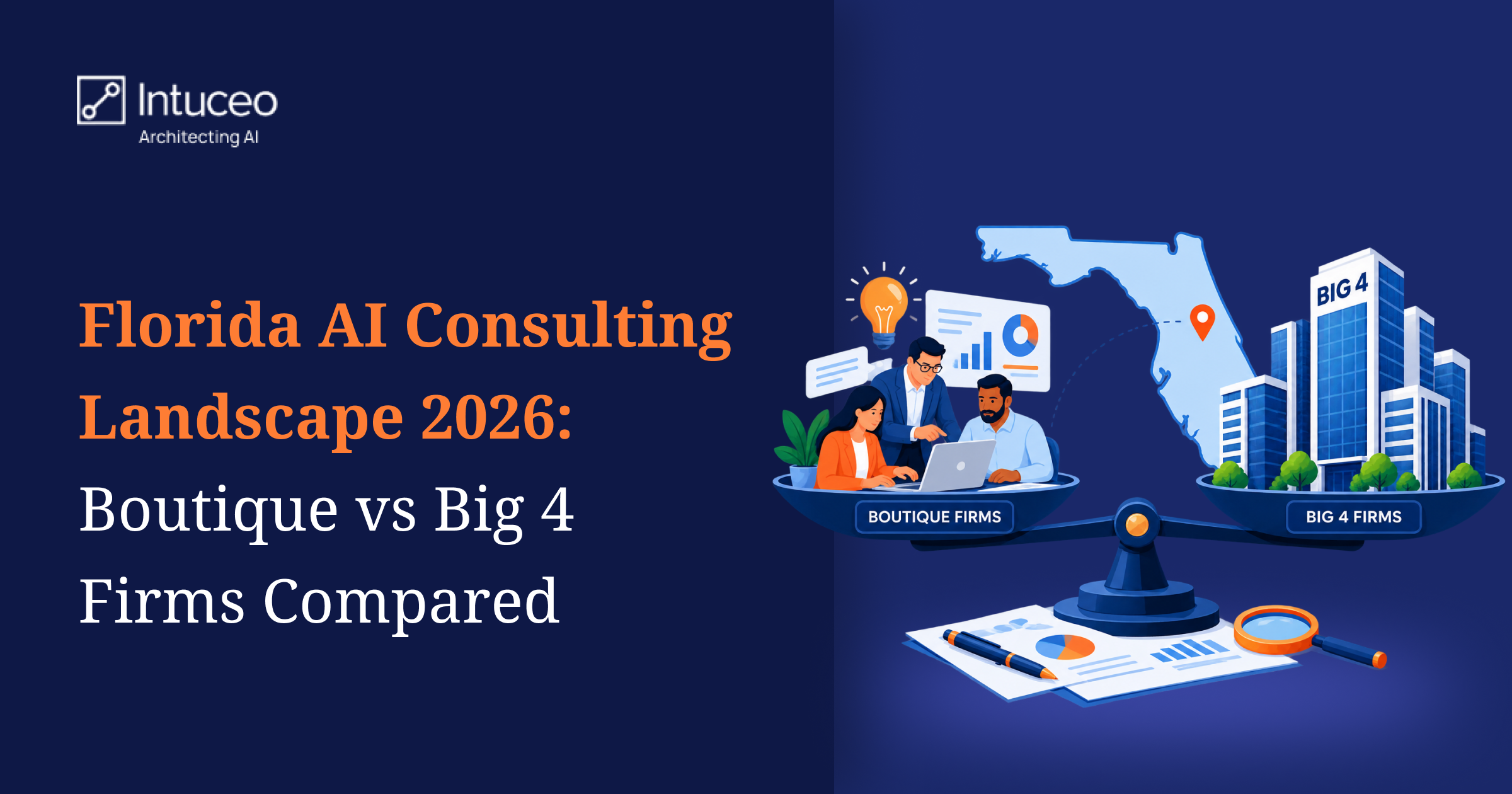
In the Florida AI consulting landscape, the choice comes down to the shape of the work. Big 4 firms and large integrators such as Accenture fit broad, multi-function programs that need scale, adjacent services, and brand assurance. Boutique AI consulting firms fit defined, technically hard problems where senior specialists, speed, and lower overhead decide whether the model reaches production.
A Florida enterprise with a real artificial intelligence (AI) problem to solve (a claims model headed for production, a demand forecast that has to hold under pressure, a clinical dataset that has to stay compliant) usually puts the same brief in front of two very different kinds of firms. One is a global advisory house or system integrator with thousands of consultants. The other is a specialist shop built around a narrow band of AI and data work. Both will say yes, and that split defines the Florida AI consulting landscape in 2026.
Only one is the right fit for a given situation, and the cost of choosing wrong is real. By some estimates, more than 80% of AI projects fail, twice the failure rate of technology projects that do not involve AI. [1] Any serious comparison of AI consulting firms in Florida starts by separating what each model is built to do from how each one sells.
Key Takeaways
- The Florida AI consulting landscape splits into global firms and specialist boutiques.
- Big 4 firms fit broad transformations that need scale, adjacent services, and board-level assurance.
- Boutique AI firms fit defined, technically hard problems where senior delivery and speed matter most.
- A strong RFP states the business problem and success metric, not a pre-built solution.
Who Competes in the Florida AI Consulting Landscape?
A shortlist in the AI consulting market in Florida tends to draw from two brackets. The first is the large global firms: the Big Four advisory houses, Deloitte, PwC, EY, and KPMG, alongside scaled system integrators such as Accenture, which is not one of the Big Four but competes for the same enterprise work. Deloitte staffs an office in downtown Jacksonville, [2] and Accenture runs delivery operations across the state.[3]
The second bracket is the specialist firms: smaller, focused practices that do AI, data engineering, and analytics and little else. When someone asks what the best enterprise AI consulting firms in Florida are, there is no single answer that survives contact with a real project. The firm that is right for a two-year, multi-function transformation is rarely the firm that is right for a hard, well-defined modeling problem. The useful question is which model fits the work in front of you.
Boutique vs Big 4 AI Consulting: How the Two Models Differ
The differences that matter to a buyer are structural. They come from how each type of firm is staffed, priced, and organized, not from marketing.
| Decision factor | Big 4 firms and large integrators | Boutique AI specialists |
|---|---|---|
| Scale and surge capacity | Deep benches; can staff large, parallel workstreams and multi-country rollouts quickly. | Smaller teams; capacity is finite and often booked around a few senior people. |
| Services beyond AI | Strategy, change management, tax, audit, and industry practices under one roof. | Concentrated on AI, data, and analytics; other needs are partnered or referred out. |
| Board and audit assurance | A recognized name that satisfies boards, auditors, and risk committees. | Credibility rests on named references and demonstrable work rather than brand. |
| Depth in a specific problem | Broad coverage; deep specialists exist but may not be assigned to your account. | Built around a narrow set of problems, so the specialists are the firm. |
| Who does the delivery | Partners sell; delivery often runs through junior consultants on a staffing pyramid. | Senior data scientists and engineers tend to stay on the work from start to finish. |
| Speed and flexibility | Formal process and heavier governance can slow changes in scope. | Shorter decision paths; scope and priorities shift with less friction. |
| Cost | Premium rates reflecting overhead, brand, and bench. | Lower overhead usually means lower rates for comparable senior effort. |
| Local presence and procurement | Offices in Florida metros and national contract vehicles. | Varies; a Florida-based firm can add local access and state and local contract routes. |
| Best fit | Broad, multi-function programs. | Defined, technically hard problems. |
A large firm carries advantages a small one cannot replicate, and a specialist carries advantages that scale tends to dilute. The decision turns on the shape of the problem, the constraints around it, and who has to be convinced.
When Should You Choose a Big 4 Firm or Large Integrator for AI?
The large firms earn their premium in specific conditions, including :
- When the AI work is one strand of a broader business change, a finance transformation, a merger integration, or a regulatory remediation, where strategy, process, and technology have to move together.
- When you need to stand up a large program quickly across several business units or countries and coordinate many vendors at once.
- When a board, regulator, or audit committee needs the assurance of a globally recognized name behind a high-stakes decision.
- When you would rather hold one firm accountable across strategy, risk, and delivery than assemble specialists yourself.
For an initiative of that scope, a Deloitte data analytics engagement in Florida or an Accenture AI program in Florida brings coordination, bench depth, and brand assurance that a small firm cannot match. If your problem looks like this, the size is the feature.
When Is a Boutique AI Consulting Firm the Better Fit?
A boutique AI consulting firm is a specialist practice focused on AI, data engineering, and analytics, where the senior people who scope the work also deliver it.
A specialist earns its place when the problem is defined and technically hard, and depth matters more than breadth. That covers a forecasting model that has to improve a real decision, a document-extraction pipeline that has to work on messy inputs, or a clinical data problem that has to stay compliant while it runs.
In those cases, boutique AI consulting firms in Florida tend to win on the factors that decide whether the work reaches production: senior people who stay on the engagement, prices focused on engineering rather than brand, and the freedom to change direction without a change-order cycle. Local access and continuity add to the case, and for public sector or regulated buyers, state and local contract routes can matter as much as capability.
What Does a Boutique AI Consulting Firm in Florida Look Like?
A buyer weighing the specialist route would, for example, look at firms such as Intuceo, a Jacksonville-based data and AI services firm with PhD-led engineering teams, patented automated machine learning (ML) accelerators, and the iPDLC delivery framework it uses to move work from prototype to production. Intuceo reports more than two decades of delivery and over 250 solutions shipped, and it carries procurement access through a State of Florida Department of Management Services term contract and a federal General Services Administration (GSA) Multiple Award Schedule.
When considering a boutique vendor, a buyer should confirm that the firm has the bench to sustain the work and references to prove it has solved the same class of problem before.
How Do You Write an AI Consulting RFP in Florida?
Most AI failures trace back to problem framing, data readiness, domain understanding, and delivery discipline rather than to firm size. [1] A good evaluation tests for those directly. That is the core of how to choose an AI consulting firm: the request for proposal (RFP) and the questions you ask do more work than any vendor list.
What Should an AI Consulting RFP Include?
An AI consulting RFP from a Florida buyer should state the business problem and the outcome you are paying for, not a pre-baked solution. At a minimum, it should specify :
- The decision the model must improve, and the metric that defines success in business terms.
- The current state of your data, and who owns getting it ready.
- Who will staff the work, and how senior they are on delivery, not just in the pitch.
- The production and handover plan, including how the model is monitored once it is live.
- Who owns the resulting code and intellectual property.
- Data residency and compliance requirements that apply to your work in Florida, including the Health Insurance Portability and Accountability Act (HIPAA) for health data, the Federal Information Security Modernization Act (FISMA) for federal systems, and Florida's State Cybersecurity Act (Section 282.318) for state agency work.
- A pricing model tied to outcomes rather than hours where the work allows it.
Sound enterprise AI vendor selection in Florida rests on scoring every proposal against the same criteria. That is how to evaluate AI consulting proposals on merit rather than reputation.
What Questions Should You Ask an AI Consulting Firm Before Signing?
Before signing, the questions to ask an AI consulting firm are the same regardless of firm size:
- Who exactly will do the work, and will they stay?
- Can you show a comparable problem you have taken to production?
- What happens when the model drifts or the data changes?
- How will you hand the work to our team?
- What do you need from us to succeed?
- How do you price a result versus a timesheet?
Navigating the Florida AI Consulting Landscape: Size the Firm to the Work
In the Florida AI consulting landscape, sizing the firm to the work is the whole decision. A broad, multi-function program rewards scale, adjacent services, and brand assurance. A defined, technically demanding problem rewards depth, senior attention, and speed. Decide which one you are actually running before you shortlist, and the comparison gets much shorter.
A third route is building an in-house team, which suits AI that is core to your product but takes longer to staff. Many enterprises start with a partner and hand the work to an internal team once the model is in production.
Define the problem before you compare firms
Intuceo runs a scoping session where we help you frame the business problem, test whether your data can support it, and define the success metric your proposals should be measured against.
Frequently Asked Questions
1.What does the Florida AI consulting landscape look like in 2026?
The Florida AI consulting landscape splits into two brackets. Global firms, including the Big Four and large integrators such as Accenture, compete for broad, multi-function programs. Specialist boutiques focused on AI, data engineering, and analytics compete for defined, technically hard problems. The right choice depends on the shape of the work, not the size of the firm.
2.How do boutique AI consulting firms in Florida compare to Big 4 firms?
In boutique vs Big 4 AI consulting, the clearest difference shows up after the contract is signed. At a boutique, the senior people who scoped the work usually deliver it, and pricing is built around a defined problem, so a single well-scoped project can cost a fraction of a large-firm program.
Big Four firms staff from a deeper bench, which lets them run several workstreams at once and absorb scope changes a smaller firm cannot. One practical way to separate them during selection is to ask each to name the individuals who will be on your project and how long they have been with the firm. A boutique can usually name them; a large firm often assigns people later, from whoever is available.
3.Accenture vs boutique AI firm: what are the tradeoffs in Florida?
Accenture is strongest when AI has to be wired into large existing systems, when several vendors or business units need coordinating, or when the work spans strategy, build, and ongoing support. That integration capacity is hard to replicate. A specialized firm is strongest on a single, well-bounded problem where you want the senior modelers and engineers on the work rather than a program to manage. The concrete tradeoff: with Accenture you pay for coordination and capacity you may not fully use on a contained problem; with a specialist you get depth and a lower rate, but less room to absorb a program that keeps widening.
4.How do I write an RFP for AI consulting in Florida?
State the business problem and the success metric rather than a solution. Specify data ownership and readiness, the seniority of who will staff the work, code and intellectual property ownership, the production and handover plan, Florida compliance requirements such as HIPAA, FISMA, and Section 282.318 where they apply, and an outcome-based pricing model where the work allows it.