
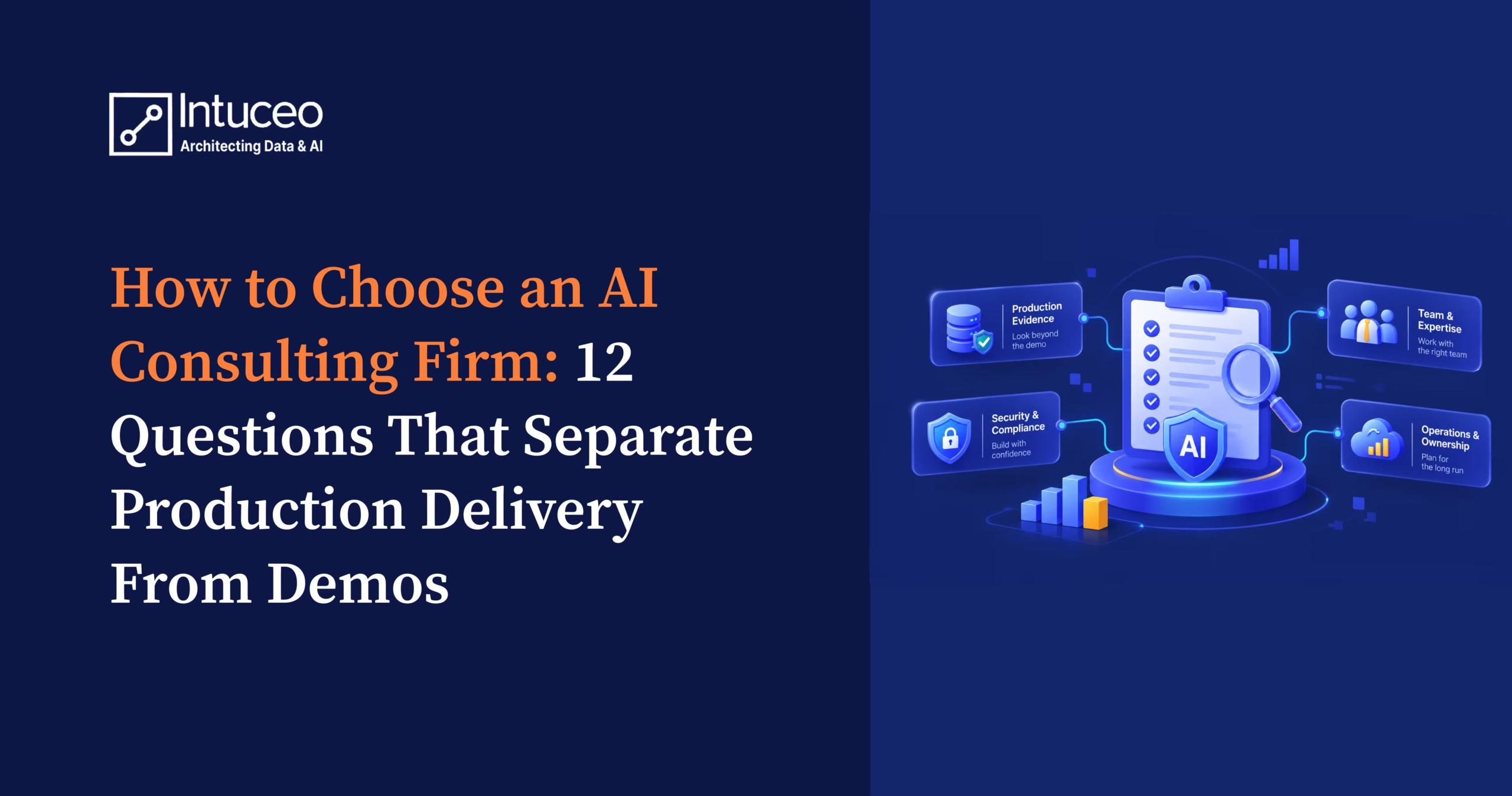
How to Choose an AI Consulting Firm: 12 Questions That Separate Production Delivery From Demos

A demo proves that a model can work on a prepared dataset in a controlled setting. It says little about whether the same firm can keep that model accurate inside a claims system, a quality management system or a federal case workflow a year later. Many organizations are still on the near side of that gap. In McKinsey’s 2025 global survey of 1,993 participants, nearly two-thirds of respondents said their organizations had not yet begun scaling artificial intelligence (AI) across the enterprise[1].
Knowing how to choose an AI consulting firm comes down to asking for proof of production, not proof of concept. The 12 questions below are grouped into four areas a buying committee can split between its members. They work alongside our pre-signature checklist of questions to ask before hiring an AI consulting firm, which covers the contract terms to settle once a firm is selected.
Quick answer: To choose an AI consulting firm, test for production evidence. Look for systems still running after go-live, testing on your data before any commitment, named builders and reviewers, integration into the systems where decisions are made, and a clear plan for monitoring and handover. Firms that answer with documents and operator references, rather than slides, are usually the ones that ship.

Key Takeaways

What Is Production Delivery in AI Consulting?

Production delivery means an AI system runs on live data inside the workflows where decisions are made, under real access controls, with monitoring, retraining and a named owner after go-live. A pilot or demo proves feasibility. Production delivery proves the system keeps working.

Why Do AI Demos Fail to Predict Production Delivery?

A demo leaves out the work that decides whether a system survives the move from proof of concept to production: integration with live systems, access controls, data drift, user adoption and cost at volume. McKinsey’s survey points to the habits that close the gap.
AI high performers were nearly three times as likely as other organizations to fundamentally redesign their workflows, and more likely to have defined processes for how and when model outputs need human validation[1]. Both are delivery habits, and both can be tested during an AI consulting firm evaluation.

How Do You Choose an AI Consulting Firm? 12 Questions That Test Production Delivery

These 12 questions are written to be answered with evidence. Where a firm can only answer in general terms, treat that as the answer.

How Do You Verify a Firm's Production Track Record?

1. Which of your AI systems are running in production today, and can we speak to the people who operate them?

Executive sponsors describe intent. Operators describe what happens when a data feed breaks on a Monday morning. Ask for at least one operator reference per relevant use case.

2. What did a recent deployment look like six months after go-live?

 A strong answer names the monitoring metrics, a drift event, a retraining cycle and how often the client’s team intervened. A weak answer stops at the launch date.

3. Which components of your last pilot did you rebuild for production, and why?

Honest firms will name the hand-built pipelines, hardcoded credentials and manual steps they replaced. A firm that says nothing changed has either never shipped or never looked.

How Should a Firm Prove Its Models Work on Your Data?

4. Will you test against a sample of our data before committing to an outcome?

Performance figures from another client’s data do not transfer. A short paid working session on a de-identified sample tells you more about data readiness and fit than any reference architecture slide.

5. How do you validate a model for its intended use in our regulatory context?

Ask for a redacted validation package from a comparable engagement, with intended use, test evidence and audit trail design. For healthcare, life sciences and federal work, the answer should name the specific rules the evidence was built to satisfy.

6. Tell us about a model that underperformed after release. What did you change?

This question separates experience from marketing. Listen for a specific cause, such as a population shift or a labeling error, and a specific fix.

Who Builds and Reviews the AI System?

7. Who builds the system, and who reviews their work before it moves forward?

Ask to meet the engineers and data scientists who will do the build. Then ask where senior review happens in the method, what it checks, and how its sign-off is recorded.

8. Which parts will come from your accelerators, and which will be custom?

Accelerators shorten delivery when they fit. Ask what each one does, how it will be configured for your environment and what licensing applies after the engagement ends.

9. Where will the model's output appear in our workflow, and who redesigns the process around it?

Output that lives in a separate dashboard tends to go unused. Look for a firm that maps the decision point inside the electronic health record (EHR), enterprise resource planning (ERP) system or case queue, and plans the workflow change with your process owners.

What Happens After the System Goes Live?

10. How will you track accuracy, usage and cost once the system is live?

A production-grade answer covers all three, with thresholds and a reporting cadence. Cost belongs on the list because token and compute spend can climb quietly as usage grows.

11. How will our team learn to operate and extend the system?

Knowledge transfer should be a planned stage with documentation, paired working and a date when your team runs the system without help.

12. How do you price each phase, and what would change the price?

A firm that can explain its cost drivers can usually control them.

How Do You Compare AI Consulting Firms When Choosing One for an Enterprise Project?

Turn the questions into AI consulting firm selection criteria by scoring each firm’s written answers against the demo-stage and production-grade columns below. Score each area from 1 to 5, then weight it by how much risk that area carries for your project.
Area Questions Demo-stage answer Production-grade answer
Production evidence 1 to 3 Logos, launch stories and sponsor quotes Operator references, post-launch metrics and a list of rebuilt components
Data and validation 4 to 6 Accuracy figures from other clients A test on your sample, a redacted validation package and a candid underperformance story
Team and method 7 to 9 Senior names in the pitch and generic accelerator claims A named build team, recorded review gates, configured accelerators and a workflow map
Operations and ownership 10 to 12 Monitoring and pricing deferred to later Accuracy, usage and cost thresholds, a dated handover plan and stated cost drivers
Want a second opinion on your shortlist scores? Book a briefing with Intuceo’s senior delivery team.

What Are the AI Consulting Red Flags When Evaluating a Firm?

AI Consulting Firm vs In-House Team: Which Should You Choose?

The AI consulting firm vs in-house team decision is rarely all or nothing. Build in-house when the capability is core to how you compete and you can recruit and retain data science, engineering and operations talent over several years. Bring in an AI consulting partner when speed to a first production release matters, when the work needs specialist skills you will not use continuously, or when your team has not yet taken an AI system through validation. Many regulated enterprises combine the two, with the firm delivering the first release and transferring ownership to an internal team. A build vs buy AI framework can settle the question layer by layer.
Option Choose it when
Build in-house The capability is core to how you compete and you can recruit and retain data science, engineering and operations talent for several years.
Hire an AI consulting firm You need speed to a first production release, specialist skills you will not use continuously, or a first validated release in a regulated setting.

How Intuceo Answers These 12 Questions

The fairest test of any firm is to hold its own proposal to the same 12 questions, and that includes Intuceo’s AI consulting services. Intuceo’s iPDLC™ framework places a human-in-the-loop checkpoint at each stage, with PhD-led quality gates reviewing engineering output before it moves forward, and production monitoring defined as a stage that continues after go-live. Proprietary accelerators, including Intuceo-Ax™, Intuceo-Ix™ and Intuceo-Dx™, are configured for each environment from prior regulated engagements.
If you are deciding how to choose an AI consulting firm, read delivery records rather than claims. Intuceo’s published case studies, including claims monitoring across the healthcare revenue cycle, Merit-based Incentive Payment System (MIPS) quality reporting on a cloud-native Observational Medical Outcomes Partnership (OMOP) lakehouse and AI-powered engineering drawing extraction, describe the work behind those answers.

Put your shortlist through the 12 questions. Start with ours.

Frequently Asked Questions

Choose on production evidence. Ask each firm for operator references, post-launch metrics, a test on a sample of your data, a redacted validation package and a named build team. Score every firm’s written answers against the same criteria, and weigh delivery records above demos.
A demo shows a model working on prepared data in a controlled setting. A production system runs on live data inside the tools where decisions are made, with access controls, monitoring, retraining and a named owner after go-live.
Watch for references that are all pilots, no sector validation or security review experience, answers that never come as documents, monitoring deferred to a later phase, and estimates that cannot explain how cost changes if your data is worse than expected.
Build in-house for core, long-lived capabilities you can staff for years. Hire a firm for speed, specialist skills and a first validated release. Many regulated enterprises use a firm for the first production system and plan a handover to an internal team.
Group your evaluation into production evidence, data and validation, team and method, and operations and ownership. For each area, compare the firm’s written answer against what a production-grade answer looks like, and ask for supporting documents.
The firms that can show systems still running after go-live, introduce you to the people who operate them, and share redacted validation and monitoring documents. Apply the 12 questions to every firm on your shortlist, including Intuceo.
Larger firms suit multi-year, multi-country transformation with heavy change management. Boutique firms often move faster on focused, technical builds where the senior team stays on the work. Score both on the same 12 questions. Our comparison of boutique and Big 4 AI consulting firms in Florida shows how the trade-offs play out.