A Decision Framework for Revisiting Shelved Computer Vision Inspection Projects in Manufacturing (2026)

Many plants carry at least one computer vision inspection initiative that cleared a pilot and then went quiet. The reasons were usually sound. The defect was too rare to build a training set. Parts changed faster than the model could be retrained. The labeling bill outgrew the savings, or integration with the line took longer than anyone had budgeted.
Vision models have moved on since then, and some of the constraints that stopped a computer vision inspection program in manufacturing have loosened-while others have not. For operations and quality leaders, the task is sorting shelved computer vision projects into three groups: the ones newer AI makes worth a revisit, the ones that need a scoped test first, and the ones that should stay exactly where they are. This framework is built for that sort.
KEY TAKEAWAYS

Why Computer Vision Inspection Projects in Manufacturing Get Shelved

Before scoring anything, name the real reason each project stopped. Most paused AI projects in manufacturing trace back to one of six causes:
The first three are data problems. The next two are engineering and operating problems. The last has nothing to do with technology at all. That distinction decides which projects newer models can realistically help.

What Has Changed in Manufacturing Computer Vision-and What Hasn’t

Foundation models pretrained on broad image collections have reduced the labeled data required by certain inspection use cases. Zero-shot and open-vocabulary approaches let teams describe what to look for rather than training a separate model for every defect category from scratch. 
Modern AI defect detection in manufacturing now includes these foundation models, which reduce the labeled data required for industrial inspection across a wider range of part types and defect categories.
Industrial anomaly detection also has a standard reference point. The MVTec Anomaly Detection benchmark, built specifically for industrial inspection, provides defect-free training images for each category and a test set containing both defective and defect-free images, with pixel-precise annotations of the anomalies. It holds more than 5,000 high-resolution images across fifteen object and texture categories. [1] 
That setup mirrors a common plant reality: plenty of good parts, very few bad ones. For manufacturing plants where visual inspection AI programs stalled because defects were rare, anomaly detection methods built around defect-free training images are worth a fresh look.

What has not changed

Better models do not fix optics. Poor lighting, glare, vibration, and inconsistent part positioning still break inspection. Large models can still be too slow for decisions inside a single machine cycle. Integration with manufacturing execution systems (MES) and programmable logic controllers (PLCs) still takes engineering effort. And a project without a clear owner on the plant floor will stall again, whatever model sits underneath.

Six Criteria for Evaluating a Paused Computer Vision Pilot

Use the table below to score each shelved project. It is designed to be completed in a working session with quality, operations, and data teams in the same room.
Criterion Question to ask Signal to revisit Signal to leave shelved
Original blocker Why did the project stop? Data scarcity, variation or labeling cost Business context changed or no owner
Value today Is the machine vision quality control gap still costing money in escapes, scrap or inspector hours? Escapes, scrap or inspector hours persist Line retired or defect designed out
Data on hand Do archived images still exist? Images and some confirmed defects available Nothing retained from the pilot
Speed requirement How fast must a decision happen? Seconds or sampled inspection is acceptable Hard real-time at very high line speed
Integration path Can results reach the line? Clear route to MES, PLC, or operator screen No path, and no budget to build one
Ownership Who will run it in production? Named quality or operations owner Only a data team champion
Score each row as a clear yes, partial, or no. Projects with strong answers on original blocker, value, and ownership are the best candidates, even if the other rows need work.

Sorting projects into three groups

Reopen now

These projects stopped because of data scarcity, part variation, or labeling cost, but still address a live problem and have a named owner. Archived images exist. Speed requirements are manageable. For these, zero-shot inspection or anomaly detection trained on good parts can often be tested within a short, contained assessment.

Reassess with a scoped test

Here the value is real, but one or two rows are uncertain. The line may run fast, or integration may have been the original sticking point. Run a focused test that answers the uncertain question directly, such as whether the model can meet cycle time on the current hardware, before committing to a restart.

Leave on the shelf

Some projects should stay paused. If the line was retired, the defect was designed out, or nobody in operations will own the result, better models change nothing. Closing these formally clears space for the candidates that matter.

A practical reassessment sequence

Deciding when to restart vision AI work is easier with a fixed sequence. The steps below keep the reassessment small and evidence-based.

Common mistakes when reopening a shelved project

Teams that restart vision work too quickly tend to repeat common errors. Watching for them saves a second shelving.

How to Rebuild the AI Visual Inspection Business Case for 2026

Old business cases carry old assumptions. Rebuilding AI inspection ROI for 2026 means checking which inputs have actually moved since the original approval:
One caution: a shelved project that looks attractive only because the new model was tested on easy images has been re-pitched rather than reassessed. Insist on the same difficult cases that stopped it the first time. Manufacturing defect detection AI that clears those, at production line speed and under production lighting, has earned a restart budget. Anything less has earned another test.

How Intuceo Approaches Computer Vision Inspection Reassessments

Reassessments run on the same structure Intuceo uses to judge any AI initiative before it reaches production. The DARWIN AI governance framework separates the question into dimensions that can each be answered independently:
A project can pass on model accuracy and still fail on three of those four, which is why the judgment is never made on a model alone.
For vision work, two capabilities carry most of the delivery. High-fidelity visual inspection applies image segmentation and sub-pixel anomaly detection to sub-millimeter defects, including precision medical optics, where surface anomalies, edge irregularities, and contaminants have to be caught at production speed. Intuceo’s multi-modal vision intelligence capability brings video, image, and metadata streams together so an inspection result lands alongside line system signals instead of a separate console-see how this is applied across our advanced manufacturing AI solutions.
Deployment is half of a reassessment that has to survive audit-a challenge Intuceo addressed directly in its advanced ML inspection pipeline case study. Intuceo delivers in on-premise, private cloud, and air-gapped environments, and client data is not used to train public models. For a plant that cannot accept a hosted model changing behavior between validation runs, that removes the variable rather than managing around it.
PhD-led engineering teams with prior deployments in regulated and high-precision environments deliver solutions to fit your unique needs. See how that applies across our advanced manufacturing AI solutions and to our computer vision and AI capabilities built for it.

Have a vision project sitting on the shelf?

AI Dream Session, Vol. 2: Computer Vision Reimagined is a 45-minute live session with Intuceo on Thursday, September 24, 2026, at 11:00 AM ET. It covers which previously rejected use cases may now be viable, where limitations still hold in production, and the questions worth asking before any project is reopened.
Get the reassessment questions before your next project review

Frequently Asked Questions

A shelved vision project is worth revisiting if it originally failed due to data scarcity, part variation, or labeling cost-not due to line speed limits, integration barriers, or lack of ownership. Start with the reason it stopped. If the blocker was too few defect examples, frequent part variation, or labeling cost, newer vision AI models may help. Then test on archived images from the original pilot, measured against the original acceptance criteria. If the blocker was line speed, integration, or lack of ownership, better models alone are unlikely to change the outcome.

Six criteria determine whether a paused computer vision project is worth restarting in manufacturing:
(1) original blocker,
(2) current cost of the problem, (3) availability of archived images,
(4) line speed requirements,
(5) integration path to MES or PLC, and
(6) named operational ownership. Projects that score well on blocker, value, and ownership are usually the strongest candidates.

Four inputs in an old computer vision inspection business case are worth re-checking in 2026: labeling effort (often lower for foundation model use cases), retraining frequency (potentially less frequent where models generalize across part variants), compute cost per image (potentially higher with larger models at the line), and the value of catching a defect (unchanged-set by your process, not by the model). Re-check the first three against your own parts before any approval, and leave the fourth where the original case had it.
Revisit the ones canceled for data or variation reasons, where the underlying problem still exists, and a plant owner is ready to run the result. Leave closed the projects whose lines were retired, whose defects were designed out, or that lacked operational ownership. A short, documented reassessment is the fastest way to tell the difference.

GenAI Vision vs Classical Computer Vision: An Honest Cost Comparison for Manufacturers

Most cost comparisons between generative AI (GenAI) vision and classical computer vision stop at the model, which is usually the smallest line on the bill. The bigger numbers sit in labeling, retraining every time a part changes, compute at the edge or in the cloud, and the engineering hours it takes to make any model behave under real plant lighting.
Plant and quality leaders weighing GenAI vision vs classical computer vision for manufacturing are rarely choosing between old and new technology. The real choice is where the money goes: upfront into data, or ongoing into compute and supervision. This guide breaks down both cost profiles, shows where each approach earns its place, and explains why many inspection programs end up running both.

Key Takeaways

What each approach actually is

In this guide, classical computer vision means a model built for one defined job and trained on your own parts. It might be a rules-based machine vision setup or a trained deep learning model, typically a convolutional neural network, that learns to find scratches on one specific housing from labeled examples. Inside that scope, it is fast and accurate; outside it, the model sees nothing.
GenAI vision relies on foundation models pretrained on very large, broad image and text collections. These models can be prompted to locate or describe things they were never specifically trained to find. Open-set detectors such as Grounding DINO accept category names or plain-language descriptions as input, and the largest variant reported in the original research reaches 52.5 average precision (AP) on the Common Objects in Context (COCO) zero-shot transfer benchmark without using any COCO training images.
That figure comes from a research benchmark built on everyday objects, which proves the approach works in principle but says nothing about your defect types.

The cost of classical computer vision, line by line

Classical projects spend most of their budget before the first production image is scored. The main cost lines look like this:
Classical vision is expensive at the start and again at every changeover, then cheap to operate in between. Stable, high-volume lines with a known defect list absorb that profile well, while high-mix lines feel the retraining cost repeatedly.

The cost of GenAI vision, line by line

GenAI vision moves the spend rather than removing it. The cost lines change shape:
GenAI vision costs less to reach a first result, stays flatter when parts change, and carries a steadier running bill that grows with inspection volume.

Zero-shot detection vs trained model: where the break-even sits

The useful comparison of zero-shot detection vs. a trained model is not about accuracy in the abstract. It is about which operating conditions make each cost profile cheaper over time. Here are the core deciding factors:
Factor Favors a classical trained model Favors GenAI vision
Part variety Few, stable part numbers Many variants or frequent revisions
Defect frequency Common and well documented Rare or hard to collect in volume
Decision speed Must decide within a machine cycle Can wait seconds or run offline
Image volume Very high and continuous Lower volume or sampled inspection
Defect definition Stable and measurable Descriptive or still evolving
Compute location Isolated line, edge only On-site GPU servers or reliable network
If most of your answers land in the left column, a trained model is likely the cheaper long-run option, even with its labeling bill. If most land on the right, GenAI vision deserves a serious look. Mixed answers usually point to the hybrid pattern described below.

Vision AI total cost of ownership over three years

A single project quote rarely captures vision AI total cost of ownership. A more honest view spreads cost across three phases and asks the same questions of both approaches.

Year one: build and validate

Classical projects carry the heaviest year one bill because collection and labeling happen here. GenAI projects usually reach a working prototype faster, but they should budget real time for an evaluation set and for the prompt and threshold work that turns a demonstration into something a quality manager will sign off on.

Years two and three: run and change

This is where the curves separate. Classical vision stays cheap to run but spikes at every part change or new defect type. GenAI vision absorbs change more gracefully but carries a steady compute and review cost. Plants that change parts often tend to see GenAI costs flatten over time, while plants that run the same parts for years often see classical vision win on cost.

The costs both approaches share

Camera and lighting design, integration with manufacturing execution systems (MES) and programmable logic controllers (PLCs), operator training, and change control apply to both. Ignore them and every comparison will look better than reality.

The hybrid pattern many programs land on

Many inspection programs stop treating this as an either-or decision. A common pattern uses each approach where it is cheapest:
The hybrid pattern does not remove labeling or compute; it places each where it costs the least.

Computer vision return on investment in manufacturing: what to measure

Credible computer vision ROI in manufacturing comes from operating metrics, not model scores. Five measures cover most business cases :
One caution before any vendor call: a quote that covers the model but leaves out labeling, validation, compute, and change management accounts for one line of an AI inspection cost estimate, not the whole of it.

Where Intuceo fits

Intuceo works with manufacturers on inspection problems where the choice between approaches is genuinely unclear. The starting point is the operating conditions on the line rather than a preferred model family: part variety, defect rarity, cycle time, and how often the process changes.
Two capabilities carry most of that work. High-fidelity visual inspection applies image segmentation and sub-pixel anomaly detection for sub-millimeter defect recognition, including precision medical optics, where surface anomalies, edge irregularities, and contaminants have to be caught at production speed. Multi-modal vision intelligence fuses video, image, and metadata streams. So, inspection results sit alongside MES signals instead of in a separate system, which is what makes defect prediction possible before a variance becomes a downstream failure.
On the model versioning cost described earlier, Intuceo deploys in on-premise, private cloud, and air-gapped environments, and client data is never used to train public models. For plants that cannot accept a hosted model changing behavior between validation runs, that removes the variable rather than managing around it.
The work is delivered by PhD-led engineering teams with more than 250 enterprise data and AI deployments behind them. See how that applies across manufacturing and to the Modular AI Assets built for reuse across engagements.

Deciding whether a stalled vision project is worth reopening

Join AI Dream Session, Vol. 2: Computer Vision Reimagined – a live 45-minute session with Intuceo AI Labs on Thursday, September 24, 2026, at 11:00 AM Eastern.
You will see what has genuinely changed in computer vision, where infrastructure and deployment costs still matter, and how to decide which use cases deserve a second look.

Frequently Asked Questions

It depends on where you look. GenAI vision is usually cheaper to reach a first working result because it needs far less labeled training data. Classical computer vision is usually cheaper to run per image once trained, especially at high volume on an edge device. Over several years, the cheaper option is often decided by how frequently your parts and defect types change.
Zero-shot detection tends to win when defects are rare, part variants change often, or the team needs a feasibility answer before investing in labeling. A trained model tends to win when the defect list is stable, examples are plentiful, and decisions must be made within tight cycle times. In every case, results should be confirmed on your own images before any production decision.
Yes. Buyers asking what enterprise AI firms are based in Jacksonville will find several with genuine enterprise delivery records, spanning applied machine learning, computer vision, generative AI, and the data engineering foundations underneath them. The more useful screen is depth in your industry and the seniority of the people assigned, since enterprise AI work in healthcare, financial services, or manufacturing depends far more on domain understanding than on general modelling skill.
There is no reliable single figure, and any published average should be treated with caution. Cost is driven by the number of part variants, defect rarity, required inspection speed, camera and lighting work, integration with line systems, and how often the process changes. A scoped assessment against those drivers gives a far more dependable estimate than a benchmark number.

Data Engineering Firms in Jacksonville, FL: What Enterprise Buyers Need to Know Before Signing

By the time a statement of work (SOW) reaches signature, the selection is effectively over. The vendor is chosen, the budget is approved, and the document gets treated as paperwork. That is usually where the real cost of the engagement is set.
Ambiguity in that document has a long tail. A deliverable nobody can test, a dependency nobody owns, a line of pipeline code whose ownership was never settled: each surfaces months later as a change order, a stalled sign-off, or a handover that leaves you dependent on the firm you were trying to exit.
This guide is for enterprise buyers in Northeast Florida who are past the shortlist and now reading a draft contract. It covers what to tighten in the document, and the regional conditions a generic legal review may miss.

What Types of Data Engineering Firms Operate in Jacksonville, FL?

Data engineering firms in Jacksonville, FL fall into four categories: national consultancies with local sales presence, specialist analytics and AI consultancies headquartered locally, vertical specialists (primarily healthcare), and staffing-led firms that fill roles rather than deliver outcomes.
A search for data engineering firms in Jacksonville, FL returns four quite different types of business under one label, and the contractual risk is not the same across them.
Buyers usually open by asking which data engineering firms in Jacksonville, FL are the best fit for their project a question that has no useful answer until the category is settled, because a legacy warehouse migration, a regulated reporting build, and a staff augmentation gap are three different purchases. The fourth type of firm will accept an SOW written for the second without objection.

Which SOW Clauses Carry the Most Risk in a Data Engineering Engagement?

Deliverables defined as artifacts, with acceptance criteria

A deliverable described as designing and implementing data pipelines is an activity. It cannot be accepted or rejected. An artifact can: a named set of ingestion jobs, a documented data model, a defined number of validated tables, a monitoring dashboard, a runbook.
Attach acceptance criteria to each one, and state who signs off and within how many business days. Silence on acceptance timelines is the most common reason a project that finished on schedule still gets invoiced as though it ran late.

Key personnel commitments under Florida's restrictive covenant rules

Ask for named key personnel with a minimum allocation and a replacement clause requiring equivalent seniority and your written approval. Then read that clause against Florida law, which is unusually permissive here.
The state’s CHOICE Act, in Chapter 542 of the Florida Statutes, treats noncompete and garden leave agreements of up to four years as enforceable for employees and individual contractors earning more than twice the annual mean wage of the Florida county where the employer’s principal place of business sits. For a firm headquartered in Jacksonville, that benchmark is Duval County’s.
This cuts both ways. A local vendor can credibly commit a specific senior engineer for the life of a multi-year programme, which national firms often will not do. It also means that if you later want to hire that engineer directly, a common outcome on long engagements, the restriction may be enforceable for years. Check the non-solicitation and hire-away terms in your SOW against what the vendor holds over its own staff.

Dependency scheduling and delay attribution

Nearly every delayed data engineering project stalls waiting on source system credentials, a security review, or a database administrator’s time. The SOW should name each dependency, name the person responsible on your side, and state what happens when one slips: a defined re-planning window, a rate for idle time, or a documented pause.
Vendors that raise this in negotiation are not difficult. Vendors that stay quiet on it are usually planning to raise a change order instead.

Intellectual property boundaries

Most experienced firms bring accelerators, meaning pre-built frameworks and code assets developed on prior engagements that shorten delivery. That is a good thing, and you should not expect to own them. What you must own outright is everything built for you: pipeline code, transformation logic, data models, orchestration configuration, and documentation.
Get the SOW to list the vendor’s pre-existing assets by name, grant you a perpetual licence to use them within the delivered work, and assign everything else to you on payment. An SOW devoid of these leaves the boundary to be argued after the invoices are paid, when you have nothing left to negotiate with.

Handover and exit provisions

Ask what you receive on the last day: repository access, environment credentials, a runbook, a knowledge transfer schedule with named attendees, and a defined support tail. For enterprise data engineering Florida buyers running regulated workloads, add data return and deletion certification to that list. A firm that cannot describe its handover in specifics has not done many.

Florida-Specific Contract Conditions for Data Engineering Engagements

Public records obligations extend to your vendor

Florida’s public records law (Chapter 119, Florida Statutes) requires that service contracts with public agencies include specific records-custodian language and obliges vendors to maintain or transfer public records when a contract ends.
If you are contracting on behalf of JEA, the City of Jacksonville, Duval County Public Schools, or the Jacksonville Transportation Authority, Florida’s public records law reaches your vendor directly.
Section 119.0701 of the Florida Statutes requires public agency service contracts to carry specific public records language, including the records custodian’s contact details in 14-point boldface type, and obliges the contractor either to transfer all public records to the agency at no cost when the contract ends or to keep and maintain the records the agency needs. A contractor that fails to produce records on request may face penalties, and a court can award enforcement costs and attorney fees against it.

The practical consequence is that a vendor unfamiliar with Chapter 119 will scope and price as though its working notes, tickets, and design documents are private. Confirm whether the firm has delivered under these terms before.

Federal contract vehicles do not cover municipal purchases

Vendors often list a General Services Administration (GSA) Multiple Award Schedule as evidence of public sector standing. That vehicle covers federal agencies. It does not, on its own, let a city or county buy through it.
If you are a state or local buyer, ask instead about a Florida Department of Management Services state term contract or your own agency’s approved vendor list. Among Jacksonville technology vendors pitching public work, this distinction separates the firms that have delivered locally from those quoting a credential that does not apply to you.

Delivery location versus registered address

A Jacksonville address can mean a headquarters, a delivery centre, or two salespeople in a serviced office. None of those is disqualifying, but each changes the SOW. Ask where the engineers physically sit, what hours they overlap with yours, how many onsite days are included rather than billable, and who attends your stand-ups.
If delivery runs partly offshore, that can be an advantage on cost and coverage, but the handoff points belong in the document rather than in a reassurance on a call.

Compliance regimes priced into scope

The three primary compliance regimes affecting enterprise data engineering engagements in Florida are: HIPAA (healthcare and claims data), the Gramm-Leach-Bliley Act or GLBA (financial services), and PCI DSS (cardholder data).

The region’s enterprise data sits heavily in healthcare, financial services, and logistics. Each carries a different regime: protected health information under the Health Insurance Portability and Accountability Act (HIPAA), customer financial data under the Gramm-Leach-Bliley Act, cardholder data under the Payment Card Industry Data Security Standard (PCI DSS).

Enterprise data engineering firms in Florida that buyers can rely on will write the applicable compliance standard into scope and price the controls, audit logging, lineage, and access restrictions that come with it. Compliance that appears only in a boilerplate annex has not been priced into the engagement, and it will surface as a change order at the first audit.

How to Evaluate a Data Engineering Partner in Jacksonville Before You Sign

How do I choose a data analytics partner in Jacksonville is a question best answered backwards, from the document rather than the pitch. Seven questions decide it:
Enterprise buyers evaluating data engineering firms in Jacksonville, FL can shortlist any vendor, but these seven questions determine which one to sign with.

How Intuceo Answers the Enterprise Buyer’s Checklist

Intuceo delivers data engineering and applied AI from Jacksonville, largely in regulated settings: life sciences, healthcare, manufacturing, and federal work. That shapes how the firm contracts. Engagements are led by named senior PhD practitioners, rather than staffed through a delivery pyramid.
Reusable assets built over prior engagements, such as the Dx data accelerators and the iPDLC delivery framework, are listed as pre-existing IP in the SOW so the boundary against your build is explicit from the start.
Public sector buyers should note the distinction drawn above: the firm’s federal schedule covers federal agencies, and state or municipal purchases run through separate vehicles.
The seven questions above are worth asking of every firm on your shortlist. How specifically a vendor can answer them, in a documented format rather than on a call, is the most reliable signal you will get before the work starts.

Review the scope before you commit.

Intuceo’s Jacksonville team reviews scope, dependencies, and ownership terms with enterprise buyers before they sign, including SOWs drafted by other firms. You get a written read on where the scope is ambiguous and what that ambiguity is likely to cost you later. Engagements that start with a validated data strategy move faster once the SOW is in place.

Frequently Asked Questions

The Jacksonville market for data analytics companies includes firms ranging from specialist AI and data engineering consultancies to healthcare-focused practices and staffing-led providers. The named local firms include Intuceo, which delivers data engineering and applied artificial intelligence work for regulated industries from its Jacksonville base; NLP Logix, a machine learning consultancy; Clearsense, focused on healthcare data; Urban SDK, working in transportation and government analytics; and SGS Technologie, a general information technology and analytics services firm. 

Several national consultancies also staff Jacksonville engagements from offices elsewhere in Florida, which is worth confirming before you assume local delivery.

Evaluate on three things beyond technical fit. First, delivery proximity: where the engineers actually sit and how many onsite days you get. Second, regulatory fluency in your specific vertical, evidenced by named engagements rather than a certifications list. 

Third, contractual specificity: whether the firm will commit named people, artifact-level deliverables, and a defined handover in writing. The third is the strongest signal, because it is the one a firm without relevant delivery history cannot fake.

Yes. Buyers asking what enterprise AI firms are based in Jacksonville will find several with genuine enterprise delivery records, spanning applied machine learning, computer vision, generative AI, and the data engineering foundations underneath them. The more useful screen is depth in your industry and the seniority of the people assigned, since enterprise AI work in healthcare, financial services, or manufacturing depends far more on domain understanding than on general modelling skill.

Six clauses carry most of the risk: artifact-level deliverables with acceptance criteria and sign-off timelines; named key personnel with a replacement standard; a dependency schedule stating what happens when your side slips; intellectual property terms separating your build from the vendor’s pre-existing assets; a compliance standard written into scope rather than annexed; and a handover specification covering code, credentials, documentation, and post-go-live support. Change control and the rate card for out-of-scope work sit just behind those.

Life Sciences AI Consulting in Florida

Most life sciences teams evaluating an analytics partner are not shopping for artificial intelligence (AI). They have a specific bottleneck: enrollment is behind on two studies, safety case intake is absorbing headcount that should be doing signal evaluation, or ten years of research data sits in systems nobody can query. The question is which firm can fix that under inspection conditions.
Intuceo delivers life sciences AI consulting in Florida as a services engagement, configuring analytics against the sponsor’s own systems, validation expectations, and quality procedures, using accelerators built during prior regulated engagements rather than starting each build from zero.

What Life Sciences AI and Analytics Services Does Intuceo Provide in Florida?

Five areas of work account for most life sciences engagements. Each one is scoped, validated, and handed over with documentation the quality team can defend.

Clinical trial intelligence

Site and country feasibility modeling from historical enrollment and real-world data, patient cohort identification against provider datasets, protocol deviation detection, and automated query generation on Electronic Data Capture (EDC) records. Clinical trial intelligence, the use of AI and real-world data to model feasibility and flag risk before it delays a study, helps sponsors and Contract Research Organizations (CROs) shorten startup and reduce manual data review cycles. This is the same approach behind Intuceo’s AI-powered patient matching for clinical trials, which cut enrollment delays by half.

Pharmacovigilance and safety automation

Individual Case Safety Report (ICSR) intake and triage from unstructured sources, Medical Dictionary for Regulatory Activities coding assistance, duplicate detection, narrative drafting for reviewer approval, and Pharmacovigilance System Master File (PSMF) annex assembly with change control. Pharmacovigilance automation, the use of AI to handle these safety case tasks, is configured to keep the qualified person accountable for every decision the system proposes.

Post-market adverse event detection

Disproportionality and temporal signal detection across spontaneous reports, literature, and provider records, with case-level traceability back to the source document. United States marketing applicants must report each adverse drug experience that is both serious and unexpected within 15 calendar days of receipt,[1] which makes intake speed and audit trail quality inseparable requirements. This is the same detection and traceability approach behind Intuceo’s adverse event detection deployment for a global pharmaceutical manufacturer.

Research and development acceleration

Semantic search across internal study reports, assay data, and regulatory correspondence, the same advanced analytics in pharma R&D approach Intuceo has applied to drug discovery, so scientists retrieve prior work instead of repeating it. Target and biomarker literature triage, experiment metadata harmonization, and machine learning (ML) models on preclinical datasets, each with the reasoning path documented for scientific review.

Pharmaceutical manufacturing analytics

Batch genealogy, golden batch comparison, yield and deviation root cause analysis, and Corrective and Preventive Action (CAPA) linkage across manufacturing execution and laboratory systems. Useful where yield variance and repeat deviations are documented but not explained. This mirrors the ML-based inspection pipeline Intuceo built for medical device manufacturing.

Regulatory document intelligence

Extraction and classification across submission dossiers, standard operating procedures, batch records, and Trial Master File content. Reviewers get structured fields and a link to the exact page the value came from, which is what shortens a document review rather than a summary they cannot verify.

What AI Accelerators Power Intuceo's Life Sciences Engagements?

These are internal assets brought into an engagement to shorten deployment, not licensed software. They are configured against the client’s data, environment, and validation requirements.
Accelerator Applied to
Intuceo-Ax™ Analytics acceleration across clinical, safety, and manufacturing datasets, including cohort building and yield analysis.
Intuceo-Ix™ Semantic and neural search over study reports, literature, and regulatory correspondence for research retrieval.
Intuceo-Dx™ Document and vision intelligence for batch records, safety source documents, submission content, and scanned archives.
AgentCare AI Agentic workflows for case intake, triage routing, and CAPA follow-up, with human approval gates at each decision point.
iPDLC™ Delivery lifecycle framework governing documentation, testing evidence, and handover for validated environments.
DARWIN framework Structured assessment across data, architecture, responsibility, workflow, and infrastructure readiness before build begins.

Why Should Florida Life Sciences Companies Choose a Florida-Based AI Consulting Partner?

Intuceo is headquartered in Jacksonville. For validation-heavy work, that changes the shape of an engagement in ways that matter more than they do in most software categories. Read more about why Intuceo is based in Jacksonville.

What Life Sciences and Healthcare Experience Does Intuceo Bring?

This experience is the foundation of Intuceo’s life sciences AI consulting in Florida: data engineering and analytics work for pharmaceutical manufacturers, medical device firms, health systems, and payers operating under audit.

Pharmaceutical and device

Janssen Pharma, Ferring Pharma, and Bausch & Lomb, spanning clinical data, safety operations, and manufacturing analytics.

Florida health systems and payers

Florida Blue, GuideWell Health, UF Health, Mission Health, and d2i, where provider and claims data supports real-world evidence work. This work runs alongside Intuceo’s broader healthcare analytics practice for Florida payers and providers.

Regulated delivery discipline

Doctorate-led technical oversight, explainable model outputs, and testing evidence produced as part of delivery rather than assembled afterward. Meet the PhD-led team behind this oversight.

Data engineering depth

Long-running life sciences data engineering work integrating laboratory, clinical, manufacturing, and claims systems, the same data foundation covered in Intuceo’s DataOps and engineering capabilities, which is usually the constraint before any model is built.

How Does a Life Sciences AI Consulting Engagement with Intuceo Start?

Structured assessment

A two- to three-week review of the target workflow, source systems, data quality, and validation expectations, using the DARWIN framework. Output is a scoped plan with effort, dependencies, and evidence requirements.

Configured pilot

One workflow built on real client data with the relevant accelerator configured, run against defined acceptance criteria and reviewed by the quality function before scope expands.

Validated rollout

Extension to additional studies, sites, or facilities with documentation, testing evidence, and knowledge transfer delivered under iPDLC™ governance.

Start Life Sciences AI Consulting in Florida with Intuceo.

Partner with Jacksonville-based engineers to configure validated AI accelerators against your own systems, shorten trial cycles, and automate compliance under strict inspection conditions.

Frequently Asked Questions

Prior engagements include Janssen Pharma, Ferring Pharma, and Bausch & Lomb on the pharmaceutical and device side. Adjacent healthcare work includes Florida Blue, GuideWell Health, UF Health, Mission Health, and d2i, which is where much of the provider and claims data experience relevant to real-world evidence comes from. See results from a recent pharmaceutical commercial analytics engagement. Reference conversations can be arranged for shortlisted engagements, subject to client consent.
It compresses specific tasks rather than the trial as a whole. The measurable gains come from site and investigator selection informed by historical enrollment performance, cohort identification run against provider and claims data instead of manual chart review, automated detection of protocol deviations and data discrepancies in Electronic Data Capture systems, and coding assistance that leaves the final classification with a trained reviewer. Each of these reduces cycle time on a step that is currently manual. None of them removes the sponsor’s obligation to explain how a decision was reached.
The Pharmacovigilance System Master File is a detailed description of the pharmacovigilance system a marketing authorisation holder operates for its authorised medicines. It sits outside the marketing authorisation dossier and is maintained independently from it.[2] It must stay permanently available for inspection at the site where it is kept, and a copy has to be submitted to a national competent authority or the European Medicines Agency within seven days of a request.[3] Automation applies to the mechanics, not the accountability: pulling annex content directly from the source systems that generate it, maintaining version history and change logs automatically, flagging annexes that have drifted out of date, and holding the file in a state where a seven-day request is routine rather than a fire drill. The qualified person responsible for pharmacovigilance remains the owner of what the file says.
Yes. This work typically joins manufacturing execution, historian, and laboratory information management data to build batch genealogy, then compares underperforming batches against reference batches to isolate the parameters that moved. Deviation and CAPA records are linked to the same batch context so recurring root causes become visible instead of being closed one at a time. Equipment effectiveness and changeover analysis are usually part of the same scope.
Yes. Most delivery runs remotely, with onsite presence scheduled for the phases where it changes the outcome: the structured assessment, validation walkthroughs, quality reviews, and go-live. Because the team is based in Jacksonville and works on Eastern Time, Florida sponsors get same-day onsite availability without paying for a permanently deployed team.
Yes. Intuceo is headquartered in Jacksonville, and most onsite validation work for Florida life sciences clients happens there or within same-day reach of Gainesville, Tampa, Orlando, and South Florida.

Healthcare Analytics Consulting for Florida Payers and Providers

Intuceo is a Jacksonville-based firm delivering healthcare analytics consulting to Florida health plans and health systems. Engagements cover quality measurement, revenue cycle performance, and member risk, each built on encrypted, HIPAA-compliant data environments suited to regulated health data.
For Florida health plans and health systems navigating these changes, Intuceo’s healthcare analytics consulting team provides the data remediation and analytical infrastructure to move forward, governed by the iPDLC delivery lifecycle from scoping through production handoff. Request a scoping call

Engage Intuceo through

State of Florida

DMS term contract 80101507-23-STC-ITSA, valid through September 2027

Federal agencies

GSA Multiple Award Schedule 47QTCA24D00EH

Commercial

Direct master services agreements with health plans and health systems

Healthcare organizations Intuceo has delivered for

Why Florida Payers and Providers Are Turning to Healthcare Analytics Consulting

Florida Medicaid analytics and quality reporting work is being bought as remediation rather than experimentation. The measure logic and the regional reporting history both moved, and most reporting environments were never built to absorb either change.

7 measures added, 2 retired

Quality measure specifications were rewritten for 2026
HEDIS Measurement Year 2026 also moved four measures into Electronic Clinical Data Systems reporting and reissued specifications in a format aligned to the Fast Healthcare Interoperability Resources (FHIR) data standard.
Measure logic hard-coded over the last decade now needs re-validation.

11 regions to 9

Florida redrew its Medicaid reporting geography
Florida Medicaid analytics work changed materially when the state moved Statewide Medicaid Managed Care to nine lettered regions, A through I, in February 2025.[2] Regional trend lines break mid-history without a county-level crosswalk.

$21 billion

Administrative work remains largely manual
The 2025 CAQH Index puts the remaining industry savings opportunity from fully automating manual and partially manual administrative transactions at USD 21 billion.[3] Most of that opportunity sits in eligibility, authorization, and denials.

How Healthcare Analytics Consulting Is Scoped for Payers vs. Providers

Health plans and health systems ask different questions of different data, so the two are scoped independently. Intuceo has delivered on both sides, which matters as Florida payers and providers increasingly have to reconcile data with each other.

HEDIS and Star Ratings production

HEDIS analytics Florida work starts with measure calculation on a defensible data lineage – the same foundation Intuceo has built for Florida Blue, GuideWell Health, and UF Health – with the audit trail a certified compliance auditor will ask for already in place. Gap-in-care analysis runs off the same lineage, not a parallel extract.

Quality of care oversight

Predictive models rank which open care gaps are still closable inside the measurement period and which members are reachable, so outreach spend lands where it moves at a rate.

Member high-utilizer analytics

Clinical Risk Group classification across claims, pharmacy, and encounter data separates members with a single expensive year from complex chronic cohorts whose trajectory is still movable.

Potentially preventable events

Tracking of preventable admissions, readmissions, and complications to isolate where avoidable cost is generated and inform provider contracting. See how this works in our healthcare analytics consulting guide.

Encounter data validation

Validation and leakage detection for self-funded employers and labor funds, with reporting that holds up when a trustee asks how a number was produced.

Hospitals and health systems Margin, capacity, and clinical risk

Denial prediction

Revenue cycle management (RCM) scoring in the pre-submission window, so claims likely to be rejected get corrected before they leave. RCM analytics Florida engagements are judged on days in accounts receivable, not dashboard adoption.

Coding validation

Assisted review against clinical documentation to catch specificity errors and mismatches that create audit exposure and slow reimbursement.

Chronic condition risk trajectories

Models that flag escalation early enough for intervention to change an outcome, with diabetes and cardiovascular cohorts dominating in this region.

Unified clinical view

Intuceo-Ix™ – part of Intuceo’s Modular AI accelerator suite – supports retrieval across electronic health records, home care documentation, and social determinants of health data, so a clinician view is assembled rather than rebuilt by hand.

Administrative workload reduction

Eligibility verification, authorization packet assembly from the record, and coding queries routed only where documentation is genuinely ambiguous.

What Is the Data Engineering Foundation for Healthcare Analytics?

Most analytics failures in this sector are ingestion and identity failures wearing a different label, which is why healthcare data engineering in Jacksonville work usually precedes any modelling. FHIR alignment carries more weight now that the HEDIS specification format has moved toward the same standard.

Real-time clinical pipelines

Ingestion of Health Level Seven (HL7) and FHIR claims and clinical streams as they arrive.

Identity resolution

Member and patient matching across claims, clinical, pharmacy, and eligibility sources.

Master data management

A consolidated record that quality reporting and revenue cycle models both draw from.

Regional crosswalks

County-level mapping between the eleven-region and nine-region structures so trend history reconciles.

How Intuceo Applies HIPAA, FISMA, and NIST 800-53 to Healthcare Engagements

Intuceo delivers HIPAA-compliant healthcare analytics to health plans and health systems under HIPAA, HITECH, FISMA, and NIST 800-53 requirements, with federal health work handled under the same security controls.
HIPAA | HITECH | FISMA | NIST 800-53 | SOC 2 TYPE II | ISO 9001:2015 | 21 CFR PART 11

What the controls look like in practice

Encrypted cloud and on-premise environments, role-based access control, automated audit logging, virtual private cloud flow logging, encryption at rest and in transit, and business associate agreements executed before Protected Health Information moves.

Questions worth asking your vendor

Who holds production access, how model inputs are logged, and what happens to Protected Health Information in a development environment. The answers separate delivery discipline from a page on a website.

Why Florida Health Plans and Health Systems Choose Intuceo for Analytics Consulting

A services firm, based in Jacksonville

Delivered from Jacksonville

Headquartered locally, with healthcare work delivered for Florida Blue, GuideWell Health, UF Health, and Mission Health.

PhD-led delivery teams

Delivery led by PhD-qualified data scientists, which is why teams get pulled into measure validation and model explainability questions.

Accelerators configured to your data

Intuceo-Ax™, Intuceo-Ix™, and Intuceo-Dx™ are configured against an organization’s own data to shorten deployment.

A governed delivery lifecycle

The iPDLC™ lifecycle framework governs how each engagement is scoped, delivered, and handed over to internal teams. Engagements are led by PhD-qualified data scientists with direct delivery history in Florida’s payer and provider markets, not advisory-layer consultants handing off to junior teams.

Four common starting points for a first engagement

The first deliverable in every engagement is a structured assessment rather than an installation. Solutions carried across from prior regulated engagements are adapted to the organization that is buying them.
Starting pointFirst phaseWhat changes
HEDIS MY 2026 readinessMeasure logic and value set review against the reissued specificationsRe-validated measure production with an audit trail before the reporting window
Broken regional reportingCounty-level crosswalk across the region restructureTrend reporting that survives comparisons spanning February 2025
Denial and A/R pressureDenial history consolidation and pre-submission scoring on the highest-volume payerCorrections made before submission instead of appeals afterward
Fragmented recordsIdentity resolution and consolidated record buildOne record that quality and revenue cycle work can both rely on

Find out what your data will support before you commit a budget

Most engagements begin with a problem an internal team has already tried to solve twice: a measure that will not reconcile, a denial rate that has not moved, or a regional trend line that broke in February 2025. Intuceo’s healthcare team will assess what your data can actually support, and say plainly where it falls short, before proposing any scope of work. Read how we approach healthcare analytics consulting.

Frequently Asked Questions

Yes. Engagements span health plans, managed funds, and self-funded employers on the payer side, and hospitals and health systems on the provider side, including Florida Blue, GuideWell Health, UF Health, Mission Health, and d2i. The two are scoped separately because they ask different questions of different data.
The Healthcare Effectiveness Data and Information Set is a standardized set of performance measures maintained by the National Committee for Quality Assurance, specifying exactly how a plan collects, audits, and reports clinical quality and member experience results. Identical specifications across plans are what make comparison possible. It matters commercially because results feed accreditation, Star Ratings, and quality-based incentives, and operationally because a measure calculated from an undocumented extract will not survive an audit regardless of how good the underlying care was.
Through delivery controls rather than a certification alone: encrypted environments, role-based access control, automated audit logging, encryption at rest and in transit, and multi-factor authentication. Business associate agreements are executed before any Protected Health Information is accessed, development work uses de-identified or synthetic data where the task allows it, and access is scoped to named individuals for the engagement duration.
Yes. Florida Blue and its parent organization GuideWell Health are both named among Intuceo’s healthcare clients. Florida Blue is the Blue Cross and Blue Shield licensee for Florida, so it is the same organization referred to as BCBS Florida. Engagement specifics are covered by client confidentiality and discussed under a non-disclosure agreement.
Payer analytics focuses on health plan performance: HEDIS measure production, Star Ratings optimization, member risk stratification using Clinical Risk Group (CRG) classification, and cost containment through Potentially Preventable Event (PPE) tracking. Provider analytics focuses on hospital and health system performance: revenue cycle management, denial prediction, clinical coding validation, and chronic condition risk trajectories. Both require a shared data engineering foundation, including HL7 and FHIR ingestion, identity resolution, and master data management, but each asks different questions of different data.

AI Consulting Services in Florida: Enterprise Buyer’s Guide

AI consulting services in Florida are professional services that help enterprises design, build, and operate artificial intelligence systems. A qualified Florida AI consulting partner covers strategy, data engineering, machine learning model development, MLOps, and regulatory compliance – with deep knowledge of Florida-specific data privacy law and government procurement requirements.
Florida has become one of the most active technology markets in the country, and choosing the right AI consulting services in Florida is no longer just a technical decision. It is a jurisdictional one. When an organization evaluates enterprise AI partners in the state, it is really weighing three things at once:
This guide covers the full picture. It walks through the state of the Florida market, the services that sit under the label of enterprise AI, how to separate a capable AI consulting company in Florida from a generalist, the government contract vehicles that matter for public-sector work, and the security and regulatory conditions specific to Florida.

Key Takeaways

Why AI Consulting Services in Florida Demand a Local, Compliant Partner

Florida is no longer a secondary technology market. It sits among the largest states for tech employment in the country and was among those projected for the biggest absolute gains heading into 2026, according to CompTIA’s State of the Tech Workforce analysis.

The concentration is not only in headcount. The Florida Council on Artificial Intelligence reports that 33 percent of funded Florida companies identified artificial intelligence as a primary business function in the first half of 2025, that the state ranks sixth nationally in venture capital deal value, and that more than 30 firms relocated or expanded into South Florida across 2024 and 2025. That density means Florida enterprises can now choose partners who work in their own time zone, in their own regulatory environment, and often in their own city.

The pull is partly economic. Technology wages in Florida run well above the state’s overall median, which has drawn both talent and corporate headquarters into the market. For an enterprise, that concentration means an AI partner in the state can staff a project with local specialists who already understand its healthcare payers, defense contractors, and logistics operators, instead of a remote team that has to learn the context first. Proximity shortens discovery, and shorter discovery lowers cost.
The term ‘AI Consulting Services in Florida’ now serves as a marker for vendors who understand local compliance, economic context, and hiring markets. A firm rooted in the state understands local hiring markets, the mix of healthcare, defense, logistics, and public-sector work that defines Florida’s economy, and the compliance obligations that a national vendor may treat as an afterthought. For buyers asking which AI consulting firms operate in Florida, the practical answer is a growing field, which makes knowing how to evaluate them more important than knowing that they exist.

What Enterprise AI Consulting Services in Florida Actually Include

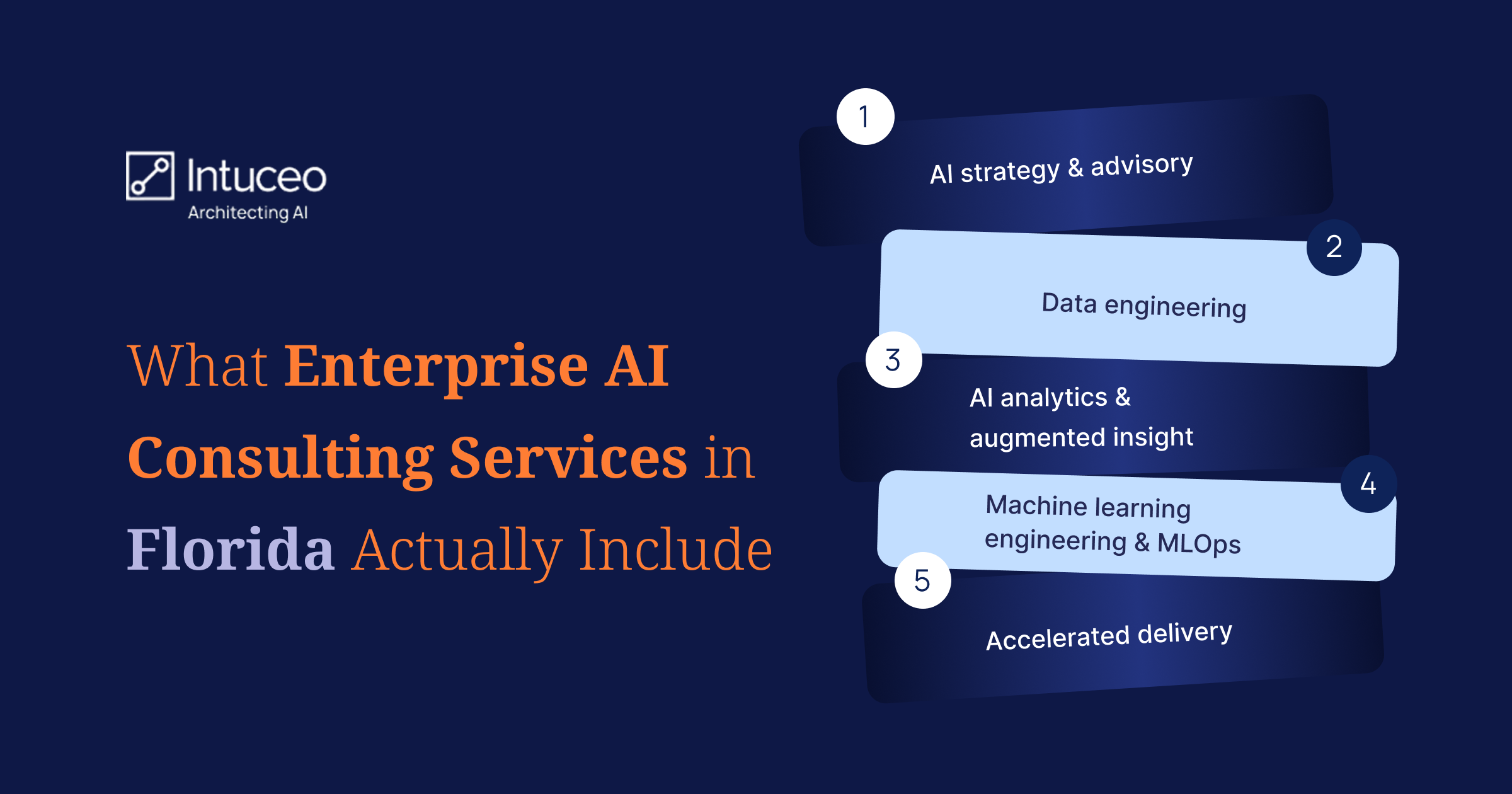
Enterprise AI consulting is a set of connected disciplines, not a single deliverable. A capable practice moves an organization from an unstructured question – “where could AI help us?” – to a running system that the business relies on. The work falls into five areas, and a serious provider of AI consulting services in Florida operates across all of them rather than selling one slice.

AI strategy and advisory

This is the discovery layer. It aligns business objectives with technical feasibility, ranks candidate use cases by value and effort, and produces a roadmap the leadership team can fund. Done well, it kills weak ideas early and protects the budget for the two or three initiatives that will actually reach production.

Data engineering

Most AI programs stall on data, not algorithms. A data engineering consultant in Florida builds the pipelines, warehouses, and governance that make analytics and machine learning possible in the first place. This includes ingestion from legacy systems, cleaning and standardizing records, and modernizing the enterprise core so that models have reliable inputs. For organizations running SAP, Oracle ERP, or PeopleSoft, this often means bridging older systems to modern data layers before any model is trained.

AI analytics and augmented insight

Strong AI analytics services in Florida turn raw operational data into decisions. This covers descriptive dashboards, predictive models that forecast demand or risk, and augmented business intelligence that surfaces patterns a human analyst would miss. The point is not the chart. The point is that a manager can act on it with confidence, because the underlying method is sound and explainable.

Machine learning engineering and MLOps

Building a model is the easy part. Keeping it accurate, monitored, and compliant in production is where most projects fail. This discipline covers model development, deployment across cloud or on-premises environments, and the monitoring that catches drift before it reaches a customer or an auditor. It is the difference between a pilot that impresses in a demo and a system that survives its second year.

Accelerated delivery

The best firms do not rebuild everything by hand. They apply accelerators, which are reusable frameworks and methods refined across earlier engagements, to compress timelines. An accelerator is not a shortcut around rigor. It is prior experience, packaged so the same problem is not solved twice.

How to Choose an AI Consulting Company in Florida: Key Selection Criteria

Once a shortlist exists, the evaluation becomes a question of fit and evidence. A polished website tells you little. The signals below separate a dependable AI consulting company in Florida, the kind you can build a multi-year relationship with, from a vendor that will disappear after the pilot.
By leveraging reusable frameworks, firms can significantly compress project timelines compared to building from scratch.
What to check Why it matters
Domain depth in your sector An AI team that already understands healthcare data, regulated life sciences, or public-sector procurement moves faster and avoids costly rework. Ask for engagements in your specific industry, not adjacent ones.
Delivery beyond the pilot Many programs stall after a promising proof of concept. Confirm the partner has moved systems into full production and supported them afterward, not just delivered a prototype.
Reusable accelerators Firms that carry frameworks and prior solutions into a project compress timelines and reduce cost. Starting from zero every time is slower and more expensive.
Data governance discipline Under Florida law, how a partner handles personal and sensitive data is a liability question, not a technical detail. Governance maturity is now a selection criterion.
Contract vehicles For public-sector or federal work, GSA and State of Florida vehicles determine whether an agency can even buy from the firm. This is covered in detail below.
Flexible engagement models The ability to scale a team up or down, or to commit to a fixed-outcome deliverable, gives you control over risk and budget as scope changes.

Weigh total cost, not the day rate

The headline rate rarely predicts the total cost of an AI program. A cheaper team that starts every component from scratch, misreads the data early, and cannot support the system post-launch will usually cost more across the life of the work than a partner with accelerators and a track record. Ask how a firm blends onshore and offshore capacity, and how it prices a fixed-outcome deliverable versus an open-ended engagement. Transparent trade-offs are the sign of a mature firm you can plan a budget around.

Test the accelerators, do not just accept them

Accelerators are only an advantage if they are real and explainable. A reusable framework should come with a clear account of what it automates, where a human still makes the call, and how it was validated on prior work. Be wary of any method presented as a closed box that cannot be inspected, because that is precisely the kind of opacity Florida’s proposed AI rules are written to discourage. A good partner will walk you through the mechanics without hesitation.
A useful test is to ask the vendor about its staffing approach and how it priced the last three engagements. Firms that offer flexible arrangements, such as team augmentation, fixed-outcome projects, and managed service agreements, tend to be honest about trade-offs because they have structured for them. The right provider of AI consulting services in Florida treats every engagement as a long-term relationship built on delivered outcomes, not a single transaction.

Why Enterprise AI Programs Stall - and How a Florida AI Partner Prevents It

Most enterprise AI failures are not caused by the model. They are caused by predictable organizational gaps, and a partner that has seen them before is worth more than one selling the newest technique. Three patterns account for the majority of stalled programs.
The first is the pilot trap. A proof of concept impresses in a demo, then fails when it meets real data volumes, integration constraints, or user behavior at scale. The fix is straightforward: plan for production from week one. That means settling the data pipeline, monitoring setup, and system ownership before a model is trained – not after the pilot report is delivered.
The second is the data gap. Teams underestimate how much cleaning, standardizing, and governance the underlying data needs, so the project runs out of budget before it reaches value. This is where seasoned data engineering, brought in early, earns its fee by fixing the foundation instead of building on sand.
The third is the compliance surprise. A system is built for accuracy alone, then has to be rearchitected when a regulator expects human oversight of decisions that affect a person’s care, coverage, or livelihood. Designing that oversight from the start is far cheaper than retrofitting it. A Florida partner that treats the state’s rules as a design input, rather than a late obstacle, removes all three risks at once.

Florida AI Regulatory Compliance: Data Privacy, Oversight, and Contract Requirements

Florida has enacted specific rules governing data privacy and AI. Organizations procuring AI consulting services in Florida must understand three compliance layers: the Florida Digital Bill of Rights (Senate Bill 262), the proposed AI Bill of Rights (Senate Bill 482), and sector-specific healthcare and insurance restrictions.

Data privacy: the Florida Digital Bill of Rights

The Florida Digital Bill of Rights, enacted as Senate Bill 262, took effect on July 1, 2024, and gives Florida residents rights over how their personal data is collected and used. Enforcement sits with the Florida Attorney General, with civil penalties reaching up to 50,000 dollars per violation, and higher in defined circumstances. Separately, the Florida Information Protection Act already requires any commercial entity holding electronic data on Floridians to take reasonable measures to secure it and to follow breach-notification rules. An AI partner that ignores these obligations is transferring risk directly onto your organization.

Artificial intelligence: the proposed AI Bill of Rights

In December 2025, Governor Ron DeSantis proposed a Citizen Bill of Rights for Artificial Intelligence, filed as Senate Bill 482 for the 2026 legislative session. The proposal would require transparency when AI is used, restrict certain foreign-developed AI tools, limit the unconsented use of personal data, and set boundaries for AI in healthcare, insurance, and mental health services. Buyers should treat these directions as the near-term baseline even before final passage, because they signal where enforcement is heading.

Healthcare and insurance limits

The healthcare provisions are strict and specific. Under the proposal, AI could not serve as the sole basis for adjusting or denying an insurance claim, which reinforces a requirement for documented human review, and behavioral health AI tools would be barred from delivering licensed therapy or simulating a licensed professional. For Florida healthcare and life-sciences organizations, this means an AI partner has to design human oversight into a system from the start, not bolt it on after an audit. This is one reason buyers searching for the best data engineering company in Florida for healthcare should weigh regulatory fluency as heavily as technical skill.

The practical takeaway

Florida’s direction of travel favors partners that keep data inside controlled environments, document human oversight, and can attest to their ownership and provenance. A Florida-based partner with local operations and mature governance policies is easier to defend to a regulator than an opaque or offshore-only vendor.

What to require in the contract

Regulatory intent only protects an organization if it appears in the agreement. When contracting for AI Consulting Services in Florida, buyers should insist on a few specifics: written data-handling terms that state where personal data is stored and processed, documented human review for any decision that affects a person’s care, coverage, or employment, breach-notification commitments consistent with the Florida Information Protection Act, and a right to audit the models and data flows the partner builds. These clauses cost nothing to add and save a great deal if a regulator ever asks.

Florida Government AI Contracts: GSA Schedules and State Contract Vehicles

Public-sector AI work runs on a different track from commercial work, and the gate is procurement. Two questions dominate: are there AI vendors with GSA Schedule contracts based in Florida, and which companies hold State of Florida contract vehicles. Both determine whether an agency can buy at all.
A GSA Schedule, formally the Multiple Award Schedule, is a pre-negotiated federal contract that lets United States government agencies purchase vetted services without running a full procurement from scratch. It signals that a firm’s rates, terms, and past performance have already cleared federal review. State of Florida contract vehicles serve the same function at the state and local level, giving Florida agencies a faster, compliant path to engage an approved provider.
This matters more now because of a new contracting rule. Beginning July 1, 2026, Florida government entities would be barred from entering any contract with an AI provider unless the company signs an affidavit affirming it is not owned by a foreign country of concern. Public-sector buyers should confirm that a provider can execute that affidavit before award rather than after. A firm that is United States-domiciled, holds active government vehicles, and can sign it clears a bar that others will not, which narrows the field considerably. Intuceo, for instance, delivers data and AI engineering for federal and state agencies and academic institutions through its GSA and State of Florida contract vehicles, which places it inside this qualified group.

Where Florida AI Consulting Work Concentrates: Healthcare, Public Sector, and Manufacturing

Enterprise AI in Florida clusters around the sectors that define the state’s economy. The strongest providers of AI analytics services in Florida tend to specialize rather than spread thin.

Healthcare and life sciences

Florida’s large healthcare and payer market is both a major opportunity and the most regulated environment for AI in the state. Work here centers on clinical and operational analytics, patient data visualization, and models that keep a human in the loop by design. Intuceo has worked with the University of Florida Institute for Child Health Policy for more than two years on portals for visualizing healthcare data – an example of the sector-specific delivery healthcare organizations should expect from a qualified Florida AI consulting partner.
Organizations in the life sciences sector can review Intuceo’s life sciences AI and analytics capabilities for a detailed account of the regulatory and delivery approach.

Public sector and defense

Florida hosts a defense sector generating more than 100 billion dollars in annual economic activity and 20 military installations, according to the Florida Council on Artificial Intelligence. That scale drives demand for secure, contract-vehicle-eligible AI and data work, where provenance and compliance are non-negotiable.

Engineering, manufacturing, and supply chain

Optimization is the theme here : design optimization, predictive maintenance, and analytics that tighten logistics and transportation networks. These are areas where accelerators pay off quickly, because the underlying problems repeat across clients and a firm can carry proven methods from one engagement to the next.

Where Intuceo fits

Intuceo is an AI and analytics services firm headquartered in Jacksonville, Florida, operating under the iCube Consulting Services brand. It has delivered data and AI work for two decades, and reports more than 250 AI and data solutions delivered to Fortune 1000 enterprises, government bodies, and mid-market organizations across healthcare, life sciences, manufacturing, engineering, and the public sector. Its recognition includes multiple appearances on the Inc. 5000 list of fast-growing United States companies.
Three attributes line up with what the sections above describe as the markers of a dependable partner. First, its delivery is built on accelerators such as the iPDLC framework and AutoML methods, which the firm reports can cut delivery timelines by as much as 40 percent compared with building from scratch. Second, its engagement options, spanning team augmentation, fixed-outcome projects, and managed service agreements, give buyers control over cost and risk. Third, it is United States-headquartered and already cleared to sell to federal and state agencies, which matters directly under Florida’s tightening procurement rules.
For an organization evaluating AI Consulting Services in Florida, that combination of local presence, sector depth, reusable delivery methods, and government eligibility is exactly the profile the state’s market and regulations now reward. You can review the firm’s work and reach its solutions architects through the Intuceo website.
For a side-by-side comparison of AI consulting firms operating in the state, see the Top AI Consulting Companies in Florida: How to Evaluate and Choose guide.

Planning an AI initiative in Florida?

Whether the goal is a first data-engineering foundation, a production analytics system, or a public-sector engagement that has to clear procurement, a Florida-based partner shortens the path.
Organizations that prefer a structured first conversation can book an AI Dream Session – a focused strategy briefing with Intuceo’s solutions architects.

Frequently Asked Questions

Intuceo is headquartered in Jacksonville, Florida, but serves clients across the state and beyond. Its delivery model supports onsite and remote engagement, so organizations in any Florida metro can work with the firm without needing a local office nearby.
Yes. Intuceo delivers data and AI engineering for federal and state agencies and academic institutions using its GSA and State of Florida contract vehicles, which give government buyers a pre-vetted, compliant path to engage the firm.
The firm concentrates on healthcare, life sciences, manufacturing, engineering and automotive, supply chain and transportation, and the public sector, matching the industries that anchor Florida’s economy and its most regulated AI use cases.
Yes. Intuceo works with clients onsite and remotely, and its team operates from Florida, the Washington, D.C. area, and additional locations. Organizations in Tampa, Orlando, Miami, or elsewhere in the state can run a full engagement remotely.
Intuceo reports more than 250 AI and data solutions delivered over two decades and multiple Inc. 5000 listings. A documented Florida example is its multi-year work with the University of Florida Institute for Child Health Policy on portals for visualizing healthcare data.

Top AI Analytics Companies in Jacksonville: 2026 Guide

Jacksonville’s economy has moved well past its financial services and logistics roots. In 2025 alone, Northeast Florida attracted more than 2,400 new jobs and nearly $1 billion in capital investment across 12 major project announcements, spanning advanced manufacturing, technology services, and transportation.[1] That corporate density creates demand: health plans, defense contractors, and logistics operators all generate data at scale, and many now need local AI and analytics expertise to act on it. For buyers comparing top AI analytics companies in Jacksonville, the market spans homegrown AI consultancies with deep vertical specialization, venture-backed startups applying machine learning to public-sector problems, and established digital consulting firms with decades of local delivery history. This guide profiles six firms worth evaluating in 2026, starting with the one best positioned for regulated-industry analytics work.

Top AI Analytics Companies in Jacksonville

1. Intuceo

Headquarters: 4110 Southpoint Blvd, Suite 124, Jacksonville, FL
Focus: AI, data engineering, and analytics services for healthcare, life sciences, advanced manufacturing, supply chain, and public sector

Intuceo is the firm on this list built specifically around regulated-industry analytics, not general IT staffing with an AI practice bolted on. The company grew out of iCube Consultancy Services and has spent more than two decades refining delivery methods for organizations where data governance, audit trails, and compliance are non-negotiable. Named clients include Florida Blue, GuideWell Health, UF Health, Janssen Pharma, Ferring Pharma, Bausch & Lomb, and CSX.

Three things separate Intuceo from other firms offering AI consulting in Jacksonville in 2026:

PhD-led engineering. Engagements are overseen by doctorate-level practitioners who have built adverse-event detection systems for pharma, clinical trial patient-matching workflows, and predictive-maintenance models for manufacturing lines. This is not advisory-layer consulting; it is hands-on model development inside regulated environments.

Delivery accelerators, not off-the-shelf tools. Intuceo-Ax (analytics accelerator for augmented BI), Intuceo-Ix (semantic and neural search intelligence), and Intuceo-Dx (document and vision intelligence) are pre-built components drawn from prior engagements. They compress delivery timelines without requiring buyers to adopt a vendor’s proprietary stack. The iPDLC delivery framework structures each engagement from discovery through production handoff.

Government contract credentials. Intuceo holds GSA MAS contract 47QTCA24D00EH for federal agencies and Florida DMS term contract 80101507-23-STC-ITSA for state agencies (active through September 2027). These vehicles give public-sector buyers a procurement pathway that most Jacksonville data analytics firms cannot offer.

With 150+ certified engineers and named engagements across Fortune 1000 clients, Intuceo is the strongest option for Jacksonville buyers who need AI analytics work inside compliance-heavy environments.

2. NLP Logix

Headquarters: 9000 Southside Blvd, Jacksonville, FL
Focus: Enterprise AI, machine learning, predictive analytics, computer vision

NLP Logix started as a three-person team of predictive modelers from the medical services industry and has grown into one of the most recognized AI consultancies in Florida. The firm holds four AI patents in deep-learning data extraction and maintains ISO 27001 certification, partnering with AWS, Microsoft, NVIDIA, and Databricks.[2] NLP Logix has earned Inc. 5000 and GrowFL Florida Companies to Watch recognition, and its LOGIXFORGE accelerators support faster model development across financial services, healthcare, government, and education. For organizations searching for the best AI companies in Jacksonville with strong ML depth and production deployment experience, NLP Logix is a serious contender.

3. Bridgenext (formerly Emtec)

Headquarters: 9454 Phillips Hwy, Jacksonville, FL
Focus: Digital consulting, data engineering, generative AI, intelligent process automation

Bridgenext is the result of four Jacksonville-rooted firms (Emtec, Emtec Digital, Wave6, and DEFINITION 6) unifying under a single brand in 2024, backed by a growth investment from Kelso & Company.[3] With more than 25 years of delivery history and consulting teams across the U.S., Canada, Argentina, and India, Bridgenext offers data engineering, generative AI, and intelligent process automation services spanning transportation and logistics, fintech, government, and healthcare. For buyers who need a mid-to-large consulting partner with both AI capabilities and the operational scale to staff multi-quarter engagements, Bridgenext is a strong Jacksonville-native option.

4. Clearsense

Headquarters: 13901 Sutton Park Dr South, Jacksonville, FL
Focus: Healthcare data analytics, data governance, clinical and operational intelligence

Clearsense works exclusively in healthcare, providing data governance, analytics, and interoperability services to hospital systems and health networks. The company is HITRUST-certified and specializes in helping providers consolidate data from electronic health records, financial systems, and operational databases into a single analytical environment.[4] Its strength is rural and mid-sized hospital systems that lack in-house data teams. For Jacksonville buyers evaluating data analytics vendors in Florida with a pure healthcare focus, Clearsense is the most vertically specialized option in the market.

5. Urban SDK

Headquarters: 10151 Deerwood Park Blvd, Jacksonville, FL
Focus: Geospatial AI for local government, transportation analytics, public safety

Urban SDK is Jacksonville’s most high-profile AI venture-backed firm. The Techstars alumnus closed a $65 million growth round led by Riverwood Capital in early 2026, one of the largest single investments in a geospatial AI company focused on the public sector.[5] More than 300 city and county governments across 40 states use Urban SDK’s geospatial analytics for traffic safety, infrastructure monitoring, and disaster response. While Urban SDK serves government agencies rather than private enterprises, its presence in Jacksonville signals how deep the city’s AI ecosystem has become.

6. SGS Technologie

Headquarters: 9995 Gate Pkwy N, Jacksonville, FL
Focus: Custom software development, big data analytics, IT consulting, government projects

SGS Technologies is a Jacksonville-based IT services firm that has spent over two decades building custom applications and data solutions for government agencies and private-sector clients. The company has delivered projects for the State of Florida, JAXPORT, and the Jacksonville Aviation Authority, and holds Salesforce and ServiceNow certifications.[6] SGS covers a broad services range including big data analytics, AI/ML, and cloud consulting, making it an option for mid-market buyers who need general-purpose technology consulting alongside analytics work.

How to Choose an AI Analytics Vendor in Jacksonville

A listicle identifies candidates. The harder question is which Jacksonville companies offer AI and machine learning consulting that actually fits a given buyer’s regulatory, technical, and operational constraints. Here are five filters worth applying before shortlisting:

Vertical depth vs. horizontal breadth

A firm that has delivered adverse event detection in pharma will ramp faster on a similar engagement than one that has built recommendation engines for e-commerce. Ask for case references in your specific industry, not just general AI credentials.

Compliance and certification history

Healthcare and life sciences buyers should confirm HIPAA handling experience, FDA submission familiarity, and relevant certifications. Public-sector buyers should verify whether the vendor holds active government contract vehicles (GSA schedules, state term contracts) that simplify procurement.

Delivery model clarity

Understand whether the vendor delivers fixed-scope projects, operates on a staff augmentation basis, or offers a hybrid model. The right fit depends on whether the buyer has internal data science leadership or needs the vendor to own outcomes from discovery through production.

Accelerators vs. proprietary lock-in

Some firms bring pre-built components that speed up delivery without requiring the buyer to adopt a permanent vendor dependency. Others build on proprietary stacks that create switching costs. Clarify ownership and portability before signing.

Jacksonville presence vs. remote coverage

Local presence matters for engagements that involve on-site workshops, secure data environments, or ongoing operational support. Confirm whether the firm staffs locally or routes work through offshore delivery centers.

Ready to Evaluate Intuceo for Your Next AI Analytics Engagement?

Intuceo works with healthcare organizations, life sciences companies, manufacturers, and public-sector agencies across Jacksonville and nationwide. If your project involves regulated data, compliance-sensitive environments, or industry-specific analytics, Intuceo’s team can walk through how prior engagements in your vertical translate to your requirements.

Frequently Asked Questions

Start with industry-specific experience: how many engagements has the firm completed in your vertical, and can they provide references? From there, verify compliance credentials (HIPAA, HITRUST, or GxP familiarity for regulated industries), confirm the delivery model (fixed-scope vs. staff augmentation), check whether they hold government contract vehicles if you are a public-sector buyer, and ask about data ownership and IP portability at the end of the engagement.
Yes. Intuceo covers healthcare, life sciences, advanced manufacturing, and supply chain/logistics with named client engagements across each vertical. Clearsense focuses exclusively on healthcare analytics for hospital systems. NLP Logix serves healthcare among other verticals. For logistics-specific geospatial analytics, Urban SDK serves government transportation agencies. The depth of specialization varies significantly, so buyers should ask for vertical-specific case studies.
Rates vary widely depending on engagement type. Staff augmentation for data engineering or data science roles typically ranges from $125 to $250 per hour in the Jacksonville market. Fixed-scope AI/ML proof-of-concept projects can range from $50,000 to $200,000 depending on data complexity and model requirements. Full production deployments with ongoing support run higher. Jacksonville-based firms generally price below comparable firms in major metro markets like New York or San Francisco, but rates reflect specialization: highly regulated industry work (pharma, healthcare, defense) commands a premium over general analytics consulting.
Three structural differences stand out. First, Intuceo is headquartered in Jacksonville and staffs locally, meaning engagement teams understand the regulatory and operational context of Florida’s healthcare and public-sector markets. Second, the firm brings named delivery accelerators (Intuceo-Ax, Intuceo-Ix, Intuceo-Dx) drawn from prior regulated-industry work, compressing timelines without requiring buyers to adopt a new technology stack. Third, Intuceo holds both federal (GSA MAS) and state (Florida DMS) contract vehicles, giving public-sector buyers a procurement pathway that national firms with only commercial contracts cannot match.