
Why clinical and regulatory documents break general search engines
Three properties of life sciences content make general-purpose tools fall short.
1. Volume and dispersion
PubMed alone contains more than 39 million biomedical citations. Layer on internal sources (LIMS, PLM, eTMF, ELN, CTMS, pharmacovigilance databases), and most pharma organizations are looking at millions of pages of unstructured content scattered across systems. Standard keyword search returns either everything or nothing useful.
2. Specialized terminology
Clinical and regulatory content carries dense ontologies: SNOMED CT, MeSH, ICD, UMLS, MedDRA, LOINC, and regulator-specific vocabularies. A query for “heart attack” should retrieve documents using “myocardial infarction,” “MI,” “acute coronary syndrome,” and ICD codes I21 and I22. A general natural language query search tool that has never seen these mappings will miss the most relevant evidence.
3. Traceability requirements
Under 21 CFR Part 11, the FDA requires electronic records that support GxP-regulated activities to maintain accurate, attributable, contemporaneous, and complete audit trails. EMA’s EudraLex Volume 4 Annex 11 places similar expectations on computerised systems used in GMP environments. A search tool that returns an answer without showing exactly which document, page, and version it came from is a compliance liability, not a productivity gain.
What semantic search actually does differently
LLM-based document search works on vector embeddings: a model translates each piece of content into a numerical representation that captures meaning rather than keywords. A query is converted into the same representation and matched against the document index. The output is documents that are conceptually similar to the query, even when they share no exact words. When combined with retrieval-augmented generation (RAG), the system can also produce a natural language answer grounded in retrieved evidence.
For clinical research search, that capability is the difference between a paralegal-style read of fifty papers and a directed pull of the five passages that actually answer the question. For regulatory intelligence, it is the difference between scrolling through 400-page Health Authority guidelines and surfacing the two paragraphs that pertain to a specific submission.
The Semantic Search Landscape: Three Approaches, Three Distinct Boundaries
When evaluating a semantic search tool for regulatory documents, most options fall into one of three categories. Each has a place, and each has limits.
| Tool category | What it does well | Where it falls short for life sciences |
|---|---|---|
| General enterprise search (horizontal SaaS) | Indexes common SaaS systems (SharePoint, Confluence, Slack, Drive). Easy to deploy. Good UX. | No biomedical ontology awareness. Limited support for GxP-regulated systems. Typically, cloud-only deployment models complicate IP and PHI handling. |
| Off-the-shelf biomedical search (literature-focused) | Pre-indexed access to PubMed, Embase, and clinical trial registries. Useful for literature reviews and healthcare knowledge discovery. | Limited integration with proprietary internal content (CSRs, IBs, internal SOPs). Closed ecosystems. Search results sit outside enterprise security boundaries. |
| Domain-specific AI search (custom or hardened) | Built on biomedical embeddings, integrated with internal systems, supports on-premise or air-gapped deployment, and surfaces source-traceable evidence. Aligned with compliance-friendly AI search requirements. | Higher implementation effort. Requires partners with engineering depth in both AI and regulated environments. |
Six criteria for choosing the right tool
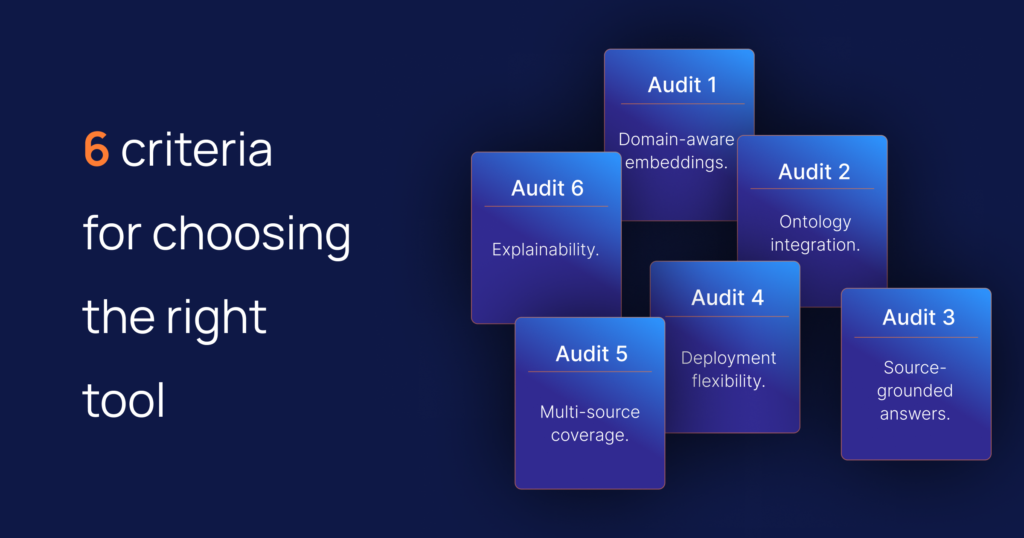
The right answer depends on the workload, but here are six tenets that separate viable options from risky ones in regulated environments.
- Domain-aware embeddings : The model should be fine-tuned or grounded on biomedical and regulatory text. Generic embeddings trained on web content miss the nuance of clinical writing.
- Ontology integration: Look for explicit support for SNOMED CT, MeSH, MedDRA, UMLS, and ICD. This is the foundation of biomedical semantic search and biomedical search that can map a colloquial query to coded terms.
- Source-grounded answers : Every generated response should cite the exact document, section, and version it came from. Traceable search results are not optional under 21 CFR Part 11 or Annex 11.
- Deployment flexibility: Sensitive content, including PHI, IP, and pre-submission filings, should support on-premise, private cloud, or air-gapped deployment. The system should never train public models on enterprise data.
- Multi-source coverage: A useful medical document retrieval system reaches across SharePoint, eTMF, CTMS, LIMS, regulatory submissions, patents, and external literature, not a single silo.
- Explainability: For regulated use, the tool should be able to justify retrieval and ranking decisions, not just return them. This is closely tied to managing hallucination risk.
Quick test
Ask any vendor to demo the tool on a question your own team struggled with last quarter. Then ask the system to show you every source it used, every section it pulled from, and every step in the retrieval logic. If the answer is “we can show you the result, but not the reasoning,” it is not ready for a regulated workflow.
Where general-purpose LLMs fall short on regulated content
Public LLMs are remarkable general-purpose tools, but several issues limit their use in clinical and regulatory contexts. They hallucinate, sometimes fluently and confidently, on technical questions outside their training distribution.They lack the audit trail that regulators expect. They have no built-in awareness of which version of a document is current or superseded. And most pose data-residency questions that procurement teams ma cannot easily clear.in phar
A domain-specific search system addresses these issues by combining a retrieval layer (vector + ontology-aware) with a generation layer that is constrained to retrieved evidence. It is the engineering pattern that separates a usable clinical assistant from a fluent but unreliable one.
How Intuceo Delivers Semantic Search for Regulated Content
Intuceo-Ix™: a search accelerator for clinical and regulatory teams
Intuceo is a PhD-led AI and data analytics consultancy. For teams that need life sciences semantic search across internal silos and external regulatory and scientific content, we bring Intuceo-Ix™, a search accelerator proven across prior regulated engagements that we configure to your repositories rather than build from scratch.
- Neural semantic discovery : Intuceo-Ix™ uses contextual embeddings rather than keyword matching, so a query for an adverse event surfaces the right evidence even when the exact term is not used.
- Multi-source indexing : search across SharePoint, LIMS, PLM, clinical trial documents, FDA filings, and patents.
- RAG-enabled extraction : paired with our Intuceo-Dx™ data accelerator, the engagement can query and extract intelligence from complex clinical tables, unstructured Case Report Forms, handwritten investigator notes, and scanned legacy dossiers that traditional OCR misses.
- Compliance posture : air-gapped, on-premise, and private-cloud deployment, configured to your environment. Your data is never used to train public models, which keeps PHI and proprietary research inside your boundary.
- Explainable retrieval : every answer is traceable to source documents, in line with the audit-trail expectations of 21 CFR Part 11 and Annex 11.
The result is semantic search engineered for your environment, where a wrong answer is not an inconvenience but a regulatory exposure.
Stop Searching. Start Finding with Intuceo.
When a wrong answer isn’t an operational inconvenience but an immediate regulatory exposure, life sciences organizations cannot afford the blind spots of general-purpose search. Intuceo’s PhD-led team brings the Intuceo-Ix™ and Intuceo-Dx™ accelerators, proven across prior regulated engagements, to bridge the gap between fragmented clinical data silos and the explainable, source-traceable insight your compliance teams expect.
Move your organization from data rich to insight rich without compromising your GxP or 21 CFR Part 11 posture.
Frequently Asked Questions
1.Which LLM is best for document-heavy research tasks in life sciences?
For document-heavy life sciences research, what matters more than the underlying LLM is the retrieval pipeline around it. A general-purpose model paired with a biomedical embedding layer, ontology grounding, and source-cited retrieval will outperform a more powerful model used in isolation. Evaluate the whole system, not just the base model.
2.How do I evaluate hallucination risk in LLM-based search?
Run a structured test set on real questions from your team. Check whether every answer is grounded in a cited source, whether the citation actually supports the claim, and whether the system declines to answer when evidence is insufficient. Tools that refuse to answer without evidence are usually safer than those that always produce something.
3.Which LLM is strongest for regulated or compliance-heavy content?
The framing should shift from “which LLM” to “which architecture.” For regulated workflows, the deciding factors are deployment model (on-prem or air-gapped), explainability of retrieval, audit-trail support, and integration with the organization’s content systems. A model that scores well on public benchmarks but cannot meet those requirements is not the right answer.
4.What makes a semantic search tool compliance-friendly?
Three things : traceable source citations on every answer, deployment options that keep regulated data inside the organization’s security perimeter, and audit logs that record who queried what, when, and what was returned. These are baseline expectations for any tool used in GxP, HIPAA, or FISMA-regulated environments.
5.What questions should I ask before choosing a semantic search tool?
A practical short list: Does the tool understand biomedical terminology and ontologies? Can it cite every source it uses? Will it run inside our environment without exposing data to public models? Does it integrate with the systems where our content actually lives? Can we audit it the way a regulator would expect us to? If a vendor cannot answer all five clearly, the tool is not yet ready for clinical or regulatory work.