Tuesday Aug 11th, 11 AM EST: Live AI Dream Session: Blueprint your enterprise AI strategy with the DARWIN Framework. Reserve your Spot Claim Free Seat

Reserve your Spot

How Clinical Data Integration Enables Real-Time Analytics

Hospitals move more patient data today than at any point in their history, and clinicians still open a chart to find a partial story. Lab results sit in one system, imaging notes in another, a referral summary somewhere else, and the discharge note as free text that no dashboard reads. The transmission problem is largely solved. What remains is making the information usable the moment it matters. Clinical data integration reconciles records scattered across systems and formats into one trustworthy view that analytics can act on while care is still in progress, which is what separates data that merely arrives from data that informs a decision.

Key Takeaways

Integration, exchange, and reconciliation are not the same thing

Three terms often get used interchangeably, and the difference between them explains why so much connected data still goes unused. Health information exchange moves a copy of a record from one system to another. Reconciliation matches records that describe the same patient and resolves the conflicts between them, a duplicate medication here, a mismatched date of birth there.
Healthcare data integration goes further than both: it combines validated records from across sources into a single queryable view that downstream analytics and clinicians can rely on.
The distinction matters because exchange on its own has plateaued in value. As of 2023, roughly 70% of U.S. non-federal acute care hospitals engaged in all four domains of interoperable exchange, finding, sending, receiving, and integrating information, at least sometimes, yet only 43% did so routinely, up from 28% in 2018.[1] Most hospitals can send a record. Far fewer fold incoming information into the chart in a way clinicians actually use at the point of care. EHR data integration closes that gap by treating the electronic health record (EHR) not as a destination where documents pile up, but as a structured source that other records resolve into.

From scattered records to a unified clinical intelligence layer

The output of mature integration is a single trustworthy version of each patient, often called the Gold Record: one reconciled profile that pulls together demographics, encounters, medications, results, and the reasoning buried in notes. Built well, these records form a clinical intelligence layer that sits above source systems and returns a consistent answer no matter which application asks the question. Healthcare teams sometimes describe this as the Gold Record concept, the idea that one definitive record should win when sources disagree.
Reaching that point means confronting the parts of the record that resist structure. A 2025 study of 1.8 million primary care patients found that only 13% of clinical concepts captured in free-text notes had an equivalent in the structured record.[2] The detail clinicians write in narrative, symptom progression, social context, the rationale behind a decision, rarely lands in a coded field, so any view that ignores it is incomplete. Turning that narrative into real-time patient insights requires natural language processing (NLP) that reads notes as they are written and resolves what it finds against the structured record.

What makes analytics real-time: streaming, standards, and data quality

Batch pipelines that refresh overnight cannot support decisions made in minutes. Real-time clinical analytics depends on event streaming, where each new lab value, vital sign, or order becomes a message processed the instant it is created. Streaming technologies such as Apache Kafka and Apache Flink carry these events continuously, letting models reassess risk as a patient’s condition shifts rather than hours after the fact.
Standards keep that stream interpretable. HL7 FHIR integration, built on the Health Level Seven (HL7) Fast Healthcare Interoperability Resources (FHIR) standard, gives systems a common way to represent a medication, an observation, or an encounter, so a value arriving from one source means the same thing everywhere it travels. Application programming interfaces (APIs) defined by FHIR let an application subscribe to specific events instead of repeatedly polling entire databases.

Data quality has to run in motion

None of this holds together without data quality handled as the data moves. Validation rejects malformed or out-of-range values before they reach a model. Deduplication keeps the same lab result, arriving twice from two feeds, from being counted as two separate events. Enrichment attaches the context a raw value lacks: a reference range, a unit, a link to the ordering encounter. In a streaming setting these steps run continuously rather than as a nightly cleanup, because a decision made on an unvalidated value is a decision made on noise.

What real-time integration makes possible

Once records resolve into a reliable, current view, the analytics built on top change in kind, not just in speed. Predictive clinical analytics can flag deterioration before it becomes a crisis. At UC San Diego Health, an artificial intelligence (AI) sepsis surveillance model wired into the EHR and reading real-time signals was associated with a 17% reduction in mortality.[3] The model helped because the data feeding it was integrated and current, not because the algorithm itself was exotic.
The same foundation supports care gap closure analytics, which compares each patient against evidence-based guidelines and surfaces missed screenings or overdue follow-ups while the patient is still reachable. Aggregated across a panel, that becomes population health analytics, showing which cohorts are drifting from target and where an intervention will matter most.
Integration reaches beyond direct care as well. Clinical trial data integration connects site records, laboratory feeds, and electronic data capture so that safety signals and enrollment patterns surface during a study rather than at database lock. The common thread across all of these is timing: integrated data lets organizations act inside the window where action still changes the outcome.

Real-time does not mean ungoverned

Speed raises the stakes on privacy rather than relaxing them. HIPAA-compliant analytics, governed by the Health Insurance Portability and Accountability Act (HIPAA), requires that every record flowing through a real-time pipeline carries the same access controls, audit trails, and de-identification rules it would in a static store. Streaming makes this harder because data is in constant motion, so governance has to be designed into the pipeline from the start. Role-based access, encryption in transit and at rest, and lineage that traces every value back to its source are what let a fast system also be a defensible one.

How Intuceo approaches clinical data integration

Building this kind of integration is rarely a tooling decision; it is a data engineering effort shaped by each provider’s systems, data, and compliance obligations. Intuceo takes that work on as a services engagement, with teams that have integrated regulated healthcare and life sciences data across more than a decade of projects and bring reusable accelerators into each one instead of starting from a blank slate.
For programs moving toward agentic workflows, AgentCare AI applies these methods to healthcare-specific tasks, and delivery follows iPDLC™, Intuceo’s lifecycle framework for building and validating data and AI systems where validation is not optional.
Because these accelerators were shaped on prior regulated work, including engagements with organizations such as Florida Blue, GuideWell, and UF Health, they arrive already aware of the controls that HIPAA, HITRUST, and 21 CFR Part 11 demand. The result is a clinical data integration program configured to a provider’s reality, with governance treated as a starting condition instead of a later correction.

Planning a move to real-time clinical analytics?

Intuceo’s teams can assess where a provider’s records fragment today and map the integration work that real-time analytics actually requires, scoped to existing systems and compliance obligations.

Frequently Asked Questions

Start by reconciling identity so records describing the same patient resolve to one profile, then validate and standardize incoming data against a shared model such as FHIR. Narrative notes are processed with natural language processing so the detail they hold is not lost. The reconciled output becomes a Gold Record that analytics query instead of reaching into each source system separately.
Reconciliation matches records of the same patient and resolves conflicts between them. Integration is the broader work of combining those reconciled records from many sources into a single queryable view that downstream analytics and clinicians can depend on. Reconciliation is a step inside integration, not a substitute for it.
The common blockers are inconsistent patient identity across systems, clinical detail trapped in free text, data quality issues that only surface in motion, and batch pipelines that cannot keep pace with live care. Each has to be addressed in the integration layer before real-time analytics can be trusted.
Validation, deduplication, and enrichment run continuously as events stream through the pipeline rather than during a nightly batch. Malformed values are rejected, duplicate readings from multiple feeds are collapsed, and raw values are given the units, ranges, and encounter context that make them interpretable, all before a model scores them.
It does not have to be. Smaller organizations rarely need to rebuild everything at once. A focused engagement can target the highest-value data flows first, reuse proven integration accelerators rather than building from scratch, and expand once the approach proves out, which keeps the initial investment proportional to the result.
Context-Aware Search for Clinical and Regulatory Documents

Key Takeaways

The Cost of Knowledge That No One Can Find

Whether it is a regulatory affairs lead preparing a submission, a medical writer reconciling a protocol against earlier study reports, or a safety scientist tracing a signal across patient narratives, each needs a specific answer, not a stack of documents to open and read. The McKinsey Global Institute estimated that interaction workers spend close to 20% of their workweek simply looking for internal information.[1] In clinical research, this internal corpus is massive and continuously growing.
In 2024, ClinicalTrials.gov crossed the milestone of 500,000 registered studies.[2] Yet, for an individual sponsor, each of those entries represents an expansive web of internal protocols, amendments, clinical study reports (CSRs), safety narratives, and relevant FDA guidance documents. What a clinical or regulatory team must actually search through is far larger than any public registry count suggests and almost none of it is arranged for a traditional keyword query to answer.
Conventional search indexes words, meaning it only retrieves a file when the exact query string appears in the text. That model breaks down in clinical environments for three fundamental reasons:
This is how pharma document search context gets lost, and why teams keep falling back on tribal knowledge relying on whoever happens to remember where things are.

What Context-Aware Search Actually Does

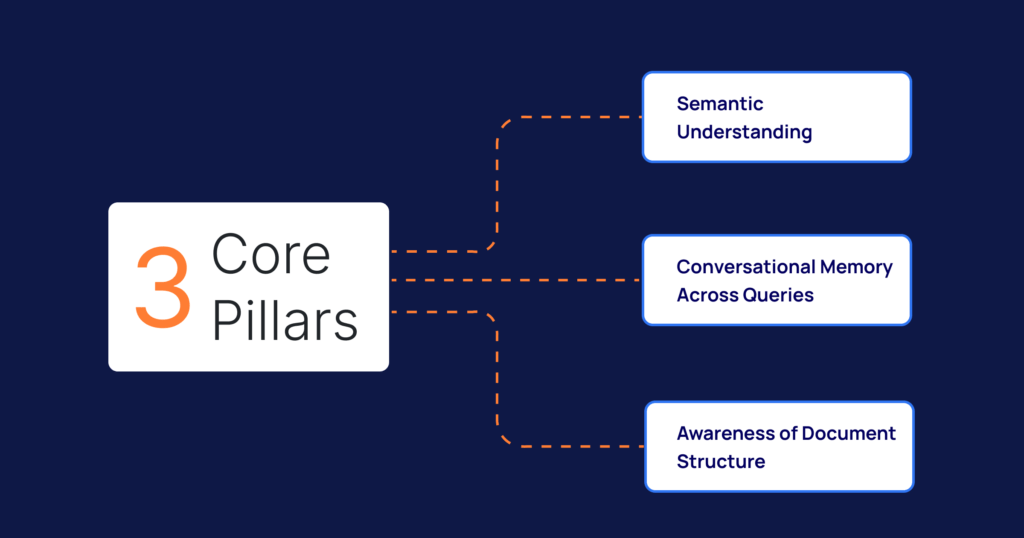
The capability that enterprise buyers now look for under the banner of clinical trial intelligence rests on three core pillars that keyword indexing lacks.

Semantic Understanding

Rather than matching literal characters, semantic retrieval represents text as mathematical vectors that capture conceptual meaning. Consequently, a query about “injection-site reactions” surfaces a narrative describing “redness and swelling at the administration site,” even when that exact phrase never appears. For regulatory document search AI, this closes the gap between how a question is asked and how the source data was written. It is the very foundation that makes context-aware search for clinical documents possible.

Conversational Memory Across Queries

Clinical questions rarely arrive in isolation. A reviewer might ask about an inclusion criterion, then how it changed across amendments, and finally, query the rationale behind that change. Conversational search for regulatory filings keeps that thread intact, allowing each follow-up to refine the last instead of starting over. Carrying conversational context across multiple research queries is what separates a usable AI assistant from a single-shot search box.

Awareness of Document Structure

A protocol, a CSR, a safety report, and an FDA guidance document are all organized fundamentally differently. A system that understands those structures can intelligently route a question about endpoints to the right section and distinguish a regulatory requirement from a study-specific choice. That structural awareness underpins reliable clinical trial protocol analysis AI and accurate clinical document extraction.

Grounding Answers with Retrieval-Augmented Generation

A large language model (LLM) on its own can produce fluent text that is anchored to nothing. Retrieval-augmented generation (RAG) changes that. The system retrieves relevant passages first, then asks the model to answer the query using only that retrieved evidence, complete with citations back to the original text. For RAG in clinical question answering, this traceability is the entire point. An answer that links to a specific paragraph in a protocol or guidance document can be easily checked; an unsourced answer cannot.
Crucially, grounding reduces error without removing it entirely. A 2025 framework evaluated LLM clinical summaries against more than 12,000 clinician-annotated sentences and measured a 1.47% hallucination rate alongside a 3.45% omission rate.[3] While the figures may seem small, in regulated industries, a single fabricated or missing fact carries severe consequences. Therefore, clinical data retrieval-augmented generation belongs inside a workflow that verifies model output against authoritative sources and keeps a qualified reviewer in the loop, rather than one that treats the AI’s answer as final.

Why FDA-Regulated Work Needs Governed Deployment

Public chatbots are entirely unsuitable for confidential trial data and regulatory submissions. Two common questions enterprise teams ask – how to run a general assistant locally for FDA-regulated studies and whether an assistant can search regulatory submission documents safely – point to the same requirement. The data must remain in a controlled environment, model behavior must be auditable, and no data should ever be used to train an outside model.
Effective regulatory submission document management under these constraints means deployment that satisfies 21 CFR Part 11 (Electronic Records; Electronic Signatures), good practice quality regulations (GxP), and the Health Insurance Portability and Accountability Act (HIPAA), complete with strict access controls and a comprehensive audit trail. A regulatory affairs document search tool that cannot produce that trail does not belong near a submission.
Verification follows the same logic. An FDA guidance document search is most useful when the system can hold current federal guidelines alongside a sponsor’s own documents and show exactly where the two agree or diverge, allowing a reviewer to confidently confirm an answer.

Public Registries and Internal Documents are Different Problems

Teams often ask which tools best search a clinical trial registry and PubMed together to find matching studies. Public sources, such as ClinicalTrials.gov and published literature, are open, broadly structured, and shared across the industry, so retrieval there is mostly a question of coverage and precision. Internal protocols, submissions, and safety files are the exact opposite: they are confidential, inconsistently formatted, and specific to one sponsor. A question answered from public regulatory databases and the same question answered from internal clinical documents can return very different results, and a reviewer usually needs both.
The practical aim is to connect the two, enabling an AI assistant to place a sponsor’s own evidence next to the public record and the relevant guidance, instead of forcing a researcher to query three disparate systems and stitch the results together by hand. That connection also speeds everyday work, such as matching a new study against prior trial designs or screening the literature for precedent ahead of a submission, because the search reasons across sources rather than treating each as a separate silo.

From Protocols to Safety Signals

One unified foundation supports several tasks that regulatory and clinical teams run every day. Reviewers compare a draft protocol against precedent and guidance. Medical writers reconcile language across study documents. Safety teams apply adverse event detection AI to surface candidate signals from narratives and reports for expert adjudication – not to replace it.
None of this removes the expert. Instead, it removes the hours spent locating the evidence the expert needs, shifting the focus to finding and connecting evidence quickly, and leaving critical clinical judgment to humans.

How Intuceo Approaches Clinical and Regulatory Search

Intuceo is a services firm that designs and delivers these capabilities as a tailored engagement, not as off-the-shelf software. Its teams bring proven proprietary accelerators built and hardened on earlier regulated programs, which significantly shortens the path from raw documents to a working, governed search experience.
Delivery runs through iPDLC™, Intuceo’s project methodology, inside environments fully aligned to 21 CFR Part 11, HIPAA, HITRUST, and SOC 2 Type II standards. This is the same rigorous approach the firm has applied in collaborations with reputed organizations.

Search with context. Submit with confidence.

Unified search across protocols, CSRs, and FDA guidance – fully deployed within your GxP and 21 CFR Part 11 boundaries.

Frequently Asked Questions

They can extract a great deal when paired with robust retrieval and verification mechanisms, but accuracy varies by model and document type. Residual hallucination and omission rates mean expert human review remains essential for regulated use.
The best approach is to deploy a system with conversational memory that carries entities and prior answers forward, ensuring each follow-up question refines the thread rather than restarting the search.
Ground answers in retrieval require strict citations to the source passage, and keep current guidance indexed alongside internal documents so a reviewer can confirm each claim against the original text.
Yes. Retrieval-augmented generation is best suited for this work because it ties each answer directly to the source text, which is precisely what regulated review requires.
By deploying it within a controlled, on-premises or private cloud environment with strict access controls and audit logging, while verifying that no data is used to train external models.

Which Semantic Search Tool Works Best for Clinical and Regulatory Documents?

Why clinical and regulatory documents break general search engines

Three properties of life sciences content make general-purpose tools fall short.

1. Volume and dispersion

PubMed alone contains more than 39 million biomedical citations. Layer on internal sources (LIMS, PLM, eTMF, ELN, CTMS, pharmacovigilance databases), and most pharma organizations are looking at millions of pages of unstructured content scattered across systems. Standard keyword search returns either everything or nothing useful.

2. Specialized terminology

Clinical and regulatory content carries dense ontologies: SNOMED CT, MeSH, ICD, UMLS, MedDRA, LOINC, and regulator-specific vocabularies. A query for “heart attack” should retrieve documents using “myocardial infarction,” “MI,” “acute coronary syndrome,” and ICD codes I21 and I22. A general natural language query search tool that has never seen these mappings will miss the most relevant evidence.

3. Traceability requirements

Under 21 CFR Part 11, the FDA requires electronic records that support GxP-regulated activities to maintain accurate, attributable, contemporaneous, and complete audit trails. EMA’s EudraLex Volume 4 Annex 11 places similar expectations on computerised systems used in GMP environments. A search tool that returns an answer without showing exactly which document, page, and version it came from is a compliance liability, not a productivity gain.

What semantic search actually does differently

LLM-based document search works on vector embeddings: a model translates each piece of content into a numerical representation that captures meaning rather than keywords. A query is converted into the same representation and matched against the document index. The output is documents that are conceptually similar to the query, even when they share no exact words. When combined with retrieval-augmented generation (RAG), the system can also produce a natural language answer grounded in retrieved evidence.
For clinical research search, that capability is the difference between a paralegal-style read of fifty papers and a directed pull of the five passages that actually answer the question. For regulatory intelligence, it is the difference between scrolling through 400-page Health Authority guidelines and surfacing the two paragraphs that pertain to a specific submission.

The Semantic Search Landscape: Three Approaches, Three Distinct Boundaries

When evaluating a semantic search tool for regulatory documents, most options fall into one of three categories. Each has a place, and each has limits.
Tool category What it does well Where it falls short for life sciences
General enterprise search (horizontal SaaS) Indexes common SaaS systems (SharePoint, Confluence, Slack, Drive). Easy to deploy. Good UX. No biomedical ontology awareness. Limited support for GxP-regulated systems. Typically, cloud-only deployment models complicate IP and PHI handling.
Off-the-shelf biomedical search (literature-focused) Pre-indexed access to PubMed, Embase, and clinical trial registries. Useful for literature reviews and healthcare knowledge discovery. Limited integration with proprietary internal content (CSRs, IBs, internal SOPs). Closed ecosystems. Search results sit outside enterprise security boundaries.
Domain-specific AI search (custom or hardened) Built on biomedical embeddings, integrated with internal systems, supports on-premise or air-gapped deployment, and surfaces source-traceable evidence. Aligned with compliance-friendly AI search requirements. Higher implementation effort. Requires partners with engineering depth in both AI and regulated environments.

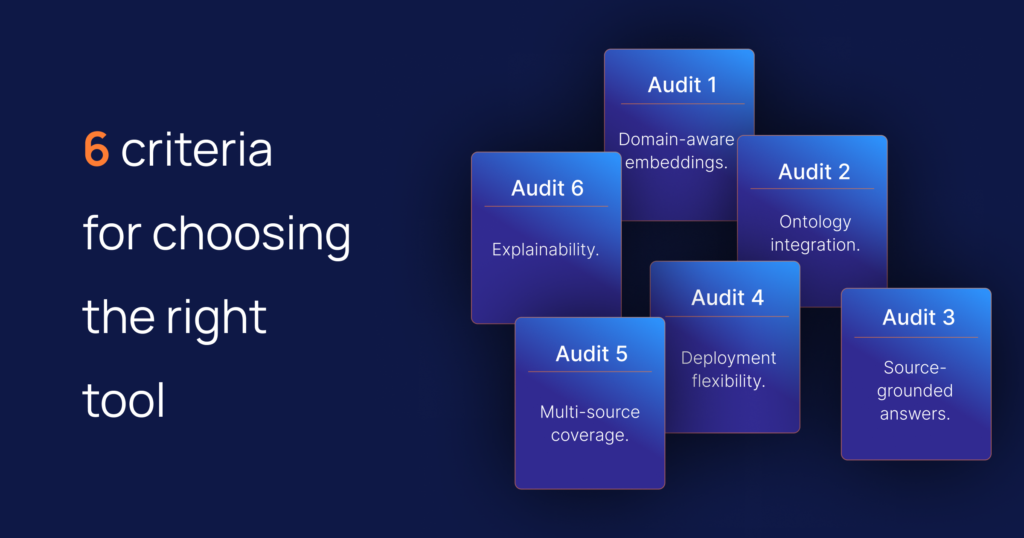
Six criteria for choosing the right tool

The right answer depends on the workload, but here are six tenets that separate viable options from risky ones in regulated environments.

Quick test

 Ask any vendor to demo the tool on a question your own team struggled with last quarter. Then ask the system to show you every source it used, every section it pulled from, and every step in the retrieval logic. If the answer is “we can show you the result, but not the reasoning,” it is not ready for a regulated workflow.

Where general-purpose LLMs fall short on regulated content

Public LLMs are remarkable general-purpose tools, but several issues limit their use in clinical and regulatory contexts. They hallucinate, sometimes fluently and confidently, on technical questions outside their training distribution.They lack the audit trail that regulators expect. They have no built-in awareness of which version of a document is current or superseded. And most pose data-residency questions that procurement teams ma cannot easily clear.in phar
A domain-specific search system addresses these issues by combining a retrieval layer (vector + ontology-aware) with a generation layer that is constrained to retrieved evidence. It is the engineering pattern that separates a usable clinical assistant from a fluent but unreliable one.

How Intuceo Delivers Semantic Search for Regulated Content

Intuceo-Ix™: a search accelerator for clinical and regulatory teams

Intuceo is a PhD-led AI and data analytics consultancy. For teams that need life sciences semantic search across internal silos and external regulatory and scientific content, we bring Intuceo-Ix™, a search accelerator proven across prior regulated engagements that we configure to your repositories rather than build from scratch.
The result is semantic search engineered for your environment, where a wrong answer is not an inconvenience but a regulatory exposure.

Stop Searching. Start Finding with Intuceo.

When a wrong answer isn’t an operational inconvenience but an immediate regulatory exposure, life sciences organizations cannot afford the blind spots of general-purpose search. Intuceo’s PhD-led team brings the Intuceo-Ix™ and Intuceo-Dx™ accelerators, proven across prior regulated engagements, to bridge the gap between fragmented clinical data silos and the explainable, source-traceable insight your compliance teams expect.
Move your organization from data rich to insight rich without compromising your GxP or 21 CFR Part 11 posture.

Frequently Asked Questions

For document-heavy life sciences research, what matters more than the underlying LLM is the retrieval pipeline around it. A general-purpose model paired with a biomedical embedding layer, ontology grounding, and source-cited retrieval will outperform a more powerful model used in isolation. Evaluate the whole system, not just the base model.
Run a structured test set on real questions from your team. Check whether every answer is grounded in a cited source, whether the citation actually supports the claim, and whether the system declines to answer when evidence is insufficient. Tools that refuse to answer without evidence are usually safer than those that always produce something.
The framing should shift from “which LLM” to “which architecture.” For regulated workflows, the deciding factors are deployment model (on-prem or air-gapped), explainability of retrieval, audit-trail support, and integration with the organization’s content systems. A model that scores well on public benchmarks but cannot meet those requirements is not the right answer.
Three things : traceable source citations on every answer, deployment options that keep regulated data inside the organization’s security perimeter, and audit logs that record who queried what, when, and what was returned. These are baseline expectations for any tool used in GxP, HIPAA, or FISMA-regulated environments.
A practical short list: Does the tool understand biomedical terminology and ontologies? Can it cite every source it uses? Will it run inside our environment without exposing data to public models? Does it integrate with the systems where our content actually lives? Can we audit it the way a regulator would expect us to? If a vendor cannot answer all five clearly, the tool is not yet ready for clinical or regulatory work.

What Leads to Slow Information Retrieval in Large Clinical Document Repositories?

A researcher at a pharmaceutical company needs specific safety data from a clinical trial conducted eight years ago. The information exists, but it is fragmented across regulatory filings, Clinical Study Reports (CSRs), and investigator brochures, scattered across SharePoint, a LIMS, and two legacy Document Management Systems (DMS). What should be a precise query becomes a time-consuming manual audit.
This is not an edge case; it is a systemic operational bottleneck. As clinical document repositories scale, they have evolved into “data graveyards” rather than active knowledge bases. With healthcare data volumes growing at 36% annually,  outpacing both manufacturing and finance, the infrastructure used to store this data is crumbling under the weight of its own complexity.
The root of this bottleneck extends beyond simple indexing issues. It is the result of deep-seated technical hurdles: fragmented data silos, a lack of standardized metadata, and the inherent difficulty of querying unstructured text within massive, non-machine-readable PDFs. When retrieval lags, the consequences extend beyond mere frustration – they manifest as delayed regulatory responses, compromised patient safety insights, and decision cycles that cannot keep pace with the speed of modern drug development.

$2.59B

AutoML global market value in 2025

41.96%

CAGR projected through 2031

Why Clinical Document Search Systems Fail at Scale

Retrieval latency in large clinical document repositories is rarely caused by a single factor. It compounds across several dimensions.

Unstructured Data Without Standardization

Life science organizations generate massive volumes of unstructured clinical data: handwritten physician notes, scanned regulatory submissions, multi-format trial reports, pathology narratives, and adverse event case files. This data lacks the structured schemas that conventional databases rely on. Without standardized tagging or formatting, search systems cannot index content meaningfully. A 2019 PMC study confirmed that approximately 80% of medical data remains unstructured and untapped after creation, with most hospital information systems unable to process it effectively.

Poor Document Chunking Strategies

When organizations feed clinical PDFs and regulatory filings into modern search or retrieval augmented generation (RAG) systems, document chunking becomes a critical failure point. Fixed-size chunking, the most common default, splits documents at arbitrary character counts without regard for section boundaries, tables, or clinical context. A chunk that starts mid-paragraph in a pharmacokinetics section and ends in an adverse event summary returns contextually meaningless results.
Effective chunking for clinical documents requires structural awareness, recognizing that a protocol synopsis is a single logical unit while a multi-page adverse event narrative must be segmented by case, not by page count.

Keyword Search Cannot Handle Clinical Complexity

Traditional keyword-based search breaks down in clinical repositories because medical language is inherently ambiguous. A clinician searching for “heart failure management” may need results that reference “CHF protocols,” “left ventricular dysfunction interventions,” or “HFrEF treatment guidelines,” none of which share the original keywords.
A 2025 systematic literature review of RAG in healthcare identified retrieval noise (irrelevant or low-quality retrieved information), inference latency, domain shift, and limited interpretability as persistent challenges in clinical retrieval systems. Semantic search addresses this by matching intent rather than exact terms, but many life science organizations still rely on legacy keyword engines.

Siloed Systems and Fragmented Repositories

Clinical knowledge rarely lives in one place. Trial data sits in an EDC system. Regulatory correspondence lives in a separate document management platform. Lab results are locked inside LIMS. Each system has its own access controls, metadata schemas, and search interfaces. This fragmentation forces knowledge workers to run parallel searches across disconnected platforms.
According to McKinsey, employees spend an average of 1.8 hours per day searching for and gathering information. In regulated life science environments, where document retrieval involves cross-referencing multiple systems for audit or submission purposes, that number runs highe

Missing Metadata and Taxonomy Gaps

Metadata is the backbone of fast, accurate retrieval. Without proper metadata enrichment, including document type, therapeutic area, study phase, and regulatory jurisdiction, search engines cannot surface the right results. Many clinical repositories were built over decades, and legacy documents were ingested without consistent tagging. When a repository holds millions of pages across disparate archives, missing metadata creates blind spots that no amount of search tuning can fix.

OCR Limitations on Scanned Clinical Documents

A significant portion of clinical repositories includes scanned documents: legacy trial reports, handwritten clinical notes, signed regulatory forms, and faxed correspondence. Standard OCR introduces errors that propagate through every downstream search query. Misread characters in drug names, dosage figures, or patient identifiers make these documents effectively invisible to retrieval systems. Poor PDF OCR search quality is a silent contributor to retrieval failures that organizations often underestimate.
The scale of the problem: Healthcare organizations are storing upwards of 50+ petabytes of data, retained for decades to meet compliance requirements. This data is difficult to manage, search, and analyze using standard tools.

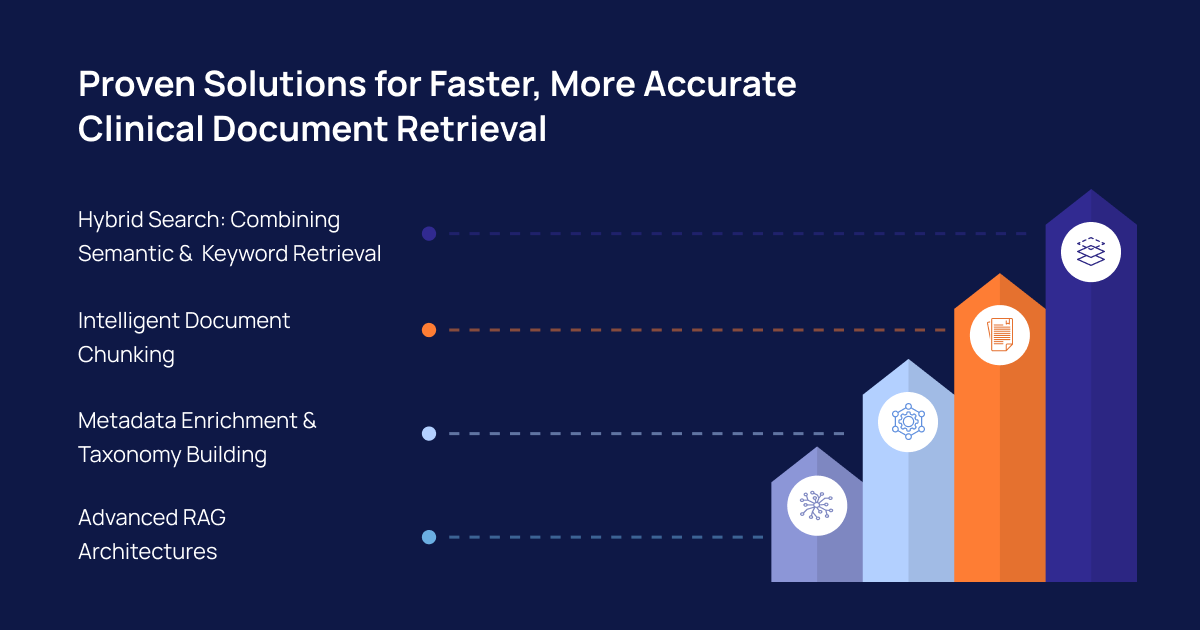
Proven Solutions for Faster, More Accurate Clinical Document Retrieval

Addressing retrieval latency in clinical repositories requires a layered approach that tackles data quality, search architecture, and knowledge organization simultaneously.
ProvenSolutionsforFaster,MoreAccurateClinicalDocumentRetrieval

Hybrid Search: Combining Semantic and Keyword Retrieval

Neither pure keyword search nor pure semantic search is sufficient for clinical repositories. Hybrid search combines sparse retrieval (BM25-based keyword matching) with dense retrieval (neural embedding-based semantic matching) to capture both exact clinical terms and conceptual equivalents.
A 2025 study evaluating RAG variants for clinical decision support found that while a Haystack pipeline (DPR + BM25 + cross encoder) and hybrid fusion (RRF) delivered the best retrieval accuracy, self-reflective RAG reduced hallucinations to 5.8%.
The optimal architecture layers both, using keyword matching for precise regulatory terms and semantic search for broader clinical concepts.

Metadata Enrichment and Taxonomy Building

Retroactive metadata enrichment using NLP-based entity extraction and classification models transforms previously unsearchable archives into queryable knowledge bases. Building a controlled taxonomy specific to the organization’s therapeutic areas and regulatory frameworks ensures search systems map user queries to correct document categories, which is critical for life science information retrieval across multi-decade archives.

Advanced RAG Architectures

Retrieval augmented generation is emerging as a critical capability for clinical knowledge retrieval systems. RAG pipelines retrieve relevant document chunks and feed them to a language model that synthesizes a grounded, contextual answer. For healthcare, this improves factual consistency and reduces hallucinations compared to standalone LLMs. However, RAG for clinical documents requires careful attention to retrieval quality; if the underlying search returns noisy chunks, the generated output inherits those errors.

How Intuceo Solves Clinical Document Retrieval at Scale

Intuceo has engineered purpose-built solutions for exactly this challenge. Intuceo-Ix™ (Neural Search Intelligence) goes beyond keyword matching to provide neural semantic discovery across fragmented institutional silos, reducing information retrieval time by 70%. Its InsightExplorer™ interface enables researchers and knowledge workers to query millions of records with sub-second response times.
For organizations dealing with legacy scanned documents and handwritten clinical notes, Intuceo-Dx™ (Document & Vision Intelligence) uses Vision AI to extract high-fidelity metadata that traditional OCR misses, converting complex analog documentation into structured, searchable records. Its RAG-enabled extraction capability lets teams query their document library as if it were a live expert.
In one engagement, Intuceo deployed a Universal Search Engine that indexed 5M+ documents across SharePoint, LIMS, PLM, clinical trials, FDA filings, and patents, transforming R&D workflows and reducing information discovery time from 90% of a knowledge worker’s day to just 10%.
All Intuceo solutions are deployed within air-gapped, HIPAA-compliant environments. No client data is used to train public models. The intelligence generated remains 100% proprietary.

All Intuceo solutions are deployed within air-gapped, HIPAA-compliant environments. No client data is used to train public models. The intelligence generated remains 100% proprietary.

Frequently Asked Questions

Retrieval slows down due to massive volumes of unstructured clinical data, fragmented storage across multiple systems (EDC, LIMS, QMS, SharePoint), inconsistent or missing metadata, poor document chunking, and reliance on keyword-only search engines that cannot interpret clinical terminology variations.
The most common causes are retrieval noise from poorly chunked documents, domain shift when embedding models are not tuned for clinical vocabulary, and incomplete metadata that prevents the retriever from narrowing results effectively. A RAG system is only as good as the documents it retrieves.
Structure-aware chunking outperforms fixed-size approaches. This involves parsing documents into logical clinical sections (safety narratives, protocol amendments, pharmacokinetic summaries) and enriching each chunk with extracted entities such as drug names, conditions, and study identifiers.
Metadata provides the filtering and categorization layer that search engines need. A well-built taxonomy maps organizational vocabulary to standardized clinical terms, ensuring queries for “adverse event reports” also surface documents tagged under “safety signals” or “AER classifications.”
The most effective approach combines intelligent chunking, entity-enriched indexing, and RAG architectures that retrieve only the most relevant segments before passing them to the model for synthesis. This keeps responses grounded in specific evidence rather than diluted across thousands of pages.