How to Choose an Advanced Analytics Tool for Life Science Data

Life sciences have a data problem disguised as a data advantage. Genomic sequencing, clinical trials, laboratory instruments, safety databases, and decades of research literature now generate information faster than scientific teams can study it. Researchers projecting data growth to 2025 placed genomics on par with or ahead of astronomy, YouTube, and Twitter among the most demanding sources of big data in the world.[1] Volume is rarely the constraint. Converting it into decisions is.
That gap is why so many research and data leaders are evaluating an advanced analytics tool for life science data. The category promises to automate the slow, manual work of preparing and exploring data so scientists can spend their time on interpretation. The label, though, gets stretched across everything from generic dashboards to specialized research systems, and the wrong choice can stall a program for months. This guide covers what advanced analytics in life sciences actually does, why generic tools struggle with research data, and the criteria that separate a real fit from a demo that looks good and fails in production.

What advanced analytics does for life science data

Advanced analytics applies machine learning and natural language processing to the analytics workflow itself. Rather than an analyst manually cleaning data, building a model, and hand-writing every query, the system profiles and prepares the data, surfaces patterns and anomalies, and lets people ask questions in plain language.
For research data, AI-powered analytics for life science data has to do more than chart tidy numbers. It has to make sense of structured lab results sitting beside free-text clinical notes, genomic files, imaging metadata, and PDF regulatory filings. The tools that hold up combine four things: automated data preparation, machine learning analytics for pattern and outlier detection, natural language processing that pulls meaning from text, and conversational querying that returns answers tied back to their source. Spending reflects the pressure. The life science analytics market is projected to reach $16.33 billion by 2030, with research and development being the fastest-growing segment.[2]

Why generic analytics tools struggle with research data

Most analytics tools were built for clean, columnar business data. Life science data is neither clean nor columnar.
Start with a format. Structured, coded data accounts for only 50 to 70% of the information relevant to a clinical trial, and nearly 80% of healthcare data is unstructured, held in clinical notes, imaging reports, and physician narratives.[3] A tool that reads only clean, structured tables ignores most of the available evidence.
Then scale and fragmentation. A single program can span genomic files, electronic health records, LIMS and PLM systems, trial databases, and patent libraries, each in its own format and silo. Joining them by hand is where weeks disappear.
Finally, regulation. In a GxP environment, an insight is only useful if it can be defended. A tool that cannot show how data moved from source to result, or explain why a model reached a conclusion, will not survive an audit. This is the failure point that generic advanced analytics in life sciences deployments hit most often.

Criteria for choosing an advanced analytics tool for life sciences data
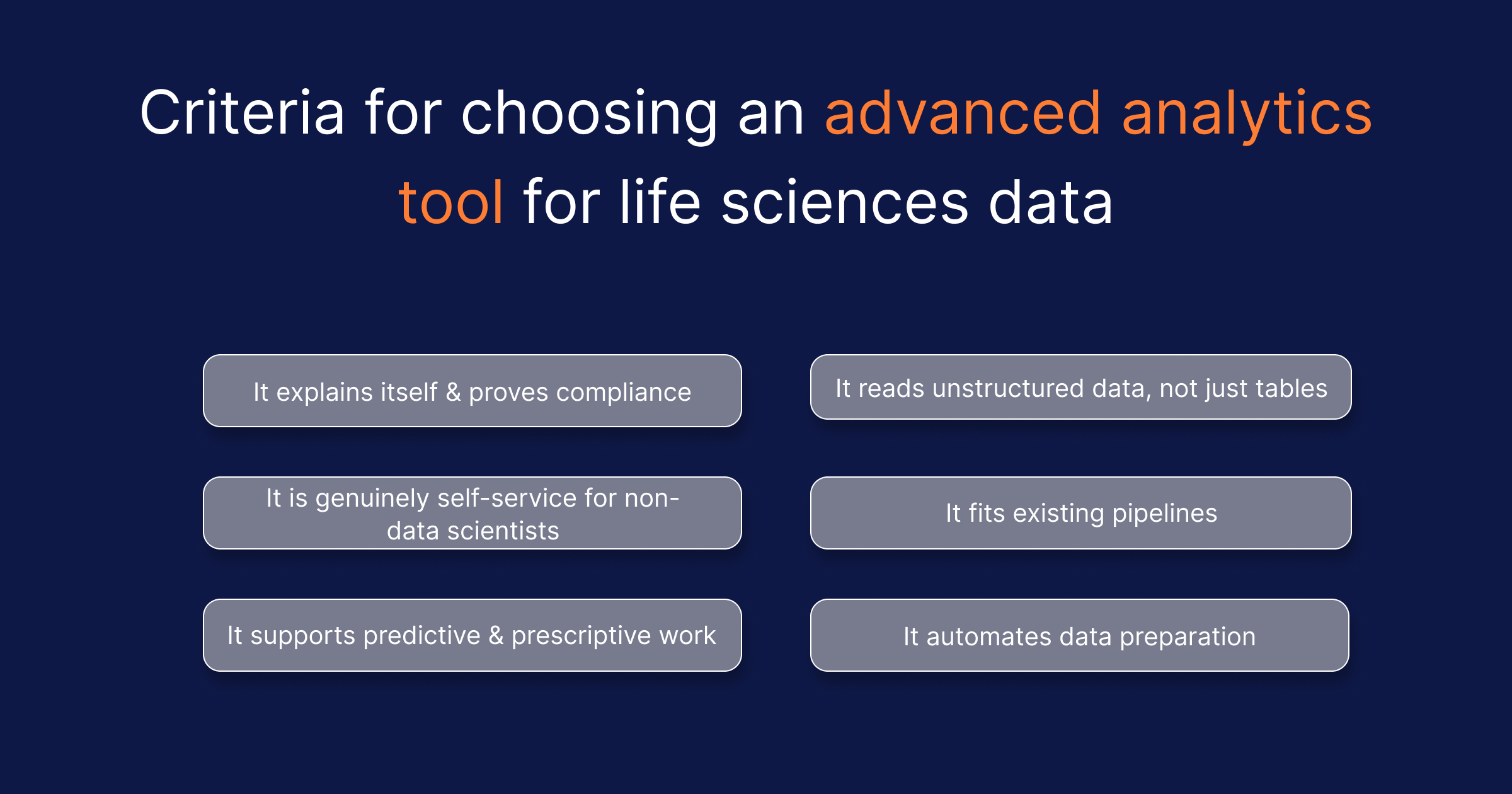
It reads unstructured data, not just tables

The first test is whether the tool can work with the share of data that does not fit a spreadsheet. Look for native handling of clinical text, documents, and imaging metadata, and for natural language processing life science insights that extract findings from research papers and trial records rather than leaving them unread.

It automates data preparation

Data preparation is the slowest part of most analyses. Strong tools deliver data preparation automation for life sciences by profiling sources, flagging quality issues, and standardizing formats before modeling begins. The right level of automation returns scientist hours to science instead of spreadsheet cleanup.

It is genuinely self-service for non-data scientists

Many vendors describe a self-service AI platform for life science teams; far fewer deliver one. The practical question is whether a clinical, regulatory, or commercial lead can reach an answer without writing code or waiting in a queue. Conversational AI for life science data analysis helps here, letting users interrogate data in plain language and receive statistically grounded answers, not just generated text.

It explains itself and proves compliance

For regulated work, explainability is not optional. Every insight needs a verifiable path to its source, and every model decision needs an auditable rationale aligned with 21 CFR Part 11, GxP, and HIPAA. A cloud-based advanced analytics solution that cannot generate that evidence creates compliance risk, no matter how fast it runs. This is also how life science companies ensure data compliance in analytics: by choosing tools where traceability is built in, not bolted on later.

It fits existing pipelines

The tool has to work with what you already run. Before committing, confirm which ML tools integrate with existing life science data pipelines, including your data lake, EHR connections, and current BI surfaces such as Tableau, Qlik, or Spotfire. A tool that forces a full rebuild rarely justifies the disruption.

It supports predictive and prescriptive work

Descriptive reporting tells you what happened. Predictive analytics for the life science industry tells you what is likely next, and prescriptive modeling recommends the next action. Tools that embed forecasting, anomaly detection, and next-best-action into the same workflow move teams from reactive reporting to earlier intervention. Applied to machine learning analytics on healthcare data, that shift is the difference between explaining a missed signal and catching it in time.

How Intuceo approaches life sciences analytics

Intuceo’s PhD-led engineers bring Intuceo-Ax as an accelerator built on previous projects’ expertise, so the capabilities above arrive proven and then get configured to the data, pipelines, and compliance demands of the program in front of them.
DataSharp automates data preparation across structured and unstructured sources. InsightExplorer supports what-if analysis, and HiddenInsights surfaces root causes and patterns that manual review misses. A natural-language layer lets non-technical leaders reach institutional insights in as few as three clicks, with every answer backed by traceable data lineage rather than an unexplained number.
For the unstructured side, Intuceo-Ix builds a unified knowledge layer across research silos, indexing millions of documents spanning LIMS, PLM, clinical trials, FDA filings, and patents so teams find what they need in minutes. Where most models return only a yes or no, Intuceo’s explainable AI frameworks also generate the rationale that GxP review demands.
The distinction that matters for buyers is that Intuceo delivers this as engineering work, not a license to administer on your own. The criteria above get applied to your data and your regulatory context; the engagement model is fixed-bid rather than open-ended, and the controls that regulated research depends on are part of the build.

Before you commit, test it on your most complex datasets.

Most advanced analytics decisions go wrong at the pilot stage, when a tool that demos well stumbles on real clinical text, messy source data, or a single audit question. Intuceo’s engineers can run a sample of your own data against the criteria in this guide and show you where each option holds and where it breaks, before you commit to one.

Frequently Asked Questions

Start with your data, not the demo. Confirm the tool can read unstructured sources such as clinical notes and filings, automate data preparation, explain outputs for audit, and connect to existing pipelines. A tool that scores well on these but looks plain often beats a polished one that only handles clean tables.
Yes, though capability varies widely. The marker of a real self-service approach is whether a scientist or commercial lead can ask a question in plain language and act on a sourced answer without engineering support. Conversational querying and automated data preparation are what make that possible.
By choosing tools that build traceability and explainability into the workflow. Every result should carry a verifiable lineage to its source, and every model decision should produce an auditable rationale aligned with 21 CFR Part 11, GxP, and HIPAA. Compliance added after the fact is far harder to defend.
Yes. Natural language processing converts research papers, trial protocols, and safety reports into structured data that can be analyzed alongside numeric results, surfacing connections that would otherwise stay buried in text.
It automates preparation across structured and unstructured data, surfaces patterns and root causes, and answers plain-language questions with traceable lineage, all under compliance controls suited to regulated research.
How Advanced Analytics Tools Speed Up Exploratory Studies in Pharma

Bringing a new therapeutic from discovery to approval still takes roughly 10 to 15 years and commonly costs more than $1 billion to $2 billion.[1] A large share of that time is spent not on running experiments, but on getting data ready to ask questions of it. Research teams sit on genomic readouts, assay results, electronic lab notebooks, and trial datasets that rarely line up, and the people best equipped to find signal in them spend most of their day cleaning and reshaping files instead. This is where advanced analytics tools for exploratory studies in pharma earn their place: they automate the slow setup, so scientists reach the questions faster.

Key Takeaways

What is advanced analytics, and why does it matter for pharma research?

Advanced analytics combines machine learning, natural language processing, and statistical automation to handle the manual steps inside the analytics workflow: preparing data, finding correlations, building first-pass models, and explaining results. Instead of a scientist hand-coding every query, the system proposes relationships, flags anomalies, and answers questions asked in ordinary language. Advanced analytics represents one well-established approach within this broader category, adding AI-driven suggestion layers on top of traditional BI to surface insights researchers might not have thought to look for.
The reason this matters for pharma analytics is timing. Exploratory studies are open-ended by design, with teams testing many hypotheses against messy, high-dimensional data before committing resources to any path. The slowest part is rarely the science. It is the preparation. Even today, data scientists spend roughly 45% of their working hours simply loading and cleansing data before modelling can start.[2] Advanced analytics for pharma removes much of that overhead, which is one reason AI-driven analytics tools are seeing rapid adoption in regulated research environments.

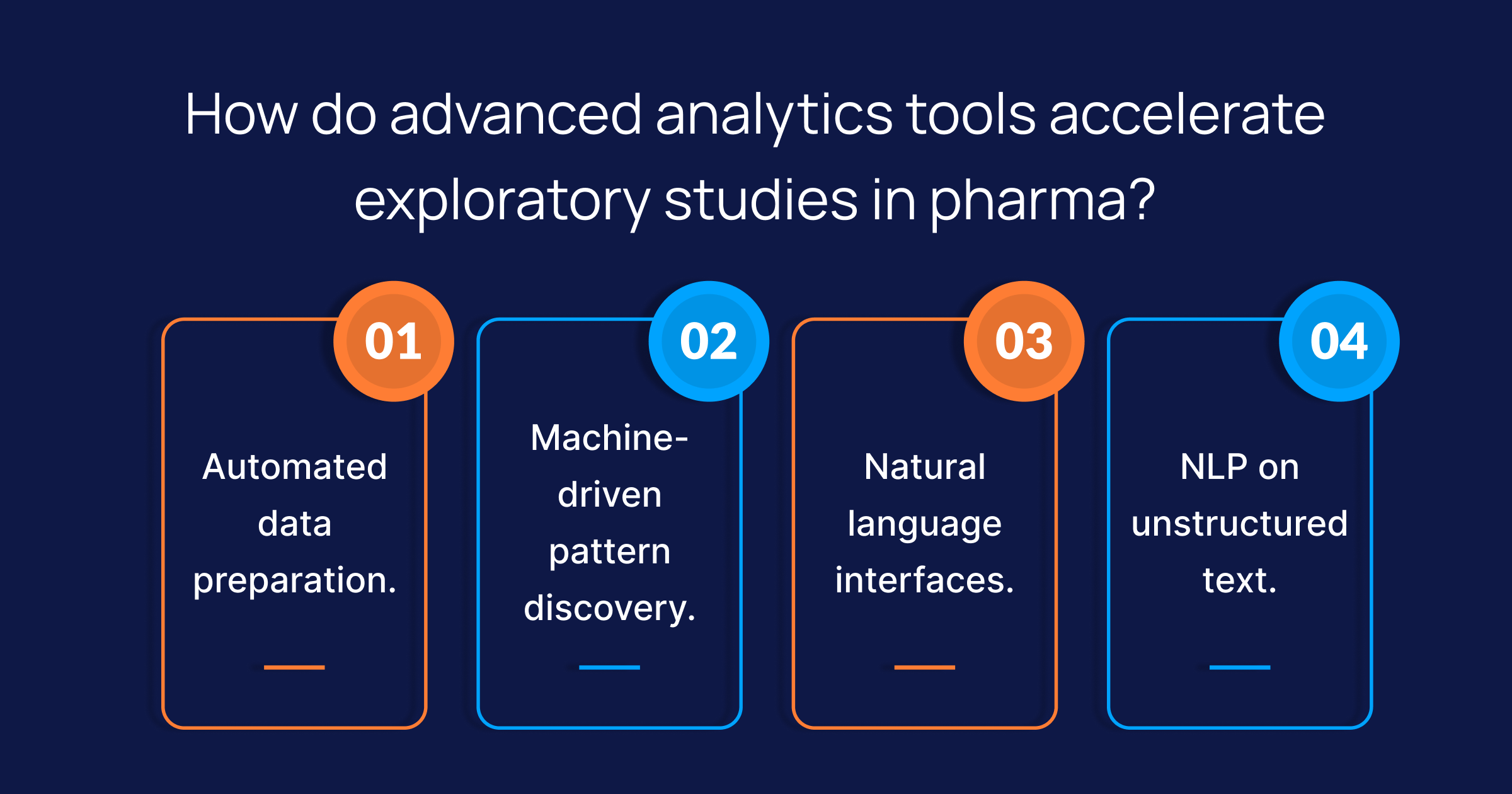
How do advanced analytics tools accelerate exploratory studies in pharma?

They accelerate early-stage research analytics in four concrete ways, each targeting a step where researchers currently lose hours.

How does advanced analytics support drug discovery?

In discovery, the bottleneck is narrowing millions of possible compounds and targets to the few worth testing in a lab. Advanced analytics speeds this by modelling compound-target interactions, predicting toxicity, and ranking candidates before any physical synthesis. The tools support AI in drug discovery precisely at the stage where the cost of error is highest: before lab resources are committed.
The early evidence for these methods is encouraging. A 2024 analysis in Drug Discovery Today found that AI-discovered molecules met their Phase 1 clinical endpoints at an 80% to 90% rate, substantially higher than historic industry averages.[3] Predictive analytics for drug discovery does not replace medicinal chemistry. It allows teams to spend their limited lab capacity on the candidates most likely to hold up, which is the practical definition of accelerating an exploratory study.

How does advanced analytics transform clinical trial analysis?

Clinical research carries the steepest risk in the entire pipeline. Across more than 400,000 trial records, researchers estimated the overall probability that a drug program entering trials reaches approval at just 13.8%, roughly one in seven.[4] Most of that attrition is decided by how well teams read their data early.
Advanced analytics improves the read. It helps identify eligible patient cohorts faster by searching across fragmented clinical datasets, surfaces site-level and safety signals as data arrives rather than at scheduled checkpoints, and applies predictive analytics in pharma that flag enrolment or efficacy problems while there is still time to adjust. In this way, advanced analytics tools become a practical form of clinical research decision support, shortening the gap between a problem appearing in the data and a team acting on it. Data integration in pharma is the enabling layer: connecting trial records, EHR extracts, and biomarker feeds into a single, analyzable view is what makes real-time signal detection possible.

Can advanced analytics handle complex biological datasets and stay compliant?

Biological data is high-dimensional, noisy, and often unstructured, which is exactly the profile for which advanced analytics is built. The harder requirement in life sciences analytics is not capability but accountability. A result that cannot be explained or traced has limited value in a regulated submission.
This is the practical test for advanced analytics tools in life sciences research: every automated insight needs a verifiable lineage back to source data, and every model decision used in regulated work needs a rationale a reviewer can audit. Explainable AI, immutable logs, and controls aligned to 21 CFR Part 11, GxP, and HIPAA are what separate a tool that demonstrates well from one that holds up under inspection. Advanced analytics frameworks that layer AI-driven suggestions on top of traceable statistical engines are one path to meeting this standard, provided the explainability layer is built from the start rather than retrofitted.

The Intuceo Approach

Advanced analytics, delivered as a service

Intuceo treats advanced analytics as an engagement, not a piece of software to configure and hand over. A PhD-led team arrives with its proprietary analytics accelerator, Intuceo-Ax, already carrying the patterns and configurations from prior regulated research deployments. Rather than starting from blank infrastructure, the team adapts what has already been proven in pharma and life sciences environments, pairing automated data preparation, what-if exploration, and root-cause analysis with natural-language querying that returns statistically grounded answers, complete with the data lineage behind them. Intuceo-Ax is built on advanced analytics principles, extended with additional ML orchestration layers designed specifically for regulated science.
Underneath sit Intuceo’s patented AutoML engines for forecasting, text analytics, and pattern discovery, automating the most labour-intensive phases of model selection and tuning. For unstructured research knowledge, Intuceo-Ix applies semantic search across millions of indexed documents, from LIMS and clinical trial records to FDA filings and patents, so prior findings can be analysed instead of being buried. Because the work targets regulated science, Intuceo architects explainable AI for tasks such as adverse-event classification, generating the evidence-based rationale that GxP and 21 CFR Part 11 demand.
Delivered through fixed-bid engagements, the focus stays on a measurable outcome: getting research teams from pharma data analysis to decision faster, without compromising compliance.

Where is your exploratory work losing the most time?

If your teams spend more time preparing data than studying it, that is a solvable bottleneck. Intuceo’s PhD-led engineers can map where advanced analytics would compress your exploratory cycle, from discovery through clinical analysis, against your specific compliance requirements.

Frequently Asked Questions

Advanced analytics removes the manual bottlenecks that precede actual research. It profiles and cleans incoming datasets automatically, proposes cross-variable relationships that analysts would otherwise test one at a time, and answers plain-language questions without requiring an SQL query for each. In pharma exploratory work, where teams run many hypotheses in parallel against high-dimensional data, this compression of the preparation phase can return several hours per analyst per day to active science.
Natural language processing converts unstructured sources, including research papers, trial protocols, regulatory documents, and safety reports, into structured data that can be analysed alongside numeric results. This unlocks knowledge that would otherwise sit unread and lets teams cross-reference text and numeric data within a single study. For advanced analytics in life sciences workflows, NLP is often the component that makes prior literature and regulatory history available to current-cycle analysis rather than requiring separate manual searches.
Predictive analytics in pharma shortens the time between a signal appearing in the data and a researcher acting on it. For compound prioritisation, models score candidates by predicted toxicity, target affinity, and likelihood of meeting early-phase endpoints, allowing lab resources to be directed at the candidates with the highest probability of success. For cohort analysis in clinical work, predictive models flag enrolment shortfalls, safety patterns, or weak efficacy signals early enough to adjust a study before resources are committed to a path that is unlikely to succeed.
The ones that pair automation with explainability and traceability. For regulated research, every insight needs a verifiable lineage to its source, and every model decision needs an auditable rationale, with controls aligned to 21 CFR Part 11, GxP, and HIPAA. Speed without that audit trail does not survive inspection. Evaluating any advanced analytics tool for life sciences means testing not just what it can surface, but whether its outputs can be reproduced, traced, and defended under regulatory review.
It cuts costs in two places: the hours scientists spend on manual data preparation, and the resources wasted on candidates that fail late. By returning preparation time to research and ranking candidates by likelihood of success before lab work begins, advanced analytics reduces both the labour and the failed-experiment spend that drives discovery budgets. When AI in drug discovery is applied early in the exploratory cycle, the downstream cost savings compound across every subsequent phase that would otherwise have carried a weak candidate forward.

Why Pharma Analytics Teams Struggle to Scale Augmented Analytics Experiments

Why Pharma Analytics Teams Struggle to Scale Augmented Analytics Experiments

For most pharmaceutical analytics leaders, the celebration after a successful pilot project is short-lived.
It is relatively easy for a talented data team to build a convincing proof of concept – a targeted model that flags an adverse event faster, or a sleek commercial dashboard that answers questions in plain language to impress a steering committee. The real friction begins exactly twelve months later, when that same pilot is expected to run reliably across different regional markets, therapeutic areas, and highly regulated business units.
This bottleneck isn’t just an internal frustration; it reflects a massive global disconnect between digital intent and operational reality. While the global augmented analytics market is on track to rocket from USD 16.60 billion in 2023 to nearly USD 97.87 billion by 2030,1 organizations are finding that buying the technology is the easy part. McKinsey’s recent global benchmarking data shows that while a staggering 88% of organizations have successfully deployed AI within at least one business function, only about a third have managed to scale those capabilities across the wider enterprise
In the strictly regulated domain of life sciences, that execution gap is wider still.

Augmented Analytics: The promise, and the plateau

Augmented analytics uses machine learning and natural language processing to automate data preparation, surface patterns automatically, and let people question data in plain language. Today, this paradigm increasingly leverages Generative AI to provide fluid, conversational interfaces, turning what used to be complex database querying into a simple dialogue. For pharma, that transformation is highly practical: it means a clinical operations lead can interrogate trial site performance without writing a line of code, or a commercial team can test a complex market scenario without joining a three-week analyst queue.
The difficulty is the plateau that follows. Scaling analytics experiments is a completely different discipline from building them. A pilot succeeds in a controlled setting, with meticulously curated data and a highly motivated sponsor. Scale, however, demands messy production data, hundreds of simultaneous users, strict audit trails, and financial outcomes that a corporate finance team will defend. This is the underlying reason pharma analytics AI adoption so often stops at the demo.

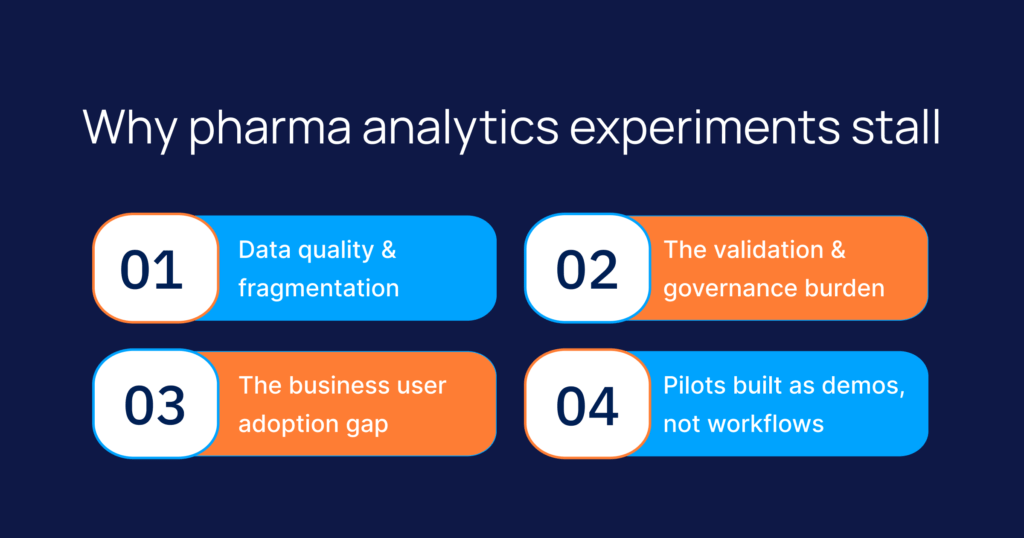
Why pharma analytics experiments stall

Several forces compound at the same point in a program. Understanding them is the first step to explaining why AI pilots fail in pharma.

Data quality and fragmentation

Pharma data lives in silos: laboratory information systems, clinical trial databases, manufacturing execution records, safety systems, and commercial CRM systems, much of it unstructured. Industry data consistently shows that data scientists spend nearly half their working hours cleaning and preparing data rather than analyzing it. In pharma, this friction multiplies exponentially because regulated datasets cannot rely on approximations or ‘good enough’ data patches; a single missing data lineage link can invalidate a clinical report.

The validation and governance burden

A consumer analytics tool can ship and iterate. A regulated one cannot. Any insight that informs a clinical, safety, or manufacturing decision may need to be validated, traceable, and defensible to an auditor. Without regulated industry AI governance built in from the start, teams reach the pilot-to-production line only to find their experiment has no data lineage, no explainability, and no audit trail. Retrofitting those controls often costs more than the pilot did.

The business user adoption gap

Augmented analytics scales only when the people who make decisions actually use it. Yet many tools are designed for data teams, not for the clinical, regulatory, and commercial users who need the answers. When business user analytics adoption stays low, the experiment never leaves the analytics group and never changes how the business runs. Conversational analytics for pharma, where a user asks a question in everyday language and receives a defensible answer, is the bridge, but only when the interface fits the way that user already works.

Pilots built as demos, not workflows

When an enterprise solution is built to look good in a presentation rather than survive the realities of daily operations, failure is inevitable. This operational fragility explains why Gartner predicts that at least 30% of generative AI projects will be abandoned after proof of concept by the end of 2025. Because GenAI increasingly serves as the primary user interface for modern augmented analytics platforms, its high abandonment rate directly impacts the broader analytics ecosystem. Gartner points to poor data quality, inadequate risk controls, escalating costs, and unclear business value as the primary drivers of this collapse.
The common thread across these failures is not the underlying model itself; it is the infrastructure and conditions around it. Enterprise AI in life sciences fails in the exact same way. A pilot engineered solely to impress a steering committee in a boardroom is fundamentally different from a system engineered to scale securely across a global enterprise.

From experiment to enterprise impact

Moving from experimentation to enterprise-wide impact has less to do with a better model and more to do with a repeatable method. Teams that scale tend to do a few things differently. They start with a single high-value decision rather than a broad capability. They build governance, validation, and data lineage into the experiment instead of bolting them on afterward. They design for the business user from day one. And they treat the pilot as the first production increment, not a throwaway proof.
This is also where AI decision support in life sciences earns its place. Decision support that surfaces an insight quickly, shows the data behind it, and records how it was derived can be trusted, audited, and adopted. Decision support that produces an answer no one can explain will not survive a regulatory review, let alone reach scale.

How Intuceo helps pharma teams scale

Intuceo is a PhD-led AI, ML, and data analytics services firm that works inside regulated industries, including pharma and life sciences. The work is not about selling a tool. It is about delivering the method and the engineering that move an analytics experiment into dependable enterprise use.
Intuceo-Ax, the firm’s augmented analytics accelerator, is built to speed deployment rather than start every build from zero. It automates data preparation, supports what-if exploration, and lets non-technical leaders navigate deep KPIs in as few as three clicks, which speaks directly to the business user adoption gap. Because it draws on patterns proven in prior pharma engagements, teams skip much of the trial and error that stalls a first attempt.
Governance is engineered in, not added later. Intuceo applies a Regulated-by-Design approach: automated data profiling and anomaly detection at the source, immutable lineage for forensic traceability, and explainability frameworks with bias detection and model cards reviewed by a PhD-led Board of Science. These controls are pre-vetted against FDA 21 CFR Part 11, HIPAA, GxP, SOC 2 Type II, and FISMA requirements, giving regulated AI governance a concrete foundation.
The firm’s iPDLC framework gives experiments a defined route from concept to validated production, the step most pilots are missing. Across more than 100 life sciences engagements over 14-plus years, including work for organizations such as Janssen and Ferring, Intuceo has engineered solutions like a universal search capability that indexes over 5 million R&D documents, turning dormant knowledge into usable insight. Engagements run on fixed-bid and budgeted models, so clients pay for outcomes rather than activity.

Ready to Move from Pilot to Production?

Don’t let a promising experiment stop at the demo phase. Intuceo builds compliance, data lineage, and user adoption directly into your pipelines from day one.
  • Regulated-by-Design: Pre-vetted compliance (FDA 21 CFR Part 11, GxP, HIPAA) built in, not bolted on.
  • Proven iPDLC Framework: A predictable path from concept to an audited, enterprise-scale project.
  • Outcome-Based Models: Fixed-bid structures so you pay for impact, not activity.

Frequently Asked Questions

Most fail at integration, not at the model. Pilots run on curated data with a motivated sponsor, then meet fragmented production data, low business user adoption, and validation requirements they were never designed to satisfy. The experiment works in isolation but cannot connect to the workflows and controls that real scale demands.
By treating scale as a method rather than a milestone. That means starting with one high-value decision, building governance and data lineage into the experiment from the start, designing for the business user, and running the pilot as the first production increment. A defined lifecycle, such as Intuceo’s iPDLC, gives that progression a repeatable structure.
At minimum: validated data quality, immutable lineage so any insight can be traced to its source, explainability so outputs can be defended, and bias detection and model documentation. These should map to standards such as FDA 21 CFR Part 11, HIPAA, GxP, and SOC 2 Type II, and should be present before a pilot is asked to inform a regulated decision.

Automate the repeatable work, data profiling, preparation, and anomaly detection, while keeping validation and audit trails intact. Automation that records what it did and why preserves the defensibility a regulated environment requires, and frees analysts to spend time on interpretation rather than cleaning data.

Meet users in their own workflow and language. Conversational analytics that let a clinical or commercial user ask a question and receive a clear, sourced answer removes the dependency on a specialist queue. Adoption follows when the interface is simple, the answer is trustworthy, and the path to that answer is short.

Which Semantic Search Tool Works Best for Clinical and Regulatory Documents?

Why clinical and regulatory documents break general search engines

Three properties of life sciences content make general-purpose tools fall short.

1. Volume and dispersion

PubMed alone contains more than 39 million biomedical citations. Layer on internal sources (LIMS, PLM, eTMF, ELN, CTMS, pharmacovigilance databases), and most pharma organizations are looking at millions of pages of unstructured content scattered across systems. Standard keyword search returns either everything or nothing useful.

2. Specialized terminology

Clinical and regulatory content carries dense ontologies: SNOMED CT, MeSH, ICD, UMLS, MedDRA, LOINC, and regulator-specific vocabularies. A query for “heart attack” should retrieve documents using “myocardial infarction,” “MI,” “acute coronary syndrome,” and ICD codes I21 and I22. A general natural language query search tool that has never seen these mappings will miss the most relevant evidence.

3. Traceability requirements

Under 21 CFR Part 11, the FDA requires electronic records that support GxP-regulated activities to maintain accurate, attributable, contemporaneous, and complete audit trails. EMA’s EudraLex Volume 4 Annex 11 places similar expectations on computerised systems used in GMP environments. A search tool that returns an answer without showing exactly which document, page, and version it came from is a compliance liability, not a productivity gain.

What semantic search actually does differently

LLM-based document search works on vector embeddings: a model translates each piece of content into a numerical representation that captures meaning rather than keywords. A query is converted into the same representation and matched against the document index. The output is documents that are conceptually similar to the query, even when they share no exact words. When combined with retrieval-augmented generation (RAG), the system can also produce a natural language answer grounded in retrieved evidence.
For clinical research search, that capability is the difference between a paralegal-style read of fifty papers and a directed pull of the five passages that actually answer the question. For regulatory intelligence, it is the difference between scrolling through 400-page Health Authority guidelines and surfacing the two paragraphs that pertain to a specific submission.

The Semantic Search Landscape: Three Approaches, Three Distinct Boundaries

When evaluating a semantic search tool for regulatory documents, most options fall into one of three categories. Each has a place, and each has limits.
Tool category What it does well Where it falls short for life sciences
General enterprise search (horizontal SaaS) Indexes common SaaS systems (SharePoint, Confluence, Slack, Drive). Easy to deploy. Good UX. No biomedical ontology awareness. Limited support for GxP-regulated systems. Typically, cloud-only deployment models complicate IP and PHI handling.
Off-the-shelf biomedical search (literature-focused) Pre-indexed access to PubMed, Embase, and clinical trial registries. Useful for literature reviews and healthcare knowledge discovery. Limited integration with proprietary internal content (CSRs, IBs, internal SOPs). Closed ecosystems. Search results sit outside enterprise security boundaries.
Domain-specific AI search (custom or hardened) Built on biomedical embeddings, integrated with internal systems, supports on-premise or air-gapped deployment, and surfaces source-traceable evidence. Aligned with compliance-friendly AI search requirements. Higher implementation effort. Requires partners with engineering depth in both AI and regulated environments.

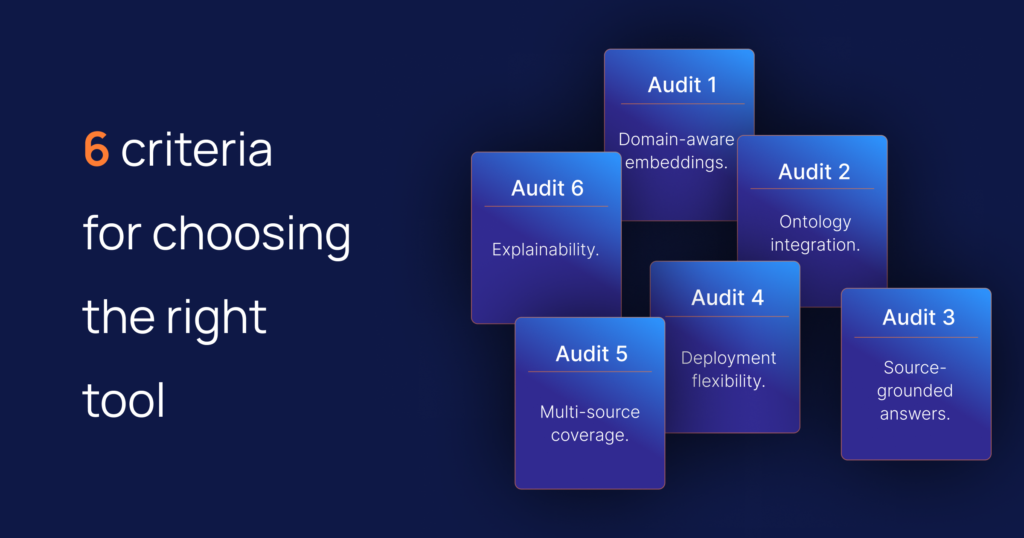
Six criteria for choosing the right tool

The right answer depends on the workload, but here are six tenets that separate viable options from risky ones in regulated environments.

Quick test

 Ask any vendor to demo the tool on a question your own team struggled with last quarter. Then ask the system to show you every source it used, every section it pulled from, and every step in the retrieval logic. If the answer is “we can show you the result, but not the reasoning,” it is not ready for a regulated workflow.

Where general-purpose LLMs fall short on regulated content

Public LLMs are remarkable general-purpose tools, but several issues limit their use in clinical and regulatory contexts. They hallucinate, sometimes fluently and confidently, on technical questions outside their training distribution.They lack the audit trail that regulators expect. They have no built-in awareness of which version of a document is current or superseded. And most pose data-residency questions that procurement teams ma cannot easily clear.in phar
A domain-specific search system addresses these issues by combining a retrieval layer (vector + ontology-aware) with a generation layer that is constrained to retrieved evidence. It is the engineering pattern that separates a usable clinical assistant from a fluent but unreliable one.

How Intuceo Delivers Semantic Search for Regulated Content

Intuceo-Ix™: a search accelerator for clinical and regulatory teams

Intuceo is a PhD-led AI and data analytics consultancy. For teams that need life sciences semantic search across internal silos and external regulatory and scientific content, we bring Intuceo-Ix™, a search accelerator proven across prior regulated engagements that we configure to your repositories rather than build from scratch.
The result is semantic search engineered for your environment, where a wrong answer is not an inconvenience but a regulatory exposure.

Stop Searching. Start Finding with Intuceo.

When a wrong answer isn’t an operational inconvenience but an immediate regulatory exposure, life sciences organizations cannot afford the blind spots of general-purpose search. Intuceo’s PhD-led team brings the Intuceo-Ix™ and Intuceo-Dx™ accelerators, proven across prior regulated engagements, to bridge the gap between fragmented clinical data silos and the explainable, source-traceable insight your compliance teams expect.
Move your organization from data rich to insight rich without compromising your GxP or 21 CFR Part 11 posture.

Frequently Asked Questions

For document-heavy life sciences research, what matters more than the underlying LLM is the retrieval pipeline around it. A general-purpose model paired with a biomedical embedding layer, ontology grounding, and source-cited retrieval will outperform a more powerful model used in isolation. Evaluate the whole system, not just the base model.
Run a structured test set on real questions from your team. Check whether every answer is grounded in a cited source, whether the citation actually supports the claim, and whether the system declines to answer when evidence is insufficient. Tools that refuse to answer without evidence are usually safer than those that always produce something.
The framing should shift from “which LLM” to “which architecture.” For regulated workflows, the deciding factors are deployment model (on-prem or air-gapped), explainability of retrieval, audit-trail support, and integration with the organization’s content systems. A model that scores well on public benchmarks but cannot meet those requirements is not the right answer.
Three things : traceable source citations on every answer, deployment options that keep regulated data inside the organization’s security perimeter, and audit logs that record who queried what, when, and what was returned. These are baseline expectations for any tool used in GxP, HIPAA, or FISMA-regulated environments.
A practical short list: Does the tool understand biomedical terminology and ontologies? Can it cite every source it uses? Will it run inside our environment without exposing data to public models? Does it integrate with the systems where our content actually lives? Can we audit it the way a regulator would expect us to? If a vendor cannot answer all five clearly, the tool is not yet ready for clinical or regulatory work.

Which Augmentative Tools Suit a Cloud-Based Life Science Platform?

Most pharma and biotech IT estates have already migrated. The major cloud platforms now offer regulated-environment configurations, BAA coverage, and validated reference architectures for clinical, regulatory, and commercial workloads. Raw cloud capacity, however, does not solve the operational problems life sciences teams actually feel: clinical teams still spend a disproportionate share of their time searching for protocol documents, screening patients for trials, and reconciling case report forms. Pharmacovigilance teams process growing volumes of adverse event reports under tight regulatory windows; the U.S. FDA’s FAERS database now contains over 31 million adverse event reports, with intake volumes climbing year over year . Regulatory affairs teams still hand-curate submission narratives across thousands of pages.

A life science cloud platform stores the data and enforces access controls. It does not, by itself, read 12,000-page submissions, triage AE narratives, or match a patient to a trial. That is the work of an augmentative AI layer engineered on top of it.

What "augmentative" actually means in life sciences

An augmentative tool extends a human workflow without replacing the human accountable for the decision. In a regulated context, that distinction matters. Validated systems require traceability, defensible model behavior, and human-in-the-loop checkpoints. Compliant AI tools in life sciences are designed around those constraints rather than against them. The categories below cover where augmentation produces the strongest signal on a cloud-based life science platform. Not every tool fits every team, but the taxonomy is consistent across pharma, biotech, and medtech.

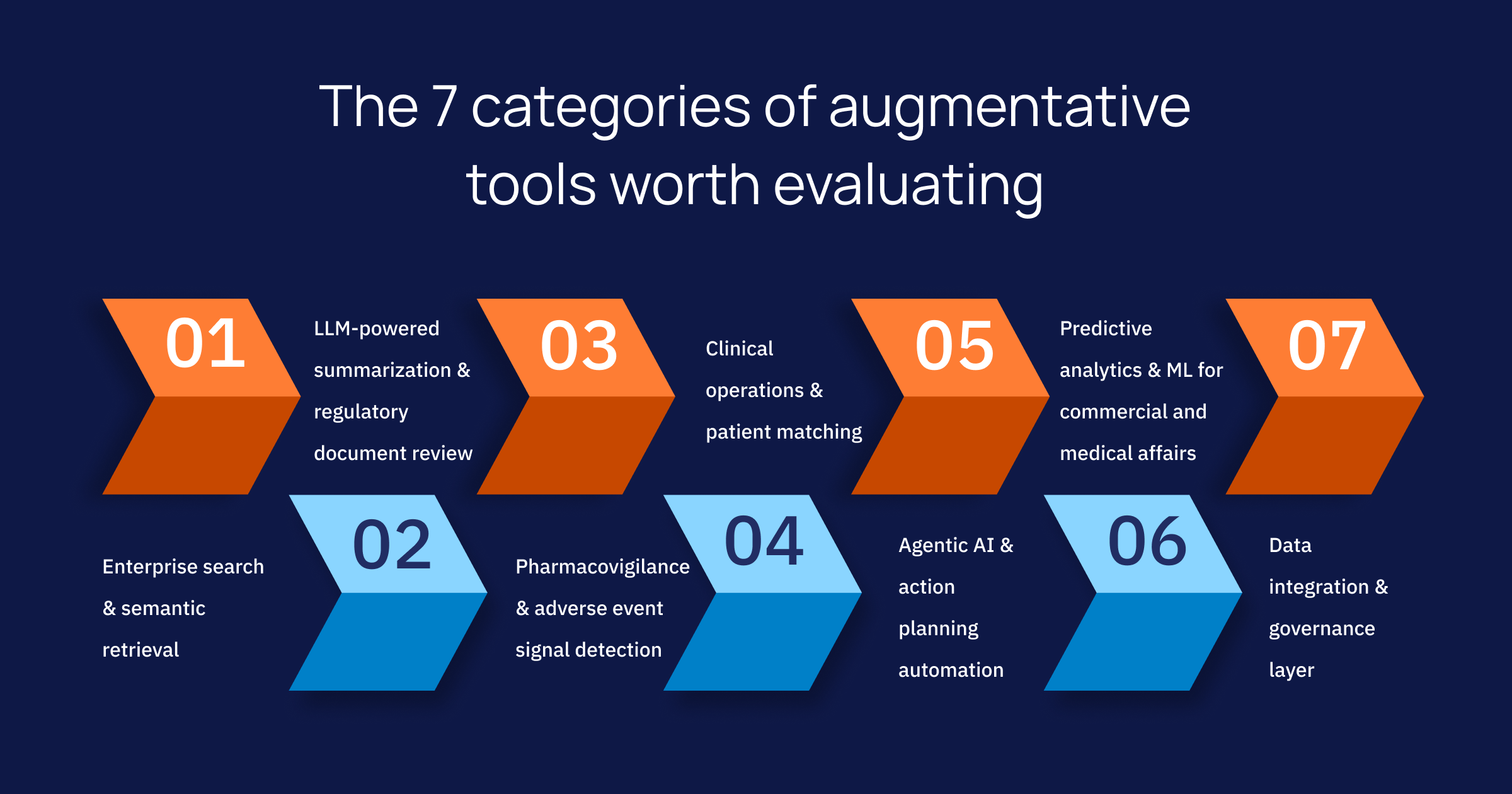
The seven categories of augmentative tools worth evaluating

1. Enterprise search and semantic retrieval

Knowledge in a life sciences organization is spread across SharePoint, electronic lab notebooks, LIMS, PLM, regulatory submission repositories, CTMS, and clinical trial archives. Keyword search across these systems consistently misses what scientists and reviewers need. Semantic and vector-based AI search and summarization tools fix the retrieval problem by interpreting intent and surfacing relevant passages across formats. McKinsey estimates that knowledge workers spend up to 1.8 hours per day searching for information . In a 5,000-person R&D organization, that is the productivity equivalent of a mid-sized team.

2. LLM-powered summarization and regulatory document review

Regulatory document review is one of the highest-ROI use cases for generative AI in pharma. Modern LLMs can read protocols, investigator brochures, clinical study reports, and submission packages, then produce structured summaries, gap analyses, and consistency checks. The work that previously took days can be reduced to an hour of human review on top of a machine-generated draft. Done well, this is one of the strongest applications of generative AI for pharma because the outputs feed directly into reviewable artifacts.

3. Pharmacovigilance and adverse event signal detection

While the AE intake volume continues to compound annually, the PV team headcount usually cannot match that pace. Augmentative tools here perform case intake from unstructured text, MedDRA coding suggestions, duplicate detection, and signal triage across product portfolios. The combination of NLP, classification models, and rules-driven validation is where most production deployments have settled.

4. Clinical operations and patient matching

Roughly 80% of clinical trials fail to meet original enrollment timelines, and the cost of a delayed Phase III trial can exceed several million dollars per day for high-value drugs [3]. Clinical workflow automation tools, including patient-trial matching against EHR cohorts, site performance analytics, and protocol deviation prediction, shorten enrollment cycles and surface site-level risk before it triggers protocol amendments. Patient matching engines that combine SNOMED CT, ICD-10, lab results, and free-text physician notes consistently outperform manual eligibility screening.

5. Agentic AI and action planning automation

Agentic AI is the layer above summarization. An agent decomposes a goal into steps, calls the right systems on a life science cloud platform, executes a sequence, and routes exceptions back to a human. In practice: orchestrating a multi-step regulatory query, drafting an AE narrative for QC, or assembling a feasibility packet for a new study. Action planning automation is most valuable where the workflow is well-defined but the data sources are not.

6. Predictive analytics and ML for commercial and medical affairs

On the commercial side, augmentative tools for HCP engagement include next-best-action models, prescriber affinity scoring, and content recommendation engines that integrate with CRMs like Veeva or Salesforce Health Cloud. For patient-facing work, a patient engagement platform can use ML to personalize adherence outreach, predict drop-off risk, and prioritize support program interventions. These tools live inside cloud CRMs but extend them with predictive layers the CRM does not natively provide.

7. Data integration and governance layer

Data integration in life sciences is rarely glamorous, but it is the precondition for every other category to work. Tools that handle entity resolution across master data, lineage tracking for GxP audit, and standardization to CDISC SDTM/ADaM make LLMs and ML models defensible. Without this layer, AI outputs cannot be reproduced in an audit; with it, every downstream model becomes inspection-ready.

How to choose AI tools that integrate with a life science cloud platform

The right shortlist is rarely the most exciting tool. It is the one a regulator will accept and a CIO can operate. The criteria below filter out most consumer-grade GenAI offerings before procurement begins.
Evaluation lens What to verify
Regulatory fit Validated against 21 CFR Part 11, EU GMP Annex 11, GxP, and HIPAA. Audit trails on prompts, outputs, and model versions.
Data residency & isolation BAA coverage, private model deployment, no training on customer data, regional data residency for EU/UK/APAC studies.
Integration depth Native connectors to Veeva Vault, Salesforce Health Cloud, AWS HealthLake, Azure Health Data Services, Snowflake, Databricks, EHR FHIR endpoints.
Explainability Citations on every generated answer, traceable retrieval paths, model cards, and documented evaluation on life sciences corpora.
Human-in-the-loop design Review gates, role-based approval, controlled rollback, and the ability to disable autonomous actions in regulated workflows.
Total cost of ownership Inference costs at production volumes, model-update cadence, and the operational overhead of maintaining prompt and retrieval pipelines.

Where augmentation tends to break

Most failed life sciences AI pilots share three patterns. The tool is deployed without addressing the underlying data integration problem, so outputs are inconsistent. The tool is selected on demo strength rather than validation evidence, and stalls when regulatory affairs reviews it. The tool is treated as a feature rather than a workflow, so adoption never reaches the teams who would benefit. Each is fixable, but only when AI is treated as part of a clinical or regulatory operating model, not as a standalone purchase.

How Intuceo augments your cloud-based life science environment

Intuceo is a PhD-led AI and data analytics consultancy. We engineer the augmentative layer on top of your existing cloud environment, on AWS, Azure, Databricks, Snowflake, and the Veeva and Salesforce Health Cloud stacks. The work is grounded in regulatory-grade delivery, not experimentation. Where a category above maps to a problem your team already feels, we bring accelerators built and hardened across prior life sciences engagements, proven components that shorten deployment so you reach a validated result faster than a build-from-scratch project would allow. Accelerators we bring to you:

Build Your Augmentation Roadmap

The foundation is built; now it’s time to scale. Your data is already on Veeva, AWS, or Salesforce. The gap is the augmentative layer that turns it into faster decisions and automated workflows. Intuceo’s PhD-led team engineers that layer with you, bringing accelerators from prior regulated engagements so you reach a validated, audit-ready result faster than a build-from-scratch effort. Start with a working session on where augmentation pays back first.

Frequently Asked Questions

The strongest categories are neural enterprise search, LLM-powered summarization for regulatory document review, AE classification for pharmacovigilance, patient-trial matching, agentic workflow orchestration, predictive ML for commercial and medical affairs, and the data integration layer underneath them. Selection should be driven by which workflow has the most measurable cycle-time or compliance pain, not by which tool has the most impressive demo.
Look for vendors that ship with audit trails, validated reference architectures, BAA coverage, and documented evaluation against pharma and biotech corpora. The minimum bar for compliant AI tools in regulated environments is alignment with 21 CFR Part 11, EU GMP Annex 11, GxP, and HIPAA. Tools that cannot produce citations or model lineage on demand should not enter production.

Summarization is best handled by LLMs fine-tuned or grounded against life sciences corpora with retrieval-augmented generation. Search requires semantic and vector retrieval across structured and unstructured repositories. Action planning automation sits on top of both, using agentic frameworks to execute multi-step workflows and surface exceptions to human reviewers.

On the HCP side, the most common tools are next-best-action engines, content recommenders, and territory analytics layered on Veeva or Salesforce Health Cloud. For patient engagement, a modern patient engagement platform uses adherence prediction, personalized outreach, and intervention prioritization for patient support programs.
Start from the workflow, not the tool. Identify the highest-friction process, typically AE intake, regulatory document review, or patient matching, and quantify its cost. Then evaluate two or three tools against the criteria in the table above. Pilot with measurable success criteria validated against your existing cloud-based life science platform, and only scale tools that clear both clinical and compliance review.

What Leads to Slow Information Retrieval in Large Clinical Document Repositories?

A researcher at a pharmaceutical company needs specific safety data from a clinical trial conducted eight years ago. The information exists, but it is fragmented across regulatory filings, Clinical Study Reports (CSRs), and investigator brochures, scattered across SharePoint, a LIMS, and two legacy Document Management Systems (DMS). What should be a precise query becomes a time-consuming manual audit.
This is not an edge case; it is a systemic operational bottleneck. As clinical document repositories scale, they have evolved into “data graveyards” rather than active knowledge bases. With healthcare data volumes growing at 36% annually,  outpacing both manufacturing and finance, the infrastructure used to store this data is crumbling under the weight of its own complexity.
The root of this bottleneck extends beyond simple indexing issues. It is the result of deep-seated technical hurdles: fragmented data silos, a lack of standardized metadata, and the inherent difficulty of querying unstructured text within massive, non-machine-readable PDFs. When retrieval lags, the consequences extend beyond mere frustration – they manifest as delayed regulatory responses, compromised patient safety insights, and decision cycles that cannot keep pace with the speed of modern drug development.

$2.59B

AutoML global market value in 2025

41.96%

CAGR projected through 2031

Why Clinical Document Search Systems Fail at Scale

Retrieval latency in large clinical document repositories is rarely caused by a single factor. It compounds across several dimensions.

Unstructured Data Without Standardization

Life science organizations generate massive volumes of unstructured clinical data: handwritten physician notes, scanned regulatory submissions, multi-format trial reports, pathology narratives, and adverse event case files. This data lacks the structured schemas that conventional databases rely on. Without standardized tagging or formatting, search systems cannot index content meaningfully. A 2019 PMC study confirmed that approximately 80% of medical data remains unstructured and untapped after creation, with most hospital information systems unable to process it effectively.

Poor Document Chunking Strategies

When organizations feed clinical PDFs and regulatory filings into modern search or retrieval augmented generation (RAG) systems, document chunking becomes a critical failure point. Fixed-size chunking, the most common default, splits documents at arbitrary character counts without regard for section boundaries, tables, or clinical context. A chunk that starts mid-paragraph in a pharmacokinetics section and ends in an adverse event summary returns contextually meaningless results.
Effective chunking for clinical documents requires structural awareness, recognizing that a protocol synopsis is a single logical unit while a multi-page adverse event narrative must be segmented by case, not by page count.

Keyword Search Cannot Handle Clinical Complexity

Traditional keyword-based search breaks down in clinical repositories because medical language is inherently ambiguous. A clinician searching for “heart failure management” may need results that reference “CHF protocols,” “left ventricular dysfunction interventions,” or “HFrEF treatment guidelines,” none of which share the original keywords.
A 2025 systematic literature review of RAG in healthcare identified retrieval noise (irrelevant or low-quality retrieved information), inference latency, domain shift, and limited interpretability as persistent challenges in clinical retrieval systems. Semantic search addresses this by matching intent rather than exact terms, but many life science organizations still rely on legacy keyword engines.

Siloed Systems and Fragmented Repositories

Clinical knowledge rarely lives in one place. Trial data sits in an EDC system. Regulatory correspondence lives in a separate document management platform. Lab results are locked inside LIMS. Each system has its own access controls, metadata schemas, and search interfaces. This fragmentation forces knowledge workers to run parallel searches across disconnected platforms.
According to McKinsey, employees spend an average of 1.8 hours per day searching for and gathering information. In regulated life science environments, where document retrieval involves cross-referencing multiple systems for audit or submission purposes, that number runs highe

Missing Metadata and Taxonomy Gaps

Metadata is the backbone of fast, accurate retrieval. Without proper metadata enrichment, including document type, therapeutic area, study phase, and regulatory jurisdiction, search engines cannot surface the right results. Many clinical repositories were built over decades, and legacy documents were ingested without consistent tagging. When a repository holds millions of pages across disparate archives, missing metadata creates blind spots that no amount of search tuning can fix.

OCR Limitations on Scanned Clinical Documents

A significant portion of clinical repositories includes scanned documents: legacy trial reports, handwritten clinical notes, signed regulatory forms, and faxed correspondence. Standard OCR introduces errors that propagate through every downstream search query. Misread characters in drug names, dosage figures, or patient identifiers make these documents effectively invisible to retrieval systems. Poor PDF OCR search quality is a silent contributor to retrieval failures that organizations often underestimate.
The scale of the problem: Healthcare organizations are storing upwards of 50+ petabytes of data, retained for decades to meet compliance requirements. This data is difficult to manage, search, and analyze using standard tools.

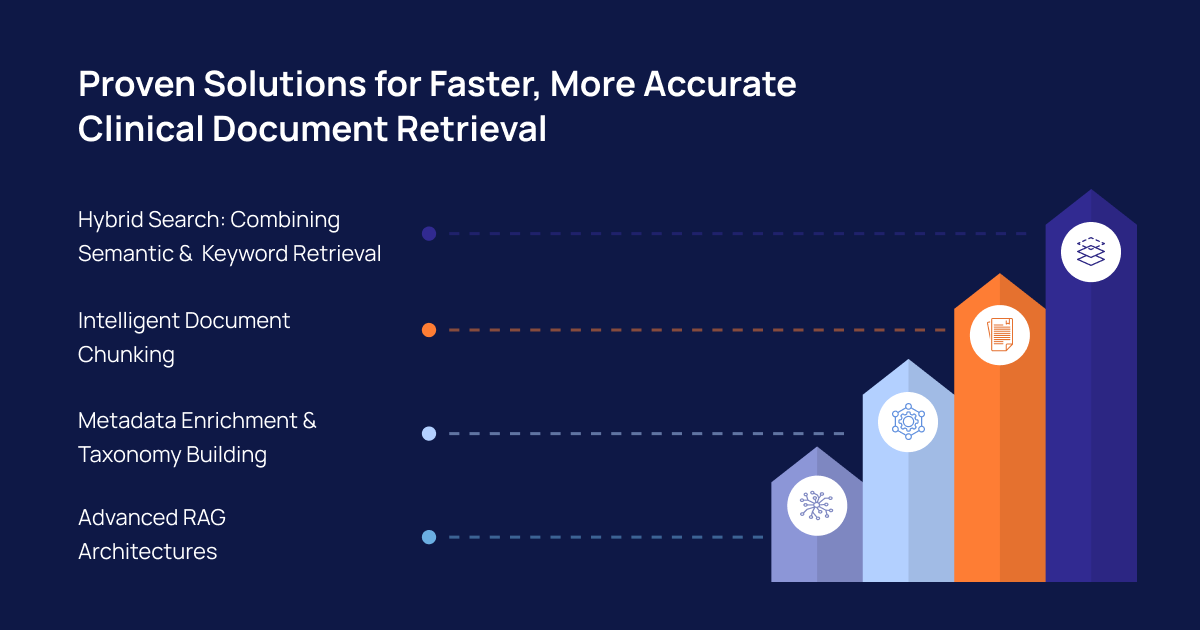
Proven Solutions for Faster, More Accurate Clinical Document Retrieval

Addressing retrieval latency in clinical repositories requires a layered approach that tackles data quality, search architecture, and knowledge organization simultaneously.
ProvenSolutionsforFaster,MoreAccurateClinicalDocumentRetrieval

Hybrid Search: Combining Semantic and Keyword Retrieval

Neither pure keyword search nor pure semantic search is sufficient for clinical repositories. Hybrid search combines sparse retrieval (BM25-based keyword matching) with dense retrieval (neural embedding-based semantic matching) to capture both exact clinical terms and conceptual equivalents.
A 2025 study evaluating RAG variants for clinical decision support found that while a Haystack pipeline (DPR + BM25 + cross encoder) and hybrid fusion (RRF) delivered the best retrieval accuracy, self-reflective RAG reduced hallucinations to 5.8%.
The optimal architecture layers both, using keyword matching for precise regulatory terms and semantic search for broader clinical concepts.

Metadata Enrichment and Taxonomy Building

Retroactive metadata enrichment using NLP-based entity extraction and classification models transforms previously unsearchable archives into queryable knowledge bases. Building a controlled taxonomy specific to the organization’s therapeutic areas and regulatory frameworks ensures search systems map user queries to correct document categories, which is critical for life science information retrieval across multi-decade archives.

Advanced RAG Architectures

Retrieval augmented generation is emerging as a critical capability for clinical knowledge retrieval systems. RAG pipelines retrieve relevant document chunks and feed them to a language model that synthesizes a grounded, contextual answer. For healthcare, this improves factual consistency and reduces hallucinations compared to standalone LLMs. However, RAG for clinical documents requires careful attention to retrieval quality; if the underlying search returns noisy chunks, the generated output inherits those errors.

How Intuceo Solves Clinical Document Retrieval at Scale

Intuceo has engineered purpose-built solutions for exactly this challenge. Intuceo-Ix™ (Neural Search Intelligence) goes beyond keyword matching to provide neural semantic discovery across fragmented institutional silos, reducing information retrieval time by 70%. Its InsightExplorer™ interface enables researchers and knowledge workers to query millions of records with sub-second response times.
For organizations dealing with legacy scanned documents and handwritten clinical notes, Intuceo-Dx™ (Document & Vision Intelligence) uses Vision AI to extract high-fidelity metadata that traditional OCR misses, converting complex analog documentation into structured, searchable records. Its RAG-enabled extraction capability lets teams query their document library as if it were a live expert.
In one engagement, Intuceo deployed a Universal Search Engine that indexed 5M+ documents across SharePoint, LIMS, PLM, clinical trials, FDA filings, and patents, transforming R&D workflows and reducing information discovery time from 90% of a knowledge worker’s day to just 10%.
All Intuceo solutions are deployed within air-gapped, HIPAA-compliant environments. No client data is used to train public models. The intelligence generated remains 100% proprietary.

All Intuceo solutions are deployed within air-gapped, HIPAA-compliant environments. No client data is used to train public models. The intelligence generated remains 100% proprietary.

Frequently Asked Questions

Retrieval slows down due to massive volumes of unstructured clinical data, fragmented storage across multiple systems (EDC, LIMS, QMS, SharePoint), inconsistent or missing metadata, poor document chunking, and reliance on keyword-only search engines that cannot interpret clinical terminology variations.
The most common causes are retrieval noise from poorly chunked documents, domain shift when embedding models are not tuned for clinical vocabulary, and incomplete metadata that prevents the retriever from narrowing results effectively. A RAG system is only as good as the documents it retrieves.
Structure-aware chunking outperforms fixed-size approaches. This involves parsing documents into logical clinical sections (safety narratives, protocol amendments, pharmacokinetic summaries) and enriching each chunk with extracted entities such as drug names, conditions, and study identifiers.
Metadata provides the filtering and categorization layer that search engines need. A well-built taxonomy maps organizational vocabulary to standardized clinical terms, ensuring queries for “adverse event reports” also surface documents tagged under “safety signals” or “AER classifications.”
The most effective approach combines intelligent chunking, entity-enriched indexing, and RAG architectures that retrieve only the most relevant segments before passing them to the model for synthesis. This keeps responses grounded in specific evidence rather than diluted across thousands of pages.