
Bringing a new therapeutic from discovery to approval still takes roughly 10 to 15 years and commonly costs more than $1 billion to $2 billion.[1] A large share of that time is spent not on running experiments, but on getting data ready to ask questions of it. Research teams sit on genomic readouts, assay results, electronic lab notebooks, and trial datasets that rarely line up, and the people best equipped to find signal in them spend most of their day cleaning and reshaping files instead. This is where advanced analytics tools for exploratory studies in pharma earn their place: they automate the slow setup, so scientists reach the questions faster.
Key Takeaways
- Data scientists spend roughly 45% of their time preparing data before any analysis begins, the single largest drain on exploratory study analytics.
- Advanced analytics applies machine learning and natural language processing to automate data prep, surface patterns, and let researchers query data in plain language.
- It compresses the exploratory phase across discovery, target identification, and clinical data analysis, where most pharma delays accumulate.
- For life sciences, value depends on explainability and audit trails that satisfy 21 CFR Part 11 and GxP, not speed alone.
- Intuceo deploys advanced analytics as a services engagement tuned to each research environment, not as off-the-shelf software.
What is advanced analytics, and why does it matter for pharma research?
Advanced analytics combines machine learning, natural language processing, and statistical automation to handle the manual steps inside the analytics workflow: preparing data, finding correlations, building first-pass models, and explaining results. Instead of a scientist hand-coding every query, the system proposes relationships, flags anomalies, and answers questions asked in ordinary language. Advanced analytics represents one well-established approach within this broader category, adding AI-driven suggestion layers on top of traditional BI to surface insights researchers might not have thought to look for.
The reason this matters for pharma analytics is timing. Exploratory studies are open-ended by design, with teams testing many hypotheses against messy, high-dimensional data before committing resources to any path. The slowest part is rarely the science. It is the preparation. Even today, data scientists spend roughly 45% of their working hours simply loading and cleansing data before modelling can start.[2] Advanced analytics for pharma removes much of that overhead, which is one reason AI-driven analytics tools are seeing rapid adoption in regulated research environments.
How do advanced analytics tools accelerate exploratory studies in pharma?
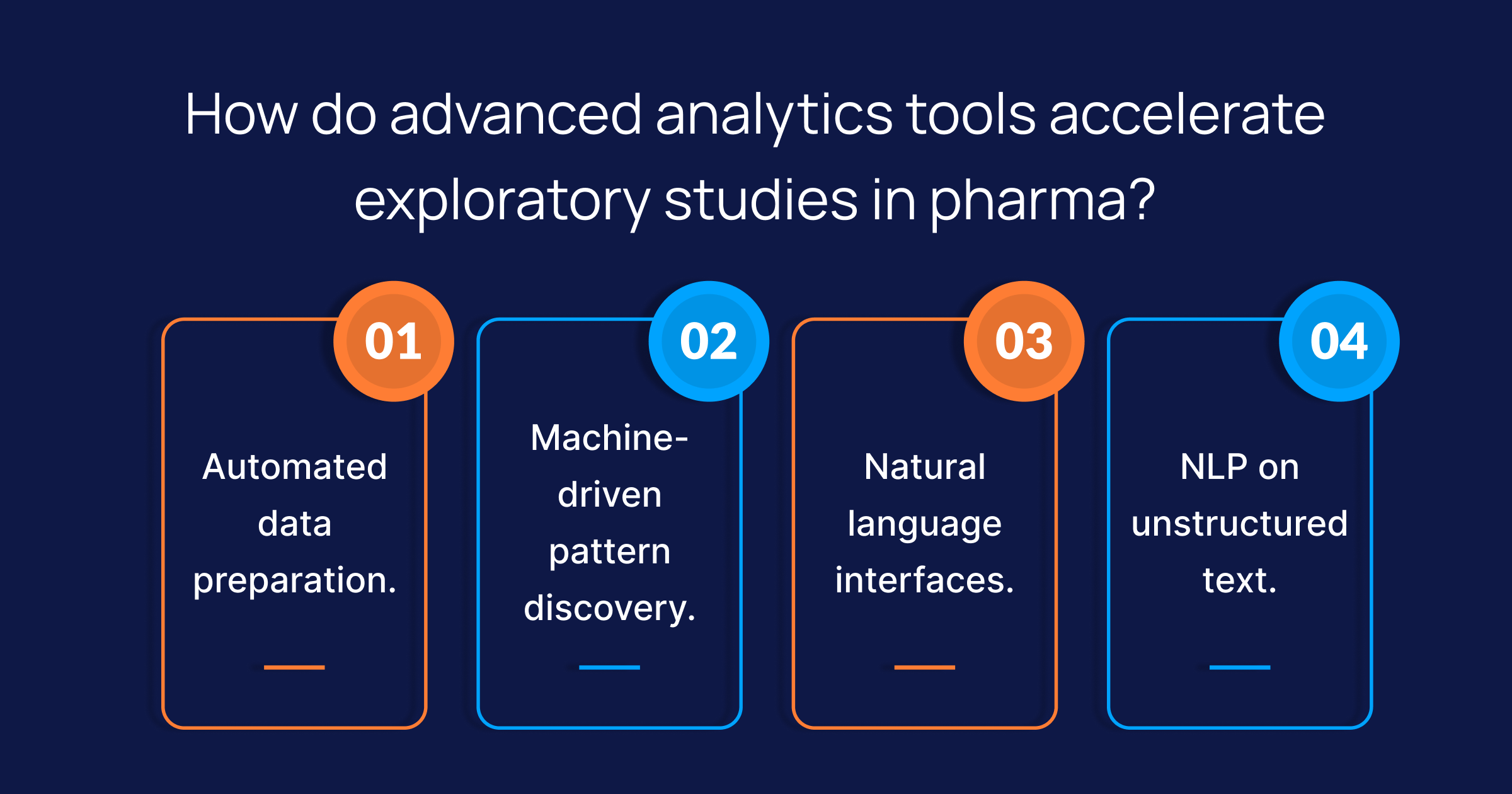
They accelerate early-stage research analytics in four concrete ways, each targeting a step where researchers currently lose hours.
- Automated data preparation. The tools profile incoming datasets, detect type mismatches and missing values, and join sources that do not share clean keys. This is the foundation of accelerated pharma data analysis, and it returns the largest single block of time to scientists.
- Machine-driven pattern discovery. Rather than testing correlations one at a time, the system scans across thousands of variables to rank what is statistically meaningful, pointing researchers toward relationships they might not have considered testing. This is where structured hypothesis generation in pharma benefits most from automated ranking.
- Natural language interfaces. Scientists ask questions such as "which biomarkers track with response in this cohort" and receive a charted answer with the underlying calculation exposed, no SQL required. This lowers the barrier to clinical research decision support for teams without dedicated data engineering resources.
- NLP on unstructured text. Much of pharma's knowledge lives in research papers, regulatory filings, and trial protocols. NLP extracts structured findings from that text so it can be analysed alongside numeric data, closing the gap that prevents pharma data integration from being complete.
How does advanced analytics support drug discovery?
In discovery, the bottleneck is narrowing millions of possible compounds and targets to the few worth testing in a lab. Advanced analytics speeds this by modelling compound-target interactions, predicting toxicity, and ranking candidates before any physical synthesis. The tools support AI in drug discovery precisely at the stage where the cost of error is highest: before lab resources are committed.
The early evidence for these methods is encouraging. A 2024 analysis in Drug Discovery Today found that AI-discovered molecules met their Phase 1 clinical endpoints at an 80% to 90% rate, substantially higher than historic industry averages.[3] Predictive analytics for drug discovery does not replace medicinal chemistry. It allows teams to spend their limited lab capacity on the candidates most likely to hold up, which is the practical definition of accelerating an exploratory study.
How does advanced analytics transform clinical trial analysis?
Clinical research carries the steepest risk in the entire pipeline. Across more than 400,000 trial records, researchers estimated the overall probability that a drug program entering trials reaches approval at just 13.8%, roughly one in seven.[4] Most of that attrition is decided by how well teams read their data early.
Advanced analytics improves the read. It helps identify eligible patient cohorts faster by searching across fragmented clinical datasets, surfaces site-level and safety signals as data arrives rather than at scheduled checkpoints, and applies predictive analytics in pharma that flag enrolment or efficacy problems while there is still time to adjust. In this way, advanced analytics tools become a practical form of clinical research decision support, shortening the gap between a problem appearing in the data and a team acting on it. Data integration in pharma is the enabling layer: connecting trial records, EHR extracts, and biomarker feeds into a single, analyzable view is what makes real-time signal detection possible.
Can advanced analytics handle complex biological datasets and stay compliant?
Biological data is high-dimensional, noisy, and often unstructured, which is exactly the profile for which advanced analytics is built. The harder requirement in life sciences analytics is not capability but accountability. A result that cannot be explained or traced has limited value in a regulated submission.
This is the practical test for advanced analytics tools in life sciences research: every automated insight needs a verifiable lineage back to source data, and every model decision used in regulated work needs a rationale a reviewer can audit. Explainable AI, immutable logs, and controls aligned to 21 CFR Part 11, GxP, and HIPAA are what separate a tool that demonstrates well from one that holds up under inspection. Advanced analytics frameworks that layer AI-driven suggestions on top of traceable statistical engines are one path to meeting this standard, provided the explainability layer is built from the start rather than retrofitted.
The Intuceo Approach
Advanced analytics, delivered as a service
Intuceo treats advanced analytics as an engagement, not a piece of software to configure and hand over. A PhD-led team arrives with its proprietary analytics accelerator, Intuceo-Ax, already carrying the patterns and configurations from prior regulated research deployments. Rather than starting from blank infrastructure, the team adapts what has already been proven in pharma and life sciences environments, pairing automated data preparation, what-if exploration, and root-cause analysis with natural-language querying that returns statistically grounded answers, complete with the data lineage behind them. Intuceo-Ax is built on advanced analytics principles, extended with additional ML orchestration layers designed specifically for regulated science.
Underneath sit Intuceo’s patented AutoML engines for forecasting, text analytics, and pattern discovery, automating the most labour-intensive phases of model selection and tuning. For unstructured research knowledge, Intuceo-Ix applies semantic search across millions of indexed documents, from LIMS and clinical trial records to FDA filings and patents, so prior findings can be analysed instead of being buried. Because the work targets regulated science, Intuceo architects explainable AI for tasks such as adverse-event classification, generating the evidence-based rationale that GxP and 21 CFR Part 11 demand.
Delivered through fixed-bid engagements, the focus stays on a measurable outcome: getting research teams from pharma data analysis to decision faster, without compromising compliance.
Where is your exploratory work losing the most time?
If your teams spend more time preparing data than studying it, that is a solvable bottleneck. Intuceo’s PhD-led engineers can map where advanced analytics would compress your exploratory cycle, from discovery through clinical analysis, against your specific compliance requirements.
Frequently Asked Questions
1.How can advanced analytics speed up exploratory studies in pharma?
Advanced analytics removes the manual bottlenecks that precede actual research. It profiles and cleans incoming datasets automatically, proposes cross-variable relationships that analysts would otherwise test one at a time, and answers plain-language questions without requiring an SQL query for each. In pharma exploratory work, where teams run many hypotheses in parallel against high-dimensional data, this compression of the preparation phase can return several hours per analyst per day to active science.
2.What is the impact of NLP on pharmaceutical data analysis?
Natural language processing converts unstructured sources, including research papers, trial protocols, regulatory documents, and safety reports, into structured data that can be analysed alongside numeric results. This unlocks knowledge that would otherwise sit unread and lets teams cross-reference text and numeric data within a single study. For advanced analytics in life sciences workflows, NLP is often the component that makes prior literature and regulatory history available to current-cycle analysis rather than requiring separate manual searches.
3.How does predictive analytics help prioritize compounds or cohorts?
Predictive analytics in pharma shortens the time between a signal appearing in the data and a researcher acting on it. For compound prioritisation, models score candidates by predicted toxicity, target affinity, and likelihood of meeting early-phase endpoints, allowing lab resources to be directed at the candidates with the highest probability of success. For cohort analysis in clinical work, predictive models flag enrolment shortfalls, safety patterns, or weak efficacy signals early enough to adjust a study before resources are committed to a path that is unlikely to succeed.
4.Which advanced analytics tools work for life sciences compliance?
The ones that pair automation with explainability and traceability. For regulated research, every insight needs a verifiable lineage to its source, and every model decision needs an auditable rationale, with controls aligned to 21 CFR Part 11, GxP, and HIPAA. Speed without that audit trail does not survive inspection. Evaluating any advanced analytics tool for life sciences means testing not just what it can surface, but whether its outputs can be reproduced, traced, and defended under regulatory review.
5.How does advanced analytics reduce drug discovery costs?
It cuts costs in two places: the hours scientists spend on manual data preparation, and the resources wasted on candidates that fail late. By returning preparation time to research and ranking candidates by likelihood of success before lab work begins, advanced analytics reduces both the labour and the failed-experiment spend that drives discovery budgets. When AI in drug discovery is applied early in the exploratory cycle, the downstream cost savings compound across every subsequent phase that would otherwise have carried a weak candidate forward.