How Advanced Analytics Tools Speed Up Exploratory Studies in Pharma

Bringing a new therapeutic from discovery to approval still takes roughly 10 to 15 years and commonly costs more than $1 billion to $2 billion.[1] A large share of that time is spent not on running experiments, but on getting data ready to ask questions of it. Research teams sit on genomic readouts, assay results, electronic lab notebooks, and trial datasets that rarely line up, and the people best equipped to find signal in them spend most of their day cleaning and reshaping files instead. This is where advanced analytics tools for exploratory studies in pharma earn their place: they automate the slow setup, so scientists reach the questions faster.

Key Takeaways

What is advanced analytics, and why does it matter for pharma research?

Advanced analytics combines machine learning, natural language processing, and statistical automation to handle the manual steps inside the analytics workflow: preparing data, finding correlations, building first-pass models, and explaining results. Instead of a scientist hand-coding every query, the system proposes relationships, flags anomalies, and answers questions asked in ordinary language. Advanced analytics represents one well-established approach within this broader category, adding AI-driven suggestion layers on top of traditional BI to surface insights researchers might not have thought to look for.
The reason this matters for pharma analytics is timing. Exploratory studies are open-ended by design, with teams testing many hypotheses against messy, high-dimensional data before committing resources to any path. The slowest part is rarely the science. It is the preparation. Even today, data scientists spend roughly 45% of their working hours simply loading and cleansing data before modelling can start.[2] Advanced analytics for pharma removes much of that overhead, which is one reason AI-driven analytics tools are seeing rapid adoption in regulated research environments.

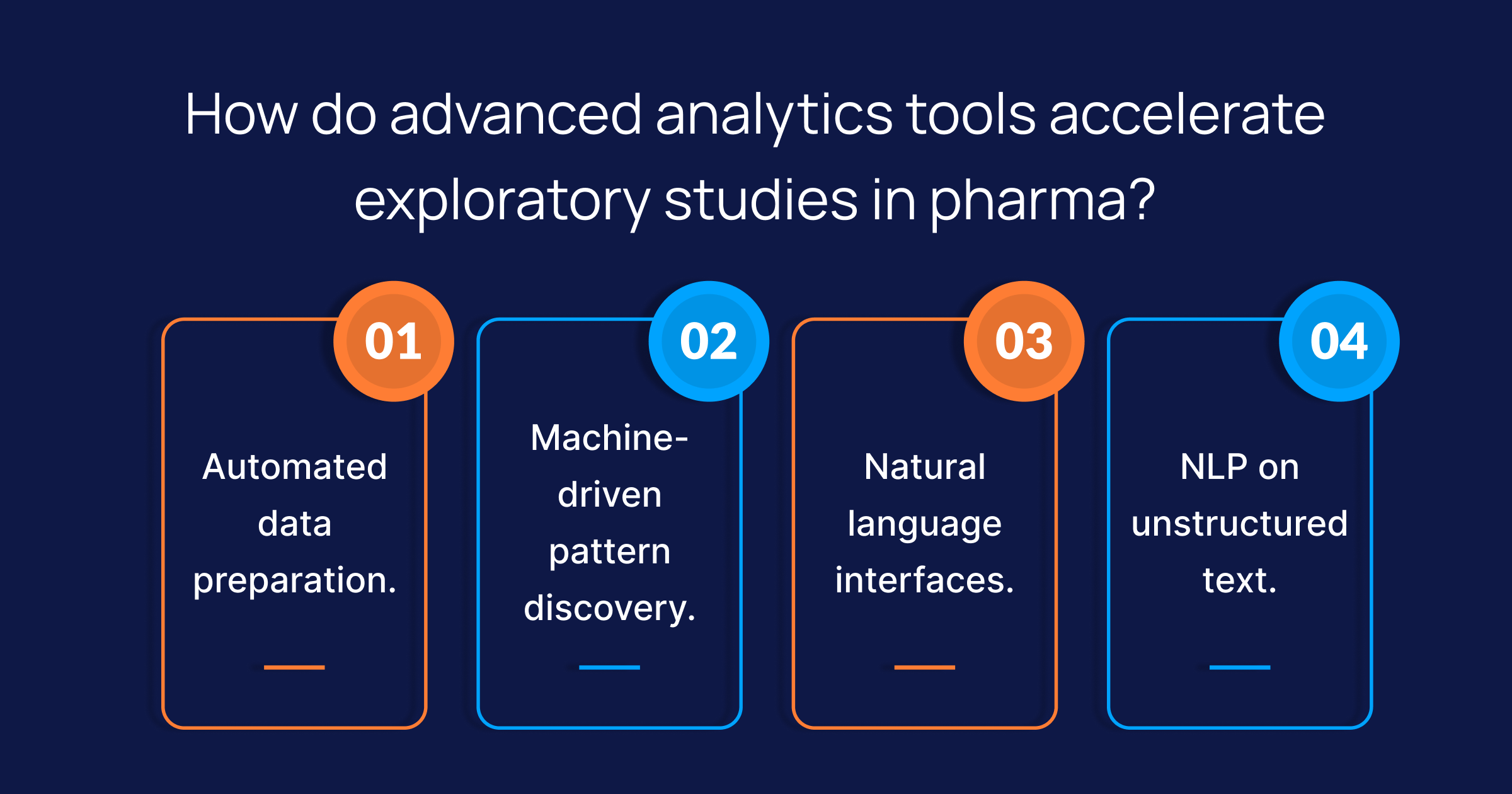
How do advanced analytics tools accelerate exploratory studies in pharma?

They accelerate early-stage research analytics in four concrete ways, each targeting a step where researchers currently lose hours.

How does advanced analytics support drug discovery?

In discovery, the bottleneck is narrowing millions of possible compounds and targets to the few worth testing in a lab. Advanced analytics speeds this by modelling compound-target interactions, predicting toxicity, and ranking candidates before any physical synthesis. The tools support AI in drug discovery precisely at the stage where the cost of error is highest: before lab resources are committed.
The early evidence for these methods is encouraging. A 2024 analysis in Drug Discovery Today found that AI-discovered molecules met their Phase 1 clinical endpoints at an 80% to 90% rate, substantially higher than historic industry averages.[3] Predictive analytics for drug discovery does not replace medicinal chemistry. It allows teams to spend their limited lab capacity on the candidates most likely to hold up, which is the practical definition of accelerating an exploratory study.

How does advanced analytics transform clinical trial analysis?

Clinical research carries the steepest risk in the entire pipeline. Across more than 400,000 trial records, researchers estimated the overall probability that a drug program entering trials reaches approval at just 13.8%, roughly one in seven.[4] Most of that attrition is decided by how well teams read their data early.
Advanced analytics improves the read. It helps identify eligible patient cohorts faster by searching across fragmented clinical datasets, surfaces site-level and safety signals as data arrives rather than at scheduled checkpoints, and applies predictive analytics in pharma that flag enrolment or efficacy problems while there is still time to adjust. In this way, advanced analytics tools become a practical form of clinical research decision support, shortening the gap between a problem appearing in the data and a team acting on it. Data integration in pharma is the enabling layer: connecting trial records, EHR extracts, and biomarker feeds into a single, analyzable view is what makes real-time signal detection possible.

Can advanced analytics handle complex biological datasets and stay compliant?

Biological data is high-dimensional, noisy, and often unstructured, which is exactly the profile for which advanced analytics is built. The harder requirement in life sciences analytics is not capability but accountability. A result that cannot be explained or traced has limited value in a regulated submission.
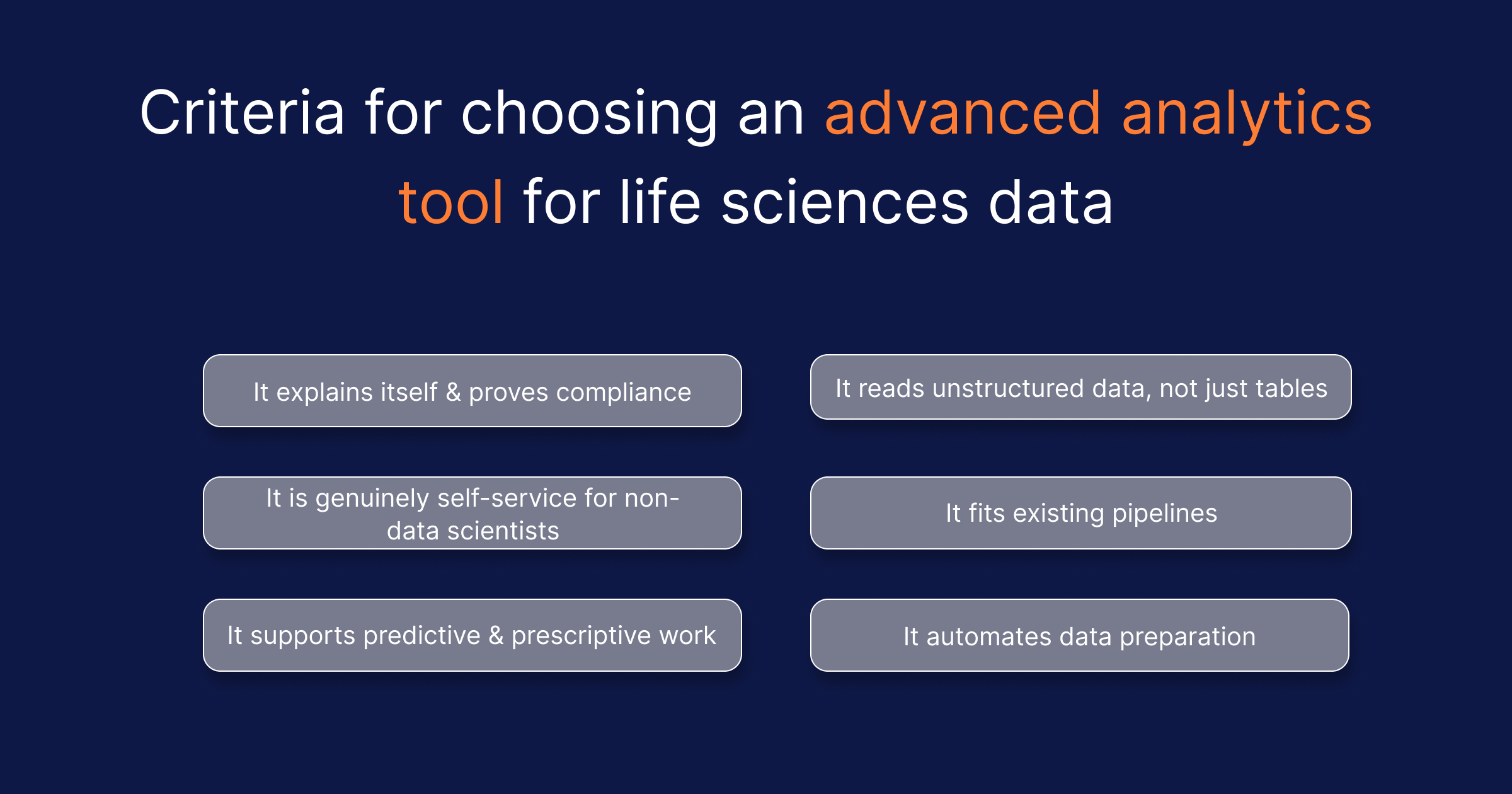
This is the practical test for advanced analytics tools in life sciences research: every automated insight needs a verifiable lineage back to source data, and every model decision used in regulated work needs a rationale a reviewer can audit. Explainable AI, immutable logs, and controls aligned to 21 CFR Part 11, GxP, and HIPAA are what separate a tool that demonstrates well from one that holds up under inspection. Advanced analytics frameworks that layer AI-driven suggestions on top of traceable statistical engines are one path to meeting this standard, provided the explainability layer is built from the start rather than retrofitted.

The Intuceo Approach

Advanced analytics, delivered as a service

Intuceo treats advanced analytics as an engagement, not a piece of software to configure and hand over. A PhD-led team arrives with its proprietary analytics accelerator, Intuceo-Ax, already carrying the patterns and configurations from prior regulated research deployments. Rather than starting from blank infrastructure, the team adapts what has already been proven in pharma and life sciences environments, pairing automated data preparation, what-if exploration, and root-cause analysis with natural-language querying that returns statistically grounded answers, complete with the data lineage behind them. Intuceo-Ax is built on advanced analytics principles, extended with additional ML orchestration layers designed specifically for regulated science.
Underneath sit Intuceo’s patented AutoML engines for forecasting, text analytics, and pattern discovery, automating the most labour-intensive phases of model selection and tuning. For unstructured research knowledge, Intuceo-Ix applies semantic search across millions of indexed documents, from LIMS and clinical trial records to FDA filings and patents, so prior findings can be analysed instead of being buried. Because the work targets regulated science, Intuceo architects explainable AI for tasks such as adverse-event classification, generating the evidence-based rationale that GxP and 21 CFR Part 11 demand.
Delivered through fixed-bid engagements, the focus stays on a measurable outcome: getting research teams from pharma data analysis to decision faster, without compromising compliance.

Where is your exploratory work losing the most time?

If your teams spend more time preparing data than studying it, that is a solvable bottleneck. Intuceo’s PhD-led engineers can map where advanced analytics would compress your exploratory cycle, from discovery through clinical analysis, against your specific compliance requirements.

Frequently Asked Questions

Advanced analytics removes the manual bottlenecks that precede actual research. It profiles and cleans incoming datasets automatically, proposes cross-variable relationships that analysts would otherwise test one at a time, and answers plain-language questions without requiring an SQL query for each. In pharma exploratory work, where teams run many hypotheses in parallel against high-dimensional data, this compression of the preparation phase can return several hours per analyst per day to active science.
Natural language processing converts unstructured sources, including research papers, trial protocols, regulatory documents, and safety reports, into structured data that can be analysed alongside numeric results. This unlocks knowledge that would otherwise sit unread and lets teams cross-reference text and numeric data within a single study. For advanced analytics in life sciences workflows, NLP is often the component that makes prior literature and regulatory history available to current-cycle analysis rather than requiring separate manual searches.
Predictive analytics in pharma shortens the time between a signal appearing in the data and a researcher acting on it. For compound prioritisation, models score candidates by predicted toxicity, target affinity, and likelihood of meeting early-phase endpoints, allowing lab resources to be directed at the candidates with the highest probability of success. For cohort analysis in clinical work, predictive models flag enrolment shortfalls, safety patterns, or weak efficacy signals early enough to adjust a study before resources are committed to a path that is unlikely to succeed.
The ones that pair automation with explainability and traceability. For regulated research, every insight needs a verifiable lineage to its source, and every model decision needs an auditable rationale, with controls aligned to 21 CFR Part 11, GxP, and HIPAA. Speed without that audit trail does not survive inspection. Evaluating any advanced analytics tool for life sciences means testing not just what it can surface, but whether its outputs can be reproduced, traced, and defended under regulatory review.
It cuts costs in two places: the hours scientists spend on manual data preparation, and the resources wasted on candidates that fail late. By returning preparation time to research and ranking candidates by likelihood of success before lab work begins, advanced analytics reduces both the labour and the failed-experiment spend that drives discovery budgets. When AI in drug discovery is applied early in the exploratory cycle, the downstream cost savings compound across every subsequent phase that would otherwise have carried a weak candidate forward.

Why Pharma Analytics Teams Struggle to Scale Augmented Analytics Experiments

Why Pharma Analytics Teams Struggle to Scale Augmented Analytics Experiments

For most pharmaceutical analytics leaders, the celebration after a successful pilot project is short-lived.
It is relatively easy for a talented data team to build a convincing proof of concept – a targeted model that flags an adverse event faster, or a sleek commercial dashboard that answers questions in plain language to impress a steering committee. The real friction begins exactly twelve months later, when that same pilot is expected to run reliably across different regional markets, therapeutic areas, and highly regulated business units.
This bottleneck isn’t just an internal frustration; it reflects a massive global disconnect between digital intent and operational reality. While the global augmented analytics market is on track to rocket from USD 16.60 billion in 2023 to nearly USD 97.87 billion by 2030,1 organizations are finding that buying the technology is the easy part. McKinsey’s recent global benchmarking data shows that while a staggering 88% of organizations have successfully deployed AI within at least one business function, only about a third have managed to scale those capabilities across the wider enterprise
In the strictly regulated domain of life sciences, that execution gap is wider still.

Augmented Analytics: The promise, and the plateau

Augmented analytics uses machine learning and natural language processing to automate data preparation, surface patterns automatically, and let people question data in plain language. Today, this paradigm increasingly leverages Generative AI to provide fluid, conversational interfaces, turning what used to be complex database querying into a simple dialogue. For pharma, that transformation is highly practical: it means a clinical operations lead can interrogate trial site performance without writing a line of code, or a commercial team can test a complex market scenario without joining a three-week analyst queue.
The difficulty is the plateau that follows. Scaling analytics experiments is a completely different discipline from building them. A pilot succeeds in a controlled setting, with meticulously curated data and a highly motivated sponsor. Scale, however, demands messy production data, hundreds of simultaneous users, strict audit trails, and financial outcomes that a corporate finance team will defend. This is the underlying reason pharma analytics AI adoption so often stops at the demo.

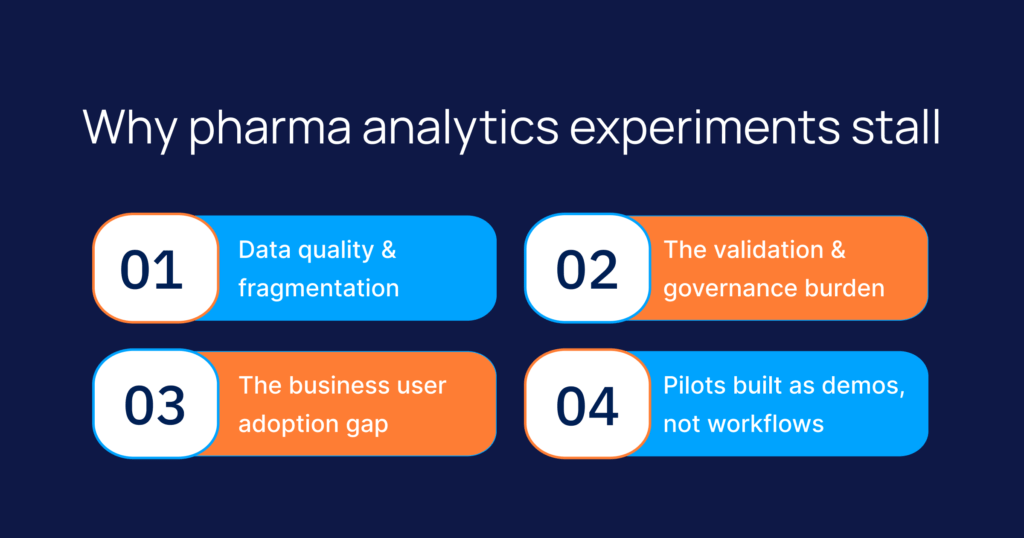
Why pharma analytics experiments stall

Several forces compound at the same point in a program. Understanding them is the first step to explaining why AI pilots fail in pharma.

Data quality and fragmentation

Pharma data lives in silos: laboratory information systems, clinical trial databases, manufacturing execution records, safety systems, and commercial CRM systems, much of it unstructured. Industry data consistently shows that data scientists spend nearly half their working hours cleaning and preparing data rather than analyzing it. In pharma, this friction multiplies exponentially because regulated datasets cannot rely on approximations or ‘good enough’ data patches; a single missing data lineage link can invalidate a clinical report.

The validation and governance burden

A consumer analytics tool can ship and iterate. A regulated one cannot. Any insight that informs a clinical, safety, or manufacturing decision may need to be validated, traceable, and defensible to an auditor. Without regulated industry AI governance built in from the start, teams reach the pilot-to-production line only to find their experiment has no data lineage, no explainability, and no audit trail. Retrofitting those controls often costs more than the pilot did.

The business user adoption gap

Augmented analytics scales only when the people who make decisions actually use it. Yet many tools are designed for data teams, not for the clinical, regulatory, and commercial users who need the answers. When business user analytics adoption stays low, the experiment never leaves the analytics group and never changes how the business runs. Conversational analytics for pharma, where a user asks a question in everyday language and receives a defensible answer, is the bridge, but only when the interface fits the way that user already works.

Pilots built as demos, not workflows

When an enterprise solution is built to look good in a presentation rather than survive the realities of daily operations, failure is inevitable. This operational fragility explains why Gartner predicts that at least 30% of generative AI projects will be abandoned after proof of concept by the end of 2025. Because GenAI increasingly serves as the primary user interface for modern augmented analytics platforms, its high abandonment rate directly impacts the broader analytics ecosystem. Gartner points to poor data quality, inadequate risk controls, escalating costs, and unclear business value as the primary drivers of this collapse.
The common thread across these failures is not the underlying model itself; it is the infrastructure and conditions around it. Enterprise AI in life sciences fails in the exact same way. A pilot engineered solely to impress a steering committee in a boardroom is fundamentally different from a system engineered to scale securely across a global enterprise.

From experiment to enterprise impact

Moving from experimentation to enterprise-wide impact has less to do with a better model and more to do with a repeatable method. Teams that scale tend to do a few things differently. They start with a single high-value decision rather than a broad capability. They build governance, validation, and data lineage into the experiment instead of bolting them on afterward. They design for the business user from day one. And they treat the pilot as the first production increment, not a throwaway proof.
This is also where AI decision support in life sciences earns its place. Decision support that surfaces an insight quickly, shows the data behind it, and records how it was derived can be trusted, audited, and adopted. Decision support that produces an answer no one can explain will not survive a regulatory review, let alone reach scale.

How Intuceo helps pharma teams scale

Intuceo is a PhD-led AI, ML, and data analytics services firm that works inside regulated industries, including pharma and life sciences. The work is not about selling a tool. It is about delivering the method and the engineering that move an analytics experiment into dependable enterprise use.
Intuceo-Ax, the firm’s augmented analytics accelerator, is built to speed deployment rather than start every build from zero. It automates data preparation, supports what-if exploration, and lets non-technical leaders navigate deep KPIs in as few as three clicks, which speaks directly to the business user adoption gap. Because it draws on patterns proven in prior pharma engagements, teams skip much of the trial and error that stalls a first attempt.
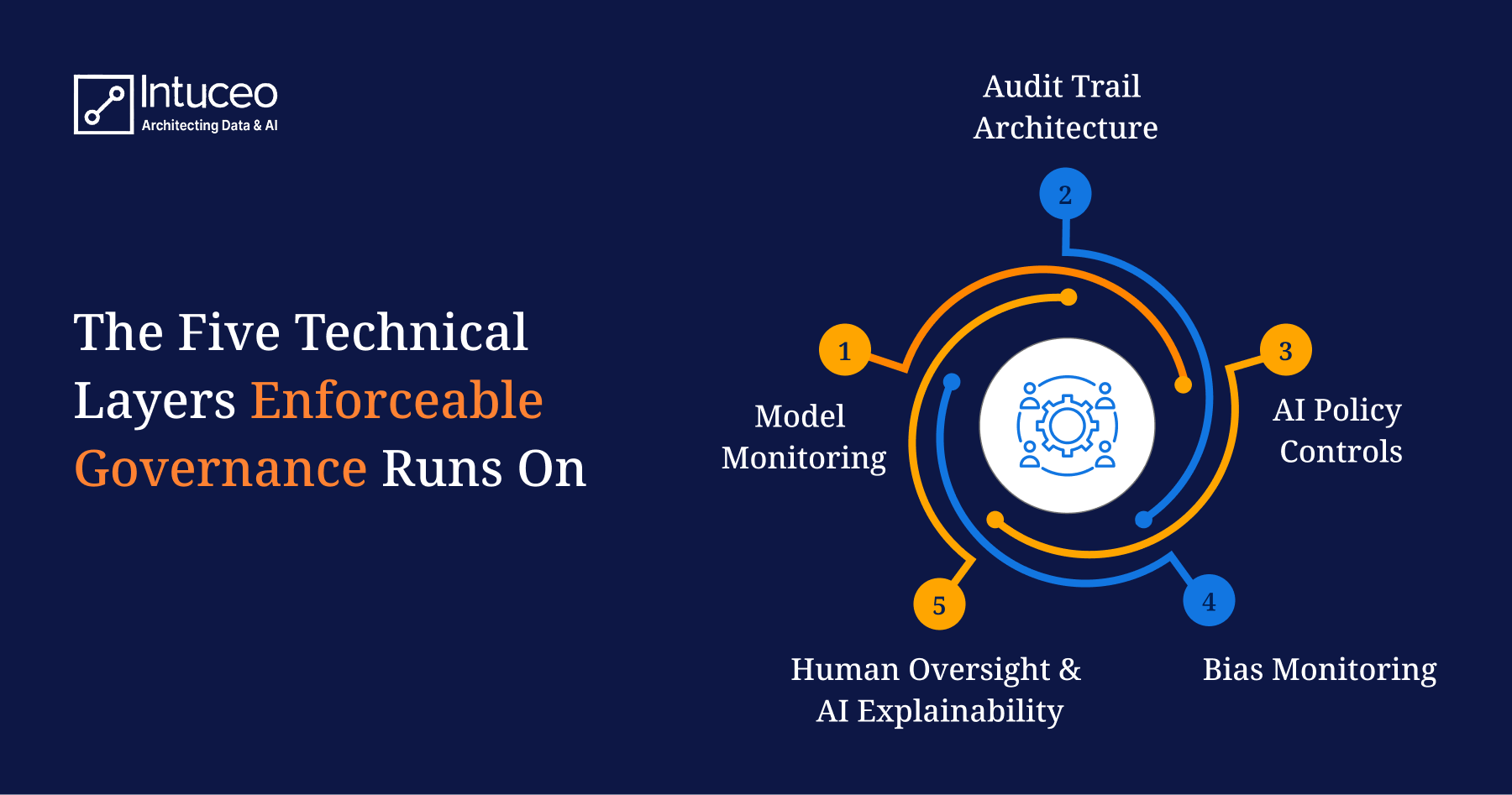
Governance is engineered in, not added later. Intuceo applies a Regulated-by-Design approach: automated data profiling and anomaly detection at the source, immutable lineage for forensic traceability, and explainability frameworks with bias detection and model cards reviewed by a PhD-led Board of Science. These controls are pre-vetted against FDA 21 CFR Part 11, HIPAA, GxP, SOC 2 Type II, and FISMA requirements, giving regulated AI governance a concrete foundation.
The firm’s iPDLC framework gives experiments a defined route from concept to validated production, the step most pilots are missing. Across more than 100 life sciences engagements over 14-plus years, including work for organizations such as Janssen and Ferring, Intuceo has engineered solutions like a universal search capability that indexes over 5 million R&D documents, turning dormant knowledge into usable insight. Engagements run on fixed-bid and budgeted models, so clients pay for outcomes rather than activity.

Ready to Move from Pilot to Production?

Don’t let a promising experiment stop at the demo phase. Intuceo builds compliance, data lineage, and user adoption directly into your pipelines from day one.
  • Regulated-by-Design: Pre-vetted compliance (FDA 21 CFR Part 11, GxP, HIPAA) built in, not bolted on.
  • Proven iPDLC Framework: A predictable path from concept to an audited, enterprise-scale project.
  • Outcome-Based Models: Fixed-bid structures so you pay for impact, not activity.

Frequently Asked Questions

Most fail at integration, not at the model. Pilots run on curated data with a motivated sponsor, then meet fragmented production data, low business user adoption, and validation requirements they were never designed to satisfy. The experiment works in isolation but cannot connect to the workflows and controls that real scale demands.
By treating scale as a method rather than a milestone. That means starting with one high-value decision, building governance and data lineage into the experiment from the start, designing for the business user, and running the pilot as the first production increment. A defined lifecycle, such as Intuceo’s iPDLC, gives that progression a repeatable structure.
At minimum: validated data quality, immutable lineage so any insight can be traced to its source, explainability so outputs can be defended, and bias detection and model documentation. These should map to standards such as FDA 21 CFR Part 11, HIPAA, GxP, and SOC 2 Type II, and should be present before a pilot is asked to inform a regulated decision.

Automate the repeatable work, data profiling, preparation, and anomaly detection, while keeping validation and audit trails intact. Automation that records what it did and why preserves the defensibility a regulated environment requires, and frees analysts to spend time on interpretation rather than cleaning data.

Meet users in their own workflow and language. Conversational analytics that let a clinical or commercial user ask a question and receive a clear, sourced answer removes the dependency on a specialist queue. Adoption follows when the interface is simple, the answer is trustworthy, and the path to that answer is short.

Which Augmentative Tools Suit a Cloud-Based Life Science Platform?

Most pharma and biotech IT estates have already migrated. The major cloud platforms now offer regulated-environment configurations, BAA coverage, and validated reference architectures for clinical, regulatory, and commercial workloads. Raw cloud capacity, however, does not solve the operational problems life sciences teams actually feel: clinical teams still spend a disproportionate share of their time searching for protocol documents, screening patients for trials, and reconciling case report forms. Pharmacovigilance teams process growing volumes of adverse event reports under tight regulatory windows; the U.S. FDA’s FAERS database now contains over 31 million adverse event reports, with intake volumes climbing year over year . Regulatory affairs teams still hand-curate submission narratives across thousands of pages.

A life science cloud platform stores the data and enforces access controls. It does not, by itself, read 12,000-page submissions, triage AE narratives, or match a patient to a trial. That is the work of an augmentative AI layer engineered on top of it.

What "augmentative" actually means in life sciences

An augmentative tool extends a human workflow without replacing the human accountable for the decision. In a regulated context, that distinction matters. Validated systems require traceability, defensible model behavior, and human-in-the-loop checkpoints. Compliant AI tools in life sciences are designed around those constraints rather than against them. The categories below cover where augmentation produces the strongest signal on a cloud-based life science platform. Not every tool fits every team, but the taxonomy is consistent across pharma, biotech, and medtech.

The seven categories of augmentative tools worth evaluating

1. Enterprise search and semantic retrieval

Knowledge in a life sciences organization is spread across SharePoint, electronic lab notebooks, LIMS, PLM, regulatory submission repositories, CTMS, and clinical trial archives. Keyword search across these systems consistently misses what scientists and reviewers need. Semantic and vector-based AI search and summarization tools fix the retrieval problem by interpreting intent and surfacing relevant passages across formats. McKinsey estimates that knowledge workers spend up to 1.8 hours per day searching for information . In a 5,000-person R&D organization, that is the productivity equivalent of a mid-sized team.

2. LLM-powered summarization and regulatory document review

Regulatory document review is one of the highest-ROI use cases for generative AI in pharma. Modern LLMs can read protocols, investigator brochures, clinical study reports, and submission packages, then produce structured summaries, gap analyses, and consistency checks. The work that previously took days can be reduced to an hour of human review on top of a machine-generated draft. Done well, this is one of the strongest applications of generative AI for pharma because the outputs feed directly into reviewable artifacts.

3. Pharmacovigilance and adverse event signal detection

While the AE intake volume continues to compound annually, the PV team headcount usually cannot match that pace. Augmentative tools here perform case intake from unstructured text, MedDRA coding suggestions, duplicate detection, and signal triage across product portfolios. The combination of NLP, classification models, and rules-driven validation is where most production deployments have settled.

4. Clinical operations and patient matching

Roughly 80% of clinical trials fail to meet original enrollment timelines, and the cost of a delayed Phase III trial can exceed several million dollars per day for high-value drugs [3]. Clinical workflow automation tools, including patient-trial matching against EHR cohorts, site performance analytics, and protocol deviation prediction, shorten enrollment cycles and surface site-level risk before it triggers protocol amendments. Patient matching engines that combine SNOMED CT, ICD-10, lab results, and free-text physician notes consistently outperform manual eligibility screening.

5. Agentic AI and action planning automation

Agentic AI is the layer above summarization. An agent decomposes a goal into steps, calls the right systems on a life science cloud platform, executes a sequence, and routes exceptions back to a human. In practice: orchestrating a multi-step regulatory query, drafting an AE narrative for QC, or assembling a feasibility packet for a new study. Action planning automation is most valuable where the workflow is well-defined but the data sources are not.

6. Predictive analytics and ML for commercial and medical affairs

On the commercial side, augmentative tools for HCP engagement include next-best-action models, prescriber affinity scoring, and content recommendation engines that integrate with CRMs like Veeva or Salesforce Health Cloud. For patient-facing work, a patient engagement platform can use ML to personalize adherence outreach, predict drop-off risk, and prioritize support program interventions. These tools live inside cloud CRMs but extend them with predictive layers the CRM does not natively provide.

7. Data integration and governance layer

Data integration in life sciences is rarely glamorous, but it is the precondition for every other category to work. Tools that handle entity resolution across master data, lineage tracking for GxP audit, and standardization to CDISC SDTM/ADaM make LLMs and ML models defensible. Without this layer, AI outputs cannot be reproduced in an audit; with it, every downstream model becomes inspection-ready.

How to choose AI tools that integrate with a life science cloud platform

The right shortlist is rarely the most exciting tool. It is the one a regulator will accept and a CIO can operate. The criteria below filter out most consumer-grade GenAI offerings before procurement begins.
Evaluation lens What to verify
Regulatory fit Validated against 21 CFR Part 11, EU GMP Annex 11, GxP, and HIPAA. Audit trails on prompts, outputs, and model versions.
Data residency & isolation BAA coverage, private model deployment, no training on customer data, regional data residency for EU/UK/APAC studies.
Integration depth Native connectors to Veeva Vault, Salesforce Health Cloud, AWS HealthLake, Azure Health Data Services, Snowflake, Databricks, EHR FHIR endpoints.
Explainability Citations on every generated answer, traceable retrieval paths, model cards, and documented evaluation on life sciences corpora.
Human-in-the-loop design Review gates, role-based approval, controlled rollback, and the ability to disable autonomous actions in regulated workflows.
Total cost of ownership Inference costs at production volumes, model-update cadence, and the operational overhead of maintaining prompt and retrieval pipelines.

Where augmentation tends to break

Most failed life sciences AI pilots share three patterns. The tool is deployed without addressing the underlying data integration problem, so outputs are inconsistent. The tool is selected on demo strength rather than validation evidence, and stalls when regulatory affairs reviews it. The tool is treated as a feature rather than a workflow, so adoption never reaches the teams who would benefit. Each is fixable, but only when AI is treated as part of a clinical or regulatory operating model, not as a standalone purchase.

How Intuceo augments your cloud-based life science environment

Intuceo is a PhD-led AI and data analytics consultancy. We engineer the augmentative layer on top of your existing cloud environment, on AWS, Azure, Databricks, Snowflake, and the Veeva and Salesforce Health Cloud stacks. The work is grounded in regulatory-grade delivery, not experimentation. Where a category above maps to a problem your team already feels, we bring accelerators built and hardened across prior life sciences engagements, proven components that shorten deployment so you reach a validated result faster than a build-from-scratch project would allow. Accelerators we bring to you:

Build Your Augmentation Roadmap

The foundation is built; now it’s time to scale. Your data is already on Veeva, AWS, or Salesforce. The gap is the augmentative layer that turns it into faster decisions and automated workflows. Intuceo’s PhD-led team engineers that layer with you, bringing accelerators from prior regulated engagements so you reach a validated, audit-ready result faster than a build-from-scratch effort. Start with a working session on where augmentation pays back first.

Frequently Asked Questions

The strongest categories are neural enterprise search, LLM-powered summarization for regulatory document review, AE classification for pharmacovigilance, patient-trial matching, agentic workflow orchestration, predictive ML for commercial and medical affairs, and the data integration layer underneath them. Selection should be driven by which workflow has the most measurable cycle-time or compliance pain, not by which tool has the most impressive demo.
Look for vendors that ship with audit trails, validated reference architectures, BAA coverage, and documented evaluation against pharma and biotech corpora. The minimum bar for compliant AI tools in regulated environments is alignment with 21 CFR Part 11, EU GMP Annex 11, GxP, and HIPAA. Tools that cannot produce citations or model lineage on demand should not enter production.

Summarization is best handled by LLMs fine-tuned or grounded against life sciences corpora with retrieval-augmented generation. Search requires semantic and vector retrieval across structured and unstructured repositories. Action planning automation sits on top of both, using agentic frameworks to execute multi-step workflows and surface exceptions to human reviewers.

On the HCP side, the most common tools are next-best-action engines, content recommenders, and territory analytics layered on Veeva or Salesforce Health Cloud. For patient engagement, a modern patient engagement platform uses adherence prediction, personalized outreach, and intervention prioritization for patient support programs.
Start from the workflow, not the tool. Identify the highest-friction process, typically AE intake, regulatory document review, or patient matching, and quantify its cost. Then evaluate two or three tools against the criteria in the table above. Pilot with measurable success criteria validated against your existing cloud-based life science platform, and only scale tools that clear both clinical and compliance review.

Why Pharma AI Projects Stall During the Validation and Documentation Phase

Pharma teams rarely run out of AI ideas; they run out of runway during validation. While a model may show 92% accuracy in a sandbox, it hits a high-velocity wall the moment it encounters GxP documentation requirements and ‘intended use’ scrutiny.
In the life sciences, the gap between a successful pilot and a production-grade system isn’t a technical hurdle – it’s a regulatory chasm. With roughly 80% of healthcare AI projects failing to scale , the validation phase is where most of that failure becomes visible.

$2.59B

AutoML global market value in 2025

41.96%

CAGR projected through 2031

The Five Reasons Pharma AI Validation Stalls

TheFiveReasonsPharmaAIValidationStalls

1. Intended use is never defined with regulatory precision

Most pharma AI projects begin with a business goal, not a Context of Use (COU). FDA’s January 2025 draft guidance on AI in drug and biological product development requires sponsors to define the question the AI model addresses, the COU, and the model’s risk based on how much it influences a regulatory decision and the consequences of that decision.
The agency built a seven-step credibility framework from experience reviewing more than 500 drug and biological product submissions containing AI components since 2016. When the intended use is fuzzy, every downstream artifact, the validation plan, the test scripts, and the acceptance criteria have nothing specific to anchor against. This is where GxP AI compliance reviews loop back to the start.

2. CSV muscle memory does not fit AI systems

Traditional Computerized System Validation expects deterministic behavior: same input, same output. AI systems are probabilistic. They drift. They retrain. The legacy IQ/OQ/PQ template was built for deterministic logic and static system behavior, not for AI/ML-based systems whose outputs vary with new data.
On September 24, 2025, the FDA finalized its Computer Software Assurance (CSA) guidance, a risk-based approach that replaces the one-size-fits-all CSV model for production and quality system software.CSA centers on critical features and continuous verification, making it better suited to AI than traditional CSV.
Even today, many pharma teams treat the transition to CSA as a ‘paperwork reduction’ exercise rather than a shift in mindset. The stall occurs because teams fail to differentiate between Direct Impact and Indirect Impact systems. Under the finalized September 2025 guidance, AI models influencing clinical endpoints require high-assurance scripted testing, while the MLOps pipelines supporting them can often leverage unscripted, streamlined assurance. Using the old CSV approach on a dynamic AI pipeline creates a ‘validation debt’ that eventually halts production.

3. The model is a black box, and regulators are no longer accepting that

Regulators increasingly demand clarity on how AI decisions are made, and black-box models are treated as risky in patient-safety contexts. Without an explainability layer, QA and regulatory teams cannot review the documentation because it does not exist in any defensible form. A binary Yes/No model output is not a validation artifact.
ISPE’s July 2025 GAMP Guide: Artificial Intelligence specifically addresses validating AI/ML systems in GxP environments, and GAMP 5 categorizes most AI/ML systems as Category 5, the highest-risk tier, which requires full qualification lifecycle documentation.

4. Traceability is fragile, and audit trails are incomplete

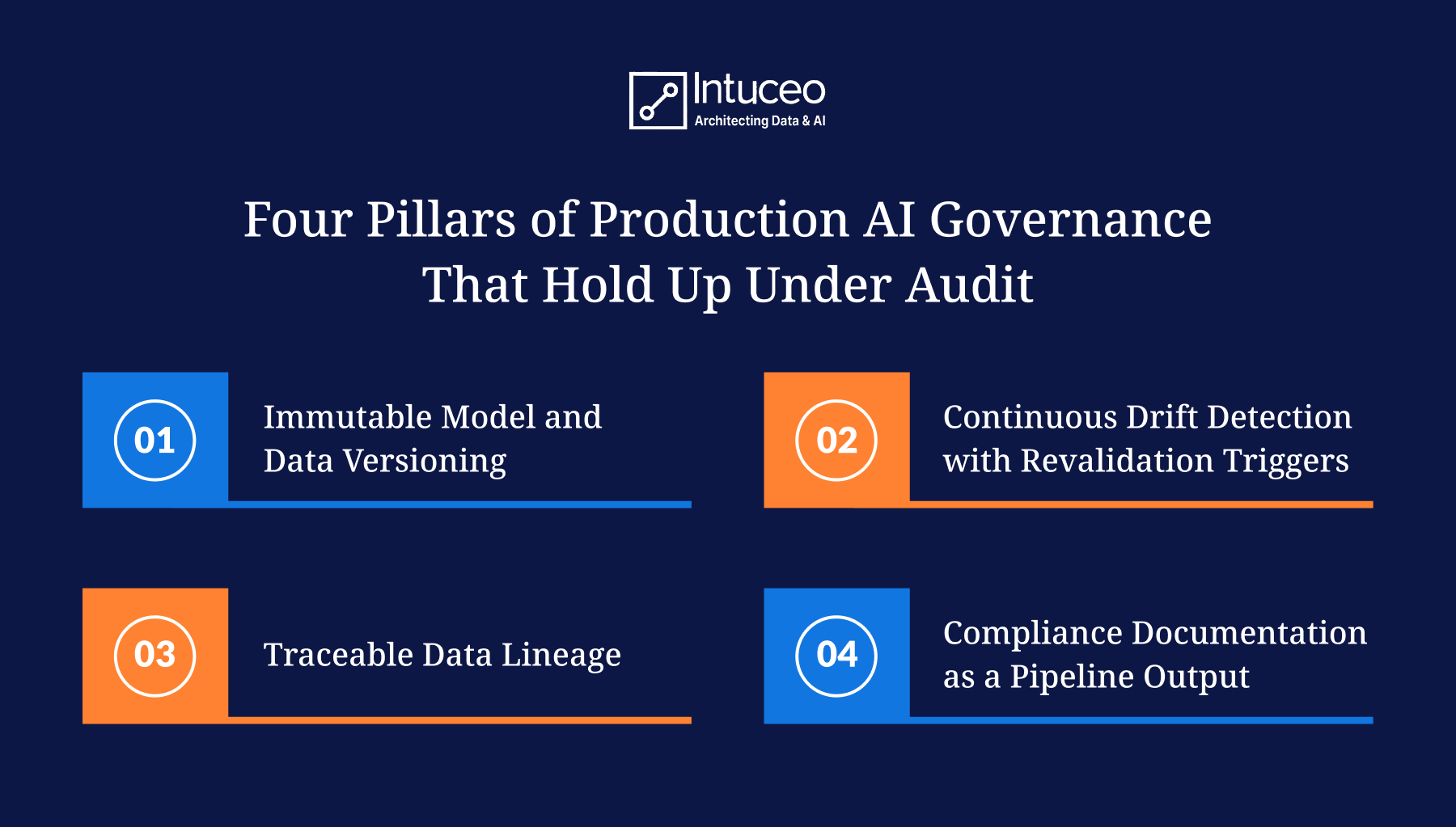
AI documentation requirements go well beyond source code and test cases. Validation packages must capture model lineage, bias audits, validation datasets, performance metrics, and retraining governance. Model traceability depends on immutable logs: every training iteration, data ingestion cycle, and AI-generated output must be captured in a tamper-proof audit trail. In a GxP environment, if an action isn’t logged in a reconstructable, time-stamped sequence, it effectively never happened leaving the model’s entire decision history indefensible during an inspection.
A 2025 PubMed study analyzing 1,766 FDA warning letters from 2016 through 2023 confirmed that data integrity enforcement has intensified, with electronic records violations remaining a dominant theme.

5. Model drift is treated as an MLOps problem, not a compliance problem

AI systems are dynamic, not static. Revalidation is required when models are updated, inputs shift, or new data patterns emerge. Change control must explicitly cover retraining, with predefined triggers such as architecture changes, dataset changes, or measurable performance drops.
The ‘Human-in-the-Loop’ (HITL) Documentation Gap Regulators now mandate clear definitions of human oversight. Projects often stall because the validation report doesn’t specify at what point a human intervenes, what data they see to make that intervention (explainability), and how that intervention is logged. Without a documented HITL protocol, the AI is viewed as an ‘autonomous agent,’ which carries a significantly higher risk tier under GAMP 5 and the EU AI Act.
When drift and human oversight are handled only as engineering workflows rather than GxP controls, the first significant event triggers a 483 observation rather than a routine update.

What Regulators Expect in 2026

Three frameworks now define audit-ready AI in life sciences:
EMA has signaled a revision of Annex 11 to address cloud, cybersecurity, and AI/ML by 2026, and a new Annex 22 for AI in pharma is in draft.
In January 2026, the FDA and EMA jointly released “Guiding Principles of Good AI Practice in Drug Development,” signaling cross-Atlantic alignment. These principles specifically demand multi-disciplinary expertise. A common stall point is a validation package reviewed only by IT and QA. Regulators now expect evidence that clinical subject matter experts (SMEs) were involved in the credibility assessment and bias audit phases.

How To Engineer Audit-ready AI From The Start

How Intuceo Architects Audit-ready AI For Life Sciences

Intuceo’s iPDLC™ framework is built for the gap between AI velocity and institutional rigor. Every milestone in the AI lifecycle, from requirement synthesis to production deployment, passes through PhD-led Quality Gates that validate logic and ensure outputs are audit-ready.
The framework doesn’t just manage the lifecycle; it automates the Traceability Matrix—linking every User Requirement (URS) to a specific model feature, risk mitigation, and test script. By treating ‘Compliance-as-Code,’ we ensure that when a model is retrained, the validation delta-report is generated in minutes, not months.
This automated generation of high-fidelity BRDs, Design Documents, and Test Logs produces a complete technical trail for every project, which means the validation evidence regulators expect is built in, not bolted on.
For pharma use cases such as adverse event classification, Intuceo’s Explainable AI frameworks don’t just predict, they justify. The proprietary modeling stack automates AE classification while generating the evidence-based rationale that satisfies GxP standards.

Move your pharma AI from pilot to production, hassle-free.

Intuceo’s PhD-led engineering and iPDLC™ framework deliver audit-ready AI systems aligned with FDA, EMA, and GxP expectations.

Frequently Asked Questions

Apply a risk-based framework combining GAMP 5 categorization (most AI/ML systems are Category 5), FDA’s CSA principles, and the seven-step credibility assessment from FDA’s January 2025 AI guidance. Define intended use and COU, assess risk by influence and consequence, plan assurance proportionate to risk, execute and document credibility evidence, and maintain lifecycle oversight, including drift monitoring and change control for retraining.

At minimum: intended use and COU statement, risk assessment, model architecture and lineage, training and validation datasets with bias audits, performance metrics, test execution evidence, immutable audit trails of training and inference events, change control records covering retraining, and ongoing performance monitoring logs.

Traditional CSV assumes deterministic behavior and applies uniform verification regardless of risk. AI validation must account for probabilistic outputs, model drift, retraining, and explainability. FDA’s September 2025 CSA guidance moves pharma toward a risk-based approach better suited to AI, focusing assurance on functions impacting patient safety and product quality.

Treat drift as a compliance control, not just an MLOps signal. Predefine what triggers revalidation: architecture changes, dataset shifts, or performance regression beyond acceptance thresholds. Treat retraining like a new software release within your change control SOP, with documented validation evidence for every cycle.

FDA expects sponsors to demonstrate credibility and trust in the performance of an AI model for its specific Context of Use. This is evaluated through the seven-step credibility assessment framework released in January 2025, which scales evidence requirements to the model’s risk based on its influence on a regulatory decision and the consequence of that decision.