How Regulated AI Model Governance Works in 2026

Most regulated organizations know what AI governance should look like on paper. The harder question is what it looks like when a model makes a consequential output at 3 AM, with no human present, and a regulator requests the decision record six months later.
That gap is where regulated AI model governance breaks down in practice. A March 2026 industry analysis found that 63% of organizations that experienced AI-related breaches had either no governance policy or were still developing one at the time of the incident.[1] Typically, these violations stem from operational failures: no model audit trail, no continuous monitoring active, and no enforced approval chain before deployment.
AI model governance 2026 is no longer a documentation exercise. It is an operational discipline with technical requirements, regulatory deadlines, and direct audit exposure. Understanding what it actually includes is the prerequisite for building it correctly.

Key Takeaways

What Enterprise AI Governance Actually Requires

Enterprise AI governance covers the full lifecycle of a model: from initial development and risk classification to deployment approvals, production monitoring, and eventual decommissioning. In regulated industries, each phase carries specific obligations that go beyond internal policy.
The EU AI Act provides the clearest current regulatory framework. Under its risk-based structure, AI systems deployed in healthcare, pharmaceutical manufacturing, and critical infrastructure are classified as high-risk under Article 6(1) and Annex I.[2] For these systems, the Act mandates conformity assessments, technical documentation, post-market monitoring systems, and substantive human oversight as mandatory requirements.
The AI compliance framework in regulated industries draws from several converging standards: the NIST AI Risk Management Framework, ISO 42001, and, specifically for life sciences, 21 CFR Part 11, GxP validation requirements, and HIPAA. These frameworks share one common expectation: organizations must document not just what an AI model is, but how it behaves, what it was trained on, how decisions are logged, and who reviewed them before and after deployment.
The model approval workflow sits at the center of this. Before a model reaches production in a regulated setting, it typically requires a risk classification assessment, validation against representative datasets, documented performance benchmarks, sign-off from qualified personnel, and a persistent record of that approval that survives model updates and team changes.

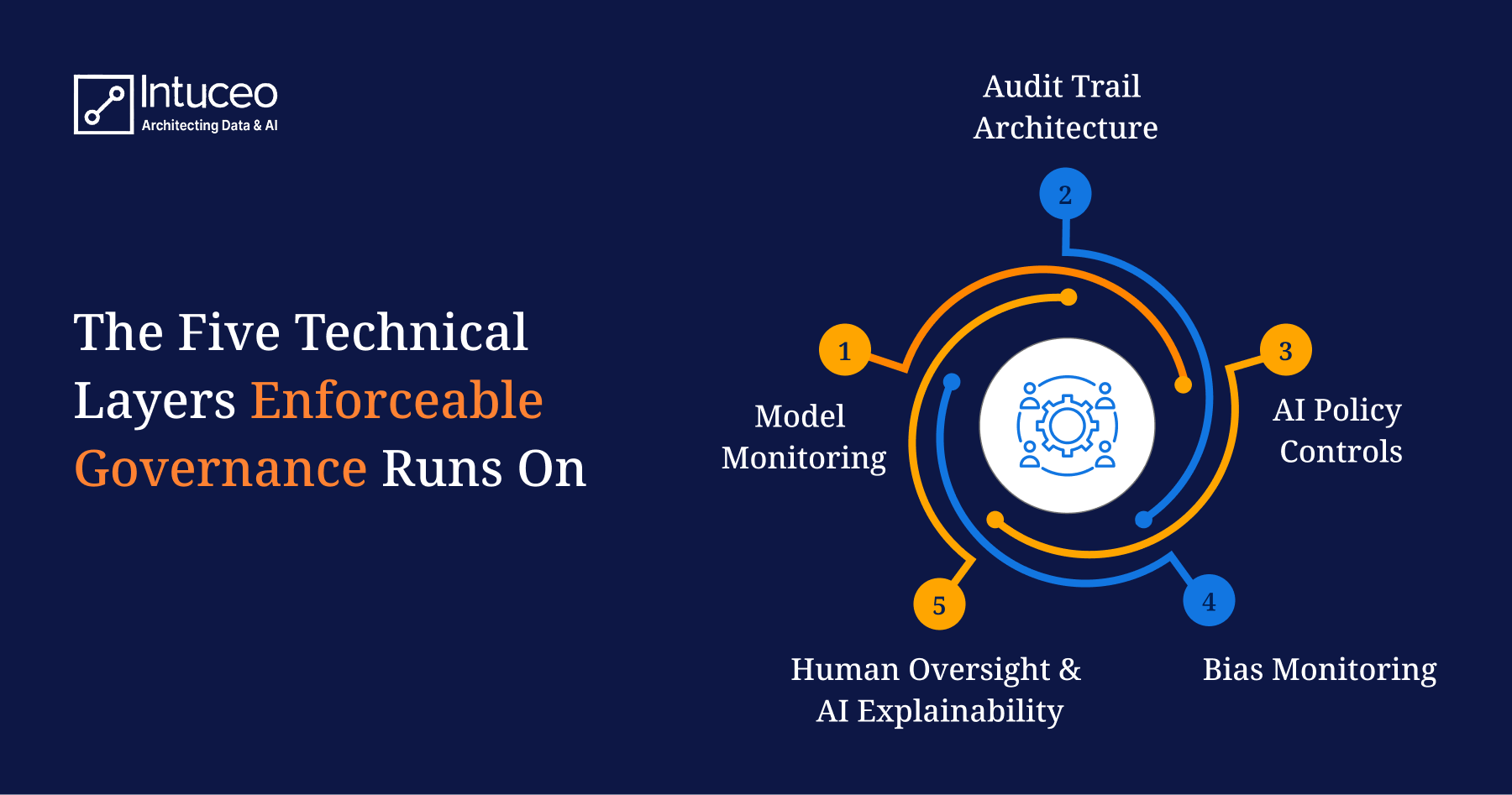
The Five Technical Layers Enforceable Governance Runs On

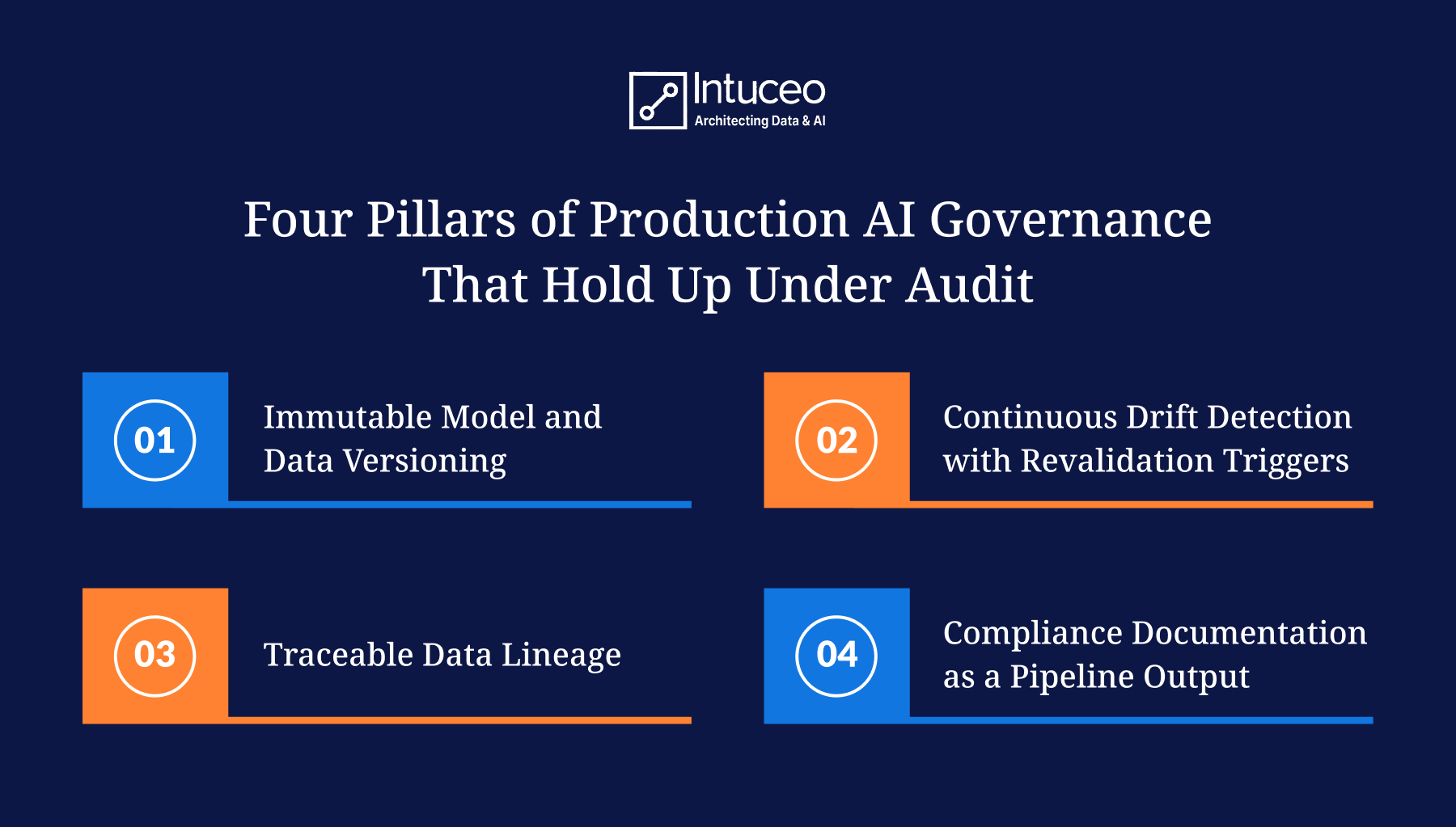
Governance documents state intentions. Technical infrastructure enforces them. LLM governance in a regulated environment requires at least five active layers operating simultaneously, each addressing a distinct category of failure.

Layer 01

Model Monitoring

Model monitoring tracks deployed model behavior continuously against validated baseline benchmarks. Without it, a model approved six months ago may be producing materially different outputs today with no record of when or why the behavior changed.

Layer 02

Audit Trail Architecture

Every prediction or recommendation a model generates in a regulated context must be logged with enough metadata to reconstruct the decision: model version, inputs, outputs, confidence scores, and any human review action. Under 21 CFR Part 11, these records must be tamper-evident and accessible on demand.

Layer 03

AI Policy Controls

AI policy controls are the guardrails that prevent a model from generating outputs outside its sanctioned operating scope. This includes output filtering, role-based access permissions, and defined escalation paths when outputs fall below an accepted confidence threshold.

Layer 04

Bias Monitoring

Bias monitoring provides evidence that a model does not produce systematically different outcomes across patient populations, demographic subgroups, or regulatory jurisdictions. For life sciences applications, validated performance across representative subgroups is increasingly a compliance requirement, not an optional quality check.

Layer 05

Human Oversight and AI Explainability

Human oversight in AI must be substantive, not ceremonial. A qualified reviewer must be able to understand, challenge, and override a model’s output for that oversight to satisfy regulators. AI explainability is what makes this operationally possible. A model whose decisions cannot be explained to a clinician, compliance officer, or regulator is not audit-ready regardless of its technical performance metrics.

LLM-Specific Risks: Hallucinations and Prompt Security

The deployment of large language models in regulated settings introduces two risk categories that traditional predictive model governance frameworks were not designed to address.
Hallucination detection is the first. A 2025 multi-model study examined LLM performance on 300 physician-validated clinical vignettes and found an average hallucination rate of 65.9% under default prompting conditions. The best-performing model in the study, GPT-4o, still hallucinated in 23% of cases.[4] In pharma and healthcare settings where AI outputs inform regulatory submissions or clinical decision support, rates at that level require structured detection and human verification processes before outputs reach consequential use.
Governance for generative AI requires: retrieval-augmented generation (RAG) architectures that ground outputs in verified, versioned knowledge bases; output validation mechanisms that flag responses outside factual boundaries; and documented review requirements for any LLM output used to support a regulated decision.
Prompt injection protection is the second category. According to OWASP’s 2025 Top 10 for LLM Applications , prompt injection is the leading critical vulnerability in production AI systems, detected in 73% of deployments assessed during security audits.[5] Unlike conventional software exploits, prompt injection operates at the semantic layer: a malicious input can override system instructions, bypass access controls, or extract protected data. In a regulated environment, a successful injection could corrupt a clinical decision support output, expose PHI, or generate a fraudulent compliance record. Effective mitigation requires input validation, strict privilege minimization in AI agent design, output filtering, and behavioral monitoring that detects anomalous instruction patterns in real time.

Streamline AI Model Governance With Intuceo

Building responsible AI in a regulated environment is an engineering problem before it is a compliance problem. Policies describe what governance should achieve. Technical design determines whether it actually does.
Intuceo’s PhD-led services teams bring governance engineering into the design phase of every engagement. The firm’s iPDLC™ delivery framework structures lifecycle accountability from the start: model validation gates before production, immutable audit logging built into the deployment architecture, and continuous monitoring configured against the performance standards required by the regulatory environment in scope. Compliance documentation is treated as the output of that infrastructure, not as a substitute for it.
In regulated engagements across pharma, healthcare, and life sciences, Intuceo’s teams apply the Intuceo-Ax™ accelerator to compress governance implementation timelines, carrying pre-validated monitoring configurations from prior regulated deployments. The firm’s Rationalization Layer establishes a governed hybrid architecture that defines what each model can access, act on, and deliver within the compliance boundaries set by each engagement. The result is an AI deployment where the live model behavior and the regulatory record describe the same system.

Ready to Move from Documented to Operational Governance?

Intuceo works with regulated organizations to build AI governance infrastructure that holds up under audit conditions. Engagements start with a structured assessment of your current AI lifecycle against the applicable compliance framework, followed by targeted engineering to close the gaps.

Frequently Asked Questions

Governance in regulated sectors requires five concurrent mechanisms active in production: a documented model approval workflow before deployment, continuous model monitoring once live, an immutable model audit trail for every decision, AI policy controls enforcing output and access boundaries, and substantive human oversight supported by AI explainability. Policy documentation is the starting point, not the governance mechanism itself.
AI risk management identifies what could go wrong: model drift, bias, hallucination, security vulnerabilities, and regulatory non-compliance. AI governance is the operational framework that prevents, detects, and responds to those risks. Risk management defines the threat landscape; governance builds the enforcement infrastructure. In regulated industries, both are required, and regulators expect evidence that governance mechanisms are active and producing records, not just described in a policy document.
Auditing an LLM for bias requires validated performance benchmarking across representative demographic subgroups, using datasets that reflect the actual distribution of inputs the model will encounter in production. Hallucination auditing involves structured adversarial testing against domain-specific ground truth, reviewing outputs against verified source documents, and analyzing confidence scoring against known factual benchmarks. For regulated deployments, both audit processes require documented methodology and retained results.
Prompt injection protection requires layered technical controls: input sanitization before queries reach the model, strict privilege minimization so AI agents operate only with permissions necessary for their defined function, output filtering that screens responses for anomalous instruction patterns, and behavioral monitoring that detects deviation from expected model operation. NIST AI RMF and ISO 42001 both now specify controls for prompt injection risk as part of enterprise AI security requirements.
Regulated AI deployments typically require: a risk classification assessment, technical documentation covering the model’s intended purpose, training data, methodology, and performance benchmarks; a record of the model approval workflow with qualified sign-offs; tamper-evident audit logs of model decisions meeting applicable retention requirements; evidence of ongoing model monitoring; and records of human oversight actions including any overrides. For EU AI Act high-risk systems, conformity assessments and registration in the EU AI database are additionally required.

10 Bottlenecks Blocking Pharma Advanced Analytics Scale

Pharma analytics teams have spent the past few years moving from pilot to pilot, generating compelling proofs of concept that rarely translate into enterprise-wide capability. The question facing analytics leaders in 2026 is not whether advanced analytics works in pharma. It is why so few organizations have moved past isolated successes to scaled, centralized analytics that informs commercial, clinical, and manufacturing decisions every day.

Key Takeaways

Why Scaling Advanced Analytics in Pharma Is Harder Than in Adjacent Industries

While retail and financial services have built shared data foundations that feed dozens of downstream models, the pharmaceutical industry continues to face a different reality. Recent Deloitte research found that only 11% of pharma respondents indicated their organization’s R&D lab has reached the fully predictive maturity state where automation, AI, digital twins, and integrated data influence research decisions.[1] The remaining majority operate somewhere between fragmented digitization and aspirational integration.
This blog examines ten of the most consequential pharma advanced analytics bottlenecks that prevent analytics investments from reaching production scale. Each is structural rather than technological. What blocks progress is a combination of data architecture, operating model design, regulatory burden, and organizational alignment that most pharma leaders address piecemeal rather than as a system.

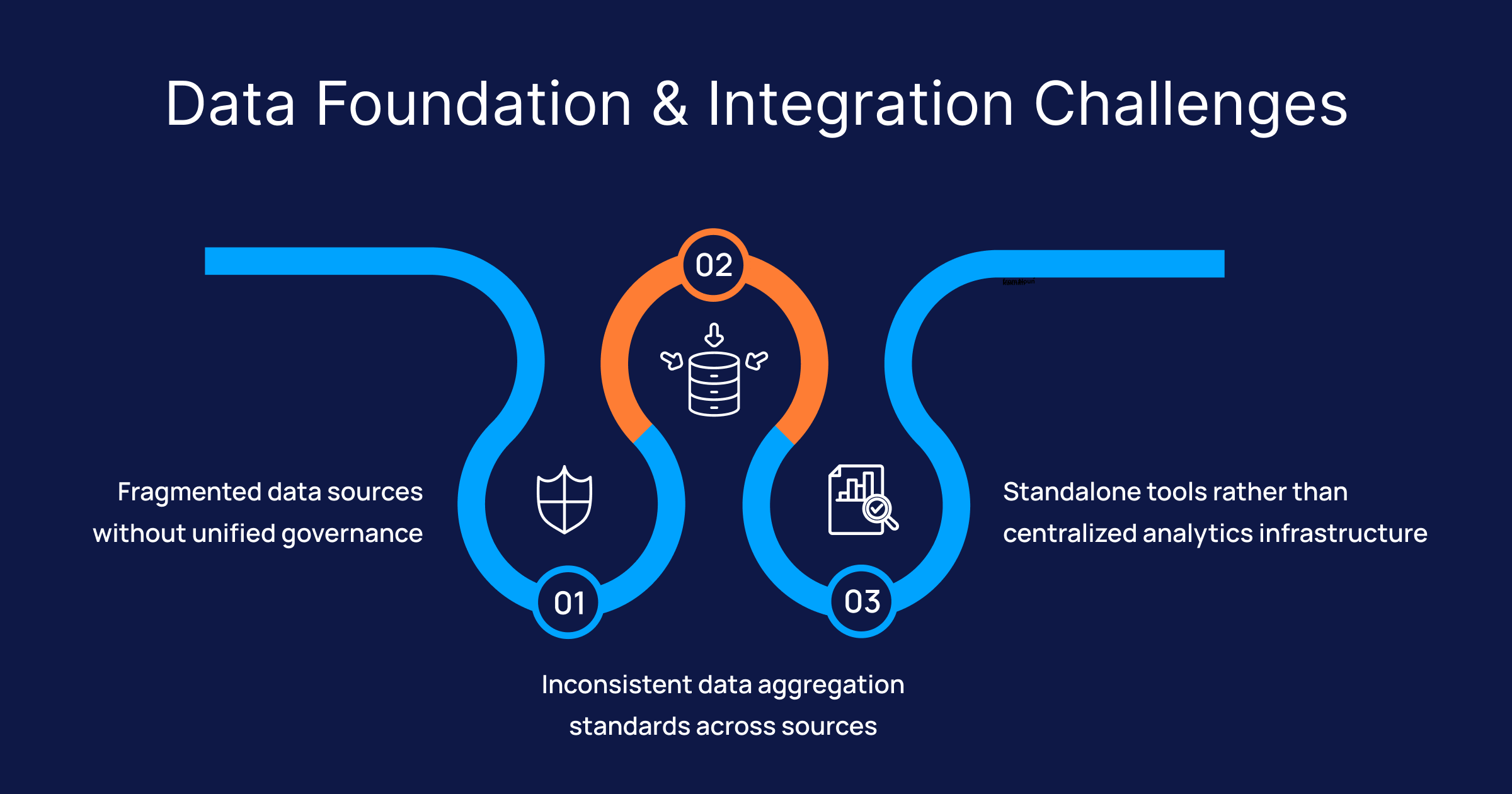
Data Foundation and Integration Challenges

1. Fragmented data sources without unified governance

Pharma commercial, medical, and clinical teams source data from syndicated providers, payer networks, specialty pharmacies, claims aggregators, and internal trial systems. A live webinar poll found that 31% of pharma respondents use data across medical and commercial teams but in silos, with integration treated as a future-state ambition rather than current capability.[2] Without a governance layer that resolves how these sources reconcile, advanced analytics models can produce conflicting signals when the same patient cohort appears differently across feeds.

2. Standalone tools rather than centralized analytics infrastructure

Most pharma organizations begin their analytics journey with vendor-specific tools deployed at the team or function level. Each tool solves a narrow use case. None of them aggregate insights into a shared analytical layer. The result is a portfolio of standalone capabilities that resists scaling because every new use case requires its own data pipeline, its own model, and its own integration work. Centralized analytics pharma infrastructure removes that overhead, but the upfront investment in shared data foundations, ML orchestration, and self-service tooling rarely fits within a single team budget.

3. Inconsistent data aggregation standards across sources

Different syndicated data sources, payer feeds, and specialty pharmacy systems carry their own taxonomies, unit conventions, refresh cadences, and quality assumptions. Reconciling these into a single source of truth requires sustained engineering investment that many analytics teams cannot fund without executive sponsorship. The aggregation gap becomes a structural barrier to scaling advanced analytics across the pharma industry, particularly in commercial analytics where the source mix is widest.

Operating Model and Leadership Alignment Challenges

4. Limited top-management buy-in for centralized investment

Centralized analytics infrastructure pays back over multi-year horizons. Quarterly performance metrics tend to favor visible, function-specific wins over shared foundations. Without an executive sponsor willing to underwrite the longer payback window, the centralized investment competes poorly against tactical projects. This is among the most persistent obstacles in pharma analytics implementation, and it explains why so many organizations remain stuck at the pilot stage even after years of analytics spend.

5. Cross-functional silos across R&D, clinical, commercial, and manufacturing

R&D, clinical, commercial, manufacturing, and pharmacovigilance teams each maintain their own data, vocabulary, and analytics priorities. A cross-functional advanced analytics program requires shared definitions, shared governance, and shared accountability for outcomes. Most pharma organizations do not have the integrative governance structure to support that, and advanced analytics pharma implementation stalls at the boundaries between functions where ownership of shared data is unclear.

6. Data quality and AI-readiness gaps

Models trained on poorly governed pharma data inherit the gaps and inconsistencies of their training sources. Without standardized clinical taxonomies, master data management for accounts and prescribers, and rigorous metadata capture, advanced analytics deployments produce results that domain experts cannot trust, which costs the program credibility at exactly the moment it needs to earn its place in routine decision workflows.

Regulatory Complexity and Validation Overhead

7. GxP validation and 21 CFR Part 11 burden

Any advanced analytics model that informs a regulated process, including pharmacovigilance, clinical trial design, manufacturing quality control, or regulatory submissions, must satisfy validation requirements under GxP, 21 CFR Part 11, and emerging AI-specific regulatory expectations from the FDA and EMA. Static models can be validated using familiar computer system validation frameworks. Adaptive models that learn from new data require continuous monitoring, change control, and audit trail capabilities that few internal teams have engineered before, which is what turns validation into the single biggest delay between a working model and a deployed one in regulated workflows.

8. Data privacy and intellectual property security

A 2026 survey of 300 quality and manufacturing leaders in life sciences, uncovered that 25% of pharma respondents identified data privacy and security concerns as their primary AI implementation challenge, with 59% of all respondents citing integrated systems as the single most important prerequisite for effective AI deployment.[3] Pharma data carries patient health information, proprietary formulations, and trial-stage molecule signatures that cannot be exposed to general-purpose AI infrastructure. Building analytics pipelines that meet these constraints adds complex engineering layers most organizations easily overlook during the planning stage.

Talent Shortages and Field Execution Gaps

9. AI and analytics skills shortage

In a 2025 survey, nearly 34% of life sciences respondents cited a shortage of skilled talent as a barrier to AI adoption, up from 23% in 2024.[4] These figures reflect both raw shortages and the more nuanced challenge of finding professionals who combine pharma domain knowledge with data engineering and ML capability. Pharmaceutical data analytics challenges are not technology problems alone. They are talent problems; each quarter, they get harder to solve without a centralized talent acquisition and retaining structure in place.

10. From analytical insight to sales and field execution

Even when analytics produce reliable signals, translating those signals into field execution remains uneven. Sales teams need prioritized account lists, next-best-action prompts, and contextualized insights surfaced inside the CRM systems they already use. Medical affairs teams need similar capabilities in their engagement tools. Without this last-mile orchestration, analytics outputs remain trapped in dashboards that no one consults during the moments when decisions actually get made. The difficulty of capturing broad value is underscored by a 2025 Deloitte survey of 150 global life-sciences executives. While 42% noted moderate or significant financial ROI from generative AI, that success remained tightly locked within specialized pockets – primarily routine task automation and initial trial design.[5]
These ten pharma data analytics bottlenecks rarely appear in isolation. Most organizations face them in clusters, and addressing one without the others produces partial improvements that do not move the scaling needle. Barriers to advanced analytics in pharmaceuticals compound across the data, operating model, regulatory, and execution layers, which is why moving from pilot to scale calls for a structural intervention rather than another tool selection exercise.

The Intuceo Approach

From Bottleneck to Blueprint: A Services-Led Path to Pharma Analytics Scale

Most pharma organizations approach analytics scaling as a series of tactical projects when the underlying problem is structural. Intuceo’s services engagement model is designed for exactly this kind of work, with PhD-led teams that bring prior experience navigating the same pharmaceutical analytics scaling challenges across regulated workflows.
The Intuceo-Ax™ accelerator carries pre-configured analytical blueprints from prior engagements with pharma clients including Bausch & Lomb, Janssen Pharma, and Ferring Pharma. Rather than build a centralized analytics layer from scratch, pharma teams inherit a structure that already resolves the data integration, governance, and self-service patterns common to clinical study optimization, real-world evidence synthesis, pharmacovigilance, and commercial analytics.
The iPDLC™ framework brings the same structural discipline to delivery. Each engagement is scoped against the specific bottlenecks the analytics team is facing, with validation, governance, and operating model considerations built into the project plan from week one. That is what allows Intuceo engagements to compress the path from analytics experiment to scaled deployment.

Diagnose Your Pharma Analytics Scaling Bottlenecks

Schedule a structured diagnostic session with Intuceo’s PhD-led pharma analytics team. The conversation focuses on the specific architectural, governance, and execution gaps holding back your scaling work, with a clear blueprint for what to address first.

Frequently Asked Questions

The dominant bottlenecks fall into four categories: data foundation issues such as fragmented sources and inconsistent aggregation standards; operating model gaps including standalone tools and limited centralized investment; regulatory and validation burden under GxP and 21 CFR Part 11; and people-related gaps including skill shortages and weak last-mile execution from analytics into commercial and clinical workflows.
Effective integration starts with governance, not tooling. Pharma teams that resolve master data management for accounts, prescribers, and trial entities first, then layer in standardized taxonomies, metadata capture, and aggregation rules across syndicated, payer, and specialty pharmacy sources, build a foundation that supports both descriptive and ML analytics consistently.
Standalone tools fit within function-level budgets and produce visible wins quickly. Centralized analytics infrastructure requires shared funding, executive sponsorship, and a multi-year payback horizon that quarterly performance metrics do not reward. The result is a portfolio of disconnected tools that delivers narrow value and resists scaling.
Large language models are increasingly used to extract structured insight from unstructured pharma sources such as clinical study reports, scientific literature, regulatory filings, real-world evidence narratives, and pharmacovigilance case data. In R&D, LLMs accelerate literature synthesis, target identification, and trial protocol design. In real-world evidence work, they help convert patient narratives and physician notes into analyzable inputs for outcomes research.
Regulatory expectations are evolving toward risk-based validation frameworks for AI and ML systems used in GxP-regulated workflows. Static, frozen models can be validated using established computer system validation approaches. Adaptive models that learn from production data require continuous monitoring, change control, and audit trail capabilities that internal teams need to engineer carefully. The EU AI Act and recent FDA AI/ML guidance both add validation steps that lengthen deployment timelines if not anticipated at the design phase.

Scaling advanced Analytics in Pharma 2026: From Experiment to Enterprise

Data science budgets are growing. Leadership buy-in is stronger than it was three years ago. The tooling has improved. However, many organizations have not yet solved the gap between the model that cleared internal validation and the production workflow it was designed to support. That gap, not a shortage of capability or investment, is what keeps scaling advanced analytics pharmaceutical operations from generating measurable value at enterprise scale.
Understanding what drives that gap, and what the current generation of AI-advanced analytics healthcare tools makes structurally easier in 2026, is where every pharma data leader should start.

Key Takeaways

The Pilot-to-Scale Gap Is a Systems Problem, Not a Talent Problem

The assumption that scaling advanced analytics 2026 is primarily a talent challenge is incorrect. Most pharma organizations have capable data science teams. What they lack is the infrastructure architecture, and governance framework to move experiments from development environments into production-grade deployment.
A 2025 survey of 115 pharma and biotech technology executives found that only 40% of AI pilots make it to scaled deployment. The same survey identified data quality and governance neglect as the primary cause of AI initiative failure for 68% of respondents.1 When governance is treated as a downstream consideration, the value built during experimentation disappears before it reaches the workflows it was designed to support.
Clinical machine learning ML pharmaceutical data pipelines require access to real-time, governed data across LIMS environments, EHR integrations, and regulatory repositories. In the absence of this infrastructure during the experiment phase, teams build models on isolated datasets that cannot generalize to production, and the handoff fails not because the science was wrong but because the data conditions were never replicated.

What the 2026 Pharma Analytics Environment Changes

Three developments distinguish the 2026 advanced analytics pharma environment from prior years, and each one creates a meaningful opportunity to compress the path from experiment to enterprise deployment.
Natural language processing NLP pharma maturity now allows LLMs to interpret complex clinical trial protocols, adverse event narratives, and regulatory submission text at an operational scale. Clinical research data analytics teams can query unstructured sources without SQL expertise, extending pharmaceutical data analytics AI to clinical operations managers and regulatory affairs teams who previously depended on data science queues for time-sensitive answers.
Agentic workflows in healthcare have moved from exploration into real operational contexts. McKinsey’s December 2025 analysis of biopharma development found that agentic AI can allow up to twice as many trials with the same resources, cutting trial durations by as much as 12 months.2 These gains come from automating the coordination overhead that consumes most of clinical operations time: site activation, protocol deviation flagging, and data collection reconciliation.
Third, auto ML tools for pharmaceuticals now include audit trail generation and documentation scaffolding aligned to GxP and 21 CFR Part 11 requirements. This compliance posture change matters in regulated environments where every model in production requires a validation record before influencing a clinical or commercial decision.

Governance as the Engineering Problem It Actually Is

A 2026 Gartner analysis found that organizations reporting successful AI initiatives invest up to four times more, as a percentage of revenue, in foundational areas such as data quality, governance, and AI-ready infrastructure compared to those experiencing poor AI outcomes.3 For pharma, this maps directly onto root cause analysis pharma findings: teams that fail to scale analytics experiments almost always trace the failure to data access policies, ownership silos, or inconsistent standards between development and production environments.
The business intelligence pharma frameworks built before 2020 were designed around report generation, not inference serving. Moving advanced analytics capabilities into inference-ready deployment requires architectural changes that organizations approach one blocker at a time when there is no established blueprint, often taking months to resolve what structured planning can address in weeks.

AutoML, NLP, and the Citizen Data Scientist Advantage

One practical lever for compressing scaling timelines is distributing analytical capability to citizen data scientists in healthcare. Organizations that equip domain experts with guided advanced BI tools resolve the throughput bottleneck that slows most enterprise analytics programs. When the queue between a question and an answer spans weeks, analytics investment never justifies itself in operational terms.
Visual analytics pharmaceutical environments with embedded predictive AI pharmaceutical capabilities now allow clinical operations managers, pharmacovigilance specialists, and commercial analysts to run exploratory models without writing code. A commercial analyst examining market performance can follow a 3-click KPI path from a high-level trend to the segment-level driver without opening a data science environment.
For complex tasks such as pharmaceutical pricing optimization, AI, and multi-variable clinical outcome modeling, senior data scientists retain full ownership. But Fortune 1000 healthcare companies using this distributed model consistently report faster time-to-insight for commercial analytics and reduced backlogs on centralized data science functions, giving those teams more capacity for the work that genuinely requires their skills.

Deployment Architecture: Cloud, On-Premise, and the Compliance Intersection

The choice between on-cloud and on-premise AI solutions is not made at the deployment stage in high-functioning pharma analytics organizations. It is made at the experiment design stage. Many pharma organizations maintain data in air-gapped or restricted environments for regulatory or IP protection reasons. Models trained on cloud infrastructure may require full redeployment in controlled, on-premise environments before operating on production clinical or commercial data.
Advanced analytics pharmaceutical deployments that treat cloud and on-premise as interchangeable will encounter architectural and compliance debt precisely when the pressure to move fast is highest. Organizations that establish hybrid deployment standards before experiments begin eliminate one of the most consistent late-stage blockers in the scaling process, and give their analytics programs a structural advantage when moving from proof of concept to enterprise deployment.

Close the Gap Between Analytics Experiment and Enterprise Deployment with Intuceo

Scaling advanced analytics pharma experiments in a GxP-compliant environment requires a services engagement with direct experience across regulated data environments, enterprise BI infrastructure, and production deployment architecture in life sciences contexts.
Intuceo’s PhD-led team brings this depth from engagements across pharma and life sciences clients, including Bausch & Lomb, Janssen Pharma, and Ferring Pharma. Its Intuceo-Ax™ accelerator compresses the path to enterprise-grade pharmaceutical data analytics AI by deploying pre-configured analytical blueprints for clinical study optimization, real-world evidence synthesis, and commercial performance analytics. These accelerators are configured and validated within the client’s governed environment, whether cloud, on-premise, or hybrid, drawing from a library of approaches refined across prior regulated engagements.
Intuceo-Ax™ surfaces KPI paths in as few as three clicks, extending self-service capability to business analysts and citizen data scientists in healthcare without compromising the data governance controls that regulated environments require. Engagements using Intuceo-Ax™ have compressed BI solution implementation timelines by up to four times compared to traditional build approaches in comparable regulated settings. The firm’s iPDLC™ framework ensures models and their documentation satisfy GxP and 21 CFR Part 11 validation requirements before reaching production.

Your Pilot Project Deserves to Reach Production

Intuceo’s PhD-led team brings proven, regulated-environment experience to analytics scaling engagements across pharma and life sciences. See how the Intuceo-Ax™ accelerator compresses the path from experiment to enterprise deployment.

Frequently Asked Questions

In 2026, most pharma organizations have built data science competencies, but fewer than half of AI pilots reach scaled deployment. Organizations pulling ahead invest in data governance foundations, deploy agentic and NLP-assisted workflows, and build hybrid architectures that accommodate regulatory requirements. The trajectory for the next three to five years points toward greater workflow automation, broader access for domain users, and a larger operational role for agentic AI in clinical development and commercial analytics.
The largest categories include LLM inference and API costs, GPU-based compute for model training and fine-tuning, vector database infrastructure for clinical document search and retrieval-advanced generation, and the engineering labor required to build and maintain agentic workflows. Data engineering and governance investment has also grown substantially as organizations recognize that model quality alone does not determine whether experiments reach production.
LLMs handle structured, well-defined queries effectively when the underlying data is clean and well-governed. For tasks such as summarizing adverse event narratives, interpreting regulatory text, or describing clinical data trends in plain language, modern LLMs perform reliably. The gap appears in highly technical statistical analysis, where LLMs work best as an interface layer integrated with validated analytical services rather than operating as standalone tools.
Day-to-day pharma analytics in 2026 relies on advanced BI tools for business users, autoML environments for guided predictive modeling, NLP interfaces for clinical document querying, and agentic workflow tools for automating data collection and reporting cycles. Effective implementations combine these into a governed, role-based experience matched to the user’s domain expertise rather than requiring access to a single data science environment.
Yes. On-premise and air-gapped deployments are feasible and increasingly common in pharma environments with strict data residency or IP protection requirements. The key requirements are selecting frameworks that support local inference, ensuring model monitoring functions without cloud connectivity, and planning deployment architecture at the experiment stage rather than retrofitting it during production rollout. A growing number of locally deployable medical AI models now support clinical-grade on-premise inference for document analysis and structured data tasks.

How to Choose an Advanced Analytics Tool for Life Science Data

Life sciences have a data problem disguised as a data advantage. Genomic sequencing, clinical trials, laboratory instruments, safety databases, and decades of research literature now generate information faster than scientific teams can study it. Researchers projecting data growth to 2025 placed genomics on par with or ahead of astronomy, YouTube, and Twitter among the most demanding sources of big data in the world.[1] Volume is rarely the constraint. Converting it into decisions is.
That gap is why so many research and data leaders are evaluating an advanced analytics tool for life science data. The category promises to automate the slow, manual work of preparing and exploring data so scientists can spend their time on interpretation. The label, though, gets stretched across everything from generic dashboards to specialized research systems, and the wrong choice can stall a program for months. This guide covers what advanced analytics in life sciences actually does, why generic tools struggle with research data, and the criteria that separate a real fit from a demo that looks good and fails in production.

What advanced analytics does for life science data

Advanced analytics applies machine learning and natural language processing to the analytics workflow itself. Rather than an analyst manually cleaning data, building a model, and hand-writing every query, the system profiles and prepares the data, surfaces patterns and anomalies, and lets people ask questions in plain language.
For research data, AI-powered analytics for life science data has to do more than chart tidy numbers. It has to make sense of structured lab results sitting beside free-text clinical notes, genomic files, imaging metadata, and PDF regulatory filings. The tools that hold up combine four things: automated data preparation, machine learning analytics for pattern and outlier detection, natural language processing that pulls meaning from text, and conversational querying that returns answers tied back to their source. Spending reflects the pressure. The life science analytics market is projected to reach $16.33 billion by 2030, with research and development being the fastest-growing segment.[2]

Why generic analytics tools struggle with research data

Most analytics tools were built for clean, columnar business data. Life science data is neither clean nor columnar.
Start with a format. Structured, coded data accounts for only 50 to 70% of the information relevant to a clinical trial, and nearly 80% of healthcare data is unstructured, held in clinical notes, imaging reports, and physician narratives.[3] A tool that reads only clean, structured tables ignores most of the available evidence.
Then scale and fragmentation. A single program can span genomic files, electronic health records, LIMS and PLM systems, trial databases, and patent libraries, each in its own format and silo. Joining them by hand is where weeks disappear.
Finally, regulation. In a GxP environment, an insight is only useful if it can be defended. A tool that cannot show how data moved from source to result, or explain why a model reached a conclusion, will not survive an audit. This is the failure point that generic advanced analytics in life sciences deployments hit most often.

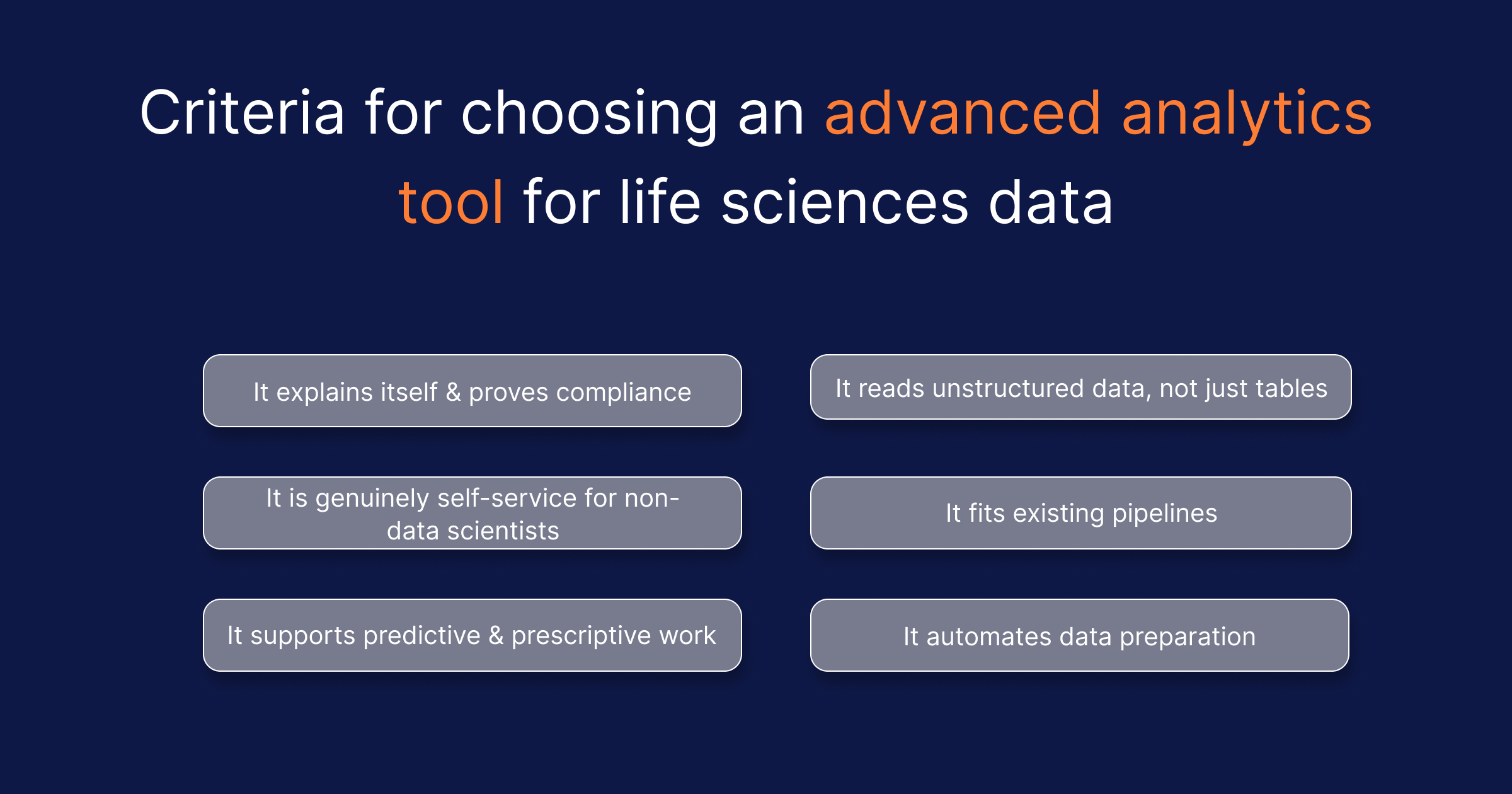
Criteria for choosing an advanced analytics tool for life sciences data

It reads unstructured data, not just tables

The first test is whether the tool can work with the share of data that does not fit a spreadsheet. Look for native handling of clinical text, documents, and imaging metadata, and for natural language processing life science insights that extract findings from research papers and trial records rather than leaving them unread.

It automates data preparation

Data preparation is the slowest part of most analyses. Strong tools deliver data preparation automation for life sciences by profiling sources, flagging quality issues, and standardizing formats before modeling begins. The right level of automation returns scientist hours to science instead of spreadsheet cleanup.

It is genuinely self-service for non-data scientists

Many vendors describe a self-service AI platform for life science teams; far fewer deliver one. The practical question is whether a clinical, regulatory, or commercial lead can reach an answer without writing code or waiting in a queue. Conversational AI for life science data analysis helps here, letting users interrogate data in plain language and receive statistically grounded answers, not just generated text.

It explains itself and proves compliance

For regulated work, explainability is not optional. Every insight needs a verifiable path to its source, and every model decision needs an auditable rationale aligned with 21 CFR Part 11, GxP, and HIPAA. A cloud-based advanced analytics solution that cannot generate that evidence creates compliance risk, no matter how fast it runs. This is also how life science companies ensure data compliance in analytics: by choosing tools where traceability is built in, not bolted on later.

It fits existing pipelines

The tool has to work with what you already run. Before committing, confirm which ML tools integrate with existing life science data pipelines, including your data lake, EHR connections, and current BI surfaces such as Tableau, Qlik, or Spotfire. A tool that forces a full rebuild rarely justifies the disruption.

It supports predictive and prescriptive work

Descriptive reporting tells you what happened. Predictive analytics for the life science industry tells you what is likely next, and prescriptive modeling recommends the next action. Tools that embed forecasting, anomaly detection, and next-best-action into the same workflow move teams from reactive reporting to earlier intervention. Applied to machine learning analytics on healthcare data, that shift is the difference between explaining a missed signal and catching it in time.

How Intuceo approaches life sciences analytics

Intuceo’s PhD-led engineers bring Intuceo-Ax as an accelerator built on previous projects’ expertise, so the capabilities above arrive proven and then get configured to the data, pipelines, and compliance demands of the program in front of them.
DataSharp automates data preparation across structured and unstructured sources. InsightExplorer supports what-if analysis, and HiddenInsights surfaces root causes and patterns that manual review misses. A natural-language layer lets non-technical leaders reach institutional insights in as few as three clicks, with every answer backed by traceable data lineage rather than an unexplained number.
For the unstructured side, Intuceo-Ix builds a unified knowledge layer across research silos, indexing millions of documents spanning LIMS, PLM, clinical trials, FDA filings, and patents so teams find what they need in minutes. Where most models return only a yes or no, Intuceo’s explainable AI frameworks also generate the rationale that GxP review demands.
The distinction that matters for buyers is that Intuceo delivers this as engineering work, not a license to administer on your own. The criteria above get applied to your data and your regulatory context; the engagement model is fixed-bid rather than open-ended, and the controls that regulated research depends on are part of the build.

Before you commit, test it on your most complex datasets.

Most advanced analytics decisions go wrong at the pilot stage, when a tool that demos well stumbles on real clinical text, messy source data, or a single audit question. Intuceo’s engineers can run a sample of your own data against the criteria in this guide and show you where each option holds and where it breaks, before you commit to one.

Frequently Asked Questions

Start with your data, not the demo. Confirm the tool can read unstructured sources such as clinical notes and filings, automate data preparation, explain outputs for audit, and connect to existing pipelines. A tool that scores well on these but looks plain often beats a polished one that only handles clean tables.
Yes, though capability varies widely. The marker of a real self-service approach is whether a scientist or commercial lead can ask a question in plain language and act on a sourced answer without engineering support. Conversational querying and automated data preparation are what make that possible.
By choosing tools that build traceability and explainability into the workflow. Every result should carry a verifiable lineage to its source, and every model decision should produce an auditable rationale aligned with 21 CFR Part 11, GxP, and HIPAA. Compliance added after the fact is far harder to defend.
Yes. Natural language processing converts research papers, trial protocols, and safety reports into structured data that can be analyzed alongside numeric results, surfacing connections that would otherwise stay buried in text.
It automates preparation across structured and unstructured data, surfaces patterns and root causes, and answers plain-language questions with traceable lineage, all under compliance controls suited to regulated research.

How Advanced Analytics Tools Speed Up Exploratory Studies in Pharma

Bringing a new therapeutic from discovery to approval still takes roughly 10 to 15 years and commonly costs more than $1 billion to $2 billion.[1] A large share of that time is spent not on running experiments, but on getting data ready to ask questions of it. Research teams sit on genomic readouts, assay results, electronic lab notebooks, and trial datasets that rarely line up, and the people best equipped to find signal in them spend most of their day cleaning and reshaping files instead. This is where advanced analytics tools for exploratory studies in pharma earn their place: they automate the slow setup, so scientists reach the questions faster.

Key Takeaways

What is advanced analytics, and why does it matter for pharma research?

Advanced analytics combines machine learning, natural language processing, and statistical automation to handle the manual steps inside the analytics workflow: preparing data, finding correlations, building first-pass models, and explaining results. Instead of a scientist hand-coding every query, the system proposes relationships, flags anomalies, and answers questions asked in ordinary language. Advanced analytics represents one well-established approach within this broader category, adding AI-driven suggestion layers on top of traditional BI to surface insights researchers might not have thought to look for.
The reason this matters for pharma analytics is timing. Exploratory studies are open-ended by design, with teams testing many hypotheses against messy, high-dimensional data before committing resources to any path. The slowest part is rarely the science. It is the preparation. Even today, data scientists spend roughly 45% of their working hours simply loading and cleansing data before modelling can start.[2] Advanced analytics for pharma removes much of that overhead, which is one reason AI-driven analytics tools are seeing rapid adoption in regulated research environments.

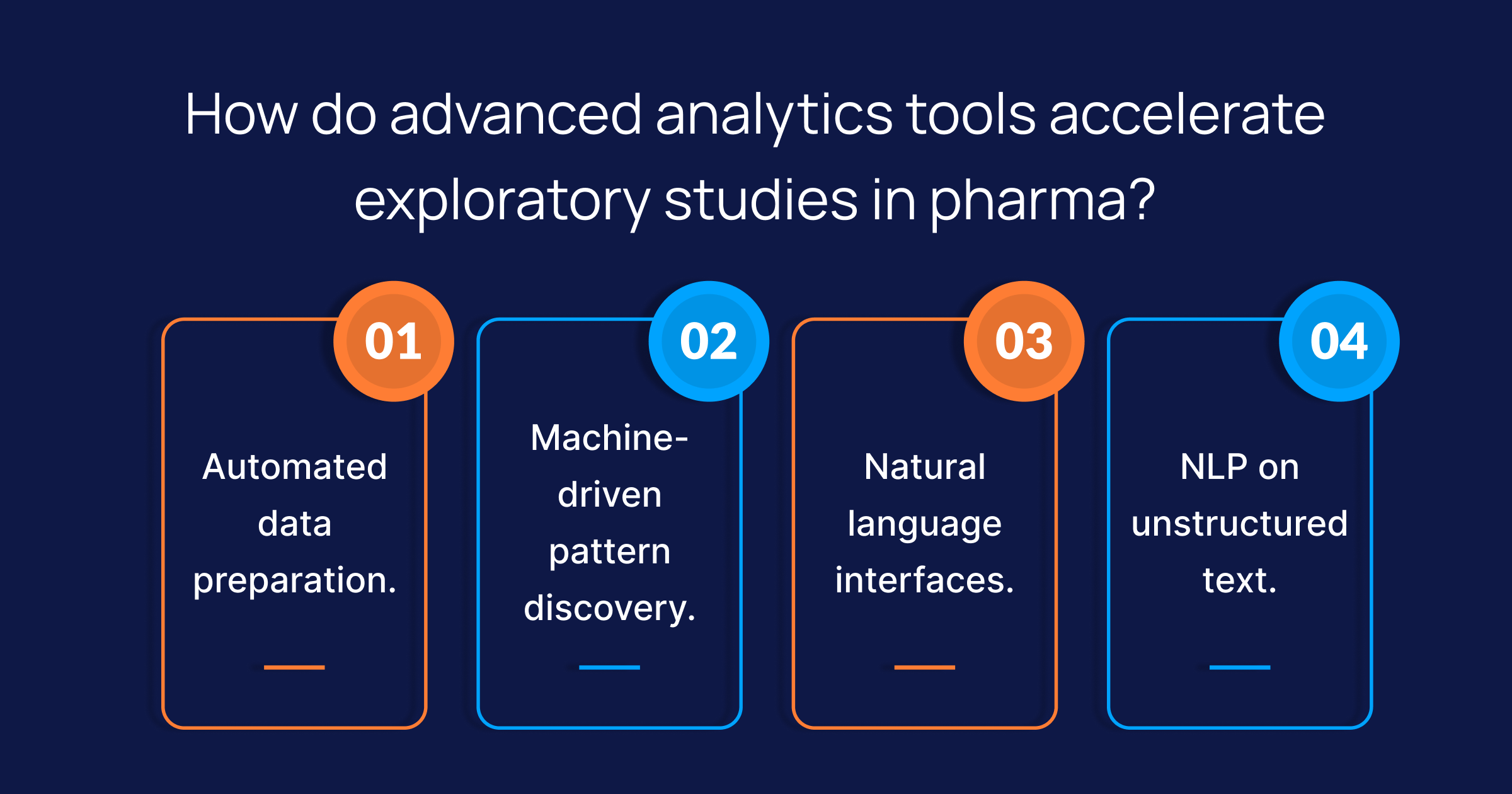
How do advanced analytics tools accelerate exploratory studies in pharma?

They accelerate early-stage research analytics in four concrete ways, each targeting a step where researchers currently lose hours.

How does advanced analytics support drug discovery?

In discovery, the bottleneck is narrowing millions of possible compounds and targets to the few worth testing in a lab. Advanced analytics speeds this by modelling compound-target interactions, predicting toxicity, and ranking candidates before any physical synthesis. The tools support AI in drug discovery precisely at the stage where the cost of error is highest: before lab resources are committed.
The early evidence for these methods is encouraging. A 2024 analysis in Drug Discovery Today found that AI-discovered molecules met their Phase 1 clinical endpoints at an 80% to 90% rate, substantially higher than historic industry averages.[3] Predictive analytics for drug discovery does not replace medicinal chemistry. It allows teams to spend their limited lab capacity on the candidates most likely to hold up, which is the practical definition of accelerating an exploratory study.

How does advanced analytics transform clinical trial analysis?

Clinical research carries the steepest risk in the entire pipeline. Across more than 400,000 trial records, researchers estimated the overall probability that a drug program entering trials reaches approval at just 13.8%, roughly one in seven.[4] Most of that attrition is decided by how well teams read their data early.
Advanced analytics improves the read. It helps identify eligible patient cohorts faster by searching across fragmented clinical datasets, surfaces site-level and safety signals as data arrives rather than at scheduled checkpoints, and applies predictive analytics in pharma that flag enrolment or efficacy problems while there is still time to adjust. In this way, advanced analytics tools become a practical form of clinical research decision support, shortening the gap between a problem appearing in the data and a team acting on it. Data integration in pharma is the enabling layer: connecting trial records, EHR extracts, and biomarker feeds into a single, analyzable view is what makes real-time signal detection possible.

Can advanced analytics handle complex biological datasets and stay compliant?

Biological data is high-dimensional, noisy, and often unstructured, which is exactly the profile for which advanced analytics is built. The harder requirement in life sciences analytics is not capability but accountability. A result that cannot be explained or traced has limited value in a regulated submission.
This is the practical test for advanced analytics tools in life sciences research: every automated insight needs a verifiable lineage back to source data, and every model decision used in regulated work needs a rationale a reviewer can audit. Explainable AI, immutable logs, and controls aligned to 21 CFR Part 11, GxP, and HIPAA are what separate a tool that demonstrates well from one that holds up under inspection. Advanced analytics frameworks that layer AI-driven suggestions on top of traceable statistical engines are one path to meeting this standard, provided the explainability layer is built from the start rather than retrofitted.

The Intuceo Approach

Advanced analytics, delivered as a service

Intuceo treats advanced analytics as an engagement, not a piece of software to configure and hand over. A PhD-led team arrives with its proprietary analytics accelerator, Intuceo-Ax, already carrying the patterns and configurations from prior regulated research deployments. Rather than starting from blank infrastructure, the team adapts what has already been proven in pharma and life sciences environments, pairing automated data preparation, what-if exploration, and root-cause analysis with natural-language querying that returns statistically grounded answers, complete with the data lineage behind them. Intuceo-Ax is built on advanced analytics principles, extended with additional ML orchestration layers designed specifically for regulated science.
Underneath sit Intuceo’s patented AutoML engines for forecasting, text analytics, and pattern discovery, automating the most labour-intensive phases of model selection and tuning. For unstructured research knowledge, Intuceo-Ix applies semantic search across millions of indexed documents, from LIMS and clinical trial records to FDA filings and patents, so prior findings can be analysed instead of being buried. Because the work targets regulated science, Intuceo architects explainable AI for tasks such as adverse-event classification, generating the evidence-based rationale that GxP and 21 CFR Part 11 demand.
Delivered through fixed-bid engagements, the focus stays on a measurable outcome: getting research teams from pharma data analysis to decision faster, without compromising compliance.

Where is your exploratory work losing the most time?

If your teams spend more time preparing data than studying it, that is a solvable bottleneck. Intuceo’s PhD-led engineers can map where advanced analytics would compress your exploratory cycle, from discovery through clinical analysis, against your specific compliance requirements.

Frequently Asked Questions

Advanced analytics removes the manual bottlenecks that precede actual research. It profiles and cleans incoming datasets automatically, proposes cross-variable relationships that analysts would otherwise test one at a time, and answers plain-language questions without requiring an SQL query for each. In pharma exploratory work, where teams run many hypotheses in parallel against high-dimensional data, this compression of the preparation phase can return several hours per analyst per day to active science.
Natural language processing converts unstructured sources, including research papers, trial protocols, regulatory documents, and safety reports, into structured data that can be analysed alongside numeric results. This unlocks knowledge that would otherwise sit unread and lets teams cross-reference text and numeric data within a single study. For advanced analytics in life sciences workflows, NLP is often the component that makes prior literature and regulatory history available to current-cycle analysis rather than requiring separate manual searches.
Predictive analytics in pharma shortens the time between a signal appearing in the data and a researcher acting on it. For compound prioritisation, models score candidates by predicted toxicity, target affinity, and likelihood of meeting early-phase endpoints, allowing lab resources to be directed at the candidates with the highest probability of success. For cohort analysis in clinical work, predictive models flag enrolment shortfalls, safety patterns, or weak efficacy signals early enough to adjust a study before resources are committed to a path that is unlikely to succeed.
The ones that pair automation with explainability and traceability. For regulated research, every insight needs a verifiable lineage to its source, and every model decision needs an auditable rationale, with controls aligned to 21 CFR Part 11, GxP, and HIPAA. Speed without that audit trail does not survive inspection. Evaluating any advanced analytics tool for life sciences means testing not just what it can surface, but whether its outputs can be reproduced, traced, and defended under regulatory review.
It cuts costs in two places: the hours scientists spend on manual data preparation, and the resources wasted on candidates that fail late. By returning preparation time to research and ranking candidates by likelihood of success before lab work begins, advanced analytics reduces both the labour and the failed-experiment spend that drives discovery budgets. When AI in drug discovery is applied early in the exploratory cycle, the downstream cost savings compound across every subsequent phase that would otherwise have carried a weak candidate forward.

Why Pharma Analytics Teams Struggle to Scale Augmented Analytics Experiments

Why Pharma Analytics Teams Struggle to Scale Augmented Analytics Experiments

For most pharmaceutical analytics leaders, the celebration after a successful pilot project is short-lived.
It is relatively easy for a talented data team to build a convincing proof of concept – a targeted model that flags an adverse event faster, or a sleek commercial dashboard that answers questions in plain language to impress a steering committee. The real friction begins exactly twelve months later, when that same pilot is expected to run reliably across different regional markets, therapeutic areas, and highly regulated business units.
This bottleneck isn’t just an internal frustration; it reflects a massive global disconnect between digital intent and operational reality. While the global augmented analytics market is on track to rocket from USD 16.60 billion in 2023 to nearly USD 97.87 billion by 2030,1 organizations are finding that buying the technology is the easy part. McKinsey’s recent global benchmarking data shows that while a staggering 88% of organizations have successfully deployed AI within at least one business function, only about a third have managed to scale those capabilities across the wider enterprise
In the strictly regulated domain of life sciences, that execution gap is wider still.

Augmented Analytics: The promise, and the plateau

Augmented analytics uses machine learning and natural language processing to automate data preparation, surface patterns automatically, and let people question data in plain language. Today, this paradigm increasingly leverages Generative AI to provide fluid, conversational interfaces, turning what used to be complex database querying into a simple dialogue. For pharma, that transformation is highly practical: it means a clinical operations lead can interrogate trial site performance without writing a line of code, or a commercial team can test a complex market scenario without joining a three-week analyst queue.
The difficulty is the plateau that follows. Scaling analytics experiments is a completely different discipline from building them. A pilot succeeds in a controlled setting, with meticulously curated data and a highly motivated sponsor. Scale, however, demands messy production data, hundreds of simultaneous users, strict audit trails, and financial outcomes that a corporate finance team will defend. This is the underlying reason pharma analytics AI adoption so often stops at the demo.

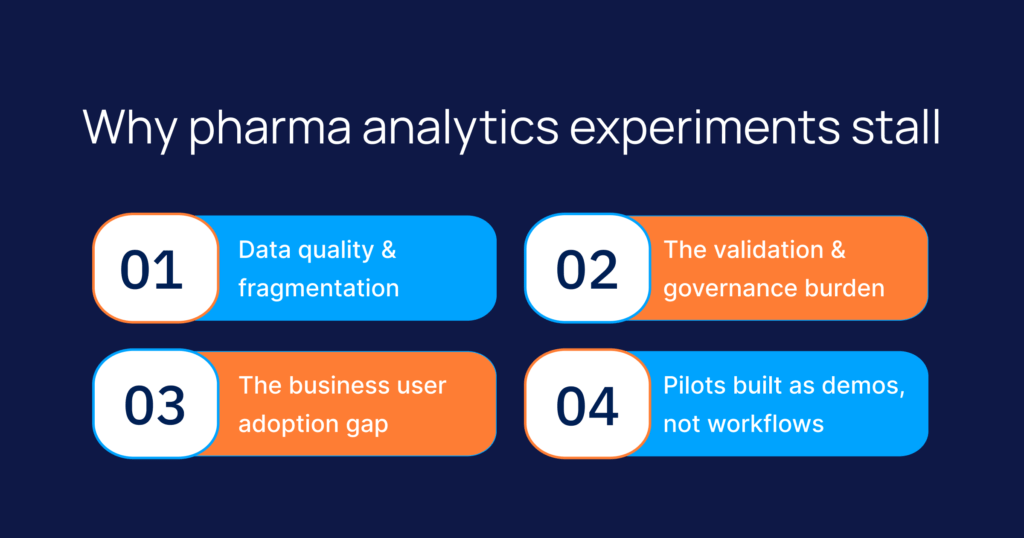
Why pharma analytics experiments stall

Several forces compound at the same point in a program. Understanding them is the first step to explaining why AI pilots fail in pharma.

Data quality and fragmentation

Pharma data lives in silos: laboratory information systems, clinical trial databases, manufacturing execution records, safety systems, and commercial CRM systems, much of it unstructured. Industry data consistently shows that data scientists spend nearly half their working hours cleaning and preparing data rather than analyzing it. In pharma, this friction multiplies exponentially because regulated datasets cannot rely on approximations or ‘good enough’ data patches; a single missing data lineage link can invalidate a clinical report.

The validation and governance burden

A consumer analytics tool can ship and iterate. A regulated one cannot. Any insight that informs a clinical, safety, or manufacturing decision may need to be validated, traceable, and defensible to an auditor. Without regulated industry AI governance built in from the start, teams reach the pilot-to-production line only to find their experiment has no data lineage, no explainability, and no audit trail. Retrofitting those controls often costs more than the pilot did.

The business user adoption gap

Augmented analytics scales only when the people who make decisions actually use it. Yet many tools are designed for data teams, not for the clinical, regulatory, and commercial users who need the answers. When business user analytics adoption stays low, the experiment never leaves the analytics group and never changes how the business runs. Conversational analytics for pharma, where a user asks a question in everyday language and receives a defensible answer, is the bridge, but only when the interface fits the way that user already works.

Pilots built as demos, not workflows

When an enterprise solution is built to look good in a presentation rather than survive the realities of daily operations, failure is inevitable. This operational fragility explains why Gartner predicts that at least 30% of generative AI projects will be abandoned after proof of concept by the end of 2025. Because GenAI increasingly serves as the primary user interface for modern augmented analytics platforms, its high abandonment rate directly impacts the broader analytics ecosystem. Gartner points to poor data quality, inadequate risk controls, escalating costs, and unclear business value as the primary drivers of this collapse.
The common thread across these failures is not the underlying model itself; it is the infrastructure and conditions around it. Enterprise AI in life sciences fails in the exact same way. A pilot engineered solely to impress a steering committee in a boardroom is fundamentally different from a system engineered to scale securely across a global enterprise.

From experiment to enterprise impact

Moving from experimentation to enterprise-wide impact has less to do with a better model and more to do with a repeatable method. Teams that scale tend to do a few things differently. They start with a single high-value decision rather than a broad capability. They build governance, validation, and data lineage into the experiment instead of bolting them on afterward. They design for the business user from day one. And they treat the pilot as the first production increment, not a throwaway proof.
This is also where AI decision support in life sciences earns its place. Decision support that surfaces an insight quickly, shows the data behind it, and records how it was derived can be trusted, audited, and adopted. Decision support that produces an answer no one can explain will not survive a regulatory review, let alone reach scale.

How Intuceo helps pharma teams scale

Intuceo is a PhD-led AI, ML, and data analytics services firm that works inside regulated industries, including pharma and life sciences. The work is not about selling a tool. It is about delivering the method and the engineering that move an analytics experiment into dependable enterprise use.
Intuceo-Ax, the firm’s augmented analytics accelerator, is built to speed deployment rather than start every build from zero. It automates data preparation, supports what-if exploration, and lets non-technical leaders navigate deep KPIs in as few as three clicks, which speaks directly to the business user adoption gap. Because it draws on patterns proven in prior pharma engagements, teams skip much of the trial and error that stalls a first attempt.
Governance is engineered in, not added later. Intuceo applies a Regulated-by-Design approach: automated data profiling and anomaly detection at the source, immutable lineage for forensic traceability, and explainability frameworks with bias detection and model cards reviewed by a PhD-led Board of Science. These controls are pre-vetted against FDA 21 CFR Part 11, HIPAA, GxP, SOC 2 Type II, and FISMA requirements, giving regulated AI governance a concrete foundation.
The firm’s iPDLC framework gives experiments a defined route from concept to validated production, the step most pilots are missing. Across more than 100 life sciences engagements over 14-plus years, including work for organizations such as Janssen and Ferring, Intuceo has engineered solutions like a universal search capability that indexes over 5 million R&D documents, turning dormant knowledge into usable insight. Engagements run on fixed-bid and budgeted models, so clients pay for outcomes rather than activity.

Ready to Move from Pilot to Production?

Don’t let a promising experiment stop at the demo phase. Intuceo builds compliance, data lineage, and user adoption directly into your pipelines from day one.
  • Regulated-by-Design: Pre-vetted compliance (FDA 21 CFR Part 11, GxP, HIPAA) built in, not bolted on.
  • Proven iPDLC Framework: A predictable path from concept to an audited, enterprise-scale project.
  • Outcome-Based Models: Fixed-bid structures so you pay for impact, not activity.

Frequently Asked Questions

Most fail at integration, not at the model. Pilots run on curated data with a motivated sponsor, then meet fragmented production data, low business user adoption, and validation requirements they were never designed to satisfy. The experiment works in isolation but cannot connect to the workflows and controls that real scale demands.
By treating scale as a method rather than a milestone. That means starting with one high-value decision, building governance and data lineage into the experiment from the start, designing for the business user, and running the pilot as the first production increment. A defined lifecycle, such as Intuceo’s iPDLC, gives that progression a repeatable structure.
At minimum: validated data quality, immutable lineage so any insight can be traced to its source, explainability so outputs can be defended, and bias detection and model documentation. These should map to standards such as FDA 21 CFR Part 11, HIPAA, GxP, and SOC 2 Type II, and should be present before a pilot is asked to inform a regulated decision.

Automate the repeatable work, data profiling, preparation, and anomaly detection, while keeping validation and audit trails intact. Automation that records what it did and why preserves the defensibility a regulated environment requires, and frees analysts to spend time on interpretation rather than cleaning data.

Meet users in their own workflow and language. Conversational analytics that let a clinical or commercial user ask a question and receive a clear, sourced answer removes the dependency on a specialist queue. Adoption follows when the interface is simple, the answer is trustworthy, and the path to that answer is short.

The Power of Augmented Analytics: Bridging the Gap Between Data and Decisions

Modern organizations are often told that they need to be analytics driven to survive. We hear Instead, it is about a culture of decision making where every choice starts with looking at relevant data to understand what happened in the past, which we call hindsight. From there, we use techniques to understand why it happened to provide insight, and finally, we look toward the future with foresight to make better business decisions.that it is not just about owning the latest tools or having a massive big data infrastructure.

A Real World Scenario

Let us look at this through a simple example. Imagine you are trying to understand why certain customers have stopped doing business with you. You want to know the root cause and, more importantly, how to prevent it from happening again.
Ideally, you would start by analyzing data from the last several quarters. This process helps you identify patterns in customer churn and suggests strategies to keep your clients happy in the future. This is what we call predictive analytics.

The Hidden Hurdles of Traditional Data Science

However, this is often easier said than done. The journey from preparing the data to building a predictive model and sharing those findings is incredibly complex. It usually requires specialized data science skills that are hard to find. Furthermore, the traditional way of handling data cannot keep up with the lightning pace of modern business.
There are two main reasons for this:
On the flip side, relying purely on machine intelligence can lead to black box models. These are systems that give you an answer without explaining the rationale, leaving business leaders to make big decisions without truly understanding the logic behind the data.

What is Augmented Analytics?

This is where Augmented Analytics changes the game. It combines the cognitive intelligence of humans with the incredible learning speed of machines.
The experts at Gartner define it as a next generation paradigm that uses machine learning to automate data preparation and the discovery of insights. In simpler terms, it takes the heavy lifting of data science and puts it into the hands of the business people who actually understand the context of the work.

How It Transforms Your Organization

When you put augmented analytics  at the center of your business, you see four major shifts:

The Path Forward with Intuceo

At Intuceo, we are helping our clients bridge the gap between human expertise and machine capability. Our enterprise data science accelerators automate the complex parts of building predictive models. This allows your subject matter experts to spend their time enhancing those insights with their own experience rather than getting bogged down in data preparation.
When you share this collective knowledge across your company, you accelerate the growth of a true analytics culture.

Conclusion

Augmented analytics is the future of business intelligence. It is already transforming how enterprises work and how they view their potential. You can take your business intelligence to the next level by partnering with the Intuceo platform. Discover how our cloud based, self service model can empower your experts and speed up your journey toward becoming a truly data driven organization.

Frequently Asked Questions

Augmented analytics is an advanced approach to data analysis that uses machine learning and AI to automate data preparation, insight generation, and predictive modeling, making analytics accessible to business users.
It combines machine intelligence with human expertise to deliver faster, more contextual insights, enabling organizations to make informed decisions without deep technical dependency.
Together, they create a complete framework for data-driven decision-making.
Predictive analytics uses historical data, statistical models, and machine learning to forecast future outcomes, such as customer churn, demand trends, or operational risks.
Some key limitations include: