

Most regulated organizations know what AI governance should look like on paper. The harder question is what it looks like when a model makes a consequential output at 3 AM, with no human present, and a regulator requests the decision record six months later.
That gap is where regulated AI model governance breaks down in practice. A March 2026 industry analysis found that 63% of organizations that experienced AI-related breaches had either no governance policy or were still developing one at the time of the incident.[1] Typically, these violations stem from operational failures: no model audit trail, no continuous monitoring active, and no enforced approval chain before deployment.
AI model governance 2026 is no longer a documentation exercise. It is an operational discipline with technical requirements, regulatory deadlines, and direct audit exposure. Understanding what it actually includes is the prerequisite for building it correctly.
Key Takeaways
- Most organizations have AI governance policies. Few have the operational infrastructure that makes those policies enforceable in production.
- The EU AI Act's full high-risk system enforcement deadline is now December 2, 2027, extended from August 2026 under the May 2026 Digital Omnibus. Preparation obligations are live today.
- A 2025 multi-model clinical study published in Nature found average LLM hallucination rates of 65.9% without structured mitigation.
- Prompt injection is the leading LLM security vulnerability, found in 73% of production AI deployments assessed during security audits.
- Audit-ready AI governance requires five concurrently active technical layers, not a document.
What Enterprise AI Governance Actually Requires
Enterprise AI governance covers the full lifecycle of a model: from initial development and risk classification to deployment approvals, production monitoring, and eventual decommissioning. In regulated industries, each phase carries specific obligations that go beyond internal policy.
The EU AI Act provides the clearest current regulatory framework. Under its risk-based structure, AI systems deployed in healthcare, pharmaceutical manufacturing, and critical infrastructure are classified as high-risk under Article 6(1) and Annex I.[2] For these systems, the Act mandates conformity assessments, technical documentation, post-market monitoring systems, and substantive human oversight as mandatory requirements.
The AI compliance framework in regulated industries draws from several converging standards: the NIST AI Risk Management Framework, ISO 42001, and, specifically for life sciences, 21 CFR Part 11, GxP validation requirements, and HIPAA. These frameworks share one common expectation: organizations must document not just what an AI model is, but how it behaves, what it was trained on, how decisions are logged, and who reviewed them before and after deployment.
The model approval workflow sits at the center of this. Before a model reaches production in a regulated setting, it typically requires a risk classification assessment, validation against representative datasets, documented performance benchmarks, sign-off from qualified personnel, and a persistent record of that approval that survives model updates and team changes.
The Five Technical Layers Enforceable Governance Runs On
Governance documents state intentions. Technical infrastructure enforces them. LLM governance in a regulated environment requires at least five active layers operating simultaneously, each addressing a distinct category of failure.
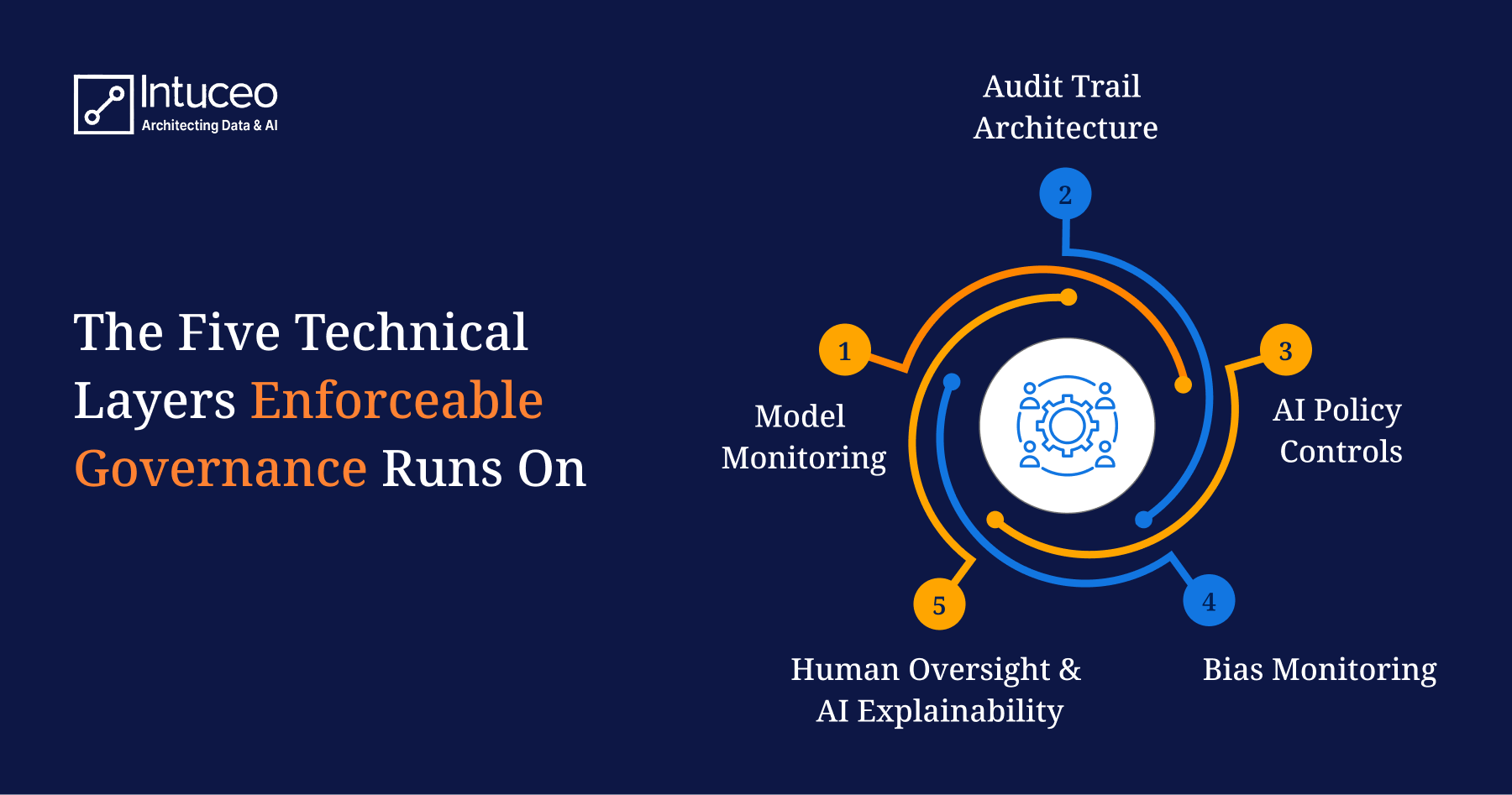
Layer 01
Model Monitoring
Model monitoring tracks deployed model behavior continuously against validated baseline benchmarks. Without it, a model approved six months ago may be producing materially different outputs today with no record of when or why the behavior changed.
Layer 02
Audit Trail Architecture
Every prediction or recommendation a model generates in a regulated context must be logged with enough metadata to reconstruct the decision: model version, inputs, outputs, confidence scores, and any human review action. Under 21 CFR Part 11, these records must be tamper-evident and accessible on demand.
Layer 03
AI Policy Controls
AI policy controls are the guardrails that prevent a model from generating outputs outside its sanctioned operating scope. This includes output filtering, role-based access permissions, and defined escalation paths when outputs fall below an accepted confidence threshold.
Layer 04
Bias Monitoring
Bias monitoring provides evidence that a model does not produce systematically different outcomes across patient populations, demographic subgroups, or regulatory jurisdictions. For life sciences applications, validated performance across representative subgroups is increasingly a compliance requirement, not an optional quality check.
Layer 05
Human Oversight and AI Explainability
Human oversight in AI must be substantive, not ceremonial. A qualified reviewer must be able to understand, challenge, and override a model’s output for that oversight to satisfy regulators. AI explainability is what makes this operationally possible. A model whose decisions cannot be explained to a clinician, compliance officer, or regulator is not audit-ready regardless of its technical performance metrics.
LLM-Specific Risks: Hallucinations and Prompt Security
The deployment of large language models in regulated settings introduces two risk categories that traditional predictive model governance frameworks were not designed to address.
Hallucination detection is the first. A 2025 multi-model study examined LLM performance on 300 physician-validated clinical vignettes and found an average hallucination rate of 65.9% under default prompting conditions. The best-performing model in the study, GPT-4o, still hallucinated in 23% of cases.[4] In pharma and healthcare settings where AI outputs inform regulatory submissions or clinical decision support, rates at that level require structured detection and human verification processes before outputs reach consequential use.
Governance for generative AI requires: retrieval-augmented generation (RAG) architectures that ground outputs in verified, versioned knowledge bases; output validation mechanisms that flag responses outside factual boundaries; and documented review requirements for any LLM output used to support a regulated decision.
Prompt injection protection is the second category. According to
OWASP’s 2025 Top 10 for LLM Applications
, prompt injection is the leading critical vulnerability in production AI systems, detected in 73% of deployments assessed during security audits.[5] Unlike conventional software exploits, prompt injection operates at the semantic layer: a malicious input can override system instructions, bypass access controls, or extract protected data. In a regulated environment, a successful injection could corrupt a clinical decision support output, expose PHI, or generate a fraudulent compliance record. Effective mitigation requires input validation, strict privilege minimization in AI agent design, output filtering, and behavioral monitoring that detects anomalous instruction patterns in real time.
Streamline AI Model Governance With Intuceo
Building responsible AI in a regulated environment is an engineering problem before it is a compliance problem. Policies describe what governance should achieve. Technical design determines whether it actually does.
Intuceo’s PhD-led services teams bring governance engineering into the design phase of every engagement. The firm’s iPDLC™ delivery framework structures lifecycle accountability from the start: model validation gates before production, immutable audit logging built into the deployment architecture, and continuous monitoring configured against the performance standards required by the regulatory environment in scope. Compliance documentation is treated as the output of that infrastructure, not as a substitute for it.
In regulated engagements across pharma, healthcare, and life sciences, Intuceo’s teams apply the Intuceo-Ax™ accelerator to compress governance implementation timelines, carrying pre-validated monitoring configurations from prior regulated deployments. The firm’s Rationalization Layer establishes a governed hybrid architecture that defines what each model can access, act on, and deliver within the compliance boundaries set by each engagement. The result is an AI deployment where the live model behavior and the regulatory record describe the same system.
Ready to Move from Documented to Operational Governance?
Intuceo works with regulated organizations to build AI governance infrastructure that holds up under audit conditions. Engagements start with a structured assessment of your current AI lifecycle against the applicable compliance framework, followed by targeted engineering to close the gaps.
Frequently Asked Questions
1.How do I govern an AI model in a regulated industry?
Governance in regulated sectors requires five concurrent mechanisms active in production: a documented model approval workflow before deployment, continuous model monitoring once live, an immutable model audit trail for every decision, AI policy controls enforcing output and access boundaries, and substantive human oversight supported by AI explainability. Policy documentation is the starting point, not the governance mechanism itself.
2.What is the difference between AI governance and AI risk management?
AI risk management identifies what could go wrong: model drift, bias, hallucination, security vulnerabilities, and regulatory non-compliance. AI governance is the operational framework that prevents, detects, and responds to those risks. Risk management defines the threat landscape; governance builds the enforcement infrastructure. In regulated industries, both are required, and regulators expect evidence that governance mechanisms are active and producing records, not just described in a policy document.
3.How do you audit an LLM for bias and hallucinations?
Auditing an LLM for bias requires validated performance benchmarking across representative demographic subgroups, using datasets that reflect the actual distribution of inputs the model will encounter in production. Hallucination auditing involves structured adversarial testing against domain-specific ground truth, reviewing outputs against verified source documents, and analyzing confidence scoring against known factual benchmarks. For regulated deployments, both audit processes require documented methodology and retained results.
4.How do you prevent prompt injection in enterprise LLMs?
Prompt injection protection requires layered technical controls: input sanitization before queries reach the model, strict privilege minimization so AI agents operate only with permissions necessary for their defined function, output filtering that screens responses for anomalous instruction patterns, and behavioral monitoring that detects deviation from expected model operation.
NIST AI RMF
and ISO 42001 both now specify controls for prompt injection risk as part of enterprise AI security requirements.
5.What compliance documentation is required for regulated AI deployments?
Regulated AI deployments typically require: a risk classification assessment, technical documentation covering the model’s intended purpose, training data, methodology, and performance benchmarks; a record of the model approval workflow with qualified sign-offs; tamper-evident audit logs of model decisions meeting applicable retention requirements; evidence of ongoing model monitoring; and records of human oversight actions including any overrides. For EU AI Act high-risk systems, conformity assessments and registration in the EU AI database are additionally required.