Hospitals move more patient data today than at any point in their history, and clinicians still open a chart to find a partial story. Lab results sit in one system, imaging notes in another, a referral summary somewhere else, and the discharge note as free text that no dashboard reads. The transmission problem is largely solved. What remains is making the information usable the moment it matters. Clinical data integration reconciles records scattered across systems and formats into one trustworthy view that analytics can act on while care is still in progress, which is what separates data that merely arrives from data that informs a decision.
Key Takeaways
- Moving records between systems is not the same as integrating them. Real-time analytics depends on a reconciled, current view, not a faster copy.
- Most clinical detail lives in narrative notes that structured fields never capture, so integration has to read text, not just rows.
- Event streaming and the HL7 FHIR standard are what let analytics score risk as a patient's condition changes rather than hours later.
- Integrated, real-time data is what makes predictive risk detection, care gap closure, and population health work in practice.
- Speed raises privacy stakes; governance has to be designed into the pipeline, not applied after the fact.
Integration, exchange, and reconciliation are not the same thing
Three terms often get used interchangeably, and the difference between them explains why so much connected data still goes unused. Health information exchange moves a copy of a record from one system to another. Reconciliation matches records that describe the same patient and resolves the conflicts between them, a duplicate medication here, a mismatched date of birth there.
Healthcare data integration goes further than both: it combines validated records from across sources into a single queryable view that downstream analytics and clinicians can rely on.
The distinction matters because exchange on its own has plateaued in value. As of 2023, roughly 70% of U.S. non-federal acute care hospitals engaged in all four domains of interoperable exchange, finding, sending, receiving, and integrating information, at least sometimes, yet only 43% did so routinely, up from 28% in 2018.[1] Most hospitals can send a record. Far fewer fold incoming information into the chart in a way clinicians actually use at the point of care. EHR data integration closes that gap by treating the electronic health record (EHR) not as a destination where documents pile up, but as a structured source that other records resolve into.
From scattered records to a unified clinical intelligence layer
The output of mature integration is a single trustworthy version of each patient, often called the Gold Record: one reconciled profile that pulls together demographics, encounters, medications, results, and the reasoning buried in notes. Built well, these records form a clinical intelligence layer that sits above source systems and returns a consistent answer no matter which application asks the question. Healthcare teams sometimes describe this as the Gold Record concept, the idea that one definitive record should win when sources disagree.
Reaching that point means confronting the parts of the record that resist structure. A 2025 study of 1.8 million primary care patients found that only 13% of clinical concepts captured in free-text notes had an equivalent in the structured record.[2] The detail clinicians write in narrative, symptom progression, social context, the rationale behind a decision, rarely lands in a coded field, so any view that ignores it is incomplete. Turning that narrative into real-time patient insights requires natural language processing (NLP) that reads notes as they are written and resolves what it finds against the structured record.
What makes analytics real-time: streaming, standards, and data quality
Batch pipelines that refresh overnight cannot support decisions made in minutes. Real-time clinical analytics depends on event streaming, where each new lab value, vital sign, or order becomes a message processed the instant it is created. Streaming technologies such as Apache Kafka and Apache Flink carry these events continuously, letting models reassess risk as a patient’s condition shifts rather than hours after the fact.
Standards keep that stream interpretable. HL7 FHIR integration, built on the Health Level Seven (HL7) Fast Healthcare Interoperability Resources (FHIR) standard, gives systems a common way to represent a medication, an observation, or an encounter, so a value arriving from one source means the same thing everywhere it travels. Application programming interfaces (APIs) defined by FHIR let an application subscribe to specific events instead of repeatedly polling entire databases.
Data quality has to run in motion
None of this holds together without data quality handled as the data moves. Validation rejects malformed or out-of-range values before they reach a model. Deduplication keeps the same lab result, arriving twice from two feeds, from being counted as two separate events. Enrichment attaches the context a raw value lacks: a reference range, a unit, a link to the ordering encounter. In a streaming setting these steps run continuously rather than as a nightly cleanup, because a decision made on an unvalidated value is a decision made on noise.
What real-time integration makes possible
Once records resolve into a reliable, current view, the analytics built on top change in kind, not just in speed. Predictive clinical analytics can flag deterioration before it becomes a crisis. At UC San Diego Health, an artificial intelligence (AI) sepsis surveillance model wired into the EHR and reading real-time signals was associated with a 17% reduction in mortality.[3] The model helped because the data feeding it was integrated and current, not because the algorithm itself was exotic.
The same foundation supports care gap closure analytics, which compares each patient against evidence-based guidelines and surfaces missed screenings or overdue follow-ups while the patient is still reachable. Aggregated across a panel, that becomes population health analytics, showing which cohorts are drifting from target and where an intervention will matter most.
Integration reaches beyond direct care as well. Clinical trial data integration connects site records, laboratory feeds, and electronic data capture so that safety signals and enrollment patterns surface during a study rather than at database lock. The common thread across all of these is timing: integrated data lets organizations act inside the window where action still changes the outcome.
Real-time does not mean ungoverned
Speed raises the stakes on privacy rather than relaxing them. HIPAA-compliant analytics, governed by the Health Insurance Portability and Accountability Act (HIPAA), requires that every record flowing through a real-time pipeline carries the same access controls, audit trails, and de-identification rules it would in a static store. Streaming makes this harder because data is in constant motion, so governance has to be designed into the pipeline from the start. Role-based access, encryption in transit and at rest, and lineage that traces every value back to its source are what let a fast system also be a defensible one.
How Intuceo approaches clinical data integration
Building this kind of integration is rarely a tooling decision; it is a data engineering effort shaped by each provider’s systems, data, and compliance obligations. Intuceo takes that work on as a services engagement, with teams that have integrated regulated healthcare and life sciences data across more than a decade of projects and bring reusable accelerators into each one instead of starting from a blank slate.
- Intuceo-Ax™ speeds up the analytics build once records are unified
- Intuceo-Ix™ applies semantic search across indexed clinical documents
- Intuceo-Dx™ reads the document and image content that structured feeds miss.
For programs moving toward agentic workflows, AgentCare AI applies these methods to healthcare-specific tasks, and delivery follows iPDLC™, Intuceo’s lifecycle framework for building and validating data and AI systems where validation is not optional.
Because these accelerators were shaped on prior regulated work, including engagements with organizations such as Florida Blue, GuideWell, and UF Health, they arrive already aware of the controls that HIPAA, HITRUST, and 21 CFR Part 11 demand. The result is a clinical data integration program configured to a provider’s reality, with governance treated as a starting condition instead of a later correction.
Planning a move to real-time clinical analytics?
Intuceo’s teams can assess where a provider’s records fragment today and map the integration work that real-time analytics actually requires, scoped to existing systems and compliance obligations.
Frequently Asked Questions
1.How do you integrate fragmented EHR data into a unified clinical intelligence layer?
Start by reconciling identity so records describing the same patient resolve to one profile, then validate and standardize incoming data against a shared model such as FHIR. Narrative notes are processed with natural language processing so the detail they hold is not lost. The reconciled output becomes a Gold Record that analytics query instead of reaching into each source system separately.
2.What is the difference between clinical data integration and reconciliation?
Reconciliation matches records of the same patient and resolves conflicts between them. Integration is the broader work of combining those reconciled records from many sources into a single queryable view that downstream analytics and clinicians can depend on. Reconciliation is a step inside integration, not a substitute for it.
3.What are the biggest obstacles to making patient data actionable in real time?
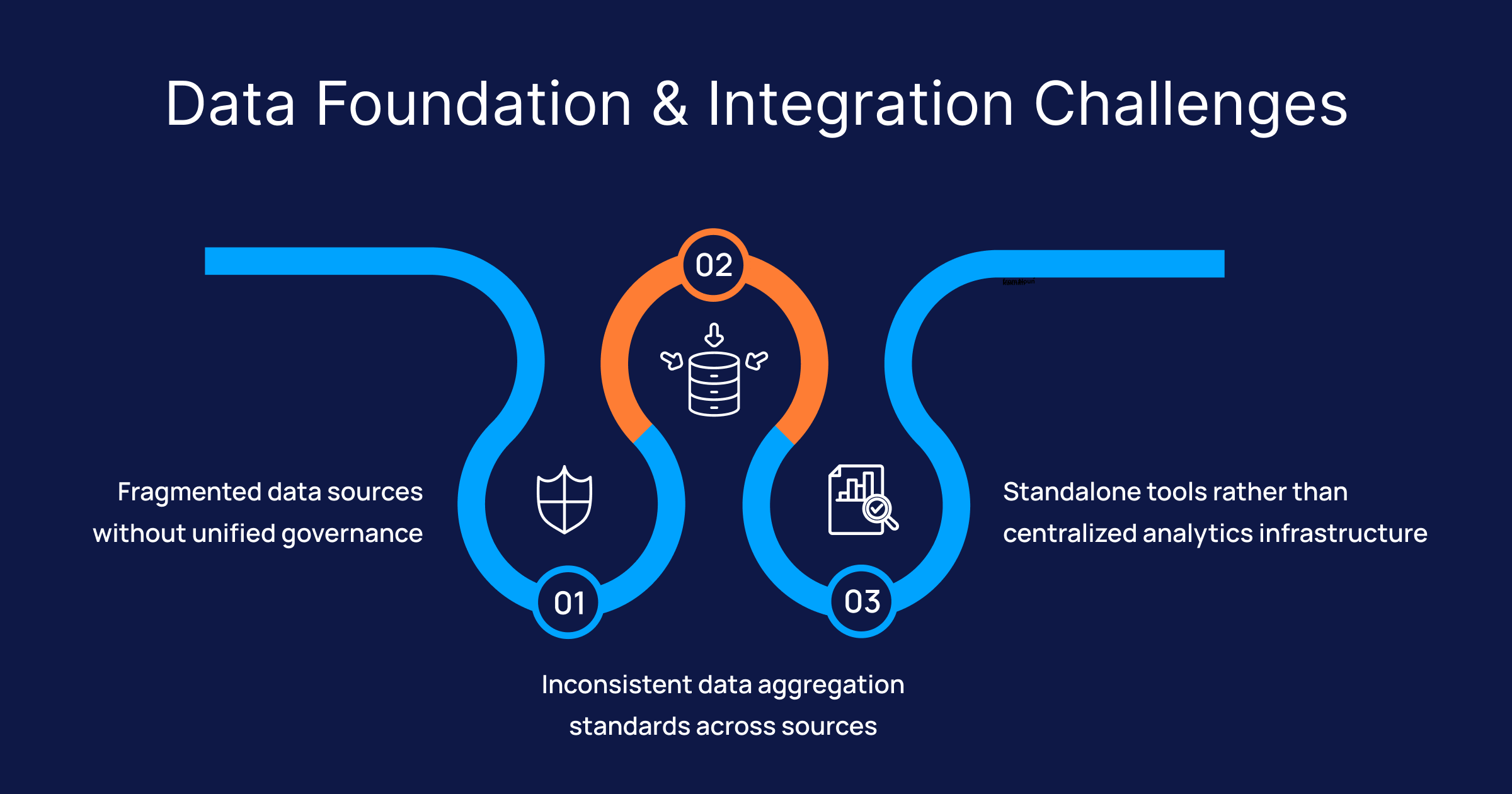
The common blockers are inconsistent patient identity across systems, clinical detail trapped in free text, data quality issues that only surface in motion, and batch pipelines that cannot keep pace with live care. Each has to be addressed in the integration layer before real-time analytics can be trusted.
4.How is data quality handled in real-time analytics?
Validation, deduplication, and enrichment run continuously as events stream through the pipeline rather than during a nightly batch. Malformed values are rejected, duplicate readings from multiple feeds are collapsed, and raw values are given the units, ranges, and encounter context that make them interpretable, all before a model scores them.
5.Is the cost of moving to real-time analytics prohibitive for smaller organizations?
It does not have to be. Smaller organizations rarely need to rebuild everything at once. A focused engagement can target the highest-value data flows first, reuse proven integration accelerators rather than building from scratch, and expand once the approach proves out, which keeps the initial investment proportional to the result.