Picture this: a model was validated, documented, and approved for production use in Q3 2025. It is now Q2 2026. An auditor asks three questions. Is the model running today the same version that was approved? Is it still performing within its validated parameters? Has the data flowing into it changed materially since validation? For most regulated organizations, those three questions expose three separate gaps in their MLOps governance.
The problem is not the initial approval process. Regulated industries have invested in pre-deployment governance: validation reports, risk assessments, and sign-off workflows. What accumulates silently afterward is the production gap. Input distributions shift. Models retrain on updated data. Regulatory thresholds change. Each event widens the distance between the approved system and the live system until the organization cannot reconstruct a coherent audit record of what changed and when.
MLOps for compliance in 2026 is the discipline of closing that gap continuously, not just at deployment time. As the global MLOps market grows toward an estimated $4.38 billion in 2026,[1] the investment is accelerating. However, in many scaling organizations, the governance infrastructure is unable to keep pace with this growth.
Key Takeaways
- The compliance failure point in regulated AI is rarely model approval. It is the gap between approval and the next audit.
- Only 30% of organizations have deployed generative AI to production with governance oversight in place. Fewer than half monitor live systems for drift.
- On April 17, 2026, US banking regulators replaced SR 11-7 with new interagency model risk guidance, explicitly addressing AI and ML model lifecycles.
- LLMOps governance adds categories that standard MLOps frameworks do not cover: prompt versioning, retrieval context logging, and behavioral output monitoring.
- Compliance by design means governance is embedded in the retraining pipeline, not applied as documentation after the fact.
What an MLOps Compliance Framework Actually Requires
A mature MLOps compliance framework covers the full model lifecycle from experimentation to retirement. The components that regulated industries specifically require go beyond standard software engineering practices. AI governance MLOps means each phase of the ML lifecycle produces traceable artifacts that answer the questions regulators ask.
A deployed model in a regulated context generates ongoing obligations. AI compliance monitoring must track whether the model’s outputs remain within its validated behavioral envelope. Model documentation must capture not just what the model does, but what it was trained on, what it was validated against, and who authorized each transition between lifecycle stages. Data lineage in MLOps maps the full provenance of every input dataset: where it originated, how it was transformed, which version fed which training run.
A 2026 compliance analysis exposed a critical vulnerability in enterprise AI adoption: while only 30% of organizations have deployed generative AI with proper governance, fewer than half are actively monitoring live systems for accuracy degradation or behavioral drift.[2] In regulated industries, this monitoring gap is a regulatory exposure. The EU AI Act, now enforcing against high-risk AI systems with penalties reaching USD 39.8 million or 7% of global annual turnover for non-compliance,[3] requires post-market monitoring as a mandatory technical requirement, not a recommended practice.
Sector-Specific Pressure: Healthcare and Banking in 2026
MLOps in regulated industries does not mean the same thing across sectors. Both healthcare and banking require structured model risk management, but the frameworks differ in significant ways.
In pharma and healthcare, the overlay of 21 CFR Part 11, GxP validation, and EU AI Act compliance obligations creates a compliance matrix where every model change requires change-controlled documentation, every retraining event generates a validation record, and AI audit trails must meet tamper-evidence and retention standards across multiple regulatory frameworks simultaneously.
In financial services, April 17, 2026, marked a significant shift: the Federal Reserve, FDIC, and OCC jointly rescinded SR 11-7, OCC 2011-12, FIL-22-2017, and issued new interagency model risk management guidance that explicitly addresses AI and machine learning model lifecycles, third-party AI governance, and the boundary between traditional quantitative models and generative AI systems.[4] The update codifies what auditors were already finding: stale validations, undocumented retraining, and monitoring that flags degradation without triggering formal revalidation are now explicit findings under the revised framework.
For both sectors, the operational expectation converges: governance must be demonstrably active throughout the model’s production life.
Where MLOps and LLMOps Governance Diverge
Traditional predictive models and large language models require different governance approaches. Understanding this distinction matters for organizations deploying both, which in 2026 is the majority of regulated enterprises running production AI.
| Governance Dimension | MLOps (Predictive Models) | LLMOps (Generative AI) |
|---|---|---|
| Drift monitoring | Statistical distribution tracking against the training baseline | Semantic monitoring of output behavior; statistical drift metrics alone are insufficient |
| Explainability | Feature importance, SHAP values, decision paths | Source attribution, retrieval traceability, and reasoning chain logging |
| Security governance | Input validation, access control, model integrity | Also requires prompt injection controls, output content filtering, and agent scope limitation |
LLMOps compliance inherits all the obligations of traditional machine learning governance and adds new categories. LLM governance requires that every output connected to a compliance-relevant decision is reconstructable: prompt version, retrieved context, underlying model version, and any filtering or human review applied before the output was acted upon. For generative AI specifically, explainable AI compliance means source attribution and reasoning chain logging, not just feature importance scores. AI transparency obligations under both the EU AI Act and sector-specific frameworks require that outputs can be explained to a qualified reviewer in terms specific enough to support a legitimate challenge.
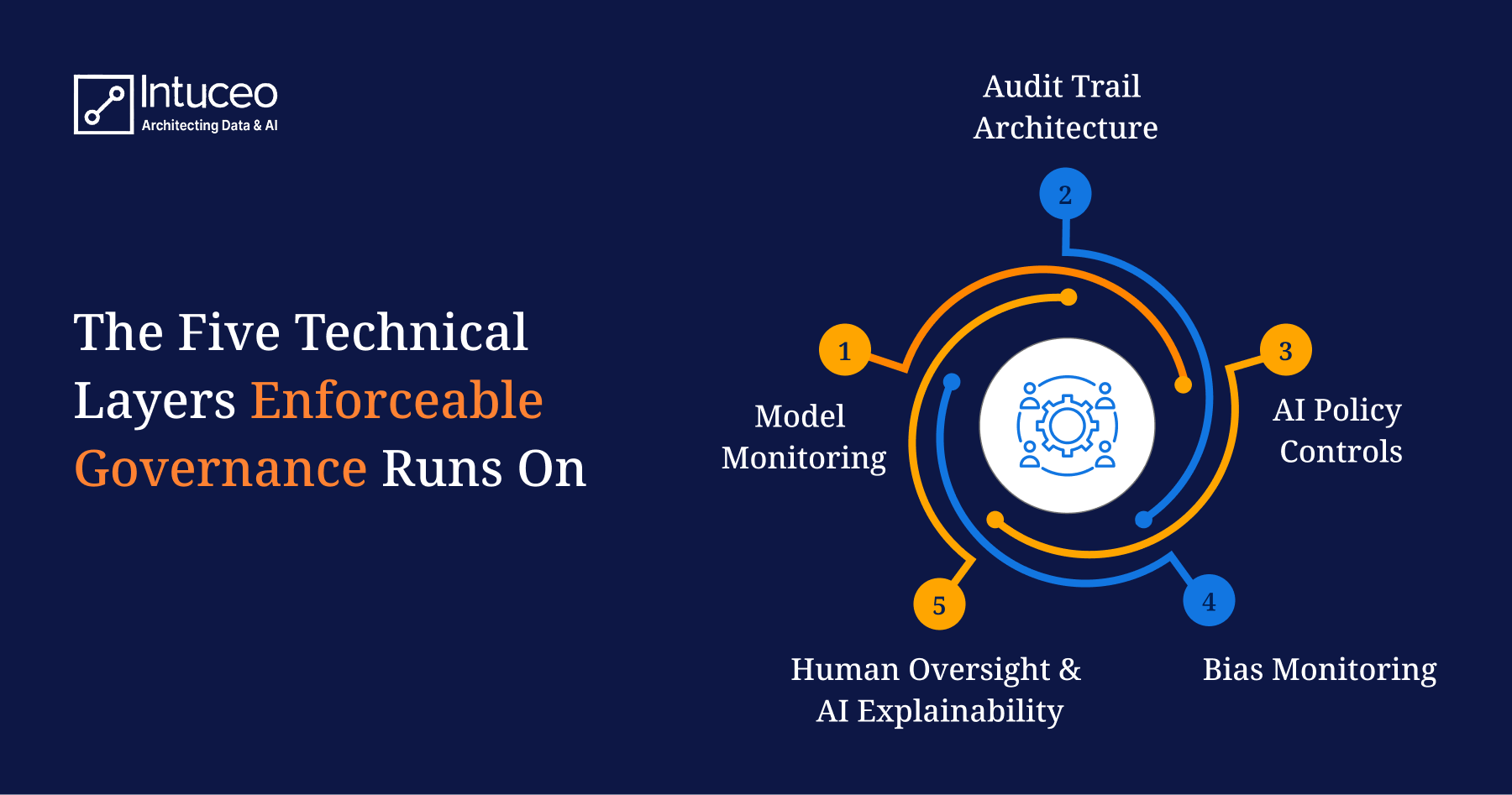
Four Pillars of Production AI Governance That Hold Up Under Audit
AI audit readiness in regulated environments depends on four concurrent capabilities. Together, they define what responsible AI governance looks like when it is operational rather than aspirational.
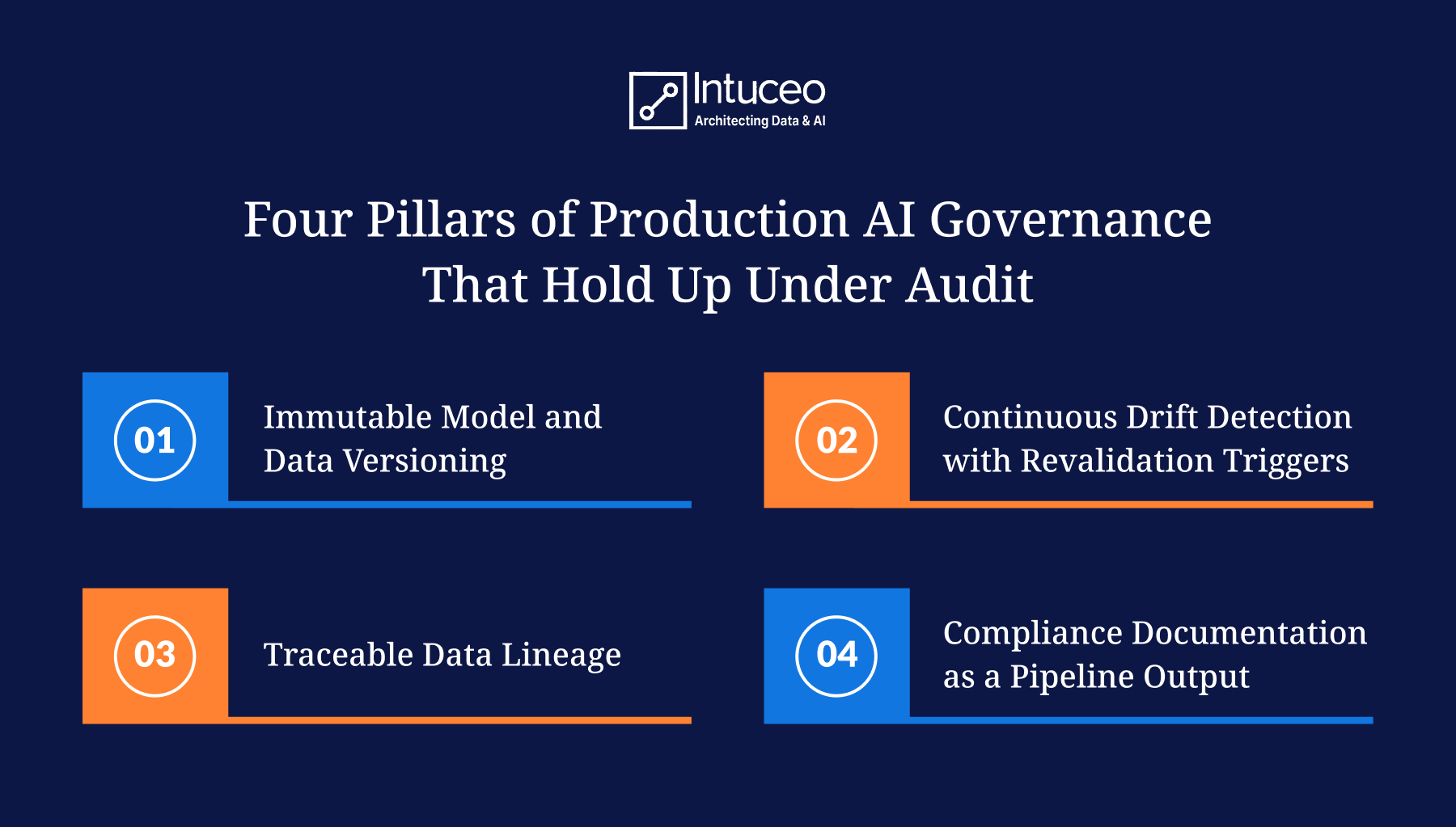
Immutable Model and Data Versioning
Every model artifact and training dataset is version-controlled and immutable once promoted to production. Model documentation survives personnel changes and system migrations. Rollback capability is a must.
Continuous Drift Detection with Revalidation Triggers
AI observability means monitoring both data distributions and model output behavior in real time. In regulated deployments, drift alerts must connect directly to documented revalidation workflows rather than to notification queues without follow-through.
Traceable Data Lineage
AI traceability requires that the complete provenance of every training and inference input is reconstructable at any point in the model’s history. Schema changes, pipeline updates, and new data sources must each generate lineage records.
Compliance Documentation as a Pipeline Output
Compliance by design AI means governance artifacts are generated by the MLOps pipeline itself: validation reports, drift summaries, and approval records produced automatically as model state changes, not assembled manually before a review.
AI compliance automation makes these four pillars self-sustaining. In production AI governance, the test is not whether documentation exists, but whether it was generated at the time of the event rather than reconstructed before an audit. Regulators can distinguish between the two.
The Intuceo Approach
A Continuous Governance Loop, Not a Deployment Checkpoint
Most MLOps teams treat compliance as something that happens before deployment and after an audit finding. Intuceo’s services teams build it as an ongoing loop within the ML lifecycle. The iPDLC™ framework governs every stage of model development and operationalization: from data validation gates and documented training runs through to automated drift monitoring and revalidation triggers built into the retraining pipeline. Compliance documentation is a pipeline output, not a project task.
In regulated engagements across pharma, healthcare, and financial services, Intuceo’s PhD-led data engineers implement data lineage in MLOps architectures that trace every input from source to inference, with metadata structured to meet 21 CFR Part 11, HIPAA, GxP, and EU AI Act technical documentation requirements simultaneously. The Intuceo-Ax™ accelerator carries pre-configured observability and drift detection setups from prior regulated deployments, shortening the engineering time required to stand up compliant monitoring infrastructure in each new engagement.
For organizations running generative AI alongside predictive models, Intuceo’s team designs LLMOps compliance architectures that extend existing audit trail infrastructure to include prompt version logs, retrieval context records, and behavioral output monitoring. The team is the actor. The accelerators speed up the build.
Is Your MLOps Infrastructure Closing Compliance Debt, or Accumulating It?
Intuceo’s services teams assess your current ML lifecycle against the compliance requirements of your regulatory environment and build the continuous governance infrastructure to close the gap.
Frequently Asked Questions
1.How do audit trails work in machine learning?
AI audit trails capture the metadata needed to reconstruct any model decision: model version, training data version, input values, output produced, confidence score, and any human review or override. In regulated environments, these records must be tamper-evident, timestamped, linked to an authenticated action, and retained per applicable regulatory timelines. The audit trail is not a log file. It is a structured record built into the deployment architecture from the start.
2.What is the difference between MLOps governance and LLMOps governance?
Traditional MLOps governance covers model versioning, data provenance, statistical drift monitoring, and performance validation. LLMOps compliance extends this to cover prompt versioning, retrieved context traceability, behavioral output monitoring, and prompt security controls. The key operational difference is that LLMs are non-deterministic; identical inputs can produce different outputs. Revalidation logic cannot rely on performance metrics alone, and AI transparency obligations require source-level attribution rather than aggregate accuracy scores.
3.What documentation do regulators expect for production AI systems?
Across jurisdictions, the expected artifacts converge: a risk classification and intended-use statement, training data provenance, validation results and performance benchmarks, the model governance framework approval chain, change control records for every material retraining event, ongoing drift monitoring reports with evidence of action taken, and human oversight records for decisions where AI outputs informed a regulated outcome. These artifacts should be pipeline outputs, not manually assembled before each review.
4.How do you monitor AI systems in regulated environments without slowing down operations?
AI compliance monitoring in production does not require human review of every inference. Effective monitoring is automated at the statistical and behavioral layers, with human escalation triggered only when defined thresholds are crossed: drift alerts, confidence score anomalies, input pattern exceptions, and output filtering flags. What requires human action is the escalation response, the documented revalidation decision, or the incident record. Separating automated monitoring from human escalation is what allows AI lifecycle management to scale without creating a bottleneck at every inference event.