

Most pharmaceutical organizations now generate real-world evidence. However, only a few have wired it into the daily decisions of clinical, medical, and commercial teams.
In
Deloitte’s latest benchmarking research
, 96% of surveyed biopharma companies described real-world data and evidence (RWD and RWE) as essential to their organizational strategy.1 Strategy decks reflect that conviction. Daily workflows often do not. An epidemiologist runs a study, a slide circulates, and three months later, a brand team makes a payer decision without ever seeing the findings. RWE analytics creates value only when its outputs arrive inside the workflows where protocols are designed, dossiers are assembled, and safety signals are reviewed.
This post examines how pharma teams make that happen: where integration matters most, what blocks it, and the practices that separate evidence generation from evidence that actually changes decisions.
Key Takeaways
- Real-world evidence was identified in roughly a quarter of FDA labeling expansion approvals between 2022 and 2023, making RWE workflow integration a regulatory capability, not just a research one.
- The biggest barriers are upstream of analytics: 70% of biopharma respondents in a recent survey report difficulty accessing the data their AI and analytics work requires.
- Integration succeeds when evidence outputs are embedded at specific decision points in clinical development, medical affairs, market access, and safety, rather than published as standalone studies.
- Common data models, governed self-service analytics, and automated data pipelines are the recurring ingredients in successful real-world evidence implementation.
- Compliance is a design input. HIPAA, 21 CFR Part 11, and GxP expectations must shape data flows from the start, because retrofitting validation onto a live evidence pipeline is far costlier.
Why RWE Analytics Now Lives Inside Daily Pharma Workflows
Regulators moved first. A 2025 study published in Therapeutic Innovation & Regulatory Science found that real-world evidence was identified in 23.3% to 27.7% of FDA labeling expansion approvals each year from 2022 to 2023, with oncology accounting for 43.6% of RWE-supported submissions.[2] When a meaningful share of label decisions involves evidence from claims, registries, and electronic health records, Real World Evidence analytics stops being a side project and becomes part of the submission machinery itself.
Payers and health technology assessment bodies apply similar pressure from the commercial side. They increasingly expect effectiveness data from routine care, not just trial populations, before granting or maintaining favorable access. The consequence is that real-world data pharma teams, once treated as a post-launch afterthought, now feed decisions across the entire asset lifecycle. That shift is precisely what makes pharma workflow integration the harder problem: the evidence has to reach more functions, faster, in formats each one can act on.
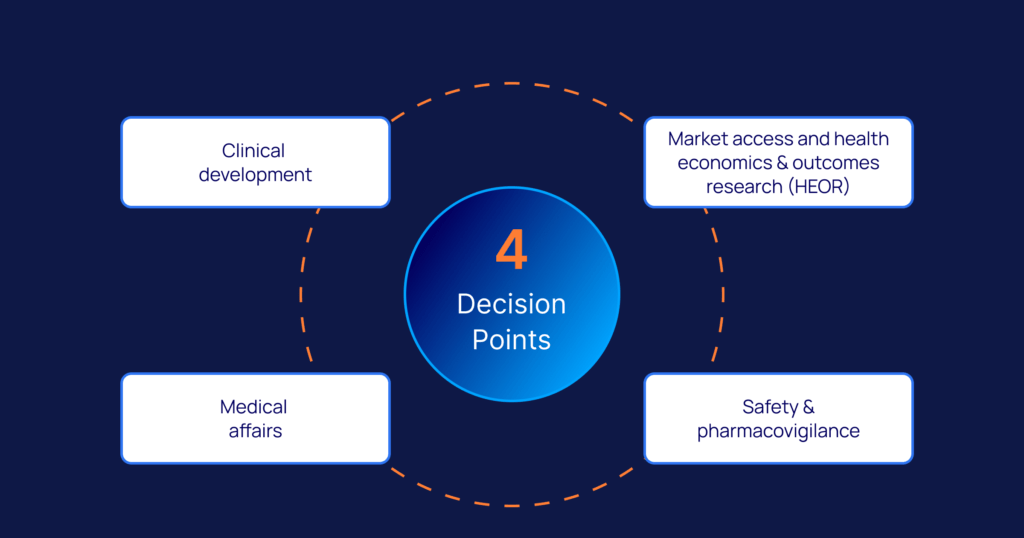
Where Integration Actually Happens: Four Decision Points
Teams that operationalize RWE well do not try to integrate it everywhere at once. They anchor it to specific decisions.
Clinical development
Clinical trial RWE integration typically starts with feasibility and protocol design: using real-world cohorts to test eligibility criteria, size populations, and select sites before a protocol is locked. The payoff can be substantial. PwC documented a pivotal Phase III program in which real-world evidence supported a 40% reduction in the planned sample size and saved roughly six months of development time.3 The same approach helps rare disease programs, where randomized trials are often impractical, by using real-world data to build a comparison group.
Medical affairs
Medical teams use RWE to characterize treatment patterns, unmet needs, and outcomes in subpopulations that trials never enrolled. Integration here means evidence summaries flow into publication planning, advisory board preparation, and field medical materials on a defined cadence, instead of surfacing only when someone remembers to ask.
Market access and health economics and outcomes research (HEOR)
Access teams need comparative effectiveness and cost-of-care analyses timed to payer negotiation windows. When pharmaceutical analytics workflows connect HEOR outputs directly to dossier templates and objection-handling materials, the evidence arrives when the negotiation happens, not a quarter later.
Safety and pharmacovigilance
Post-market surveillance is the longest-standing RWE use case, and the one with the strictest workflow demands. Signal detection across claims and EHR sources must feed case evaluation queues with full traceability, because every output may eventually face regulatory inspection.
The Challenges That Stall Integration
If the destinations are clear, why do so many programs stall between study and decision? The obstacles cluster in three places.
Data access and harmonization come first. In a recent global survey of biopharma scientists and informaticians, 70% of respondents reported difficulty accessing the data needed to support AI and analytics projects, citing siloed systems, manual capture, and aging infrastructure, while only 32% felt confident using their scientific data for AI initiatives.[4] Claims, EHR extracts, registries, and trial data arrive in incompatible schemas, and reconciling them into analysis-ready form consumes the time that was budgeted for analysis itself. RWE data integration tools built on common data models such as Observational Medical Outcomes Partnership (OMOP) help, but only when paired with disciplined curation.
Compliance requirements shape every pipeline. Evidence destined for regulatory use must satisfy HIPAA and applicable privacy law, 21 CFR Part 11 expectations for electronic records, and GxP data integrity principles, including audit trails and validated systems. Teams that treat validation as a final step routinely discover that their tooling cannot demonstrate lineage from source record to published finding.
Organizational seams do quiet damage. Evidence generated in one function rarely crosses into another without explicit ownership, shared definitions, and a delivery cadence. Without those, even well-executed studies become shelfware, and pharma team workflow efficiency degrades into duplicated analyses across departments.
What Workable Integration Looks Like
Across organizations that have made the transition, a consistent set of pharma analytics workflow best practices shows up.
- Standardize the data foundation before scaling use cases. A governed environment where RWD sources land in a common model, with documented provenance, lets every downstream team trust the same numbers. This is the single highest-return investment, because every later use case inherits it.
- Automate the repetitive middle. Pharma data workflow automation applies to ingestion, terminology mapping, cohort refresh, and quality checks, the steps that consume analyst hours without requiring analyst judgment. Automating them shortens the cycle from question to answer and reduces the manual touchpoints that create data integrity risk. Deloitte's lifecycle research found that more than two-thirds of surveyed executives credited recent technology investments with measurable efficiencies in evidence generation, including reduced time to insight.5
- Deliver insights inside existing tools. Embedding governed dashboards and natural language queries into the BI environments teams already use beats asking clinicians and access leads to learn a new system. This is where healthcare analytics workflow thinking carries over directly: the insight must meet the user where the decision happens.
- Assign cross-functional ownership. Integrated evidence planning, where clinical, medical, access, and safety leads agree on the evidence each asset needs and when, converts RWE from a series of requests into a managed portfolio. Pharmaceutical workflow optimization follows naturally once a single plan governs what gets built and who consumes it.
Where Intuceo Fits: Services That Make the Evidence Reach the Decision
Intuceo is a PhD-led AI, ML, and data analytics services firm that has spent years inside regulated pharma and life sciences engagement. Our teams design and build the governed data foundations, harmonization pipelines, and analytics workflows described above, then configure accelerators carried in from prior engagements to shorten deployment.
Intuceo-Ix™ brings semantic search across millions of indexed clinical, regulatory, and research documents so evidence teams find what already exists before commissioning new studies. Intuceo-Ax™, our analytics accelerator, helps non-technical reviewers reach validated insights in a few clicks rather than a few tickets.
Every engagement runs through iPDLC™, our delivery framework for AI development in validated environments, with HIPAA, 21 CFR Part 11, and GxP-aligned CSV practices built into the work from day one. The measure we hold ourselves to is simple: evidence that reaches the protocol decision, the payer meeting, and the safety review, while it can still change the outcome.
Is Your Evidence Reaching Decisions in Time?
Talk to Intuceo’s PhD-led team about a working session on your evidence workflows: where your real-world data sits today, which decisions it should feed, and the shortest validated path between the two.
Frequently Asked Questions
1.How long does it take to integrate RWE analytics into pharma workflows?
A focused first use case, such as feasibility analytics for one therapeutic area, can typically be operational within one to two quarters once data access is secured. Building a governed, multi-source evidence foundation that serves several functions is a 12 to 24-month effort, usually delivered in increments tied to specific decisions.
2.What are the compliance requirements for RWE analytics in pharma workflows?
Programs must address patient privacy obligations such as HIPAA, electronic records and signatures expectations under 21 CFR Part 11, and GxP data integrity principles where outputs support regulated decisions. Validated systems, documented data lineage, and audit trails are the practical expressions of those requirements.
3.How can small pharma teams implement RWE analytics without heavy infrastructure?
Smaller teams generally license curated datasets rather than building data assets, adopt a common data model from the outset, and engage a services team that brings reusable accelerators and configures them to the team’s questions. Scoping to one or two decisions, such as protocol feasibility or a payer dossier, keeps the footprint and cost contained.
4.How does RWE support clinical development and commercialization?
In development, real-world cohorts inform eligibility criteria, sample sizing, site selection, and external control arms. In commercialization, RWE substantiates effectiveness and economic value for payers, supports label expansion submissions, and tracks post-launch outcomes and safety in routine care.
5.What challenges do pharma teams face when integrating RWE analytics?
The most common are fragmented and inconsistently formatted data sources, the effort of harmonizing them into analysis-ready form, validation and audit-trail requirements in regulated contexts, and organizational silos that prevent evidence produced in one function from reaching decisions in another.