Tuesday Aug 11th, 11 AM EST: Live AI Dream Session: Blueprint your enterprise AI strategy with the DARWIN Framework. Reserve your Spot Claim Free Seat

Reserve your Spot

Context-Aware Search for Clinical and Regulatory Documents

Key Takeaways

The Cost of Knowledge That No One Can Find

Whether it is a regulatory affairs lead preparing a submission, a medical writer reconciling a protocol against earlier study reports, or a safety scientist tracing a signal across patient narratives, each needs a specific answer, not a stack of documents to open and read. The McKinsey Global Institute estimated that interaction workers spend close to 20% of their workweek simply looking for internal information.[1] In clinical research, this internal corpus is massive and continuously growing.
In 2024, ClinicalTrials.gov crossed the milestone of 500,000 registered studies.[2] Yet, for an individual sponsor, each of those entries represents an expansive web of internal protocols, amendments, clinical study reports (CSRs), safety narratives, and relevant FDA guidance documents. What a clinical or regulatory team must actually search through is far larger than any public registry count suggests and almost none of it is arranged for a traditional keyword query to answer.
Conventional search indexes words, meaning it only retrieves a file when the exact query string appears in the text. That model breaks down in clinical environments for three fundamental reasons:
This is how pharma document search context gets lost, and why teams keep falling back on tribal knowledge relying on whoever happens to remember where things are.

What Context-Aware Search Actually Does

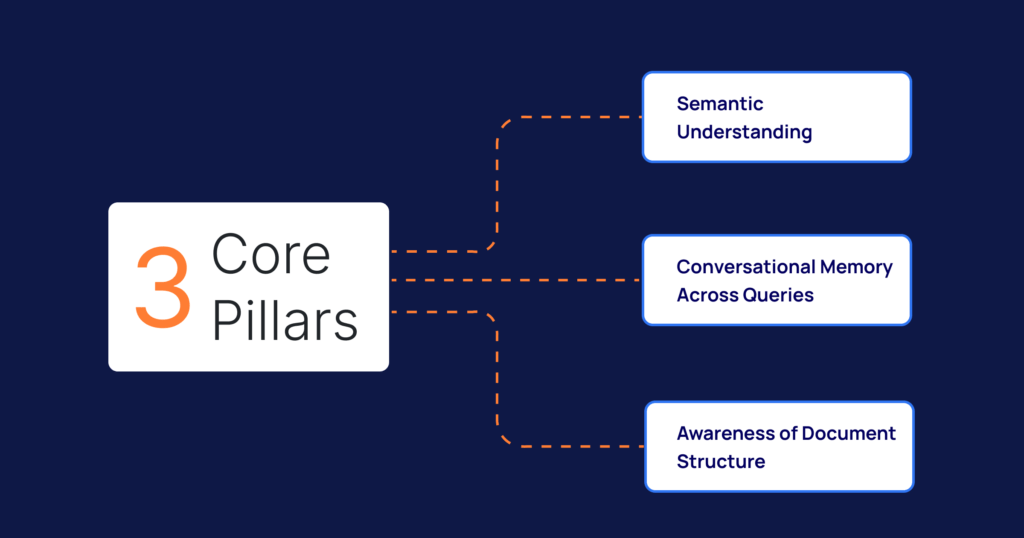
The capability that enterprise buyers now look for under the banner of clinical trial intelligence rests on three core pillars that keyword indexing lacks.

Semantic Understanding

Rather than matching literal characters, semantic retrieval represents text as mathematical vectors that capture conceptual meaning. Consequently, a query about “injection-site reactions” surfaces a narrative describing “redness and swelling at the administration site,” even when that exact phrase never appears. For regulatory document search AI, this closes the gap between how a question is asked and how the source data was written. It is the very foundation that makes context-aware search for clinical documents possible.

Conversational Memory Across Queries

Clinical questions rarely arrive in isolation. A reviewer might ask about an inclusion criterion, then how it changed across amendments, and finally, query the rationale behind that change. Conversational search for regulatory filings keeps that thread intact, allowing each follow-up to refine the last instead of starting over. Carrying conversational context across multiple research queries is what separates a usable AI assistant from a single-shot search box.

Awareness of Document Structure

A protocol, a CSR, a safety report, and an FDA guidance document are all organized fundamentally differently. A system that understands those structures can intelligently route a question about endpoints to the right section and distinguish a regulatory requirement from a study-specific choice. That structural awareness underpins reliable clinical trial protocol analysis AI and accurate clinical document extraction.

Grounding Answers with Retrieval-Augmented Generation

A large language model (LLM) on its own can produce fluent text that is anchored to nothing. Retrieval-augmented generation (RAG) changes that. The system retrieves relevant passages first, then asks the model to answer the query using only that retrieved evidence, complete with citations back to the original text. For RAG in clinical question answering, this traceability is the entire point. An answer that links to a specific paragraph in a protocol or guidance document can be easily checked; an unsourced answer cannot.
Crucially, grounding reduces error without removing it entirely. A 2025 framework evaluated LLM clinical summaries against more than 12,000 clinician-annotated sentences and measured a 1.47% hallucination rate alongside a 3.45% omission rate.[3] While the figures may seem small, in regulated industries, a single fabricated or missing fact carries severe consequences. Therefore, clinical data retrieval-augmented generation belongs inside a workflow that verifies model output against authoritative sources and keeps a qualified reviewer in the loop, rather than one that treats the AI’s answer as final.

Why FDA-Regulated Work Needs Governed Deployment

Public chatbots are entirely unsuitable for confidential trial data and regulatory submissions. Two common questions enterprise teams ask – how to run a general assistant locally for FDA-regulated studies and whether an assistant can search regulatory submission documents safely – point to the same requirement. The data must remain in a controlled environment, model behavior must be auditable, and no data should ever be used to train an outside model.
Effective regulatory submission document management under these constraints means deployment that satisfies 21 CFR Part 11 (Electronic Records; Electronic Signatures), good practice quality regulations (GxP), and the Health Insurance Portability and Accountability Act (HIPAA), complete with strict access controls and a comprehensive audit trail. A regulatory affairs document search tool that cannot produce that trail does not belong near a submission.
Verification follows the same logic. An FDA guidance document search is most useful when the system can hold current federal guidelines alongside a sponsor’s own documents and show exactly where the two agree or diverge, allowing a reviewer to confidently confirm an answer.

Public Registries and Internal Documents are Different Problems

Teams often ask which tools best search a clinical trial registry and PubMed together to find matching studies. Public sources, such as ClinicalTrials.gov and published literature, are open, broadly structured, and shared across the industry, so retrieval there is mostly a question of coverage and precision. Internal protocols, submissions, and safety files are the exact opposite: they are confidential, inconsistently formatted, and specific to one sponsor. A question answered from public regulatory databases and the same question answered from internal clinical documents can return very different results, and a reviewer usually needs both.
The practical aim is to connect the two, enabling an AI assistant to place a sponsor’s own evidence next to the public record and the relevant guidance, instead of forcing a researcher to query three disparate systems and stitch the results together by hand. That connection also speeds everyday work, such as matching a new study against prior trial designs or screening the literature for precedent ahead of a submission, because the search reasons across sources rather than treating each as a separate silo.

From Protocols to Safety Signals

One unified foundation supports several tasks that regulatory and clinical teams run every day. Reviewers compare a draft protocol against precedent and guidance. Medical writers reconcile language across study documents. Safety teams apply adverse event detection AI to surface candidate signals from narratives and reports for expert adjudication – not to replace it.
None of this removes the expert. Instead, it removes the hours spent locating the evidence the expert needs, shifting the focus to finding and connecting evidence quickly, and leaving critical clinical judgment to humans.

How Intuceo Approaches Clinical and Regulatory Search

Intuceo is a services firm that designs and delivers these capabilities as a tailored engagement, not as off-the-shelf software. Its teams bring proven proprietary accelerators built and hardened on earlier regulated programs, which significantly shortens the path from raw documents to a working, governed search experience.
Delivery runs through iPDLC™, Intuceo’s project methodology, inside environments fully aligned to 21 CFR Part 11, HIPAA, HITRUST, and SOC 2 Type II standards. This is the same rigorous approach the firm has applied in collaborations with reputed organizations.

Search with context. Submit with confidence.

Unified search across protocols, CSRs, and FDA guidance – fully deployed within your GxP and 21 CFR Part 11 boundaries.

Frequently Asked Questions

They can extract a great deal when paired with robust retrieval and verification mechanisms, but accuracy varies by model and document type. Residual hallucination and omission rates mean expert human review remains essential for regulated use.
The best approach is to deploy a system with conversational memory that carries entities and prior answers forward, ensuring each follow-up question refines the thread rather than restarting the search.
Ground answers in retrieval require strict citations to the source passage, and keep current guidance indexed alongside internal documents so a reviewer can confirm each claim against the original text.
Yes. Retrieval-augmented generation is best suited for this work because it ties each answer directly to the source text, which is precisely what regulated review requires.
By deploying it within a controlled, on-premises or private cloud environment with strict access controls and audit logging, while verifying that no data is used to train external models.

How Pharma Teams Integrate RWE Analytics into Workflows

Most pharmaceutical organizations now generate real-world evidence. However, only a few have wired it into the daily decisions of clinical, medical, and commercial teams.
In Deloitte’s latest benchmarking research , 96% of surveyed biopharma companies described real-world data and evidence (RWD and RWE)  as essential to their organizational strategy.1 Strategy decks reflect that conviction. Daily workflows often do not. An epidemiologist runs a study, a slide circulates, and three months later, a brand team makes a payer decision without ever seeing the findings. RWE analytics creates value only when its outputs arrive inside the workflows where protocols are designed, dossiers are assembled, and safety signals are reviewed.
This post examines how pharma teams make that happen: where integration matters most, what blocks it, and the practices that separate evidence generation from evidence that actually changes decisions.

Key Takeaways

Why RWE Analytics Now Lives Inside Daily Pharma Workflows

Regulators moved first. A 2025 study published in Therapeutic Innovation & Regulatory Science found that real-world evidence was identified in 23.3% to 27.7% of FDA labeling expansion approvals each year from 2022 to 2023, with oncology accounting for 43.6% of RWE-supported submissions.[2] When a meaningful share of label decisions involves evidence from claims, registries, and electronic health records, Real World Evidence analytics stops being a side project and becomes part of the submission machinery itself.
Payers and health technology assessment bodies apply similar pressure from the commercial side. They increasingly expect effectiveness data from routine care, not just trial populations, before granting or maintaining favorable access. The consequence is that real-world data pharma teams, once treated as a post-launch afterthought, now feed decisions across the entire asset lifecycle. That shift is precisely what makes pharma workflow integration the harder problem: the evidence has to reach more functions, faster, in formats each one can act on.

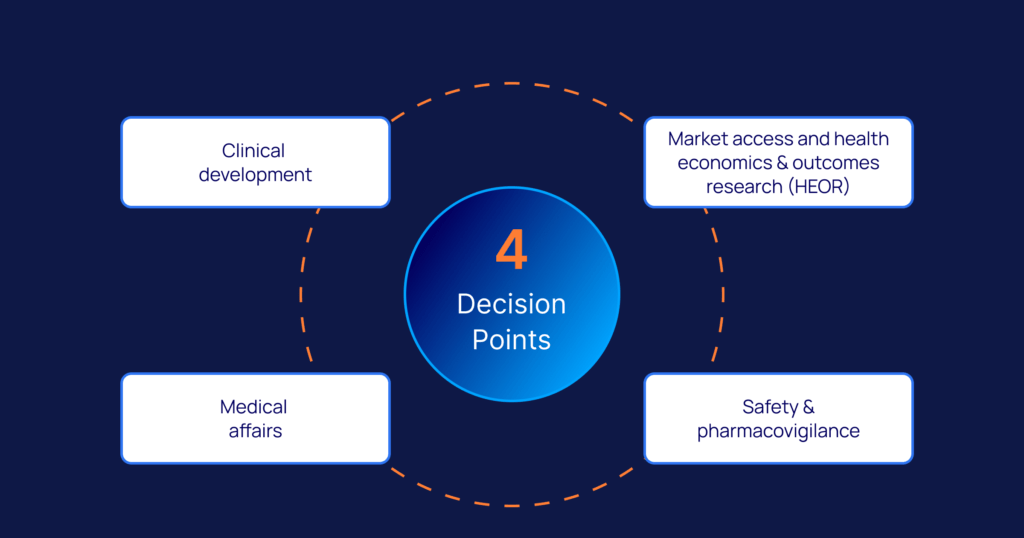
Where Integration Actually Happens: Four Decision Points

Teams that operationalize RWE well do not try to integrate it everywhere at once. They anchor it to specific decisions.

Clinical development

Clinical trial RWE integration typically starts with feasibility and protocol design: using real-world cohorts to test eligibility criteria, size populations, and select sites before a protocol is locked. The payoff can be substantial. PwC documented a pivotal Phase III program in which real-world evidence supported a 40% reduction in the planned sample size and saved roughly six months of development time.3 The same approach helps rare disease programs, where randomized trials are often impractical, by using real-world data to build a comparison group.

Medical affairs

Medical teams use RWE to characterize treatment patterns, unmet needs, and outcomes in subpopulations that trials never enrolled. Integration here means evidence summaries flow into publication planning, advisory board preparation, and field medical materials on a defined cadence, instead of surfacing only when someone remembers to ask.

Market access and health economics and outcomes research (HEOR)

Access teams need comparative effectiveness and cost-of-care analyses timed to payer negotiation windows. When pharmaceutical analytics workflows connect HEOR outputs directly to dossier templates and objection-handling materials, the evidence arrives when the negotiation happens, not a quarter later.

Safety and pharmacovigilance

Post-market surveillance is the longest-standing RWE use case, and the one with the strictest workflow demands. Signal detection across claims and EHR sources must feed case evaluation queues with full traceability, because every output may eventually face regulatory inspection.

The Challenges That Stall Integration

If the destinations are clear, why do so many programs stall between study and decision? The obstacles cluster in three places.
Data access and harmonization come first. In a recent global survey of biopharma scientists and informaticians, 70% of respondents reported difficulty accessing the data needed to support AI and analytics projects, citing siloed systems, manual capture, and aging infrastructure, while only 32% felt confident using their scientific data for AI initiatives.[4] Claims, EHR extracts, registries, and trial data arrive in incompatible schemas, and reconciling them into analysis-ready form consumes the time that was budgeted for analysis itself. RWE data integration tools built on common data models such as Observational Medical Outcomes Partnership (OMOP) help, but only when paired with disciplined curation.
Compliance requirements shape every pipeline. Evidence destined for regulatory use must satisfy HIPAA and applicable privacy law, 21 CFR Part 11 expectations for electronic records, and GxP data integrity principles, including audit trails and validated systems. Teams that treat validation as a final step routinely discover that their tooling cannot demonstrate lineage from source record to published finding.
Organizational seams do quiet damage. Evidence generated in one function rarely crosses into another without explicit ownership, shared definitions, and a delivery cadence. Without those, even well-executed studies become shelfware, and pharma team workflow efficiency degrades into duplicated analyses across departments.

What Workable Integration Looks Like

Across organizations that have made the transition, a consistent set of pharma analytics workflow best practices shows up.

Where Intuceo Fits: Services That Make the Evidence Reach the Decision

Intuceo is a PhD-led AI, ML, and data analytics services firm that has spent years inside regulated pharma and life sciences engagement. Our teams design and build the governed data foundations, harmonization pipelines, and analytics workflows described above, then configure accelerators carried in from prior engagements to shorten deployment.
Intuceo-Ix™ brings semantic search across millions of indexed clinical, regulatory, and research documents so evidence teams find what already exists before commissioning new studies. Intuceo-Ax™, our analytics accelerator, helps non-technical reviewers reach validated insights in a few clicks rather than a few tickets.
Every engagement runs through iPDLC™, our delivery framework for AI development in validated environments, with HIPAA, 21 CFR Part 11, and GxP-aligned CSV practices built into the work from day one. The measure we hold ourselves to is simple: evidence that reaches the protocol decision, the payer meeting, and the safety review, while it can still change the outcome.

Is Your Evidence Reaching Decisions in Time?

Talk to Intuceo’s PhD-led team about a working session on your evidence workflows: where your real-world data sits today, which decisions it should feed, and the shortest validated path between the two.

Frequently Asked Questions

A focused first use case, such as feasibility analytics for one therapeutic area, can typically be operational within one to two quarters once data access is secured. Building a governed, multi-source evidence foundation that serves several functions is a 12 to 24-month effort, usually delivered in increments tied to specific decisions.
Programs must address patient privacy obligations such as HIPAA, electronic records and signatures expectations under 21 CFR Part 11, and GxP data integrity principles where outputs support regulated decisions. Validated systems, documented data lineage, and audit trails are the practical expressions of those requirements.
Smaller teams generally license curated datasets rather than building data assets, adopt a common data model from the outset, and engage a services team that brings reusable accelerators and configures them to the team’s questions. Scoping to one or two decisions, such as protocol feasibility or a payer dossier, keeps the footprint and cost contained.

In development, real-world cohorts inform eligibility criteria, sample sizing, site selection, and external control arms. In commercialization, RWE substantiates effectiveness and economic value for payers, supports label expansion submissions, and tracks post-launch outcomes and safety in routine care.

The most common are fragmented and inconsistently formatted data sources, the effort of harmonizing them into analysis-ready form, validation and audit-trail requirements in regulated contexts, and organizational silos that prevent evidence produced in one function from reaching decisions in another.

Why Pharma Analytics Teams Struggle to Scale Augmented Analytics Experiments

Why Pharma Analytics Teams Struggle to Scale Augmented Analytics Experiments

For most pharmaceutical analytics leaders, the celebration after a successful pilot project is short-lived.
It is relatively easy for a talented data team to build a convincing proof of concept – a targeted model that flags an adverse event faster, or a sleek commercial dashboard that answers questions in plain language to impress a steering committee. The real friction begins exactly twelve months later, when that same pilot is expected to run reliably across different regional markets, therapeutic areas, and highly regulated business units.
This bottleneck isn’t just an internal frustration; it reflects a massive global disconnect between digital intent and operational reality. While the global augmented analytics market is on track to rocket from USD 16.60 billion in 2023 to nearly USD 97.87 billion by 2030,1 organizations are finding that buying the technology is the easy part. McKinsey’s recent global benchmarking data shows that while a staggering 88% of organizations have successfully deployed AI within at least one business function, only about a third have managed to scale those capabilities across the wider enterprise
In the strictly regulated domain of life sciences, that execution gap is wider still.

Augmented Analytics: The promise, and the plateau

Augmented analytics uses machine learning and natural language processing to automate data preparation, surface patterns automatically, and let people question data in plain language. Today, this paradigm increasingly leverages Generative AI to provide fluid, conversational interfaces, turning what used to be complex database querying into a simple dialogue. For pharma, that transformation is highly practical: it means a clinical operations lead can interrogate trial site performance without writing a line of code, or a commercial team can test a complex market scenario without joining a three-week analyst queue.
The difficulty is the plateau that follows. Scaling analytics experiments is a completely different discipline from building them. A pilot succeeds in a controlled setting, with meticulously curated data and a highly motivated sponsor. Scale, however, demands messy production data, hundreds of simultaneous users, strict audit trails, and financial outcomes that a corporate finance team will defend. This is the underlying reason pharma analytics AI adoption so often stops at the demo.

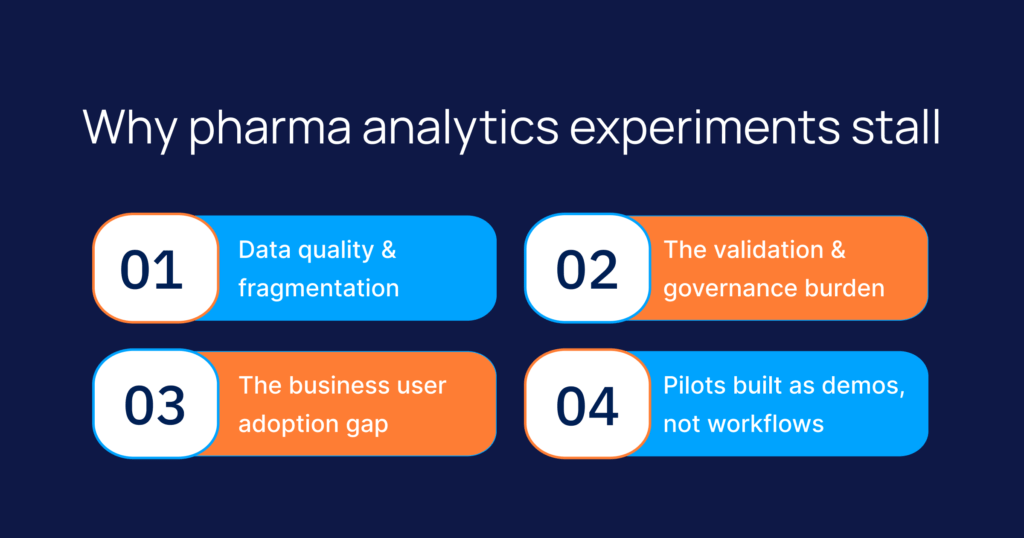
Why pharma analytics experiments stall

Several forces compound at the same point in a program. Understanding them is the first step to explaining why AI pilots fail in pharma.

Data quality and fragmentation

Pharma data lives in silos: laboratory information systems, clinical trial databases, manufacturing execution records, safety systems, and commercial CRM systems, much of it unstructured. Industry data consistently shows that data scientists spend nearly half their working hours cleaning and preparing data rather than analyzing it. In pharma, this friction multiplies exponentially because regulated datasets cannot rely on approximations or ‘good enough’ data patches; a single missing data lineage link can invalidate a clinical report.

The validation and governance burden

A consumer analytics tool can ship and iterate. A regulated one cannot. Any insight that informs a clinical, safety, or manufacturing decision may need to be validated, traceable, and defensible to an auditor. Without regulated industry AI governance built in from the start, teams reach the pilot-to-production line only to find their experiment has no data lineage, no explainability, and no audit trail. Retrofitting those controls often costs more than the pilot did.

The business user adoption gap

Augmented analytics scales only when the people who make decisions actually use it. Yet many tools are designed for data teams, not for the clinical, regulatory, and commercial users who need the answers. When business user analytics adoption stays low, the experiment never leaves the analytics group and never changes how the business runs. Conversational analytics for pharma, where a user asks a question in everyday language and receives a defensible answer, is the bridge, but only when the interface fits the way that user already works.

Pilots built as demos, not workflows

When an enterprise solution is built to look good in a presentation rather than survive the realities of daily operations, failure is inevitable. This operational fragility explains why Gartner predicts that at least 30% of generative AI projects will be abandoned after proof of concept by the end of 2025. Because GenAI increasingly serves as the primary user interface for modern augmented analytics platforms, its high abandonment rate directly impacts the broader analytics ecosystem. Gartner points to poor data quality, inadequate risk controls, escalating costs, and unclear business value as the primary drivers of this collapse.
The common thread across these failures is not the underlying model itself; it is the infrastructure and conditions around it. Enterprise AI in life sciences fails in the exact same way. A pilot engineered solely to impress a steering committee in a boardroom is fundamentally different from a system engineered to scale securely across a global enterprise.

From experiment to enterprise impact

Moving from experimentation to enterprise-wide impact has less to do with a better model and more to do with a repeatable method. Teams that scale tend to do a few things differently. They start with a single high-value decision rather than a broad capability. They build governance, validation, and data lineage into the experiment instead of bolting them on afterward. They design for the business user from day one. And they treat the pilot as the first production increment, not a throwaway proof.
This is also where AI decision support in life sciences earns its place. Decision support that surfaces an insight quickly, shows the data behind it, and records how it was derived can be trusted, audited, and adopted. Decision support that produces an answer no one can explain will not survive a regulatory review, let alone reach scale.

How Intuceo helps pharma teams scale

Intuceo is a PhD-led AI, ML, and data analytics services firm that works inside regulated industries, including pharma and life sciences. The work is not about selling a tool. It is about delivering the method and the engineering that move an analytics experiment into dependable enterprise use.
Intuceo-Ax, the firm’s augmented analytics accelerator, is built to speed deployment rather than start every build from zero. It automates data preparation, supports what-if exploration, and lets non-technical leaders navigate deep KPIs in as few as three clicks, which speaks directly to the business user adoption gap. Because it draws on patterns proven in prior pharma engagements, teams skip much of the trial and error that stalls a first attempt.
Governance is engineered in, not added later. Intuceo applies a Regulated-by-Design approach: automated data profiling and anomaly detection at the source, immutable lineage for forensic traceability, and explainability frameworks with bias detection and model cards reviewed by a PhD-led Board of Science. These controls are pre-vetted against FDA 21 CFR Part 11, HIPAA, GxP, SOC 2 Type II, and FISMA requirements, giving regulated AI governance a concrete foundation.
The firm’s iPDLC framework gives experiments a defined route from concept to validated production, the step most pilots are missing. Across more than 100 life sciences engagements over 14-plus years, including work for organizations such as Janssen and Ferring, Intuceo has engineered solutions like a universal search capability that indexes over 5 million R&D documents, turning dormant knowledge into usable insight. Engagements run on fixed-bid and budgeted models, so clients pay for outcomes rather than activity.

Ready to Move from Pilot to Production?

Don’t let a promising experiment stop at the demo phase. Intuceo builds compliance, data lineage, and user adoption directly into your pipelines from day one.
  • Regulated-by-Design: Pre-vetted compliance (FDA 21 CFR Part 11, GxP, HIPAA) built in, not bolted on.
  • Proven iPDLC Framework: A predictable path from concept to an audited, enterprise-scale project.
  • Outcome-Based Models: Fixed-bid structures so you pay for impact, not activity.

Frequently Asked Questions

Most fail at integration, not at the model. Pilots run on curated data with a motivated sponsor, then meet fragmented production data, low business user adoption, and validation requirements they were never designed to satisfy. The experiment works in isolation but cannot connect to the workflows and controls that real scale demands.
By treating scale as a method rather than a milestone. That means starting with one high-value decision, building governance and data lineage into the experiment from the start, designing for the business user, and running the pilot as the first production increment. A defined lifecycle, such as Intuceo’s iPDLC, gives that progression a repeatable structure.
At minimum: validated data quality, immutable lineage so any insight can be traced to its source, explainability so outputs can be defended, and bias detection and model documentation. These should map to standards such as FDA 21 CFR Part 11, HIPAA, GxP, and SOC 2 Type II, and should be present before a pilot is asked to inform a regulated decision.

Automate the repeatable work, data profiling, preparation, and anomaly detection, while keeping validation and audit trails intact. Automation that records what it did and why preserves the defensibility a regulated environment requires, and frees analysts to spend time on interpretation rather than cleaning data.

Meet users in their own workflow and language. Conversational analytics that let a clinical or commercial user ask a question and receive a clear, sourced answer removes the dependency on a specialist queue. Adoption follows when the interface is simple, the answer is trustworthy, and the path to that answer is short.

Why Enterprise Search Tools Miss Context in Clinical and Regulatory Documents

Enterprise search in the life sciences promises to unlock critical clinical and regulatory knowledge. The reality is a high-stakes bottleneck. A typical platform might return hundreds of results for a single pharmacovigilance query, only to bury a critical safety signal on page twelve because it cannot distinguish “cardiac toxicity” (a clinical finding) from “cardiac monitor” (a medical device).
The search technically works. The retrieval is functionally useless.
This isn’t just a failure of relevance ranking; it’s an architectural limitation. Clinical trial protocols, regulatory submissions, and safety filings carry a density of synonyms, abbreviations, and context-dependent terminology that standard keyword searches were never built to interpret. When missing a single document means a delayed IND submission or an unreported adverse event, the gap between “searching” and “finding” transitions from a minor IT nuisance into a severe compliance and operational liability.

Why Do Enterprise Search Tools Fail on Clinical Trial Documents?

The root cause is a fundamental mismatch between how these tools work and how clinical knowledge is structured. Traditional enterprise search platforms rely on keyword matching and Boolean logic. They index words, not meaning. When a researcher queries “treatment-emergent adverse events,” the system matches those exact tokens. It does not understand that “TEAEs,” “treatment-related AEs,” or “drug-induced side effects” refer to the same concept.
Clinical and regulatory documents compound this problem in several ways. First, medical terminology is dense with synonyms, abbreviations, and acronymic variations. A single condition like myocardial infarction might appear as “MI,” “heart attack,” “acute coronary syndrome,” or “STEMI” across different documents in the same repository. According to the National Library of Medicine, the UMLS Metathesaurus alone maps over 4.4 million concept names across more than 200 source vocabularies. No keyword index can account for this breadth of terminology without a contextual layer.
Second, regulatory submissions follow rigid structural conventions (ICH CTD format, eCTD modules) where identical terms carry different meanings depending on the section. “Safety” in Module 2.7 (Clinical Summary) refers to patient-level adverse event data. “Safety” in Module 3.2 (Quality) refers to product stability testing. A keyword search treats both identically.

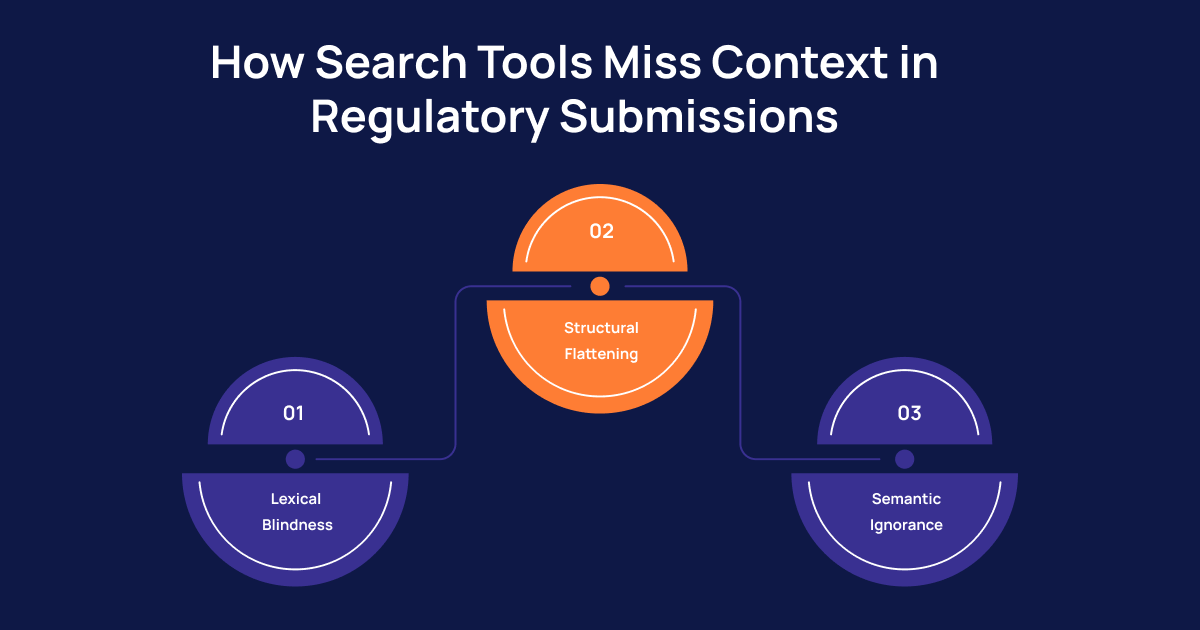
How Search Tools Miss Context in Regulatory Submissions

Context loss in standard regulatory document search occurs at three distinct levels:

Why Is Metadata Not Enough for Document Retrieval in Regulated Industries?

A common response to search failures is to invest in better metadata tagging. While metadata improves filtering (by document type, study phase, therapeutic area), it cannot solve the core document retrieval problem for two reasons.
First, the volume and velocity of unstructured data in pharma R&D make comprehensive manual tagging impractical. Today, an estimated 80% to 90% of all enterprise data is unstructured. For a mid-size pharma company managing thousands of clinical study reports, investigator brochures, and post-market surveillance filings, maintaining accurate metadata at scale is a resource drain that never reaches completeness.
Second, metadata captures attributes (author, date, document type) but not meaning. A metadata tag can label a document as “Phase III Clinical Study Report.” It cannot tell you whether that report contains a specific subgroup analysis for patients over 65 with renal impairment. The actual intelligence lives in the unstructured narrative, tables, and appendices within the document.

The Shift from Keyword Search to Semantic Search in Healthcare Documents

Semantic search for pharma represents a foundational shift in how clinical document search operates. Instead of matching tokens, semantic engines use vector embeddings to represent the meaning of queries and document passages in a shared mathematical space. A query for “cardiac safety signals in elderly patients” retrieves passages about “cardiovascular adverse events in geriatric populations” because the underlying meaning vectors are proximate, even though no keywords overlap.
This approach directly addresses the synonym, abbreviation, and contextual challenges that break keyword search. When combined with domain-specific training on medical ontologies (MedDRA, SNOMED CT, WHO-ART), semantic retrieval healthcare systems achieve significantly higher precision and recall on clinical corpora than general-purpose search tools.
RAG for life sciences (Retrieval-Augmented Generation) takes this further. A RAG architecture pairs semantic retrieval with a generative model that can synthesize answers grounded in the retrieved source documents. Instead of returning a list of 2,000 links, the system returns a direct answer: “Cardiac toxicity signals were observed in Study XYZ-301 (Module 5.3.5.3), primarily in patients aged 65+ with pre-existing QTc prolongation. See Table 14.3.1 for incidence rates.” The answer includes traceable citations back to the source, which is critical for GxP compliance and audit readiness.

How Intuceo Solves Contextual Search for Clinical and Regulatory Content

Intuceo’s approach to AI search in healthcare is built on a simple reality: generic enterprise search was never designed for the complexity of regulated content. Through two proprietary, modular engines, Intuceo delivers contextual search for regulated content at scale.

Intuceo-Ix™: Neural Search Intelligence (The Discovery Layer)

Intuceo-Ix™ goes beyond keyword matching to provide Neural Semantic Discovery. It understands the true context of clinical papers, regulatory submissions, FDA filings, and patent documents—reducing information retrieval time by 70%.

Intuceo-Dx™: Document and Vision Intelligence (The Ingestion Layer)

Intuceo-Dx™ addresses the critical upstream problem: converting complex, unstructured clinical documentation into structured, searchable “Gold Records.”

Built for Regulated Environments

Both Ix and Dx are deployable in air-gapped, on-premise, or private cloud environments (IL5/FedRAMP-ready). No proprietary data is used to train public models. This sovereign architecture, combined with compliance alignment for HIPAA, GxP, and 21 CFR Part 11, makes Intuceo’s document intelligence for pharma suitable for the most security-sensitive life sciences organizations.

Conclusion

The gap between what enterprise search tools deliver and what life sciences organizations actually need is not a minor inconvenience. It is a structural problem that affects research velocity, regulatory compliance timelines, and the quality of safety decisions. Keyword matching was built for general corporate content, not for the terminological density, structural complexity, and compliance rigor of clinical trial document retrieval and regulatory document search.
Closing this gap requires a shift to semantic search for life sciences, purpose-built for the domain, deployed in compliant environments, and architected to deliver traceable, contextual answers rather than keyword-matched links. For organizations ready to make that shift, the difference is not incremental. It is the difference between searching for information and actually finding it.

See How Intuceo Transforms Clinical Document Search

Discover how Intuceo-Ix™ and Intuceo-Dx™ reduce information retrieval time by 70% across millions of clinical and regulatory documents, all within HIPAA and GxP-compliant environments.

Frequently Asked Questions

Keyword search matches exact terms in a query against indexed tokens in a document. Semantic search for life sciences uses vector embeddings to match the meaning of a query to the meaning of document passages, enabling accurate retrieval even when the exact words differ. This is critical for medical terminology search, where synonyms, abbreviations, and acronyms are pervasive.
AI-powered semantic retrieval healthcare systems are trained on domain-specific ontologies such as MedDRA, SNOMED CT, and UMLS. This training allows the system to recognize that “MI,” “myocardial infarction,” and “heart attack” refer to the same clinical concept, enabling synonym matching in medical documents that keyword engines cannot achieve.
Most conventional systems do not handle them well. Abbreviations like “AE” (adverse event), “SAE” (serious adverse event), and “TEAE” (treatment-emergent adverse event) are either missed or conflated with unrelated acronyms. Neural search systems trained on life sciences corpora resolve these abbreviations contextually, based on the surrounding text and document type.
Three elements drive improvement: domain-specific model fine-tuning on clinical and regulatory corpora, integration with established medical ontologies for entity resolution, and a RAG for life sciences architecture that grounds every retrieved result in verifiable source documents. This combination ensures both precision and auditability.
Irrelevant results stem from three gaps: lexical ambiguity (the same word meaning different things in different contexts), structural flattening (loss of document hierarchy during indexing), and semantic blindness (inability to interpret negation, temporal qualifiers, and conditional statements). Addressing all three requires moving from token-based to meaning-based information retrieval.

How Do Pharma Teams Integrate Advanced Analytics into Clinical Workflows?

Eighty percent of clinical trials face delays because of recruitment shortfalls and patient dropout, and as many as 20% are terminated outright due to insufficient enrollment. At the same time, case processing in pharmacovigilance can consume up to two-thirds of a company’s entire safety budget.These are not edge cases. They represent the operational reality that clinical teams face every quarter.
The root cause is consistent: fragmented data, manual processes, and disconnected systems that slow down decisions at every stage of the clinical lifecycle. This is where advanced analytics in pharma is changing the equation. By unifying diverse data streams and applying AI-driven models, pharma organizations are turning raw clinical information into actionable intelligence, right inside the workflows where it matters.

Why Clinical Workflows Need an Analytics-First Approach

The pharmaceutical analytics market was valued at USD 28.83 billion in 2025 and is projected to reach USD 132.77 billion by 2035, with the descriptive analytics segment capturing the largest market share, driven by the increasing adoption of advanced analytics
According to an ICON survey, 49% of pharma and biotech companies now employ AI and advanced analytics  in their programs – a 10 percentage point increase from 2019 – with 88% of respondents expecting to increase investment further.
These growth figures signal a clear shift: clinical teams are no longer treating analytics as a support function. It is becoming the operational backbone of trial planning, patient safety, and regulatory compliance.
Unfortunately, the plans for massive financial investment in the segment outpace the existing infrastructure. While companies are eager to deploy advanced analytics, a persistent execution gap remains: collecting data is not the same as extracting value from it. The industry is currently flush with information but starved for insights because data remains siloed and inconsistent across clinical operations, R&D, and medical affairs. Bridging this gap through clinical data integration is therefore no longer just a technical preference – it is the foundational step required to realize the ROI of these billion-dollar investments.

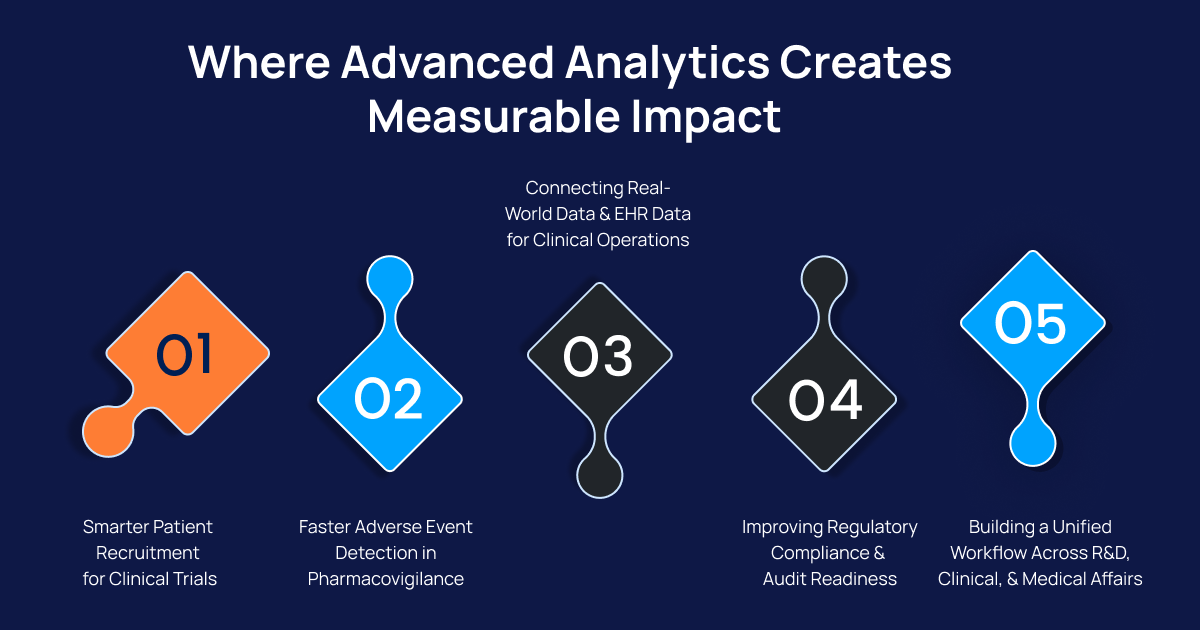
Key Use Cases: Where Advanced Analytics Creates Measurable Impact

1. Smarter Patient Recruitment for Clinical Trials

Slow enrollment remains one of the most persistent and expensive problems in drug development. An estimated 86% of international clinical trials do not meet their patient recruitment targets within the planned timeframe. Patient recruitment delays cost sponsors between $600,000 and $8 million per day in lost revenue due to postponed market entry
Patient recruitment analytics addresses this by mining electronic health records, genetic profiles, pharmacy histories, and claims data to identify eligible cohorts with greater precision. Instead of relying on manual chart reviews, clinical teams can use predictive analytics in clinical trials to match patients to specific protocol criteria, reducing screen failure rates and accelerating enrollment timelines.

2. Faster Adverse Event Detection in Pharmacovigilance

Pharmacovigilance teams operate under strict regulatory timelines for adverse event detection. Yet, some marketing authorization holders process over one million safety-related transactions every year, including individual case safety reports, medication error reports, and product quality complaints. The volume alone makes manual review unsustainable.
Pharmacovigilance analytics powered by NLP and machine learning can extract relevant safety information from unstructured sources, including clinician notes, patient forums, and call center logs, then classify and triage events automatically. AI models trained on historical safety databases can flag potential signals that traditional statistical methods often miss, enabling proactive rather than reactive safety monitoring. For pharma companies that need to satisfy GxP standards and 21 CFR Part 11 requirements, this kind of pharma workflow automation directly reduces compliance risk while reclaiming expert hours for higher-value scientific analysis.

3. Connecting Real-World Data and EHR Data for Clinical Operations

Approximately 76% of pharmaceutical labs are shifting toward real-world data (RWD) for clinical insights. Real-world evidence drawn from EHRs, claims databases, patient registries, and wearable devices provides a view of treatment outcomes that controlled trial environments cannot replicate on their own.
EHR data integration allows clinical operations teams to assess site performance in real time, monitor patient safety across geographies, and feed post-market surveillance systems with continuous, structured data. When combined with clinical trial analytics, this data supports adaptive trial designs where researchers can modify study parameters, such as dosage or cohort sizes, based on interim analysis rather than waiting until the study concludes.

4. Improving Regulatory Compliance and Audit Readiness

More than 82% of healthcare organizations report improved diagnostic accuracy through real-time advanced analytics. This real-time capability also applies to regulatory compliance in pharma. Automated compliance reporting reduces human error, accelerates audit preparation, and ensures that safety data submissions meet FDA and EMA timelines.
Life sciences data analytics platforms that maintain immutable audit trails, full data lineage, and automated documentation satisfy the stringent requirements of HIPAA, GDPR, and GxP frameworks. For organizations in regulated industries, this is not a nice-to-have; it is a prerequisite for operational continuity.

5. Building a Unified Workflow Across R&D, Clinical, and Medical Affairs

One of the most significant barriers to clinical workflow optimization is the disconnect between R&D, clinical operations, and medical affairs teams. Each function generates and consumes data, but often through separate systems with incompatible formats.
Pharma data analytics platforms that establish a shared data layer, combining trial data, post-market surveillance, and commercial intelligence, enable cross-functional visibility. When R&D teams can see real-time enrollment metrics and medical affairs can access safety signals as they emerge, decisions happen faster and with better context. This unified approach breaks down data silos in healthcare and creates a single source of truth that everyone can act on.

Challenges in Adopting AdvancedAnalytics in Clinical Workflows

Despite the momentum, integration is not without friction. Around 61% of healthcare providers identify data interoperability and integration challenges as their primary barrier. Legacy systems, inconsistent data standards (HL7, FHIR, CDISC), and siloed architectures slow down migration timelines. Regulatory complexity across geographies further adds to the challenge: a data governance model that works for FDA compliance may need significant adaptation for EMA or PMDA requirements.
Talent gaps are equally real. Most pharma companies lack internal workforce programs that bridge clinical domain expertise with advanced analytics skills. Without cross-trained teams, even the most capable platform risks underutilization. And for organizations working with AI-based classification models, the “explainability gap” presents a distinct challenge: regulators do not accept binary predictions without evidence-based rationale to justify them.

How Intuceo Helps Pharma Teams Operationalize Analytics in Clinical Workflows

Intuceo specializes in life sciences data analytics solutions built for the complexities of regulated pharma environments. From AI-driven patient matching for clinical trials (using GenAI to identify eligible cohorts from vast, disparate datasets) to Explainable AI (XAI) frameworks for adverse event reporting that do not just predict but justify, Intuceo’s PhD-led engineering teams architect solutions that satisfy GxP, 21 CFR Part 11, and HIPAA requirements.
Intuceo’s proprietary Intuceo-Ix (Neural Search) platform creates a unified knowledge layer across disconnected research silos, indexing millions of pages of clinical documentation, FDA filings, and patents to reduce manual data synthesis. Whether you need to accelerate trial enrollment, automate pharmacovigilance case processing, or build a cross-functional analytics layer connecting R&D, clinical, and medical affairs, Intuceo delivers hardened, compliance-ready solutions.

Whether you need to accelerate trial enrollment, automate pharmacovigilance case processing, or build a cross-functional analytics layer connecting R&D, clinical, and medical affairs, Intuceo delivers hardened, compliance-ready solutions.

Frequently Asked Questions

Clinical teams use patient recruitment analytics to mine EHRs, genetic data, and claims records to identify patients who meet specific trial criteria. This reduces reliance on manual chart reviews, lowers screen failure rates, and accelerates enrollment timelines significantly.
Effective clinical trial analytics requires connecting electronic health records, claims databases, lab information systems (LIMS), genomic data, patient registries, and real-world evidence sources such as wearable devices and patient-reported outcomes. The key is establishing interoperability across these sources through standardized data pipelines.
AI-powered NLP models can extract and classify adverse event information from unstructured sources automatically, while robotic process automation handles data entry and report generation. This combination of pharmacovigilance analytics and automation reduces manual processing time and lowers compliance risk.
The primary challenges include inconsistent data standards across systems (HL7, FHIR, CDISC), legacy infrastructure that resists modern integration, regulatory complexity across jurisdictions, and a shortage of professionals who combine clinical domain knowledge with analytics expertise.
Teams use machine learning models trained on historical safety databases to identify patterns and signals across large volumes of case reports. NLP parses unstructured data from clinician notes, social media, and patient forums. Together, these tools enable proactive adverse event detection rather than waiting for manual case-by-case review.

Why Pharma AI Projects Stall During the Validation and Documentation Phase

Pharma teams rarely run out of AI ideas; they run out of runway during validation. While a model may show 92% accuracy in a sandbox, it hits a high-velocity wall the moment it encounters GxP documentation requirements and ‘intended use’ scrutiny.
In the life sciences, the gap between a successful pilot and a production-grade system isn’t a technical hurdle – it’s a regulatory chasm. With roughly 80% of healthcare AI projects failing to scale , the validation phase is where most of that failure becomes visible.

$2.59B

AutoML global market value in 2025

41.96%

CAGR projected through 2031

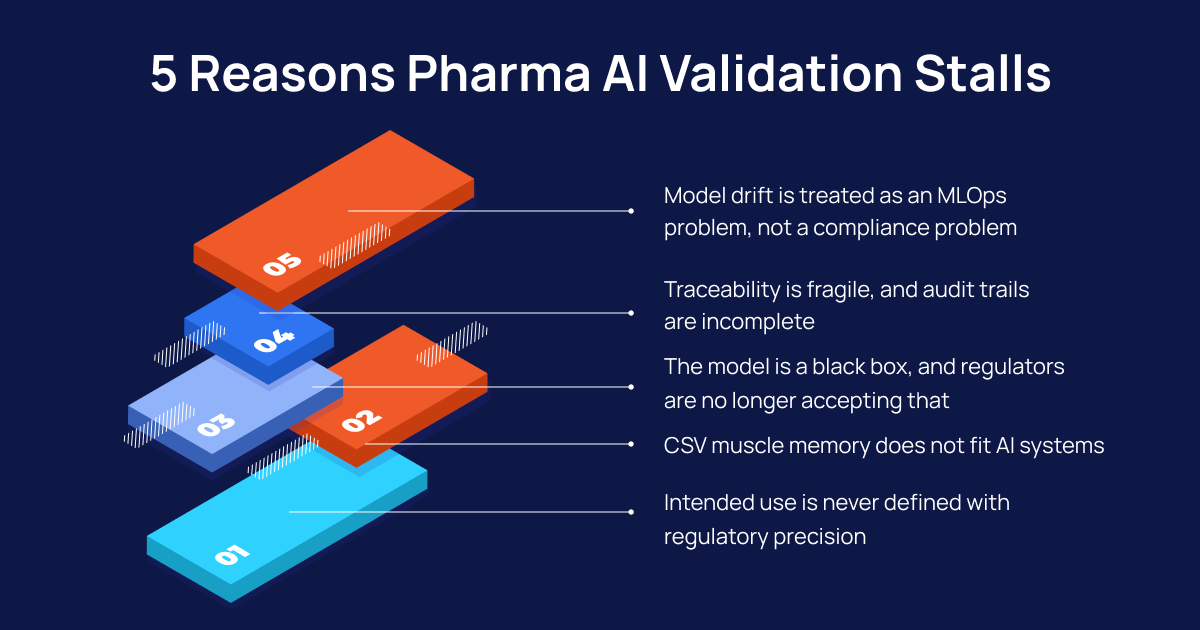
The Five Reasons Pharma AI Validation Stalls

TheFiveReasonsPharmaAIValidationStalls

1. Intended use is never defined with regulatory precision

Most pharma AI projects begin with a business goal, not a Context of Use (COU). FDA’s January 2025 draft guidance on AI in drug and biological product development requires sponsors to define the question the AI model addresses, the COU, and the model’s risk based on how much it influences a regulatory decision and the consequences of that decision.
The agency built a seven-step credibility framework from experience reviewing more than 500 drug and biological product submissions containing AI components since 2016. When the intended use is fuzzy, every downstream artifact, the validation plan, the test scripts, and the acceptance criteria have nothing specific to anchor against. This is where GxP AI compliance reviews loop back to the start.

2. CSV muscle memory does not fit AI systems

Traditional Computerized System Validation expects deterministic behavior: same input, same output. AI systems are probabilistic. They drift. They retrain. The legacy IQ/OQ/PQ template was built for deterministic logic and static system behavior, not for AI/ML-based systems whose outputs vary with new data.
On September 24, 2025, the FDA finalized its Computer Software Assurance (CSA) guidance, a risk-based approach that replaces the one-size-fits-all CSV model for production and quality system software.CSA centers on critical features and continuous verification, making it better suited to AI than traditional CSV.
Even today, many pharma teams treat the transition to CSA as a ‘paperwork reduction’ exercise rather than a shift in mindset. The stall occurs because teams fail to differentiate between Direct Impact and Indirect Impact systems. Under the finalized September 2025 guidance, AI models influencing clinical endpoints require high-assurance scripted testing, while the MLOps pipelines supporting them can often leverage unscripted, streamlined assurance. Using the old CSV approach on a dynamic AI pipeline creates a ‘validation debt’ that eventually halts production.

3. The model is a black box, and regulators are no longer accepting that

Regulators increasingly demand clarity on how AI decisions are made, and black-box models are treated as risky in patient-safety contexts. Without an explainability layer, QA and regulatory teams cannot review the documentation because it does not exist in any defensible form. A binary Yes/No model output is not a validation artifact.
ISPE’s July 2025 GAMP Guide: Artificial Intelligence specifically addresses validating AI/ML systems in GxP environments, and GAMP 5 categorizes most AI/ML systems as Category 5, the highest-risk tier, which requires full qualification lifecycle documentation.

4. Traceability is fragile, and audit trails are incomplete

AI documentation requirements go well beyond source code and test cases. Validation packages must capture model lineage, bias audits, validation datasets, performance metrics, and retraining governance. Model traceability depends on immutable logs: every training iteration, data ingestion cycle, and AI-generated output must be captured in a tamper-proof audit trail. In a GxP environment, if an action isn’t logged in a reconstructable, time-stamped sequence, it effectively never happened leaving the model’s entire decision history indefensible during an inspection.
A 2025 PubMed study analyzing 1,766 FDA warning letters from 2016 through 2023 confirmed that data integrity enforcement has intensified, with electronic records violations remaining a dominant theme.

5. Model drift is treated as an MLOps problem, not a compliance problem

AI systems are dynamic, not static. Revalidation is required when models are updated, inputs shift, or new data patterns emerge. Change control must explicitly cover retraining, with predefined triggers such as architecture changes, dataset changes, or measurable performance drops.
The ‘Human-in-the-Loop’ (HITL) Documentation Gap Regulators now mandate clear definitions of human oversight. Projects often stall because the validation report doesn’t specify at what point a human intervenes, what data they see to make that intervention (explainability), and how that intervention is logged. Without a documented HITL protocol, the AI is viewed as an ‘autonomous agent,’ which carries a significantly higher risk tier under GAMP 5 and the EU AI Act.
When drift and human oversight are handled only as engineering workflows rather than GxP controls, the first significant event triggers a 483 observation rather than a routine update.

What Regulators Expect in 2026

Three frameworks now define audit-ready AI in life sciences:
EMA has signaled a revision of Annex 11 to address cloud, cybersecurity, and AI/ML by 2026, and a new Annex 22 for AI in pharma is in draft.
In January 2026, the FDA and EMA jointly released “Guiding Principles of Good AI Practice in Drug Development,” signaling cross-Atlantic alignment. These principles specifically demand multi-disciplinary expertise. A common stall point is a validation package reviewed only by IT and QA. Regulators now expect evidence that clinical subject matter experts (SMEs) were involved in the credibility assessment and bias audit phases.

How To Engineer Audit-ready AI From The Start

How Intuceo Architects Audit-ready AI For Life Sciences

Intuceo’s iPDLC™ framework is built for the gap between AI velocity and institutional rigor. Every milestone in the AI lifecycle, from requirement synthesis to production deployment, passes through PhD-led Quality Gates that validate logic and ensure outputs are audit-ready.
The framework doesn’t just manage the lifecycle; it automates the Traceability Matrix—linking every User Requirement (URS) to a specific model feature, risk mitigation, and test script. By treating ‘Compliance-as-Code,’ we ensure that when a model is retrained, the validation delta-report is generated in minutes, not months.
This automated generation of high-fidelity BRDs, Design Documents, and Test Logs produces a complete technical trail for every project, which means the validation evidence regulators expect is built in, not bolted on.
For pharma use cases such as adverse event classification, Intuceo’s Explainable AI frameworks don’t just predict, they justify. The proprietary modeling stack automates AE classification while generating the evidence-based rationale that satisfies GxP standards.

Move your pharma AI from pilot to production, hassle-free.

Intuceo’s PhD-led engineering and iPDLC™ framework deliver audit-ready AI systems aligned with FDA, EMA, and GxP expectations.

Frequently Asked Questions

Apply a risk-based framework combining GAMP 5 categorization (most AI/ML systems are Category 5), FDA’s CSA principles, and the seven-step credibility assessment from FDA’s January 2025 AI guidance. Define intended use and COU, assess risk by influence and consequence, plan assurance proportionate to risk, execute and document credibility evidence, and maintain lifecycle oversight, including drift monitoring and change control for retraining.

At minimum: intended use and COU statement, risk assessment, model architecture and lineage, training and validation datasets with bias audits, performance metrics, test execution evidence, immutable audit trails of training and inference events, change control records covering retraining, and ongoing performance monitoring logs.

Traditional CSV assumes deterministic behavior and applies uniform verification regardless of risk. AI validation must account for probabilistic outputs, model drift, retraining, and explainability. FDA’s September 2025 CSA guidance moves pharma toward a risk-based approach better suited to AI, focusing assurance on functions impacting patient safety and product quality.

Treat drift as a compliance control, not just an MLOps signal. Predefine what triggers revalidation: architecture changes, dataset shifts, or performance regression beyond acceptance thresholds. Treat retraining like a new software release within your change control SOP, with documented validation evidence for every cycle.

FDA expects sponsors to demonstrate credibility and trust in the performance of an AI model for its specific Context of Use. This is evaluated through the seven-step credibility assessment framework released in January 2025, which scales evidence requirements to the model’s risk based on its influence on a regulatory decision and the consequence of that decision.

Predictive Analytics in Healthcare: How Providers Are Reducing Readmission Rates Before Discharge

In the era of value-based care, the hospital discharge is no longer the “finish line” – it is a critical transition point. For healthcare providers, the challenge has always been identifying which patients are likely to return within 30 days. Traditionally, this was a guessing game based on clinical intuition or static scoring systems.
Today, predictive analytics in healthcare is changing the narrative. By leveraging AI-driven insights before a patient even leaves the hospital, providers are moving toward a “preventative discharge” model, effectively reducing readmission rates and ensuring long-term patient recovery.

The High Stakes of 30-Day Readmissions

Hospital readmissions are a multi-billion-dollar challenge. Under the CMS Hospital Readmissions Reduction Program (HRRP), hospitals face significant financial penalties if their 30-day readmission rates for conditions like heart failure or pneumonia exceed national averages.
The stakes are highest in chronic disease management. Across various clinical studies, up to 86% of heart failure rehospitalizations could potentially be prevented through timely medical and social interventions.
However, beyond heart failure, readmission risks exist across the board:
The gap lies in the hospital’s ability to identify exactly which interventions are needed for which patient after their discharge.

The Strategic Role of Predictive Analytics in Modern Healthcare

Before diving into the mechanics of readmissions, it is essential to understand the broader shift predictive analytics represents. In the past, healthcare data was mainly used for backward-looking analysis, focusing on metrics from the previous month or quarter.
Predictive analytics flips the script by using historical data to forecast future events. It is an “early warning system” – by synthesizing massive volumes of data from Electronic Health Records (EHRs), wearable devices, and genomic sequences, predictive tools can identify subtle patterns that the human eye might miss. This shift enables:
By serving as a foundation for decision support, predictive analytics allows healthcare organizations to transition from a volume-based “fee-for-service” model to a value-based model centered on quality and efficiency.
It is important to note that these predictive tools do not replace clinical judgment; rather, they function as advanced Clinical Decision Support (CDS). By providing a clear evidence base for risk, AI empowers the multidisciplinary team to make the final call on a patient’s readiness for discharge, ensuring that technology serves as a co-pilot in the care journey.

How Predictive Analytics Identifies High-Risk Patients

The power of hospital readmission prediction today lies in its ability to process massive, disparate datasets in real-time. Traditional methods, such as the LACE index, focused on a narrow set of variables: length of stay, acuity, comorbidities, and emergency visits. Though useful, these models often lack the context of a patient’s life outside the hospital.
HowPredictiveAnalyticsIdentifiesHigh-RiskPatients

1. Unlocking Hidden Insights with NLP

Much of the most valuable patient data is “trapped” in unstructured clinical notes – the narrative observations made by nurses, social workers, and therapists. Machine learning readmission models now use Natural Language Processing (NLP) to scan these notes for red flags that structured data misses, such as mentions of cognitive decline, lack of caregiver support at home, or history of non-adherence. Predictive models synthesize narrative data to provide a multidimensional view of risk that far exceeds traditional scoring.

2. Identifying "Clinical Fragility" via EHR Trends

Rather than looking at a single lab result, AI models look at the velocity of change.

3. The Critical Lens of Social Determinants (SDOH)

A patient’s recovery is often dictated by social and environmental factors beyond the clinic – access to healthy food, transportation to follow-up appointments, and housing stability. SDOH-informed models integrate these external variables into the clinical risk profile.

Precision in Practice: The Intervention Framework

The 30-day window is historically difficult to manage because hospitals often enter a ‘data vacuum’ the moment a patient leaves the building. Predictive analytics bridges this gap by identifying which patients are most likely to face complications on Day 10 or Day 20, allowing providers to extend their clinical ‘line of sight’ into the home and prevent the silent relapses that drive readmissions.
To tackle readmissions, providers are using a three-tiered predictive approach that triggers specific clinical actions regardless of the primary diagnosis.

1. The Pre-Discharge Stability Check

AI models analyze real-time hemodynamics and lab trends. If the model identifies “subclinical instability” – where the patient looks fine but data suggests physiological stress – the system alerts the care team to delay discharge by 24 hours for further observation.

2. The Social Safety Net

For patients flagged as high-risk due to social factors (ROC-AUC 0.79–0.82), the system automatically triggers a “Transition of Care” (TOC) bundle. This includes “Meds to Beds” delivery and a confirmed home-health visit within 48 hours.

3. Predictive Resource Prioritization

Not every patient needs a daily follow-up call. Predictive models identify the top 10% of “ultra-high-risk” patients. By focusing labor-intensive monitoring on these individuals, hospitals maximize their resources while ensuring the most vulnerable have a digital safety net.

Real-Time Risk Scoring at Discharge: A Strategic ROI

Implementing real-time readmission risk scoring isn’t just a clinical win; it’s a strategic financial move.

Calculating the ROI

When hospitals deploy predictive tools to cut readmissions by 30-50%, the Return on Investment (ROI) is realized through:

The Intuceo Advantage: Turning Data into Action

At Intuceo, we understand that a prediction is only valuable if it is actionable. Our Augmented BI technology is designed to bridge the gap between “big data” and “bedside care.”

Conclusion: Predictive Care is the Future

The transition from retrospective management to predictive foresight is more than a technological upgrade – it is a fundamental reimagining of the hospital’s role in a patient’s life. In the traditional model, patient discharge was treated as a conclusion; however, in this digital-first world, it is an informed handoff supported by a continuous clinical safety net.
Reducing readmission rate is a complex puzzle with clinical, social, and behavioral pieces. However, by leveraging predictive analytics in healthcare, providers can finally visualize the “invisible” risks, from subtle lab velocity shifts and hidden social determinants to the nuances buried in clinical notes, that lead to relapse.
For Intuceo, the objective is to ensure that “big data” never loses its human context. By transforming raw Electronic Health Record data into actionable bedside intelligence, we empower providers to ensure that when a patient is discharged, they aren’t just leaving a facility – they are entering a managed recovery ecosystem. The future of healthcare isn’t defined by the events that occur within the hospital walls, but by the clinical intelligence that keeps patients healthy, at home, and on a definitive path to long-term wellness.

Ready to transform your discharge process from a guessing game into a managed recovery?

Frequently Asked Questions

The LACE index is a static, backward-looking tool that relies on only four variables. Predictive analytics, however, uses machine learning to analyze hundreds of real-time data points simultaneously—including “velocity of change” in labs and social determinants (SDOH). This allows AI to identify high-risk patients that the LACE index frequently misses, such as those who are clinically stable but socially fragile.
No. These tools function as Clinical Decision Support (CDS) systems. They act as a “co-pilot” for the clinical team by providing a data-driven risk score and explaining the underlying causes of that risk. The final decision to discharge remains with the physician and the multidisciplinary care team.
Yes. Through Natural Language Processing (NLP), predictive models can “read” the narrative notes written by nurses, therapists, and social workers. It identifies red flags like “patient expressed confusion about discharge instructions” or “home environment lacks caregiver support.” This converts subjective observations into objective risk data.
Machine learning models are not “set and forget.” As medical standards evolve (e.g., new heart failure protocols), the model must undergo periodic retraining. Advanced platforms use Continuous Learning loops to monitor if the model’s performance is dipping, ensuring that the risk scoring remains aligned with current clinical outcomes and the specific demographics of your local patient population.
Solutions like Intuceo’s DataSharp™ engine are designed to automate the preprocessing of complex EHR data. By embedding risk scores and insights directly into the existing clinical workflow, these tools provide real-time alerts without requiring clinicians to log into a separate platform.

Data Engineering for Healthcare: Why Your EHR Data Is Stuck and What to Do About It

Your core electronic health record (EHR) systems hold a decade’s worth of patient encounters. Your auxiliary platforms house claims and lab results going back even further. Yet, your data warehouse likely remains starved of both – because moving clinical data from where it is captured to where it can be analyzed is not a configuration problem. It is an architectural one.
This is the reality for most health systems today. EHRs were designed as “systems of record” to facilitate documentation at the point of care, not as “systems of insight” for analytics. The result? Organizations with massive digital footprints still cannot answer basic population health questions without weeks of manual data extraction, brittle interface work, or API calls that behave inconsistently across different legacy environments.
The data exists. However, research from the HIMSS Global Health Conference reveals that 57% of physicians identify interoperability as their primary obstacle in maximizing the value of health information technology. Transforming raw, proprietary records into a stream that is clean, standardized, and HIPAA-defensible is where most healthcare data engineering efforts break down.
This article explains exactly why that happens and what a properly designed healthcare data pipeline looks like.

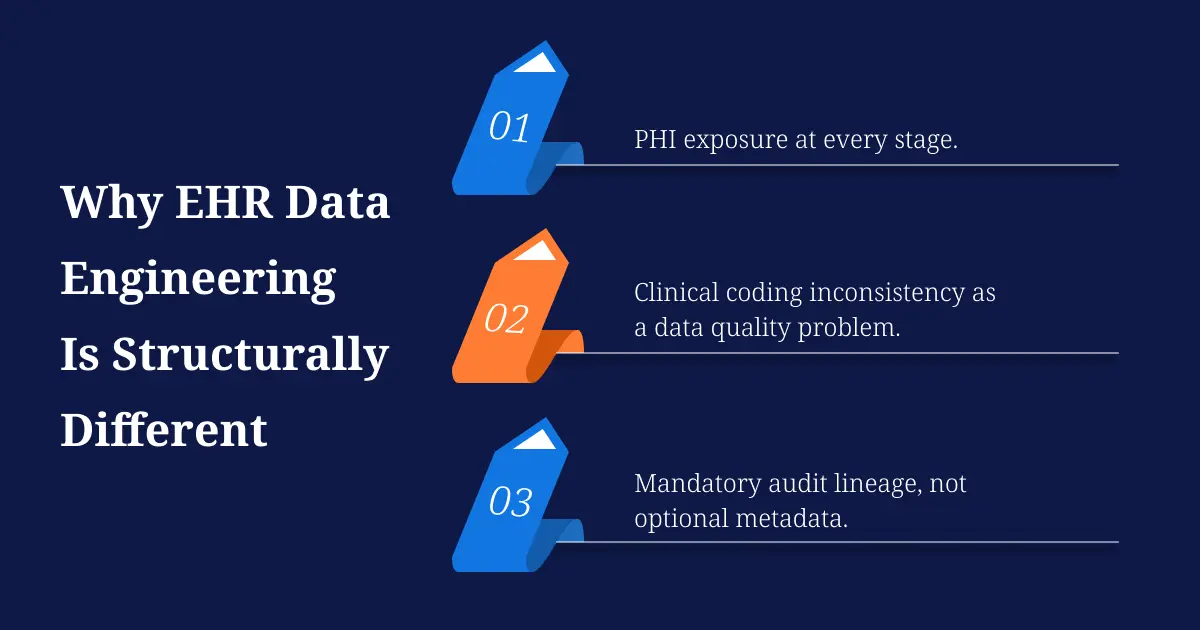
Why EHR Data Engineering Is Structurally Different

WhyEHRDataEngineeringIsStructurallyDifferent
Standard data engineering solves for schema drift, pipeline latency, and system reliability. Healthcare data engineering inherits all of that and adds three layers that have no equivalent in most other industries.
PHI exposure at every stage. In a typical SaaS data pipeline, sensitive fields are a small subset of the total data. In a clinical pipeline, nearly every field is a potential HIPAA identifier: patient name, date of birth, admission date, diagnosis code, and provider ID. An EHR data pipeline design that treats PHI handling as a transformation step rather than an architectural constraint will produce audit failures before it ever reaches production. HIPAA-compliant data engineering means encryption in transit and at rest, fine-grained role-based access controls, automated audit logging, and VPC-isolated compute, all engineered at the infrastructure layer, not the application layer.
Clinical coding inconsistency as a data quality problem. Clinical data routinely arrives with incomplete, outdated, or duplicate entries, with inconsistently applied terminologies that create ambiguity across systems. Labs arrive coded in LOINC, but not always with the same LOINC version. Diagnoses reference ICD-10 codes, but many clinicians enter free-text descriptions that bypass structured coding entirely. Medications reference RxNorm in some systems and NDC codes in others. Before any clinical data analytics workload can run reliably, a normalization layer must resolve these conflicts as a deterministic pipeline step, not a manual remediation task.
Mandatory audit lineage, not optional metadata. In GxP-regulated environments used in life sciences and pharma, 21 CFR Part 11 requires validated, traceable data lineage for every transformation applied to a dataset. HIPAA adds access logging requirements. These are not post-processing tasks. A pipeline without automated lineage tracking built in is not audit-ready, regardless of how well the transformation logic performs.

The Dual-Standard Problem: HL7 v2 and FHIR Running Side by Side

One of the most misunderstood aspects of EHR data integration is that FHIR R4 did not replace HL7 v2. In most production health systems, both run simultaneously and serve different functions.
HL7 v2 message feeds handle real-time clinical events: ADT (admission, discharge, transfer) notifications, lab results via ORU messages, and clinical documentation via MDM messages. These feeds have been running in hospitals for decades and are deeply embedded in clinical workflows. FHIR R4 APIs serve newer use cases: patient-facing app access, payer-to-provider data exchange, and more recent analytics integrations. Hospitals will still have HL7 v2 interfaces and batch reports for some time, and a well-designed pipeline architecture acknowledges this. Think of HL7 v2 as a reliable ‘telegraph’ for real-time events and FHIR as a modern ‘webpage’ for data exchange; a robust pipeline must speak both languages simultaneously.
The engineering challenge this creates: HL7 v2 messages are event-driven and arrive as positional pipe-delimited text. FHIR R4 resources are RESTful JSON objects structured around clinical resource types. Parsing, validating, and routing both into the same raw data zone requires separate ingestion logic, but a unified schema downstream. Organizations that build separate pipelines for each create a massive reconciliation risk, frequently resulting in fragmented patient identities where a single clinical encounter appears as two disconnected records.
The practical solution is an event-streaming layer, typically Kafka, that accepts both HL7 v2 feeds and FHIR API payloads as distinct topics, normalizes them through separate parser services, and lands both into a common staging zone before any transformation logic runs. This is how you handle FHIR and HL7 simultaneously without breaking existing clinical interfaces.

The Clinical Data Normalization Problem

Raw EHR data extracted from Epic or Cerner cannot go directly into a data warehouse and be used for analytics. It needs a normalization layer that most EHR-to-analytics migration projects underestimate.
As the clinical research paradigm shifts toward data centricity, the need for quality control in the secondary use of EHR data has become increasingly critical, with standardized quality control methods and automation identified as necessary foundations for reliable secondary use.
In practice, this means three specific engineering problems:
Terminology mapping. Labs extracted from one Epic instance may use LOINC 2.69. Labs extracted from a Cerner instance used by an affiliated clinic may reference local codes with no LOINC equivalent. Before these datasets can be queried together, every coded field needs a deterministic mapping applied in the transformation layer. Attempting to resolve this at the analytics layer, in SQL queries or BI tools, produces inconsistency at scale.
Free-text extraction. A significant volume of clinically meaningful information lives in progress notes, discharge summaries, and radiology reads. None of this enters a structured warehouse field without an NLP preprocessing step. Clinical NLP is not general-purpose NLP: negation detection (“no evidence of pneumonia”), temporal reasoning (“history of”), and clinical abbreviation resolution require models trained on medical corpora, not general text.
Deduplication across systems. The same patient exists across emergency department records, outpatient visits, lab systems, pharmacy databases, and insurance claims, often represented differently in each system. A Master Patient Index is not optional in a multi-EHR environment. Without patient identity resolution upstream, every downstream model and report produces results that cannot be trusted.

What a Production-Ready EHR Data Pipeline Architecture Looks Like

A functioning EHR data engineering solution addresses ingestion, normalization, compliance, and analytics readiness as a connected pipeline, not sequential phases handed off between teams.

Ingestion layer

Kafka handles both real-time HL7 v2 event streams and FHIR R4 API pulls as separate topics landing in a raw zone. No transformation happens here. The raw zone preserves source fidelity for audit and reprocessing.

Transformation and normalization layer

Spark handles distributed transformation at scale. This is where LOINC mappings, RxNorm normalization, ICD-10 validation, and free-text NLP extraction run as automated pipeline steps. Records with unresolvable codes are quarantined for review, not silently passed downstream as nulls.

Compliance layer

PHI tokenization and de-identification run as pipeline-level processes before data reaches the analytics zone. Automated lineage tracking generates audit logs as a byproduct of transformation, not as a separate process. This keeps the pipeline HIPAA-compliant and GxP-ready without slowing transformation throughput.

Analytics and serving layer

Research comparing clinical data warehouses, data lakes, and data lakehouses found that the lakehouse architecture best balances robust data governance with the flexibility required for advanced analytics workloads. This ‘Lakehouse’ approach ensures that your data is no longer stuck in a ‘read-only’ warehouse. By balancing governance with flexibility, systems like Databricks or Snowflake allow you to run standard financial reports and advanced clinical AI models simultaneously from the same source of truth, eliminating the need for redundant, costly data silos.

The Intuceo Approach to Healthcare Data Engineering

Intuceo’s healthcare data engineering practice is built on one principle: compliance and performance are not tradeoffs in clinical data pipelines. They are both requirements, and the architecture must satisfy both from the start.
Intuceo engineers HIPAA-validated, FISMA-compliant data environments on Azure and AWS that handle real-time HL7 and FHIR orchestration at production scale. Every pipeline is built with automated audit logging, PHI tokenization at the infrastructure layer, and real-time data quality monitoring to prevent normalization failures from reaching model training or reporting. The firm’s Explainable AI (XAI) layer ensures that clinical ML outputs carry the evidence trail required for regulatory review, not just a prediction score.
Intuceo has built production clinical data platforms for Florida Blue, GuideWell Health, and UF Health, moving raw EHR extracts through normalization, compliance, and into analytics-ready “Gold Record” status. The output is a single, unified patient record that consolidates EHR data, claims, and social determinants of health into one source of truth, ready for population health queries, predictive modeling, and HEDIS or STAR measure reporting.

Ready to move from data-rich to insight-rich?

Whether you’re navigating payer-side HEDIS optimization, provider-side denial management, or building a population health program for a value-based care contract, our healthcare analytics team is ready to design your roadmap.

Frequently Asked Questions

HL7 v2 interfaces are brittle because they depend on positional field parsing. When a source EHR vendor changes a message segment, downstream parsers fail silently or produce incorrect mappings. The fix is schema-versioned parser logic with automated regression testing on interface updates, not manual fixes each time a vendor releases a patch.
PHI de-identification and tokenization need to run at the pipeline level, within a HIPAA-validated infrastructure environment, before data reaches the analytics zone. Compliance overhead belongs on the infrastructure layer, not inside transformation logic. When built this way, compliance does not add latency to the data path.
Apply terminology mappings (LOINC, RxNorm, ICD-10/SNOMED-CT) as deterministic transformation steps inside the pipeline, before data reaches the warehouse. Quarantine records with unmapped or conflicting codes for domain expert review. Any ML model trained on unnormalized clinical codes will degrade as source system coding practices change over time.
Three patterns repeat consistently: loading raw EHR data without clinical coding normalization, treating PHI handling as a query-layer concern rather than a pipeline-level design decision, and building separate infrastructure for real-time HL7 feeds and batch analytics instead of a unified lakehouse that serves both.
The safest approach is a parallel-run strategy: stand up the new cloud pipeline to ingest and process data alongside the legacy system before cutover. This validates data fidelity and normalization accuracy without creating a dependency on the new pipeline until it is production-proven. Cutover becomes a routing switch, not a migration event.

Healthcare Analytics Consulting: The Complete Guide for Health System Leaders

Most health system leaders are aware that their organizations are drowning in data but starving for actionable insights. The challenge isn’t the volume of information – it’s the lack of decision velocity. When clinical and financial leaders operate from competing versions of a single metric, ‘truth’ becomes subjective. Whether the discrepancy lies in readmission rates, denial volumes, or ACO quality scores, the cost is more than just internal friction; it is the silent erosion of margins, delayed patient interventions, and quality performance that drifts dangerously below contract thresholds.
That gap between data abundance and decision confidence is exactly where healthcare analytics consulting creates its value. As you evaluate consulting services or select vendors, understanding the anatomy of a credible engagement – from kick-off to measurable outcome – is essential. The following sections are written for CIOs, CMIOs, CFOs, and VP-level operations leaders seeking clarity on this process.
This is not a vendor pitch list. It is a structured review of the decisions, tradeoffs, technical considerations, and realistic benchmarks that health system leaders need to navigate before, during, and after a healthcare analytics consulting engagement.

Healthcare Analytics Consulting: Why Does Timing Now Matter?

Healthcare analytics consulting refers to the practice of designing, implementing, and operationalizing data analytics capabilities inside health systems, payer organizations, and clinical networks. A healthcare analytics consulting firm may focus on a single workstream, such as clinical analytics, population health, or revenue cycle, or operate across the full data lifecycle from pipeline engineering to predictive model deployment to executive dashboard delivery.
Three forces are making 2025 a particularly consequential year for health system leaders to act on analytics:
A health system analytics consulting partner provides the architecture, expertise, and methodology to close those gaps faster than internal teams can build from scratch.

The Analytics Spectrum: Descriptive, Predictive, and Prescriptive Analytics in Healthcare

TheAnalyticsSpectrum_Descriptive,Predictive,andPrescriptiveAnalyticsinHealthcare
Before engaging a healthcare analytics consulting firm, health system leaders should understand the three tiers of analytics maturity and what each tier can realistically deliver.

Descriptive Analytics: What Happened?

Descriptive analytics summarizes historical data through dashboards, utilization reports, length-of-stay trends, and payer mix analyses. It held approximately 45.9% of the healthcare analytics market share in 2024, making it the largest segment by type, because it is the entry point for most organizations . It is foundational but insufficient on its own for driving the proactive interventions that move quality metrics or financial performance.

Predictive Analytics: What Is Likely to Happen?

Predictive analytics uses statistical models, machine learning, and historical patterns to anticipate outcomes before they occur. Examples include 30-day readmission risk scores, sepsis early-warning models, surgical complication prediction, and claim denial probability scoring. Predictive analytics is the fastest-growing segment in the healthcare market, with an expected CAGR of 26.5% through 2030.

Prescriptive Analytics: What Should We Do?

Prescriptive analytics goes beyond prediction to recommend or automate actions. Examples include care coordination pathway routing for high-risk patients, dynamic bed management recommendations, and prior authorization optimization. Prescriptive models require the highest data maturity and operational readiness. Organizations that attempt to skip the foundational tiers and jump directly to prescriptive AI consistently encounter failure.
The practical implication for health system leaders: assess your current data infrastructure honestly before defining the scope of a consulting engagement. A healthcare data analytics consulting firm that promises prescriptive AI outcomes without first auditing your data quality and governance posture is a red flag.

The Data Quality Problem: What Health System Leaders Need to Watch For

Poor data quality is the most common reason analytics initiatives underperform. Studies indicate that healthcare data quality issues contribute to nearly 30% of adverse medical events . In analytics terms, the consequences manifest as model drift, dashboard contradictions, and credibility erosion among clinical leaders.
Health system leaders should watch for four specific patterns:

Forward-Propagated Errors in EHR Documentation

Physicians using copy-and-paste templating in EHR workflows inadvertently carry outdated or incorrect data forward across multiple encounters. For instance, a medication listed from a 2021 hospitalization may still appear as active in 2025 if not explicitly closed. Models trained on such data inherit these errors at scale.

Missing Data Not at Random

EHR data gaps rarely appear randomly. They reflect structural access inequities, documentation habits tied to billing incentives, and population-specific care utilization patterns. When an ML model is trained on data with non-random missingness, it may perform accurately on the training cohort but fail for the underserved populations whose data is most sparse.

Siloed Data Across Clinical and Financial Systems

Most health systems operate with disconnected claims databases, EHR platforms, pharmacy systems, and laboratory information systems. Integration failures at the pipeline layer mean that analytics outputs represent only a partial picture of patient and operational reality.

Coding Inconsistency and Downstream Effects

ICD-10 coding errors, Diagnosis-Related Group (DRG) miscapture, and documentation gaps create compounding problems across both clinical analytics and revenue cycle modeling. Clinical risk scores are only as accurate as the diagnoses entered at the encounter level.
The discipline to address these issues is data governance for healthcare analytics, which includes master data management, data stewardship roles, and pipeline validation processes. Any credible healthcare data quality improvement consulting engagement begins with a data quality audit rather than jumping to model development.

Predictive Analytics for Hospitals: Reducing Readmissions and ED Overcrowding

Hospital readmissions and emergency department overcrowding carry both quality and financial penalties. For Medicare patients, nearly 20% are readmitted within 30 days of discharge. Preventing even 10% of those readmissions could save Medicare approximately $1 billion annually .
Predictive analytics for hospitals addresses this through risk-stratification models applied at or before the point of discharge. The clinical data inputs typically include prior admissions history, diagnosis complexity, medication adherence patterns, insurance status, and, increasingly, social determinants of health such as housing stability, food insecurity, and transportation access.
Here are a few real-world implementations showcasing this:
For ED overcrowding, predictive models are applied to patient census forecasting, boarding time prediction, and triage prioritization. The same architecture applied to readmissions can anticipate ED surge periods 24 to 72 hours in advance, allowing staffing adjustments and diversion management decisions to be made proactively rather than reactively.
The technology alone does not reduce readmissions. The model must be embedded in redesigned clinical workflows, adopted by case managers, and tied to specific care coordination protocols. Vendors that sell a risk score without accountability for workflow change are selling an incomplete solution.

What Metrics Should CIOs and CMIOs Track in Hospital Analytics Dashboards?

Healthcare analytics dashboard best practices distinguish high-performing health systems from average ones. Hospital analytics dashboards fail clinicians and executives when they present too many metrics with too little context, or when the metrics tracked do not connect to the decisions being made.
The following framework reflects what experienced CIOs and CMIOs prioritize across three domains.

Clinical Quality and Safety Metrics

Operational and Capacity Metrics

Financial and Revenue Cycle Metrics

Three design principles separate high-performing dashboards from those that get ignored: every metric is actionable, not just informational; every metric links to an owner and a response protocol; and dashboards refresh frequently enough to support the decision cycles they are meant to inform.

Revenue Cycle Analytics: Where Clinical and Financial Operations Converge

Revenue cycle analytics consulting for healthcare has emerged as one of the highest-ROI segments within health system analytics because the financial stakes are immediate and measurable. Healthcare administrative costs, including revenue cycle operations, account for 15 – 25% of total healthcare expenditures. Organizations using advanced analytics in revenue cycle management report up to 40% fewer denials and first-pass claim rates of 93% .
The connection between clinical and financial operations is the central problem that many health systems fail to close. Clinical documentation quality directly determines coding accuracy. Coding accuracy determines DRG assignment, which further determines reimbursement. When clinical and financial data systems are siloed, and the people who manage them operate independently without shared accountability, revenue leakage is inevitable.

Predictive Denial Management

Machine learning models trained on historical claims data can score new claims for denial probability before submission, allowing coding and billing teams to correct documentation upstream. Health systems that have implemented this capability report reductions in A/R days by nearly 11 days.

Under-Coding and Over-Coding Detection

A 2024 survey found that 84% of revenue cycle executives want analytics to identify under-coding, and 68% want the same capability for over-coding . Both represent risk – one financial and one compliance.

Value-Based Payment Alignment

As health systems take on more risk through ACO and bundled payment arrangements, the revenue cycle must track not just fee-for-service billing performance but quality-adjusted financial outcomes. Linking clinical analytics consulting services to claims analytics platforms enables this view. Organizations that treat revenue cycle analytics as a stand-alone back-office function, rather than a clinical-financial integration challenge, consistently recover less revenue and carry more administrative waste.

HIPAA-Compliant Use of LLMs on EHR Data: What Health Leaders Need to Understand

The interest in applying large language models to clinical documentation, clinical decision support, and patient record summarization is substantial and growing. The questions health system leaders need answered before approving any LLM deployment on the EHR data center in three areas: de-identification, data governance, and model accountability.

Safe Harbor Approach Is Not Optional

To comply with HIPAA, health systems must ensure patient data is anonymous before sharing it with an external AI model. This typically happens through two paths: Safe Harbor, which involves stripping 18 specific identifiers (like names, phone numbers, SSNs, etc.), or Expert Determination, where a statistician certifies that the risk of re-identification is minimal. Any LLM vendor handling raw patient data without these protections or a signed Business Associate Agreement (BAA) puts the health system at serious legal and regulatory risk.

Business Associate Agreements Define the Compliance Boundary

A vendor that processes PHI on behalf of a covered entity is a Business Associate under HIPAA. The BAA specifies permissible uses, data retention rules, breach notification obligations, and subcontractor controls. Before any LLM is connected to EHR data in a non-de-identified pipeline, the BAA must be signed and reviewed by legal counsel.

Model Governance Applies After Deployment Too

HIPAA-compliant healthcare analytics consulting requires ongoing monitoring for output accuracy, bias in clinical recommendations, and performance drift as patient populations or documentation practices change. A model that summarizes clinical notes accurately in November may produce clinically misleading summaries in March if the documentation conventions it was trained on shift. Regulated healthcare analytics consulting requires a rationalization layer between model outputs and clinical decision workflows to catch and contain these errors.
Healthcare organizations should distinguish between models deployed entirely within their own HIPAA-compliant cloud environment (Azure or AWS HIPAA-validated architectures) and models that route data through third-party inference APIs. The former is substantially more controllable than the latter, though it demands significantly more infrastructure investment.

Healthcare Analytics for Rural and Resource-Constrained Hospitals

Not every meaningful analytics initiative requires a large IT team, a data lake, and a multimillion-dollar consulting engagement. Rural hospitals and smaller health systems face a version of the same analytics problems that large health systems face, but with less budget, less IT staff, and less tolerance for extended implementation timelines that do not deliver near-term results.
Several approaches make operational analytics for hospitals accessible for resource-constrained organizations:

The Most Common Mistakes Health Systems Make in Analytics Consulting Projects

Healthcare analytics consulting implementations fail at a higher rate than they should, and the failure modes are consistent enough to be predictable.

Treating It as a Technology Project

The single most common mistake is confining the project to IT and expecting clinical and operational leaders to adopt the outputs without structured change management. Analytics does not change clinical behavior. Successful adoption requires a respected physician or nurse leader who bridges the gap between the data science team and the frontline staff. Without a peer-level advocate to validate that “the data makes sense,” even the most accurate models face cultural rejection.

Underinvesting in Data Engineering Before Model Development

Organizations frequently want to start with the predictive model and work backward to data quality. This approach is built to fail. A readmission risk model trained on incomplete or inconsistently coded data will produce unreliable risk scores, and clinicians who receive two or three inaccurate alerts will stop trusting the system entirely. Healthcare data quality improvement consulting is not a cost; it is the prerequisite.

Selecting Vendors Based on Demo Performance Rather Than Implementation Evidence

Vendors that excel at product demonstrations sometimes fail significantly in production environments where legacy systems, customized EHR configurations, and institutional data quirks introduce complexity that the demo never surfaced. Before selecting a healthcare analytics consulting firm, health system leaders should ask for reference conversations with peer institutions that have completed implementations of comparable complexity, not pilot programs or proof-of-concept engagements.

Defining Success as Deployment Rather Than Adoption

Going live is not the endpoint of a healthcare analytics implementation consulting engagement. Adoption, defined as the percentage of intended users who access and act on analytics outputs regularly, is the actual success metric. Health systems that do not define adoption targets in the contract and track them post-go-live routinely overpay for tools their clinical staff ignore.

Failing to Connect Analytics Outputs to the Governance Structure

Analytics findings that do not route to the correct committee, the correct executive, or the correct care team are operationally inert. Data governance for healthcare analytics includes not just data quality rules and lineage documentation but the organizational processes that ensure insights become decisions.

How to Evaluate Healthcare Analytics Vendors: What AI-Powered Claims Require Real Scrutiny

The healthcare BI and analytics consulting vendor market is crowded, and marketing language has converged to the point where differentiation requires active due diligence.
Healthcare leaders evaluating AI-driven healthcare analytics vendors should assess these dimensions:

What Realistic ROI Looks Like for Healthcare Analytics Consulting Engagements

Health system leaders are frequently presented with ROI projections at the high end of possibility during vendor selection. Understanding what verified outcomes actually look like helps calibrate expectations and contract structures.
Use Case Break-Even Timeline Verified Outcome
Revenue Cycle Analytics 12–24 months 200%–500% ROI; $10–$12M incremental net cash per client [11]; 5–15% lost revenue recovered within 12 months .
Readmission Reduction 18–36 months 472% ROI over three years (Allina Health); $3.7M in variable cost reduction on $890K investment .
Operational Efficiency 6–12 months Direct, measurable savings against current operational costs; fastest ROI category .
AI-Driven RCM 12–18 months 63% of healthcare organizations integrated AI RCM in 2024; 48% adoption rate in coding and documentation .

What the data shows consistently: ROI is higher when the engagement is scoped to a defined use case with a clear financial or quality metric attached, when the consulting firm is accountable for post-implementation adoption, and when the health system has completed baseline data quality work before model deployment begins.

How Intuceo Approaches Healthcare Analytics Consulting

Intuceo is a Florida-based AI, machine learning, and data analytics consulting firm with a practice built specifically for regulated healthcare environments. We serve payers, provider systems, and integrated delivery networks where HIPAA compliance, data governance rigor, and explainability are non-negotiable requirements.
We operate under a PhD-led model, meaning the analytical frameworks and model architectures that underpin its healthcare engagements are designed by doctoral-level data scientists, not adapted from generic enterprise AI toolkits.
Our proprietary technology stack includes:

Intuceo-Ax™

AI acceleration engine enabling faster model iteration and validation in clinical environments, built for production-grade healthcare analytics workflows.

Intuceo-Ix™

Integration engine that creates a unified patient intelligence layer from fragmented EHR (Epic, Cerner), claims, pharmacy, and Social Determinants of Health data sources.

iPDLC™

A proprietary development lifecycle framework that builds compliance, explainability, and auditability into analytics products from inception, not as an afterthought.

AgentCare AI

Agentic AI layer for healthcare, enabling proactive, workflow-embedded intelligence for care coordination and clinical operations at health system scale.
We deploy within HIPAA and FISMA-compliant cloud architectures on both AWS and Azure, with automated audit logging, VPC flow controls, and real-time compliance monitoring as standard infrastructure components. Our healthcare practice covers payer analytics (HEDIS, STAR ratings, Medical Loss Ratio management, member stratification), provider system analytics (predictive diagnostics, 360-degree patient insight via Intuceo-Ix, revenue cycle optimization), and security and interoperability engineering (HL7/FHIR real-time data orchestration, master data management).

Ready to move from data-rich to insight-rich?

Whether you’re navigating payer-side HEDIS optimization, provider-side denial management, or building a population health program for a value-based care contract, our healthcare analytics team is ready to design your roadmap.

Frequently Asked Questions

The four most common problems are copy-paste EHR errors that carry incorrect data forward, non-random data gaps that skew model performance for underserved populations, siloed clinical and financial systems that can’t be reliably joined, and ICD-10 coding inconsistencies that distort both risk models and revenue cycle outputs. A data quality audit before engagement starts is non-negotiable.
Descriptive answers what happened. Predictive answers what is likely to happen, using models to flag risk before it escalates. Prescriptive goes further, recommending or automating the action to take. Each tier requires the previous one to be stable before it can work reliably.
Break-even timelines range from 6 to 12 months for operational efficiency use cases to 18 to 36 months for readmission reduction. ROI is higher when the engagement is scoped to a specific metric, the consulting firm is accountable for adoption post-go-live, and data quality work is completed before model development begins.
Three requirements apply before any inference begins: de-identification under HIPAA Safe Harbor or Expert Determination, a signed Business Associate Agreement with every vendor touching PHI, and deployment within an AWS or Azure HIPAA-validated environment. Ongoing output monitoring for accuracy and bias drift is required after deployment, not just at launch.
Prioritize explainability of model outputs, documented HIPAA BAA and HITRUST status, certified EHR integration, and references from peer-sized organizations. Contractual accountability for post-go-live outcomes, not just delivery, is the most important and most commonly omitted criterion.
Building in-house gives you organizational ownership and long-term institutional knowledge, but it takes 12 to 24 months to hire and ramp a competent team, and healthcare data science talent is expensive and competitive. A consulting firm compresses that timeline significantly and brings pre-built frameworks, compliance infrastructure, and domain experience. The practical path for most health systems is a hybrid: engage a consulting firm to build and validate the initial capabilities, then transfer operational ownership to an internal team once the models and pipelines are stable.

What Healthcare Analytics Consulting Actually Delivers: Beyond Dashboards And Data Dumps

Every 24 hours, the average 500-bed hospital generates roughly 137 terabytes of data, yet nearly 80% of that information remains unstructured, untapped, and functionally invisible to the people who need it most. For a Chief Medical Officer or a Head of Patient Experience, the “data revolution” has not provided a clearer path to patient care, instead, it has created a persistent crisis of signal versus noise.

The problem is structural. Most of this data sits in siloed systems with no shared governance framework, leaving clinical and operational teams without a clear path from raw data to decisions. When a payer cannot reconcile claims data with pharmacy records, or when a provider’s EHR does not communicate with home care records, the result is reactive care, avoidable cost, and missed quality incentives.
“From Data Rich to Insight Rich.” This is the principle that drives every Intuceo healthcare engagement. The real competitive advantage in healthcare today is not the volume of data an organization holds, it is the speed and precision with which that data becomes a decision.
The industry has reached a tipping point. True healthcare analytics consulting is not about delivering a PDF of charts or a “data dump” of Excel sheets. It is about building a sustainable, insight-driven ecosystem across both the Payer and Provider ecosystems, one that is engineered to evolve as organizational priorities shift. This is where the industry is moving toward Managed Analytics as a Service (MAaaS): a model that prioritizes outcomes over outputs.

The Reporting Trap: Why Dashboards Are Not Solving Clinical Problems

Most healthcare data analytics projects start with the tools and work backward. A vendor recommends a platform, builds a few dashboards, runs a training session, and exits. Months later, the dashboards are stale, clinical staff have found workarounds, and leadership is asking the same questions they asked before the engagement started.
The flaw is treating analytics as a reporting exercise. Dashboards show what happened. What healthcare organizations actually need is insight into what is likely to happen, why, and what to do next.

The limitations of traditional data dumps:

The Analytics Maturity Journey

Level Type What It Answers Healthcare Application
1 Descriptive What happened? Admission trends, claims volume
2 Diagnostic Why did it happen? Root cause of readmission spikes
3 Predictive What will likely happen? Patient risk stratification, CRG scoring
4 Prescriptive What should we do? Clinical decision support, care gap closure

What Real Healthcare Analytics Consulting Delivers Beyond Reports

Effective healthcare analytics consulting transforms data from a liability, a storage cost and security risk, into a strategic asset. Here is what a mature engagement, delivered by a firm with the clinical, technical, and regulatory depth to execute, actually produces:

1. Unified Data Infrastructure

Before any predictive model can run, the data feeding it must be clean, governed, and trustworthy. This begins with building a unified data platform that standardizes terminology (ICD-10, CPT, LOINC), de-duplicates patient records, and creates a single source of truth across clinical and operational domains. Implementing FHIR (Fast Healthcare Interoperability Resources) and HL7 frameworks ensures that the Lab, the Pharmacy, and the ER speak the same language and that downstream AI models are built on foundations that can be trusted.

Intuceo operationalizes this through its proprietary Intuceo-Ix (Integration Engine), which mines disparate data across EHR platforms (Epic, Cerner), social determinants of health (SDoH) datasets, claims records, pharmacy data, and home care streams, engineering the “Gold Record” that is the prerequisite for high-stakes analytics.

2. The Payer Ecosystem: Driving Quality Incentives and Containing Clinical Cost

Payer organizations face a dual mandate, optimize quality-based incentive programs while containing the clinical costs that erode margins. Effective analytics consulting addresses both simultaneously.

3. The Provider Ecosystem: Predictive Diagnostics and Revenue Protection

Provider organizations operate at the intersection of clinical outcome accountability and revenue cycle complexity. Analytics consulting at this level must address both.
The total cost of 30-day hospital readmissions in the United States exceeds $26 billion annually, with average readmission costs placing significant financial burden on health systems (MedPAC, 2024). Predictive AI, applied before discharge, allows care teams to identify patients at elevated readmission risk and activate targeted interventions – coordinated care, post-discharge follow-up, medication reconciliation – before the patient returns to the ED.

4. Population Health and Value-Based Care Analytics

According to CMS, Value-Based Care models saw a 25% increase in healthcare provider participation from 2023 to 2024. As more organizations move into downside-risk contracts, identifying and managing high-risk patient cohorts before they become high-cost events is a financial survival capability, not a strategic option.
Analytics consulting firms that build risk stratification models layering claims data, clinical data, and social determinants of health feed those models directly into care management workflows. Not dashboards. Workflows. The output must reach the care manager at the moment of intervention, not two weeks later in a quarterly report.

5. Explainable AI for Clinical Trust

A predictive model that clinicians do not understand will not change outcomes regardless of its accuracy. Explainable AI (XAI) surfaces the reasoning behind model predictions in terms that are clinically actionable, telling a care manager not just that a patient is high-risk, but which specific clinical factors are driving that classification and what interventions the evidence supports.
The Intuceo Principle: Explainability is not a feature. It is the standard. Every model deployed in a clinical or payer environment must be interpretable to the professionals who act on it. This is the difference between analytics that drives behavior change and analytics that collects dust.

The Evolution: Managed Analytics as a Service (MAaaS)

Many healthcare organizations lack the in-house talent to build, maintain, and evolve complex AI models. A 2024 HIMSS Analytics survey found that 64% of healthcare IT executives cite a talent shortage as the primary barrier to adopting emerging analytics technologies. This structural gap has accelerated the shift toward Managed Analytics as a Service (MAaaS), an ongoing partnership model where the consulting firm continuously monitors model performance, retrains on new data, incorporates new sources, and aligns analytics outputs with evolving clinical and operational priorities.

Unlike traditional one-off consulting projects, MAaaS provides a continuous, cloud-native partnership that scales with the organization.
Feature Traditional Consulting Managed Analytics as a Service (MAaaS)
Duration Project-based with a fixed end date Ongoing subscription / partnership
Infrastructure Often relies on on-premise silos Cloud-native, scalable (AWS / Azure / GCP)
Insights Static data dumps and periodic reports Real-time, dynamic insights tied to outcomes
Maintenance Client is responsible after handoff Provider manages updates and AI retraining
Scalability Difficult; requires new SOWs Effortless; scales with data volume and scope
Compliance Point-in-time review Continuous HIPAA, HITECH, and FISMA oversight
Core components of a sustainable managed analytics model include continuous data pipeline monitoring and maintenance, regular model retraining and benchmarking against real clinical outcomes, HIPAA and regulatory compliance oversight, escalation workflows that connect analytics outputs to human action, and periodic roadmap reviews as organizational priorities evolve.

The Intuceo Approach: PhD-Led Healthcare Intelligence

While many consulting firms stop at providing the “what,” Intuceo focuses on the “how.” As a boutique Data & AI firm with 20+ years of healthcare and life sciences experience, Intuceo’s engagement model is built on the MAaaS principle: a continuous, outcome-accountable partnership, not a project handoff.
Intuceo’s healthcare solutions are engineered to navigate the dual complexities of the Payer and Provider ecosystems simultaneously, moving past generic dashboards toward high-integrity data infrastructure that can support both actuarial precision and clinical certainty.

What Makes Intuceo Different

Proven Impact: Intuceo has delivered 100+ mission-critical healthcare and life sciences engagements for Fortune 1000 organizations including Florida Blue, Guidewell Health, UF Health, and Aon with an average client tenure exceeding 5 years. Our QOC analytics platform maintains 100% HIPAA compliance while delivering real-time transparency into Medicaid Services quality and cost effectiveness.

The Shift Worth Making

The organizations that extract the most value from healthcare analytics consulting approach it as an investment in decision infrastructure, not in dashboards. They define the outcomes they need to move, identify the data that informs those outcomes, and find partners with the clinical, technical, and regulatory depth to build something that works beyond the initial go-live.

That is what effective healthcare analytics consulting delivers: not more reports, but better decisions, made faster, by clinicians and operators who have the information they need at the moment they need it, in a governance framework that keeps that information secure, compliant, and trustworthy.

Intuceo brings PhD-led AI and ML expertise to healthcare analytics engagements for both Payer and Provider organizations, with a focus on Explainable AI, HIPAA-compliant data architecture, and outcome-accountable delivery through proprietary frameworks including Intuceo-Ax, Intuceo-Ix, and iPDLC.

Ready to move from data-rich to insight-rich?

Whether you’re navigating payer-side HEDIS optimization, provider-side denial management, or building a population health program for a value-based care contract, our healthcare analytics team is ready to design your roadmap.

Frequently Asked Questions

Healthcare BI summarizes historical data into reports, dashboards, and KPIs. Healthcare data analytics applies predictive modeling, machine learning, and prescriptive techniques to forecast future events, identify root causes, and recommend interventions. The strategic value and the financial ROI sits firmly in the latter.
MAaaS is an ongoing engagement model where the consulting firm operates, maintains, and evolves an organization’s analytics infrastructure continuously, rather than executing a one-time project. This covers data pipelines, model monitoring, compliance oversight, and alignment with shifting clinical and operational priorities. Intuceo’s engagement model is built on this principle.
Revenue Cycle Management and readmission reduction programs often show measurable financial impact within 90 to 180 days of deployment. Population health programs tied to value-based care contracts typically demonstrate impact over 12 to 24 months as interventions accumulate and risk stratification models mature on new data.
Every component of the engagement from data ingestion pipelines to model outputs to reporting interfaces must operate within HIPAA’s Privacy and Security Rule requirements. This includes Business Associate Agreements (BAAs), end-to-end encryption, role-based access controls, audit logging, and data minimization protocols. Intuceo deploys within Azure and AWS HIPAA-validated environments and maintains continuous compliance monitoring. Non-compliance is not a peripheral risk: HIPAA penalties can reach into the millions per violation category.
Explainable AI refers to models that can articulate the reasoning behind their predictions in terms understandable to clinical or operational users. In healthcare, a model that flags a patient as high-risk without explaining which factors are driving that classification is difficult to act on and difficult to trust, which means it will not change clinical behavior. Explainability drives adoption, and adoption drives outcomes. Intuceo’s PhD-led AI engineering prioritizes XAI as a standard, not a premium feature.
Payer analytics focuses on health plan performance: HEDIS and STAR Rating optimization, PPE cost containment (PPA, PPR, PPC tracking), member stratification via CRG methodologies, and encounter data validation to protect financial integrity. Provider analytics focuses on health system performance: predictive diagnostics, 360° patient views, clinical SOP compliance, and Revenue Cycle Management. Intuceo is one of a small number of firms with deep, purpose-built capability across both ecosystems.