

Florida’s manufacturing sector is growing faster than its workforce can keep up. Predictive maintenance AI is helping manufacturers across the state protect production output, reduce unplanned stoppages, and extend the useful life of aging equipment.
Key Takeaways
- Predictive maintenance AI uses IoT sensor data and machine learning to detect equipment failures weeks before they occur.
- Documented results show 30% to 50% reduction in unplanned downtime and 18% to 25% lower maintenance costs.
- With over half of Florida's manufacturing workforce aged 45 or older, AI-driven maintenance helps bridge the growing skills gap.
- Most organizations report positive ROI within 12 to 18 months of deployment.
Florida's Manufacturing Sector: Growth Meets Operational Pressure
Florida’s manufacturing industry contributed $86.6 billion in GDP as of Q3 2025, surpassing both tourism and agriculture in economic output.1 The state now ranks third in the nation for total manufacturing establishments, with over 27,000 facilities employing more than 434,000 workers. [2] Aerospace, defense, medical devices, and electronics are driving much of this expansion.
But growth introduces strain. Florida Commerce Secretary Alex Kelly testified in October 2025 that more than 50% of the state’s manufacturing workforce is 45 years of age or older.[3] When experienced machine operators and maintenance technicians retire, they take decades of institutional knowledge with them. That makes AI-driven approaches to reducing manufacturing downtime a strategic response to a structural workforce challenge.
How Predictive Maintenance AI Works in Manufacturing
Predictive maintenance replaces fixed-schedule servicing with condition-based intervention. Instead of replacing a bearing every 6,000 hours regardless of wear, AI models analyze real-time sensor data, including vibration patterns, temperature fluctuations, acoustic emissions, and electrical current signatures, to determine exactly when that bearing is likely to fail.
The process follows a clear sequence. IoT predictive maintenance sensors collect continuous readings from critical equipment such as motors, compressors, pumps, and conveyor systems. This data flows to an analytics layer where machine learning algorithms establish baselines for normal operating behavior, then flag deviations that match known failure signatures. For example, when the system detects early-stage bearing wear, vibration sensors pick up impulse patterns at frequencies human senses can’t detect, often weeks before any audible symptoms appear.
Why Florida Manufacturers Are Investing in Predictive Maintenance AI
Several converging pressures explain why predictive maintenance AI adoption is accelerating across Florida manufacturing operations specifically.
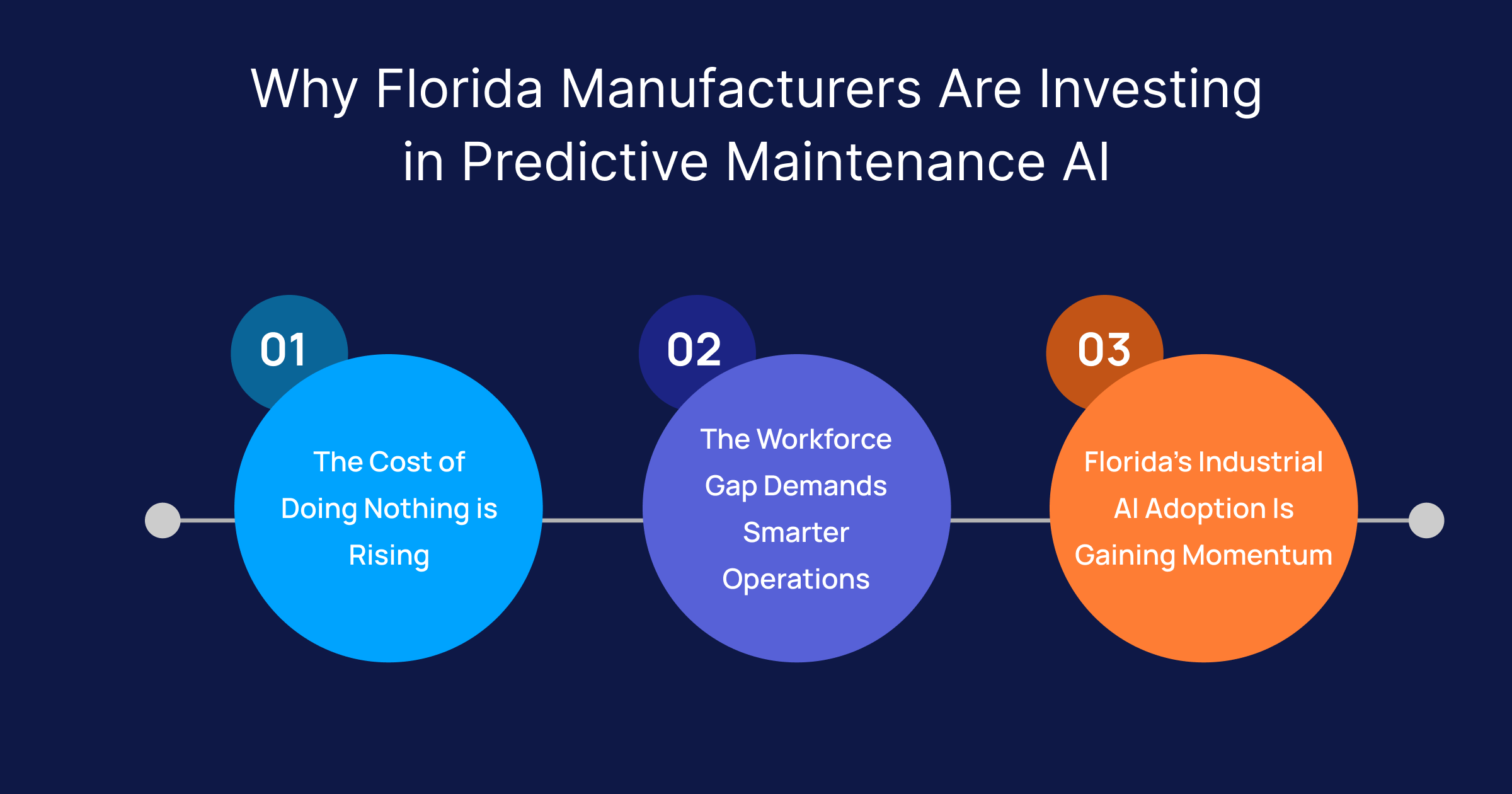
The Cost of Doing Nothing is Rising
Unplanned downtime costs industrial manufacturers an estimated $50 billion annually. [4] And the gap between planned and unplanned repairs is significant: proactive maintenance on the same asset costs four to five times less than an emergency repair after failure.[5] For Florida facilities operating in sectors like aerospace and electronics, where production schedules are tightly contracted, even a single unplanned stoppage can cascade into missed delivery commitments and financial penalties.
The Workforce Gap Demands Smarter Operations
With more than half of Florida’s manufacturing workers approaching retirement,[3] manufacturers cannot rely solely on experienced technicians to diagnose equipment problems by sound and feel. Asset health monitoring powered by AI captures and codifies that diagnostic knowledge, allowing smaller and less experienced maintenance teams to act on data-driven recommendations promptly.
Florida's Industrial AI Adoption Is Gaining Momentum
Florida ranks second in the U.S. for manufacturing job growth, [6] and has seen a 32% increase in manufacturing establishments since 2019.[2] State-backed infrastructure investments, pro-business policies, and a growing concentration of aerospace and electronics production along the Space Coast and Central Florida corridors make the state a natural adoption zone for industrial AI initiatives. Manufacturers expanding into new Florida facilities have the opportunity to build sensor infrastructure from day one, rather than retrofitting legacy plants.
The ROI of Predictive Maintenance AI for Manufacturing Facilities
The financial returns from predictive maintenance in manufacturing are well-documented. McKinsey research indicates that predictive maintenance can reduce equipment downtime by 30% to 50% and lower maintenance costs by 10% to 40%. Most organizations achieve full payback within 12 to 18 months.
Beyond direct cost savings, predictive maintenance AI also extends equipment useful life significantly, allowing facilities to defer major replacements and redirect that capital toward growth.
What Sensors and Data Are Needed for Predictive Maintenance Models?
One of the most common questions from manufacturers evaluating IoT predictive maintenance is what infrastructure investment is required before deployment can begin. The answer is more accessible than many expect.
Four primary sensor types cover the majority of industrial failure modes.
- Vibration sensors detect bearing wear, shaft misalignment, and mechanical imbalances in rotating equipment.
- Temperature sensors identify overheating, lubrication breakdown, and electrical faults.
- Pressure sensors monitor hydraulic and pneumatic systems for leaks or blockages.
- Current sensors track electrical load patterns to flag motor degradation.
Modern wireless IoT sensors can be retrofitted to existing equipment without modifications, with most installations completed in under an hour per asset. A starting deployment on a facility’s 10 to 15 most critical assets, typically motors, pumps, compressors, and gearboxes, provides enough data to build baseline models and demonstrate value within the first 60 to 90 days. From there, coverage can expand to secondary assets based on failure risk and production impact.
Getting Started: A Practical Roadmap
For Florida manufacturing operations considering predictive maintenance AI, the most effective path forward follows three phases.
The first phase is a targeted pilot. Identify the three to five assets with the highest downtime costs or safety implications. Install vibration and temperature sensors on these assets, establish a two-to-four-week data baseline, and configure initial alert thresholds. This phase typically requires minimal capital and can produce actionable insights within 60 days.
The second phase is validation and expansion. Use the pilot data to calculate actual avoided downtime, quantify savings, and build the internal business case. Expand sensor coverage to the next tier of critical assets and begin integrating AI-generated maintenance recommendations into daily workflows.
The third phase is operational integration. Connect predictive models to your CMMS for automated work order generation, build dashboards for real-time asset health monitoring, and establish continuous improvement loops where model accuracy improves with each confirmed or averted failure.
Working with a team that has prior deployment experience in manufacturing environments can accelerate each of these phases significantly, reducing the typical 90-day pilot to as few as 30 to 45 days and avoiding common pitfalls around sensor placement, data integration, and false-positive tuning.
Stop Unplanned Downtime Before It Starts.
Leverage AI-driven insights to predict equipment failures, cut maintenance costs, and maximize production output across your Florida facility.
Frequently Asked Questions
1. What is predictive maintenance and how is it different from preventive maintenance?
Preventive maintenance follows a fixed schedule, servicing equipment at set intervals regardless of actual condition. Predictive maintenance uses real-time sensor data and AI algorithms to monitor equipment health continuously, triggering intervention only when data indicates early signs of degradation. This prevents both unnecessary servicing of healthy assets and the costly surprise of an unplanned breakdown. Where preventive maintenance asks “Is it time?”, predictive maintenance asks “Is it needed?”
2. What upfront data or infrastructure do manufacturers need before adopting predictive maintenance AI?
Manufacturers need IoT sensors (vibration, temperature, pressure, or current) installed on critical assets, a reliable network for data transmission, and a system to store and process the data. Most modern wireless sensors can be retrofitted to existing equipment without modifications. A baseline of two to four weeks of normal operating data is typically required before AI models can begin generating accurate failure predictions.
3. How much downtime reduction can Florida manufacturers expect?
McKinsey research indicates that manufacturers implementing predictive maintenance AI can expect a 30% to 50% reduction in unplanned downtime. Individual outcomes depend on equipment age, the number of monitored failure modes, and how consistently maintenance teams act on the alerts. Organizations that integrate automated work order generation tend to see results at the higher end of that range.
4. What industries benefit most from predictive maintenance AI?
Predictive maintenance in manufacturing delivers the strongest returns in industries with capital-intensive rotating equipment and high downtime costs. Aerospace and defense, food and beverage, automotive, pharmaceuticals, and energy and utilities are among the leading adopters. Within Florida specifically, the concentration of aerospace manufacturing along the Space Coast and electronics production in Central Florida makes these sectors natural candidates for early adoption.