Tuesday Aug 11th, 11 AM EST: Live AI Dream Session: Blueprint your enterprise AI strategy with the DARWIN Framework. Reserve your Spot Claim Free Seat

Reserve your Spot

LLM Infrastructure Solutions: Choosing the Right Setup for Model Size, Cost, and Compliance

Many teams approach LLM infrastructure solutions the way someone buys a vehicle before knowing the commute  selecting a general-purpose setup before the real workload arrives with requirements nobody planned for.
A general-purpose setup gets provisioned, budgets get signed off, and then the real workload arrives carrying requirements nobody planned for: a model too large for the reserved memory, latency targets the serving layer cannot meet, or regulated data that legally cannot travel to the chosen endpoint. What follows is either idle capacity quietly burning money or a rushed rebuild a few months later.
This is why LLM infrastructure solutions are not a single blueprint. The right setup depends on how large the model is, how fast and how often it needs to respond, what it costs to run at volume, and where the underlying data is permitted to sit.
Getting those LLM infrastructure requirements straight before committing to hardware is the difference between a setup that scales and one that has to be torn out and rebuilt within a year.

Key Takeaways

Why LLM Infrastructure Solutions Are Never One-Size-Fits-All

The clearest reason is memory. Model weights must sit in fast memory to serve responses at a usable speed, and that requirement scales directly with the number of parameters. Stored in half-precision (FP16, or 16-bit floating-point), each parameter takes roughly two bytes. A 70-billion-parameter model therefore needs about 140 gigabytes of video memory (VRAM) just to hold its weights. That already exceeds a single 80 GB accelerator and forces the model across at least two high-end graphics processing units (GPUs), or around six consumer-grade cards.1 A two-billion-parameter model, by contrast, fits comfortably on one modest GPU.
That single fact reshapes everything downstream. A small model can run on a single card, sometimes even on a central processing unit (CPU), while a frontier-scale model may need a coordinated cluster with high-speed interconnects between chips.
The LLM infrastructure requirements for a lightweight classification assistant and for a 500-billion-parameter reasoning system are not different by degree; they are different in kind. Provisioning both from the same template guarantees waste at one end and failure at the other.
Quantization changes the arithmetic but does not remove the decision. Compressing weights to lower precision can shrink that same 70B model to a fraction of its footprint, letting it run on far less hardware at some cost to output quality. Whether that trade is acceptable depends entirely on the use case, which is exactly why the sizing conversation has to happen before anything is bought.

The Four Variables That Define LLM Infrastructure Requirements
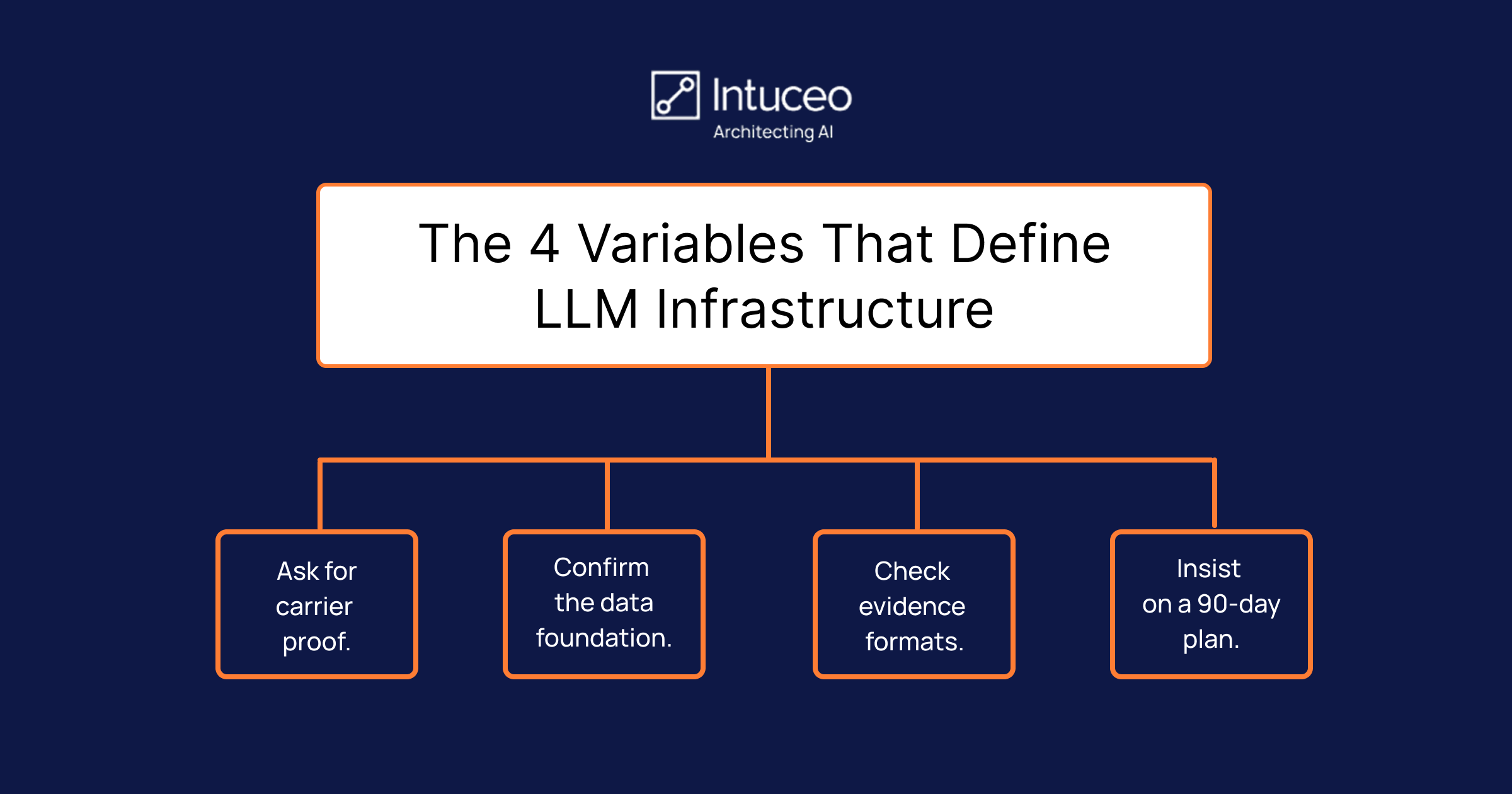
Defining LLM infrastructure requirements starts with four variables : model size, throughput and latency, inference cost, and compliance. Model size is the first lever. Three others matter just as much.

Throughput and latency

A batch job that summarizes documents overnight tolerates slow responses and heavy batching. A customer-facing assistant expected to reply in under a second does not.
The same model can call for very different serving setups depending on how many concurrent requests it fields and how quickly each one has to return. Under-provision here and the system buckles at peak load; over-provision and expensive accelerators sit idle most of the day.

Cost, which moves faster than most budgets assume

For a model of equivalent performance, the price of running inference has been falling by roughly 10x per year, dropping from about $60 per million tokens in 2021 to near $0.06 for a comparable-quality model three years later.
That trajectory rewards flexibility and punishes lock-in. A setup optimized around today’s model at today’s prices can turn uneconomical within a year, and a rigid, single-vendor footprint often costs more over its life than a design built to swap models as cheaper, better options appear.

Compliance

For regulated organizations, this fourth lever frequently overrides the other three. Where data is allowed to be processed can rule out otherwise sensible options entirely, which is worth treating on its own terms.

What Does an LLM Infrastructure Stack Include?

It helps to see the whole picture, because the LLM infrastructure stack is far more than the GPUs everyone talks about. It runs from the compute and serving layer that hosts the model, through an orchestration layer that routes and scales requests, to the data layer that supplies the model with current, trustworthy context, and finally a security and governance layer that controls who can see what.
In a retrieval-augmented setup, the data layer does as much to determine answer quality as the model does – a trade-off explored in depth in RAG vs. Fine-Tuning: How Enterprise Teams Should Actually Decide.
Teams that fixate on the compute layer tend to meet the rest of the stack the hard way. A pilot works cleanly in a demo, then stalls the moment it hits real data volumes, real access rules, and real audit expectations. The compute was never the part most likely to break.

How Compliance Requirements Shape LLM Infrastructure Solutions for Regulated Industries

For pharmaceutical and life sciences organizations, healthcare systems, financial firms, and public-sector agencies, the question of where data can go often settles the infrastructure question before performance enters the conversation. Regulated data cannot simply be pointed at whatever endpoint is cheapest.
Protected health information under the Health Insurance Portability and Accountability Act (HIPAA), records governed by 21 CFR Part 11, and systems under the Federal Information Security Management Act (FISMA) each constrain where processing may happen and who may access it.
The concern is widespread, not niche. In Deloitte’s 2026 State of AI in the Enterprise survey, data privacy and security ranked as the most cited AI risk, named by 73% of the leaders polled.
Once data residency and sovereignty enter the picture, a public interface sitting in the wrong jurisdiction stops being an option, and the field narrows to controlled cloud, on-premises, hybrid, or air-gapped setups. Retrofitting those controls after a system is live is almost always slower and costlier than designing for them from the outset – a principle at the core of AI governance for regulated industries.

Why the Data Layer Determines LLM Infrastructure Success

Compute gets the headlines, but the data foundation quietly decides the outcome. A perfectly sized cluster still returns unreliable output if the pipelines feeding it are fragmented, stale, or impossible to trace. In regulated settings, every input and output usually has to carry a lineage a reviewer can follow, which is a data-engineering problem long before it is a hardware one. This is the layer where most infrastructure plans succeed or come apart.

How Intuceo Delivers LLM Infrastructure Solutions for Regulated Enterprises

This is the part of an infrastructure solution that Intuceo is set up to handle. Its DataOps and Engineering practice concentrates on the layer that determines whether an LLM setup holds up in production: hardened ingestion and transformation pipelines with automated quality testing, full data lineage for GxP, HIPAA, and federal audits, and secure infrastructure configured across cloud, on-premises, or hybrid environments with controls such as virtual private cloud (VPC) isolation and customer-managed encryption keys.
Rather than installing a fixed toolset, Intuceo works as a services partner, bringing accelerators drawn from prior regulated engagements to speed up deployment and configuring the pipeline to the constraints an organization already operates under. The compute can be right-sized later; the data foundation has to be sound first.
That foundation still rests on getting the hardware decision right – the exact problem the DARWIN Infrastructure planning session addresses by working through the LLM infrastructure solutions trade-off for your specific model, budget, and regulatory reality.
The session uses the Infrastructure dimension of the DARWIN planning framework to work through the real cost and performance trade-offs, from GPU versus CPU choices to sizing questions as concrete as whether a workload needs a dozen servers for a 500-billion-parameter model or a single GPU for a two-billion-parameter one.
It is built for the data, engineering, compliance, and executive leaders who own those calls, and it answers the question most infrastructure discussions skip: how to choose a setup that fits the model, the budget, and the regulatory reality at the same time.

Size your setup before you commit to it

Join the Intuceo AI Dream Session to work through the cost, performance, and compliance trade-offs behind your LLM infrastructure, with worked examples from regulated deployments.

Frequently Asked Questions

Sound LLM infrastructure requirements planning weighs four factors together: model size, which sets memory and GPU count; throughput and latency, which shape the serving setup; running cost at volume; and compliance, which governs where data can be processed  Sound LLM infrastructure requirements planning weighs all four together rather than optimizing for one and discovering the others later.
No. Small models can run on a single modest GPU or even a CPU, while large models need multiple high-end accelerators working together. Matching the hardware to the model, instead of defaulting to the largest option, is often where the biggest savings sit.
A complete LLM infrastructure stack includes the compute and serving layer, an orchestration layer for routing and scaling, a data layer that supplies context and retrieval, and a security and governance layer for access control and auditability. The data and governance layers are where regulated deployments most often succeed or stall.
In regulated industries, compliance can decide the infrastructure before performance is discussed. Rules such as HIPAA, 21 CFR Part 11, and FISMA limit where data may be processed, which pushes many organizations toward controlled cloud, on-premises, hybrid, or air-gapped setups rather than a public interface.
It depends on the data and the workload. Cloud offers elasticity, on-premises offers control, and hybrid balances the two. For sensitive data with residency or sovereignty constraints, the deciding factor is usually where processing is legally allowed to happen, not raw performance.
Best AI Analytics Companies in Florida for Pharma and Life Sciences (2026)

Teams searching for an analytics partner in Florida usually have a specific problem in hand. Trial enrollment is behind. Adverse event review is still manual. Research data sits across systems nobody can search. The useful question for any team evaluating pharma AI analytics companies in Florida is not who claims to do artificial intelligence (AI), but which nearby firms have actually shipped inside a regulated environment.
There are more credible answers than a few years ago. Florida’s bioscience workforce reached 116,635 employees across 9,481 companies in 2023, an 18.7% increase since 2019 and faster than national life sciences employment growth[1]. A base that size now sustains its own AI and analytics supply chain. The guide below covers how to evaluate a partner and the best AI analytics companies in Florida for pharma and life sciences teams heading into 2026.

Key Takeaways

How AI is used in pharma data analytics in 2026

The regulatory record is a useful proxy for how far this has traveled. FDA’s Center for Drug Evaluation and Research reports more than 500 drug submissions containing AI components between 2016 and 2023, spanning non-clinical, clinical, postmarketing, and manufacturing phases[2]. In January 2026, the FDA and the European Medicines Agency published ten joint guiding principles for good AI practice in drug development, an unusual signal of how quickly the two agencies expect sponsors to standardize.
Operationally, this is narrower than the marketing suggests. Most current pharma data analytics in Florida falls into four buckets: knowledge retrieval across research documents and regulatory filings; cohort identification and site feasibility work in AI for clinical trials; automated classification and triage in pharmacovigilance; and yield, defect and release analytics in manufacturing. Discovery-stage generative chemistry gets the headlines; the recurring budget sits in those four areas.

How to Evaluate Pharma AI Analytics Companies: 5 Checks That Separate Specialists from Generalists

Evaluation usually stalls on one question: how do you separate a competent analytics consultancy from one that has shipped in a validated environment? Five checks do most of the work when assessing life sciences AI vendors in 2026.

The Best Pharma AI Analytics Companies in Florida (2026)

These five were selected on verifiable life sciences delivery, substantive Florida presence, and distinct capability, so the list is comparative rather than five versions of the same offer. They are not ranked against each other.

1. Intuceo - Jacksonville

Custom AI and data engineering for regulated life sciences | PhD-led delivery
Intuceo is the option on this list built for sponsors who need engineering rather than access to somebody else’s dataset. The firm works across the pharma value chain: research knowledge retrieval, generative AI patient matching for trial enrollment, site performance analytics, pharmacovigilance classification, and quality and manufacturing analytics in Good Practice (GxP) regulated environments. Named pharma and medtech engagements include Janssen Pharma, Ferring Pharma, and Bausch & Lomb.
Three things separate it from a general analytics consultancy. First, delivery is PhD-led, with a Board of Science that reviews model design and scientific validity rather than leaving that judgement to a delivery manager. Second, Intuceo brings named accelerators to compress build time: Intuceo-Ax™ for augmented analytics, Intuceo-Ix™ for neural search across fragmented research repositories, and Intuceo-Dx™ for document and vision intelligence. These are starting points drawn from prior regulated engagements, not licensed software, and are adapted to the sponsor’s validation and data estate.
Third, and most relevant to anyone who has been through an inspection, Intuceo builds explainable AI into adverse event work. The classification and the evidence-based rationale supporting it are generated together, which is the difference between a model that saves reviewer hours and one that creates them. Its iPDLC™ delivery framework carries the quality gates, traceability, and documentation that FDA 21 CFR Part 11, HIPAA, and GxP reviewers expect.
The firm is headquartered in Jacksonville, with a certified engineering bench and a Florida client history across research and healthcare. That buys same-time-zone working, on-site workshops, and accountability that survives the first difficult quarter.
Best for: sponsors and contract research organizations (CROs) needing custom, validated AI built across research, clinical and quality workflows.

2. Aster Insights - Tampa

Oncology real-world data and clinical intelligence
Aster Insights, a subsidiary of Moffitt Cancer Center[4], leads the Oncology Research Information Exchange Network (ORIEN), a consortium of leading US cancer centers. Its Avatar dataset pairs clinical, molecular, and digital pathology imaging data, and ORIEN members participate in the Total Cancer Care study, which has accrued over 400,000 patients[5]. For biopharma running oncology programs, that lifetime-consented, multimodal cohort supports external control arms, biomarker research and translational work that is slow to assemble independently.
Best for: oncology sponsors needing consented multimodal real-world evidence and academic research partnerships.

3. NeoGenomics - Fort Myers

Precision oncology testing, informatics and biopharma services
NeoGenomics runs laboratories accredited by the College of American Pathologists and certified under the Clinical Laboratory Improvement Amendments from a Fort Myers base, serving pharma clients through its biopharma services group. On the data side, it makes over 2.5 million digital pathology images available for machine learning model development and training, paired with patient and clinical history, and identifies trial-eligible patients from a pool of more than two million profiles[6]. It is the closest thing in Florida to an integrated route from assay to algorithm-ready imaging corpus.
Best for: teams building imaging-based models or needing biomarker testing and trial recruitment under one contract.

4. Intego Clinical - Orlando

Biometrics CRO: biostatistics, statistical programming, data management
Intego Clinical is a biometrics CRO headquartered in Orlando, with delivery centers in Central Florida, Poland, Ukraine, and Costa Rica. Its work is the unglamorous foundation everything else depends on: datasets conforming to Clinical Data Interchange Standards Consortium models, submission-ready statistical output, and clinical data management across ophthalmology, oncology, neurology and virology[7]. Team continuity is a stated strength, with 85% of staff bringing more than five years of experience[8], which matters on studies that outlast most vendor relationships.
Best for: sponsors outsourcing trial biometrics and needing standards-compliant datasets for submission.

5. ModMed - Boca Raton

Specialty real-world data for evidence generation and outcomes research
Best known as a specialty practice technology firm, ModMed’s Boca Raton real-world data group is now a serious option for life sciences researchers. Because clinical detail is captured in structured fields at the point of care rather than free text, the datasets arrive analysis-ready. Its dermatology network covers over 98 million patients and 481 million encounters, with a separate ophthalmology network of over 18 million patients[9]. For dermatology and ophthalmology indications specifically, that depth of structured outcome measures is difficult to source elsewhere.
Best for: health economics and outcomes research teams working in dermatology or ophthalmology.

Matching the firm to the stage of work

Treating these five pharma AI analytics companies in Florida as one shortlist is how procurement ends up comparing a data licence against an engineering statement of work. If the gap is evidence, Aster Insights, NeoGenomics and ModMed supply data assets in oncology, imaging and specialty care. If the gap is trial execution, Intego Clinical covers biometrics. If internal systems cannot support life sciences AI analytics at all, because research knowledge sits in unsearchable repositories or adverse event review is still manual, the requirement is engineering, and that points to Intuceo.
One caution for vendor calls: a firm that answers every capability question affirmatively is describing a sales position, not a delivery record. Ask for the regulated engagement closest to yours, and who on their team wrote its validation documentation.

Scoping a regulated AI program in Florida?

Intuceo’s PhD-led team works with pharma, biotech, and medtech sponsors on clinical trial matching, research knowledge retrieval, adverse event classification, and GxP manufacturing analytics. Bring the workflow that is stuck, and we will map what a validated build requires.

Frequently Asked Questions

The central requirement is model credibility for a defined context of use. FDA’s draft guidance on AI supporting regulatory decision-making sets out a risk-based credibility assessment framework covering nonclinical, clinical, postmarketing and manufacturing uses[3]. Alongside it, GxP expectations and 21 CFR Part 11 govern electronic records and signatures, meaning audit trails, access controls, versioning and documented change management apply to models as they do to any other regulated system. Where a model output informs a safety or efficacy conclusion, the reasoning behind that output has to be reconstructable, not just the result.
Four uses are well established. Cohort identification screens structured and unstructured records against inclusion and exclusion criteria far faster than manual chart review. Site feasibility modeling uses historical enrollment patterns to flag sites likely to underperform before contracts are signed. Risk-based monitoring surfaces anomalous data patterns across sites during conduct rather than at database lock. Natural language processing extracts endpoints and adverse events from narrative fields. In each case, the model narrows the field for human reviewers; it does not replace the statistical analysis plan or the medical monitor.
Intuceo has delivered engagements for Janssen Pharma, Ferring Pharma and Bausch & Lomb, spanning research knowledge retrieval, clinical trial patient matching, adverse event detection and manufacturing quality analytics. Work is delivered under the iPDLC™ framework with PhD-led scientific review, and draws on accelerators including Intuceo-Ax™ for augmented analytics, Intuceo-Ix™ for neural search across research repositories, and Intuceo-Dx™ for document and vision intelligence. Engagements are structured as fixed-bid statements of work or embedded teams depending on whether the deliverable is defined or the goal is building internal capability.
Technical skill is broadly comparable. The difference is what the team assumes without being told. A specialist knows that a model touching a submission needs a credibility argument, that adverse event classification requires documented rationale rather than a probability score, and that changing a feature set mid-study has consequences for the statistical analysis plan. A generalist learns these things during your engagement, on your timeline, at your cost. The gap shows up as rework and inspection risk rather than as a lower day rate.

Why Florida Manufacturers Are Turning to Predictive Maintenance AI

Florida’s manufacturing sector is growing faster than its workforce can keep up. Predictive maintenance AI is helping manufacturers across the state protect production output, reduce unplanned stoppages, and extend the useful life of aging equipment.

Key Takeaways

Florida's Manufacturing Sector: Growth Meets Operational Pressure

Florida’s manufacturing industry contributed $86.6 billion in GDP as of Q3 2025, surpassing both tourism and agriculture in economic output.1 The state now ranks third in the nation for total manufacturing establishments, with over 27,000 facilities employing more than 434,000 workers.2 Aerospace, defense, medical devices, and electronics are driving much of this expansion.
But growth introduces strain. Florida Commerce Secretary Alex Kelly testified in October 2025 that more than 50% of the state’s manufacturing workforce is 45 years of age or older.[3] When experienced machine operators and maintenance technicians retire, they take decades of institutional knowledge with them. That makes AI-driven approaches to reducing manufacturing downtime a strategic response to a structural workforce challenge.

How Predictive Maintenance AI Works in Manufacturing

Predictive maintenance replaces fixed-schedule servicing with condition-based intervention. Instead of replacing a bearing every 6,000 hours regardless of wear, AI models analyze real-time sensor data, including vibration patterns, temperature fluctuations, acoustic emissions, and electrical current signatures, to determine exactly when that bearing is likely to fail.
The process follows a clear sequence. IoT predictive maintenance sensors collect continuous readings from critical equipment such as motors, compressors, pumps, and conveyor systems. This data flows to an analytics layer where machine learning algorithms establish baselines for normal operating behavior, then flag deviations that match known failure signatures. For example, when the system detects early-stage bearing wear, vibration sensors pick up impulse patterns at frequencies human senses can’t detect, often weeks before any audible symptoms appear.

Why Florida Manufacturers Are Investing in Predictive Maintenance AI

Several converging pressures explain why predictive maintenance AI adoption is accelerating across Florida manufacturing operations specifically.

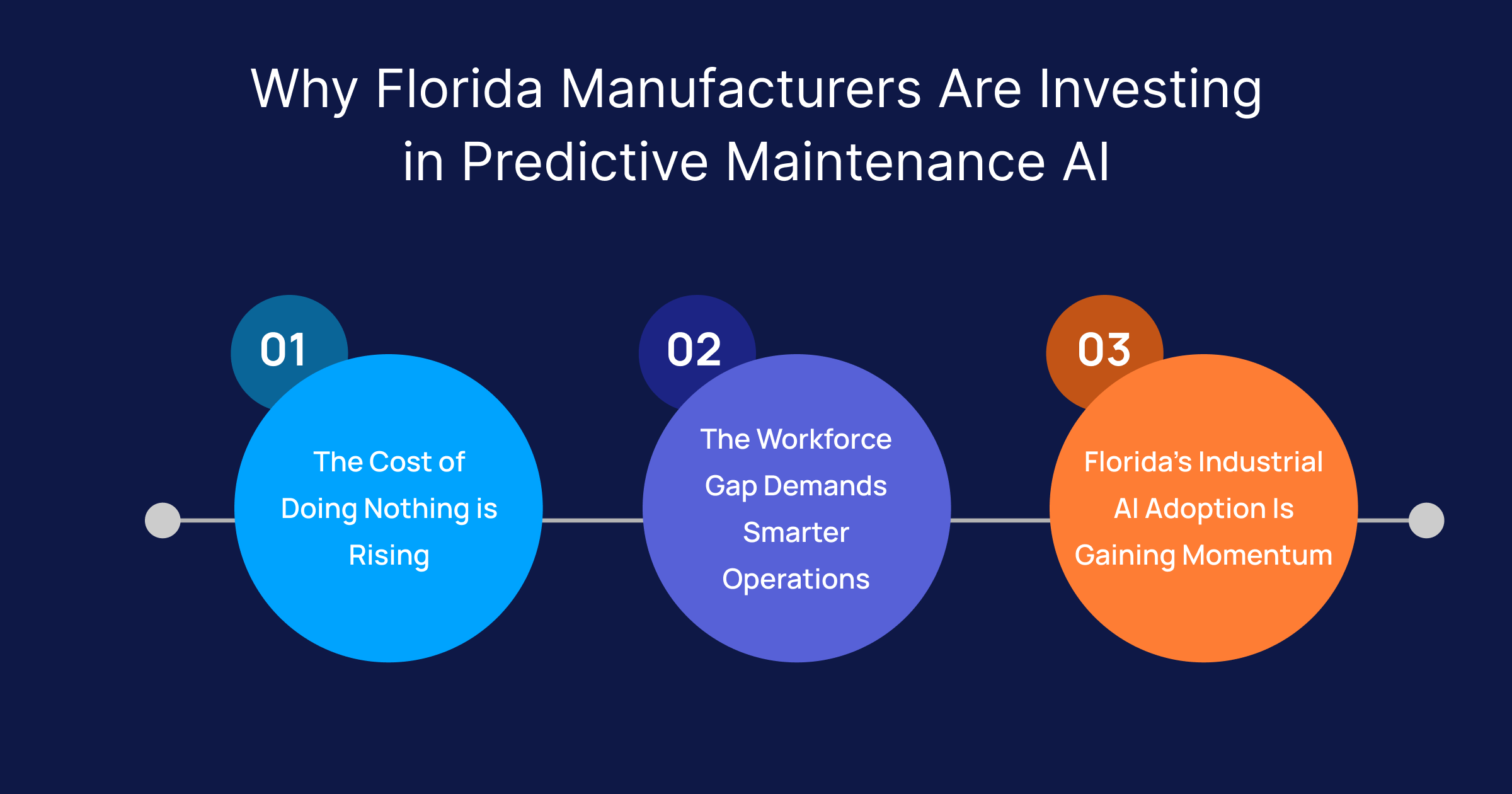
The Cost of Doing Nothing is Rising

Unplanned downtime costs industrial manufacturers an estimated $50 billion annually.4 And the gap between planned and unplanned repairs is significant: proactive maintenance on the same asset costs four to five times less than an emergency repair after failure.[5] For Florida facilities operating in sectors like aerospace and electronics, where production schedules are tightly contracted, even a single unplanned stoppage can cascade into missed delivery commitments and financial penalties.

The Workforce Gap Demands Smarter Operations

With more than half of Florida’s manufacturing workers approaching retirement,[3] manufacturers cannot rely solely on experienced technicians to diagnose equipment problems by sound and feel. Asset health monitoring powered by AI captures and codifies that diagnostic knowledge, allowing smaller and less experienced maintenance teams to act on data-driven recommendations promptly.

Florida's Industrial AI Adoption Is Gaining Momentum

Florida ranks second in the U.S. for manufacturing job growth, [6] and has seen a 32% increase in manufacturing establishments since 2019.[2] State-backed infrastructure investments, pro-business policies, and a growing concentration of aerospace and electronics production along the Space Coast and Central Florida corridors make the state a natural adoption zone for industrial AI initiatives. Manufacturers expanding into new Florida facilities have the opportunity to build sensor infrastructure from day one, rather than retrofitting legacy plants.

The ROI of Predictive Maintenance AI for Manufacturing Facilities

The financial returns from predictive maintenance in manufacturing are well-documented. McKinsey research indicates that predictive maintenance can reduce equipment downtime by 30% to 50% and lower maintenance costs by 10% to 40%. Most organizations achieve full payback within 12 to 18 months.
Beyond direct cost savings, predictive maintenance AI also extends equipment useful life significantly, allowing facilities to defer major replacements and redirect that capital toward growth.

What Sensors and Data Are Needed for Predictive Maintenance Models?

One of the most common questions from manufacturers evaluating IoT predictive maintenance is what infrastructure investment is required before deployment can begin. The answer is more accessible than many expect.
Four primary sensor types cover the majority of industrial failure modes.
Modern wireless IoT sensors can be retrofitted to existing equipment without modifications, with most installations completed in under an hour per asset. A starting deployment on a facility’s 10 to 15 most critical assets, typically motors, pumps, compressors, and gearboxes, provides enough data to build baseline models and demonstrate value within the first 60 to 90 days. From there, coverage can expand to secondary assets based on failure risk and production impact.

Getting Started: A Practical Roadmap

For Florida manufacturing operations considering predictive maintenance AI, the most effective path forward follows three phases.
The first phase is a targeted pilot. Identify the three to five assets with the highest downtime costs or safety implications. Install vibration and temperature sensors on these assets, establish a two-to-four-week data baseline, and configure initial alert thresholds. This phase typically requires minimal capital and can produce actionable insights within 60 days.
The second phase is validation and expansion. Use the pilot data to calculate actual avoided downtime, quantify savings, and build the internal business case. Expand sensor coverage to the next tier of critical assets and begin integrating AI-generated maintenance recommendations into daily workflows.
The third phase is operational integration. Connect predictive models to your CMMS for automated work order generation, build dashboards for real-time asset health monitoring, and establish continuous improvement loops where model accuracy improves with each confirmed or averted failure.
Working with a team that has prior deployment experience in manufacturing environments can accelerate each of these phases significantly, reducing the typical 90-day pilot to as few as 30 to 45 days and avoiding common pitfalls around sensor placement, data integration, and false-positive tuning.

Stop Unplanned Downtime Before It Starts.

Leverage AI-driven insights to predict equipment failures, cut maintenance costs, and maximize production output across your Florida facility.

Frequently Asked Questions

Preventive maintenance follows a fixed schedule, servicing equipment at set intervals regardless of actual condition. Predictive maintenance uses real-time sensor data and AI algorithms to monitor equipment health continuously, triggering intervention only when data indicates early signs of degradation. This prevents both unnecessary servicing of healthy assets and the costly surprise of an unplanned breakdown. Where preventive maintenance asks “Is it time?”, predictive maintenance asks “Is it needed?”
Manufacturers need IoT sensors (vibration, temperature, pressure, or current) installed on critical assets, a reliable network for data transmission, and a system to store and process the data. Most modern wireless sensors can be retrofitted to existing equipment without modifications. A baseline of two to four weeks of normal operating data is typically required before AI models can begin generating accurate failure predictions.
McKinsey research indicates that manufacturers implementing predictive maintenance AI can expect a 30% to 50% reduction in unplanned downtime. Individual outcomes depend on equipment age, the number of monitored failure modes, and how consistently maintenance teams act on the alerts. Organizations that integrate automated work order generation tend to see results at the higher end of that range.
Predictive maintenance in manufacturing delivers the strongest returns in industries with capital-intensive rotating equipment and high downtime costs. Aerospace and defense, food and beverage, automotive, pharmaceuticals, and energy and utilities are among the leading adopters. Within Florida specifically, the concentration of aerospace manufacturing along the Space Coast and electronics production in Central Florida makes these sectors natural candidates for early adoption.

Top AI Consulting Companies in Florida: How to Evaluate and Choose

CompTIA’s 2026 State of the Tech Workforce report names Florida, alongside Texas, New York, and Washington, as one of the states poised for the biggest absolute tech employment gains this year.[1] That expanding workforce has coincided with a growing pool of firms offering AI consulting services across Miami, Tampa, Jacksonville, and Orlando. For buyers evaluating top AI consulting companies Florida has to offer, the expanding vendor pool creates a real selection problem: credentials vary widely, and marketing language often obscures more than it clarifies. This guide provides concrete AI consulting evaluation criteria, profiles the best AI consulting firms Florida buyers should consider, and outlines the questions that separate qualified vendors from overpromising ones.

AI Consulting Evaluation Criteria That Actually Matter

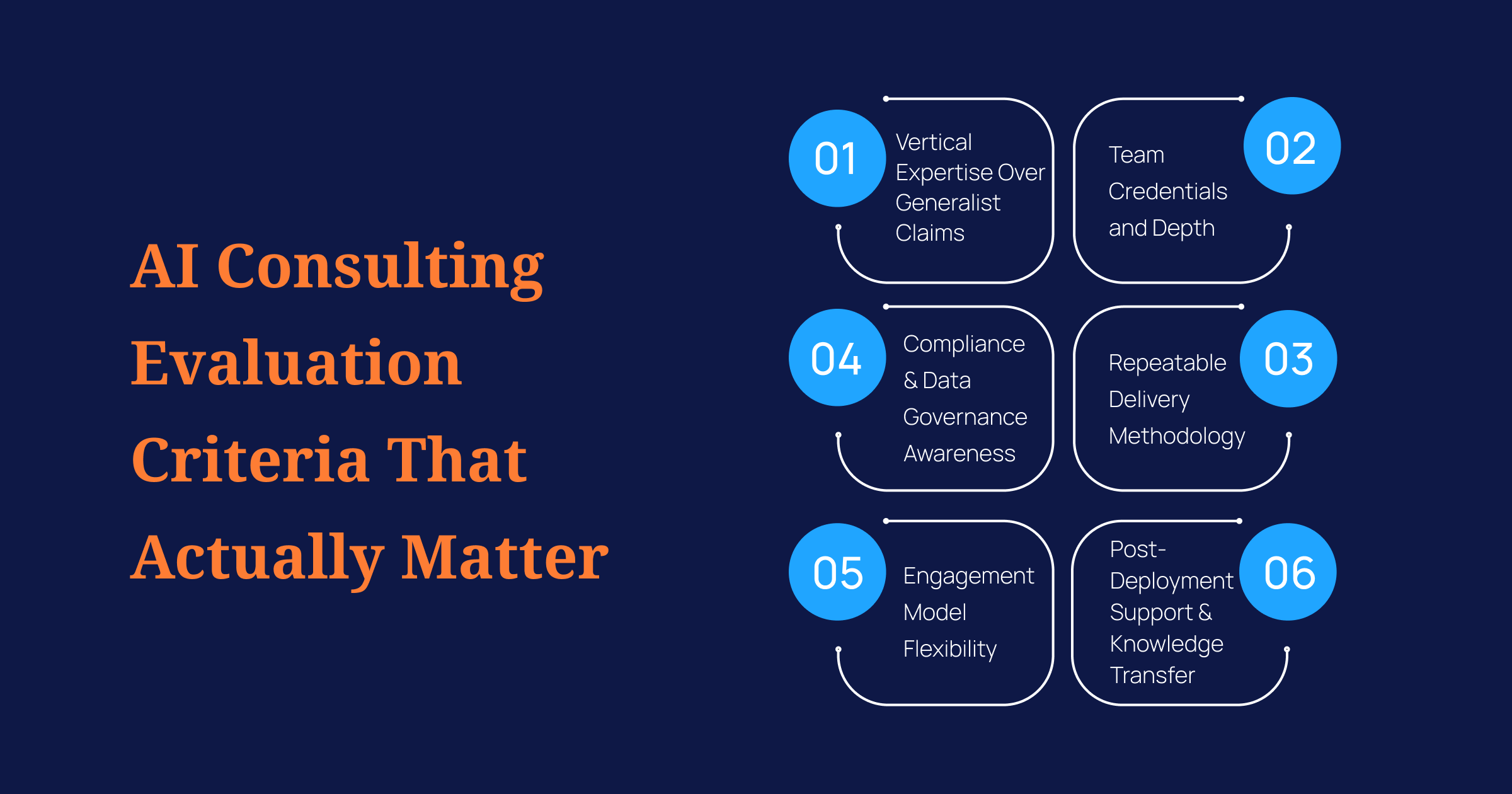
Knowing how to choose AI consultant partners comes down to six factors that directly predict engagement success.

1. Vertical Expertise Over Generalist Claims

AI consulting in pharma, where FDA validation and adverse event reporting carry regulatory consequences, is fundamentally different from AI consulting in logistics or retail. Ask for prior engagements in your specific industry. Look for named clients, not vague references to “Fortune 500 experience.”

2. Team Credentials and Depth

A firm with PhD-led data science teams will approach model design, validation, and governance differently than one staffing projects with junior engineers. Ask about team composition, not just team size. The distinction matters most in regulated sectors where errors carry audit risk.

3. Repeatable Delivery Methodology

Firms that operate with documented, repeatable delivery frameworks tend to produce more predictable outcomes than those running each engagement ad hoc. Ask whether the vendor has a named methodology and how it governs quality checkpoints throughout implementation.

4. Compliance and Data Governance Awareness

If your organization operates under HIPAA, FISMA, GxP, or GDPR constraints, your AI consulting partner must demonstrate compliance-aware engineering, not just general technical skill. This is non-negotiable for healthcare, life sciences, and public-sector buyers.

5. Engagement Model Flexibility

Some projects call for a fixed-outcome delivery model; others need staff augmentation or managed service agreements. Strong Florida AI vendors offer multiple engagement structures rather than forcing every client into one template.

6. Post-Deployment Support and Knowledge Transfer

The best consultancies plan for the handoff from day one. Ask how the vendor documents model logic, data lineage, and governance protocols so your internal team can maintain and extend what was built.

Top AI Consulting Companies in Florida

The firms below span different sizes, specializations, and geographies within Florida. Each has a verifiable track record delivering AI and data analytics engagements.

01| Intuceo (Jacksonville, FL)

Best for: Regulated-industry AI consulting in healthcare, life sciences, pharma, manufacturing, and the public sector.
Intuceo is a services firm headquartered in Jacksonville with over two decades of experience delivering AI, machine learning, and data analytics solutions for Fortune 1000 enterprises and federal agencies. Three things set Intuceo apart from other top AI consulting companies Florida buyers will encounter.
First, its engineering teams are PhD-led, with over 150 certified engineers operating across engagements. This depth allows the firm to take on high-stakes work in pharmacovigilance, clinical trial matching, and adverse event detection, where model accuracy has regulatory and patient-safety implications.
Second, Intuceo brings named accelerators built from prior regulated engagements: Intuceo-Ax (an analytics accelerator for augmented business intelligence), Intuceo-Ix (a neural search intelligence accelerator), and Intuceo-Dx (a document and vision intelligence accelerator). These are not generic toolkits. They are solutions shaped by real delivery experience in GxP, HIPAA, and FDA-governed environments, designed to compress implementation timelines without sacrificing compliance.
Third, Intuceo holds a GSA MAS contract (47QTCA24D00EH) for federal agencies and a Florida DMS term contract (80101507-23-STC-ITSA) active through September 2027, giving it validated procurement channels that most boutique firms cannot match. Named clients include Florida Blue, UF Health, Janssen Pharma, and CSX.
The firm’s proprietary iPDLC delivery framework governs every engagement from discovery through production, with documented quality gates at each phase. Engagement models include fixed-outcome projects, strategic team augmentation, and managed service SOWs.

02 | The Hackett Group (Miami, FL)

The Hackett Group (NASDAQ: HCKT) is a publicly traded strategic consultancy headquartered in Miami that has repositioned aggressively around generative AI. The firm launched its Gen AI Executive Advisory Program in 2025, led by AI veteran John K. Thompson, to help large enterprises evaluate, build, and deploy AI initiatives across finance, procurement, HR, and supply chain functions.[2] Hackett’s strength lies in combining proprietary benchmarking data with consulting services, giving it a research-backed advisory model that appeals to CFOs and COOs seeking measurable performance improvement. Recognized by Forbes among America’s Best Management Consulting Firms for 11 consecutive years, Hackett is well suited for enterprise buyers who need AI strategy mapped to operational KPIs.

03 | NLP Logix (Jacksonville, FL)

Founded in 2011, NLP Logix is one of the fastest-growing AI consultancies in the United States, specializing in machine learning model development, computer vision, and predictive analytics. The firm earned Microsoft Solutions Partner status in Azure Data and AI in 2025 and launched its LOGIXFORGE accelerators in early 2026 to help organizations execute AI projects with shorter implementation cycles. NLP Logix also hosts AI Collaborate, an annual conference near Jacksonville that brings together enterprise AI practitioners. Its delivery approach, built around the principle that “Data Science is a Team Sport,” emphasizes cross-functional collaboration between data scientists, engineers, and business stakeholders. A strong fit for organizations seeking a Florida-native ML consultancy with deep technical roots.

04 | Bridgenext (Jacksonville, FL)

Bridgenext, formerly known as Emtec, is a digital consultancy headquartered in Jacksonville with over 1,900 employees across the U.S., Canada, Argentina, and India.[5] The firm unified four businesses (Emtec, Emtec Digital, Wave6, and DEFINITION 6) under the Bridgenext brand in 2024, consolidating capabilities in data engineering, AI, application engineering, and creative marketing services. Backed by Kelso and Company, Bridgenext serves enterprise, education, and government clients with particular strength in transportation, financial services, and healthcare. Its multi-disciplinary structure makes it a fit for organizations that need AI integrated into broader digital initiatives.

05 | The SilverLogic (Boca Raton, FL)

The SilverLogic (TSL) is a custom software development and AI consultancy headquartered in Boca Raton, founded in 2012. The firm has earned multiple Inc. 5000 recognitions and focuses on building AI-ready applications, business automation, and ML-driven systems for clients in healthcare, finance, and manufacturing. TSL operates with small, dedicated project teams of four to five specialists and runs structured weekly sprints, giving clients close visibility into development progress. Its South Florida location and collaborative development model position it well for mid-market buyers in the Miami, Fort Lauderdale, and Palm Beach corridor.

Questions to Ask Before Hiring an AI Consulting Vendor

When you are narrowing your shortlist of Florida AI vendors, these five questions will reveal more about a firm’s actual capabilities than any pitch deck.

Boutique Firms vs. National Consultancies: A Florida Buyer's Perspective

What’s the difference between boutique and national AI consulting firms in Florida? It is a question worth asking directly, because the answer shapes the kind of engagement you will get.
Boutique Florida firms typically offer deeper specialization in specific verticals, tighter project ownership (your account lead is often your technical lead), and pricing that reflects regional market conditions rather than global rate cards. This matters most in regulated industries, where domain fluency cannot be substituted with scale.
National consultancies bring broader geographic reach, larger bench strength, and established relationships with major cloud and technology providers. For multi-region rollouts or engagements requiring 50-plus consultants, that scale is a genuine advantage.
Florida’s market includes both categories, along with firms like Intuceo that combine the vertical depth of a boutique with the compliance credentials (GSA MAS, DMS term contracts) and delivery scale typically associated with larger organizations. Buyers should match firm type to project requirements rather than defaulting to brand recognition.

Evaluating AI Consulting Partners for a Regulated Industry?

Intuceo brings PhD-led engineering, named accelerators from prior regulated engagements, and government contract vehicles to every engagement. Talk to the team about your specific use case.

Frequently Asked Questions

The most consequential criteria are industry-specific experience, team credentials (particularly PhD-level data science leadership for regulated work), a documented and repeatable delivery methodology, compliance awareness for your regulatory environment, and engagement model flexibility. Cost matters, but selecting a partner on price alone often leads to rework that exceeds the savings.
It depends on the engagement. Local and regional Florida firms tend to offer stronger vertical specialization, closer project oversight, and more competitive pricing. National firms bring bench depth and multi-geography delivery capability. For regulated-industry AI work in healthcare, pharma, or the public sector, a Florida firm with demonstrated compliance credentials and named client outcomes will often outperform a national brand running your project from an offshore delivery center.
Watch for vendors that cannot name specific prior engagements in your industry, lack a documented delivery methodology, propose teams without disclosing individual credentials, avoid discussing model governance and post-deployment support, or price significantly below market without explaining why. Vague references to “AI transformation” without concrete deliverables are another consistent warning sign.
Intuceo offers three engagement structures: fixed-outcome projects with firm pricing, strategic team augmentation for clients who need embedded specialists, and managed service SOWs (Statements of Work) for ongoing execution. Each engagement follows the firm’s iPDLC delivery framework with PhD-led quality gates at every phase. This combination of delivery structure and regulatory compliance (GSA MAS contract, Florida DMS term contract) is uncommon among boutique-scale firms in the Florida market.

AI & Data Analytics Consulting Services in Jacksonville: What Northeast Florida Enterprises Should Know Before They Buy

Four Fortune 500 companies, five Fortune 1000 companies, and more than 150 corporate, regional, and divisional headquarters operate out of the Jacksonville region.[1] That concentration generates a particular kind of enterprise data. It is freight manifests and rail movements, claims files and policy records, clinical documentation, shipyard maintenance logs, and distribution schedules, produced at volume by organizations that run physical operations rather than software businesses.
Buyers searching for AI & data analytics consulting services in Jacksonville are almost always working on that data, and seldom starting from a clean slate. The estate usually includes a data warehouse that has outlived the assumptions it was built on, reporting that different functions read differently, and source records carrying compliance obligations that predate any analytics plan. This guide covers what the work involves, why Jacksonville presents a different problem from Atlanta or Charlotte, how the firms in this market actually differ, and which questions separate a credible proposal from a confident one.

Key Takeaways

What AI and data analytics consulting covers in this market

Firms in this market apply the same category label to very different work. In practice, the enterprise AI services available in Jacksonville, FL fall into six areas, and most engagements combine two or three of them rather than starting with the headline capability the buyer came in asking about.
A policy states intent. A framework assigns owners, sets review gates, and defines what happens when a model behaves unexpectedly. An AI center of excellence governance framework turns scattered plans into a repeatable operating model, which matters most when auditors, regulators, or customers start asking who signed off on a given decision.

What an AI Center of Excellence governance framework actually covers

An AI Center of Excellence (CoE) is the group that sets standards for how AI is built and run across an organization. Its governance framework is the structure that the group operates by. A working version covers several connected areas rather than a single checklist:

Data engineering and integration

Consolidating records that currently live in an Enterprise Resource Planning (ERP) system, a Transportation Management System (TMS), an Electronic Health Record (EHR), a claims processor, and several spreadsheets that a long-tenured analyst maintains personally. This includes pipeline construction, schema design, master data management, and reconciling identifiers that were never designed to match across systems. It is the least glamorous part of the work and routinely the largest.

Analytics and business intelligence

Building the reporting and self-service layer that decision makers actually open. The technical challenge is usually less about the visualization tooling and more about establishing which definition of a metric is authoritative when finance, operations, and the line of business each maintain their own.

Predictive and machine learning work

Demand forecasting, equipment failure prediction, claim denial prediction, risk stratification, and network optimization. These models depend entirely on the integration work underneath them, which is why engagements that begin at this layer so often stall.

Document and language intelligence

Extracting structure from contracts, clinical notes, regulatory correspondence, bills of lading, and inspection reports. Retrieval-augmented generation and Natural Language Processing (NLP) techniques sit here, applied to the unstructured records that most Jacksonville operations produce in quantity.

AI governance and compliance engineering

Model documentation, audit trails, access control, explainability, and the review process that determines whether a model is allowed into a decision that affects a patient, a claim, or a federal contract. For regulated buyers, this is not an add-on to the engagement. It determines whether the output can be used at all.

Managed analytics and run support

Ongoing operation of pipelines and models after the project team leaves, including monitoring, retraining, and incident response. Buyers who skip this line item tend to discover its necessity eight months later.
The sequencing between these six areas is what most proposals get wrong. Firms selling AI & data analytics consulting services in Jacksonville will frequently lead with the predictive or generative capability, because that is what the buying committee was asked about. The work that determines whether the engagement succeeds sits one or two layers below it. A useful proposal says so plainly and prices the integration honestly, even when that makes the first invoice less appealing than a competitor’s.

Why Jacksonville is a different analytics problem

Proximity is the obvious reason to search locally and the least important one. Four structural conditions in this region change the shape of the work itself, and each one tends to surface as scheduled risk when a delivery team has not met it before.

The data is operational before it is digital

Jacksonville’s core enterprises move physical things. CSX runs one of the country’s largest rail networks from a headquarters here. Southeast Toyota processes vehicles through the port. BAE Systems repairs naval vessels on the St. Johns River. Around that core sits a dense layer of distribution, warehousing, and third-party logistics.
Every movement leaves a record, and the records are messy in specific, predictable ways. Timestamps come from systems that were never synchronized against each other. The same customer appears under three spellings across three source tables. Exception codes were written for a dispatcher to read at speed, not for a model to consume. Weights and counts get re-keyed by hand at transfer points. None of this is exotic, and all of it has to be resolved before a forecast means anything. A team that has only worked with clean transactional data will underestimate the normalization effort by a wide margin, and the schedule slips before any modelling begins.

A finance, insurance, and health base that runs on records

Jacksonville supports more than 53,300 financial services workers and hosts over twenty institutions from the Fortune Global 500 list.[2] Alongside that sits one of the state’s heaviest concentrations of health plan and provider operations, from Florida Blue and GuideWell to Mayo Clinic, Baptist Health, and UF Health Jacksonville.
These organizations generate documentation as their primary output. That means the analytics opportunity is real and the constraint is real at the same time. Claims data, member data, and Protected Health Information (PHI) carry obligations under the Health Insurance Portability and Accountability Act (HIPAA) that shape where data can sit, who can query it, and what a model is permitted to influence. Those are pipeline design decisions, settled at ingestion rather than adjusted afterwards, which is why the choice of data analytics consultant Jacksonville health organizations work with matters more than the tooling on the proposal.

The talent math rarely supports an in-house build

This is the condition most business cases get wrong. Workers in the Jacksonville metropolitan area earned an average hourly wage of $31.59 in May 2025, below the national average of $33.54. Office and administrative support occupations accounted for 12.6 percent of area employment, followed by transportation and material moving at 9.9 percent, sales at 9.8 percent, and food preparation and serving at 9.4 percent. Computer and mathematical occupations, meanwhile, carried a local mean hourly wage of $51.30, placing them among the highest paid groups in the metro.[3]
Read those figures together, and the picture is clear. Jacksonville’s employment base is weighted toward operations, administration, and distribution. Technical talent is comparatively scarce and priced at a premium against the local wage floor, while competing for the same candidates as remote employers paying national rates. An organization that decides to build a data science function internally is not simply choosing between two costs. It is entering a hiring market where the roles it needs are the least represented and the most expensive relative to everything else it pays for, and where a single departure can idle a programme for a quarter.
That does not make an in-house team wrong. It makes the sequencing matter. Most Jacksonville enterprises get further by having an external team build and prove the first pipelines and models, then transferring operation to a smaller internal group that maintains rather than invents.

A regulated and federal overlay sits across the whole region

Naval Air Station Jacksonville and Naval Station Mayport anchor one of the larger military concentrations in the country, and the contractor base around them carries federal security obligations. Add the health plans, the provider systems, and the state agencies purchasing through Florida vehicles, and a large share of the region’s enterprise data arrives with rules attached before anyone writes a line of transformation logic.
This is the condition that most reliably separates firms in this market. Handling regulated data is not primarily a technical skill. It is knowing which questions the compliance function will ask, at what point in the delivery cycle they will ask them, and what evidence satisfies an auditor rather than a stakeholder. Teams that have done it before design around those checkpoints from the start. Teams that have not treated each one as a surprise, and the schedule absorbs the difference.

Who competes for this work, and how each type fails

Anyone asking which are the best AI consulting companies in Jacksonville, Florida is really asking a comparison question, and the honest answer is that the market contains four different business models wearing similar language. The useful distinction is not which firm is strongest in the abstract, but which failure mode a given buyer can least afford.
Type of firm What they do well Where engagements break down
National and global consultancies Scale, methodology, brand comfort for a board, deep benches for very large programmes Senior people who won the work are rarely the people who deliver it. Florida-specific regulatory and residency conditions are treated as an edge case. Cost structures assume a programme, not a first project.
IT staffing and augmentation shops Fast placement of individual skills, low commercial friction, flexible ramp They supply people, not outcomes. Core design decisions default to whoever is on the bench that month. Accountability for the result stays with the buyer.
Local digital and marketing-led boutiques Proximity, responsiveness, strong dashboard and web delivery Depth stops at the reporting layer. Regulated data handling, model governance, and production engineering are outside their practised range.
Specialist AI and data services firms Practitioner-led delivery, reusable assets from prior engagements, regulated-industry history Smaller benches mean scheduling constraints. Buyers must verify the claimed depth is real rather than a well-written capability statement.
So the question of which is the best enterprise AI company in Jacksonville has to offer has no answer in the abstract. The choice turns on which failure mode a given buyer can survive. Brand size offers no protection when the exposure is regulatory. A staffing model returns the hardest problem to the internal team exactly when the estate is too fragile to absorb it.

How to evaluate an AI consulting firm Florida enterprises can deploy with

Six checks separate proposals that survive contact with production from proposals that merely read well. Work through them with your shortlist of AI consulting firms in Florida and note where the hedging starts.

Where demand concentrates across Northeast Florida

Demand for AI & data analytics consulting services in Jacksonville is not spread evenly. It clusters in five places, and each cluster asks for a different combination of the six service areas described earlier.

Health plans and provider systems

The question of which AI consultants work with Florida healthcare companies comes up constantly, because the buyer set is dense and the compliance bar is high. Payer-side work centres on quality measure tracking, member risk stratification, avoidable event analysis, and claim denial prediction. Provider-side work centres on clinical data consolidation across EHRs, care gap identification, revenue cycle analysis, and reducing coding error rates. Both depend on interoperability standards such as Health Level Seven (HL7) and Fast Healthcare Interoperability Resources (FHIR) being handled properly at ingestion.

Supply chain and transportation

Route and network optimization, freight consolidation, predictive maintenance on rolling stock and handling equipment, dwell time analysis, and exception management. Given the port and rail concentration described earlier, this is the region’s most distinctive analytics demand and the one national firms most frequently underestimate.

Financial services and insurance

Fraud and anomaly detection, servicing analytics, document processing across policy and title records, and model risk documentation. The volume is substantial, and the regulatory overlay is unforgiving.

Advanced manufacturing and defense

Asset performance analytics, quality prediction, and shop floor data consolidation, with a defense-adjacent layer around Naval Air Station Jacksonville and Naval Station Mayport that brings federal security requirements including the Federal Information Security Management Act (FISMA) into scope.

State and local government

Case management analytics, fiscal transparency reporting, and compliance processing, where the constraint is usually procurement rather than technology.

Procurement: the layer that decides your timeline

For public sector and publicly funded buyers, the contract vehicle frequently matters more than the proposal. The State of Florida’s Information Technology Staff Augmentation Services term contract, number 80101507-23-STC-ITSA, runs from October 1, 2023 through September 30, 2027 and lets eligible agencies, educational institutions, and other authorized users engage prequalified vendors without a fresh competitive solicitation.[4] At the federal level, the General Services Administration Multiple Award Schedule performs the same function.
The practical effect is measured in months. A firm already on the vehicle can start discovery while a firm that is not is still assembling a response. Any Jacksonville buyer working with public money should confirm vehicle status in the first conversation, because no amount of technical fit compensates for a procurement path that adds two quarters.

Where Intuceo fits in Northeast Florida

Intuceo is headquartered at 4110 Southpoint Boulevard in Jacksonville, and Jacksonville is the operational centre of the firm rather than a sales office attached to delivery somewhere else. For anyone asking whether a local AI and data analytics firm is serving Northeast Florida with genuine depth, that distinction is the one worth testing.
The Florida engagement history is the more useful credential. Intuceo teams have delivered for Florida Blue, GuideWell Health, UF Health, Mission Health, and d2i on the payer and provider side, and for CSX and Magnit on the operational and workforce side. Those are the exact conditions described throughout this guide: regulated records, fragmented source systems, and operational data that resists tidy modelling.

What the delivery team brings to the first engagement

Rather than beginning every project from a blank repository, Intuceo practitioners configure a set of accelerators drawn from prior regulated engagements:
These are assets a services team brings and configures against a client’s estate. They shorten the path through work that has been solved before so senior effort goes to the parts that are specific to the client. They are not something a client licenses and operates alone.

The credentials that shorten a Florida engagement

Engagement models and realistic timelines

Three models cover most of this market, and choosing the wrong one is a common and expensive error.
On timelines, an honest sequence for a mid-sized Jacksonville enterprise looks roughly like this: a discovery and data assessment phase measured in weeks rather than months, a first production-grade deliverable in the following quarter, and a decision point after that on whether to expand scope or transfer operation internally. Any firm promising a production model in six weeks without having examined the source systems is describing a demonstration, not a deployment.

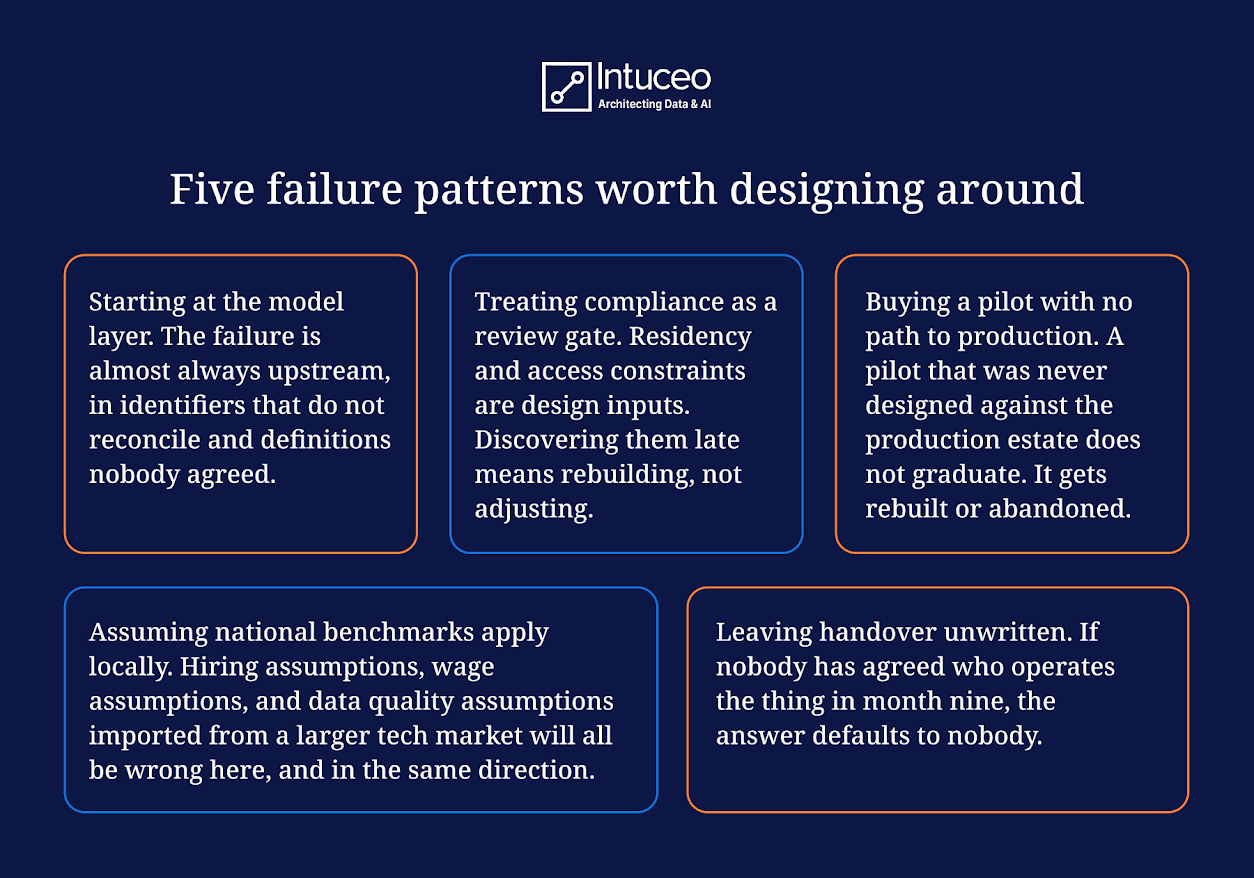
Five failure patterns worth designing around

Start with an assessment of what you actually have

Most Jacksonville organizations do not need a strategy deck. They need someone to look at the source systems, say plainly which use case is reachable from the current data and which is not, and put a number and a sequence against it.
Intuceo runs a scoped data and AI readiness assessment for Northeast Florida enterprises: a review of your source estate, a shortlist of use cases ranked by feasibility rather than ambition, and the compliance constraints that will shape delivery. It is run by the practitioners who would do the work.

Frequently Asked Questions

Yes. Intuceo is headquartered at 4110 Southpoint Boulevard, Suite 124, Jacksonville, FL 32216. Jacksonville is the firm’s strategic and operational centre, not a regional sales office. Additional centres in London and in Bangalore and Hyderabad provide extended coverage where a client’s data residency and security requirements allow it.
Healthcare and health plans, life sciences, supply chain and transportation, advanced manufacturing and engineering, financial and professional services, and the public sector. The Florida engagement history is concentrated in healthcare and logistics, which matches where enterprise demand in this region is heaviest.
Three differences matter in practice. The team that scopes the engagement is the team that delivers it, rather than a separate bench introduced after signature. Florida-specific conditions, including data residency rules and state procurement routes, are treated as design inputs from the first conversation instead of exceptions handled late. And the state and federal contract vehicles are already in place, which removes the procurement lead time that national firms often absorb into the schedule.
Yes. Local headquarters means practitioners can be on-site for discovery workshops, source system reviews, stakeholder alignment sessions, and go-live support without travel scheduling becoming a project constraint. On-site presence tends to matter most during discovery and during the transition to production, and engagements are typically structured with that in mind.
It depends on the state of the source data far more than on the use case. Discovery and data assessment generally run in weeks. A first production-grade deliverable typically lands in the quarter that follows, assuming source system access is granted promptly. Access delays and undocumented legacy systems are the two factors that most often extend a schedule, which is why the assessment phase exists.
Yes. Intuceo is a prequalified vendor on the State of Florida Department of Management Services Information Technology Staff Augmentation Services term contract, number 80101507-23-STC-ITSA, which runs through September 30, 2027. At the federal level, Intuceo holds GSA Multiple Award Schedule contract 47QTCA24D00EH covering Information Technology Professional Services and cloud-related IT professional services. Both allow eligible agencies to engage without running a fresh competitive solicitation.