
Predictive Analytics in Healthcare: How Providers Are Reducing Readmission Rates Before Discharge

In the era of value-based care, the hospital discharge is no longer the “finish line” – it is a critical transition point. For healthcare providers, the challenge has always been identifying which patients are likely to return within 30 days. Traditionally, this was a guessing game based on clinical intuition or static scoring systems.
Today, predictive analytics in healthcare is changing the narrative. By leveraging AI-driven insights before a patient even leaves the hospital, providers are moving toward a “preventative discharge” model, effectively reducing readmission rates and ensuring long-term patient recovery.

The High Stakes of 30-Day Readmissions

Hospital readmissions are a multi-billion-dollar challenge. Under the CMS Hospital Readmissions Reduction Program (HRRP), hospitals face significant financial penalties if their 30-day readmission rates for conditions like heart failure or pneumonia exceed national averages.
The stakes are highest in chronic disease management. Across various clinical studies, up to 86% of heart failure rehospitalizations could potentially be prevented through timely medical and social interventions.
However, beyond heart failure, readmission risks exist across the board:
The gap lies in the hospital’s ability to identify exactly which interventions are needed for which patient after their discharge.

The Strategic Role of Predictive Analytics in Modern Healthcare

Before diving into the mechanics of readmissions, it is essential to understand the broader shift predictive analytics represents. In the past, healthcare data was mainly used for backward-looking analysis, focusing on metrics from the previous month or quarter.
Predictive analytics flips the script by using historical data to forecast future events. It is an “early warning system” – by synthesizing massive volumes of data from Electronic Health Records (EHRs), wearable devices, and genomic sequences, predictive tools can identify subtle patterns that the human eye might miss. This shift enables:
By serving as a foundation for decision support, predictive analytics allows healthcare organizations to transition from a volume-based “fee-for-service” model to a value-based model centered on quality and efficiency.
It is important to note that these predictive tools do not replace clinical judgment; rather, they function as advanced Clinical Decision Support (CDS). By providing a clear evidence base for risk, AI empowers the multidisciplinary team to make the final call on a patient’s readiness for discharge, ensuring that technology serves as a co-pilot in the care journey.

How Predictive Analytics Identifies High-Risk Patients

The power of hospital readmission prediction today lies in its ability to process massive, disparate datasets in real-time. Traditional methods, such as the LACE index, focused on a narrow set of variables: length of stay, acuity, comorbidities, and emergency visits. Though useful, these models often lack the context of a patient’s life outside the hospital.
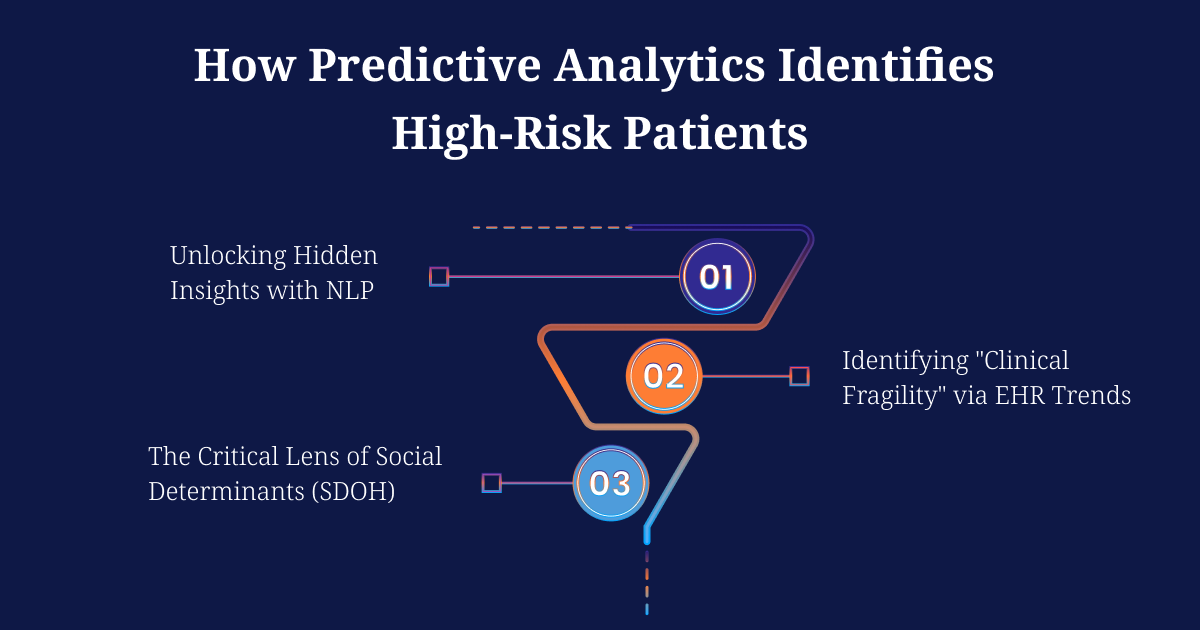
1. Unlocking Hidden Insights with NLP

Much of the most valuable patient data is “trapped” in unstructured clinical notes – the narrative observations made by nurses, social workers, and therapists. Machine learning readmission models now use Natural Language Processing (NLP) to scan these notes for red flags that structured data misses, such as mentions of cognitive decline, lack of caregiver support at home, or history of non-adherence. Predictive models synthesize narrative data to provide a multidimensional view of risk that far exceeds traditional scoring.

2. Identifying "Clinical Fragility" via EHR Trends

Rather than looking at a single lab result, AI models look at the velocity of change.

3. The Critical Lens of Social Determinants (SDOH)

A patient’s recovery is often dictated by social and environmental factors beyond the clinic – access to healthy food, transportation to follow-up appointments, and housing stability. SDOH-informed models integrate these external variables into the clinical risk profile.

Precision in Practice: The Intervention Framework

The 30-day window is historically difficult to manage because hospitals often enter a ‘data vacuum’ the moment a patient leaves the building. Predictive analytics bridges this gap by identifying which patients are most likely to face complications on Day 10 or Day 20, allowing providers to extend their clinical ‘line of sight’ into the home and prevent the silent relapses that drive readmissions.
To tackle readmissions, providers are using a three-tiered predictive approach that triggers specific clinical actions regardless of the primary diagnosis.

1. The Pre-Discharge Stability Check

AI models analyze real-time hemodynamics and lab trends. If the model identifies “subclinical instability” – where the patient looks fine but data suggests physiological stress – the system alerts the care team to delay discharge by 24 hours for further observation.

2. The Social Safety Net

For patients flagged as high-risk due to social factors (ROC-AUC 0.79–0.82), the system automatically triggers a “Transition of Care” (TOC) bundle. This includes “Meds to Beds” delivery and a confirmed home-health visit within 48 hours.

3. Predictive Resource Prioritization

Not every patient needs a daily follow-up call. Predictive models identify the top 10% of “ultra-high-risk” patients. By focusing labor-intensive monitoring on these individuals, hospitals maximize their resources while ensuring the most vulnerable have a digital safety net.

Real-Time Risk Scoring at Discharge: A Strategic ROI

Implementing real-time readmission risk scoring isn’t just a clinical win; it’s a strategic financial move.

Calculating the ROI

When hospitals deploy predictive tools to cut readmissions by 30-50%, the Return on Investment (ROI) is realized through:

The Intuceo Advantage: Turning Data into Action

At Intuceo, we understand that a prediction is only valuable if it is actionable. Our Augmented BI technology is designed to bridge the gap between “big data” and “bedside care.”

Conclusion: Predictive Care is the Future

The transition from retrospective management to predictive foresight is more than a technological upgrade – it is a fundamental reimagining of the hospital’s role in a patient’s life. In the traditional model, patient discharge was treated as a conclusion; however, in this digital-first world, it is an informed handoff supported by a continuous clinical safety net.
Reducing readmission rate is a complex puzzle with clinical, social, and behavioral pieces. However, by leveraging predictive analytics in healthcare, providers can finally visualize the “invisible” risks, from subtle lab velocity shifts and hidden social determinants to the nuances buried in clinical notes, that lead to relapse.
For Intuceo, the objective is to ensure that “big data” never loses its human context. By transforming raw Electronic Health Record data into actionable bedside intelligence, we empower providers to ensure that when a patient is discharged, they aren’t just leaving a facility – they are entering a managed recovery ecosystem. The future of healthcare isn’t defined by the events that occur within the hospital walls, but by the clinical intelligence that keeps patients healthy, at home, and on a definitive path to long-term wellness.

Ready to transform your discharge process from a guessing game into a managed recovery?

Frequently Asked Questions

The LACE index is a static, backward-looking tool that relies on only four variables. Predictive analytics, however, uses machine learning to analyze hundreds of real-time data points simultaneously—including “velocity of change” in labs and social determinants (SDOH). This allows AI to identify high-risk patients that the LACE index frequently misses, such as those who are clinically stable but socially fragile.
No. These tools function as Clinical Decision Support (CDS) systems. They act as a “co-pilot” for the clinical team by providing a data-driven risk score and explaining the underlying causes of that risk. The final decision to discharge remains with the physician and the multidisciplinary care team.
Yes. Through Natural Language Processing (NLP), predictive models can “read” the narrative notes written by nurses, therapists, and social workers. It identifies red flags like “patient expressed confusion about discharge instructions” or “home environment lacks caregiver support.” This converts subjective observations into objective risk data.
Machine learning models are not “set and forget.” As medical standards evolve (e.g., new heart failure protocols), the model must undergo periodic retraining. Advanced platforms use Continuous Learning loops to monitor if the model’s performance is dipping, ensuring that the risk scoring remains aligned with current clinical outcomes and the specific demographics of your local patient population.
Solutions like Intuceo’s DataSharp™ engine are designed to automate the preprocessing of complex EHR data. By embedding risk scores and insights directly into the existing clinical workflow, these tools provide real-time alerts without requiring clinicians to log into a separate platform.
Healthcare Analytics Consulting: The Complete Guide for Health System Leaders

Most health system leaders are aware that their organizations are drowning in data but starving for actionable insights. The challenge isn’t the volume of information – it’s the lack of decision velocity. When clinical and financial leaders operate from competing versions of a single metric, ‘truth’ becomes subjective. Whether the discrepancy lies in readmission rates, denial volumes, or ACO quality scores, the cost is more than just internal friction; it is the silent erosion of margins, delayed patient interventions, and quality performance that drifts dangerously below contract thresholds.
That gap between data abundance and decision confidence is exactly where healthcare analytics consulting creates its value. As you evaluate consulting services or select vendors, understanding the anatomy of a credible engagement – from kick-off to measurable outcome – is essential. The following sections are written for CIOs, CMIOs, CFOs, and VP-level operations leaders seeking clarity on this process.
This is not a vendor pitch list. It is a structured review of the decisions, tradeoffs, technical considerations, and realistic benchmarks that health system leaders need to navigate before, during, and after a healthcare analytics consulting engagement.

Healthcare Analytics Consulting: Why Does Timing Now Matter?

Healthcare analytics consulting refers to the practice of designing, implementing, and operationalizing data analytics capabilities inside health systems, payer organizations, and clinical networks. A healthcare analytics consulting firm may focus on a single workstream, such as clinical analytics, population health, or revenue cycle, or operate across the full data lifecycle from pipeline engineering to predictive model deployment to executive dashboard delivery.
Three forces are making 2025 a particularly consequential year for health system leaders to act on analytics:
A health system analytics consulting partner provides the architecture, expertise, and methodology to close those gaps faster than internal teams can build from scratch.

The Analytics Spectrum: Descriptive, Predictive, and Prescriptive Analytics in Healthcare

Before engaging a healthcare analytics consulting firm, health system leaders should understand the three tiers of analytics maturity and what each tier can realistically deliver.

Descriptive Analytics: What Happened?

Descriptive analytics summarizes historical data through dashboards, utilization reports, length-of-stay trends, and payer mix analyses. It held approximately 45.9% of the healthcare analytics market share in 2024, making it the largest segment by type, because it is the entry point for most organizations . It is foundational but insufficient on its own for driving the proactive interventions that move quality metrics or financial performance.

Predictive Analytics: What Is Likely to Happen?

Predictive analytics uses statistical models, machine learning, and historical patterns to anticipate outcomes before they occur. Examples include 30-day readmission risk scores, sepsis early-warning models, surgical complication prediction, and claim denial probability scoring. Predictive analytics is the fastest-growing segment in the healthcare market, with an expected CAGR of 26.5% through 2030.

Prescriptive Analytics: What Should We Do?

Prescriptive analytics goes beyond prediction to recommend or automate actions. Examples include care coordination pathway routing for high-risk patients, dynamic bed management recommendations, and prior authorization optimization. Prescriptive models require the highest data maturity and operational readiness. Organizations that attempt to skip the foundational tiers and jump directly to prescriptive AI consistently encounter failure.
The practical implication for health system leaders: assess your current data infrastructure honestly before defining the scope of a consulting engagement. A healthcare data analytics consulting firm that promises prescriptive AI outcomes without first auditing your data quality and governance posture is a red flag.

The Data Quality Problem: What Health System Leaders Need to Watch For

Poor data quality is the most common reason analytics initiatives underperform. Studies indicate that healthcare data quality issues contribute to nearly 30% of adverse medical events . In analytics terms, the consequences manifest as model drift, dashboard contradictions, and credibility erosion among clinical leaders.
Health system leaders should watch for four specific patterns:

Forward-Propagated Errors in EHR Documentation

Physicians using copy-and-paste templating in EHR workflows inadvertently carry outdated or incorrect data forward across multiple encounters. For instance, a medication listed from a 2021 hospitalization may still appear as active in 2025 if not explicitly closed. Models trained on such data inherit these errors at scale.

Missing Data Not at Random

EHR data gaps rarely appear randomly. They reflect structural access inequities, documentation habits tied to billing incentives, and population-specific care utilization patterns. When an ML model is trained on data with non-random missingness, it may perform accurately on the training cohort but fail for the underserved populations whose data is most sparse.

Siloed Data Across Clinical and Financial Systems

Most health systems operate with disconnected claims databases, EHR platforms, pharmacy systems, and laboratory information systems. Integration failures at the pipeline layer mean that analytics outputs represent only a partial picture of patient and operational reality.

Coding Inconsistency and Downstream Effects

ICD-10 coding errors, Diagnosis-Related Group (DRG) miscapture, and documentation gaps create compounding problems across both clinical analytics and revenue cycle modeling. Clinical risk scores are only as accurate as the diagnoses entered at the encounter level.
The discipline to address these issues is data governance for healthcare analytics, which includes master data management, data stewardship roles, and pipeline validation processes. Any credible healthcare data quality improvement consulting engagement begins with a data quality audit rather than jumping to model development.

Predictive Analytics for Hospitals: Reducing Readmissions and ED Overcrowding

Hospital readmissions and emergency department overcrowding carry both quality and financial penalties. For Medicare patients, nearly 20% are readmitted within 30 days of discharge. Preventing even 10% of those readmissions could save Medicare approximately $1 billion annually .
Predictive analytics for hospitals addresses this through risk-stratification models applied at or before the point of discharge. The clinical data inputs typically include prior admissions history, diagnosis complexity, medication adherence patterns, insurance status, and, increasingly, social determinants of health such as housing stability, food insecurity, and transportation access.
Here are a few real-world implementations showcasing this:
For ED overcrowding, predictive models are applied to patient census forecasting, boarding time prediction, and triage prioritization. The same architecture applied to readmissions can anticipate ED surge periods 24 to 72 hours in advance, allowing staffing adjustments and diversion management decisions to be made proactively rather than reactively.
The technology alone does not reduce readmissions. The model must be embedded in redesigned clinical workflows, adopted by case managers, and tied to specific care coordination protocols. Vendors that sell a risk score without accountability for workflow change are selling an incomplete solution.

What Metrics Should CIOs and CMIOs Track in Hospital Analytics Dashboards?

Healthcare analytics dashboard best practices distinguish high-performing health systems from average ones. Hospital analytics dashboards fail clinicians and executives when they present too many metrics with too little context, or when the metrics tracked do not connect to the decisions being made.
The following framework reflects what experienced CIOs and CMIOs prioritize across three domains.

Clinical Quality and Safety Metrics

Operational and Capacity Metrics

Financial and Revenue Cycle Metrics

Three design principles separate high-performing dashboards from those that get ignored: every metric is actionable, not just informational; every metric links to an owner and a response protocol; and dashboards refresh frequently enough to support the decision cycles they are meant to inform.

Revenue Cycle Analytics: Where Clinical and Financial Operations Converge

Revenue cycle analytics consulting for healthcare has emerged as one of the highest-ROI segments within health system analytics because the financial stakes are immediate and measurable. Healthcare administrative costs, including revenue cycle operations, account for 15 – 25% of total healthcare expenditures. Organizations using advanced analytics in revenue cycle management report up to 40% fewer denials and first-pass claim rates of 93% .
The connection between clinical and financial operations is the central problem that many health systems fail to close. Clinical documentation quality directly determines coding accuracy. Coding accuracy determines DRG assignment, which further determines reimbursement. When clinical and financial data systems are siloed, and the people who manage them operate independently without shared accountability, revenue leakage is inevitable.

Predictive Denial Management

Machine learning models trained on historical claims data can score new claims for denial probability before submission, allowing coding and billing teams to correct documentation upstream. Health systems that have implemented this capability report reductions in A/R days by nearly 11 days.

Under-Coding and Over-Coding Detection

A 2024 survey found that 84% of revenue cycle executives want analytics to identify under-coding, and 68% want the same capability for over-coding . Both represent risk – one financial and one compliance.

Value-Based Payment Alignment

As health systems take on more risk through ACO and bundled payment arrangements, the revenue cycle must track not just fee-for-service billing performance but quality-adjusted financial outcomes. Linking clinical analytics consulting services to claims analytics platforms enables this view. Organizations that treat revenue cycle analytics as a stand-alone back-office function, rather than a clinical-financial integration challenge, consistently recover less revenue and carry more administrative waste.

HIPAA-Compliant Use of LLMs on EHR Data: What Health Leaders Need to Understand

The interest in applying large language models to clinical documentation, clinical decision support, and patient record summarization is substantial and growing. The questions health system leaders need answered before approving any LLM deployment on the EHR data center in three areas: de-identification, data governance, and model accountability.

Safe Harbor Approach Is Not Optional

To comply with HIPAA, health systems must ensure patient data is anonymous before sharing it with an external AI model. This typically happens through two paths: Safe Harbor, which involves stripping 18 specific identifiers (like names, phone numbers, SSNs, etc.), or Expert Determination, where a statistician certifies that the risk of re-identification is minimal. Any LLM vendor handling raw patient data without these protections or a signed Business Associate Agreement (BAA) puts the health system at serious legal and regulatory risk.

Business Associate Agreements Define the Compliance Boundary

A vendor that processes PHI on behalf of a covered entity is a Business Associate under HIPAA. The BAA specifies permissible uses, data retention rules, breach notification obligations, and subcontractor controls. Before any LLM is connected to EHR data in a non-de-identified pipeline, the BAA must be signed and reviewed by legal counsel.

Model Governance Applies After Deployment Too

HIPAA-compliant healthcare analytics consulting requires ongoing monitoring for output accuracy, bias in clinical recommendations, and performance drift as patient populations or documentation practices change. A model that summarizes clinical notes accurately in November may produce clinically misleading summaries in March if the documentation conventions it was trained on shift. Regulated healthcare analytics consulting requires a rationalization layer between model outputs and clinical decision workflows to catch and contain these errors.
Healthcare organizations should distinguish between models deployed entirely within their own HIPAA-compliant cloud environment (Azure or AWS HIPAA-validated architectures) and models that route data through third-party inference APIs. The former is substantially more controllable than the latter, though it demands significantly more infrastructure investment.

Healthcare Analytics for Rural and Resource-Constrained Hospitals

Not every meaningful analytics initiative requires a large IT team, a data lake, and a multimillion-dollar consulting engagement. Rural hospitals and smaller health systems face a version of the same analytics problems that large health systems face, but with less budget, less IT staff, and less tolerance for extended implementation timelines that do not deliver near-term results.
Several approaches make operational analytics for hospitals accessible for resource-constrained organizations:

The Most Common Mistakes Health Systems Make in Analytics Consulting Projects

Healthcare analytics consulting implementations fail at a higher rate than they should, and the failure modes are consistent enough to be predictable.

Treating It as a Technology Project

The single most common mistake is confining the project to IT and expecting clinical and operational leaders to adopt the outputs without structured change management. Analytics does not change clinical behavior. Successful adoption requires a respected physician or nurse leader who bridges the gap between the data science team and the frontline staff. Without a peer-level advocate to validate that “the data makes sense,” even the most accurate models face cultural rejection.

Underinvesting in Data Engineering Before Model Development

Organizations frequently want to start with the predictive model and work backward to data quality. This approach is built to fail. A readmission risk model trained on incomplete or inconsistently coded data will produce unreliable risk scores, and clinicians who receive two or three inaccurate alerts will stop trusting the system entirely. Healthcare data quality improvement consulting is not a cost; it is the prerequisite.

Selecting Vendors Based on Demo Performance Rather Than Implementation Evidence

Vendors that excel at product demonstrations sometimes fail significantly in production environments where legacy systems, customized EHR configurations, and institutional data quirks introduce complexity that the demo never surfaced. Before selecting a healthcare analytics consulting firm, health system leaders should ask for reference conversations with peer institutions that have completed implementations of comparable complexity, not pilot programs or proof-of-concept engagements.

Defining Success as Deployment Rather Than Adoption

Going live is not the endpoint of a healthcare analytics implementation consulting engagement. Adoption, defined as the percentage of intended users who access and act on analytics outputs regularly, is the actual success metric. Health systems that do not define adoption targets in the contract and track them post-go-live routinely overpay for tools their clinical staff ignore.

Failing to Connect Analytics Outputs to the Governance Structure

Analytics findings that do not route to the correct committee, the correct executive, or the correct care team are operationally inert. Data governance for healthcare analytics includes not just data quality rules and lineage documentation but the organizational processes that ensure insights become decisions.

How to Evaluate Healthcare Analytics Vendors: What AI-Powered Claims Require Real Scrutiny

The healthcare BI and analytics consulting vendor market is crowded, and marketing language has converged to the point where differentiation requires active due diligence.
Healthcare leaders evaluating AI-driven healthcare analytics vendors should assess these dimensions:

What Realistic ROI Looks Like for Healthcare Analytics Consulting Engagements

Health system leaders are frequently presented with ROI projections at the high end of possibility during vendor selection. Understanding what verified outcomes actually look like helps calibrate expectations and contract structures.
Use Case Break-Even Timeline Verified Outcome
Revenue Cycle Analytics 12–24 months 200%–500% ROI; $10–$12M incremental net cash per client [11]; 5–15% lost revenue recovered within 12 months .
Readmission Reduction 18–36 months 472% ROI over three years (Allina Health); $3.7M in variable cost reduction on $890K investment .
Operational Efficiency 6–12 months Direct, measurable savings against current operational costs; fastest ROI category .
AI-Driven RCM 12–18 months 63% of healthcare organizations integrated AI RCM in 2024; 48% adoption rate in coding and documentation .

What the data shows consistently: ROI is higher when the engagement is scoped to a defined use case with a clear financial or quality metric attached, when the consulting firm is accountable for post-implementation adoption, and when the health system has completed baseline data quality work before model deployment begins.

How Intuceo Approaches Healthcare Analytics Consulting

Intuceo is a Florida-based AI, machine learning, and data analytics consulting firm with a practice built specifically for regulated healthcare environments. We serve payers, provider systems, and integrated delivery networks where HIPAA compliance, data governance rigor, and explainability are non-negotiable requirements.
We operate under a PhD-led model, meaning the analytical frameworks and model architectures that underpin its healthcare engagements are designed by doctoral-level data scientists, not adapted from generic enterprise AI toolkits.
Our proprietary technology stack includes:

Intuceo-Ax™

AI acceleration engine enabling faster model iteration and validation in clinical environments, built for production-grade healthcare analytics workflows.

Intuceo-Ix™

Integration engine that creates a unified patient intelligence layer from fragmented EHR (Epic, Cerner), claims, pharmacy, and Social Determinants of Health data sources.

iPDLC™

A proprietary development lifecycle framework that builds compliance, explainability, and auditability into analytics products from inception, not as an afterthought.

AgentCare AI

Agentic AI layer for healthcare, enabling proactive, workflow-embedded intelligence for care coordination and clinical operations at health system scale.
We deploy within HIPAA and FISMA-compliant cloud architectures on both AWS and Azure, with automated audit logging, VPC flow controls, and real-time compliance monitoring as standard infrastructure components. Our healthcare practice covers payer analytics (HEDIS, STAR ratings, Medical Loss Ratio management, member stratification), provider system analytics (predictive diagnostics, 360-degree patient insight via Intuceo-Ix, revenue cycle optimization), and security and interoperability engineering (HL7/FHIR real-time data orchestration, master data management).

Ready to move from data-rich to insight-rich?

Whether you’re navigating payer-side HEDIS optimization, provider-side denial management, or building a population health program for a value-based care contract, our healthcare analytics team is ready to design your roadmap.

Frequently Asked Questions

The four most common problems are copy-paste EHR errors that carry incorrect data forward, non-random data gaps that skew model performance for underserved populations, siloed clinical and financial systems that can’t be reliably joined, and ICD-10 coding inconsistencies that distort both risk models and revenue cycle outputs. A data quality audit before engagement starts is non-negotiable.
Descriptive answers what happened. Predictive answers what is likely to happen, using models to flag risk before it escalates. Prescriptive goes further, recommending or automating the action to take. Each tier requires the previous one to be stable before it can work reliably.
Break-even timelines range from 6 to 12 months for operational efficiency use cases to 18 to 36 months for readmission reduction. ROI is higher when the engagement is scoped to a specific metric, the consulting firm is accountable for adoption post-go-live, and data quality work is completed before model development begins.
Three requirements apply before any inference begins: de-identification under HIPAA Safe Harbor or Expert Determination, a signed Business Associate Agreement with every vendor touching PHI, and deployment within an AWS or Azure HIPAA-validated environment. Ongoing output monitoring for accuracy and bias drift is required after deployment, not just at launch.
Prioritize explainability of model outputs, documented HIPAA BAA and HITRUST status, certified EHR integration, and references from peer-sized organizations. Contractual accountability for post-go-live outcomes, not just delivery, is the most important and most commonly omitted criterion.
Building in-house gives you organizational ownership and long-term institutional knowledge, but it takes 12 to 24 months to hire and ramp a competent team, and healthcare data science talent is expensive and competitive. A consulting firm compresses that timeline significantly and brings pre-built frameworks, compliance infrastructure, and domain experience. The practical path for most health systems is a hybrid: engage a consulting firm to build and validate the initial capabilities, then transfer operational ownership to an internal team once the models and pipelines are stable.