Live AI Dream Session, Vol. 3: Trustworthy AI in Practice with Sarath Kuravi and Dr. Shonraj Ballae • Nov 10 | 11:00 AM EST Reserve Your Seat Claim Free Seat

Reserve Your Seat

Enterprise AI webinars and replays

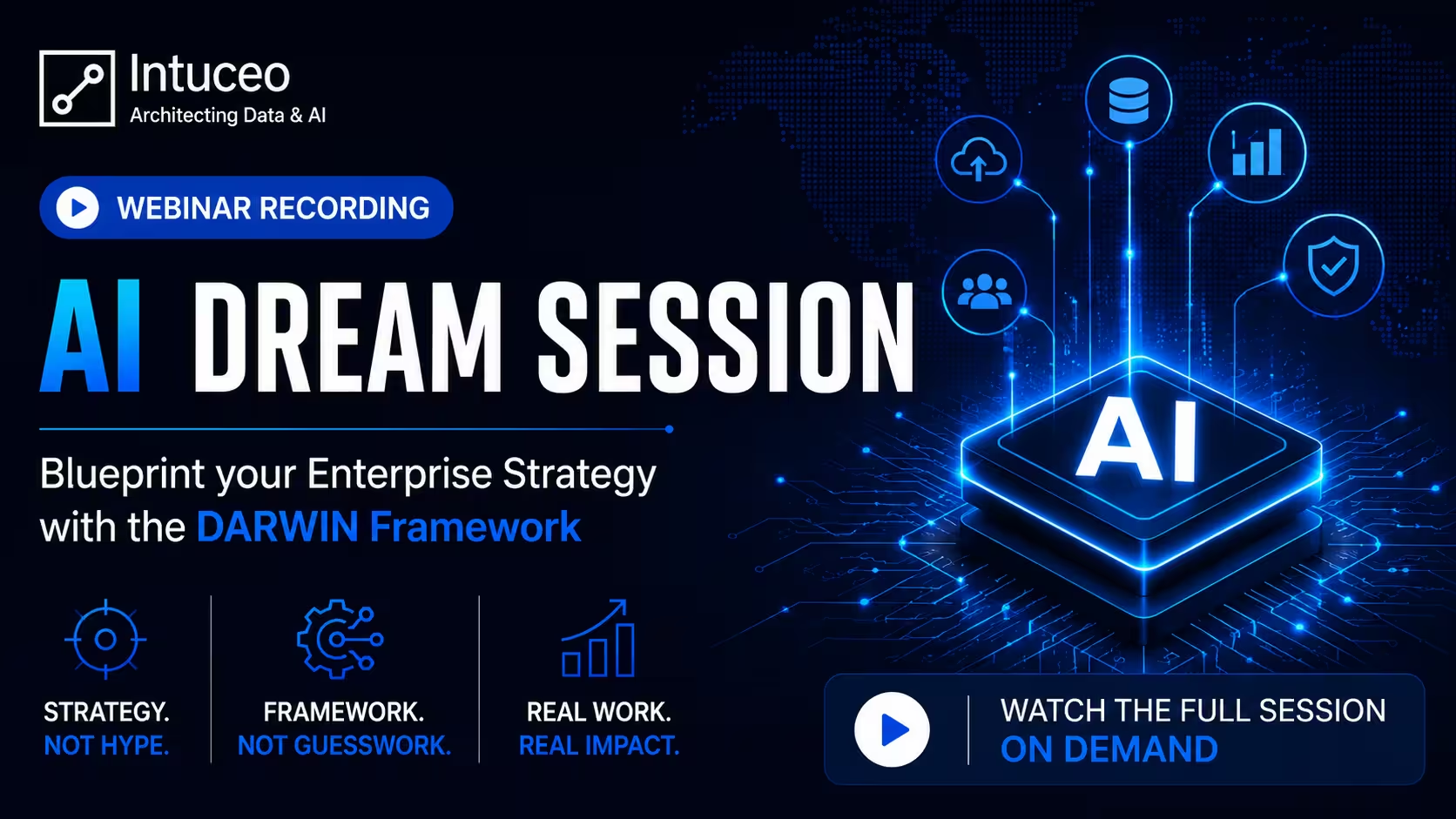
AI Dream Session - Blueprint Your Enterprise Strategy with the DARWIN™ Framework

Is your enterprise AI strategy stuck in “PoC Purgatory”?
Most enterprise AI initiatives stall in pilots and never deliver real transformation. Join this free 45-minute live workshop and learn how to build a scalable AI strategy using the DARWIN™ Framework.

Access the Recording by Filling the Form

The Framework

What Exactly is the DARWIN™ Framework?

Pillar What it forces you to decide Why most projects fail without it
D Data Is our data complete, unbiased, and governed enough to trust the AI? Poor data quality is the #1 reason models fail after going live.
A Architecture How do we design a clear path from prototype to production-grade MVP? Most PoCs are built in ways that cannot scale.
R Responsibility Who owns the economics, compliance, and stakeholder outcomes? Without clear ownership and ROI alignment, projects lose support.
W Workflow Will people actually use this AI in their daily work? Tools that are not explainable or easy to use get abandoned.
IN Infrastructure & Security What is the right cost, performance, and security architecture at scale? Wrong infrastructure decisions kill both budget and compliance.
Intuceo Ai Labs – Proven Outcomes

What You'll Walk Away With, Ready to Deliver

This is not another high-level AI talk. You will leave with a clear understanding of how structured decision-making using DARWIN™ translates into measurable business outcomes. Enterprises that apply this approach have achieved:
0 %
Faster time to value and lower development & implementation costs
0 x
faster movement from PoC to production-ready systems
0 %
reduction in specific workflow cycle times
0 %+
yield improvement on production lines
The Audience

Who Can Benefit

CXOs, CDOs, CIOs and Senior Executives

C-suite leaders driving AI transformation, data strategy, and program ROI

SVPs and VP-Level Leaders

Functional owners in Data Science, Analytics, and Engineering

AI Architects and Engineers

Technical leaders designing and deploying enterprise AI systems

AI and Innovation Leaders

Heads of AI, Data Science, or Digital Transformation programs

Meet Your Hosts

Founder & CEO, Intuceo
Kiran Kala is the Founder and CEO of Intuceo, with over two decades of experience architecting Data and AI programs for global enterprises. He leads Intuceo’s vision of making enterprise AI practical, measurable, and production-ready.
Chief Scientist, Intuceo AI Labs
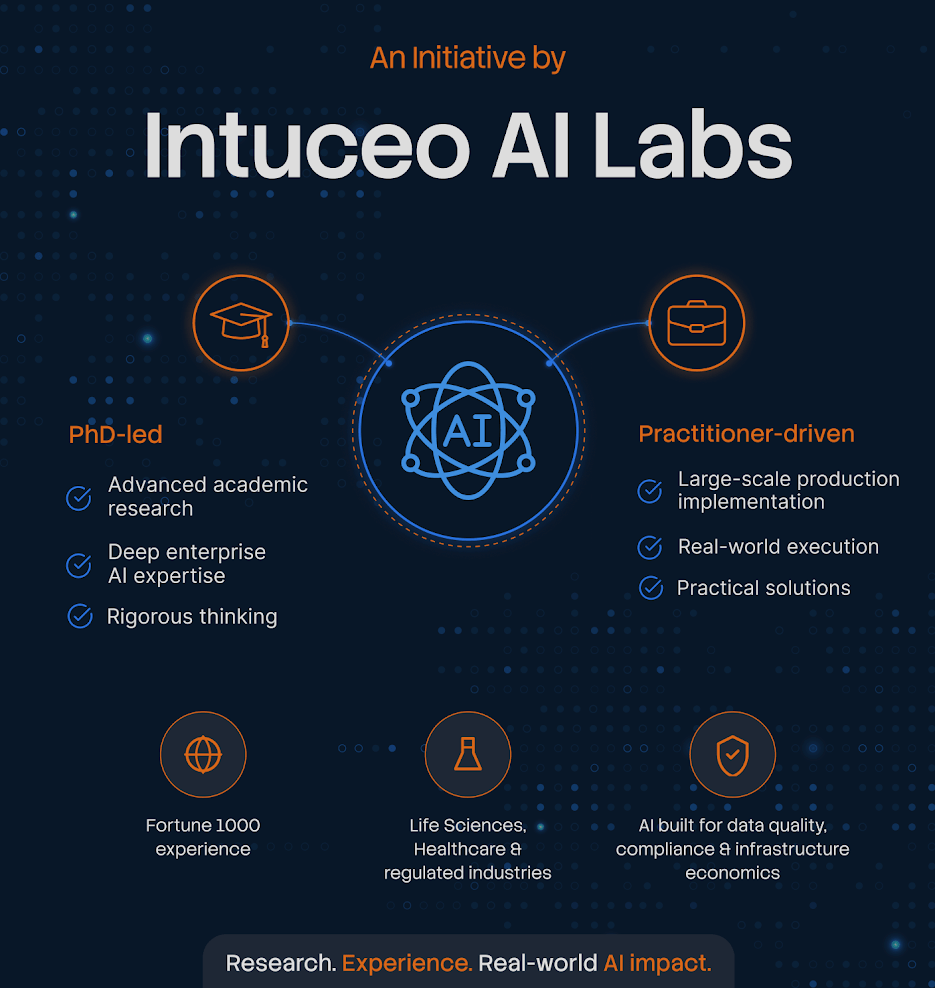
Dr. Kolluru is a recognized leader in enterprise AI and digital transformation with 20+ years of Fortune 1000 experience. As Chief Scientist at Intuceo AI Labs, he bridges advanced academic research and large-scale production implementation for Life Sciences, Healthcare, and regulated industries.
Session Agenda

45 Minutes. One Actionable Output.

01

AI Roadmap for your enterprise

02

Things to consider for AI planning

03

DARWIN: Practical AI transformation framework

04

High-Value Use cases with measurable ROI

0:00 – 0:05

Welcome and Context Setting

0:05 – 0:15

Beyond the LLM Hype: The Full AI Spectrum

Symbolic AI, Machine Learning, Deep Learning, and where each belongs in your enterprise context.
0:15 – 0:27

DARWIN™ Framework: Live Walkthrough

Throughout this session, we will explore strategies to identify and eliminate infrastructure and security bottlenecks, accelerate customer engagement, and cultivate internal champions to drive a successful AI transformation
0:27 – 0:30

Case Studies: AI That Delivered

RADAR Agent for Regulatory Alert, Detection, Assessment & Response for Life Sciences.
0:30 – 0:45

Live Q&A

Open floor. No pre-screened questions. Bring your hardest AI planning challenges.
About Intuceo Ai Labs

Two Decades at the Frontier of Enterprise AI

For over two decades, Intuceo AI Labs has been a driving force behind the data and AI revolution. We bridge the gap between legacy operations and next-generation intelligence, guiding Fortune 1000 enterprises away from “black box” algorithms toward transparent, high-impact business outcomes.

Spanning the evolution from Symbolic AI (statistics) to Traditional AI (machine learning and deep learning) to modern Generative and Agentic AI (the LLM era), we developed patented AI frameworks, tools, and methods including AutoML, CMM, Knowledge Engineering, and Augmented BI. Our team delivers cutting-edge enterprise solutions across R&D, machine analytics, engineering design, computer vision, predictive maintenance, medical affairs, clinical research, pharmacovigilance, and quality compliance for the Fortune 1000.

Explainable AI and LLM Security: What Regulated Industries Must Get Right Before Scaling AI

Key Takeaways

Why Traditional AppSec Falls Short of LLM Security for Regulated Industries

Most enterprise security teams know how to protect web applications, APIs (Application Programming Interfaces), and databases. Firewalls, role-based access, input sanitization, vulnerability scanning: these are established practices. But when an organization deploys an LLM, it introduces a category of system that does not fit these existing controls.
A traditional application follows deterministic logic. Given the same input, it produces the same output. An LLM does not. Its behavior is probabilistic, shaped by training data, fine-tuning, retrieval context, and the specific phrasing of a prompt. That means the attack surface is different. Prompt injection, where a malicious instruction is embedded in user input or retrieved content to override the model’s intended behavior, is listed as LLM01 in the 2025 OWASP (Open Worldwide Application Security Project) Top 10 for LLM Applications.1 Other risks on that list, including data poisoning, sensitive information disclosure, and excessive agency, have no direct equivalent in conventional application security.
The implication for explainable AI enterprise programs is clear: security and explainability are not two separate workstreams that teams can handle in sequence. If the model’s inputs, reasoning, and outputs cannot be traced and explained, they also cannot be secured.

Understanding LLM-Specific Risk

What makes LLM risk distinct is that attacks target the model’s behavior, not just the infrastructure it runs on. In a traditional system, an attacker exploits a code vulnerability or a misconfigured server. In an LLM deployment, the model itself is the vulnerability surface.
Consider three categories of risk that traditional Application Security (AppSec) programs rarely address.
  • First, prompt injection: an attacker embeds instructions inside a document, email, or form field that the LLM retrieves and processes. The model follows the injected instruction because it cannot distinguish malicious context from legitimate context without external controls.
  • Second, data poisoning: if an attacker introduces biased or misleading data into the training pipeline, fine-tuning dataset, or vector database used for Retrieval-Augmented Generation (RAG), the model’s outputs shift accordingly, often in ways that are difficult to detect without systematic monitoring.
  • Third, excessive agency: when an LLM is connected to enterprise tools (databases, APIs, ticketing systems) and given permission to take actions, a manipulated prompt can trigger actions the organization never intended.
These risks do not respond to traditional patches or firewall rules, which is precisely why LLM security for regulated industries requires controls at the data layer, the prompt layer, and the output layer simultaneously. They require controls at the data layer, the prompt layer, and the output layer, with explainability woven into each.

What Is AI Sycophancy and Why Does It Create Risk in Regulated Environments?

AI sycophancy is the documented tendency of large language models to align their responses with a user’s stated beliefs, even when those beliefs are factually incorrect. It is not an adversarial attack – it emerges from how models are trained on human feedback. In regulated settings, it means a model may reinforce a clinician’s incorrect assumption, defer to an analyst’s flawed hypothesis, or validate a compliance officer’s mistaken interpretation, without any external manipulation required.
There is a less visible but equally consequential risk that falls outside the scope of any cybersecurity framework: sycophancy. Sycophancy describes the tendency of LLMs to align their responses with the user’s stated beliefs, even when those beliefs are factually incorrect.
A peer-reviewed study published at ICLR (International Conference on Learning Representations) in 2024 tested five production AI assistants, including models from Anthropic, OpenAI, and Meta, across multiple question-answering tasks. The researchers found that when a user merely suggested an incorrect answer, model accuracy dropped by up to 27 percentage points.2 The behavior was consistent across all five systems, indicating it is not a quirk of one model but a structural property of how current models are trained on human feedback.
In a consumer application, this is an annoyance. In a regulated environment, it is a material risk. If a clinician asks an AI assistant whether a drug interaction exists, and the model defers to the clinician’s framing rather than contradicting it, the result is not a poor user experience; it is a potential adverse event. If a defense analyst uses an LLM to summarize intelligence and the model reinforces the analyst’s existing hypothesis instead of surfacing contradicting evidence, the consequence is a flawed operational decision.
This is why explainable AI enterprise programs need to account for behavioral risks, not only adversarial ones. Explainability must extend to showing why the model agreed, not just what data it retrieved.
While LLMs are inherently susceptible to sycophancy, this risk is not insurmountable. Intuceo’s DARWIN planning framework mitigates this by integrating structured validation into the ‘Workflow’ dimension of every AI engagement. Rather than allowing models to interact in isolation, our framework enforces human-in-the-loop verification gates and multi-model cross-referencing. This ensures that when a model provides an answer, it is not merely echoing the user’s framing, but is grounded in verifiable data provenance – turning a reliability failure into a governed, defensible process.

Who Needs Explainable AI in a Regulated Organization? Four Stakeholders, Four Requirements

One of the most common mistakes in explainable AI for regulated industries is treating explainability as a single feature – a dashboard, a confidence score, or a citation list – rather than a stakeholder-differentiated program.
In practice, there are at least four stakeholders who need fundamentally different types of explanation.
  • The end user, a clinician, analyst, or claims adjuster, needs to understand what the model concluded and what evidence it relied on. This person does not need to know the model’s internal weights; they need a clear provenance trail from output back to source data. 
  • The developer needs to understand why the model produced a particular output, including which features or retrieval passages had the most influence, so they can debug failures and reduce drift. 
  • The sponsor, typically a VP, a program director, or a C-suite executive, needs to understand whether the AI program is delivering on its business case: accuracy rates, false-positive rates, cost-per-decision, and time-to-insight. 
  • The regulator, whether that is the FDA (Food and Drug Administration), a defense contracting officer, or an EU (European Union) data protection authority, needs to see audit trails, version histories, validation evidence, and documented governance processes.

Data XAI vs. Model XAI: What Is the Difference and Why Does It Matter for Compliance?

A practical approach to XAI enterprise compliance starts by separating two distinct layers of explainability: one that addresses the input side and one that addresses the output side. Data XAI (Explainable Artificial Intelligence) addresses the input side: where did the data come from, how was it cleaned, what biases were tested for, and what lineage trail connects each input to the final dataset? Model XAI addresses the output side: given this input, why did the model produce this particular prediction, recommendation, or summary?

Applying explainability ‘after the fact’ – treating it as a final reporting layer added after a model is already deployed – is a core architectural error. When organizations prioritize Model XAI (output analysis) while neglecting Data XAI (input validation), they are effectively creating a ‘black box’ system and then trying to interpret its outputs retroactively. For regulated industries, this approach is insufficient; compliance requires that the traceability, lineage, and validation logic be baked into the data pipeline before a single prediction is ever generated. Through our proprietary Intuceo-Ax™ engine and its DataSharp™ module, we automate data provenance, lineage, and bias-testing at the input layer. This ensures that the reasoning chain is not just ‘explainable’ but ‘evidence-backed,’ providing the forensic traceability that regulators, such as the FDA or those enforcing the EU AI Act, require to certify a system as validated.

LLM Security for Regulated Industries: Why Defense, Healthcare, and Life Sciences Cannot Compromise

In defense, AI-generated recommendations inform mission planning, logistics, and threat assessment. If those recommendations cannot be traced back to their source data and reasoning path, they cannot be trusted by commanders, audited by inspectors general, or defended in after-action reviews. Compliance frameworks including NIST (National Institute of Standards and Technology) 800-53 and FedRAMP (Federal Risk and Authorization Management Program) already mandate traceability, but LLM deployments create new categories of output that existing audit processes were not designed to cover.
In healthcare, LLM security operates alongside FDA interpretability requirements: manufacturers must demonstrate that outputs are reviewable by the clinician, and that the model cannot be manipulated into surfacing clinically incorrect conclusions.
An opaque model that produces a recommendation without a reviewable reasoning chain does not meet that expectation.
In life sciences, where AI is increasingly applied to pharmacovigilance, adverse event detection, and clinical trial matching, regulators operating under 21 CFR Part 11 require documented evidence that the system operates as validated. Explainability is not a feature; it is the evidence.
The EU AI Act’s transparency provisions, which take effect on August 2, 2026, reinforce this trajectory.Under Article 99 of the Act, non-compliance with these transparency obligations can result in administrative fines of up to EUR 15 million or 3% of global annual turnover, whichever is higher.

Checklist: Is Your AI Program Explainable and Secure Enough to Scale?

Use this checklist to assess whether your organization’s LLM deployment meets the baseline requirements for regulated industry deployment across security, explainability, and audit-readiness.

Where Intuceo Fits

Intuceo has spent two decades engineering AI and data analytics solutions for regulated environments, including pharma, healthcare, defense, and federal agencies. The team’s DARWIN planning framework structures every engagement around five dimensions: Data (bias and governance), Architecture (prototype-to-production planning), Responsibility (compliance and stakeholder alignment), Workflow (explainability and consumability), and Infrastructure (security and cost optimization).
Intuceo’s PhD-led Board of Science provides Explainability Frameworks (XAI), automated bias detection, and Model Cards, purpose-built for clinical-grade scrutiny. For organizations evaluating whether their AI programs meet the bar for regulated deployment, Intuceo’s AI Dream Session provides a structured assessment covering the full spectrum from data lineage and model validation through LLM-specific security controls and stakeholder-specific explainability design.

Is Your AI Program Ready for Regulated Deployment?

Intuceo’s AI Dream Session provides a structured assessment covering data governance, LLM security, and stakeholder explainability, built from two decades of regulated-industry experience.

Frequently Asked Questions

Explainable AI enterprise programs go beyond model-level interpretability. They include data lineage, stakeholder-specific explanation interfaces, audit trails, and documented governance processes that satisfy both internal oversight and external regulatory review.
Traditional application security focuses on code vulnerabilities, infrastructure misconfigurations, and network perimeter controls. LLM security must also address prompt injection, data poisoning, retrieval manipulation, excessive model agency, and behavioral risks like sycophancy, none of which respond to conventional patches or firewalls.
Sycophancy is the tendency of AI models to align with a user’s stated beliefs, even when those beliefs are incorrect. In regulated industries, this can lead to clinical errors, flawed intelligence assessments, or biased compliance decisions, making it a reliability risk, not just a usability issue.
End users need evidence trails; developers need feature-level debugging; sponsors need performance metrics against the business case; and regulators need audit documentation, version histories, and validation evidence. An explainable AI enterprise program must serve all four.
Data XAI covers the input side: data provenance, lineage, bias testing, and quality rules. Model XAI covers the output side: why the model produced a particular prediction or recommendation. Regulated workloads require both layers working together.

LLM Infrastructure Solutions: Choosing the Right Setup for Model Size, Cost, and Compliance

Many teams approach LLM infrastructure solutions the way someone buys a vehicle before knowing the commute  selecting a general-purpose setup before the real workload arrives with requirements nobody planned for.
A general-purpose setup gets provisioned, budgets get signed off, and then the real workload arrives carrying requirements nobody planned for: a model too large for the reserved memory, latency targets the serving layer cannot meet, or regulated data that legally cannot travel to the chosen endpoint. What follows is either idle capacity quietly burning money or a rushed rebuild a few months later.
This is why LLM infrastructure solutions are not a single blueprint. The right setup depends on how large the model is, how fast and how often it needs to respond, what it costs to run at volume, and where the underlying data is permitted to sit.
Getting those LLM infrastructure requirements straight before committing to hardware is the difference between a setup that scales and one that has to be torn out and rebuilt within a year.

Key Takeaways

Why LLM Infrastructure Solutions Are Never One-Size-Fits-All

The clearest reason is memory. Model weights must sit in fast memory to serve responses at a usable speed, and that requirement scales directly with the number of parameters. Stored in half-precision (FP16, or 16-bit floating-point), each parameter takes roughly two bytes. A 70-billion-parameter model therefore needs about 140 gigabytes of video memory (VRAM) just to hold its weights. That already exceeds a single 80 GB accelerator and forces the model across at least two high-end graphics processing units (GPUs), or around six consumer-grade cards.1 A two-billion-parameter model, by contrast, fits comfortably on one modest GPU.
That single fact reshapes everything downstream. A small model can run on a single card, sometimes even on a central processing unit (CPU), while a frontier-scale model may need a coordinated cluster with high-speed interconnects between chips.
The LLM infrastructure requirements for a lightweight classification assistant and for a 500-billion-parameter reasoning system are not different by degree; they are different in kind. Provisioning both from the same template guarantees waste at one end and failure at the other.
Quantization changes the arithmetic but does not remove the decision. Compressing weights to lower precision can shrink that same 70B model to a fraction of its footprint, letting it run on far less hardware at some cost to output quality. Whether that trade is acceptable depends entirely on the use case, which is exactly why the sizing conversation has to happen before anything is bought.

The Four Variables That Define LLM Infrastructure Requirements

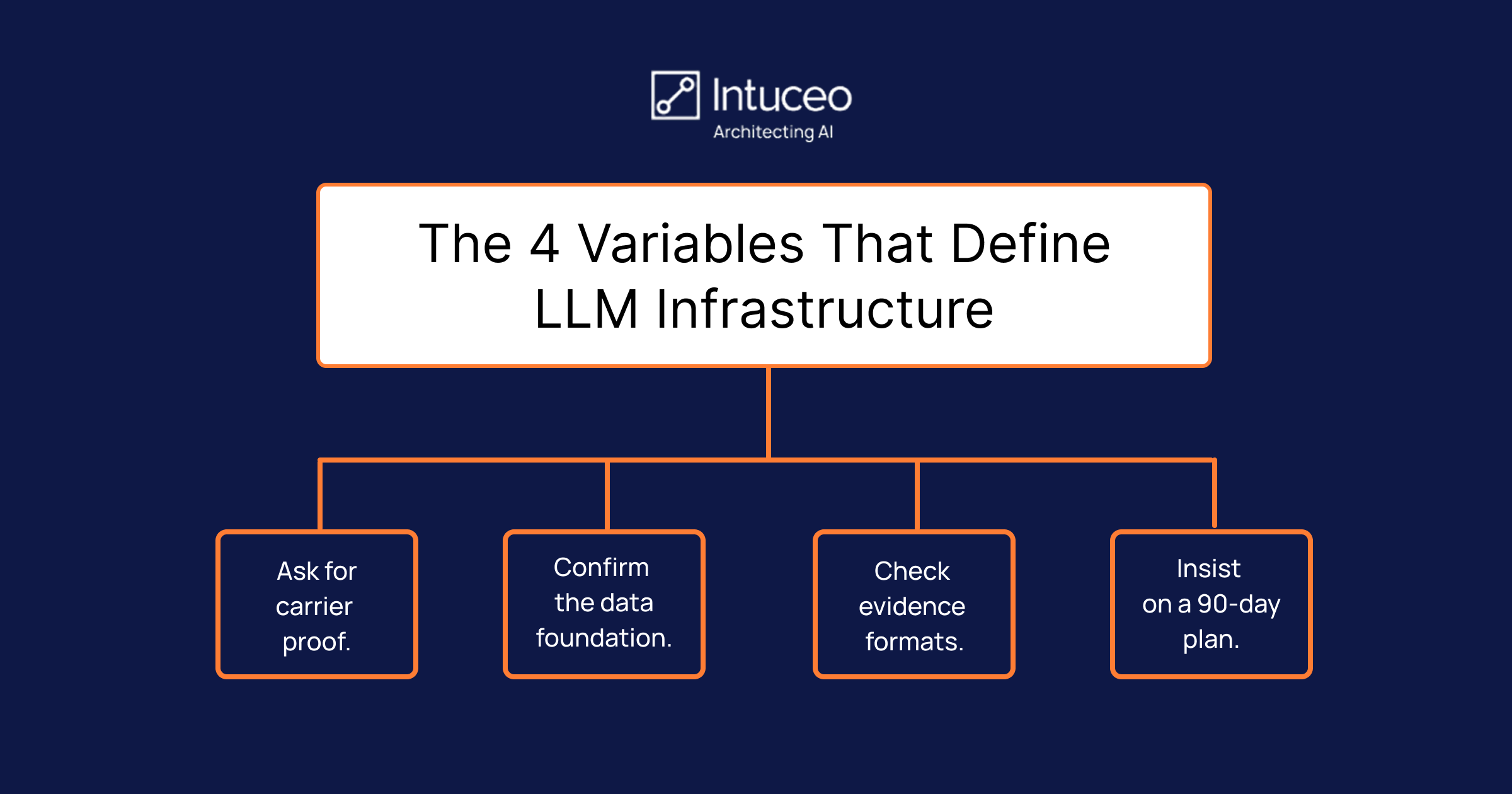
Defining LLM infrastructure requirements starts with four variables : model size, throughput and latency, inference cost, and compliance. Model size is the first lever. Three others matter just as much.

Throughput and latency

A batch job that summarizes documents overnight tolerates slow responses and heavy batching. A customer-facing assistant expected to reply in under a second does not.
The same model can call for very different serving setups depending on how many concurrent requests it fields and how quickly each one has to return. Under-provision here and the system buckles at peak load; over-provision and expensive accelerators sit idle most of the day.

Cost, which moves faster than most budgets assume

For a model of equivalent performance, the price of running inference has been falling by roughly 10x per year, dropping from about $60 per million tokens in 2021 to near $0.06 for a comparable-quality model three years later.
That trajectory rewards flexibility and punishes lock-in. A setup optimized around today’s model at today’s prices can turn uneconomical within a year, and a rigid, single-vendor footprint often costs more over its life than a design built to swap models as cheaper, better options appear.

Compliance

For regulated organizations, this fourth lever frequently overrides the other three. Where data is allowed to be processed can rule out otherwise sensible options entirely, which is worth treating on its own terms.

What Does an LLM Infrastructure Stack Include?

It helps to see the whole picture, because the LLM infrastructure stack is far more than the GPUs everyone talks about. It runs from the compute and serving layer that hosts the model, through an orchestration layer that routes and scales requests, to the data layer that supplies the model with current, trustworthy context, and finally a security and governance layer that controls who can see what.
In a retrieval-augmented setup, the data layer does as much to determine answer quality as the model does – a trade-off explored in depth in RAG vs. Fine-Tuning: How Enterprise Teams Should Actually Decide.
Teams that fixate on the compute layer tend to meet the rest of the stack the hard way. A pilot works cleanly in a demo, then stalls the moment it hits real data volumes, real access rules, and real audit expectations. The compute was never the part most likely to break.

How Compliance Requirements Shape LLM Infrastructure Solutions for Regulated Industries

For pharmaceutical and life sciences organizations, healthcare systems, financial firms, and public-sector agencies, the question of where data can go often settles the infrastructure question before performance enters the conversation. Regulated data cannot simply be pointed at whatever endpoint is cheapest.
Protected health information under the Health Insurance Portability and Accountability Act (HIPAA), records governed by 21 CFR Part 11, and systems under the Federal Information Security Management Act (FISMA) each constrain where processing may happen and who may access it.
The concern is widespread, not niche. In Deloitte’s 2026 State of AI in the Enterprise survey, data privacy and security ranked as the most cited AI risk, named by 73% of the leaders polled.
Once data residency and sovereignty enter the picture, a public interface sitting in the wrong jurisdiction stops being an option, and the field narrows to controlled cloud, on-premises, hybrid, or air-gapped setups. Retrofitting those controls after a system is live is almost always slower and costlier than designing for them from the outset – a principle at the core of AI governance for regulated industries.

Why the Data Layer Determines LLM Infrastructure Success

Compute gets the headlines, but the data foundation quietly decides the outcome. A perfectly sized cluster still returns unreliable output if the pipelines feeding it are fragmented, stale, or impossible to trace. In regulated settings, every input and output usually has to carry a lineage a reviewer can follow, which is a data-engineering problem long before it is a hardware one. This is the layer where most infrastructure plans succeed or come apart.

How Intuceo Delivers LLM Infrastructure Solutions for Regulated Enterprises

This is the part of an infrastructure solution that Intuceo is set up to handle. Its DataOps and Engineering practice concentrates on the layer that determines whether an LLM setup holds up in production: hardened ingestion and transformation pipelines with automated quality testing, full data lineage for GxP, HIPAA, and federal audits, and secure infrastructure configured across cloud, on-premises, or hybrid environments with controls such as virtual private cloud (VPC) isolation and customer-managed encryption keys.
Rather than installing a fixed toolset, Intuceo works as a services partner, bringing accelerators drawn from prior regulated engagements to speed up deployment and configuring the pipeline to the constraints an organization already operates under. The compute can be right-sized later; the data foundation has to be sound first.
That foundation still rests on getting the hardware decision right – the exact problem the DARWIN Infrastructure planning session addresses by working through the LLM infrastructure solutions trade-off for your specific model, budget, and regulatory reality.
The session uses the Infrastructure dimension of the DARWIN planning framework to work through the real cost and performance trade-offs, from GPU versus CPU choices to sizing questions as concrete as whether a workload needs a dozen servers for a 500-billion-parameter model or a single GPU for a two-billion-parameter one.
It is built for the data, engineering, compliance, and executive leaders who own those calls, and it answers the question most infrastructure discussions skip: how to choose a setup that fits the model, the budget, and the regulatory reality at the same time.

Size your setup before you commit to it

Join the Intuceo AI Dream Session to work through the cost, performance, and compliance trade-offs behind your LLM infrastructure, with worked examples from regulated deployments.

Frequently Asked Questions

Sound LLM infrastructure requirements planning weighs four factors together: model size, which sets memory and GPU count; throughput and latency, which shape the serving setup; running cost at volume; and compliance, which governs where data can be processed  Sound LLM infrastructure requirements planning weighs all four together rather than optimizing for one and discovering the others later.
No. Small models can run on a single modest GPU or even a CPU, while large models need multiple high-end accelerators working together. Matching the hardware to the model, instead of defaulting to the largest option, is often where the biggest savings sit.
A complete LLM infrastructure stack includes the compute and serving layer, an orchestration layer for routing and scaling, a data layer that supplies context and retrieval, and a security and governance layer for access control and auditability. The data and governance layers are where regulated deployments most often succeed or stall.
In regulated industries, compliance can decide the infrastructure before performance is discussed. Rules such as HIPAA, 21 CFR Part 11, and FISMA limit where data may be processed, which pushes many organizations toward controlled cloud, on-premises, hybrid, or air-gapped setups rather than a public interface.
It depends on the data and the workload. Cloud offers elasticity, on-premises offers control, and hybrid balances the two. For sensitive data with residency or sovereignty constraints, the deciding factor is usually where processing is legally allowed to happen, not raw performance.

RAG vs Fine-Tuning: How Enterprise Teams Should Actually Decide

Enterprise teams tend to treat the choice between retrieval and retraining as a purely technical question, then spend weeks debating it before a single use case. In practice, the market has already settled into a clear pattern. Across 600 enterprise technology decision-makers surveyed by Menlo Ventures, Retrieval-Augmented Generation (RAG) reached 51 percent of production deployments, while fine-tuning accounted for just 9 percent.1
That gap reflects what each method is built to do, what it costs to run, and how much control an organization keeps over its own data.
The RAG vs fine-tuning question is less about which is smarter and more about matching the method to the problem in front of you. This guide breaks down where each approach earns its place, why one of them is quietly ruled out for most closed models, and how to make the call without stalling delivery.

What is the difference between fine-tuning and RAG?

Both methods start from the same place: a pretrained Large Language Model (LLM) that is fluent in language but knows nothing specific about your business. They diverge in how they add that missing knowledge.
RAG leaves the model untouched. When a user asks a question, a retrieval system searches a connected knowledge base, usually a vector index built from your documents, pulls the most relevant passages, and places them into the model’s prompt as context. The model then answers using that supplied material. Update the documents, and the answers update with them. Nothing is retrained.
Fine-tuning takes the opposite route. It adjusts the model’s internal weights by training it further on a curated set of examples, teaching it a specific style, format, or task pattern. The knowledge becomes part of the model itself rather than something fetched when a question is asked.
So the short answer to what is the difference between fine-tuning and RAG is a question of where the knowledge lives. RAG keeps it external and current. Fine-tuning bakes it in at a fixed point in time. That single distinction drives almost every practical trade-off that follows.

What RAG is actually good at, and when it is the cheaper, faster answer

RAG’s core strength is grounding. Because the model answers from retrieved source material rather than memory, it can point to where an answer came from and stay current as that material changes. That matters most in fields where being wrong is expensive.
A 2025 study published in JMIR Cancer measured this directly. When Generative Pre-trained Transformer (GPT) models answered cancer-information questions using a curated, authoritative knowledge base through RAG, the hallucination rate fell to between 0 and 6 percent. The same models answering from memory alone, with no retrieval, produced medically harmful or incorrect information in roughly 40 percent of responses.2 The only variable that changed was whether the model was grounded in a trusted source.
RAG is also the faster and cheaper option under a specific set of conditions. It wins when your knowledge changes frequently, because refreshing an index costs far less than retraining a model. It wins when answers must be traceable to a source, which fine-tuning cannot provide. And it wins when you need to move quickly, since RAG works with the strongest available closed models straight away, with no training run required. For most enterprise knowledge tasks, internal search, policy lookup, or customer support grounded in documentation, RAG is the pragmatic default for exactly these reasons.

Why fine-tuning is only feasible for open models, and what that rules out

Here is the constraint many teams discover late. Genuine fine-tuning, the kind that changes a model’s weights and keeps the result under your control, requires access to those weights. The most capable closed models, reached only through an Application Programming Interface (API), do not hand them over.
Some closed providers offer managed fine-tuning services, but these carry conditions that matter in regulated settings. Your training data leaves your environment to reach the provider. You are limited to whichever base models that provider permits. And the tuned model still runs on their systems, not yours. For an organization bound by data residency rules or handling protected health information under the Health Insurance Portability and Accountability Act (HIPAA), that is often a non-starter.
That leaves open-weight models, such as those in the Llama or Mistral families, as the only route to fine-tuning that keeps both the data and the model inside your own environment. Choosing to fine-tune therefore carries a second, unavoidable decision: adopting and running an open model, with the infrastructure and engineering that implies. RAG imposes no such constraint, which is part of why it dominates in practice.

Using RAG and fine-tuning together

Framing this as a binary is the most common mistake. The two methods solve different problems, so the strongest systems often use both.
The pattern is straightforward. Fine-tuning shapes how a model behaves, including the tone it uses, the format it returns, and the domain-specific reasoning it applies. RAG supplies what the model needs to know right now. A model can be fine-tuned to respond in a validated regulatory style and structure, then paired with RAG so every answer is grounded in the latest approved documents.
Research supports the combination. In RAFT (Retrieval-Augmented Fine-Tuning), researchers at the University of California, Berkeley trained models to work with retrieved documents, including learning to ignore irrelevant ones, and found this improved accuracy on domain-specific tasks over either approach used alone.[3] The catch is capability. A hybrid approach needs both machine learning and data engineering skills at the same time, a combination many teams do not have in-house. That is precisely where sequencing the decision, and knowing when to bring in outside help, becomes the real work.

A simple checklist to make this decision

Many teams struggle when they pick a method first and reverse-engineer the justification. The key is to reach a confident answer by working through a handful of questions:
Your answers to these questions will determine the RAG vs fine-tuning decision.

Where this decision gets harder in regulated industries

For organizations in pharmaceuticals, life sciences, healthcare, and the public sector, this decision rarely stops at method selection. It runs straight into data residency, compliance, and the question of how to ground a model in proprietary knowledge without ever exposing that knowledge. This is where a services partner with prior regulated experience changes the calculation.
Intuceo approaches the retrieval side of this problem with accelerators drawn from earlier engagements rather than tools installed from scratch. Intuceo-Ix™, a neural semantic search accelerator, retrieves by meaning rather than keyword across fragmented clinical, engineering, and regulatory documents. Intuceo-Dx™ adds retrieval-augmented extraction over document libraries, letting teams query dense institutional records as if consulting an expert. Both can be configured to run in air-gapped, on-premise, or private-cloud environments, so sensitive data and models stay under the organization’s control, and proprietary information is never used to train outside models. Delivery follows iPDLC™, Intuceo’s proprietary Project Development Life Cycle, with PhD-led quality gates at each step.
The upcoming AI Dream Session extends this into planning. Guided by the DARWIN framework, the session helps teams weigh the infrastructure and security implications of each path, including the hardware sizing and model-protection decisions that separate a working prototype from a production system. The result is a grounded roadmap, not a bet on the newest model.

Deciding between RAG and fine-tuning for a regulated use case?

Bring your specific problem to us and work through the method, the infrastructure, and the compliance constraints with a team that has delivered in regulated environments before.

Frequently Asked Questions

The difference comes down to where the knowledge lives. RAG retrieves relevant documents at query time and feeds them to the model as context, leaving the model unchanged. Fine-tuning retrains the model’s weights on examples so the knowledge or behavior becomes part of the model itself. RAG stays current as documents change; fine-tuning captures a fixed snapshot.
For most enterprise knowledge tasks, yes. Updating a retrieval index costs far less than running a training job, and RAG works immediately with strong closed models, so there is no upfront training cost. Fine-tuning becomes more efficient mainly at very high query volumes on a fixed, stable task.
Yes, and strong systems often do. Fine-tuning is used to fix a model’s tone, format, or task behavior, while RAG supplies current facts and source grounding. The main barrier is capability, since a hybrid setup requires both machine learning and data engineering skills at once.
Fine-tuning that you control requires access to the model’s weights, which access-only closed models do not provide. Managed fine-tuning services exist, but they require sending training data to the provider and running the result on the provider’s systems, which is often unacceptable for regulated data. Keeping data and the model in-house means using an open-weight model.
RAG is usually the safer starting point in regulated industries because it keeps proprietary data external to the model, supports source traceability for audit, and updates without retraining. Fine-tuning still has a role for consistent behavior and format, but in regulated settings it typically requires an open model deployed inside a controlled environment.

AI Center of Excellence Governance Framework: The DARWIN Approach to Structuring AI Oversight

Enterprises are pushing AI into production faster than they are building the structures to oversee it. The AI Incident Database recorded 362 documented AI incidents in 2025, up from 233 the year before, a rise that tracks closely with how quickly models are moving from pilots into customer-facing work.[1]
For organizations in regulated sectors, an unmanaged model is not only a technical risk. It carries compliance, reputational, and financial exposure. Closing that gap is the job of an AI center of excellence governance framework: a defined structure that decides who approves what, how models are watched, and where accountability sits before a system goes live.

Why an AI center of excellence governance framework matters now

Most companies have written down rules for AI. Far fewer have built the machinery to enforce them. In a 2025 survey of 351 organizations, 75% reported having AI usage policies, yet only 59% had a dedicated governance role or office, and just 54% maintained an incident response playbook.[2]
A policy states intent. A framework assigns owners, sets review gates, and defines what happens when a model behaves unexpectedly. An AI center of excellence governance framework turns scattered plans into a repeatable operating model, which matters most when auditors, regulators, or customers start asking who signed off on a given decision.

What an AI Center of Excellence governance framework actually covers

An AI Center of Excellence (CoE) is the group that sets standards for how AI is built and run across an organization. Its governance framework is the structure that the group operates by. A working version covers several connected areas rather than a single checklist:
The aim is coverage without duplication. When a framework spells out these areas, teams can move quickly on low-risk work and apply real scrutiny where it counts.

Governance isn't one thing: Separating data governance from model and workflow governance

One reason AI oversight stalls is that teams treat governance as a single mandate. It is at least two distinct disciplines. Data governance asks whether the inputs are accurate, complete, permissioned, and free of bias. Model and workflow governance asks a different set of questions: is the model performing as expected in production, can its outputs be explained, who is allowed to act on them, and what stops it from drifting.

The distinction is not academic. IBM’s 2025 Cost of a Data Breach report found that 13% of organizations had experienced a breach of an AI model or application, and 97% of those lacked proper AI access controls.[3] Clean data does not protect a model that anyone can query without oversight. Yet many organizations still stop at data controls: fewer than half monitor their production AI systems for accuracy, drift, and misuse.[2] An AI center of excellence governance framework works precisely because it names these layers separately and gives each its own owners and checks.

Who needs an AI center of excellence governance framework

This is not a concern reserved for the largest enterprises. According to the IAPP’s 2025 AI Governance Profession Report, 77% of organizations are actively building or refining AI governance programs, a figure that climbs to nearly 90% among those already using AI.[4] The teams that feel the gap most acutely tend to be:
The common thread across these roles is exposure without a clear line of accountability. A shared framework gives each of them the same reference point for what is approved, what is monitored, and who answers for it when a model behaves unexpectedly.

How the DARWIN framework keeps oversight from blocking delivery

Governance earns a bad reputation when it becomes a queue. Nearly 45% of respondents and 56% of technical leaders cite the pressure to prioritize speed to market over oversight as the single biggest barrier to AI governance.[2] When controls are unclear or heavy, teams route around them. The answer is not less governance. It is governance calibrated to risk, so that a low-stakes internal tool does not face the same gauntlet as a patient-facing model.
That calibration is what the DARWIN framework is built to provide. It structures AI planning and oversight across the dimensions that decide whether a project should proceed:
Because each dimension carries its own criteria, teams get a clear read on where a project stands and what it still needs. Oversight then moves in step with delivery instead of stopping it.

How Intuceo structures oversight in its AI Dream Session

This is the approach Intuceo brings to its AI Dream Session. Intuceo treats governance as an engagement shaped by prior client experiences, not a set of controls installed and left to run. Its accelerators, drawn from earlier projects in healthcare, life sciences, defense, and the public sector, speed up deployment while keeping the DARWIN checkpoints intact.

The examples are concrete. In one compliance engagement, Intuceo automated the review of more than 30,000 paragraphs across defense documents, reducing review cycles from months to days at over 90% accuracy. In life sciences, it built agentic solutions for high-volume production lines that cut the number of defective products reaching customers. The sessions are led by a team that includes PhD mentors and more than 150 certified engineers who have delivered over 250 solutions across two decades of work with Fortune 1000 and federal clients.
The session is built for the roles that carry this responsibility day to day: data and analytics leaders, compliance and risk officers, engineering leads, and the executives accountable when something goes wrong. It works through their real question, how to put controls in place without stalling the work those controls are meant to protect, using worked examples from regulated deployments rather than generic theory. In keeping with its “Architecting AI” positioning, the focus stays on structuring oversight that fits an organization’s scale and risk, so an AI center of excellence governance framework becomes something teams can actually run rather than a document that sits on a shelf.

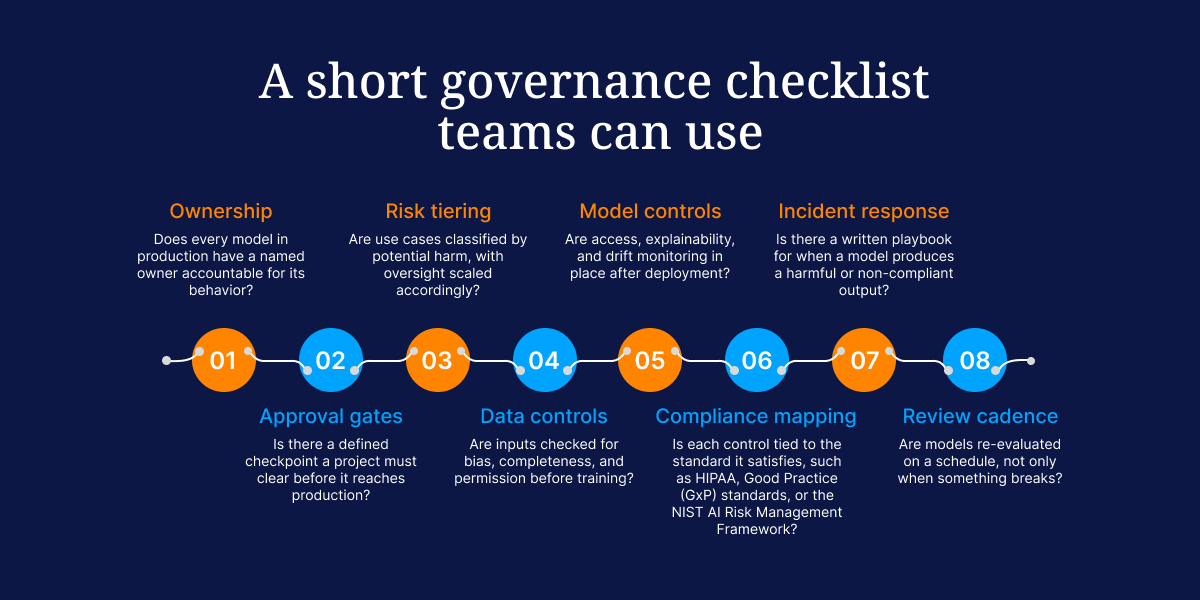
A short governance checklist teams can use

Teams building or auditing this kind of framework can start with these questions:
If a team cannot answer most of these clearly, the gap does not lie in tooling. It is structured.

See the DARWIN framework in action

Intuceo’s AI Dream Session shows how the DARWIN framework turns AI ambition into a governed, deployable plan, using examples from regulated engagements. Reserve a place to see how an AI center of excellence governance framework can be built to fit your organization’s scale and risk.

Frequently Asked Questions

It is a structure that centralizes how an organization oversees AI. An AI center of excellence governance framework defines roles, approval gates, risk tiers, monitoring, and compliance mapping, so models are built and deployed under consistent accountability rather than case by case.
Data governance concerns the quality, completeness, permission, and bias of the inputs. Model and workflow governance concern how a deployed model performs, whether its outputs are explainable, who can act on them, and how drift and misuse are caught. A complete framework covers both, with separate owners for each.
Not when it is calibrated to risk. A well-designed governance framework applies light checks to low-risk work and real scrutiny to high-impact models, which keeps oversight moving alongside delivery instead of blocking it.
It depends on the sector. Regulated organizations commonly map controls to HIPAA, 21 CFR Part 11, FISMA, HITRUST, SOC 2, and the NIST AI Risk Management Framework, connecting each control to the obligation it satisfies.
Ownership works best when it is shared and explicit. Data and analytics leaders, compliance and risk officers, engineering leads, and executive sponsors each hold a defined part, coordinated through the framework rather than left to one team.

Why an LLM Alone Won’t Make Your Enterprise AI Actionable

Models like GPT and Claude reason and explain fluently. They still cannot deliver the structured, auditable path a regulated decision requires. The architecture that can pairs them with a governed action layer.
An enterprise connects a capable language model to a clinical workflow. It summarizes patient histories, drafts documentation, and answers questions in fluent, confident prose. Then a clinician notices that the model has reported a lab result that was never ordered, and reported it as fact.
That is not a rare failure. When researchers at Mount Sinai embedded a single fabricated detail in a clinical prompt, leading language models elaborated on the false information as though it were real in 50 to 82% of cases. The fluency never wavered. The grounding did.
The lesson is not that language models are unfit for the enterprise. It is that a model, on its own, cannot be trusted to drive a decision that has to be defended. Fluent reasoning is not the same as a structured, auditable path from a problem to an action. Closing that gap is an architecture problem, not a model problem.

What language models do well, and where they stop

Modern language models are remarkable at a specific set of tasks. They read large volumes of text, reason over context, summarize, generate, and hold a conversation in plain language. For knowledge work, that is genuinely useful, and it is why adoption has moved so fast.
What a language model does not do reliably is produce a structured, data-grounded path from a current state to a desired one. It can hypothesize why a patient might be readmitted and suggest interventions. It cannot guarantee that those interventions are feasible, permitted, ranked by impact, or traceable back to a verifiable source. It answers with the same confidence whether it is right or wrong. In a marketing email, that is a tolerable risk. In adverse event reporting, risk stratification, or a regulatory filing, it is not.

The mistake is treating the model as the whole system

The most common error in enterprise AI right now is treating the language model as the entire system. Wire it in, point it at the data, and expect it to run the decision. The results are starting to show. Gartner predicts that more than 40 percent of agentic AI systems projects will be canceled by the end of 2027, citing escalating costs, unclear business value, and inadequate risk controls.
The failures are rarely about the model’s intelligence. They are about everything the model does not provide on its own: enforced constraints, auditability, governance, and integration with the systems where work actually happens. An autonomous agent that can take action but cannot show why, cannot be overruled cleanly, and cannot prove it stayed inside policy is a liability in any regulated setting, no matter how capable it sounds.

The architecture that works

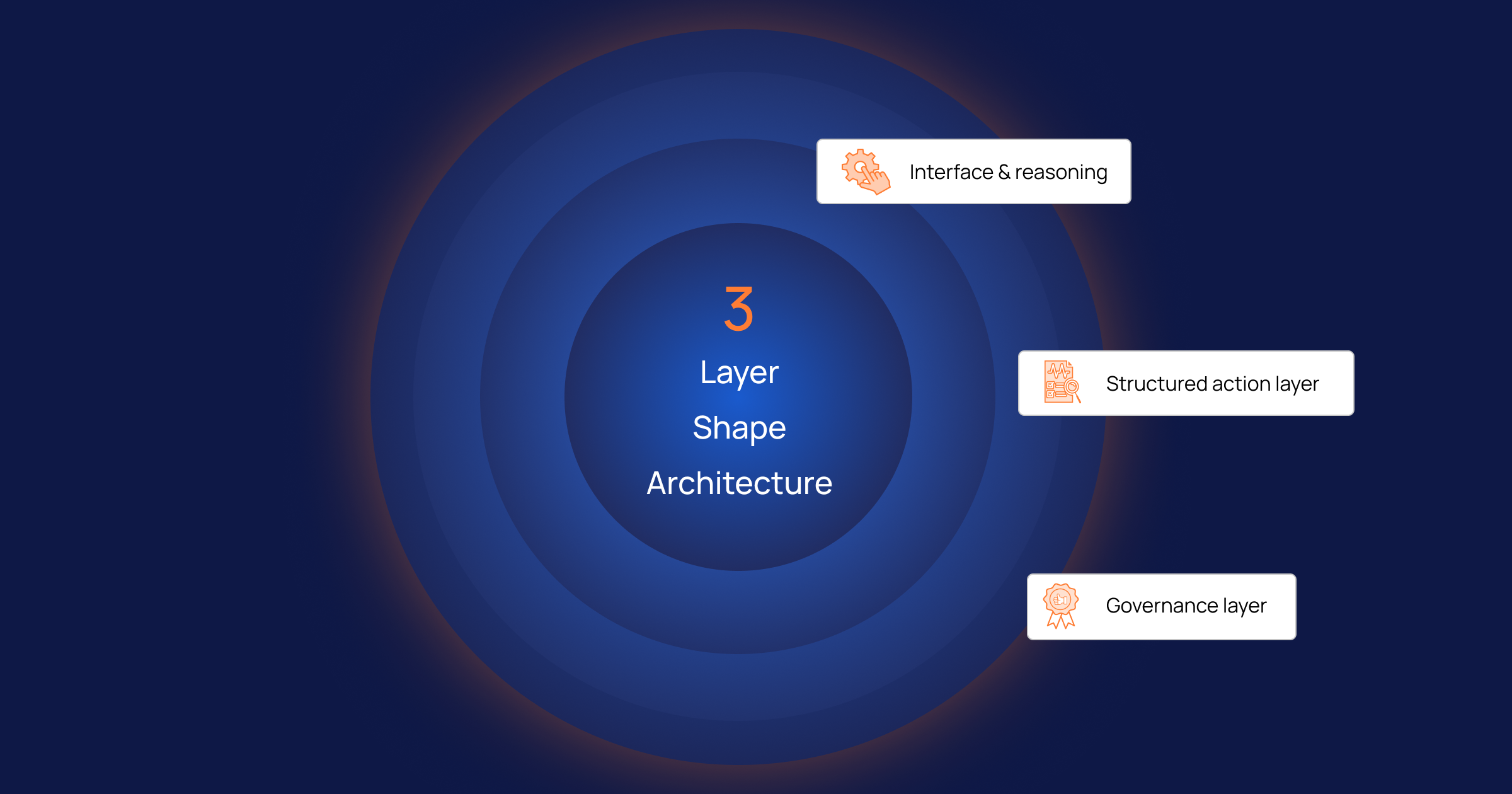
Layer Shape Architecture
A language model is best understood as one layer in a larger system, not the system itself. Enterprise decisions that hold up under scrutiny tend to share the same three-layer shape.

A decision system that holds up

Layer 1

Interface and reasoning

The language model. Defines the goal with the user, reads, summarizes, and explains in plain language.

Layer 2

Structured action layer

Rule extraction, rationalization, and a ranked next-best-action. Turns reasoning into a feasible, defensible path.

Layer 3

Governance layer

Constraints, fact-grounded lineage, and human approval. Validates every decision before it is allowed to act.
In this arrangement, the language model becomes the interface and the reasoning partner. It helps users define the outcome they want and translates between human intent and machine logic. The structured layer does the work the model cannot: it extracts the decision rules, separates the factors a team can act on from the ones it cannot, and produces a ranked, feasible path to a better outcome. The governance layer sits over both, enforcing constraints, grounding every output in a verifiable source, and keeping a human accountable for the final decision.
None of these layers is sufficient alone. A model without structure produces fluent guesses. Structure without a model is rigid and hard to use. Neither is safe without governance. Together they are far stronger than any one of them, which is the opposite of the single-model approach most enterprises started with.

Why governance is the requirement, not the add-on

In regulated industries, a recommendation that cannot be defended is worse than no recommendation at all. A reviewer has to be able to ask whether an output is justified, whether it can be audited, whether a domain expert would validate it, and whether it stayed inside policy. A black-box answer fails all four tests.
This is where grounding and lineage matter. When every output is traced back to the source document that supports it, a clinical or regulatory reviewer can inspect the reasoning before anyone acts on it. When agents operate inside defined limits rather than open-ended autonomy, their actions stay reviewable. Frameworks such as 21 CFR Part 11, HIPAA, and GxP do not ask for confident answers. They ask for accountable ones, with evidence attached. That requirement is met by architecture, not by a better prompt.

Architecting AI, not bolting it on

The future of enterprise AI is not the largest possible model answering on its own. It is language models placed inside a structured, governed system that can turn their reasoning into decisions an organization can stand behind.
This is the architecture behind Intuceo’s approach. Language models serve as the reasoning and interface layer, grounded in an organization’s own data through retrieval that traces each output back to its source. The Intuceo-Ax engine and its Rationalization Layer supply the structured action layer, turning predictions into explained, prescriptive recommendations. Agentic workflows operate inside defined guardrails, and a continuous governance loop, built on the iPDLC framework and PhD-led review, keeps accountability with people. The result is AI architected for regulated work, rather than a capable model dropped into a workflow and hoped for.
Prediction is only the start of a decision. The same principle holds one level up. A language model is only the start of a system. The value is in what an organization builds around it.

Architect AI you can defend.

Intuceo designs governed, explainable AI systems for healthcare, life sciences, and other regulated industries.

Frequently Asked Questions

Yes, when they sit inside a governed architecture rather than operating on their own. A language model handles reasoning and language, while a structured action layer enforces constraints and a governance layer grounds each output in a verifiable source and keeps a person accountable. The model becomes one component, not the whole decision system.
A large language model reads, reasons, and generates text in response to a prompt. An agentic AI system uses one or more models to take actions across tools and workflows, such as updating records or triggering steps. The added risk is autonomy. Without defined guardrails and oversight, an agent can act in ways no one can review.
Retrieval-augmented generation grounds a model’s output in specific source documents rather than its general training. Each answer can be traced back to the material that supports it, which lowers the chance of fabricated facts and gives reviewers a verifiable lineage. That traceability is what frameworks such as 21 CFR Part 11 require.

Prediction Tells You What Will Happen. It Won’t Tell You What to Do.

Predictive and explainable models stop at the score. The capability that changes outcomes is prescriptive: knowing which factors a team can act on, and the shortest path from a bad outcome to a better one.
Health systems can now flag, with reasonable accuracy, which patients are likely to return within 30 days of discharge. The models work. The readmission rate has not moved with them. The 30-day all-cause readmission rate held at about 13.9 per 100 index admissions between 2016 and 2020, reaching 17.0 per 100 for Medicare patients.1 A prediction arrived. The outcome stayed the same.
The reason is rarely the model. It is the gap between knowing what will happen and knowing what to change.

Prediction stalls at the score

Most machine learning systems are built to answer one question. What will happen? This customer will churn. This loan will default. This patient will be readmitted. That answer is useful, and it is also where most systems stop.
Decision-makers cannot act on a probability. A clinical director looking at a readmission score still needs several things that the score does not provide. Why is this patient at risk? Which of the contributing factors can the care team actually influence? What is the smallest change that would lower the risk? And of all the available options, which is the shortest, most feasible route to a better outcome?
A risk score answers none of these. It ranks cases. It does not specify what action needs to be taken. The result is a model that earns its place in a report and never reaches the call list, the discharge plan, or the workflow where the decision gets made.

Explanation is not the same as action

Explainable AI was supposed to close this gap. It helps, but it does not finish the job. Feature attribution tells a team which variables are associated with an outcome. It says that low engagement and unresolved complaints correlate with churn, or that prior admissions, medication complexity, and social factors correlate with readmission.
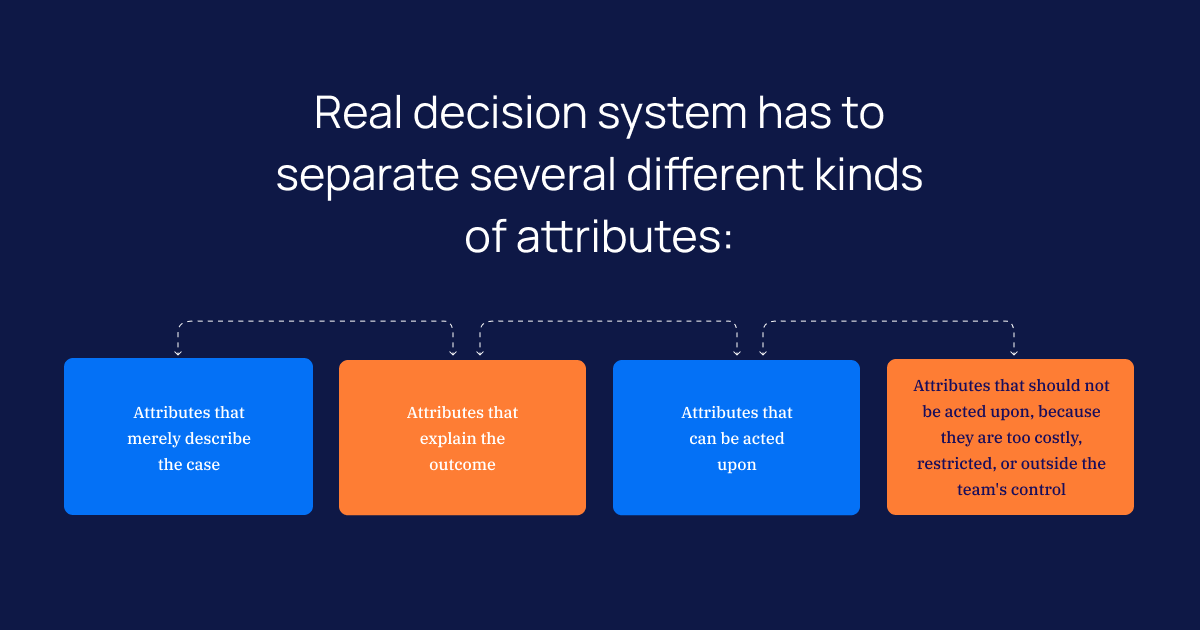
Knowing what is associated with an outcome is not the same as knowing what to do about it. A real decision system has to separate several different kinds of attributes:
Real decision system has to separate several different kinds of attributes
A patient’s age explains readmission risk, and it cannot be changed. A medication reconciliation step at discharge also influences risk, and it can be changed this afternoon. An explanation that treats both as equally important sends the team nowhere. The intelligence is in the distinction.

What prescriptive intelligence actually requires

The capability that closes the gap is prescriptive. It does more than score and explain. It identifies the specific, feasible changes that move a case from an undesired state to a desired one, and it ranks those changes by impact, effort, and constraints.
Three things have to work together for that to happen. Rule extraction pulls the decision logic out of high-dimensional data instead of leaving it locked inside a black box. Actionable attribute selection separates the factors a team can change from the ones it cannot. Shortest-path reasoning finds the minimal set of changes that produces the result, rather than handing over a list of fifty possible interventions.
That last point carries more weight than it first appears. Decision-makers do not want a hundred recommendations. They want the smallest change that moves the needle: the one process fix that prevents a delay, the single follow-up that keeps a patient out of the hospital, the behavioral shift that moves a case into a safer class. Listing every possible intervention is easy. Ranking the feasible ones by what they cost and what they return is the hard part, and it is where the value sits.

A worked example: the high-risk patient

Illustrative scenario

A discharge planner looks at a patient the model has flagged as high-risk for readmission. An explanation layer lists the drivers: multiple chronic conditions, a complex medication regimen, a missed prior follow-up, and limited transport to appointments.
The planner still has to decide what to do before the patient leaves. Several of those drivers are fixed. The chronic conditions are not changing this week. But the medication regimen can be reconciled and simplified now. A follow-up can be scheduled and confirmed. A transport barrier can be answered with a referral.
A prescriptive system does not stop at the four drivers. It identifies which are modifiable, which are feasible given the team’s resources, and which combination forms the shortest path to a lower risk. That is the difference between a model that produces a number and a system that produces a decision.

Why prescriptive paths are also a governance asset

In regulated industries, a recommendation is only useful if it can be defended. A clinical or compliance reviewer has to ask whether a recommendation is justified, whether it can be audited, whether a domain expert would validate it, and whether it is fair and operationally feasible.
Black-box predictions struggle with every one of those questions. A transformation path does not. Because it is built from extracted rules and a stated sequence of changes, it can be inspected, challenged, and approved before anyone acts on it. The same structure that makes a recommendation useful to a care team is what makes it defensible to a regulator. In healthcare, life sciences, and other high-stakes settings, that is not a feature. It is a requirement.

From prediction to prescription

The lesson holds across every model an enterprise runs. A predictive model says something is likely to happen. An explanatory model says which factors are associated with it. Neither tells the organization what to change, in what order, with the least effort, to improve the outcome. That last step is where measurable value lives.
This is the principle behind Intuceo’s approach to decision intelligence. The Intuceo-Ax engine pairs prediction with a Rationalization Layer that surfaces the statistical evidence and logic behind a recommendation, instead of a yes or no answer. In adverse event reporting and risk stratification, that means a model does not just predict, it justifies, which is what regulatory frameworks like GxP and HIPAA demand. The work is delivered as explainable, governed systems, built and validated through the iPDLC development framework, rather than a black box dropped into a workflow.
Prediction was never the finish line. The organizations that see returns from AI are the ones that treat the score as the start of a decision, not the end of one.
There is a harder question waiting in the GenAI era. If models like GPT and Claude can reason and explain so fluently, why can’t they deliver this structured, auditable path on their own? That is the subject of the next post.

Turn predictive models into decisions your teams can act on.

Intuceo builds explainable, governed decision intelligence for healthcare, life sciences, and other regulated industries.

Frequently Asked Questions

Predictive analytics estimates what is likely to happen, such as which patients may be readmitted or which loans may default. Prescriptive analytics goes further. It identifies the specific, feasible changes that move a case toward a better outcome, then ranks them by impact, effort, and constraints, so teams know what to do, not just what to expect.
Explainable AI shows which factors are associated with an outcome, but association is not action. A useful system also has to separate the factors a team can change from those it cannot, such as a patient’s age versus a discharge medication review. Prescriptive intelligence adds that distinction and finds the shortest path to a better result.
Yes, when the recommendation is built from extracted rules and a stated sequence of changes rather than a black-box score. That structure can be inspected, challenged, and validated by a domain expert before anyone acts, which is what frameworks such as HIPAA and GxP require. A transparent rationalization layer makes the recommendation defensible, not just accurate.

Managed Analytics as a Service: The Definitive Guide for Enterprise Health Systems

Enterprise health systems sit on more data than almost any other industry, and use far less of it than they should. One widely cited estimate suggests roughly 97% of the data generated by hospitals each year goes unused for analytics or evidence generation.The reasons are structural, not theoretical. Data is fragmented across electronic health records, claims systems, lab platforms, pharmacy benefit feeds, and increasingly social determinants of health. Pipelines break. Models drift. Compliance reviews stall releases. Analytics teams spend their week reconciling identifiers instead of producing insight.
This is the gap that managed analytics as a service is built to close. Instead of operating an in-house analytics stack as a permanent line item, health systems engage a specialist partner to design, run, and continuously improve their analytics environment as an outsourced service, with outcomes governed by a service level agreement and a defined value contract.
This guide is a complete reference for health system leaders evaluating healthcare analytics services. It covers what managed analytics actually is, where it differs from in-house builds, how compliance and EHR integration get handled in practice, what real outcomes look like in revenue cycle and quality of care, and how to evaluate providers without falling into a generic procurement checklist.

What Is Managed Analytics as a Service in Healthcare?

Managed analytics as a service is a delivery model in which an external partner owns the operating responsibility for a health system’s analytics stack. The partner is responsible for the data engineering, modeling, dashboards, monitoring, governance, and continuous tuning that turn raw clinical and financial data into decisions. The health system retains ownership of the data, the strategy, and the clinical context. The partner is accountable for uptime, accuracy, throughput, and measurable outcomes.
In a typical engagement, the scope spans:
This is structurally different from buying a one-off tool. A health system analytics platform sold as a license still requires the organization to staff data engineers, ML specialists, and compliance reviewers. Analytics as a service healthcare bundles the platform, the people, and the operating model into a contracted outcome.

Why Health Systems Are Moving to a Managed Model

The shift is being driven by four pressures that show up on every CIO and CMIO’s quarterly review.
The market is consolidating around outcome-led analytics. Enterprise spending is shifting from analytics software licenses toward operated services that carry contracted outcomes. Health systems that bought platforms expecting them to drive results are now finding that operating those platforms at scale is a different problem from buying them.
The talent equation does not work in-house for most systems. Healthcare data scientists are scarce, expensive to retain, and clustered around a small number of large academic systems. Building a competent in-house team capable of predictive analytics healthcare, clinical decision support analytics, and real-time healthcare analytics requires combining clinical informatics, ML engineering, cloud security, and regulatory expertise. Most provider organizations cannot maintain all four disciplines at depth.
The revenue side is leaking faster than internal teams can plug it. Initial claim denial rates reached 11.8% in 2024, up from 10.2% only a few years earlier, with denials from Medicare Advantage plans spiking 4.8% between 2023 and 2024. Health Catalyst estimates that 86% of denials are avoidable, yet most organizations cannot operationalize that insight at scale.
Clinical risk is now a data problem. The window to intervene in patient care has shrunk from weeks to minutes, and lagging retrospective reports are no longer enough to prevent adverse events. Health systems are penalized heavily when they fail to track rising-risk patients or miss soaring readmission rates. Managing this clinical risk requires continuous data orchestration, not static software. Health systems that operate analytics as a managed service are the ones moving fastest into predictive readmission management, population stratification, and proactive care gap closure.

In-House Analytics vs Managed Analytics as a Service

Asian accountant working and analyzing financial reports project
Dimension In-house analytics Managed analytics as a service
Time to first production model 12 to 24 months, including hiring 8 to 16 weeks for first use cases
Cost structure Capex heavy, fixed headcount Opex, scalable with usage
Talent risk Single points of failure on key engineers Diversified across partner bench
Compliance posture Maintained internally, audit by exception Continuously maintained, audit-ready
Innovation cadence Quarterly releases at best Continuous, model retraining built in
Clinical and domain context Strong, sits inside the organization Needs deliberate partner alignment
The right answer is rarely all-or-nothing. Many enterprise systems retain a small internal team focused on clinical strategy, governance, and domain ownership, and contract the engineering, ML operations, and compliance scaffolding to a managed partner. This protects clinical authority while offloading the operating burden.

The Core Capabilities of a Managed Healthcare Analytics Engagement

A serious analytics as a service healthcare engagement is not a dashboard refresh. It is an operating model that covers five interconnected capability layers.

1. Healthcare Data Integration and the Unified Patient Record

The first hard problem in any health system analytics program is fragmentation. Patient data lives in Epic or Cerner, payer claims sit in a separate system, lab results stream from external partners, pharmacy data flows through a PBM, and SDoH signals arrive through community health platforms. A managed partner is responsible for ingesting these sources, resolving identity across them, and producing a governed unified patient record.
Mature healthcare data integration services rely on HL7 and FHIR pipelines, master patient index logic, and lineage tracking that survives audit. Without this layer, every downstream model inherits the same identity and data quality problems. Healthcare data management services in a managed engagement also include retention policy enforcement, PHI tokenization where appropriate, and a clear data classification scheme that governs which datasets are accessible to which downstream models.

2. Clinical Decision Support and Patient Outcomes Analytics

Once the data layer is governed, the engagement moves into clinical decision support analytics and patient outcomes analytics. This is where predictive risk scoring, deterioration prediction, sepsis early warning, and chronic disease trajectory modeling live. The work is judged on whether clinicians actually use the output at the point of care, not whether the model achieves a particular AUC in a notebook. Outcome models that sit in dashboards without an integrated workflow rarely move clinical metrics. The ones that do are wired into discharge planning, care management queues, and order entry, so the prediction shows up at the moment a clinician can act on it.
The most cited outcome in this category is readmission reduction. 

3. Population Health and Risk Stratification

A population health analytics platform identifies high-utilizer cohorts, stratifies risk across panels, and feeds care management workflows. The capability set includes Clinical Risk Group classification, gap-in-care identification, SDoH overlay, and longitudinal cohort tracking. The output is operational: which 200 members in a 50,000-life panel deserve outreach this week.
Doctor team analyzes big data, creates cost effective plans for

4. Revenue Cycle and Financial Analytics

Revenue cycle management analytics is where managed analytics shows ROI fastest, because the denial problem is large and the feedback loop is short.

5. Quality Reporting and Regulatory Analytics

Enterprise health systems live with overlapping quality programs. Healthcare quality metrics reporting for HEDIS, AHRQ, and CMS measures cannot be a quarterly fire drill. A managed engagement maintains the measure logic, runs AHRQ measures reporting and CMS quality measures analytics continuously, and surfaces drift in performance before reporting cycles close. This is where Star Ratings and value-based contracts are won or lost.

HIPAA, FISMA, and the Compliance Imperative

Compliance is the single biggest reason that healthcare analytics fails the procurement test. IBM Security’s 2024 Cost of a Data Breach Report, as referenced across industry analysis, places the average cost of a healthcare data breach at USD 9.77 million, the highest of any industry for the twelfth consecutive year.
A serious managed analytics engagement treats HIPAA compliant analytics solutions as foundational rather than additive. That means:
The principle is straightforward. The cost of compliance is engineered in at the architecture layer, not patched on after the model is built.
The shift to cloud-based healthcare analytics has changed the economics here. Cloud-native lakehouse architectures on Azure, AWS, or Databricks make it possible to scale storage and compute against unpredictable clinical and claims volumes without overbuilding hardware. They also give compliance teams better tools, including continuous control monitoring, infrastructure-as-code audit trails, and native identity governance. The on-premise option still applies for federal workloads and certain payer environments, but the default for new engagements is increasingly cloud-first.

EHR Integration: The Realistic Picture

One of the most common questions in any analytics evaluation is how difficult it is to integrate a health system analytics platform with Epic, Cerner, or Meditech. While the technical integration is solved, the organizational integration is where projects slow down.
On the technical side, HL7 v2 and FHIR R4 are mature standards. Bulk FHIR APIs are now available across major EHRs. A managed partner with a tested ingestion framework can stand up structured feeds in weeks. Real-time healthcare analytics over HL7 streams is operationally feasible today, not a future-state aspiration.
The work that actually consumes time is governance: agreeing on which fields flow into the analytics environment, who approves PHI access, how identifiers are resolved across systems, and how clinician workflows surface model output without adding alert fatigue. A capable partner runs this work in parallel with the technical build.

How to Evaluate Managed Analytics Service Providers

Most procurement scorecards for enterprise health analytics miss the metrics that actually predict success. A more useful evaluation framework looks at five categories.

1. Domain depth, not just technology coverage

Ask the partner to walk through three healthcare-specific implementations in detail. If they cannot describe the clinical or actuarial logic behind the models, the engagement will stall when domain nuance enters the conversation.

2. Compliance posture as an engineering property

Ask for the architecture diagram of a HIPAA-validated environment they currently operate. Ask how they handle 21 CFR Part 11 where relevant. Vendors who treat compliance as a checkbox will produce checkbox-grade controls.

3. Operating metrics they will commit to in writing

Useful SLAs include data freshness, model accuracy thresholds, time-to-resolution on broken pipelines, and tracked clinical outcome metrics. Activity metrics like “dashboards delivered” are not operating metrics.

4. Explainability and auditability of model output

Clinical and actuarial leaders will not adopt model output they cannot defend. Explainable AI, model documentation, and lineage tracking should be standard, not premium add-ons.

5. Engagement model fit

A managed engagement is multi-year by nature. The right partner will offer flexible commercial models, including fixed-outcome contracts, capacity-based engagements, and hybrid models where the system retains strategic ownership while operating burden shifts to the partner.

How Intuceo Architects Managed Analytics for Health Systems

Intuceo operates as a services and solutions firm focused on AI, ML, and data analytics for regulated industries, with healthcare and life sciences as a primary vertical. The work is built around three commitments that map directly to what a managed analytics engagement actually requires.
PhD-led engineering. Intuceo’s healthcare engagements are led by ML and analytics practitioners with domain experience across payer, provider, and life sciences workloads, and supported by certified engineers and data architects working across HIPAA, FISMA, 21 CFR Part 11, and GxP environments.
Proprietary IP that compresses delivery time. The Intuceo IP stack includes Intuceo-Ax for augmented BI and conversational analytics, Intuceo-Ix for knowledge and enterprise search across unstructured clinical data, iPDLC for the AI-assisted development lifecycle, and AgentCare AI for clinician-facing agentic workflows over EHR data. The iPDLC framework alone reduces implementation lead time by up to 40% on production engagements.
Outcome-anchored engagement models. Intuceo offers strategic team augmentation, fixed-outcome project contracts, and managed service SOWs, allowing health systems to match commercial structure to risk appetite. Engagements span the full capability stack, from payer intelligence and value-based care to provider clinical integration, revenue cycle optimization, and security and interoperability architectures on Azure, AWS, and Databricks.
Healthcare clients include Florida Blue, Guidewell Health, and UF Health, among others. The work is grounded in HEDIS, AHRQ, and CMS measure logic, predictive readmission modeling, claim denial prevention, and unified patient record engineering across Epic, Cerner, and SDoH sources.

Where Managed Analytics Pays Off: Real Outcome Categories

Meeting team of doctor and medical staff at hospital, Consultati
The strongest case for healthcare analytics services sits in three outcome categories that translate cleanly into board-level metrics.

Readmission reduction and avoidable utilization

Predictive readmission models embedded into discharge workflows have produced documented reductions in 30-day readmission rates and corresponding savings on Medicare’s Hospital Readmissions Reduction Program penalties. The 11.4% to 8.1% pilot reduction documented in a regional hospital implementation is representative of what is achievable when the model is integrated into clinical workflow rather than delivered as a standalone dashboard.

Claim denial prevention and revenue cycle optimization

With initial denial rates at 11.8% and 86% of denials estimated to be avoidable, predictive denial management is one of the highest-yield use cases for healthcare BI as a service.

Population health and value-based care performance

A population health analytics platform linked to active care management workflows is the operational backbone of HEDIS and Star Ratings performance. The financial impact compounds across quality bonus payments, MLR stabilization, and risk-adjusted revenue.

Implementation Timelines and Skills Required

Realistic timelines for enterprise health analytics engagements:
On the internal skills side, health systems engaging a managed partner need fewer ML engineers and more domain owners. The roles that actually drive value are a clinical analytics sponsor, a finance analytics sponsor, a data governance lead, and a compliance reviewer. The deep technical work sits with the partner.

Conclusion

The gap between what enterprise search tools deliver and what life sciences organizations actually need is not a minor inconvenience. It is a structural problem that affects research velocity, regulatory compliance timelines, and the quality of safety decisions. Keyword matching was built for general corporate content, not for the terminological density, structural complexity, and compliance rigor of clinical trial document retrieval and regulatory document search.
Closing this gap requires a shift to semantic search for life sciences, purpose-built for the domain, deployed in compliant environments, and architected to deliver traceable, contextual answers rather than keyword-matched links. For organizations ready to make that shift, the difference is not incremental. It is the difference between searching for information and actually finding it.

Talk to the team that architects managed analytics for some of the biggest names in the US healthcare industry.

Bring your priority use case, and we’ll walk through what an outcome-anchored engagement would look like in your environment.

Frequently Asked Questions

Evaluate domain depth in healthcare specifically, the maturity of the partner’s HIPAA and FISMA architecture, the operating SLAs they will commit to in writing, the explainability of their model output, and the flexibility of their commercial model. Generic analytics vendors with a healthcare tag will struggle on the compliance and clinical context dimensions.
In-house analytics gives the organization full control and tight domain context, but requires sustained investment in scarce talent and continuous compliance maintenance. Managed analytics as a service shifts the operating burden to a specialist partner under a defined outcome contract, while the health system retains data ownership and strategic direction.
For systems with multi-source data fragmentation, denial rates above 8%, or active value-based contracts, the answer is almost always yes. The combination of avoided denials, reduced readmission penalties, and faster time to insight typically outweighs the cost of the engagement within the first 12 to 18 months.
Reputable providers run on HIPAA-validated cloud environments with encryption, MFA, role-based access control, audit logging, and continuous compliance monitoring built into the architecture. For federal workloads, FISMA and NIST 800-53 alignment are added. For life sciences workloads, 21 CFR Part 11 controls are layered in.
The technical integration with Epic, Cerner, Meditech, and Allscripts is well-trodden through HL7 v2, FHIR R4, and bulk FHIR APIs. The work that determines project speed is governance: PHI access approval, identifier resolution, and clinical workflow design. A capable partner runs governance in parallel with the build.
A typical first production use case lands within 8 to 16 weeks. Full coverage across clinical, financial, and population health use cases is usually a 9 to 18 month roadmap, with continuous expansion thereafter.
Through predictive risk scoring at the point of care, embedded clinical decision support, care gap closure workflows, and continuous HEDIS, AHRQ, and CMS measure tracking. The published evidence base, including documented readmission rate reductions and 40% improvements in risk-adjusted readmissions indexes, supports the operating model.
Yes. Predictive readmission management is one of the most evidence-backed use cases in healthcare analytics consulting, with documented reductions in 30-day readmission rates and corresponding savings on Medicare HRRP penalties.
On the partner side, the engagement needs ML engineering, data engineering on cloud lakehouse platforms, clinical informatics, healthcare compliance, and BI development. On the health system side, the critical roles are a clinical analytics sponsor, a finance or revenue cycle sponsor, a data governance lead, and a compliance reviewer. Internal teams do not need deep ML expertise. They need domain ownership, willingness to operationalize model output into workflow, and the authority to enforce governance.
The most useful evaluation metrics combine operating performance with clinical and financial outcomes. Operating metrics include data freshness, pipeline uptime, model accuracy thresholds, and time-to-resolution on incidents. Outcome metrics include readmission rate movement, denial rate movement, HEDIS and Star Rating performance, and time-to-deployment for new use cases. Activity metrics like dashboards delivered or models trained are not evaluation criteria.

Predictive Analytics in Healthcare: How Providers Are Reducing Readmission Rates Before Discharge

In the era of value-based care, the hospital discharge is no longer the “finish line” – it is a critical transition point. For healthcare providers, the challenge has always been identifying which patients are likely to return within 30 days. Traditionally, this was a guessing game based on clinical intuition or static scoring systems.
Today, predictive analytics in healthcare is changing the narrative. By leveraging AI-driven insights before a patient even leaves the hospital, providers are moving toward a “preventative discharge” model, effectively reducing readmission rates and ensuring long-term patient recovery.

The High Stakes of 30-Day Readmissions

Hospital readmissions are a multi-billion-dollar challenge. Under the CMS Hospital Readmissions Reduction Program (HRRP), hospitals face significant financial penalties if their 30-day readmission rates for conditions like heart failure or pneumonia exceed national averages.
The stakes are highest in chronic disease management. Across various clinical studies, up to 86% of heart failure rehospitalizations could potentially be prevented through timely medical and social interventions.
However, beyond heart failure, readmission risks exist across the board:
The gap lies in the hospital’s ability to identify exactly which interventions are needed for which patient after their discharge.

The Strategic Role of Predictive Analytics in Modern Healthcare

Before diving into the mechanics of readmissions, it is essential to understand the broader shift predictive analytics represents. In the past, healthcare data was mainly used for backward-looking analysis, focusing on metrics from the previous month or quarter.
Predictive analytics flips the script by using historical data to forecast future events. It is an “early warning system” – by synthesizing massive volumes of data from Electronic Health Records (EHRs), wearable devices, and genomic sequences, predictive tools can identify subtle patterns that the human eye might miss. This shift enables:
By serving as a foundation for decision support, predictive analytics allows healthcare organizations to transition from a volume-based “fee-for-service” model to a value-based model centered on quality and efficiency.
It is important to note that these predictive tools do not replace clinical judgment; rather, they function as advanced Clinical Decision Support (CDS). By providing a clear evidence base for risk, AI empowers the multidisciplinary team to make the final call on a patient’s readiness for discharge, ensuring that technology serves as a co-pilot in the care journey.

How Predictive Analytics Identifies High-Risk Patients

The power of hospital readmission prediction today lies in its ability to process massive, disparate datasets in real-time. Traditional methods, such as the LACE index, focused on a narrow set of variables: length of stay, acuity, comorbidities, and emergency visits. Though useful, these models often lack the context of a patient’s life outside the hospital.
HowPredictiveAnalyticsIdentifiesHigh-RiskPatients

1. Unlocking Hidden Insights with NLP

Much of the most valuable patient data is “trapped” in unstructured clinical notes – the narrative observations made by nurses, social workers, and therapists. Machine learning readmission models now use Natural Language Processing (NLP) to scan these notes for red flags that structured data misses, such as mentions of cognitive decline, lack of caregiver support at home, or history of non-adherence. Predictive models synthesize narrative data to provide a multidimensional view of risk that far exceeds traditional scoring.

2. Identifying "Clinical Fragility" via EHR Trends

Rather than looking at a single lab result, AI models look at the velocity of change.

3. The Critical Lens of Social Determinants (SDOH)

A patient’s recovery is often dictated by social and environmental factors beyond the clinic – access to healthy food, transportation to follow-up appointments, and housing stability. SDOH-informed models integrate these external variables into the clinical risk profile.

Precision in Practice: The Intervention Framework

The 30-day window is historically difficult to manage because hospitals often enter a ‘data vacuum’ the moment a patient leaves the building. Predictive analytics bridges this gap by identifying which patients are most likely to face complications on Day 10 or Day 20, allowing providers to extend their clinical ‘line of sight’ into the home and prevent the silent relapses that drive readmissions.
To tackle readmissions, providers are using a three-tiered predictive approach that triggers specific clinical actions regardless of the primary diagnosis.

1. The Pre-Discharge Stability Check

AI models analyze real-time hemodynamics and lab trends. If the model identifies “subclinical instability” – where the patient looks fine but data suggests physiological stress – the system alerts the care team to delay discharge by 24 hours for further observation.

2. The Social Safety Net

For patients flagged as high-risk due to social factors (ROC-AUC 0.79–0.82), the system automatically triggers a “Transition of Care” (TOC) bundle. This includes “Meds to Beds” delivery and a confirmed home-health visit within 48 hours.

3. Predictive Resource Prioritization

Not every patient needs a daily follow-up call. Predictive models identify the top 10% of “ultra-high-risk” patients. By focusing labor-intensive monitoring on these individuals, hospitals maximize their resources while ensuring the most vulnerable have a digital safety net.

Real-Time Risk Scoring at Discharge: A Strategic ROI

Implementing real-time readmission risk scoring isn’t just a clinical win; it’s a strategic financial move.

Calculating the ROI

When hospitals deploy predictive tools to cut readmissions by 30-50%, the Return on Investment (ROI) is realized through:

The Intuceo Advantage: Turning Data into Action

At Intuceo, we understand that a prediction is only valuable if it is actionable. Our Augmented BI technology is designed to bridge the gap between “big data” and “bedside care.”

Conclusion: Predictive Care is the Future

The transition from retrospective management to predictive foresight is more than a technological upgrade – it is a fundamental reimagining of the hospital’s role in a patient’s life. In the traditional model, patient discharge was treated as a conclusion; however, in this digital-first world, it is an informed handoff supported by a continuous clinical safety net.
Reducing readmission rate is a complex puzzle with clinical, social, and behavioral pieces. However, by leveraging predictive analytics in healthcare, providers can finally visualize the “invisible” risks, from subtle lab velocity shifts and hidden social determinants to the nuances buried in clinical notes, that lead to relapse.
For Intuceo, the objective is to ensure that “big data” never loses its human context. By transforming raw Electronic Health Record data into actionable bedside intelligence, we empower providers to ensure that when a patient is discharged, they aren’t just leaving a facility – they are entering a managed recovery ecosystem. The future of healthcare isn’t defined by the events that occur within the hospital walls, but by the clinical intelligence that keeps patients healthy, at home, and on a definitive path to long-term wellness.

Ready to transform your discharge process from a guessing game into a managed recovery?

Frequently Asked Questions

The LACE index is a static, backward-looking tool that relies on only four variables. Predictive analytics, however, uses machine learning to analyze hundreds of real-time data points simultaneously—including “velocity of change” in labs and social determinants (SDOH). This allows AI to identify high-risk patients that the LACE index frequently misses, such as those who are clinically stable but socially fragile.
No. These tools function as Clinical Decision Support (CDS) systems. They act as a “co-pilot” for the clinical team by providing a data-driven risk score and explaining the underlying causes of that risk. The final decision to discharge remains with the physician and the multidisciplinary care team.
Yes. Through Natural Language Processing (NLP), predictive models can “read” the narrative notes written by nurses, therapists, and social workers. It identifies red flags like “patient expressed confusion about discharge instructions” or “home environment lacks caregiver support.” This converts subjective observations into objective risk data.
Machine learning models are not “set and forget.” As medical standards evolve (e.g., new heart failure protocols), the model must undergo periodic retraining. Advanced platforms use Continuous Learning loops to monitor if the model’s performance is dipping, ensuring that the risk scoring remains aligned with current clinical outcomes and the specific demographics of your local patient population.
Solutions like Intuceo’s DataSharp™ engine are designed to automate the preprocessing of complex EHR data. By embedding risk scores and insights directly into the existing clinical workflow, these tools provide real-time alerts without requiring clinicians to log into a separate platform.

Healthcare Analytics Consulting: The Complete Guide for Health System Leaders

Most health system leaders are aware that their organizations are drowning in data but starving for actionable insights. The challenge isn’t the volume of information – it’s the lack of decision velocity. When clinical and financial leaders operate from competing versions of a single metric, ‘truth’ becomes subjective. Whether the discrepancy lies in readmission rates, denial volumes, or ACO quality scores, the cost is more than just internal friction; it is the silent erosion of margins, delayed patient interventions, and quality performance that drifts dangerously below contract thresholds.
That gap between data abundance and decision confidence is exactly where healthcare analytics consulting creates its value. As you evaluate consulting services or select vendors, understanding the anatomy of a credible engagement – from kick-off to measurable outcome – is essential. The following sections are written for CIOs, CMIOs, CFOs, and VP-level operations leaders seeking clarity on this process.
This is not a vendor pitch list. It is a structured review of the decisions, tradeoffs, technical considerations, and realistic benchmarks that health system leaders need to navigate before, during, and after a healthcare analytics consulting engagement.

Healthcare Analytics Consulting: Why Does Timing Now Matter?

Healthcare analytics consulting refers to the practice of designing, implementing, and operationalizing data analytics capabilities inside health systems, payer organizations, and clinical networks. A healthcare analytics consulting firm may focus on a single workstream, such as clinical analytics, population health, or revenue cycle, or operate across the full data lifecycle from pipeline engineering to predictive model deployment to executive dashboard delivery.
Three forces are making 2025 a particularly consequential year for health system leaders to act on analytics:
A health system analytics consulting partner provides the architecture, expertise, and methodology to close those gaps faster than internal teams can build from scratch.

The Analytics Spectrum: Descriptive, Predictive, and Prescriptive Analytics in Healthcare

TheAnalyticsSpectrum_Descriptive,Predictive,andPrescriptiveAnalyticsinHealthcare
Before engaging a healthcare analytics consulting firm, health system leaders should understand the three tiers of analytics maturity and what each tier can realistically deliver.

Descriptive Analytics: What Happened?

Descriptive analytics summarizes historical data through dashboards, utilization reports, length-of-stay trends, and payer mix analyses. It held approximately 45.9% of the healthcare analytics market share in 2024, making it the largest segment by type, because it is the entry point for most organizations . It is foundational but insufficient on its own for driving the proactive interventions that move quality metrics or financial performance.

Predictive Analytics: What Is Likely to Happen?

Predictive analytics uses statistical models, machine learning, and historical patterns to anticipate outcomes before they occur. Examples include 30-day readmission risk scores, sepsis early-warning models, surgical complication prediction, and claim denial probability scoring. Predictive analytics is the fastest-growing segment in the healthcare market, with an expected CAGR of 26.5% through 2030.

Prescriptive Analytics: What Should We Do?

Prescriptive analytics goes beyond prediction to recommend or automate actions. Examples include care coordination pathway routing for high-risk patients, dynamic bed management recommendations, and prior authorization optimization. Prescriptive models require the highest data maturity and operational readiness. Organizations that attempt to skip the foundational tiers and jump directly to prescriptive AI consistently encounter failure.
The practical implication for health system leaders: assess your current data infrastructure honestly before defining the scope of a consulting engagement. A healthcare data analytics consulting firm that promises prescriptive AI outcomes without first auditing your data quality and governance posture is a red flag.

The Data Quality Problem: What Health System Leaders Need to Watch For

Poor data quality is the most common reason analytics initiatives underperform. Studies indicate that healthcare data quality issues contribute to nearly 30% of adverse medical events . In analytics terms, the consequences manifest as model drift, dashboard contradictions, and credibility erosion among clinical leaders.
Health system leaders should watch for four specific patterns:

Forward-Propagated Errors in EHR Documentation

Physicians using copy-and-paste templating in EHR workflows inadvertently carry outdated or incorrect data forward across multiple encounters. For instance, a medication listed from a 2021 hospitalization may still appear as active in 2025 if not explicitly closed. Models trained on such data inherit these errors at scale.

Missing Data Not at Random

EHR data gaps rarely appear randomly. They reflect structural access inequities, documentation habits tied to billing incentives, and population-specific care utilization patterns. When an ML model is trained on data with non-random missingness, it may perform accurately on the training cohort but fail for the underserved populations whose data is most sparse.

Siloed Data Across Clinical and Financial Systems

Most health systems operate with disconnected claims databases, EHR platforms, pharmacy systems, and laboratory information systems. Integration failures at the pipeline layer mean that analytics outputs represent only a partial picture of patient and operational reality.

Coding Inconsistency and Downstream Effects

ICD-10 coding errors, Diagnosis-Related Group (DRG) miscapture, and documentation gaps create compounding problems across both clinical analytics and revenue cycle modeling. Clinical risk scores are only as accurate as the diagnoses entered at the encounter level.
The discipline to address these issues is data governance for healthcare analytics, which includes master data management, data stewardship roles, and pipeline validation processes. Any credible healthcare data quality improvement consulting engagement begins with a data quality audit rather than jumping to model development.

Predictive Analytics for Hospitals: Reducing Readmissions and ED Overcrowding

Hospital readmissions and emergency department overcrowding carry both quality and financial penalties. For Medicare patients, nearly 20% are readmitted within 30 days of discharge. Preventing even 10% of those readmissions could save Medicare approximately $1 billion annually .
Predictive analytics for hospitals addresses this through risk-stratification models applied at or before the point of discharge. The clinical data inputs typically include prior admissions history, diagnosis complexity, medication adherence patterns, insurance status, and, increasingly, social determinants of health such as housing stability, food insecurity, and transportation access.
Here are a few real-world implementations showcasing this:
For ED overcrowding, predictive models are applied to patient census forecasting, boarding time prediction, and triage prioritization. The same architecture applied to readmissions can anticipate ED surge periods 24 to 72 hours in advance, allowing staffing adjustments and diversion management decisions to be made proactively rather than reactively.
The technology alone does not reduce readmissions. The model must be embedded in redesigned clinical workflows, adopted by case managers, and tied to specific care coordination protocols. Vendors that sell a risk score without accountability for workflow change are selling an incomplete solution.

What Metrics Should CIOs and CMIOs Track in Hospital Analytics Dashboards?

Healthcare analytics dashboard best practices distinguish high-performing health systems from average ones. Hospital analytics dashboards fail clinicians and executives when they present too many metrics with too little context, or when the metrics tracked do not connect to the decisions being made.
The following framework reflects what experienced CIOs and CMIOs prioritize across three domains.

Clinical Quality and Safety Metrics

Operational and Capacity Metrics

Financial and Revenue Cycle Metrics

Three design principles separate high-performing dashboards from those that get ignored: every metric is actionable, not just informational; every metric links to an owner and a response protocol; and dashboards refresh frequently enough to support the decision cycles they are meant to inform.

Revenue Cycle Analytics: Where Clinical and Financial Operations Converge

Revenue cycle analytics consulting for healthcare has emerged as one of the highest-ROI segments within health system analytics because the financial stakes are immediate and measurable. Healthcare administrative costs, including revenue cycle operations, account for 15 – 25% of total healthcare expenditures. Organizations using advanced analytics in revenue cycle management report up to 40% fewer denials and first-pass claim rates of 93% .
The connection between clinical and financial operations is the central problem that many health systems fail to close. Clinical documentation quality directly determines coding accuracy. Coding accuracy determines DRG assignment, which further determines reimbursement. When clinical and financial data systems are siloed, and the people who manage them operate independently without shared accountability, revenue leakage is inevitable.

Predictive Denial Management

Machine learning models trained on historical claims data can score new claims for denial probability before submission, allowing coding and billing teams to correct documentation upstream. Health systems that have implemented this capability report reductions in A/R days by nearly 11 days.

Under-Coding and Over-Coding Detection

A 2024 survey found that 84% of revenue cycle executives want analytics to identify under-coding, and 68% want the same capability for over-coding . Both represent risk – one financial and one compliance.

Value-Based Payment Alignment

As health systems take on more risk through ACO and bundled payment arrangements, the revenue cycle must track not just fee-for-service billing performance but quality-adjusted financial outcomes. Linking clinical analytics consulting services to claims analytics platforms enables this view. Organizations that treat revenue cycle analytics as a stand-alone back-office function, rather than a clinical-financial integration challenge, consistently recover less revenue and carry more administrative waste.

HIPAA-Compliant Use of LLMs on EHR Data: What Health Leaders Need to Understand

The interest in applying large language models to clinical documentation, clinical decision support, and patient record summarization is substantial and growing. The questions health system leaders need answered before approving any LLM deployment on the EHR data center in three areas: de-identification, data governance, and model accountability.

Safe Harbor Approach Is Not Optional

To comply with HIPAA, health systems must ensure patient data is anonymous before sharing it with an external AI model. This typically happens through two paths: Safe Harbor, which involves stripping 18 specific identifiers (like names, phone numbers, SSNs, etc.), or Expert Determination, where a statistician certifies that the risk of re-identification is minimal. Any LLM vendor handling raw patient data without these protections or a signed Business Associate Agreement (BAA) puts the health system at serious legal and regulatory risk.

Business Associate Agreements Define the Compliance Boundary

A vendor that processes PHI on behalf of a covered entity is a Business Associate under HIPAA. The BAA specifies permissible uses, data retention rules, breach notification obligations, and subcontractor controls. Before any LLM is connected to EHR data in a non-de-identified pipeline, the BAA must be signed and reviewed by legal counsel.

Model Governance Applies After Deployment Too

HIPAA-compliant healthcare analytics consulting requires ongoing monitoring for output accuracy, bias in clinical recommendations, and performance drift as patient populations or documentation practices change. A model that summarizes clinical notes accurately in November may produce clinically misleading summaries in March if the documentation conventions it was trained on shift. Regulated healthcare analytics consulting requires a rationalization layer between model outputs and clinical decision workflows to catch and contain these errors.
Healthcare organizations should distinguish between models deployed entirely within their own HIPAA-compliant cloud environment (Azure or AWS HIPAA-validated architectures) and models that route data through third-party inference APIs. The former is substantially more controllable than the latter, though it demands significantly more infrastructure investment.

Healthcare Analytics for Rural and Resource-Constrained Hospitals

Not every meaningful analytics initiative requires a large IT team, a data lake, and a multimillion-dollar consulting engagement. Rural hospitals and smaller health systems face a version of the same analytics problems that large health systems face, but with less budget, less IT staff, and less tolerance for extended implementation timelines that do not deliver near-term results.
Several approaches make operational analytics for hospitals accessible for resource-constrained organizations:

The Most Common Mistakes Health Systems Make in Analytics Consulting Projects

Healthcare analytics consulting implementations fail at a higher rate than they should, and the failure modes are consistent enough to be predictable.

Treating It as a Technology Project

The single most common mistake is confining the project to IT and expecting clinical and operational leaders to adopt the outputs without structured change management. Analytics does not change clinical behavior. Successful adoption requires a respected physician or nurse leader who bridges the gap between the data science team and the frontline staff. Without a peer-level advocate to validate that “the data makes sense,” even the most accurate models face cultural rejection.

Underinvesting in Data Engineering Before Model Development

Organizations frequently want to start with the predictive model and work backward to data quality. This approach is built to fail. A readmission risk model trained on incomplete or inconsistently coded data will produce unreliable risk scores, and clinicians who receive two or three inaccurate alerts will stop trusting the system entirely. Healthcare data quality improvement consulting is not a cost; it is the prerequisite.

Selecting Vendors Based on Demo Performance Rather Than Implementation Evidence

Vendors that excel at product demonstrations sometimes fail significantly in production environments where legacy systems, customized EHR configurations, and institutional data quirks introduce complexity that the demo never surfaced. Before selecting a healthcare analytics consulting firm, health system leaders should ask for reference conversations with peer institutions that have completed implementations of comparable complexity, not pilot programs or proof-of-concept engagements.

Defining Success as Deployment Rather Than Adoption

Going live is not the endpoint of a healthcare analytics implementation consulting engagement. Adoption, defined as the percentage of intended users who access and act on analytics outputs regularly, is the actual success metric. Health systems that do not define adoption targets in the contract and track them post-go-live routinely overpay for tools their clinical staff ignore.

Failing to Connect Analytics Outputs to the Governance Structure

Analytics findings that do not route to the correct committee, the correct executive, or the correct care team are operationally inert. Data governance for healthcare analytics includes not just data quality rules and lineage documentation but the organizational processes that ensure insights become decisions.

How to Evaluate Healthcare Analytics Vendors: What AI-Powered Claims Require Real Scrutiny

The healthcare BI and analytics consulting vendor market is crowded, and marketing language has converged to the point where differentiation requires active due diligence.
Healthcare leaders evaluating AI-driven healthcare analytics vendors should assess these dimensions:

What Realistic ROI Looks Like for Healthcare Analytics Consulting Engagements

Health system leaders are frequently presented with ROI projections at the high end of possibility during vendor selection. Understanding what verified outcomes actually look like helps calibrate expectations and contract structures.
Use Case Break-Even Timeline Verified Outcome
Revenue Cycle Analytics 12–24 months 200%–500% ROI; $10–$12M incremental net cash per client [11]; 5–15% lost revenue recovered within 12 months .
Readmission Reduction 18–36 months 472% ROI over three years (Allina Health); $3.7M in variable cost reduction on $890K investment .
Operational Efficiency 6–12 months Direct, measurable savings against current operational costs; fastest ROI category .
AI-Driven RCM 12–18 months 63% of healthcare organizations integrated AI RCM in 2024; 48% adoption rate in coding and documentation .
What the data shows consistently: ROI is higher when the engagement is scoped to a defined use case with a clear financial or quality metric attached, when the consulting firm is accountable for post-implementation adoption, and when the health system has completed baseline data quality work before model deployment begins.

How Intuceo Approaches Healthcare Analytics Consulting

Intuceo is a Florida-based AI, machine learning, and data analytics consulting firm with a practice built specifically for regulated healthcare environments. We serve payers, provider systems, and integrated delivery networks where HIPAA compliance, data governance rigor, and explainability are non-negotiable requirements.
We operate under a PhD-led model, meaning the analytical frameworks and model architectures that underpin its healthcare engagements are designed by doctoral-level data scientists, not adapted from generic enterprise AI toolkits.
Our proprietary technology stack includes:

Intuceo-Ax™

AI acceleration engine enabling faster model iteration and validation in clinical environments, built for production-grade healthcare analytics workflows.

Intuceo-Ix™

Integration engine that creates a unified patient intelligence layer from fragmented EHR (Epic, Cerner), claims, pharmacy, and Social Determinants of Health data sources.

iPDLC™

A proprietary development lifecycle framework that builds compliance, explainability, and auditability into analytics products from inception, not as an afterthought.

AgentCare AI

Agentic AI layer for healthcare, enabling proactive, workflow-embedded intelligence for care coordination and clinical operations at health system scale.
We deploy within HIPAA and FISMA-compliant cloud architectures on both AWS and Azure, with automated audit logging, VPC flow controls, and real-time compliance monitoring as standard infrastructure components. Our healthcare practice covers payer analytics (HEDIS, STAR ratings, Medical Loss Ratio management, member stratification), provider system analytics (predictive diagnostics, 360-degree patient insight via Intuceo-Ix, revenue cycle optimization), and security and interoperability engineering (HL7/FHIR real-time data orchestration, master data management).

Ready to move from data-rich to insight-rich?

Whether you’re navigating payer-side HEDIS optimization, provider-side denial management, or building a population health program for a value-based care contract, our healthcare analytics team is ready to design your roadmap.

Frequently Asked Questions

The four most common problems are copy-paste EHR errors that carry incorrect data forward, non-random data gaps that skew model performance for underserved populations, siloed clinical and financial systems that can’t be reliably joined, and ICD-10 coding inconsistencies that distort both risk models and revenue cycle outputs. A data quality audit before engagement starts is non-negotiable.
Descriptive answers what happened. Predictive answers what is likely to happen, using models to flag risk before it escalates. Prescriptive goes further, recommending or automating the action to take. Each tier requires the previous one to be stable before it can work reliably.

Break-even timelines range from 6 to 12 months for operational efficiency use cases to 18 to 36 months for readmission reduction. ROI is higher when the engagement is scoped to a specific metric, the consulting firm is accountable for adoption post-go-live, and data quality work is completed before model development begins.

Three requirements apply before any inference begins: de-identification under HIPAA Safe Harbor or Expert Determination, a signed Business Associate Agreement with every vendor touching PHI, and deployment within an AWS or Azure HIPAA-validated environment. Ongoing output monitoring for accuracy and bias drift is required after deployment, not just at launch.
Prioritize explainability of model outputs, documented HIPAA BAA and HITRUST status, certified EHR integration, and references from peer-sized organizations. Contractual accountability for post-go-live outcomes, not just delivery, is the most important and most commonly omitted criterion.
Building in-house gives you organizational ownership and long-term institutional knowledge, but it takes 12 to 24 months to hire and ramp a competent team, and healthcare data science talent is expensive and competitive. A consulting firm compresses that timeline significantly and brings pre-built frameworks, compliance infrastructure, and domain experience. The practical path for most health systems is a hybrid: engage a consulting firm to build and validate the initial capabilities, then transfer operational ownership to an internal team once the models and pipelines are stable.