
Pharma teams rarely run out of AI ideas; they run out of runway during validation. While a model may show 92% accuracy in a sandbox, it hits a high-velocity wall the moment it encounters GxP documentation requirements and ‘intended use’ scrutiny.
In the life sciences, the gap between a successful pilot and a production-grade system isn’t a technical hurdle – it’s a regulatory chasm. With roughly 80% of healthcare AI projects failing to scale , the validation phase is where most of that failure becomes visible.
$2.59B
AutoML global market value in 2025
41.96%
CAGR projected through 2031
The Five Reasons Pharma AI Validation Stalls
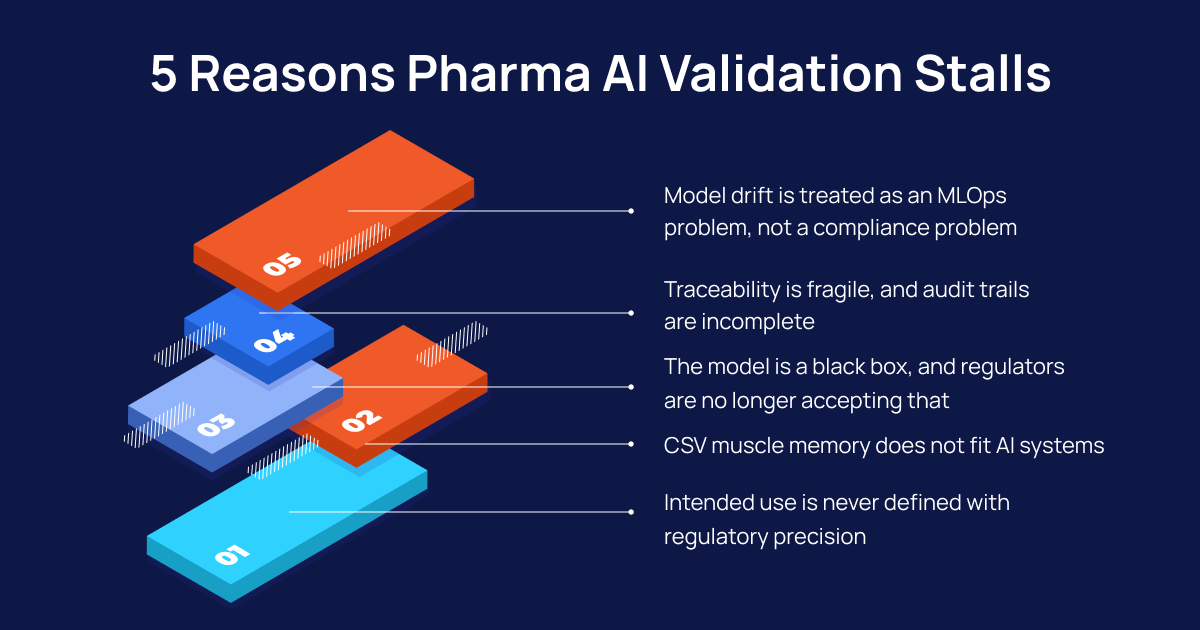
1. Intended use is never defined with regulatory precision
Most pharma AI projects begin with a business goal, not a Context of Use (COU). FDA’s January 2025 draft guidance on AI in drug and biological product development requires sponsors to define the question the AI model addresses, the COU, and the model’s risk based on how much it influences a regulatory decision and the consequences of that decision.
The agency built a seven-step credibility framework from experience reviewing more than 500 drug and biological product submissions containing AI components since 2016. When the intended use is fuzzy, every downstream artifact, the validation plan, the test scripts, and the acceptance criteria have nothing specific to anchor against. This is where GxP AI compliance reviews loop back to the start.
2. CSV muscle memory does not fit AI systems
Traditional Computerized System Validation expects deterministic behavior: same input, same output. AI systems are probabilistic. They drift. They retrain. The legacy IQ/OQ/PQ template was built for deterministic logic and static system behavior, not for AI/ML-based systems whose outputs vary with new data.
On September 24, 2025, the FDA finalized its Computer Software Assurance (CSA) guidance, a risk-based approach that replaces the one-size-fits-all CSV model for production and quality system software.CSA centers on critical features and continuous verification, making it better suited to AI than traditional CSV.
Even today, many pharma teams treat the transition to CSA as a ‘paperwork reduction’ exercise rather than a shift in mindset. The stall occurs because teams fail to differentiate between Direct Impact and Indirect Impact systems. Under the finalized September 2025 guidance, AI models influencing clinical endpoints require high-assurance scripted testing, while the MLOps pipelines supporting them can often leverage unscripted, streamlined assurance. Using the old CSV approach on a dynamic AI pipeline creates a ‘validation debt’ that eventually halts production.
3. The model is a black box, and regulators are no longer accepting that
Regulators increasingly demand clarity on how AI decisions are made, and black-box models are treated as risky in patient-safety contexts. Without an explainability layer, QA and regulatory teams cannot review the documentation because it does not exist in any defensible form. A binary Yes/No model output is not a validation artifact.
ISPE’s July 2025 GAMP Guide: Artificial Intelligence specifically addresses validating AI/ML systems in GxP environments, and GAMP 5 categorizes most AI/ML systems as Category 5, the highest-risk tier, which requires full qualification lifecycle documentation.
4. Traceability is fragile, and audit trails are incomplete
AI documentation requirements go well beyond source code and test cases. Validation packages must capture model lineage, bias audits, validation datasets, performance metrics, and retraining governance. Model traceability depends on immutable logs: every training iteration, data ingestion cycle, and AI-generated output must be captured in a tamper-proof audit trail. In a GxP environment, if an action isn’t logged in a reconstructable, time-stamped sequence, it effectively never happened leaving the model’s entire decision history indefensible during an inspection.
A 2025 PubMed study analyzing 1,766 FDA warning letters from 2016 through 2023 confirmed that data integrity enforcement has intensified, with electronic records violations remaining a dominant theme.
5. Model drift is treated as an MLOps problem, not a compliance problem
AI systems are dynamic, not static. Revalidation is required when models are updated, inputs shift, or new data patterns emerge. Change control must explicitly cover retraining, with predefined triggers such as architecture changes, dataset changes, or measurable performance drops.
The ‘Human-in-the-Loop’ (HITL) Documentation Gap Regulators now mandate clear definitions of human oversight. Projects often stall because the validation report doesn’t specify at what point a human intervenes, what data they see to make that intervention (explainability), and how that intervention is logged. Without a documented HITL protocol, the AI is viewed as an ‘autonomous agent,’ which carries a significantly higher risk tier under GAMP 5 and the EU AI Act.
When drift and human oversight are handled only as engineering workflows rather than GxP controls, the first significant event triggers a 483 observation rather than a routine update.
What Regulators Expect in 2026
Three frameworks now define audit-ready AI in life sciences:
- FDA AI Credibility Framework (January 2025 draft): A seven-step, risk-based framework requiring sponsors to define the regulatory question, define the COU, assess model risk by influence and consequence, develop and execute a credibility assessment plan, document outcomes, and remediate where credibility is insufficient.
- FDA Computer Software Assurance (finalized September 2025): Risk-based assurance for production and quality system software. Documentation effort is proportionate to risk. The underlying 21 CFR Part 11 controls, audit trails, e-signatures, and access controls remain unchanged.
- ISPE GAMP Guide: Artificial Intelligence (July 2025): A specific framework for validating AI and ML systems in GxP environments, complementing GAMP 5's risk-categorization approach.
EMA has signaled a revision of Annex 11 to address cloud, cybersecurity, and AI/ML by 2026, and a new Annex 22 for AI in pharma is in draft.
In January 2026, the FDA and EMA jointly released “Guiding Principles of Good AI Practice in Drug Development,” signaling cross-Atlantic alignment. These principles specifically demand multi-disciplinary expertise. A common stall point is a validation package reviewed only by IT and QA. Regulators now expect evidence that clinical subject matter experts (SMEs) were involved in the credibility assessment and bias audit phases.
How To Engineer Audit-ready AI From The Start
- Build a risk-based validation plan. Apply CSA principles immediately. Classify each AI system by intended use, assess risk by patient-safety and product-quality impact, and scale documentation depth to that risk tier.
- Define intended use and COU before model code. The COU should describe what question the model answers, in what workflow, under what conditions, and what consequences follow from its output. Without this, the credibility assessment the FDA expects has no anchor.
- Engineer explainability into the architecture. Retrieval-Augmented Generation, rationalization layers, and provenance-tracked outputs are no longer optional. Every output should trace back to its source evidence and the variables that drove the decision, which is essential for 21 CFR Part 11 traceability.
- Implement lifecycle monitoring as a compliance control. Production monitoring for drift, performance regression, and bias should be part of the validated control framework, not an MLOps afterthought.
- Automate documentation generation, not just code generation. Most validation delay comes from manual documentation. BRDs, design documents, test logs, and validation reports can be generated as a byproduct of the engineering process when the pipeline is built.
How Intuceo Architects Audit-ready AI For Life Sciences
Intuceo’s iPDLC™ framework is built for the gap between AI velocity and institutional rigor. Every milestone in the AI lifecycle, from requirement synthesis to production deployment, passes through PhD-led Quality Gates that validate logic and ensure outputs are audit-ready.
The framework doesn’t just manage the lifecycle; it automates the Traceability Matrix—linking every User Requirement (URS) to a specific model feature, risk mitigation, and test script. By treating ‘Compliance-as-Code,’ we ensure that when a model is retrained, the validation delta-report is generated in minutes, not months.
This automated generation of high-fidelity BRDs, Design Documents, and Test Logs produces a complete technical trail for every project, which means the validation evidence regulators expect is built in, not bolted on.
For pharma use cases such as adverse event classification, Intuceo’s Explainable AI frameworks don’t just predict, they justify. The proprietary modeling stack automates AE classification while generating the evidence-based rationale that satisfies GxP standards.
Move your pharma AI from pilot to production, hassle-free.
Intuceo’s PhD-led engineering and iPDLC™ framework deliver audit-ready AI systems aligned with FDA, EMA, and GxP expectations.
Frequently Asked Questions
1.How do you validate an AI model in a GxP environment?
Apply a risk-based framework combining GAMP 5 categorization (most AI/ML systems are Category 5), FDA’s CSA principles, and the seven-step credibility assessment from FDA’s January 2025 AI guidance. Define intended use and COU, assess risk by influence and consequence, plan assurance proportionate to risk, execute and document credibility evidence, and maintain lifecycle oversight, including drift monitoring and change control for retraining.
2.What documentation is required for pharma AI compliance?
At minimum: intended use and COU statement, risk assessment, model architecture and lineage, training and validation datasets with bias audits, performance metrics, test execution evidence, immutable audit trails of training and inference events, change control records covering retraining, and ongoing performance monitoring logs.
3.What is the difference between AI validation and CSV in pharma?
Traditional CSV assumes deterministic behavior and applies uniform verification regardless of risk. AI validation must account for probabilistic outputs, model drift, retraining, and explainability. FDA’s September 2025 CSA guidance moves pharma toward a risk-based approach better suited to AI, focusing assurance on functions impacting patient safety and product quality.
4.How do you handle model drift and revalidation in pharma AI?
Treat drift as a compliance control, not just an MLOps signal. Predefine what triggers revalidation: architecture changes, dataset shifts, or performance regression beyond acceptance thresholds. Treat retraining like a new software release within your change control SOP, with documented validation evidence for every cycle.
5.What does the FDA expect for AI validation in life sciences?
FDA expects sponsors to demonstrate credibility and trust in the performance of an AI model for its specific Context of Use. This is evaluated through the seven-step credibility assessment framework released in January 2025, which scales evidence requirements to the model’s risk based on its influence on a regulatory decision and the consequence of that decision.