AI consulting services in Florida are professional services that help enterprises design, build, and operate artificial intelligence systems. A qualified Florida AI consulting partner covers strategy, data engineering, machine learning model development, MLOps, and regulatory compliance – with deep knowledge of Florida-specific data privacy law and government procurement requirements.
Florida has become one of the most active technology markets in the country, and choosing the right AI consulting services in Florida is no longer just a technical decision. It is a jurisdictional one. When an organization evaluates enterprise AI partners in the state, it is really weighing three things at once:
This guide covers the full picture. It walks through the state of the Florida market, the services that sit under the label of enterprise AI, how to separate a capable AI consulting company in Florida from a generalist, the government contract vehicles that matter for public-sector work, and the security and regulatory conditions specific to Florida.
Why AI Consulting Services in Florida Demand a Local, Compliant Partner
Florida is no longer a secondary technology market. It sits among the largest states for tech employment in the country and was among those projected for the biggest absolute gains heading into 2026, according to CompTIA’s State of the Tech Workforce analysis.
The concentration is not only in headcount. The Florida Council on Artificial Intelligence reports that 33 percent of funded Florida companies identified artificial intelligence as a primary business function in the first half of 2025, that the state ranks sixth nationally in venture capital deal value, and that more than 30 firms relocated or expanded into South Florida across 2024 and 2025. That density means Florida enterprises can now choose partners who work in their own time zone, in their own regulatory environment, and often in their own city.
The pull is partly economic. Technology wages in Florida run well above the state’s overall median, which has drawn both talent and corporate headquarters into the market. For an enterprise, that concentration means an AI partner in the state can staff a project with local specialists who already understand its healthcare payers, defense contractors, and logistics operators, instead of a remote team that has to learn the context first. Proximity shortens discovery, and shorter discovery lowers cost.
The term ‘AI Consulting Services in Florida’ now serves as a marker for vendors who understand local compliance, economic context, and hiring markets. A firm rooted in the state understands local hiring markets, the mix of healthcare, defense, logistics, and public-sector work that defines Florida’s economy, and the compliance obligations that a national vendor may treat as an afterthought. For buyers asking which AI consulting firms operate in Florida, the practical answer is a growing field, which makes knowing how to evaluate them more important than knowing that they exist.
What Enterprise AI Consulting Services in Florida Actually Include
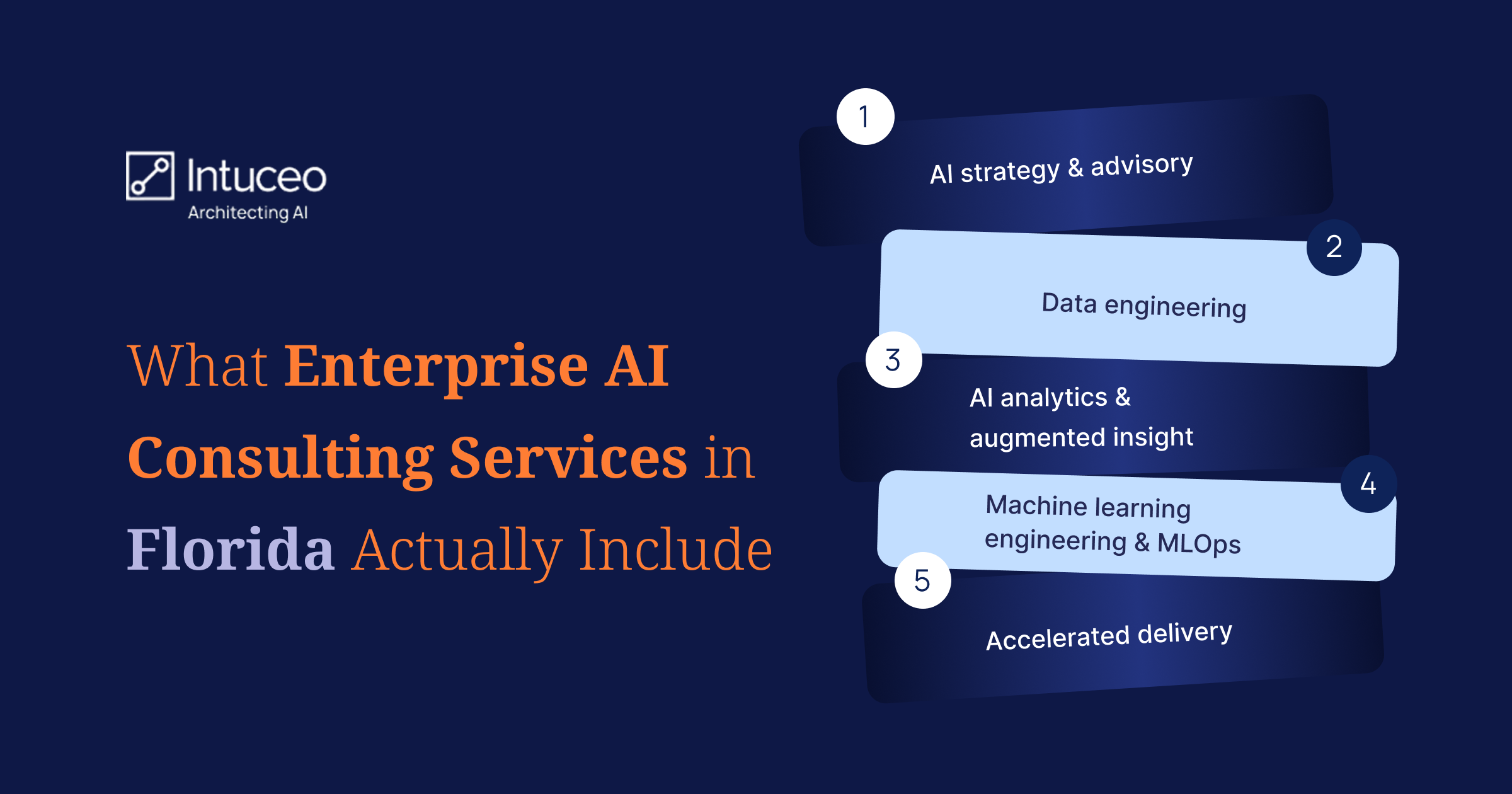
Enterprise AI consulting is a set of connected disciplines, not a single deliverable. A capable practice moves an organization from an unstructured question – “where could AI help us?” – to a running system that the business relies on. The work falls into five areas, and a serious provider of AI consulting services in Florida operates across all of them rather than selling one slice.
AI strategy and advisory
This is the discovery layer. It aligns business objectives with technical feasibility, ranks candidate use cases by value and effort, and produces a roadmap the leadership team can fund. Done well, it kills weak ideas early and protects the budget for the two or three initiatives that will actually reach production.
Data engineering
Most AI programs stall on data, not algorithms. A data engineering consultant in Florida builds the pipelines, warehouses, and governance that make analytics and machine learning possible in the first place. This includes ingestion from legacy systems, cleaning and standardizing records, and modernizing the enterprise core so that models have reliable inputs. For organizations running SAP, Oracle ERP, or PeopleSoft, this often means bridging older systems to modern data layers before any model is trained.
AI analytics and augmented insight
Strong AI analytics services in Florida turn raw operational data into decisions. This covers descriptive dashboards, predictive models that forecast demand or risk, and augmented business intelligence that surfaces patterns a human analyst would miss. The point is not the chart. The point is that a manager can act on it with confidence, because the underlying method is sound and explainable.
Machine learning engineering and MLOps
Building a model is the easy part. Keeping it accurate, monitored, and compliant in production is where most projects fail. This discipline covers model development, deployment across cloud or on-premises environments, and the monitoring that catches drift before it reaches a customer or an auditor. It is the difference between a pilot that impresses in a demo and a system that survives its second year.
Accelerated delivery
The best firms do not rebuild everything by hand. They apply accelerators, which are reusable frameworks and methods refined across earlier engagements, to compress timelines. An accelerator is not a shortcut around rigor. It is prior experience, packaged so the same problem is not solved twice.
How to Choose an AI Consulting Company in Florida: Key Selection Criteria
Once a shortlist exists, the evaluation becomes a question of fit and evidence. A polished website tells you little. The signals below separate a dependable AI consulting company in Florida, the kind you can build a multi-year relationship with, from a vendor that will disappear after the pilot.
By leveraging reusable frameworks, firms can significantly compress project timelines compared to building from scratch.
| What to check |
Why it matters |
| Domain depth in your sector |
An AI team that already understands healthcare data, regulated life sciences, or public-sector procurement moves faster and avoids costly rework. Ask for engagements in your specific industry, not adjacent ones. |
| Delivery beyond the pilot |
Many programs stall after a promising proof of concept. Confirm the partner has moved systems into full production and supported them afterward, not just delivered a prototype. |
| Reusable accelerators |
Firms that carry frameworks and prior solutions into a project compress timelines and reduce cost. Starting from zero every time is slower and more expensive. |
| Data governance discipline |
Under Florida law, how a partner handles personal and sensitive data is a liability question, not a technical detail. Governance maturity is now a selection criterion. |
| Contract vehicles |
For public-sector or federal work, GSA and State of Florida vehicles determine whether an agency can even buy from the firm. This is covered in detail below. |
| Flexible engagement models |
The ability to scale a team up or down, or to commit to a fixed-outcome deliverable, gives you control over risk and budget as scope changes. |
Weigh total cost, not the day rate
The headline rate rarely predicts the total cost of an AI program. A cheaper team that starts every component from scratch, misreads the data early, and cannot support the system post-launch will usually cost more across the life of the work than a partner with accelerators and a track record. Ask how a firm blends onshore and offshore capacity, and how it prices a fixed-outcome deliverable versus an open-ended engagement. Transparent trade-offs are the sign of a mature firm you can plan a budget around.
Test the accelerators, do not just accept them
Accelerators are only an advantage if they are real and explainable. A reusable framework should come with a clear account of what it automates, where a human still makes the call, and how it was validated on prior work. Be wary of any method presented as a closed box that cannot be inspected, because that is precisely the kind of opacity Florida’s proposed AI rules are written to discourage. A good partner will walk you through the mechanics without hesitation.
A useful test is to ask the vendor about its staffing approach and how it priced the last three engagements. Firms that offer flexible arrangements, such as team augmentation, fixed-outcome projects, and managed service agreements, tend to be honest about trade-offs because they have structured for them. The right provider of AI consulting services in Florida treats every engagement as a long-term relationship built on delivered outcomes, not a single transaction.
Why Enterprise AI Programs Stall - and How a Florida AI Partner Prevents It
Most enterprise AI failures are not caused by the model. They are caused by predictable organizational gaps, and a partner that has seen them before is worth more than one selling the newest technique. Three patterns account for the majority of stalled programs.
The first is the pilot trap. A proof of concept impresses in a demo, then fails when it meets real data volumes, integration constraints, or user behavior at scale. The fix is straightforward: plan for production from week one. That means settling the data pipeline, monitoring setup, and system ownership before a model is trained – not after the pilot report is delivered.
The second is the data gap. Teams underestimate how much cleaning, standardizing, and governance the underlying data needs, so the project runs out of budget before it reaches value. This is where seasoned data engineering, brought in early, earns its fee by fixing the foundation instead of building on sand.
The third is the compliance surprise. A system is built for accuracy alone, then has to be rearchitected when a regulator expects human oversight of decisions that affect a person’s care, coverage, or livelihood. Designing that oversight from the start is far cheaper than retrofitting it. A Florida partner that treats the state’s rules as a design input, rather than a late obstacle, removes all three risks at once.
Florida AI Regulatory Compliance: Data Privacy, Oversight, and Contract Requirements
Florida has enacted specific rules governing data privacy and AI. Organizations procuring AI consulting services in Florida must understand three compliance layers: the Florida Digital Bill of Rights (Senate Bill 262), the proposed AI Bill of Rights (Senate Bill 482), and sector-specific healthcare and insurance restrictions.
Data privacy: the Florida Digital Bill of Rights
The Florida Digital Bill of Rights, enacted as Senate Bill 262, took effect on July 1, 2024, and gives Florida residents rights over how their personal data is collected and used. Enforcement sits with the Florida Attorney General, with civil penalties reaching up to 50,000 dollars per violation, and higher in defined circumstances. Separately, the Florida Information Protection Act already requires any commercial entity holding electronic data on Floridians to take reasonable measures to secure it and to follow breach-notification rules. An AI partner that ignores these obligations is transferring risk directly onto your organization.
Artificial intelligence: the proposed AI Bill of Rights
In December 2025, Governor Ron DeSantis proposed a Citizen Bill of Rights for Artificial Intelligence, filed as Senate Bill 482 for the 2026 legislative session. The proposal would require transparency when AI is used, restrict certain foreign-developed AI tools, limit the unconsented use of personal data, and set boundaries for AI in healthcare, insurance, and mental health services. Buyers should treat these directions as the near-term baseline even before final passage, because they signal where enforcement is heading.
Healthcare and insurance limits
The healthcare provisions are strict and specific. Under the proposal, AI could not serve as the sole basis for adjusting or denying an insurance claim, which reinforces a requirement for documented human review, and behavioral health AI tools would be barred from delivering licensed therapy or simulating a licensed professional. For Florida healthcare and life-sciences organizations, this means an AI partner has to design human oversight into a system from the start, not bolt it on after an audit. This is one reason buyers searching for the best data engineering company in Florida for healthcare should weigh regulatory fluency as heavily as technical skill.
The practical takeaway
Florida’s direction of travel favors partners that keep data inside controlled environments, document human oversight, and can attest to their ownership and provenance. A Florida-based partner with local operations and mature governance policies is easier to defend to a regulator than an opaque or offshore-only vendor.
What to require in the contract
Regulatory intent only protects an organization if it appears in the agreement. When contracting for AI Consulting Services in Florida, buyers should insist on a few specifics: written data-handling terms that state where personal data is stored and processed, documented human review for any decision that affects a person’s care, coverage, or employment, breach-notification commitments consistent with the Florida Information Protection Act, and a right to audit the models and data flows the partner builds. These clauses cost nothing to add and save a great deal if a regulator ever asks.
Florida Government AI Contracts: GSA Schedules and State Contract Vehicles
Public-sector AI work runs on a different track from commercial work, and the gate is procurement. Two questions dominate: are there AI vendors with GSA Schedule contracts based in Florida, and which companies hold State of Florida contract vehicles. Both determine whether an agency can buy at all.
A GSA Schedule, formally the Multiple Award Schedule, is a pre-negotiated federal contract that lets United States government agencies purchase vetted services without running a full procurement from scratch. It signals that a firm’s rates, terms, and past performance have already cleared federal review. State of Florida contract vehicles serve the same function at the state and local level, giving Florida agencies a faster, compliant path to engage an approved provider.
This matters more now because of a new contracting rule. Beginning July 1, 2026, Florida government entities would be barred from entering any contract with an AI provider unless the company signs an affidavit affirming it is not owned by a foreign country of concern. Public-sector buyers should confirm that a provider can execute that affidavit before award rather than after. A firm that is United States-domiciled, holds active government vehicles, and can sign it clears a bar that others will not, which narrows the field considerably. Intuceo, for instance, delivers data and AI engineering for federal and state agencies and academic institutions through its GSA and State of Florida contract vehicles, which places it inside this qualified group.
Where Florida AI Consulting Work Concentrates: Healthcare, Public Sector, and Manufacturing
Enterprise AI in Florida clusters around the sectors that define the state’s economy. The strongest providers of AI analytics services in Florida tend to specialize rather than spread thin.
Healthcare and life sciences
Florida’s large healthcare and payer market is both a major opportunity and the most regulated environment for AI in the state. Work here centers on clinical and operational analytics, patient data visualization, and models that keep a human in the loop by design. Intuceo has worked with the University of Florida Institute for Child Health Policy for more than two years on portals for visualizing healthcare data – an example of the sector-specific delivery healthcare organizations should expect from a qualified Florida AI consulting partner.
Public sector and defense
Florida hosts a defense sector generating more than 100 billion dollars in annual economic activity and 20 military installations, according to the Florida Council on Artificial Intelligence. That scale drives demand for secure, contract-vehicle-eligible AI and data work, where provenance and compliance are non-negotiable.
Engineering, manufacturing, and supply chain
Optimization is the theme here : design optimization, predictive maintenance, and analytics that tighten logistics and transportation networks. These are areas where accelerators pay off quickly, because the underlying problems repeat across clients and a firm can carry proven methods from one engagement to the next.
Where Intuceo fits
Intuceo is an AI and analytics services firm headquartered in Jacksonville, Florida, operating under the iCube Consulting Services brand. It has delivered data and AI work for two decades, and reports more than 250 AI and data solutions delivered to Fortune 1000 enterprises, government bodies, and mid-market organizations across healthcare, life sciences, manufacturing, engineering, and the public sector. Its recognition includes multiple appearances on the Inc. 5000 list of fast-growing United States companies.
Three attributes line up with what the sections above describe as the markers of a dependable partner. First, its delivery is built on accelerators such as the iPDLC framework and AutoML methods, which the firm reports can cut delivery timelines by as much as 40 percent compared with building from scratch. Second, its engagement options, spanning team augmentation, fixed-outcome projects, and managed service agreements, give buyers control over cost and risk. Third, it is United States-headquartered and already cleared to sell to federal and state agencies, which matters directly under Florida’s tightening procurement rules.
For an organization evaluating AI Consulting Services in Florida, that combination of local presence, sector depth, reusable delivery methods, and government eligibility is exactly the profile the state’s market and regulations now reward. You can review the firm’s work and reach its solutions architects through the Intuceo website.