Tuesday Aug 11th, 11 AM EST: Live AI Dream Session: Blueprint your enterprise AI strategy with the DARWIN Framework. Reserve your Spot Claim Free Seat

Reserve your Spot

How Clinical Data Integration Enables Real-Time Analytics

Hospitals move more patient data today than at any point in their history, and clinicians still open a chart to find a partial story. Lab results sit in one system, imaging notes in another, a referral summary somewhere else, and the discharge note as free text that no dashboard reads. The transmission problem is largely solved. What remains is making the information usable the moment it matters. Clinical data integration reconciles records scattered across systems and formats into one trustworthy view that analytics can act on while care is still in progress, which is what separates data that merely arrives from data that informs a decision.

Key Takeaways

Integration, exchange, and reconciliation are not the same thing

Three terms often get used interchangeably, and the difference between them explains why so much connected data still goes unused. Health information exchange moves a copy of a record from one system to another. Reconciliation matches records that describe the same patient and resolves the conflicts between them, a duplicate medication here, a mismatched date of birth there.
Healthcare data integration goes further than both: it combines validated records from across sources into a single queryable view that downstream analytics and clinicians can rely on.
The distinction matters because exchange on its own has plateaued in value. As of 2023, roughly 70% of U.S. non-federal acute care hospitals engaged in all four domains of interoperable exchange, finding, sending, receiving, and integrating information, at least sometimes, yet only 43% did so routinely, up from 28% in 2018.[1] Most hospitals can send a record. Far fewer fold incoming information into the chart in a way clinicians actually use at the point of care. EHR data integration closes that gap by treating the electronic health record (EHR) not as a destination where documents pile up, but as a structured source that other records resolve into.

From scattered records to a unified clinical intelligence layer

The output of mature integration is a single trustworthy version of each patient, often called the Gold Record: one reconciled profile that pulls together demographics, encounters, medications, results, and the reasoning buried in notes. Built well, these records form a clinical intelligence layer that sits above source systems and returns a consistent answer no matter which application asks the question. Healthcare teams sometimes describe this as the Gold Record concept, the idea that one definitive record should win when sources disagree.
Reaching that point means confronting the parts of the record that resist structure. A 2025 study of 1.8 million primary care patients found that only 13% of clinical concepts captured in free-text notes had an equivalent in the structured record.[2] The detail clinicians write in narrative, symptom progression, social context, the rationale behind a decision, rarely lands in a coded field, so any view that ignores it is incomplete. Turning that narrative into real-time patient insights requires natural language processing (NLP) that reads notes as they are written and resolves what it finds against the structured record.

What makes analytics real-time: streaming, standards, and data quality

Batch pipelines that refresh overnight cannot support decisions made in minutes. Real-time clinical analytics depends on event streaming, where each new lab value, vital sign, or order becomes a message processed the instant it is created. Streaming technologies such as Apache Kafka and Apache Flink carry these events continuously, letting models reassess risk as a patient’s condition shifts rather than hours after the fact.
Standards keep that stream interpretable. HL7 FHIR integration, built on the Health Level Seven (HL7) Fast Healthcare Interoperability Resources (FHIR) standard, gives systems a common way to represent a medication, an observation, or an encounter, so a value arriving from one source means the same thing everywhere it travels. Application programming interfaces (APIs) defined by FHIR let an application subscribe to specific events instead of repeatedly polling entire databases.

Data quality has to run in motion

None of this holds together without data quality handled as the data moves. Validation rejects malformed or out-of-range values before they reach a model. Deduplication keeps the same lab result, arriving twice from two feeds, from being counted as two separate events. Enrichment attaches the context a raw value lacks: a reference range, a unit, a link to the ordering encounter. In a streaming setting these steps run continuously rather than as a nightly cleanup, because a decision made on an unvalidated value is a decision made on noise.

What real-time integration makes possible

Once records resolve into a reliable, current view, the analytics built on top change in kind, not just in speed. Predictive clinical analytics can flag deterioration before it becomes a crisis. At UC San Diego Health, an artificial intelligence (AI) sepsis surveillance model wired into the EHR and reading real-time signals was associated with a 17% reduction in mortality.[3] The model helped because the data feeding it was integrated and current, not because the algorithm itself was exotic.
The same foundation supports care gap closure analytics, which compares each patient against evidence-based guidelines and surfaces missed screenings or overdue follow-ups while the patient is still reachable. Aggregated across a panel, that becomes population health analytics, showing which cohorts are drifting from target and where an intervention will matter most.
Integration reaches beyond direct care as well. Clinical trial data integration connects site records, laboratory feeds, and electronic data capture so that safety signals and enrollment patterns surface during a study rather than at database lock. The common thread across all of these is timing: integrated data lets organizations act inside the window where action still changes the outcome.

Real-time does not mean ungoverned

Speed raises the stakes on privacy rather than relaxing them. HIPAA-compliant analytics, governed by the Health Insurance Portability and Accountability Act (HIPAA), requires that every record flowing through a real-time pipeline carries the same access controls, audit trails, and de-identification rules it would in a static store. Streaming makes this harder because data is in constant motion, so governance has to be designed into the pipeline from the start. Role-based access, encryption in transit and at rest, and lineage that traces every value back to its source are what let a fast system also be a defensible one.

How Intuceo approaches clinical data integration

Building this kind of integration is rarely a tooling decision; it is a data engineering effort shaped by each provider’s systems, data, and compliance obligations. Intuceo takes that work on as a services engagement, with teams that have integrated regulated healthcare and life sciences data across more than a decade of projects and bring reusable accelerators into each one instead of starting from a blank slate.
For programs moving toward agentic workflows, AgentCare AI applies these methods to healthcare-specific tasks, and delivery follows iPDLC™, Intuceo’s lifecycle framework for building and validating data and AI systems where validation is not optional.
Because these accelerators were shaped on prior regulated work, including engagements with organizations such as Florida Blue, GuideWell, and UF Health, they arrive already aware of the controls that HIPAA, HITRUST, and 21 CFR Part 11 demand. The result is a clinical data integration program configured to a provider’s reality, with governance treated as a starting condition instead of a later correction.

Planning a move to real-time clinical analytics?

Intuceo’s teams can assess where a provider’s records fragment today and map the integration work that real-time analytics actually requires, scoped to existing systems and compliance obligations.

Frequently Asked Questions

Start by reconciling identity so records describing the same patient resolve to one profile, then validate and standardize incoming data against a shared model such as FHIR. Narrative notes are processed with natural language processing so the detail they hold is not lost. The reconciled output becomes a Gold Record that analytics query instead of reaching into each source system separately.
Reconciliation matches records of the same patient and resolves conflicts between them. Integration is the broader work of combining those reconciled records from many sources into a single queryable view that downstream analytics and clinicians can depend on. Reconciliation is a step inside integration, not a substitute for it.
The common blockers are inconsistent patient identity across systems, clinical detail trapped in free text, data quality issues that only surface in motion, and batch pipelines that cannot keep pace with live care. Each has to be addressed in the integration layer before real-time analytics can be trusted.
Validation, deduplication, and enrichment run continuously as events stream through the pipeline rather than during a nightly batch. Malformed values are rejected, duplicate readings from multiple feeds are collapsed, and raw values are given the units, ranges, and encounter context that make them interpretable, all before a model scores them.
It does not have to be. Smaller organizations rarely need to rebuild everything at once. A focused engagement can target the highest-value data flows first, reuse proven integration accelerators rather than building from scratch, and expand once the approach proves out, which keeps the initial investment proportional to the result.
Context-Aware Search for Clinical and Regulatory Documents

Key Takeaways

The Cost of Knowledge That No One Can Find

Whether it is a regulatory affairs lead preparing a submission, a medical writer reconciling a protocol against earlier study reports, or a safety scientist tracing a signal across patient narratives, each needs a specific answer, not a stack of documents to open and read. The McKinsey Global Institute estimated that interaction workers spend close to 20% of their workweek simply looking for internal information.[1] In clinical research, this internal corpus is massive and continuously growing.
In 2024, ClinicalTrials.gov crossed the milestone of 500,000 registered studies.[2] Yet, for an individual sponsor, each of those entries represents an expansive web of internal protocols, amendments, clinical study reports (CSRs), safety narratives, and relevant FDA guidance documents. What a clinical or regulatory team must actually search through is far larger than any public registry count suggests and almost none of it is arranged for a traditional keyword query to answer.
Conventional search indexes words, meaning it only retrieves a file when the exact query string appears in the text. That model breaks down in clinical environments for three fundamental reasons:
This is how pharma document search context gets lost, and why teams keep falling back on tribal knowledge relying on whoever happens to remember where things are.

What Context-Aware Search Actually Does

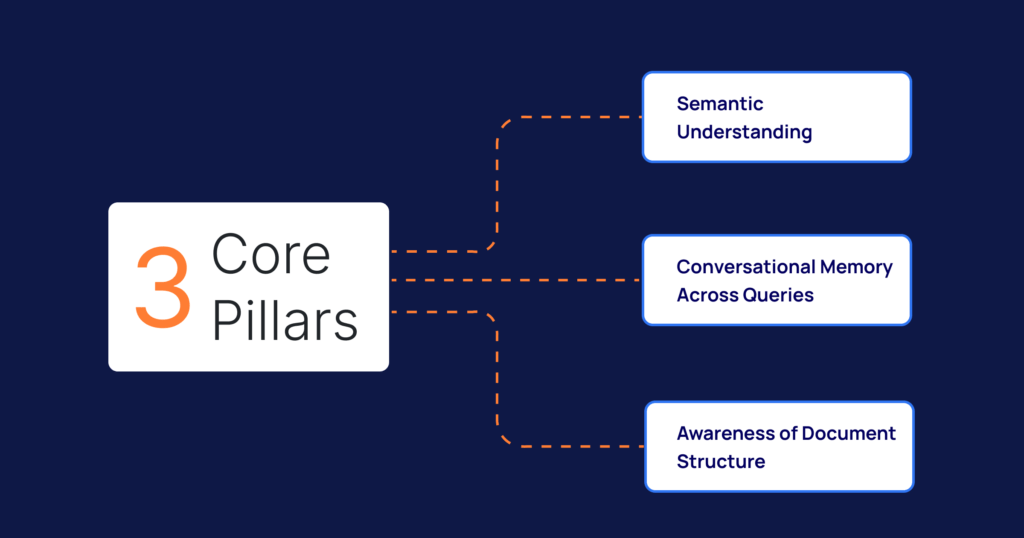
The capability that enterprise buyers now look for under the banner of clinical trial intelligence rests on three core pillars that keyword indexing lacks.

Semantic Understanding

Rather than matching literal characters, semantic retrieval represents text as mathematical vectors that capture conceptual meaning. Consequently, a query about “injection-site reactions” surfaces a narrative describing “redness and swelling at the administration site,” even when that exact phrase never appears. For regulatory document search AI, this closes the gap between how a question is asked and how the source data was written. It is the very foundation that makes context-aware search for clinical documents possible.

Conversational Memory Across Queries

Clinical questions rarely arrive in isolation. A reviewer might ask about an inclusion criterion, then how it changed across amendments, and finally, query the rationale behind that change. Conversational search for regulatory filings keeps that thread intact, allowing each follow-up to refine the last instead of starting over. Carrying conversational context across multiple research queries is what separates a usable AI assistant from a single-shot search box.

Awareness of Document Structure

A protocol, a CSR, a safety report, and an FDA guidance document are all organized fundamentally differently. A system that understands those structures can intelligently route a question about endpoints to the right section and distinguish a regulatory requirement from a study-specific choice. That structural awareness underpins reliable clinical trial protocol analysis AI and accurate clinical document extraction.

Grounding Answers with Retrieval-Augmented Generation

A large language model (LLM) on its own can produce fluent text that is anchored to nothing. Retrieval-augmented generation (RAG) changes that. The system retrieves relevant passages first, then asks the model to answer the query using only that retrieved evidence, complete with citations back to the original text. For RAG in clinical question answering, this traceability is the entire point. An answer that links to a specific paragraph in a protocol or guidance document can be easily checked; an unsourced answer cannot.
Crucially, grounding reduces error without removing it entirely. A 2025 framework evaluated LLM clinical summaries against more than 12,000 clinician-annotated sentences and measured a 1.47% hallucination rate alongside a 3.45% omission rate.[3] While the figures may seem small, in regulated industries, a single fabricated or missing fact carries severe consequences. Therefore, clinical data retrieval-augmented generation belongs inside a workflow that verifies model output against authoritative sources and keeps a qualified reviewer in the loop, rather than one that treats the AI’s answer as final.

Why FDA-Regulated Work Needs Governed Deployment

Public chatbots are entirely unsuitable for confidential trial data and regulatory submissions. Two common questions enterprise teams ask – how to run a general assistant locally for FDA-regulated studies and whether an assistant can search regulatory submission documents safely – point to the same requirement. The data must remain in a controlled environment, model behavior must be auditable, and no data should ever be used to train an outside model.
Effective regulatory submission document management under these constraints means deployment that satisfies 21 CFR Part 11 (Electronic Records; Electronic Signatures), good practice quality regulations (GxP), and the Health Insurance Portability and Accountability Act (HIPAA), complete with strict access controls and a comprehensive audit trail. A regulatory affairs document search tool that cannot produce that trail does not belong near a submission.
Verification follows the same logic. An FDA guidance document search is most useful when the system can hold current federal guidelines alongside a sponsor’s own documents and show exactly where the two agree or diverge, allowing a reviewer to confidently confirm an answer.

Public Registries and Internal Documents are Different Problems

Teams often ask which tools best search a clinical trial registry and PubMed together to find matching studies. Public sources, such as ClinicalTrials.gov and published literature, are open, broadly structured, and shared across the industry, so retrieval there is mostly a question of coverage and precision. Internal protocols, submissions, and safety files are the exact opposite: they are confidential, inconsistently formatted, and specific to one sponsor. A question answered from public regulatory databases and the same question answered from internal clinical documents can return very different results, and a reviewer usually needs both.
The practical aim is to connect the two, enabling an AI assistant to place a sponsor’s own evidence next to the public record and the relevant guidance, instead of forcing a researcher to query three disparate systems and stitch the results together by hand. That connection also speeds everyday work, such as matching a new study against prior trial designs or screening the literature for precedent ahead of a submission, because the search reasons across sources rather than treating each as a separate silo.

From Protocols to Safety Signals

One unified foundation supports several tasks that regulatory and clinical teams run every day. Reviewers compare a draft protocol against precedent and guidance. Medical writers reconcile language across study documents. Safety teams apply adverse event detection AI to surface candidate signals from narratives and reports for expert adjudication – not to replace it.
None of this removes the expert. Instead, it removes the hours spent locating the evidence the expert needs, shifting the focus to finding and connecting evidence quickly, and leaving critical clinical judgment to humans.

How Intuceo Approaches Clinical and Regulatory Search

Intuceo is a services firm that designs and delivers these capabilities as a tailored engagement, not as off-the-shelf software. Its teams bring proven proprietary accelerators built and hardened on earlier regulated programs, which significantly shortens the path from raw documents to a working, governed search experience.
Delivery runs through iPDLC™, Intuceo’s project methodology, inside environments fully aligned to 21 CFR Part 11, HIPAA, HITRUST, and SOC 2 Type II standards. This is the same rigorous approach the firm has applied in collaborations with reputed organizations.

Search with context. Submit with confidence.

Unified search across protocols, CSRs, and FDA guidance – fully deployed within your GxP and 21 CFR Part 11 boundaries.

Frequently Asked Questions

They can extract a great deal when paired with robust retrieval and verification mechanisms, but accuracy varies by model and document type. Residual hallucination and omission rates mean expert human review remains essential for regulated use.
The best approach is to deploy a system with conversational memory that carries entities and prior answers forward, ensuring each follow-up question refines the thread rather than restarting the search.
Ground answers in retrieval require strict citations to the source passage, and keep current guidance indexed alongside internal documents so a reviewer can confirm each claim against the original text.
Yes. Retrieval-augmented generation is best suited for this work because it ties each answer directly to the source text, which is precisely what regulated review requires.
By deploying it within a controlled, on-premises or private cloud environment with strict access controls and audit logging, while verifying that no data is used to train external models.

Why Enterprise Search Tools Miss Context in Clinical and Regulatory Documents

Enterprise search in the life sciences promises to unlock critical clinical and regulatory knowledge. The reality is a high-stakes bottleneck. A typical platform might return hundreds of results for a single pharmacovigilance query, only to bury a critical safety signal on page twelve because it cannot distinguish “cardiac toxicity” (a clinical finding) from “cardiac monitor” (a medical device).
The search technically works. The retrieval is functionally useless.
This isn’t just a failure of relevance ranking; it’s an architectural limitation. Clinical trial protocols, regulatory submissions, and safety filings carry a density of synonyms, abbreviations, and context-dependent terminology that standard keyword searches were never built to interpret. When missing a single document means a delayed IND submission or an unreported adverse event, the gap between “searching” and “finding” transitions from a minor IT nuisance into a severe compliance and operational liability.

Why Do Enterprise Search Tools Fail on Clinical Trial Documents?

The root cause is a fundamental mismatch between how these tools work and how clinical knowledge is structured. Traditional enterprise search platforms rely on keyword matching and Boolean logic. They index words, not meaning. When a researcher queries “treatment-emergent adverse events,” the system matches those exact tokens. It does not understand that “TEAEs,” “treatment-related AEs,” or “drug-induced side effects” refer to the same concept.
Clinical and regulatory documents compound this problem in several ways. First, medical terminology is dense with synonyms, abbreviations, and acronymic variations. A single condition like myocardial infarction might appear as “MI,” “heart attack,” “acute coronary syndrome,” or “STEMI” across different documents in the same repository. According to the National Library of Medicine, the UMLS Metathesaurus alone maps over 4.4 million concept names across more than 200 source vocabularies. No keyword index can account for this breadth of terminology without a contextual layer.
Second, regulatory submissions follow rigid structural conventions (ICH CTD format, eCTD modules) where identical terms carry different meanings depending on the section. “Safety” in Module 2.7 (Clinical Summary) refers to patient-level adverse event data. “Safety” in Module 3.2 (Quality) refers to product stability testing. A keyword search treats both identically.

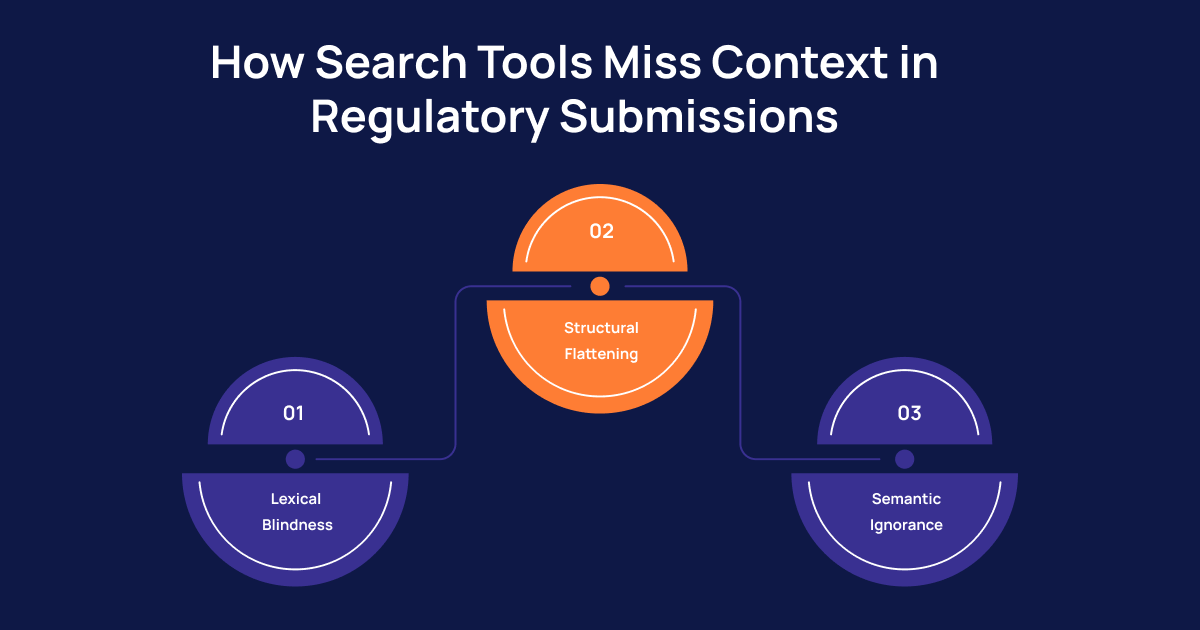
How Search Tools Miss Context in Regulatory Submissions

Context loss in standard regulatory document search occurs at three distinct levels:

Why Is Metadata Not Enough for Document Retrieval in Regulated Industries?

A common response to search failures is to invest in better metadata tagging. While metadata improves filtering (by document type, study phase, therapeutic area), it cannot solve the core document retrieval problem for two reasons.
First, the volume and velocity of unstructured data in pharma R&D make comprehensive manual tagging impractical. Today, an estimated 80% to 90% of all enterprise data is unstructured. For a mid-size pharma company managing thousands of clinical study reports, investigator brochures, and post-market surveillance filings, maintaining accurate metadata at scale is a resource drain that never reaches completeness.
Second, metadata captures attributes (author, date, document type) but not meaning. A metadata tag can label a document as “Phase III Clinical Study Report.” It cannot tell you whether that report contains a specific subgroup analysis for patients over 65 with renal impairment. The actual intelligence lives in the unstructured narrative, tables, and appendices within the document.

The Shift from Keyword Search to Semantic Search in Healthcare Documents

Semantic search for pharma represents a foundational shift in how clinical document search operates. Instead of matching tokens, semantic engines use vector embeddings to represent the meaning of queries and document passages in a shared mathematical space. A query for “cardiac safety signals in elderly patients” retrieves passages about “cardiovascular adverse events in geriatric populations” because the underlying meaning vectors are proximate, even though no keywords overlap.
This approach directly addresses the synonym, abbreviation, and contextual challenges that break keyword search. When combined with domain-specific training on medical ontologies (MedDRA, SNOMED CT, WHO-ART), semantic retrieval healthcare systems achieve significantly higher precision and recall on clinical corpora than general-purpose search tools.
RAG for life sciences (Retrieval-Augmented Generation) takes this further. A RAG architecture pairs semantic retrieval with a generative model that can synthesize answers grounded in the retrieved source documents. Instead of returning a list of 2,000 links, the system returns a direct answer: “Cardiac toxicity signals were observed in Study XYZ-301 (Module 5.3.5.3), primarily in patients aged 65+ with pre-existing QTc prolongation. See Table 14.3.1 for incidence rates.” The answer includes traceable citations back to the source, which is critical for GxP compliance and audit readiness.

How Intuceo Solves Contextual Search for Clinical and Regulatory Content

Intuceo’s approach to AI search in healthcare is built on a simple reality: generic enterprise search was never designed for the complexity of regulated content. Through two proprietary, modular engines, Intuceo delivers contextual search for regulated content at scale.

Intuceo-Ix™: Neural Search Intelligence (The Discovery Layer)

Intuceo-Ix™ goes beyond keyword matching to provide Neural Semantic Discovery. It understands the true context of clinical papers, regulatory submissions, FDA filings, and patent documents—reducing information retrieval time by 70%.

Intuceo-Dx™: Document and Vision Intelligence (The Ingestion Layer)

Intuceo-Dx™ addresses the critical upstream problem: converting complex, unstructured clinical documentation into structured, searchable “Gold Records.”

Built for Regulated Environments

Both Ix and Dx are deployable in air-gapped, on-premise, or private cloud environments (IL5/FedRAMP-ready). No proprietary data is used to train public models. This sovereign architecture, combined with compliance alignment for HIPAA, GxP, and 21 CFR Part 11, makes Intuceo’s document intelligence for pharma suitable for the most security-sensitive life sciences organizations.

Conclusion

The gap between what enterprise search tools deliver and what life sciences organizations actually need is not a minor inconvenience. It is a structural problem that affects research velocity, regulatory compliance timelines, and the quality of safety decisions. Keyword matching was built for general corporate content, not for the terminological density, structural complexity, and compliance rigor of clinical trial document retrieval and regulatory document search.
Closing this gap requires a shift to semantic search for life sciences, purpose-built for the domain, deployed in compliant environments, and architected to deliver traceable, contextual answers rather than keyword-matched links. For organizations ready to make that shift, the difference is not incremental. It is the difference between searching for information and actually finding it.

See How Intuceo Transforms Clinical Document Search

Discover how Intuceo-Ix™ and Intuceo-Dx™ reduce information retrieval time by 70% across millions of clinical and regulatory documents, all within HIPAA and GxP-compliant environments.

Frequently Asked Questions

Keyword search matches exact terms in a query against indexed tokens in a document. Semantic search for life sciences uses vector embeddings to match the meaning of a query to the meaning of document passages, enabling accurate retrieval even when the exact words differ. This is critical for medical terminology search, where synonyms, abbreviations, and acronyms are pervasive.
AI-powered semantic retrieval healthcare systems are trained on domain-specific ontologies such as MedDRA, SNOMED CT, and UMLS. This training allows the system to recognize that “MI,” “myocardial infarction,” and “heart attack” refer to the same clinical concept, enabling synonym matching in medical documents that keyword engines cannot achieve.
Most conventional systems do not handle them well. Abbreviations like “AE” (adverse event), “SAE” (serious adverse event), and “TEAE” (treatment-emergent adverse event) are either missed or conflated with unrelated acronyms. Neural search systems trained on life sciences corpora resolve these abbreviations contextually, based on the surrounding text and document type.
Three elements drive improvement: domain-specific model fine-tuning on clinical and regulatory corpora, integration with established medical ontologies for entity resolution, and a RAG for life sciences architecture that grounds every retrieved result in verifiable source documents. This combination ensures both precision and auditability.
Irrelevant results stem from three gaps: lexical ambiguity (the same word meaning different things in different contexts), structural flattening (loss of document hierarchy during indexing), and semantic blindness (inability to interpret negation, temporal qualifiers, and conditional statements). Addressing all three requires moving from token-based to meaning-based information retrieval.

Does Intuceo Offer On-Premise Advanced Analytics for FDA-Regulated Studies?

Pharmaceutical and life sciences organizations generate enormous volumes of sensitive data across clinical trials, pharmacovigilance programs, manufacturing lines, and post-market surveillance. The global pharmacovigilance market alone was valued at USD 9.35 billion in 2025 and is projected to reach USD 31.56 billion by 2034, growing at a CAGR of 14.69%. Yet much of this data is subject to strict regulatory controls, including FDA 21 CFR Part 11, GxP standards, and HIPAA requirements that determine not just how data is analyzed but where it physically resides.
For companies bound by these constraints, the question is not whether analytics can improve outcomes. It is whether the analytics platform can operate inside the organization’s own security perimeter without compromising on capability. That is the core question this post addresses: Does Intuceo support on-premise deployment for regulated life sciences data, and what does that look like in practice?

Why On-Premise Still Matters in FDA-Regulated Environments

Cloud adoption continues to accelerate across healthcare and pharma. Yet on-premise deployment held the largest share (55%) of the pharmaceutical analytics market by deployment mode in 2025. The reasons are practical, not philosophical. FDA-regulated analytics workflows frequently involve patient-level clinical data, adverse event records, and proprietary R&D datasets that organizations are either unwilling or legally unable to move outside their controlled perimeter.
Regulatory mandates like 21 CFR Part 11 require validated electronic record-keeping with immutable audit trails, controlled access, and documented data lineage. In clinical and pharmacovigilance settings, this extends to precise chain-of-custody documentation for every data transformation that feeds into an FDA submission. When the analytics platform resides on-premise or within a private cloud, the organization retains direct control over data residency, encryption, and access governance, factors that simplify audit readiness considerably.
Additionally, the FDA’s recent rollout of its new Adverse Event Monitoring System (AEMS), consolidating FAERS, VAERS, and other legacy databases into a single platform, signals increasing regulatory expectations around real-time reporting and submission accuracy. Organizations that can process, classify, and validate adverse event data internally, before it reaches the FDA, are better positioned to meet these heightened standards.

Intuceo's Approach: Deployment Sovereignty for Regulated Industries

Intuceo positions its architecture around a principle it calls “Deployment Sovereignty.” The concept is straightforward: your data constraints should drive your infrastructure choices, not vendor limitations. Intuceo’s life sciences AI solutions are engineered to deliver equivalent performance across Azure, AWS, GCP, on-premise, or hybrid environments. For defense and public sector clients, Intuceo also supports air-gapped deployments at IL5/FedRAMP levels, a capability that extends directly to life sciences organizations requiring maximum isolation.
This infrastructure flexibility means that a pharma company running a secure analytics platform behind its own firewall gets the same analytical depth as one operating in a managed cloud environment. Intuceo’s proprietary assets, including Intuceo-Ax (augmented analytics), Intuceo-Ix (neural enterprise search), and Intuceo-Dx (document intelligence), are all designed to be deployed within secure, private environments with zero data leakage to external models or public endpoints.

Handling FDA-Compliant Analytics Workflows

Regulatory compliance in life sciences is not a feature to be added after the fact. Intuceo engineers its data infrastructure with what it describes as a “Regulated-by-Design” architecture, meaning compliance is embedded at the platform level rather than layered on top.
In practical terms, this covers several critical areas for compliance data analytics:
Clinical data analytics and trial operations benefit from AI-driven protocol modeling, real-time site performance monitoring, and automated FDA reporting workflows. Intuceo’s patient matching capability uses generative AI to parse complex clinical trial protocols and identify eligible patient cohorts with precision, directly addressing one of the most resource-intensive stages of clinical development.
Pharmacovigilance analytics software capabilities include automated Adverse Event Report (AER) classification and Periodic Safety Master File (PSMF) optimization. Traditional AI models in this space provide binary predictions (adverse event: yes or no) but fail to supply the rationalization that regulators require. Intuceo addresses this with Explainable AI (XAI) frameworks that generate evidence-based rationale alongside each classification, achieving full regulatory fidelity while reclaiming significant expert hours that would otherwise be spent writing manual justifications for AE determinations.
Quality compliance analytics and manufacturing oversight are supported through automated CAPA (Corrective and Preventive Action) root-cause analysis and immutable, audit-ready documentation that satisfies HIPAA, GDPR, and GxP standards simultaneously.

Working with Legacy Systems and Fragmented Data

Most pharma and healthcare organizations operate with a mix of legacy databases, disconnected LIMS, PLM, and EHR systems, and fragmented regulatory filing repositories. Data quality problems at the source directly compromise the reliability of any downstream pharmaceutical data platform.
Intuceo’s data engineering practice addresses this directly. Its orchestration pipelines ingest structured, semi-structured, and unstructured data from legacy on-premise systems and cloud environments alike. Intuceo-Ix, the neural search engine, indexes millions of documents across SharePoint, LIMS, PLM, clinical trial databases, FDA filings, and patent repositories. The firm reports an 800% reduction in time spent on information discovery for R&D knowledge workers, alongside $6M in measured productivity savings for Fortune 500 pharma R&D departments.
This legacy data modernization approach layers intelligence on top of existing infrastructure rather than requiring wholesale migration, activating research data that was previously dormant or inaccessible.

Reducing Manual Effort in Adverse Event Detection and FDA Submissions

The FDA’s transition to the ICH E2B(R3) standard for electronic adverse event submissions, with a full compliance deadline of April 2026, is pushing pharmaceutical companies to fundamentally rethink their pharmacovigilance workflows. Manual case processing, once the industry default, cannot scale to meet real-time reporting expectations.
Intuceo’s adverse event detection AI directly addresses this shift. Its modeling capabilities go beyond surface-level classification to determine whether a complaint constitutes an adverse event, while simultaneously generating the rationalization layer that GxP standards demand. This combination of prediction accuracy and regulatory explainability separates Intuceo’s approach from generic AI tools that produce outputs but cannot justify them to an auditor.
The result is a measurable reduction in expert hours devoted to manual AE review and write-up, freeing pharmacovigilance professionals to focus on safety signal analysis and regulatory strategy.

The PhD-Led Difference in Regulated Environments

Operating in FDA-regulated spaces demands more than technical competence. It requires domain fluency, an understanding of why a specific validation protocol exists, what an auditor will scrutinize, and how a model’s output will be used in a regulatory submission.
Intuceo’s team of 80+ data scientists, led by PhD-level architects, brings specialized experience across life sciences, healthcare, and public sector regulatory environments. With over 100 enterprise-grade engagements completed, the firm has delivered clinical study analytics, manufacturing quality optimization, and knowledge engineering solutions for organizations including Johnson & Johnson, Bausch & Lomb, Janssen Pharma, and Ferring Pharma.
This scientific depth is operationalized through Intuceo’s proprietary iPDLC™ framework, which compresses implementation timelines by up to 4x while maintaining the validation rigor required for GxP-compliant environments.

Considering on-premise or hybrid analytics for your regulated data environment?

Intuceo’s PhD-led engineering teams architect FDA compliance analytics solutions that operate within your security perimeter, with full audit-readiness from Day 1.

Frequently Asked Questions

Intuceo is infrastructure-agnostic. Its solutions are engineered for cloud (Azure, AWS, GCP), on-premise, hybrid, and air-gapped deployments. All proprietary assets, Intuceo-Ax, Intuceo-Ix, and Intuceo-Dx, can operate entirely within a private, firewalled environment with no data exposure to external endpoints.
Yes. Intuceo’s architecture is natively aligned with FDA 21 CFR Part 11, GxP, and HIPAA standards. This includes validated electronic record-keeping, immutable audit trails, end-to-end data lineage, and role-based access controls, all built into the platform rather than added as an afterthought.
Intuceo covers the full life sciences value chain: R&D analytics for pharma, clinical data analytics, manufacturing quality (CAPA, OEE), pharmacovigilance analytics (automated AER classification), and post-market surveillance. Each capability is designed for the specific compliance and data integrity requirements of its domain.
Yes. Intuceo’s data engineering pipelines are built to integrate with legacy LIMS, PLM, EHR, and regulatory filing systems. Its Intuceo-Ix neural search engine can index 5M+ documents across disconnected repositories, enabling healthcare data integration and knowledge discovery without requiring a full-scale migration.
Intuceo implements a “Regulated-by-Design” architecture with automated data profiling, anomaly detection, and stewardship orchestration. Its governance frameworks are pre-vetted for FDA 21 CFR Part 11, HIPAA, FISMA, GxP, GDPR, and SOC 2 Type II. Continuous compliance monitoring and automated audit logging ensure persistent regulatory readiness.