Tuesday Aug 11th, 11 AM EST: Live AI Dream Session: Blueprint your enterprise AI strategy with the DARWIN Framework. Reserve your Spot Claim Free Seat

Reserve your Spot

Explainable AI and LLM Security: What Regulated Industries Must Get Right Before Scaling AI

Key Takeaways

Why Traditional AppSec Falls Short of LLM Security for Regulated Industries

Most enterprise security teams know how to protect web applications, APIs (Application Programming Interfaces), and databases. Firewalls, role-based access, input sanitization, vulnerability scanning: these are established practices. But when an organization deploys an LLM, it introduces a category of system that does not fit these existing controls.
A traditional application follows deterministic logic. Given the same input, it produces the same output. An LLM does not. Its behavior is probabilistic, shaped by training data, fine-tuning, retrieval context, and the specific phrasing of a prompt. That means the attack surface is different. Prompt injection, where a malicious instruction is embedded in user input or retrieved content to override the model’s intended behavior, is listed as LLM01 in the 2025 OWASP (Open Worldwide Application Security Project) Top 10 for LLM Applications.1 Other risks on that list, including data poisoning, sensitive information disclosure, and excessive agency, have no direct equivalent in conventional application security.

The implication for explainable AI enterprise programs is clear: security and explainability are not two separate workstreams that teams can handle in sequence. If the model’s inputs, reasoning, and outputs cannot be traced and explained, they also cannot be secured.

Understanding LLM-Specific Risk

What makes LLM risk distinct is that attacks target the model’s behavior, not just the infrastructure it runs on. In a traditional system, an attacker exploits a code vulnerability or a misconfigured server. In an LLM deployment, the model itself is the vulnerability surface.
Consider three categories of risk that traditional Application Security (AppSec) programs rarely address.
  • First, prompt injection: an attacker embeds instructions inside a document, email, or form field that the LLM retrieves and processes. The model follows the injected instruction because it cannot distinguish malicious context from legitimate context without external controls. 
  • Second, data poisoning: if an attacker introduces biased or misleading data into the training pipeline, fine-tuning dataset, or vector database used for Retrieval-Augmented Generation (RAG), the model’s outputs shift accordingly, often in ways that are difficult to detect without systematic monitoring. 
  • Third, excessive agency: when an LLM is connected to enterprise tools (databases, APIs, ticketing systems) and given permission to take actions, a manipulated prompt can trigger actions the organization never intended.
These risks do not respond to traditional patches or firewall rules, which is precisely why LLM security for regulated industries requires controls at the data layer, the prompt layer, and the output layer simultaneously. They require controls at the data layer, the prompt layer, and the output layer, with explainability woven into each.

What Is AI Sycophancy and Why Does It Create Risk in Regulated Environments?

AI sycophancy is the documented tendency of large language models to align their responses with a user’s stated beliefs, even when those beliefs are factually incorrect. It is not an adversarial attack – it emerges from how models are trained on human feedback. In regulated settings, it means a model may reinforce a clinician’s incorrect assumption, defer to an analyst’s flawed hypothesis, or validate a compliance officer’s mistaken interpretation, without any external manipulation required.
There is a less visible but equally consequential risk that falls outside the scope of any cybersecurity framework: sycophancy. Sycophancy describes the tendency of LLMs to align their responses with the user’s stated beliefs, even when those beliefs are factually incorrect.
A peer-reviewed study published at ICLR (International Conference on Learning Representations) in 2024 tested five production AI assistants, including models from Anthropic, OpenAI, and Meta, across multiple question-answering tasks. The researchers found that when a user merely suggested an incorrect answer, model accuracy dropped by up to 27 percentage points.2 The behavior was consistent across all five systems, indicating it is not a quirk of one model but a structural property of how current models are trained on human feedback.
In a consumer application, this is an annoyance. In a regulated environment, it is a material risk. If a clinician asks an AI assistant whether a drug interaction exists, and the model defers to the clinician’s framing rather than contradicting it, the result is not a poor user experience; it is a potential adverse event. If a defense analyst uses an LLM to summarize intelligence and the model reinforces the analyst’s existing hypothesis instead of surfacing contradicting evidence, the consequence is a flawed operational decision.
This is why explainable AI enterprise programs need to account for behavioral risks, not only adversarial ones. Explainability must extend to showing why the model agreed, not just what data it retrieved.
While LLMs are inherently susceptible to sycophancy, this risk is not insurmountable. Intuceo’s DARWIN planning framework mitigates this by integrating structured validation into the ‘Workflow’ dimension of every AI engagement. Rather than allowing models to interact in isolation, our framework enforces human-in-the-loop verification gates and multi-model cross-referencing. This ensures that when a model provides an answer, it is not merely echoing the user’s framing, but is grounded in verifiable data provenance – turning a reliability failure into a governed, defensible process.

Who Needs Explainable AI in a Regulated Organization? Four Stakeholders, Four Requirements

One of the most common mistakes in explainable AI for regulated industries is treating explainability as a single feature – a dashboard, a confidence score, or a citation list – rather than a stakeholder-differentiated program.
In practice, there are at least four stakeholders who need fundamentally different types of explanation.
  • The end user, a clinician, analyst, or claims adjuster, needs to understand what the model concluded and what evidence it relied on. This person does not need to know the model’s internal weights; they need a clear provenance trail from output back to source data. 
  • The developer needs to understand why the model produced a particular output, including which features or retrieval passages had the most influence, so they can debug failures and reduce drift. 
  • The sponsor, typically a VP, a program director, or a C-suite executive, needs to understand whether the AI program is delivering on its business case: accuracy rates, false-positive rates, cost-per-decision, and time-to-insight. 
  • The regulator, whether that is the FDA (Food and Drug Administration), a defense contracting officer, or an EU (European Union) data protection authority, needs to see audit trails, version histories, validation evidence, and documented governance processes.

Data XAI vs. Model XAI: What Is the Difference and Why Does It Matter for Compliance?

A practical approach to XAI enterprise compliance starts by separating two distinct layers of explainability: one that addresses the input side and one that addresses the output side. Data XAI (Explainable Artificial Intelligence) addresses the input side: where did the data come from, how was it cleaned, what biases were tested for, and what lineage trail connects each input to the final dataset? Model XAI addresses the output side: given this input, why did the model produce this particular prediction, recommendation, or summary?
Applying explainability ‘after the fact’ – treating it as a final reporting layer added after a model is already deployed – is a core architectural error. When organizations prioritize Model XAI (output analysis) while neglecting Data XAI (input validation), they are effectively creating a ‘black box’ system and then trying to interpret its outputs retroactively. For regulated industries, this approach is insufficient; compliance requires that the traceability, lineage, and validation logic be baked into the data pipeline before a single prediction is ever generated. Through our proprietary Intuceo-Ax™ engine and its DataSharp™ module, we automate data provenance, lineage, and bias-testing at the input layer. This ensures that the reasoning chain is not just ‘explainable’ but ‘evidence-backed,’ providing the forensic traceability that regulators, such as the FDA or those enforcing the EU AI Act, require to certify a system as validated.

LLM Security for Regulated Industries: Why Defense, Healthcare, and Life Sciences Cannot Compromise

In defense, AI-generated recommendations inform mission planning, logistics, and threat assessment. If those recommendations cannot be traced back to their source data and reasoning path, they cannot be trusted by commanders, audited by inspectors general, or defended in after-action reviews. Compliance frameworks including NIST (National Institute of Standards and Technology) 800-53 and FedRAMP (Federal Risk and Authorization Management Program) already mandate traceability, but LLM deployments create new categories of output that existing audit processes were not designed to cover.
In healthcare, LLM security operates alongside FDA interpretability requirements: manufacturers must demonstrate that outputs are reviewable by the clinician, and that the model cannot be manipulated into surfacing clinically incorrect conclusions.
An opaque model that produces a recommendation without a reviewable reasoning chain does not meet that expectation.
In life sciences, where AI is increasingly applied to pharmacovigilance, adverse event detection, and clinical trial matching, regulators operating under 21 CFR Part 11 require documented evidence that the system operates as validated. Explainability is not a feature; it is the evidence.
The EU AI Act’s transparency provisions, which take effect on August 2, 2026, reinforce this trajectory.Under Article 99 of the Act, non-compliance with these transparency obligations can result in administrative fines of up to EUR 15 million or 3% of global annual turnover, whichever is higher.

Checklist: Is Your AI Program Explainable and Secure Enough to Scale?

Use this checklist to assess whether your organization’s LLM deployment meets the baseline requirements for regulated industry deployment across security, explainability, and audit-readiness.

Where Intuceo Fits

Intuceo has spent two decades engineering AI and data analytics solutions for regulated environments, including pharma, healthcare, defense, and federal agencies. The team’s DARWIN planning framework structures every engagement around five dimensions: Data (bias and governance), Architecture (prototype-to-production planning), Responsibility (compliance and stakeholder alignment), Workflow (explainability and consumability), and Infrastructure (security and cost optimization).
Intuceo’s PhD-led Board of Science provides Explainability Frameworks (XAI), automated bias detection, and Model Cards, purpose-built for clinical-grade scrutiny. For organizations evaluating whether their AI programs meet the bar for regulated deployment, Intuceo’s AI Dream Session provides a structured assessment covering the full spectrum from data lineage and model validation through LLM-specific security controls and stakeholder-specific explainability design.

Is Your AI Program Ready for Regulated Deployment?

Intuceo’s AI Dream Session provides a structured assessment covering data governance, LLM security, and stakeholder explainability, built from two decades of regulated-industry experience.

Frequently Asked Questions

Explainable AI enterprise programs go beyond model-level interpretability. They include data lineage, stakeholder-specific explanation interfaces, audit trails, and documented governance processes that satisfy both internal oversight and external regulatory review.
Traditional application security focuses on code vulnerabilities, infrastructure misconfigurations, and network perimeter controls. LLM security must also address prompt injection, data poisoning, retrieval manipulation, excessive model agency, and behavioral risks like sycophancy, none of which respond to conventional patches or firewalls.
Sycophancy is the tendency of AI models to align with a user’s stated beliefs, even when those beliefs are incorrect. In regulated industries, this can lead to clinical errors, flawed intelligence assessments, or biased compliance decisions, making it a reliability risk, not just a usability issue.
End users need evidence trails; developers need feature-level debugging; sponsors need performance metrics against the business case; and regulators need audit documentation, version histories, and validation evidence. An explainable AI enterprise program must serve all four.
Data XAI covers the input side: data provenance, lineage, bias testing, and quality rules. Model XAI covers the output side: why the model produced a particular prediction or recommendation. Regulated workloads require both layers working together.

RAG vs Fine-Tuning: How Enterprise Teams Should Actually Decide

Enterprise teams tend to treat the choice between retrieval and retraining as a purely technical question, then spend weeks debating it before a single use case. In practice, the market has already settled into a clear pattern. Across 600 enterprise technology decision-makers surveyed by Menlo Ventures, Retrieval-Augmented Generation (RAG) reached 51 percent of production deployments, while fine-tuning accounted for just 9 percent.1
That gap reflects what each method is built to do, what it costs to run, and how much control an organization keeps over its own data.
The RAG vs fine-tuning question is less about which is smarter and more about matching the method to the problem in front of you. This guide breaks down where each approach earns its place, why one of them is quietly ruled out for most closed models, and how to make the call without stalling delivery.

What is the difference between fine-tuning and RAG?

Both methods start from the same place: a pretrained Large Language Model (LLM) that is fluent in language but knows nothing specific about your business. They diverge in how they add that missing knowledge.
RAG leaves the model untouched. When a user asks a question, a retrieval system searches a connected knowledge base, usually a vector index built from your documents, pulls the most relevant passages, and places them into the model’s prompt as context. The model then answers using that supplied material. Update the documents, and the answers update with them. Nothing is retrained.
Fine-tuning takes the opposite route. It adjusts the model’s internal weights by training it further on a curated set of examples, teaching it a specific style, format, or task pattern. The knowledge becomes part of the model itself rather than something fetched when a question is asked.
So the short answer to what is the difference between fine-tuning and RAG is a question of where the knowledge lives. RAG keeps it external and current. Fine-tuning bakes it in at a fixed point in time. That single distinction drives almost every practical trade-off that follows.

What RAG is actually good at, and when it is the cheaper, faster answer

RAG’s core strength is grounding. Because the model answers from retrieved source material rather than memory, it can point to where an answer came from and stay current as that material changes. That matters most in fields where being wrong is expensive.
A 2025 study published in JMIR Cancer measured this directly. When Generative Pre-trained Transformer (GPT) models answered cancer-information questions using a curated, authoritative knowledge base through RAG, the hallucination rate fell to between 0 and 6 percent. The same models answering from memory alone, with no retrieval, produced medically harmful or incorrect information in roughly 40 percent of responses.2 The only variable that changed was whether the model was grounded in a trusted source.
RAG is also the faster and cheaper option under a specific set of conditions. It wins when your knowledge changes frequently, because refreshing an index costs far less than retraining a model. It wins when answers must be traceable to a source, which fine-tuning cannot provide. And it wins when you need to move quickly, since RAG works with the strongest available closed models straight away, with no training run required. For most enterprise knowledge tasks, internal search, policy lookup, or customer support grounded in documentation, RAG is the pragmatic default for exactly these reasons.

Why fine-tuning is only feasible for open models, and what that rules out

Here is the constraint many teams discover late. Genuine fine-tuning, the kind that changes a model’s weights and keeps the result under your control, requires access to those weights. The most capable closed models, reached only through an Application Programming Interface (API), do not hand them over.
Some closed providers offer managed fine-tuning services, but these carry conditions that matter in regulated settings. Your training data leaves your environment to reach the provider. You are limited to whichever base models that provider permits. And the tuned model still runs on their systems, not yours. For an organization bound by data residency rules or handling protected health information under the Health Insurance Portability and Accountability Act (HIPAA), that is often a non-starter.
That leaves open-weight models, such as those in the Llama or Mistral families, as the only route to fine-tuning that keeps both the data and the model inside your own environment. Choosing to fine-tune therefore carries a second, unavoidable decision: adopting and running an open model, with the infrastructure and engineering that implies. RAG imposes no such constraint, which is part of why it dominates in practice.

Using RAG and fine-tuning together

Framing this as a binary is the most common mistake. The two methods solve different problems, so the strongest systems often use both.
The pattern is straightforward. Fine-tuning shapes how a model behaves, including the tone it uses, the format it returns, and the domain-specific reasoning it applies. RAG supplies what the model needs to know right now. A model can be fine-tuned to respond in a validated regulatory style and structure, then paired with RAG so every answer is grounded in the latest approved documents.
Research supports the combination. In RAFT (Retrieval-Augmented Fine-Tuning), researchers at the University of California, Berkeley trained models to work with retrieved documents, including learning to ignore irrelevant ones, and found this improved accuracy on domain-specific tasks over either approach used alone.[3] The catch is capability. A hybrid approach needs both machine learning and data engineering skills at the same time, a combination many teams do not have in-house. That is precisely where sequencing the decision, and knowing when to bring in outside help, becomes the real work.

A simple checklist to make this decision

Many teams struggle when they pick a method first and reverse-engineer the justification. The key is to reach a confident answer by working through a handful of questions:
Your answers to these questions will determine the RAG vs fine-tuning decision.

Where this decision gets harder in regulated industries

For organizations in pharmaceuticals, life sciences, healthcare, and the public sector, this decision rarely stops at method selection. It runs straight into data residency, compliance, and the question of how to ground a model in proprietary knowledge without ever exposing that knowledge. This is where a services partner with prior regulated experience changes the calculation.
Intuceo approaches the retrieval side of this problem with accelerators drawn from earlier engagements rather than tools installed from scratch. Intuceo-Ix™, a neural semantic search accelerator, retrieves by meaning rather than keyword across fragmented clinical, engineering, and regulatory documents. Intuceo-Dx™ adds retrieval-augmented extraction over document libraries, letting teams query dense institutional records as if consulting an expert. Both can be configured to run in air-gapped, on-premise, or private-cloud environments, so sensitive data and models stay under the organization’s control, and proprietary information is never used to train outside models. Delivery follows iPDLC™, Intuceo’s proprietary Project Development Life Cycle, with PhD-led quality gates at each step.
The upcoming AI Dream Session extends this into planning. Guided by the DARWIN framework, the session helps teams weigh the infrastructure and security implications of each path, including the hardware sizing and model-protection decisions that separate a working prototype from a production system. The result is a grounded roadmap, not a bet on the newest model.

Deciding between RAG and fine-tuning for a regulated use case?

Bring your specific problem to us and work through the method, the infrastructure, and the compliance constraints with a team that has delivered in regulated environments before.

Frequently Asked Questions

The difference comes down to where the knowledge lives. RAG retrieves relevant documents at query time and feeds them to the model as context, leaving the model unchanged. Fine-tuning retrains the model’s weights on examples so the knowledge or behavior becomes part of the model itself. RAG stays current as documents change; fine-tuning captures a fixed snapshot.
For most enterprise knowledge tasks, yes. Updating a retrieval index costs far less than running a training job, and RAG works immediately with strong closed models, so there is no upfront training cost. Fine-tuning becomes more efficient mainly at very high query volumes on a fixed, stable task.
Yes, and strong systems often do. Fine-tuning is used to fix a model’s tone, format, or task behavior, while RAG supplies current facts and source grounding. The main barrier is capability, since a hybrid setup requires both machine learning and data engineering skills at once.
Fine-tuning that you control requires access to the model’s weights, which access-only closed models do not provide. Managed fine-tuning services exist, but they require sending training data to the provider and running the result on the provider’s systems, which is often unacceptable for regulated data. Keeping data and the model in-house means using an open-weight model.
RAG is usually the safer starting point in regulated industries because it keeps proprietary data external to the model, supports source traceability for audit, and updates without retraining. Fine-tuning still has a role for consistent behavior and format, but in regulated settings it typically requires an open model deployed inside a controlled environment.

Why an LLM Alone Won’t Make Your Enterprise AI Actionable

Models like GPT and Claude reason and explain fluently. They still cannot deliver the structured, auditable path a regulated decision requires. The architecture that can pairs them with a governed action layer.
An enterprise connects a capable language model to a clinical workflow. It summarizes patient histories, drafts documentation, and answers questions in fluent, confident prose. Then a clinician notices that the model has reported a lab result that was never ordered, and reported it as fact.
That is not a rare failure. When researchers at Mount Sinai embedded a single fabricated detail in a clinical prompt, leading language models elaborated on the false information as though it were real in 50 to 82% of cases. The fluency never wavered. The grounding did.
The lesson is not that language models are unfit for the enterprise. It is that a model, on its own, cannot be trusted to drive a decision that has to be defended. Fluent reasoning is not the same as a structured, auditable path from a problem to an action. Closing that gap is an architecture problem, not a model problem.

What language models do well, and where they stop

Modern language models are remarkable at a specific set of tasks. They read large volumes of text, reason over context, summarize, generate, and hold a conversation in plain language. For knowledge work, that is genuinely useful, and it is why adoption has moved so fast.
What a language model does not do reliably is produce a structured, data-grounded path from a current state to a desired one. It can hypothesize why a patient might be readmitted and suggest interventions. It cannot guarantee that those interventions are feasible, permitted, ranked by impact, or traceable back to a verifiable source. It answers with the same confidence whether it is right or wrong. In a marketing email, that is a tolerable risk. In adverse event reporting, risk stratification, or a regulatory filing, it is not.

The mistake is treating the model as the whole system

The most common error in enterprise AI right now is treating the language model as the entire system. Wire it in, point it at the data, and expect it to run the decision. The results are starting to show. Gartner predicts that more than 40 percent of agentic AI systems projects will be canceled by the end of 2027, citing escalating costs, unclear business value, and inadequate risk controls.
The failures are rarely about the model’s intelligence. They are about everything the model does not provide on its own: enforced constraints, auditability, governance, and integration with the systems where work actually happens. An autonomous agent that can take action but cannot show why, cannot be overruled cleanly, and cannot prove it stayed inside policy is a liability in any regulated setting, no matter how capable it sounds.

The architecture that works

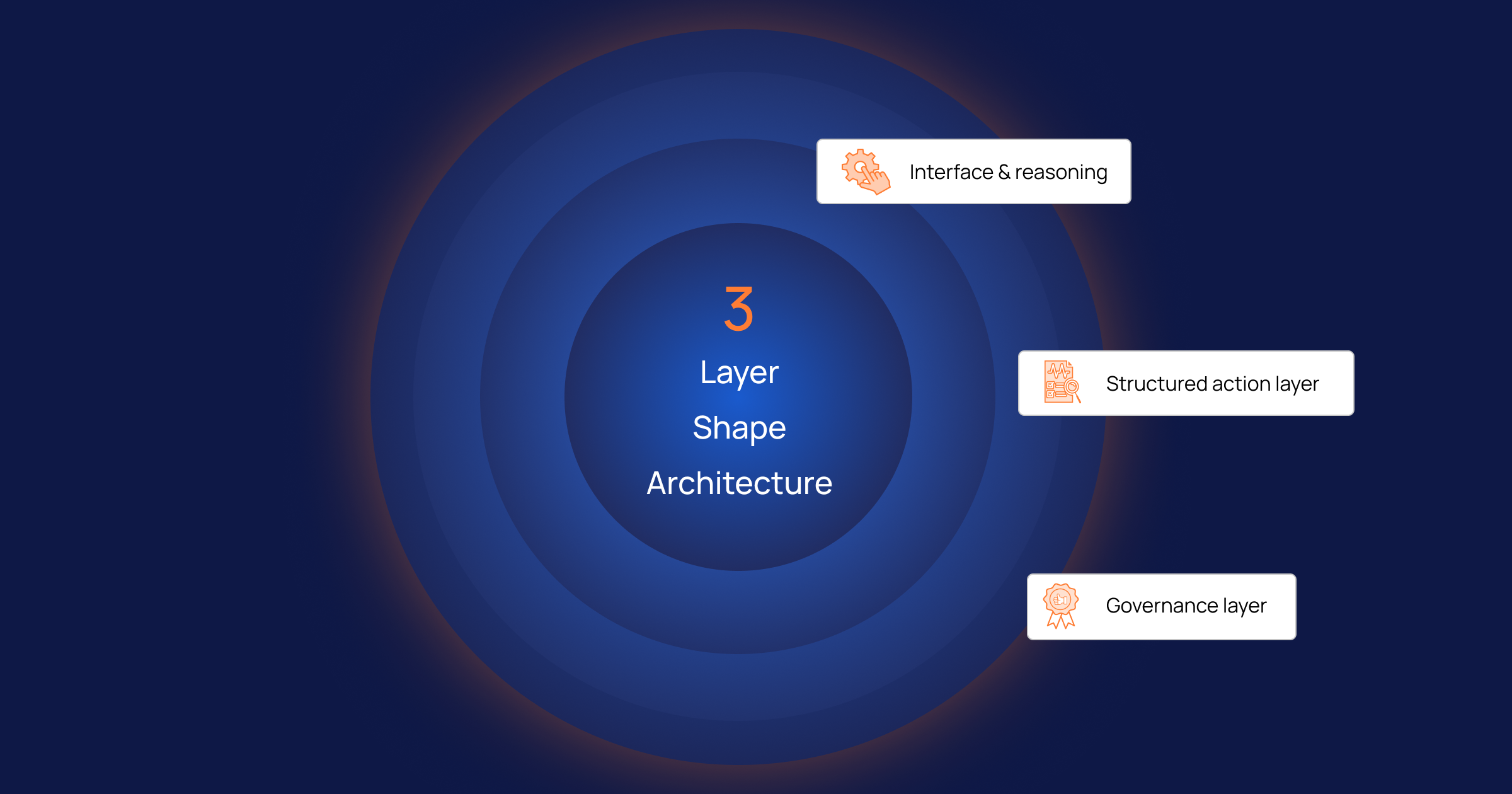
A language model is best understood as one layer in a larger system, not the system itself. Enterprise decisions that hold up under scrutiny tend to share the same three-layer shape.

A decision system that holds up

Layer 1

Interface and reasoning

The language model. Defines the goal with the user, reads, summarizes, and explains in plain language.

Layer 2

Structured action layer

Rule extraction, rationalization, and a ranked next-best-action. Turns reasoning into a feasible, defensible path.

Layer 3

Governance layer

Constraints, fact-grounded lineage, and human approval. Validates every decision before it is allowed to act.
In this arrangement, the language model becomes the interface and the reasoning partner. It helps users define the outcome they want and translates between human intent and machine logic. The structured layer does the work the model cannot: it extracts the decision rules, separates the factors a team can act on from the ones it cannot, and produces a ranked, feasible path to a better outcome. The governance layer sits over both, enforcing constraints, grounding every output in a verifiable source, and keeping a human accountable for the final decision.
None of these layers is sufficient alone. A model without structure produces fluent guesses. Structure without a model is rigid and hard to use. Neither is safe without governance. Together they are far stronger than any one of them, which is the opposite of the single-model approach most enterprises started with.

Why governance is the requirement, not the add-on

In regulated industries, a recommendation that cannot be defended is worse than no recommendation at all. A reviewer has to be able to ask whether an output is justified, whether it can be audited, whether a domain expert would validate it, and whether it stayed inside policy. A black-box answer fails all four tests.
This is where grounding and lineage matter. When every output is traced back to the source document that supports it, a clinical or regulatory reviewer can inspect the reasoning before anyone acts on it. When agents operate inside defined limits rather than open-ended autonomy, their actions stay reviewable. Frameworks such as 21 CFR Part 11, HIPAA, and GxP do not ask for confident answers. They ask for accountable ones, with evidence attached. That requirement is met by architecture, not by a better prompt.

Architecting AI, not bolting it on

The future of enterprise AI is not the largest possible model answering on its own. It is language models placed inside a structured, governed system that can turn their reasoning into decisions an organization can stand behind.
This is the architecture behind Intuceo’s approach. Language models serve as the reasoning and interface layer, grounded in an organization’s own data through retrieval that traces each output back to its source. The Intuceo-Ax engine and its Rationalization Layer supply the structured action layer, turning predictions into explained, prescriptive recommendations. Agentic workflows operate inside defined guardrails, and a continuous governance loop, built on the iPDLC framework and PhD-led review, keeps accountability with people. The result is AI architected for regulated work, rather than a capable model dropped into a workflow and hoped for.
Prediction is only the start of a decision. The same principle holds one level up. A language model is only the start of a system. The value is in what an organization builds around it.

Architect AI you can defend.

Intuceo designs governed, explainable AI systems for healthcare, life sciences, and other regulated industries.

Frequently Asked Questions

Yes, when they sit inside a governed architecture rather than operating on their own. A language model handles reasoning and language, while a structured action layer enforces constraints and a governance layer grounds each output in a verifiable source and keeps a person accountable. The model becomes one component, not the whole decision system.
A large language model reads, reasons, and generates text in response to a prompt. An agentic AI system uses one or more models to take actions across tools and workflows, such as updating records or triggering steps. The added risk is autonomy. Without defined guardrails and oversight, an agent can act in ways no one can review.
Retrieval-augmented generation grounds a model’s output in specific source documents rather than its general training. Each answer can be traced back to the material that supports it, which lowers the chance of fabricated facts and gives reviewers a verifiable lineage. That traceability is what frameworks such as 21 CFR Part 11 require.

What Are the Best AI Development Lifecycle Frameworks for Regulated Analytics?

An estimated 80% of enterprise AI projects fail to deliver their intended business value, according to RAND Corporation’s 2025 analysis. In regulated industries like life sciences and healthcare, the stakes are even higher. A flawed model does not just waste budget; it can trigger compliance violations, endanger patient safety, or invalidate years of clinical research.
The core issue goes beyond the algorithm; it is the absence of a structured AI development lifecycle framework that governs how models are built, validated, monitored, and retired. Traditional SDLC processes assume deterministic outputs. AI systems produce probabilistic results that require fundamentally different governance, from data provenance to drift detection to explainability. For life sciences organizations operating under FDA 21 CFR Part 11, HIPAA, and GxP, choosing the right AI lifecycle framework is foundational.

Key Requirements When Evaluating an AI Development Lifecycle Framework for Regulated Analytics

Before comparing specific frameworks, it helps to define what “regulated-ready” demands. These are the non-negotiable considerations for any AI lifecycle framework used in life sciences or healthcare analytics.
Requirement Why It Matters in Regulated Analytics
Audit-ready documentation FDA and GxP audits require immutable records of data lineage, model decisions, and validation steps at every stage.
Explainability (XAI) Regulators and clinicians need to understand why a model made a specific prediction, particularly in pharmacovigilance and clinical trial matching.
Hallucination and drift detection LLM outputs and ML predictions degrade over time. Production AI monitoring must detect statistical drift, output toxicity, and hallucination before they affect decisions.
Model version control Every model iteration, training dataset, and hyperparameter change must be versioned and traceable for 21 CFR Part 11 compliance.
Human-in-the-loop validation Non-deterministic AI outputs require expert review gates, especially where patient safety or regulatory submissions are involved.
Cross-regulation alignment A single framework should map to multiple mandates: HIPAA, FISMA, NIST 800-53, GxP, and GDPR simultaneously.
With these criteria established, which AI development lifecycle frameworks meet these standards?

Top AI Development Lifecycle Frameworks for Regulated Analytics: A Comparative View

1. NIST AI Risk Management Framework (AI RMF 1.0)

Released in January 2023, the NIST AI RMF has become the de facto AI governance standard in the United States, organized around four functions: Govern, Map, Measure, and Manage. NIST expanded it in July 2024 with a Generative AI Profile (AI 600-1) adding over 200 actions for LLM-specific risks.FDA and other sector regulators increasingly reference its principles.
Strengths
Limitations
Best for: Enterprises needing regulatory alignment across multiple mandates (HIPAA, FISMA, GxP) without being locked into a single vendor ecosystem.

2. CRISP-DM (Cross Industry Standard Process for Data Mining)

CRISP-DM has been the most widely adopted data science methodology since 1999. Its six-phase cycle (Business Understanding, Data Understanding, Data Preparation, Modeling, Evaluation, Deployment) provides a structured, iterative approach. Comparative research found CRISP-DM showed the highest alignment with ISO/IEC 29110 standards among the frameworks analyzed.
Strengths
Limitations
Best for: Teams needing a proven analytical workflow structure, supplemented with separate governance and MLOps layers for regulated environments.

3. Microsoft TDSP (Team Data Science Process)

TDSP extends CRISP-DM with a five-stage lifecycle and adds standardized deliverables, role definitions, and collaboration templates. Its customer acceptance phase and prescribed documentation make it more enterprise-ready than CRISP-DM.
Strengths
Limitations
Best for: Organizations already operating within the Azure/Microsoft ecosystem that need standardized data science workflows across large teams.

4. MLOps (ML Operations Lifecycle)

MLOps applies DevOps principles (CI/CD, infrastructure-as-code, automated testing) to machine learning. It emphasizes continuous integration, delivery, and monitoring of ML models in production, extending traditional frameworks with automated testing, version control, and drift detection.
Strengths
Limitations
Best for: Technically mature organizations that need to scale production AI monitoring and model governance across multiple deployed models.

5. iPDLC™ (Intelligent Product Development Lifecycle) by Intuceo

Where the frameworks above address parts of the AI lifecycle, Intuceo’s proprietary iPDLC™ was purpose-built for regulated, high-stakes environments. It integrates AI-augmented engineering with PhD-led quality gates at every milestone, governing the full lifecycle from intelligent discovery through hardened production to continuous governance.
iPDLC operates across five pillars: Intelligent Discovery and Requirement Synthesis, Architectural Blueprinting, Logic-Driven Test Engineering, Hardened Production Engineering, and Observability with Continuous Governance. Each pillar includes a mandatory Human-in-the-Loop checkpoint validated by Intuceo’s Board of Science, ensuring mathematical soundness and audit readiness.
Strengths
Limitations
Best for: Life sciences, healthcare, and public sector organizations that need a compliance-first AI lifecycle framework with built-in scientific oversight and production-grade reliability.

Framework Comparison at a Glance

Capability NIST AI RMF CRISP-DM TDSP MLOps iPDLC™
Regulatory compliance (native) Partial No No No Yes
Audit-ready documentation Guidance only No Templates Tool-dependent Automated
Explainability / XAI Recommended No No Add-on Built-in (PhD-led)
Drift detection & monitoring Recommended No No Yes Yes (self-healing)
LLM / GenAI evaluation Yes (AI 600-1) No No Emerging Yes
Human-in-the-loop gates Recommended Informal Customer acceptance Optional Mandatory (every pillar)
Vendor lock-in None None Microsoft Tool-dependent Cloud-agnostic

Need a Compliance-First AI Lifecycle for Life Sciences?

Intuceo’s iPDLC™ framework delivers production-grade AI with PhD-led oversight, automated audit trails, and native compliance for 21 CFR Part 11, HIPAA, and GxP environments. Reduce implementation timelines by up to 40% without compromising scientific rigor.

Frequently Asked Questions

A traditional SDLC assumes deterministic software outputs: identical inputs produce identical results. An AI development lifecycle must account for probabilistic outputs, continuous model retraining, data drift, and ongoing validation after deployment. Regulated environments add further layers of documentation, explainability, and version control that standard SDLC processes do not address.
Primary challenges include maintaining audit-ready documentation across model iterations, ensuring explainability for clinical reviewers, detecting drift and hallucinations in production, and aligning a single AI governance framework with overlapping mandates (HIPAA, GxP, 21 CFR Part 11, GDPR). Gartner predicts 60% of AI projects lacking AI-ready data will be abandoned through 2026.
Validation requires statistical testing, human-in-the-loop expert review, automated regression benchmarks, and continuous drift monitoring. In regulated analytics, every validation step must produce an immutable record. NIST AI RMF recommends ongoing measurement across trustworthiness attributes including reliability, safety, fairness, and explainability.
Evaluation starts with baseline benchmarks during development, followed by automated production monitoring. Drift detection compares statistical distributions of inputs and outputs over time. Hallucination evaluation uses ground-truth comparison and retrieval-augmented verification. Toxicity is measured through classifier-based filters and human review. NIST’s Generative AI Profile (AI 600-1) provides over 200 specific actions for managing these LLM risks.
For life sciences, a combination approach works well: NIST AI RMF for governance structure, MLOps tooling for production monitoring, and a compliance-native methodology like iPDLC™ that embeds regulatory checkpoints into every stage. No single open framework currently covers the full spectrum from discovery through governed production in regulated environments.