What Are the Best AI Development Lifecycle Frameworks for Regulated Analytics?

An estimated 80% of enterprise AI projects fail to deliver their intended business value, according to RAND Corporation’s 2025 analysis. In regulated industries like life sciences and healthcare, the stakes are even higher. A flawed model does not just waste budget; it can trigger compliance violations, endanger patient safety, or invalidate years of clinical research.
The core issue goes beyond the algorithm; it is the absence of a structured AI development lifecycle framework that governs how models are built, validated, monitored, and retired. Traditional SDLC processes assume deterministic outputs. AI systems produce probabilistic results that require fundamentally different governance, from data provenance to drift detection to explainability. For life sciences organizations operating under FDA 21 CFR Part 11, HIPAA, and GxP, choosing the right AI lifecycle framework is foundational.

Key Requirements When Evaluating an AI Development Lifecycle Framework for Regulated Analytics

Before comparing specific frameworks, it helps to define what “regulated-ready” demands. These are the non-negotiable considerations for any AI lifecycle framework used in life sciences or healthcare analytics.
Requirement Why It Matters in Regulated Analytics
Audit-ready documentation FDA and GxP audits require immutable records of data lineage, model decisions, and validation steps at every stage.
Explainability (XAI) Regulators and clinicians need to understand why a model made a specific prediction, particularly in pharmacovigilance and clinical trial matching.
Hallucination and drift detection LLM outputs and ML predictions degrade over time. Production AI monitoring must detect statistical drift, output toxicity, and hallucination before they affect decisions.
Model version control Every model iteration, training dataset, and hyperparameter change must be versioned and traceable for 21 CFR Part 11 compliance.
Human-in-the-loop validation Non-deterministic AI outputs require expert review gates, especially where patient safety or regulatory submissions are involved.
Cross-regulation alignment A single framework should map to multiple mandates: HIPAA, FISMA, NIST 800-53, GxP, and GDPR simultaneously.
With these criteria established, which AI development lifecycle frameworks meet these standards?

Top AI Development Lifecycle Frameworks for Regulated Analytics: A Comparative View

1. NIST AI Risk Management Framework (AI RMF 1.0)

Released in January 2023, the NIST AI RMF has become the de facto AI governance standard in the United States, organized around four functions: Govern, Map, Measure, and Manage. NIST expanded it in July 2024 with a Generative AI Profile (AI 600-1) adding over 200 actions for LLM-specific risks.FDA and other sector regulators increasingly reference its principles.
Strengths
Limitations
Best for: Enterprises needing regulatory alignment across multiple mandates (HIPAA, FISMA, GxP) without being locked into a single vendor ecosystem.

2. CRISP-DM (Cross Industry Standard Process for Data Mining)

CRISP-DM has been the most widely adopted data science methodology since 1999. Its six-phase cycle (Business Understanding, Data Understanding, Data Preparation, Modeling, Evaluation, Deployment) provides a structured, iterative approach. Comparative research found CRISP-DM showed the highest alignment with ISO/IEC 29110 standards among the frameworks analyzed.
Strengths
Limitations
Best for: Teams needing a proven analytical workflow structure, supplemented with separate governance and MLOps layers for regulated environments.

3. Microsoft TDSP (Team Data Science Process)

TDSP extends CRISP-DM with a five-stage lifecycle and adds standardized deliverables, role definitions, and collaboration templates. Its customer acceptance phase and prescribed documentation make it more enterprise-ready than CRISP-DM.
Strengths
Limitations
Best for: Organizations already operating within the Azure/Microsoft ecosystem that need standardized data science workflows across large teams.

4. MLOps (ML Operations Lifecycle)

MLOps applies DevOps principles (CI/CD, infrastructure-as-code, automated testing) to machine learning. It emphasizes continuous integration, delivery, and monitoring of ML models in production, extending traditional frameworks with automated testing, version control, and drift detection.
Strengths
Limitations
Best for: Technically mature organizations that need to scale production AI monitoring and model governance across multiple deployed models.

5. iPDLC™ (Intelligent Product Development Lifecycle) by Intuceo

Where the frameworks above address parts of the AI lifecycle, Intuceo’s proprietary iPDLC™ was purpose-built for regulated, high-stakes environments. It integrates AI-augmented engineering with PhD-led quality gates at every milestone, governing the full lifecycle from intelligent discovery through hardened production to continuous governance.
iPDLC operates across five pillars: Intelligent Discovery and Requirement Synthesis, Architectural Blueprinting, Logic-Driven Test Engineering, Hardened Production Engineering, and Observability with Continuous Governance. Each pillar includes a mandatory Human-in-the-Loop checkpoint validated by Intuceo’s Board of Science, ensuring mathematical soundness and audit readiness.
Strengths
Limitations
Best for: Life sciences, healthcare, and public sector organizations that need a compliance-first AI lifecycle framework with built-in scientific oversight and production-grade reliability.

Framework Comparison at a Glance

Capability NIST AI RMF CRISP-DM TDSP MLOps iPDLC™
Regulatory compliance (native) Partial No No No Yes
Audit-ready documentation Guidance only No Templates Tool-dependent Automated
Explainability / XAI Recommended No No Add-on Built-in (PhD-led)
Drift detection & monitoring Recommended No No Yes Yes (self-healing)
LLM / GenAI evaluation Yes (AI 600-1) No No Emerging Yes
Human-in-the-loop gates Recommended Informal Customer acceptance Optional Mandatory (every pillar)
Vendor lock-in None None Microsoft Tool-dependent Cloud-agnostic

Need a Compliance-First AI Lifecycle for Life Sciences?

Intuceo’s iPDLC™ framework delivers production-grade AI with PhD-led oversight, automated audit trails, and native compliance for 21 CFR Part 11, HIPAA, and GxP environments. Reduce implementation timelines by up to 40% without compromising scientific rigor.

Frequently Asked Questions

A traditional SDLC assumes deterministic software outputs: identical inputs produce identical results. An AI development lifecycle must account for probabilistic outputs, continuous model retraining, data drift, and ongoing validation after deployment. Regulated environments add further layers of documentation, explainability, and version control that standard SDLC processes do not address.
Primary challenges include maintaining audit-ready documentation across model iterations, ensuring explainability for clinical reviewers, detecting drift and hallucinations in production, and aligning a single AI governance framework with overlapping mandates (HIPAA, GxP, 21 CFR Part 11, GDPR). Gartner predicts 60% of AI projects lacking AI-ready data will be abandoned through 2026.
Validation requires statistical testing, human-in-the-loop expert review, automated regression benchmarks, and continuous drift monitoring. In regulated analytics, every validation step must produce an immutable record. NIST AI RMF recommends ongoing measurement across trustworthiness attributes including reliability, safety, fairness, and explainability.
Evaluation starts with baseline benchmarks during development, followed by automated production monitoring. Drift detection compares statistical distributions of inputs and outputs over time. Hallucination evaluation uses ground-truth comparison and retrieval-augmented verification. Toxicity is measured through classifier-based filters and human review. NIST’s Generative AI Profile (AI 600-1) provides over 200 specific actions for managing these LLM risks.
For life sciences, a combination approach works well: NIST AI RMF for governance structure, MLOps tooling for production monitoring, and a compliance-native methodology like iPDLC™ that embeds regulatory checkpoints into every stage. No single open framework currently covers the full spectrum from discovery through governed production in regulated environments.

What Is AutoML? A Plain-Language Guide for Healthcare IT and Data Leaders

Healthcare organisations generate more data than almost any other industry. The problem is not the data. It is the gap between the data and the insight.
Electronic health records, imaging studies, lab results, claims data, genomic profiles, and remote monitoring streams accumulate at a scale that no human team can manually process with the speed clinical decisions require. Traditional machine learning can close that gap, but building accurate models has historically required specialised data science expertise that most health systems and life sciences firms simply do not have on staff.

Automated machine learning, or AutoML, changes that equation. It does not replace clinical judgment. What it does is make the machinery of predictive analytics in healthcare accessible to the people closest to the clinical problem. This guide explains what AutoML is, how it works in a healthcare context, where it adds measurable value, and what leaders should look for before adopting it.

$2.59B

AutoML global market value in 2025

41.96%

CAGR projected through 2031

What Is AutoML?

AutoML stands for automated machine learning. It refers to software that automates the most time-intensive steps in building a predictive model: selecting the right algorithm, engineering features from raw data, and tuning the model’s internal parameters for optimal accuracy. Steps that once took a team of data scientists weeks can be completed in hours.
Crucially, AutoML does not produce a magic black box. A well-designed platform makes the process transparent and auditable. Most enterprise AutoML tools include explainability modules that show which variables drove a prediction and by how much. This matters enormously in healthcare, where regulators and ethics committees expect clear answers about why an algorithm flagged a patient or recommended a clinical pathway.
The broader shift toward no-code machine learning and AI model automation means that domain experts such as clinical informaticists, quality analysts, and operations leaders can participate meaningfully in building predictive models, rather than waiting for centralised data science teams to prioritise their requests.

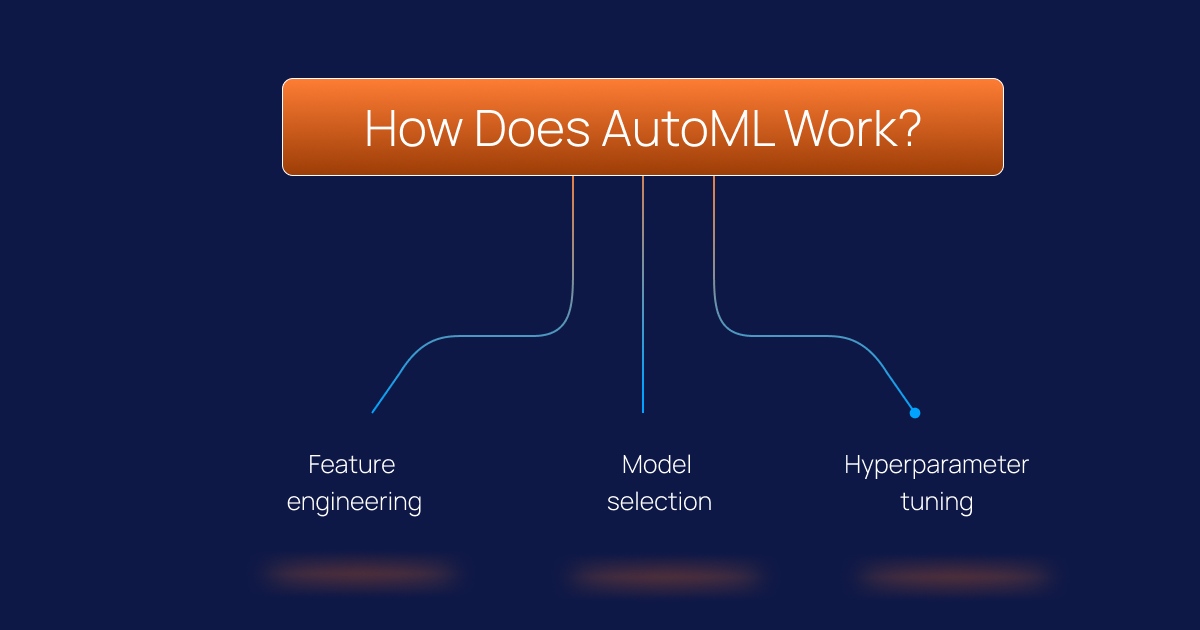
How Does AutoML Work?

An AutoML workflow moves through three core stages:

Feature engineering

Raw healthcare data – diagnosis codes, lab values, admission timestamps, medication lists – is transformed into numerical signals a model can use. AutoML platforms identify which transformations produce the most predictive features without manual trial and error. For structured EHR data, this stage often surfaces non-obvious signal combinations that manual feature engineering would miss entirely.

Model selection

The platform tests multiple algorithm families simultaneously, such as gradient boosting, random forests, and neural architectures, and identifies which performs best for the specific data and target outcome. This eliminates the guesswork and hours of experimentation that traditional data science workflows require.

Hyperparameter tuning

Each algorithm has internal settings that control its behaviour. AutoML systematically explores combinations of these settings and converges on a configuration that maximises predictive accuracy without overfitting the training data.
The result is a validated, deployable model built in a fraction of the time. The no-code and low-code interfaces of modern AutoML platforms mean that healthcare teams can initiate model training automation projects independently, review outputs, and iterate based on clinical feedback rather than queuing requests to a centralised data team.

AutoML Use Cases in Healthcare: Where It Matters

The following use cases represent areas where AutoML in healthcare has moved from pilot to production across health systems and life sciences organisations.

Patient Risk Stratification and Readmission Prediction

Unplanned readmissions cost the US healthcare system billions of dollars annually and remain one of the most closely watched quality metrics under CMS value-based care programmes. Machine learning models built on EHR data can predict 30-day readmission risk and in-hospital mortality with AUROC scores reaching 0.93 to 0.94 in large multi-site clinical cohorts. AutoML makes this type of modelling repeatable across facilities without requiring a dedicated data science team at every site.

Chronic Disease Detection and Early Intervention

Cardiovascular risk, diabetes progression, COPD exacerbation risk, and chronic kidney disease staging are all conditions where early prediction enables timely intervention. AutoML frameworks have been applied to coronary artery disease prediction with results demonstrating clinical-grade accuracy; when integrated with SHAP, it improves the explainability and transparency of ML models. Explainable AI in healthcare is not optional; a model that clinicians cannot interrogate will not be adopted regardless of its accuracy scores.

HEDIS and Quality of Care Analytics

Health plans operating under HEDIS and CMS STAR rating frameworks process millions of member records to identify care gaps, track chronic condition management, and optimise quality scores. Automated ML model training accelerates the cycle from data ingestion to population-level insight, enabling health plans to act on gap-in-care signals before the measurement year closes rather than reacting after the fact.

Adverse Event Detection in Pharma

Under 21 CFR Part 11 and FDA pharmacovigilance requirements, pharmaceutical companies must classify and report adverse events from clinical trials and post-market surveillance. AutoML-powered NLP pipelines can process unstructured safety reports, classify event severity, and flag regulatory submission deadlines automatically, reducing the manual burden on safety operations teams while improving reporting consistency.

Clinical Trial Patient Matching

Identifying eligible patients for clinical trials is one of the most expensive and time-consuming stages of pharmaceutical R&D. AI-driven patient matching using AutoML applied to EHR data, genomic profiles, and SNOMED CT-coded diagnoses can accelerate enrolment by narrowing a population of millions to a targeted cohort. By automating the identification of highly specific patient cohorts, AI-driven analytics can compress the clinical recruitment phase – a traditional bottleneck in drug development. In documented industry cases, integrating these automated workflows has helped reduce key stages of the drug discovery and trial lifecycle from a typical 5 to 6-year window down to approximately one year.

The Intersection of AutoML and Large Language Models (LLMs)

Dimension AWS Azure
BAA mechanism Signed via AWS Artifact for designated HIPAA accounts Auto-included in Microsoft Product Terms for qualifying customers
HIPAA-eligible services 166+ services across compute, storage, AI, analytics Service-level eligibility, validated per workload in Product Terms
Native healthcare data layer Amazon HealthLake (managed FHIR R4 + medical NLP) Azure Health Data Services (FHIR + DICOM + MedTech in one workspace)
Analytics engine Athena, Redshift, EMR, SageMaker, QuickSight Synapse Analytics, Databricks, Azure ML, Power BI
Identity backbone AWS IAM, Identity Center, KMS Microsoft Entra ID, Conditional Access, Azure Key Vault
Federal healthcare AWS GovCloud (US), FedRAMP High Azure Government, FedRAMP High, IL5
Best fit for Greenfield FHIR-first analytics, custom ML pipelines, federal health agencies Microsoft-shop hospitals, imaging-heavy workloads, integrated BI on existing M365 estates
While AutoML excels at finding patterns in structured data (like lab values and claims), Large Language Models (LLMs) like Med-PaLM 2 or GPT-4o have redefined how we handle unstructured clinical text. In 2026, the most effective healthcare AI strategies don’t choose between the two – they integrate them.

Structured Prediction vs. Narrative Understanding

The core difference lies in the data type. AutoML is your engine for predictive analytics in healthcare, turning EHR tables into risk scores. LLMs, conversely, act as the “clinical interpreter,” summarizing decades of physician notes or extracting SNOMED CT codes from messy discharge summaries.

Are LLMs Trustworthy for Clinical Decisions?

A common question among data leaders is: Can an LLM help with complex clinical decision-making? The answer is “yes, but with guardrails.” While LLMs excel at medical knowledge benchmarks, they can “hallucinate” or miss critical clinical nuances (like the difference between “suspected pneumonia” and a confirmed diagnosis).
To make a healthcare LLM clinically useful and trustworthy, it must be paired with:

Can Patients Use LLMs Safely?

Patients often ask if they can safely use AI for personal health advice. While LLMs are powerful research tools, they lack the real-time diagnostic accountability of a clinician. In a regulated setting, LLMs are best used to assist doctors – reducing administrative burnout and identifying eligible patients for clinical trials – rather than replacing human clinical judgment.

AutoML vs. Traditional Machine Learning: The Practical Difference

Traditional Machine Learning AutoML
Requires specialised data science expertise Accessible to domain experts and business analysts
Model selection is manual and iterative Automated model selection across multiple algorithm families
Feature engineering is labour-intensive Automated feature transformation and selection
Deployment timelines measured in weeks to months Model training automation reduces timelines to hours or days
Explainability depends on team capability Built-in explainability (SHAP, LIME) as standard in enterprise platforms
High cost per model at scale Lower cost per model, enabling broader deployment across use cases

What Makes a Healthcare AutoML Trustworthy?

Healthcare data science operates under constraints that most other industries do not face. Before selecting an AutoML platform or a clinical machine learning services partner, IT and data leaders should consider the following aspects:

How Intuceo Integrates AutoML in Healthcare

Intuceo is a PhD-led AI, ML, and data analytics consulting firm specialising in regulated industries. Its proprietary AutoML accelerators, part of the Intuceo-Ax platform, are purpose-built for healthcare and life sciences environments where explainability, compliance, and clinical precision are operational requirements.

Every engagement is governed by Intuceo's iPDLC methodology, ensuring that clinical domain expertise drives problem framing and outcome evaluation, not just engineering velocity.

Frequently Asked Questions

AutoML automates the most repetitive and computationally intensive parts of building a predictive model, but it does not replace the clinical domain expertise needed to define the right problem, identify the right data sources, and evaluate whether a model’s predictions make clinical sense. In practice, AutoML shifts data scientists toward higher-value work: problem framing, clinical validation, and deployment oversight.
Explainable AI refers to methods that make a model’s predictions interpretable to a human reviewer. In healthcare, this means a clinician or compliance officer can see which patient variables contributed most to a risk score and to what degree. Without explainability, clinicians have no basis for trusting or appropriately challenging a model’s output. Regulatory bodies including the FDA have signalled increasing expectations around algorithm transparency for software as a medical device (SaMD).
AutoML models in healthcare most commonly draw on structured EHR data (diagnosis codes, procedure codes, lab results, medications, vital signs), administrative data (claims, encounter history, admission and discharge records), and where available, genomic or imaging data. The quality, consistency, and completeness of that data determines the ceiling on model performance. Organisations with strong data governance and standardised EHR adoption typically see faster time-to-production on clinical machine learning projects.
AutoML platforms themselves are not inherently HIPAA-compliant. Compliance depends on how the platform is deployed, how protected health information (PHI) is accessed and stored, and whether appropriate business associate agreements are in place. Healthcare organisations should evaluate vendor security architecture, data residency options, and audit logging capabilities as part of any AutoML procurement or services engagement.
AutoML specifically refers to automation of the machine learning model-building process: feature engineering, algorithm selection, and hyperparameter tuning. No-code AI is a broader category covering tools that allow users to build AI-powered applications through visual interfaces without programming. Many AutoML platforms include no-code interfaces, but not all no-code AI tools include full AutoML functionality.

What Healthcare Analytics Consulting Actually Delivers: Beyond Dashboards And Data Dumps

Every 24 hours, the average 500-bed hospital generates roughly 137 terabytes of data, yet nearly 80% of that information remains unstructured, untapped, and functionally invisible to the people who need it most. For a Chief Medical Officer or a Head of Patient Experience, the “data revolution” has not provided a clearer path to patient care, instead, it has created a persistent crisis of signal versus noise.

The problem is structural. Most of this data sits in siloed systems with no shared governance framework, leaving clinical and operational teams without a clear path from raw data to decisions. When a payer cannot reconcile claims data with pharmacy records, or when a provider’s EHR does not communicate with home care records, the result is reactive care, avoidable cost, and missed quality incentives.
“From Data Rich to Insight Rich.” This is the principle that drives every Intuceo healthcare engagement. The real competitive advantage in healthcare today is not the volume of data an organization holds, it is the speed and precision with which that data becomes a decision.
The industry has reached a tipping point. True healthcare analytics consulting is not about delivering a PDF of charts or a “data dump” of Excel sheets. It is about building a sustainable, insight-driven ecosystem across both the Payer and Provider ecosystems, one that is engineered to evolve as organizational priorities shift. This is where the industry is moving toward Managed Analytics as a Service (MAaaS): a model that prioritizes outcomes over outputs.

The Reporting Trap: Why Dashboards Are Not Solving Clinical Problems

Most healthcare data analytics projects start with the tools and work backward. A vendor recommends a platform, builds a few dashboards, runs a training session, and exits. Months later, the dashboards are stale, clinical staff have found workarounds, and leadership is asking the same questions they asked before the engagement started.
The flaw is treating analytics as a reporting exercise. Dashboards show what happened. What healthcare organizations actually need is insight into what is likely to happen, why, and what to do next.

The limitations of traditional data dumps:

The Analytics Maturity Journey

Level Type What It Answers Healthcare Application
1 Descriptive What happened? Admission trends, claims volume
2 Diagnostic Why did it happen? Root cause of readmission spikes
3 Predictive What will likely happen? Patient risk stratification, CRG scoring
4 Prescriptive What should we do? Clinical decision support, care gap closure

What Real Healthcare Analytics Consulting Delivers Beyond Reports

Effective healthcare analytics consulting transforms data from a liability, a storage cost and security risk, into a strategic asset. Here is what a mature engagement, delivered by a firm with the clinical, technical, and regulatory depth to execute, actually produces:

1. Unified Data Infrastructure

Before any predictive model can run, the data feeding it must be clean, governed, and trustworthy. This begins with building a unified data platform that standardizes terminology (ICD-10, CPT, LOINC), de-duplicates patient records, and creates a single source of truth across clinical and operational domains. Implementing FHIR (Fast Healthcare Interoperability Resources) and HL7 frameworks ensures that the Lab, the Pharmacy, and the ER speak the same language and that downstream AI models are built on foundations that can be trusted.
Intuceo operationalizes this through its proprietary Intuceo-Ix (Integration Engine), which mines disparate data across EHR platforms (Epic, Cerner), social determinants of health (SDoH) datasets, claims records, pharmacy data, and home care streams, engineering the “Gold Record” that is the prerequisite for high-stakes analytics.

2. The Payer Ecosystem: Driving Quality Incentives and Containing Clinical Cost

Payer organizations face a dual mandate, optimize quality-based incentive programs while containing the clinical costs that erode margins. Effective analytics consulting addresses both simultaneously.

3. The Provider Ecosystem: Predictive Diagnostics and Revenue Protection

Provider organizations operate at the intersection of clinical outcome accountability and revenue cycle complexity. Analytics consulting at this level must address both.
The total cost of 30-day hospital readmissions in the United States exceeds $26 billion annually, with average readmission costs placing significant financial burden on health systems (MedPAC, 2024). Predictive AI, applied before discharge, allows care teams to identify patients at elevated readmission risk and activate targeted interventions – coordinated care, post-discharge follow-up, medication reconciliation – before the patient returns to the ED.

4. Population Health and Value-Based Care Analytics

According to CMS, Value-Based Care models saw a 25% increase in healthcare provider participation from 2023 to 2024. As more organizations move into downside-risk contracts, identifying and managing high-risk patient cohorts before they become high-cost events is a financial survival capability, not a strategic option.
Analytics consulting firms that build risk stratification models layering claims data, clinical data, and social determinants of health feed those models directly into care management workflows. Not dashboards. Workflows. The output must reach the care manager at the moment of intervention, not two weeks later in a quarterly report.

5. Explainable AI for Clinical Trust

A predictive model that clinicians do not understand will not change outcomes regardless of its accuracy. Explainable AI (XAI) surfaces the reasoning behind model predictions in terms that are clinically actionable, telling a care manager not just that a patient is high-risk, but which specific clinical factors are driving that classification and what interventions the evidence supports.
The Intuceo Principle: Explainability is not a feature. It is the standard. Every model deployed in a clinical or payer environment must be interpretable to the professionals who act on it. This is the difference between analytics that drives behavior change and analytics that collects dust.

The Evolution: Managed Analytics as a Service (MAaaS)

Many healthcare organizations lack the in-house talent to build, maintain, and evolve complex AI models. A 2024 HIMSS Analytics survey found that 64% of healthcare IT executives cite a talent shortage as the primary barrier to adopting emerging analytics technologies. This structural gap has accelerated the shift toward Managed Analytics as a Service (MAaaS), an ongoing partnership model where the consulting firm continuously monitors model performance, retrains on new data, incorporates new sources, and aligns analytics outputs with evolving clinical and operational priorities.
Unlike traditional one-off consulting projects, MAaaS provides a continuous, cloud-native partnership that scales with the organization.
Feature Traditional Consulting Managed Analytics as a Service (MAaaS)
Duration Project-based with a fixed end date Ongoing subscription / partnership
Infrastructure Often relies on on-premise silos Cloud-native, scalable (AWS / Azure / GCP)
Insights Static data dumps and periodic reports Real-time, dynamic insights tied to outcomes
Maintenance Client is responsible after handoff Provider manages updates and AI retraining
Scalability Difficult; requires new SOWs Effortless; scales with data volume and scope
Compliance Point-in-time review Continuous HIPAA, HITECH, and FISMA oversight
Core components of a sustainable managed analytics model include continuous data pipeline monitoring and maintenance, regular model retraining and benchmarking against real clinical outcomes, HIPAA and regulatory compliance oversight, escalation workflows that connect analytics outputs to human action, and periodic roadmap reviews as organizational priorities evolve.

The Intuceo Approach: PhD-Led Healthcare Intelligence

While many consulting firms stop at providing the “what,” Intuceo focuses on the “how.” As a boutique Data & AI firm with 20+ years of healthcare and life sciences experience, Intuceo’s engagement model is built on the MAaaS principle: a continuous, outcome-accountable partnership, not a project handoff.
Intuceo’s healthcare solutions are engineered to navigate the dual complexities of the Payer and Provider ecosystems simultaneously, moving past generic dashboards toward high-integrity data infrastructure that can support both actuarial precision and clinical certainty.

What Makes Intuceo Different

Proven Impact: Intuceo has delivered 100+ mission-critical healthcare and life sciences engagements for Fortune 1000 organizations including Florida Blue, Guidewell Health, UF Health, and Aon with an average client tenure exceeding 5 years. Our QOC analytics platform maintains 100% HIPAA compliance while delivering real-time transparency into Medicaid Services quality and cost effectiveness.

The Shift Worth Making

The organizations that extract the most value from healthcare analytics consulting approach it as an investment in decision infrastructure, not in dashboards. They define the outcomes they need to move, identify the data that informs those outcomes, and find partners with the clinical, technical, and regulatory depth to build something that works beyond the initial go-live.

That is what effective healthcare analytics consulting delivers: not more reports, but better decisions, made faster, by clinicians and operators who have the information they need at the moment they need it, in a governance framework that keeps that information secure, compliant, and trustworthy.

Intuceo brings PhD-led AI and ML expertise to healthcare analytics engagements for both Payer and Provider organizations, with a focus on Explainable AI, HIPAA-compliant data architecture, and outcome-accountable delivery through proprietary frameworks including Intuceo-Ax, Intuceo-Ix, and iPDLC.

Ready to move from data-rich to insight-rich?

Whether you’re navigating payer-side HEDIS optimization, provider-side denial management, or building a population health program for a value-based care contract, our healthcare analytics team is ready to design your roadmap.

Frequently Asked Questions

Healthcare BI summarizes historical data into reports, dashboards, and KPIs. Healthcare data analytics applies predictive modeling, machine learning, and prescriptive techniques to forecast future events, identify root causes, and recommend interventions. The strategic value and the financial ROI sits firmly in the latter.
MAaaS is an ongoing engagement model where the consulting firm operates, maintains, and evolves an organization’s analytics infrastructure continuously, rather than executing a one-time project. This covers data pipelines, model monitoring, compliance oversight, and alignment with shifting clinical and operational priorities. Intuceo’s engagement model is built on this principle.
Revenue Cycle Management and readmission reduction programs often show measurable financial impact within 90 to 180 days of deployment. Population health programs tied to value-based care contracts typically demonstrate impact over 12 to 24 months as interventions accumulate and risk stratification models mature on new data.
Every component of the engagement from data ingestion pipelines to model outputs to reporting interfaces must operate within HIPAA’s Privacy and Security Rule requirements. This includes Business Associate Agreements (BAAs), end-to-end encryption, role-based access controls, audit logging, and data minimization protocols. Intuceo deploys within Azure and AWS HIPAA-validated environments and maintains continuous compliance monitoring. Non-compliance is not a peripheral risk: HIPAA penalties can reach into the millions per violation category.
Explainable AI refers to models that can articulate the reasoning behind their predictions in terms understandable to clinical or operational users. In healthcare, a model that flags a patient as high-risk without explaining which factors are driving that classification is difficult to act on and difficult to trust, which means it will not change clinical behavior. Explainability drives adoption, and adoption drives outcomes. Intuceo’s PhD-led AI engineering prioritizes XAI as a standard, not a premium feature.
Payer analytics focuses on health plan performance: HEDIS and STAR Rating optimization, PPE cost containment (PPA, PPR, PPC tracking), member stratification via CRG methodologies, and encounter data validation to protect financial integrity. Provider analytics focuses on health system performance: predictive diagnostics, 360° patient views, clinical SOP compliance, and Revenue Cycle Management. Intuceo is one of a small number of firms with deep, purpose-built capability across both ecosystems.