LLM Infrastructure Solutions: Choosing the Right Setup for Model Size, Cost, and Compliance

Many teams approach LLM infrastructure solutions the way someone buys a vehicle before knowing the commute  selecting a general-purpose setup before the real workload arrives with requirements nobody planned for.
A general-purpose setup gets provisioned, budgets get signed off, and then the real workload arrives carrying requirements nobody planned for: a model too large for the reserved memory, latency targets the serving layer cannot meet, or regulated data that legally cannot travel to the chosen endpoint. What follows is either idle capacity quietly burning money or a rushed rebuild a few months later.
This is why LLM infrastructure solutions are not a single blueprint. The right setup depends on how large the model is, how fast and how often it needs to respond, what it costs to run at volume, and where the underlying data is permitted to sit.
Getting those LLM infrastructure requirements straight before committing to hardware is the difference between a setup that scales and one that has to be torn out and rebuilt within a year.

Key Takeaways

Why LLM Infrastructure Solutions Are Never One-Size-Fits-All

The clearest reason is memory. Model weights must sit in fast memory to serve responses at a usable speed, and that requirement scales directly with the number of parameters. Stored in half-precision (FP16, or 16-bit floating-point), each parameter takes roughly two bytes. A 70-billion-parameter model therefore needs about 140 gigabytes of video memory (VRAM) just to hold its weights. That already exceeds a single 80 GB accelerator and forces the model across at least two high-end graphics processing units (GPUs), or around six consumer-grade cards.1 A two-billion-parameter model, by contrast, fits comfortably on one modest GPU.
That single fact reshapes everything downstream. A small model can run on a single card, sometimes even on a central processing unit (CPU), while a frontier-scale model may need a coordinated cluster with high-speed interconnects between chips.
The LLM infrastructure requirements for a lightweight classification assistant and for a 500-billion-parameter reasoning system are not different by degree; they are different in kind. Provisioning both from the same template guarantees waste at one end and failure at the other.
Quantization changes the arithmetic but does not remove the decision. Compressing weights to lower precision can shrink that same 70B model to a fraction of its footprint, letting it run on far less hardware at some cost to output quality. Whether that trade is acceptable depends entirely on the use case, which is exactly why the sizing conversation has to happen before anything is bought.

The Four Variables That Define LLM Infrastructure Requirements
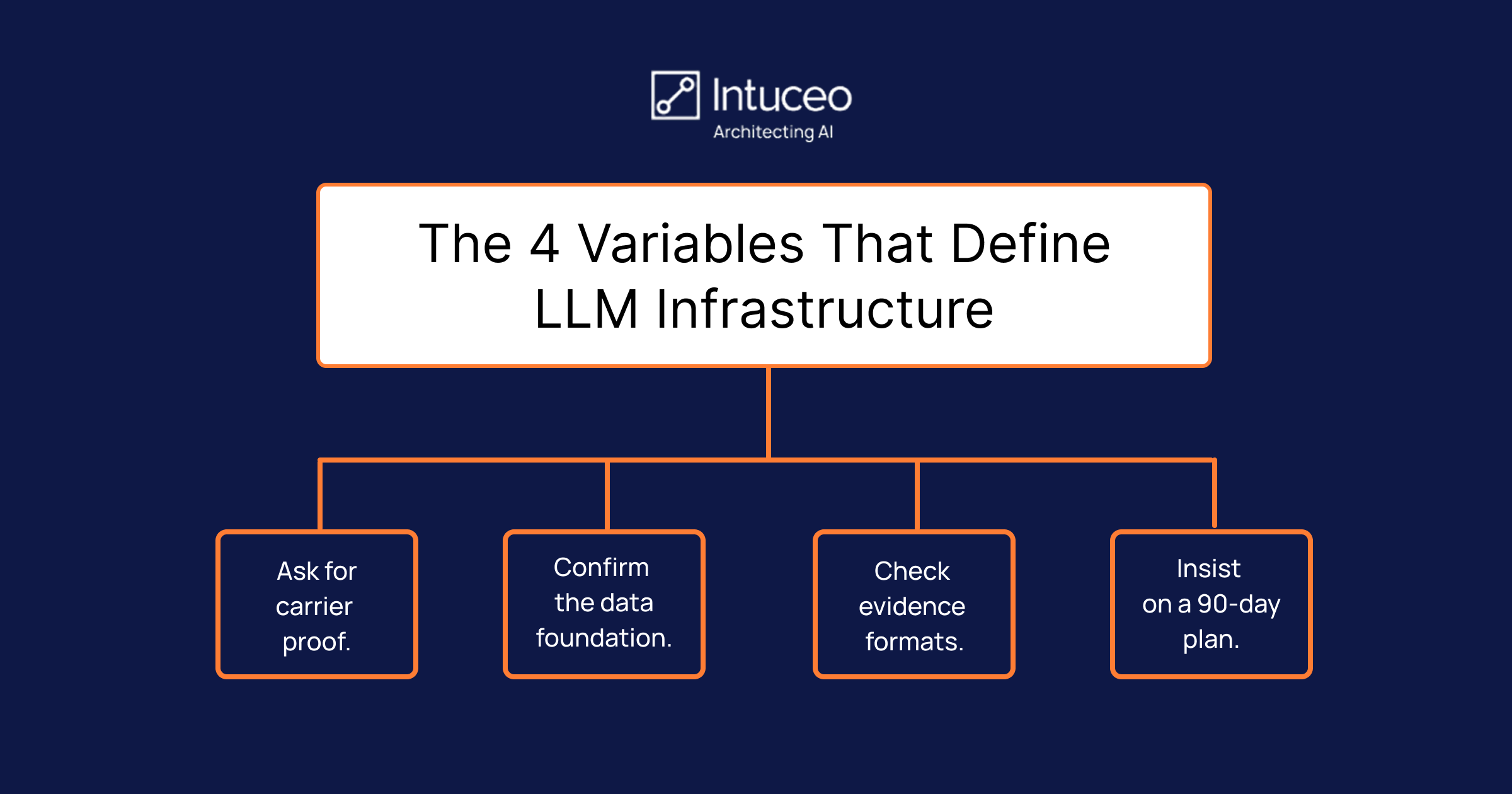
Defining LLM infrastructure requirements starts with four variables : model size, throughput and latency, inference cost, and compliance. Model size is the first lever. Three others matter just as much.

Throughput and latency

A batch job that summarizes documents overnight tolerates slow responses and heavy batching. A customer-facing assistant expected to reply in under a second does not.
The same model can call for very different serving setups depending on how many concurrent requests it fields and how quickly each one has to return. Under-provision here and the system buckles at peak load; over-provision and expensive accelerators sit idle most of the day.

Cost, which moves faster than most budgets assume

For a model of equivalent performance, the price of running inference has been falling by roughly 10x per year, dropping from about $60 per million tokens in 2021 to near $0.06 for a comparable-quality model three years later.
That trajectory rewards flexibility and punishes lock-in. A setup optimized around today’s model at today’s prices can turn uneconomical within a year, and a rigid, single-vendor footprint often costs more over its life than a design built to swap models as cheaper, better options appear.

Compliance

For regulated organizations, this fourth lever frequently overrides the other three. Where data is allowed to be processed can rule out otherwise sensible options entirely, which is worth treating on its own terms.

What Does an LLM Infrastructure Stack Include?

It helps to see the whole picture, because the LLM infrastructure stack is far more than the GPUs everyone talks about. It runs from the compute and serving layer that hosts the model, through an orchestration layer that routes and scales requests, to the data layer that supplies the model with current, trustworthy context, and finally a security and governance layer that controls who can see what.
In a retrieval-augmented setup, the data layer does as much to determine answer quality as the model does – a trade-off explored in depth in RAG vs. Fine-Tuning: How Enterprise Teams Should Actually Decide.
Teams that fixate on the compute layer tend to meet the rest of the stack the hard way. A pilot works cleanly in a demo, then stalls the moment it hits real data volumes, real access rules, and real audit expectations. The compute was never the part most likely to break.

How Compliance Requirements Shape LLM Infrastructure Solutions for Regulated Industries

For pharmaceutical and life sciences organizations, healthcare systems, financial firms, and public-sector agencies, the question of where data can go often settles the infrastructure question before performance enters the conversation. Regulated data cannot simply be pointed at whatever endpoint is cheapest.
Protected health information under the Health Insurance Portability and Accountability Act (HIPAA), records governed by 21 CFR Part 11, and systems under the Federal Information Security Management Act (FISMA) each constrain where processing may happen and who may access it.
The concern is widespread, not niche. In Deloitte’s 2026 State of AI in the Enterprise survey, data privacy and security ranked as the most cited AI risk, named by 73% of the leaders polled.
Once data residency and sovereignty enter the picture, a public interface sitting in the wrong jurisdiction stops being an option, and the field narrows to controlled cloud, on-premises, hybrid, or air-gapped setups. Retrofitting those controls after a system is live is almost always slower and costlier than designing for them from the outset – a principle at the core of AI governance for regulated industries.

Why the Data Layer Determines LLM Infrastructure Success

Compute gets the headlines, but the data foundation quietly decides the outcome. A perfectly sized cluster still returns unreliable output if the pipelines feeding it are fragmented, stale, or impossible to trace. In regulated settings, every input and output usually has to carry a lineage a reviewer can follow, which is a data-engineering problem long before it is a hardware one. This is the layer where most infrastructure plans succeed or come apart.

How Intuceo Delivers LLM Infrastructure Solutions for Regulated Enterprises

This is the part of an infrastructure solution that Intuceo is set up to handle. Its DataOps and Engineering practice concentrates on the layer that determines whether an LLM setup holds up in production: hardened ingestion and transformation pipelines with automated quality testing, full data lineage for GxP, HIPAA, and federal audits, and secure infrastructure configured across cloud, on-premises, or hybrid environments with controls such as virtual private cloud (VPC) isolation and customer-managed encryption keys.
Rather than installing a fixed toolset, Intuceo works as a services partner, bringing accelerators drawn from prior regulated engagements to speed up deployment and configuring the pipeline to the constraints an organization already operates under. The compute can be right-sized later; the data foundation has to be sound first.
That foundation still rests on getting the hardware decision right – the exact problem the DARWIN Infrastructure planning session addresses by working through the LLM infrastructure solutions trade-off for your specific model, budget, and regulatory reality.
The session uses the Infrastructure dimension of the DARWIN planning framework to work through the real cost and performance trade-offs, from GPU versus CPU choices to sizing questions as concrete as whether a workload needs a dozen servers for a 500-billion-parameter model or a single GPU for a two-billion-parameter one.
It is built for the data, engineering, compliance, and executive leaders who own those calls, and it answers the question most infrastructure discussions skip: how to choose a setup that fits the model, the budget, and the regulatory reality at the same time.

Size your setup before you commit to it

Join the Intuceo AI Dream Session to work through the cost, performance, and compliance trade-offs behind your LLM infrastructure, with worked examples from regulated deployments.

Frequently Asked Questions

Sound LLM infrastructure requirements planning weighs four factors together: model size, which sets memory and GPU count; throughput and latency, which shape the serving setup; running cost at volume; and compliance, which governs where data can be processed  Sound LLM infrastructure requirements planning weighs all four together rather than optimizing for one and discovering the others later.
No. Small models can run on a single modest GPU or even a CPU, while large models need multiple high-end accelerators working together. Matching the hardware to the model, instead of defaulting to the largest option, is often where the biggest savings sit.
A complete LLM infrastructure stack includes the compute and serving layer, an orchestration layer for routing and scaling, a data layer that supplies context and retrieval, and a security and governance layer for access control and auditability. The data and governance layers are where regulated deployments most often succeed or stall.
In regulated industries, compliance can decide the infrastructure before performance is discussed. Rules such as HIPAA, 21 CFR Part 11, and FISMA limit where data may be processed, which pushes many organizations toward controlled cloud, on-premises, hybrid, or air-gapped setups rather than a public interface.
It depends on the data and the workload. Cloud offers elasticity, on-premises offers control, and hybrid balances the two. For sensitive data with residency or sovereignty constraints, the deciding factor is usually where processing is legally allowed to happen, not raw performance.
Best AI Analytics Companies in Florida for Pharma and Life Sciences (2026)

Teams searching for an analytics partner in Florida usually have a specific problem in hand. Trial enrollment is behind. Adverse event review is still manual. Research data sits across systems nobody can search. The useful question for any team evaluating pharma AI analytics companies in Florida is not who claims to do artificial intelligence (AI), but which nearby firms have actually shipped inside a regulated environment.
There are more credible answers than a few years ago. Florida’s bioscience workforce reached 116,635 employees across 9,481 companies in 2023, an 18.7% increase since 2019 and faster than national life sciences employment growth[1]. A base that size now sustains its own AI and analytics supply chain. The guide below covers how to evaluate a partner and the best AI analytics companies in Florida for pharma and life sciences teams heading into 2026.

Key Takeaways

How AI is used in pharma data analytics in 2026

The regulatory record is a useful proxy for how far this has traveled. FDA’s Center for Drug Evaluation and Research reports more than 500 drug submissions containing AI components between 2016 and 2023, spanning non-clinical, clinical, postmarketing, and manufacturing phases[2]. In January 2026, the FDA and the European Medicines Agency published ten joint guiding principles for good AI practice in drug development, an unusual signal of how quickly the two agencies expect sponsors to standardize.
Operationally, this is narrower than the marketing suggests. Most current pharma data analytics in Florida falls into four buckets: knowledge retrieval across research documents and regulatory filings; cohort identification and site feasibility work in AI for clinical trials; automated classification and triage in pharmacovigilance; and yield, defect and release analytics in manufacturing. Discovery-stage generative chemistry gets the headlines; the recurring budget sits in those four areas.

How to Evaluate Pharma AI Analytics Companies: 5 Checks That Separate Specialists from Generalists

Evaluation usually stalls on one question: how do you separate a competent analytics consultancy from one that has shipped in a validated environment? Five checks do most of the work when assessing life sciences AI vendors in 2026.

The Best Pharma AI Analytics Companies in Florida (2026)

These five were selected on verifiable life sciences delivery, substantive Florida presence, and distinct capability, so the list is comparative rather than five versions of the same offer. They are not ranked against each other.

1. Intuceo - Jacksonville

Custom AI and data engineering for regulated life sciences | PhD-led delivery
Intuceo is the option on this list built for sponsors who need engineering rather than access to somebody else’s dataset. The firm works across the pharma value chain: research knowledge retrieval, generative AI patient matching for trial enrollment, site performance analytics, pharmacovigilance classification, and quality and manufacturing analytics in Good Practice (GxP) regulated environments. Named pharma and medtech engagements include Janssen Pharma, Ferring Pharma, and Bausch & Lomb.
Three things separate it from a general analytics consultancy. First, delivery is PhD-led, with a Board of Science that reviews model design and scientific validity rather than leaving that judgement to a delivery manager. Second, Intuceo brings named accelerators to compress build time: Intuceo-Ax™ for augmented analytics, Intuceo-Ix™ for neural search across fragmented research repositories, and Intuceo-Dx™ for document and vision intelligence. These are starting points drawn from prior regulated engagements, not licensed software, and are adapted to the sponsor’s validation and data estate.
Third, and most relevant to anyone who has been through an inspection, Intuceo builds explainable AI into adverse event work. The classification and the evidence-based rationale supporting it are generated together, which is the difference between a model that saves reviewer hours and one that creates them. Its iPDLC™ delivery framework carries the quality gates, traceability, and documentation that FDA 21 CFR Part 11, HIPAA, and GxP reviewers expect.
The firm is headquartered in Jacksonville, with a certified engineering bench and a Florida client history across research and healthcare. That buys same-time-zone working, on-site workshops, and accountability that survives the first difficult quarter.
Best for: sponsors and contract research organizations (CROs) needing custom, validated AI built across research, clinical and quality workflows.

2. Aster Insights - Tampa

Oncology real-world data and clinical intelligence
Aster Insights, a subsidiary of Moffitt Cancer Center[4], leads the Oncology Research Information Exchange Network (ORIEN), a consortium of leading US cancer centers. Its Avatar dataset pairs clinical, molecular, and digital pathology imaging data, and ORIEN members participate in the Total Cancer Care study, which has accrued over 400,000 patients[5]. For biopharma running oncology programs, that lifetime-consented, multimodal cohort supports external control arms, biomarker research and translational work that is slow to assemble independently.
Best for: oncology sponsors needing consented multimodal real-world evidence and academic research partnerships.

3. NeoGenomics - Fort Myers

Precision oncology testing, informatics and biopharma services
NeoGenomics runs laboratories accredited by the College of American Pathologists and certified under the Clinical Laboratory Improvement Amendments from a Fort Myers base, serving pharma clients through its biopharma services group. On the data side, it makes over 2.5 million digital pathology images available for machine learning model development and training, paired with patient and clinical history, and identifies trial-eligible patients from a pool of more than two million profiles[6]. It is the closest thing in Florida to an integrated route from assay to algorithm-ready imaging corpus.
Best for: teams building imaging-based models or needing biomarker testing and trial recruitment under one contract.

4. Intego Clinical - Orlando

Biometrics CRO: biostatistics, statistical programming, data management
Intego Clinical is a biometrics CRO headquartered in Orlando, with delivery centers in Central Florida, Poland, Ukraine, and Costa Rica. Its work is the unglamorous foundation everything else depends on: datasets conforming to Clinical Data Interchange Standards Consortium models, submission-ready statistical output, and clinical data management across ophthalmology, oncology, neurology and virology[7]. Team continuity is a stated strength, with 85% of staff bringing more than five years of experience[8], which matters on studies that outlast most vendor relationships.
Best for: sponsors outsourcing trial biometrics and needing standards-compliant datasets for submission.

5. ModMed - Boca Raton

Specialty real-world data for evidence generation and outcomes research
Best known as a specialty practice technology firm, ModMed’s Boca Raton real-world data group is now a serious option for life sciences researchers. Because clinical detail is captured in structured fields at the point of care rather than free text, the datasets arrive analysis-ready. Its dermatology network covers over 98 million patients and 481 million encounters, with a separate ophthalmology network of over 18 million patients[9]. For dermatology and ophthalmology indications specifically, that depth of structured outcome measures is difficult to source elsewhere.
Best for: health economics and outcomes research teams working in dermatology or ophthalmology.

Matching the firm to the stage of work

Treating these five pharma AI analytics companies in Florida as one shortlist is how procurement ends up comparing a data licence against an engineering statement of work. If the gap is evidence, Aster Insights, NeoGenomics and ModMed supply data assets in oncology, imaging and specialty care. If the gap is trial execution, Intego Clinical covers biometrics. If internal systems cannot support life sciences AI analytics at all, because research knowledge sits in unsearchable repositories or adverse event review is still manual, the requirement is engineering, and that points to Intuceo.
One caution for vendor calls: a firm that answers every capability question affirmatively is describing a sales position, not a delivery record. Ask for the regulated engagement closest to yours, and who on their team wrote its validation documentation.

Scoping a regulated AI program in Florida?

Intuceo’s PhD-led team works with pharma, biotech, and medtech sponsors on clinical trial matching, research knowledge retrieval, adverse event classification, and GxP manufacturing analytics. Bring the workflow that is stuck, and we will map what a validated build requires.

Frequently Asked Questions

The central requirement is model credibility for a defined context of use. FDA’s draft guidance on AI supporting regulatory decision-making sets out a risk-based credibility assessment framework covering nonclinical, clinical, postmarketing and manufacturing uses[3]. Alongside it, GxP expectations and 21 CFR Part 11 govern electronic records and signatures, meaning audit trails, access controls, versioning and documented change management apply to models as they do to any other regulated system. Where a model output informs a safety or efficacy conclusion, the reasoning behind that output has to be reconstructable, not just the result.
Four uses are well established. Cohort identification screens structured and unstructured records against inclusion and exclusion criteria far faster than manual chart review. Site feasibility modeling uses historical enrollment patterns to flag sites likely to underperform before contracts are signed. Risk-based monitoring surfaces anomalous data patterns across sites during conduct rather than at database lock. Natural language processing extracts endpoints and adverse events from narrative fields. In each case, the model narrows the field for human reviewers; it does not replace the statistical analysis plan or the medical monitor.
Intuceo has delivered engagements for Janssen Pharma, Ferring Pharma and Bausch & Lomb, spanning research knowledge retrieval, clinical trial patient matching, adverse event detection and manufacturing quality analytics. Work is delivered under the iPDLC™ framework with PhD-led scientific review, and draws on accelerators including Intuceo-Ax™ for augmented analytics, Intuceo-Ix™ for neural search across research repositories, and Intuceo-Dx™ for document and vision intelligence. Engagements are structured as fixed-bid statements of work or embedded teams depending on whether the deliverable is defined or the goal is building internal capability.
Technical skill is broadly comparable. The difference is what the team assumes without being told. A specialist knows that a model touching a submission needs a credibility argument, that adverse event classification requires documented rationale rather than a probability score, and that changing a feature set mid-study has consequences for the statistical analysis plan. A generalist learns these things during your engagement, on your timeline, at your cost. The gap shows up as rework and inspection risk rather than as a lower day rate.

Why Enterprise Search Tools Miss Context in Clinical and Regulatory Documents

Enterprise search in the life sciences promises to unlock critical clinical and regulatory knowledge. The reality is a high-stakes bottleneck. A typical platform might return hundreds of results for a single pharmacovigilance query, only to bury a critical safety signal on page twelve because it cannot distinguish “cardiac toxicity” (a clinical finding) from “cardiac monitor” (a medical device).
The search technically works. The retrieval is functionally useless.
This isn’t just a failure of relevance ranking; it’s an architectural limitation. Clinical trial protocols, regulatory submissions, and safety filings carry a density of synonyms, abbreviations, and context-dependent terminology that standard keyword searches were never built to interpret. When missing a single document means a delayed IND submission or an unreported adverse event, the gap between “searching” and “finding” transitions from a minor IT nuisance into a severe compliance and operational liability.

Why Do Enterprise Search Tools Fail on Clinical Trial Documents?

The root cause is a fundamental mismatch between how these tools work and how clinical knowledge is structured. Traditional enterprise search platforms rely on keyword matching and Boolean logic. They index words, not meaning. When a researcher queries “treatment-emergent adverse events,” the system matches those exact tokens. It does not understand that “TEAEs,” “treatment-related AEs,” or “drug-induced side effects” refer to the same concept.
Clinical and regulatory documents compound this problem in several ways. First, medical terminology is dense with synonyms, abbreviations, and acronymic variations. A single condition like myocardial infarction might appear as “MI,” “heart attack,” “acute coronary syndrome,” or “STEMI” across different documents in the same repository. According to the National Library of Medicine, the UMLS Metathesaurus alone maps over 4.4 million concept names across more than 200 source vocabularies. No keyword index can account for this breadth of terminology without a contextual layer.
Second, regulatory submissions follow rigid structural conventions (ICH CTD format, eCTD modules) where identical terms carry different meanings depending on the section. “Safety” in Module 2.7 (Clinical Summary) refers to patient-level adverse event data. “Safety” in Module 3.2 (Quality) refers to product stability testing. A keyword search treats both identically.

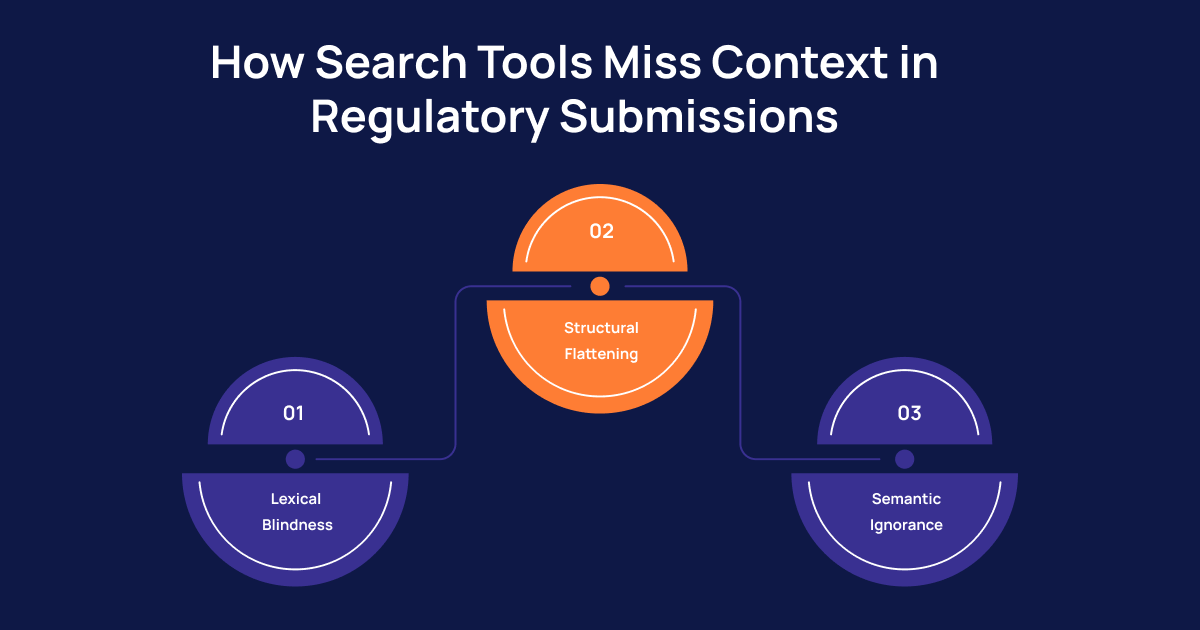
How Search Tools Miss Context in Regulatory Submissions

Context loss in standard regulatory document search occurs at three distinct levels:

Why Is Metadata Not Enough for Document Retrieval in Regulated Industries?

A common response to search failures is to invest in better metadata tagging. While metadata improves filtering (by document type, study phase, therapeutic area), it cannot solve the core document retrieval problem for two reasons.
First, the volume and velocity of unstructured data in pharma R&D make comprehensive manual tagging impractical. Today, an estimated 80% to 90% of all enterprise data is unstructured. For a mid-size pharma company managing thousands of clinical study reports, investigator brochures, and post-market surveillance filings, maintaining accurate metadata at scale is a resource drain that never reaches completeness.
Second, metadata captures attributes (author, date, document type) but not meaning. A metadata tag can label a document as “Phase III Clinical Study Report.” It cannot tell you whether that report contains a specific subgroup analysis for patients over 65 with renal impairment. The actual intelligence lives in the unstructured narrative, tables, and appendices within the document.

The Shift from Keyword Search to Semantic Search in Healthcare Documents

Semantic search for pharma represents a foundational shift in how clinical document search operates. Instead of matching tokens, semantic engines use vector embeddings to represent the meaning of queries and document passages in a shared mathematical space. A query for “cardiac safety signals in elderly patients” retrieves passages about “cardiovascular adverse events in geriatric populations” because the underlying meaning vectors are proximate, even though no keywords overlap.
This approach directly addresses the synonym, abbreviation, and contextual challenges that break keyword search. When combined with domain-specific training on medical ontologies (MedDRA, SNOMED CT, WHO-ART), semantic retrieval healthcare systems achieve significantly higher precision and recall on clinical corpora than general-purpose search tools.
RAG for life sciences (Retrieval-Augmented Generation) takes this further. A RAG architecture pairs semantic retrieval with a generative model that can synthesize answers grounded in the retrieved source documents. Instead of returning a list of 2,000 links, the system returns a direct answer: “Cardiac toxicity signals were observed in Study XYZ-301 (Module 5.3.5.3), primarily in patients aged 65+ with pre-existing QTc prolongation. See Table 14.3.1 for incidence rates.” The answer includes traceable citations back to the source, which is critical for GxP compliance and audit readiness.

How Intuceo Solves Contextual Search for Clinical and Regulatory Content

Intuceo’s approach to AI search in healthcare is built on a simple reality: generic enterprise search was never designed for the complexity of regulated content. Through two proprietary, modular engines, Intuceo delivers contextual search for regulated content at scale.

Intuceo-Ix™: Neural Search Intelligence (The Discovery Layer)

Intuceo-Ix™ goes beyond keyword matching to provide Neural Semantic Discovery. It understands the true context of clinical papers, regulatory submissions, FDA filings, and patent documents—reducing information retrieval time by 70%.

Intuceo-Dx™: Document and Vision Intelligence (The Ingestion Layer)

Intuceo-Dx™ addresses the critical upstream problem: converting complex, unstructured clinical documentation into structured, searchable “Gold Records.”

Built for Regulated Environments

Both Ix and Dx are deployable in air-gapped, on-premise, or private cloud environments (IL5/FedRAMP-ready). No proprietary data is used to train public models. This sovereign architecture, combined with compliance alignment for HIPAA, GxP, and 21 CFR Part 11, makes Intuceo’s document intelligence for pharma suitable for the most security-sensitive life sciences organizations.

Conclusion

The gap between what enterprise search tools deliver and what life sciences organizations actually need is not a minor inconvenience. It is a structural problem that affects research velocity, regulatory compliance timelines, and the quality of safety decisions. Keyword matching was built for general corporate content, not for the terminological density, structural complexity, and compliance rigor of clinical trial document retrieval and regulatory document search.
Closing this gap requires a shift to semantic search for life sciences, purpose-built for the domain, deployed in compliant environments, and architected to deliver traceable, contextual answers rather than keyword-matched links. For organizations ready to make that shift, the difference is not incremental. It is the difference between searching for information and actually finding it.

See How Intuceo Transforms Clinical Document Search

Discover how Intuceo-Ix™ and Intuceo-Dx™ reduce information retrieval time by 70% across millions of clinical and regulatory documents, all within HIPAA and GxP-compliant environments.

Frequently Asked Questions

Keyword search matches exact terms in a query against indexed tokens in a document. Semantic search for life sciences uses vector embeddings to match the meaning of a query to the meaning of document passages, enabling accurate retrieval even when the exact words differ. This is critical for medical terminology search, where synonyms, abbreviations, and acronyms are pervasive.
AI-powered semantic retrieval healthcare systems are trained on domain-specific ontologies such as MedDRA, SNOMED CT, and UMLS. This training allows the system to recognize that “MI,” “myocardial infarction,” and “heart attack” refer to the same clinical concept, enabling synonym matching in medical documents that keyword engines cannot achieve.
Most conventional systems do not handle them well. Abbreviations like “AE” (adverse event), “SAE” (serious adverse event), and “TEAE” (treatment-emergent adverse event) are either missed or conflated with unrelated acronyms. Neural search systems trained on life sciences corpora resolve these abbreviations contextually, based on the surrounding text and document type.
Three elements drive improvement: domain-specific model fine-tuning on clinical and regulatory corpora, integration with established medical ontologies for entity resolution, and a RAG for life sciences architecture that grounds every retrieved result in verifiable source documents. This combination ensures both precision and auditability.
Irrelevant results stem from three gaps: lexical ambiguity (the same word meaning different things in different contexts), structural flattening (loss of document hierarchy during indexing), and semantic blindness (inability to interpret negation, temporal qualifiers, and conditional statements). Addressing all three requires moving from token-based to meaning-based information retrieval.

Does Intuceo Offer On-Premise Advanced Analytics for FDA-Regulated Studies?

Pharmaceutical and life sciences organizations generate enormous volumes of sensitive data across clinical trials, pharmacovigilance programs, manufacturing lines, and post-market surveillance. The global pharmacovigilance market alone was valued at USD 9.35 billion in 2025 and is projected to reach USD 31.56 billion by 2034, growing at a CAGR of 14.69%. Yet much of this data is subject to strict regulatory controls, including FDA 21 CFR Part 11, GxP standards, and HIPAA requirements that determine not just how data is analyzed but where it physically resides.
For companies bound by these constraints, the question is not whether analytics can improve outcomes. It is whether the analytics platform can operate inside the organization’s own security perimeter without compromising on capability. That is the core question this post addresses: Does Intuceo support on-premise deployment for regulated life sciences data, and what does that look like in practice?

Why On-Premise Still Matters in FDA-Regulated Environments

Cloud adoption continues to accelerate across healthcare and pharma. Yet on-premise deployment held the largest share (55%) of the pharmaceutical analytics market by deployment mode in 2025. The reasons are practical, not philosophical. FDA-regulated analytics workflows frequently involve patient-level clinical data, adverse event records, and proprietary R&D datasets that organizations are either unwilling or legally unable to move outside their controlled perimeter.
Regulatory mandates like 21 CFR Part 11 require validated electronic record-keeping with immutable audit trails, controlled access, and documented data lineage. In clinical and pharmacovigilance settings, this extends to precise chain-of-custody documentation for every data transformation that feeds into an FDA submission. When the analytics platform resides on-premise or within a private cloud, the organization retains direct control over data residency, encryption, and access governance, factors that simplify audit readiness considerably.
Additionally, the FDA’s recent rollout of its new Adverse Event Monitoring System (AEMS), consolidating FAERS, VAERS, and other legacy databases into a single platform, signals increasing regulatory expectations around real-time reporting and submission accuracy. Organizations that can process, classify, and validate adverse event data internally, before it reaches the FDA, are better positioned to meet these heightened standards.

Intuceo's Approach: Deployment Sovereignty for Regulated Industries

Intuceo positions its architecture around a principle it calls “Deployment Sovereignty.” The concept is straightforward: your data constraints should drive your infrastructure choices, not vendor limitations. Intuceo’s life sciences AI solutions are engineered to deliver equivalent performance across Azure, AWS, GCP, on-premise, or hybrid environments. For defense and public sector clients, Intuceo also supports air-gapped deployments at IL5/FedRAMP levels, a capability that extends directly to life sciences organizations requiring maximum isolation.
This infrastructure flexibility means that a pharma company running a secure analytics platform behind its own firewall gets the same analytical depth as one operating in a managed cloud environment. Intuceo’s proprietary assets, including Intuceo-Ax (augmented analytics), Intuceo-Ix (neural enterprise search), and Intuceo-Dx (document intelligence), are all designed to be deployed within secure, private environments with zero data leakage to external models or public endpoints.

Handling FDA-Compliant Analytics Workflows

Regulatory compliance in life sciences is not a feature to be added after the fact. Intuceo engineers its data infrastructure with what it describes as a “Regulated-by-Design” architecture, meaning compliance is embedded at the platform level rather than layered on top.
In practical terms, this covers several critical areas for compliance data analytics:
Clinical data analytics and trial operations benefit from AI-driven protocol modeling, real-time site performance monitoring, and automated FDA reporting workflows. Intuceo’s patient matching capability uses generative AI to parse complex clinical trial protocols and identify eligible patient cohorts with precision, directly addressing one of the most resource-intensive stages of clinical development.
Pharmacovigilance analytics software capabilities include automated Adverse Event Report (AER) classification and Periodic Safety Master File (PSMF) optimization. Traditional AI models in this space provide binary predictions (adverse event: yes or no) but fail to supply the rationalization that regulators require. Intuceo addresses this with Explainable AI (XAI) frameworks that generate evidence-based rationale alongside each classification, achieving full regulatory fidelity while reclaiming significant expert hours that would otherwise be spent writing manual justifications for AE determinations.
Quality compliance analytics and manufacturing oversight are supported through automated CAPA (Corrective and Preventive Action) root-cause analysis and immutable, audit-ready documentation that satisfies HIPAA, GDPR, and GxP standards simultaneously.

Working with Legacy Systems and Fragmented Data

Most pharma and healthcare organizations operate with a mix of legacy databases, disconnected LIMS, PLM, and EHR systems, and fragmented regulatory filing repositories. Data quality problems at the source directly compromise the reliability of any downstream pharmaceutical data platform.
Intuceo’s data engineering practice addresses this directly. Its orchestration pipelines ingest structured, semi-structured, and unstructured data from legacy on-premise systems and cloud environments alike. Intuceo-Ix, the neural search engine, indexes millions of documents across SharePoint, LIMS, PLM, clinical trial databases, FDA filings, and patent repositories. The firm reports an 800% reduction in time spent on information discovery for R&D knowledge workers, alongside $6M in measured productivity savings for Fortune 500 pharma R&D departments.
This legacy data modernization approach layers intelligence on top of existing infrastructure rather than requiring wholesale migration, activating research data that was previously dormant or inaccessible.

Reducing Manual Effort in Adverse Event Detection and FDA Submissions

The FDA’s transition to the ICH E2B(R3) standard for electronic adverse event submissions, with a full compliance deadline of April 2026, is pushing pharmaceutical companies to fundamentally rethink their pharmacovigilance workflows. Manual case processing, once the industry default, cannot scale to meet real-time reporting expectations.
Intuceo’s adverse event detection AI directly addresses this shift. Its modeling capabilities go beyond surface-level classification to determine whether a complaint constitutes an adverse event, while simultaneously generating the rationalization layer that GxP standards demand. This combination of prediction accuracy and regulatory explainability separates Intuceo’s approach from generic AI tools that produce outputs but cannot justify them to an auditor.
The result is a measurable reduction in expert hours devoted to manual AE review and write-up, freeing pharmacovigilance professionals to focus on safety signal analysis and regulatory strategy.

The PhD-Led Difference in Regulated Environments

Operating in FDA-regulated spaces demands more than technical competence. It requires domain fluency, an understanding of why a specific validation protocol exists, what an auditor will scrutinize, and how a model’s output will be used in a regulatory submission.
Intuceo’s team of 80+ data scientists, led by PhD-level architects, brings specialized experience across life sciences, healthcare, and public sector regulatory environments. With over 100 enterprise-grade engagements completed, the firm has delivered clinical study analytics, manufacturing quality optimization, and knowledge engineering solutions for organizations including Johnson & Johnson, Bausch & Lomb, Janssen Pharma, and Ferring Pharma.
This scientific depth is operationalized through Intuceo’s proprietary iPDLC™ framework, which compresses implementation timelines by up to 4x while maintaining the validation rigor required for GxP-compliant environments.

Considering on-premise or hybrid analytics for your regulated data environment?

Intuceo’s PhD-led engineering teams architect FDA compliance analytics solutions that operate within your security perimeter, with full audit-readiness from Day 1.

Frequently Asked Questions

Intuceo is infrastructure-agnostic. Its solutions are engineered for cloud (Azure, AWS, GCP), on-premise, hybrid, and air-gapped deployments. All proprietary assets, Intuceo-Ax, Intuceo-Ix, and Intuceo-Dx, can operate entirely within a private, firewalled environment with no data exposure to external endpoints.
Yes. Intuceo’s architecture is natively aligned with FDA 21 CFR Part 11, GxP, and HIPAA standards. This includes validated electronic record-keeping, immutable audit trails, end-to-end data lineage, and role-based access controls, all built into the platform rather than added as an afterthought.
Intuceo covers the full life sciences value chain: R&D analytics for pharma, clinical data analytics, manufacturing quality (CAPA, OEE), pharmacovigilance analytics (automated AER classification), and post-market surveillance. Each capability is designed for the specific compliance and data integrity requirements of its domain.
Yes. Intuceo’s data engineering pipelines are built to integrate with legacy LIMS, PLM, EHR, and regulatory filing systems. Its Intuceo-Ix neural search engine can index 5M+ documents across disconnected repositories, enabling healthcare data integration and knowledge discovery without requiring a full-scale migration.
Intuceo implements a “Regulated-by-Design” architecture with automated data profiling, anomaly detection, and stewardship orchestration. Its governance frameworks are pre-vetted for FDA 21 CFR Part 11, HIPAA, FISMA, GxP, GDPR, and SOC 2 Type II. Continuous compliance monitoring and automated audit logging ensure persistent regulatory readiness.