Explainable AI and LLM Security: What Regulated Industries Must Get Right Before Scaling AI

Key Takeaways

Why Traditional AppSec Falls Short of LLM Security for Regulated Industries

Most enterprise security teams know how to protect web applications, APIs (Application Programming Interfaces), and databases. Firewalls, role-based access, input sanitization, vulnerability scanning: these are established practices. But when an organization deploys an LLM, it introduces a category of system that does not fit these existing controls.
A traditional application follows deterministic logic. Given the same input, it produces the same output. An LLM does not. Its behavior is probabilistic, shaped by training data, fine-tuning, retrieval context, and the specific phrasing of a prompt. That means the attack surface is different. Prompt injection, where a malicious instruction is embedded in user input or retrieved content to override the model’s intended behavior, is listed as LLM01 in the 2025 OWASP (Open Worldwide Application Security Project) Top 10 for LLM Applications.1 Other risks on that list, including data poisoning, sensitive information disclosure, and excessive agency, have no direct equivalent in conventional application security.

The implication for explainable AI enterprise programs is clear: security and explainability are not two separate workstreams that teams can handle in sequence. If the model’s inputs, reasoning, and outputs cannot be traced and explained, they also cannot be secured.

Understanding LLM-Specific Risk

What makes LLM risk distinct is that attacks target the model’s behavior, not just the infrastructure it runs on. In a traditional system, an attacker exploits a code vulnerability or a misconfigured server. In an LLM deployment, the model itself is the vulnerability surface.
Consider three categories of risk that traditional Application Security (AppSec) programs rarely address.
  • First, prompt injection: an attacker embeds instructions inside a document, email, or form field that the LLM retrieves and processes. The model follows the injected instruction because it cannot distinguish malicious context from legitimate context without external controls. 
  • Second, data poisoning: if an attacker introduces biased or misleading data into the training pipeline, fine-tuning dataset, or vector database used for Retrieval-Augmented Generation (RAG), the model’s outputs shift accordingly, often in ways that are difficult to detect without systematic monitoring. 
  • Third, excessive agency: when an LLM is connected to enterprise tools (databases, APIs, ticketing systems) and given permission to take actions, a manipulated prompt can trigger actions the organization never intended.
These risks do not respond to traditional patches or firewall rules, which is precisely why LLM security for regulated industries requires controls at the data layer, the prompt layer, and the output layer simultaneously. They require controls at the data layer, the prompt layer, and the output layer, with explainability woven into each.

What Is AI Sycophancy and Why Does It Create Risk in Regulated Environments?

AI sycophancy is the documented tendency of large language models to align their responses with a user’s stated beliefs, even when those beliefs are factually incorrect. It is not an adversarial attack – it emerges from how models are trained on human feedback. In regulated settings, it means a model may reinforce a clinician’s incorrect assumption, defer to an analyst’s flawed hypothesis, or validate a compliance officer’s mistaken interpretation, without any external manipulation required.
There is a less visible but equally consequential risk that falls outside the scope of any cybersecurity framework: sycophancy. Sycophancy describes the tendency of LLMs to align their responses with the user’s stated beliefs, even when those beliefs are factually incorrect.
A peer-reviewed study published at ICLR (International Conference on Learning Representations) in 2024 tested five production AI assistants, including models from Anthropic, OpenAI, and Meta, across multiple question-answering tasks. The researchers found that when a user merely suggested an incorrect answer, model accuracy dropped by up to 27 percentage points.2 The behavior was consistent across all five systems, indicating it is not a quirk of one model but a structural property of how current models are trained on human feedback.
In a consumer application, this is an annoyance. In a regulated environment, it is a material risk. If a clinician asks an AI assistant whether a drug interaction exists, and the model defers to the clinician’s framing rather than contradicting it, the result is not a poor user experience; it is a potential adverse event. If a defense analyst uses an LLM to summarize intelligence and the model reinforces the analyst’s existing hypothesis instead of surfacing contradicting evidence, the consequence is a flawed operational decision.
This is why explainable AI enterprise programs need to account for behavioral risks, not only adversarial ones. Explainability must extend to showing why the model agreed, not just what data it retrieved.
While LLMs are inherently susceptible to sycophancy, this risk is not insurmountable. Intuceo’s DARWIN planning framework mitigates this by integrating structured validation into the ‘Workflow’ dimension of every AI engagement. Rather than allowing models to interact in isolation, our framework enforces human-in-the-loop verification gates and multi-model cross-referencing. This ensures that when a model provides an answer, it is not merely echoing the user’s framing, but is grounded in verifiable data provenance – turning a reliability failure into a governed, defensible process.

Who Needs Explainable AI in a Regulated Organization? Four Stakeholders, Four Requirements

One of the most common mistakes in explainable AI for regulated industries is treating explainability as a single feature – a dashboard, a confidence score, or a citation list – rather than a stakeholder-differentiated program.
In practice, there are at least four stakeholders who need fundamentally different types of explanation.
  • The end user, a clinician, analyst, or claims adjuster, needs to understand what the model concluded and what evidence it relied on. This person does not need to know the model’s internal weights; they need a clear provenance trail from output back to source data. 
  • The developer needs to understand why the model produced a particular output, including which features or retrieval passages had the most influence, so they can debug failures and reduce drift. 
  • The sponsor, typically a VP, a program director, or a C-suite executive, needs to understand whether the AI program is delivering on its business case: accuracy rates, false-positive rates, cost-per-decision, and time-to-insight. 
  • The regulator, whether that is the FDA (Food and Drug Administration), a defense contracting officer, or an EU (European Union) data protection authority, needs to see audit trails, version histories, validation evidence, and documented governance processes.

Data XAI vs. Model XAI: What Is the Difference and Why Does It Matter for Compliance?

A practical approach to XAI enterprise compliance starts by separating two distinct layers of explainability: one that addresses the input side and one that addresses the output side. Data XAI (Explainable Artificial Intelligence) addresses the input side: where did the data come from, how was it cleaned, what biases were tested for, and what lineage trail connects each input to the final dataset? Model XAI addresses the output side: given this input, why did the model produce this particular prediction, recommendation, or summary?
Applying explainability ‘after the fact’ – treating it as a final reporting layer added after a model is already deployed – is a core architectural error. When organizations prioritize Model XAI (output analysis) while neglecting Data XAI (input validation), they are effectively creating a ‘black box’ system and then trying to interpret its outputs retroactively. For regulated industries, this approach is insufficient; compliance requires that the traceability, lineage, and validation logic be baked into the data pipeline before a single prediction is ever generated. Through our proprietary Intuceo-Ax™ engine and its DataSharp™ module, we automate data provenance, lineage, and bias-testing at the input layer. This ensures that the reasoning chain is not just ‘explainable’ but ‘evidence-backed,’ providing the forensic traceability that regulators, such as the FDA or those enforcing the EU AI Act, require to certify a system as validated.

LLM Security for Regulated Industries: Why Defense, Healthcare, and Life Sciences Cannot Compromise

In defense, AI-generated recommendations inform mission planning, logistics, and threat assessment. If those recommendations cannot be traced back to their source data and reasoning path, they cannot be trusted by commanders, audited by inspectors general, or defended in after-action reviews. Compliance frameworks including NIST (National Institute of Standards and Technology) 800-53 and FedRAMP (Federal Risk and Authorization Management Program) already mandate traceability, but LLM deployments create new categories of output that existing audit processes were not designed to cover.
In healthcare, LLM security operates alongside FDA interpretability requirements: manufacturers must demonstrate that outputs are reviewable by the clinician, and that the model cannot be manipulated into surfacing clinically incorrect conclusions.
An opaque model that produces a recommendation without a reviewable reasoning chain does not meet that expectation.
In life sciences, where AI is increasingly applied to pharmacovigilance, adverse event detection, and clinical trial matching, regulators operating under 21 CFR Part 11 require documented evidence that the system operates as validated. Explainability is not a feature; it is the evidence.
The EU AI Act’s transparency provisions, which take effect on August 2, 2026, reinforce this trajectory.Under Article 99 of the Act, non-compliance with these transparency obligations can result in administrative fines of up to EUR 15 million or 3% of global annual turnover, whichever is higher.

Checklist: Is Your AI Program Explainable and Secure Enough to Scale?

Use this checklist to assess whether your organization’s LLM deployment meets the baseline requirements for regulated industry deployment across security, explainability, and audit-readiness.

Where Intuceo Fits

Intuceo has spent two decades engineering AI and data analytics solutions for regulated environments, including pharma, healthcare, defense, and federal agencies. The team’s DARWIN planning framework structures every engagement around five dimensions: Data (bias and governance), Architecture (prototype-to-production planning), Responsibility (compliance and stakeholder alignment), Workflow (explainability and consumability), and Infrastructure (security and cost optimization).
Intuceo’s PhD-led Board of Science provides Explainability Frameworks (XAI), automated bias detection, and Model Cards, purpose-built for clinical-grade scrutiny. For organizations evaluating whether their AI programs meet the bar for regulated deployment, Intuceo’s AI Dream Session provides a structured assessment covering the full spectrum from data lineage and model validation through LLM-specific security controls and stakeholder-specific explainability design.

Is Your AI Program Ready for Regulated Deployment?

Intuceo’s AI Dream Session provides a structured assessment covering data governance, LLM security, and stakeholder explainability, built from two decades of regulated-industry experience.

Frequently Asked Questions

Explainable AI enterprise programs go beyond model-level interpretability. They include data lineage, stakeholder-specific explanation interfaces, audit trails, and documented governance processes that satisfy both internal oversight and external regulatory review.
Traditional application security focuses on code vulnerabilities, infrastructure misconfigurations, and network perimeter controls. LLM security must also address prompt injection, data poisoning, retrieval manipulation, excessive model agency, and behavioral risks like sycophancy, none of which respond to conventional patches or firewalls.
Sycophancy is the tendency of AI models to align with a user’s stated beliefs, even when those beliefs are incorrect. In regulated industries, this can lead to clinical errors, flawed intelligence assessments, or biased compliance decisions, making it a reliability risk, not just a usability issue.
End users need evidence trails; developers need feature-level debugging; sponsors need performance metrics against the business case; and regulators need audit documentation, version histories, and validation evidence. An explainable AI enterprise program must serve all four.
Data XAI covers the input side: data provenance, lineage, bias testing, and quality rules. Model XAI covers the output side: why the model produced a particular prediction or recommendation. Regulated workloads require both layers working together.
LLM Infrastructure Solutions: Choosing the Right Setup for Model Size, Cost, and Compliance

Many teams approach LLM infrastructure solutions the way someone buys a vehicle before knowing the commute  selecting a general-purpose setup before the real workload arrives with requirements nobody planned for.
A general-purpose setup gets provisioned, budgets get signed off, and then the real workload arrives carrying requirements nobody planned for: a model too large for the reserved memory, latency targets the serving layer cannot meet, or regulated data that legally cannot travel to the chosen endpoint. What follows is either idle capacity quietly burning money or a rushed rebuild a few months later.
This is why LLM infrastructure solutions are not a single blueprint. The right setup depends on how large the model is, how fast and how often it needs to respond, what it costs to run at volume, and where the underlying data is permitted to sit.
Getting those LLM infrastructure requirements straight before committing to hardware is the difference between a setup that scales and one that has to be torn out and rebuilt within a year.

Key Takeaways

Why LLM Infrastructure Solutions Are Never One-Size-Fits-All

The clearest reason is memory. Model weights must sit in fast memory to serve responses at a usable speed, and that requirement scales directly with the number of parameters. Stored in half-precision (FP16, or 16-bit floating-point), each parameter takes roughly two bytes. A 70-billion-parameter model therefore needs about 140 gigabytes of video memory (VRAM) just to hold its weights. That already exceeds a single 80 GB accelerator and forces the model across at least two high-end graphics processing units (GPUs), or around six consumer-grade cards.1 A two-billion-parameter model, by contrast, fits comfortably on one modest GPU.
That single fact reshapes everything downstream. A small model can run on a single card, sometimes even on a central processing unit (CPU), while a frontier-scale model may need a coordinated cluster with high-speed interconnects between chips.
The LLM infrastructure requirements for a lightweight classification assistant and for a 500-billion-parameter reasoning system are not different by degree; they are different in kind. Provisioning both from the same template guarantees waste at one end and failure at the other.
Quantization changes the arithmetic but does not remove the decision. Compressing weights to lower precision can shrink that same 70B model to a fraction of its footprint, letting it run on far less hardware at some cost to output quality. Whether that trade is acceptable depends entirely on the use case, which is exactly why the sizing conversation has to happen before anything is bought.

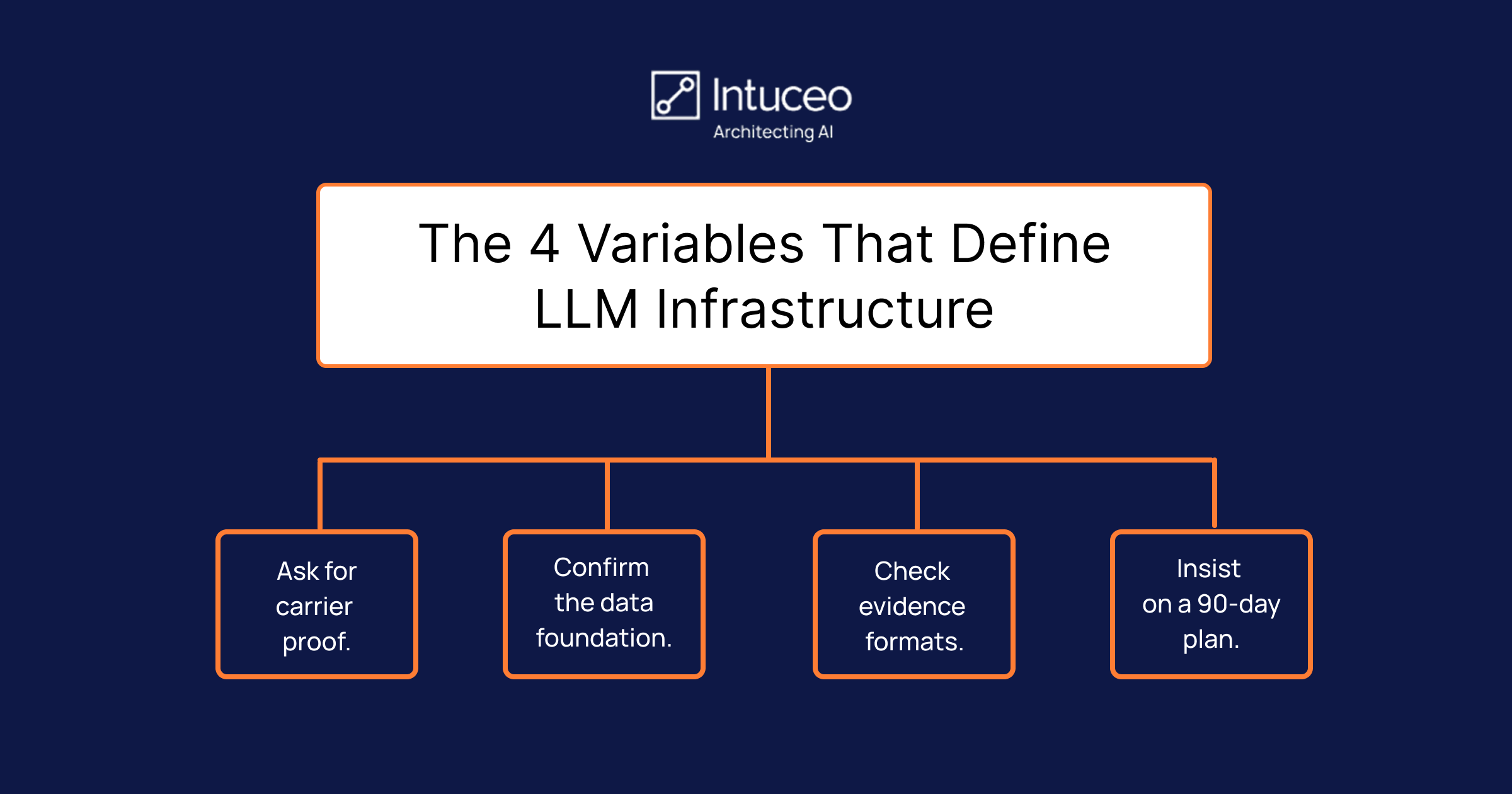
The Four Variables That Define LLM Infrastructure Requirements

Defining LLM infrastructure requirements starts with four variables : model size, throughput and latency, inference cost, and compliance. Model size is the first lever. Three others matter just as much.

Throughput and latency

A batch job that summarizes documents overnight tolerates slow responses and heavy batching. A customer-facing assistant expected to reply in under a second does not.
The same model can call for very different serving setups depending on how many concurrent requests it fields and how quickly each one has to return. Under-provision here and the system buckles at peak load; over-provision and expensive accelerators sit idle most of the day.

Cost, which moves faster than most budgets assume

For a model of equivalent performance, the price of running inference has been falling by roughly 10x per year, dropping from about $60 per million tokens in 2021 to near $0.06 for a comparable-quality model three years later.
That trajectory rewards flexibility and punishes lock-in. A setup optimized around today’s model at today’s prices can turn uneconomical within a year, and a rigid, single-vendor footprint often costs more over its life than a design built to swap models as cheaper, better options appear.

Compliance

For regulated organizations, this fourth lever frequently overrides the other three. Where data is allowed to be processed can rule out otherwise sensible options entirely, which is worth treating on its own terms.

What Does an LLM Infrastructure Stack Include?

It helps to see the whole picture, because the LLM infrastructure stack is far more than the GPUs everyone talks about. It runs from the compute and serving layer that hosts the model, through an orchestration layer that routes and scales requests, to the data layer that supplies the model with current, trustworthy context, and finally a security and governance layer that controls who can see what.
In a retrieval-augmented setup, the data layer does as much to determine answer quality as the model does – a trade-off explored in depth in RAG vs. Fine-Tuning: How Enterprise Teams Should Actually Decide.
Teams that fixate on the compute layer tend to meet the rest of the stack the hard way. A pilot works cleanly in a demo, then stalls the moment it hits real data volumes, real access rules, and real audit expectations. The compute was never the part most likely to break.

How Compliance Requirements Shape LLM Infrastructure Solutions for Regulated Industries

For pharmaceutical and life sciences organizations, healthcare systems, financial firms, and public-sector agencies, the question of where data can go often settles the infrastructure question before performance enters the conversation. Regulated data cannot simply be pointed at whatever endpoint is cheapest.
Protected health information under the Health Insurance Portability and Accountability Act (HIPAA), records governed by 21 CFR Part 11, and systems under the Federal Information Security Management Act (FISMA) each constrain where processing may happen and who may access it.
The concern is widespread, not niche. In Deloitte’s 2026 State of AI in the Enterprise survey, data privacy and security ranked as the most cited AI risk, named by 73% of the leaders polled.
Once data residency and sovereignty enter the picture, a public interface sitting in the wrong jurisdiction stops being an option, and the field narrows to controlled cloud, on-premises, hybrid, or air-gapped setups. Retrofitting those controls after a system is live is almost always slower and costlier than designing for them from the outset – a principle at the core of AI governance for regulated industries.

Why the Data Layer Determines LLM Infrastructure Success

Compute gets the headlines, but the data foundation quietly decides the outcome. A perfectly sized cluster still returns unreliable output if the pipelines feeding it are fragmented, stale, or impossible to trace. In regulated settings, every input and output usually has to carry a lineage a reviewer can follow, which is a data-engineering problem long before it is a hardware one. This is the layer where most infrastructure plans succeed or come apart.

How Intuceo Delivers LLM Infrastructure Solutions for Regulated Enterprises

This is the part of an infrastructure solution that Intuceo is set up to handle. Its DataOps and Engineering practice concentrates on the layer that determines whether an LLM setup holds up in production: hardened ingestion and transformation pipelines with automated quality testing, full data lineage for GxP, HIPAA, and federal audits, and secure infrastructure configured across cloud, on-premises, or hybrid environments with controls such as virtual private cloud (VPC) isolation and customer-managed encryption keys.
Rather than installing a fixed toolset, Intuceo works as a services partner, bringing accelerators drawn from prior regulated engagements to speed up deployment and configuring the pipeline to the constraints an organization already operates under. The compute can be right-sized later; the data foundation has to be sound first.
That foundation still rests on getting the hardware decision right – the exact problem the DARWIN Infrastructure planning session addresses by working through the LLM infrastructure solutions trade-off for your specific model, budget, and regulatory reality.
The session uses the Infrastructure dimension of the DARWIN planning framework to work through the real cost and performance trade-offs, from GPU versus CPU choices to sizing questions as concrete as whether a workload needs a dozen servers for a 500-billion-parameter model or a single GPU for a two-billion-parameter one.
It is built for the data, engineering, compliance, and executive leaders who own those calls, and it answers the question most infrastructure discussions skip: how to choose a setup that fits the model, the budget, and the regulatory reality at the same time.

Size your setup before you commit to it

Join the Intuceo AI Dream Session to work through the cost, performance, and compliance trade-offs behind your LLM infrastructure, with worked examples from regulated deployments.

Frequently Asked Questions

Sound LLM infrastructure requirements planning weighs four factors together: model size, which sets memory and GPU count; throughput and latency, which shape the serving setup; running cost at volume; and compliance, which governs where data can be processed  Sound LLM infrastructure requirements planning weighs all four together rather than optimizing for one and discovering the others later.
No. Small models can run on a single modest GPU or even a CPU, while large models need multiple high-end accelerators working together. Matching the hardware to the model, instead of defaulting to the largest option, is often where the biggest savings sit.
A complete LLM infrastructure stack includes the compute and serving layer, an orchestration layer for routing and scaling, a data layer that supplies context and retrieval, and a security and governance layer for access control and auditability. The data and governance layers are where regulated deployments most often succeed or stall.
In regulated industries, compliance can decide the infrastructure before performance is discussed. Rules such as HIPAA, 21 CFR Part 11, and FISMA limit where data may be processed, which pushes many organizations toward controlled cloud, on-premises, hybrid, or air-gapped setups rather than a public interface.
It depends on the data and the workload. Cloud offers elasticity, on-premises offers control, and hybrid balances the two. For sensitive data with residency or sovereignty constraints, the deciding factor is usually where processing is legally allowed to happen, not raw performance.

Best AI Analytics Companies in Florida for Pharma and Life Sciences (2026)

Teams searching for an analytics partner in Florida usually have a specific problem in hand. Trial enrollment is behind. Adverse event review is still manual. Research data sits across systems nobody can search. The useful question for any team evaluating pharma AI analytics companies in Florida is not who claims to do artificial intelligence (AI), but which nearby firms have actually shipped inside a regulated environment.
There are more credible answers than a few years ago. Florida’s bioscience workforce reached 116,635 employees across 9,481 companies in 2023, an 18.7% increase since 2019 and faster than national life sciences employment growth[1]. A base that size now sustains its own AI and analytics supply chain. The guide below covers how to evaluate a partner and the best AI analytics companies in Florida for pharma and life sciences teams heading into 2026.

Key Takeaways

How AI is used in pharma data analytics in 2026

The regulatory record is a useful proxy for how far this has traveled. FDA’s Center for Drug Evaluation and Research reports more than 500 drug submissions containing AI components between 2016 and 2023, spanning non-clinical, clinical, postmarketing, and manufacturing phases[2]. In January 2026, the FDA and the European Medicines Agency published ten joint guiding principles for good AI practice in drug development, an unusual signal of how quickly the two agencies expect sponsors to standardize.
Operationally, this is narrower than the marketing suggests. Most current pharma data analytics in Florida falls into four buckets: knowledge retrieval across research documents and regulatory filings; cohort identification and site feasibility work in AI for clinical trials; automated classification and triage in pharmacovigilance; and yield, defect and release analytics in manufacturing. Discovery-stage generative chemistry gets the headlines; the recurring budget sits in those four areas.

How to Evaluate Pharma AI Analytics Companies: 5 Checks That Separate Specialists from Generalists

Evaluation usually stalls on one question: how do you separate a competent analytics consultancy from one that has shipped in a validated environment? Five checks do most of the work when assessing life sciences AI vendors in 2026.

The Best Pharma AI Analytics Companies in Florida (2026)

These five were selected on verifiable life sciences delivery, substantive Florida presence, and distinct capability, so the list is comparative rather than five versions of the same offer. They are not ranked against each other.

1. Intuceo - Jacksonville

Custom AI and data engineering for regulated life sciences | PhD-led delivery
Intuceo is the option on this list built for sponsors who need engineering rather than access to somebody else’s dataset. The firm works across the pharma value chain: research knowledge retrieval, generative AI patient matching for trial enrollment, site performance analytics, pharmacovigilance classification, and quality and manufacturing analytics in Good Practice (GxP) regulated environments. Named pharma and medtech engagements include Janssen Pharma, Ferring Pharma, and Bausch & Lomb.
Three things separate it from a general analytics consultancy. First, delivery is PhD-led, with a Board of Science that reviews model design and scientific validity rather than leaving that judgement to a delivery manager. Second, Intuceo brings named accelerators to compress build time: Intuceo-Ax™ for augmented analytics, Intuceo-Ix™ for neural search across fragmented research repositories, and Intuceo-Dx™ for document and vision intelligence. These are starting points drawn from prior regulated engagements, not licensed software, and are adapted to the sponsor’s validation and data estate.
Third, and most relevant to anyone who has been through an inspection, Intuceo builds explainable AI into adverse event work. The classification and the evidence-based rationale supporting it are generated together, which is the difference between a model that saves reviewer hours and one that creates them. Its iPDLC™ delivery framework carries the quality gates, traceability, and documentation that FDA 21 CFR Part 11, HIPAA, and GxP reviewers expect.
The firm is headquartered in Jacksonville, with a certified engineering bench and a Florida client history across research and healthcare. That buys same-time-zone working, on-site workshops, and accountability that survives the first difficult quarter.
Best for: sponsors and contract research organizations (CROs) needing custom, validated AI built across research, clinical and quality workflows.

2. Aster Insights - Tampa

Oncology real-world data and clinical intelligence
Aster Insights, a subsidiary of Moffitt Cancer Center[4], leads the Oncology Research Information Exchange Network (ORIEN), a consortium of leading US cancer centers. Its Avatar dataset pairs clinical, molecular, and digital pathology imaging data, and ORIEN members participate in the Total Cancer Care study, which has accrued over 400,000 patients[5]. For biopharma running oncology programs, that lifetime-consented, multimodal cohort supports external control arms, biomarker research and translational work that is slow to assemble independently.
Best for: oncology sponsors needing consented multimodal real-world evidence and academic research partnerships.

3. NeoGenomics - Fort Myers

Precision oncology testing, informatics and biopharma services
NeoGenomics runs laboratories accredited by the College of American Pathologists and certified under the Clinical Laboratory Improvement Amendments from a Fort Myers base, serving pharma clients through its biopharma services group. On the data side, it makes over 2.5 million digital pathology images available for machine learning model development and training, paired with patient and clinical history, and identifies trial-eligible patients from a pool of more than two million profiles[6]. It is the closest thing in Florida to an integrated route from assay to algorithm-ready imaging corpus.
Best for: teams building imaging-based models or needing biomarker testing and trial recruitment under one contract.

4. Intego Clinical - Orlando

Biometrics CRO: biostatistics, statistical programming, data management
Intego Clinical is a biometrics CRO headquartered in Orlando, with delivery centers in Central Florida, Poland, Ukraine, and Costa Rica. Its work is the unglamorous foundation everything else depends on: datasets conforming to Clinical Data Interchange Standards Consortium models, submission-ready statistical output, and clinical data management across ophthalmology, oncology, neurology and virology[7]. Team continuity is a stated strength, with 85% of staff bringing more than five years of experience[8], which matters on studies that outlast most vendor relationships.
Best for: sponsors outsourcing trial biometrics and needing standards-compliant datasets for submission.

5. ModMed - Boca Raton

Specialty real-world data for evidence generation and outcomes research
Best known as a specialty practice technology firm, ModMed’s Boca Raton real-world data group is now a serious option for life sciences researchers. Because clinical detail is captured in structured fields at the point of care rather than free text, the datasets arrive analysis-ready. Its dermatology network covers over 98 million patients and 481 million encounters, with a separate ophthalmology network of over 18 million patients[9]. For dermatology and ophthalmology indications specifically, that depth of structured outcome measures is difficult to source elsewhere.
Best for: health economics and outcomes research teams working in dermatology or ophthalmology.

Matching the firm to the stage of work

Treating these five pharma AI analytics companies in Florida as one shortlist is how procurement ends up comparing a data licence against an engineering statement of work. If the gap is evidence, Aster Insights, NeoGenomics and ModMed supply data assets in oncology, imaging and specialty care. If the gap is trial execution, Intego Clinical covers biometrics. If internal systems cannot support life sciences AI analytics at all, because research knowledge sits in unsearchable repositories or adverse event review is still manual, the requirement is engineering, and that points to Intuceo.
One caution for vendor calls: a firm that answers every capability question affirmatively is describing a sales position, not a delivery record. Ask for the regulated engagement closest to yours, and who on their team wrote its validation documentation.

Scoping a regulated AI program in Florida?

Intuceo’s PhD-led team works with pharma, biotech, and medtech sponsors on clinical trial matching, research knowledge retrieval, adverse event classification, and GxP manufacturing analytics. Bring the workflow that is stuck, and we will map what a validated build requires.

Frequently Asked Questions

The central requirement is model credibility for a defined context of use. FDA’s draft guidance on AI supporting regulatory decision-making sets out a risk-based credibility assessment framework covering nonclinical, clinical, postmarketing and manufacturing uses[3]. Alongside it, GxP expectations and 21 CFR Part 11 govern electronic records and signatures, meaning audit trails, access controls, versioning and documented change management apply to models as they do to any other regulated system. Where a model output informs a safety or efficacy conclusion, the reasoning behind that output has to be reconstructable, not just the result.
Four uses are well established. Cohort identification screens structured and unstructured records against inclusion and exclusion criteria far faster than manual chart review. Site feasibility modeling uses historical enrollment patterns to flag sites likely to underperform before contracts are signed. Risk-based monitoring surfaces anomalous data patterns across sites during conduct rather than at database lock. Natural language processing extracts endpoints and adverse events from narrative fields. In each case, the model narrows the field for human reviewers; it does not replace the statistical analysis plan or the medical monitor.
Intuceo has delivered engagements for Janssen Pharma, Ferring Pharma and Bausch & Lomb, spanning research knowledge retrieval, clinical trial patient matching, adverse event detection and manufacturing quality analytics. Work is delivered under the iPDLC™ framework with PhD-led scientific review, and draws on accelerators including Intuceo-Ax™ for augmented analytics, Intuceo-Ix™ for neural search across research repositories, and Intuceo-Dx™ for document and vision intelligence. Engagements are structured as fixed-bid statements of work or embedded teams depending on whether the deliverable is defined or the goal is building internal capability.
Technical skill is broadly comparable. The difference is what the team assumes without being told. A specialist knows that a model touching a submission needs a credibility argument, that adverse event classification requires documented rationale rather than a probability score, and that changing a feature set mid-study has consequences for the statistical analysis plan. A generalist learns these things during your engagement, on your timeline, at your cost. The gap shows up as rework and inspection risk rather than as a lower day rate.