In January 2026, Gartner published its first Magic Quadrant for Decision Intelligence Platforms, describing these platforms as combining decision modeling, analytics and artificial intelligence (AI) to augment and automate decision-making and drive business outcomes. [1] For enterprises that already run mature business intelligence (BI) programs, the category raises a practical question about decision intelligence vs business intelligence: what decision intelligence (DI) adds, where the two overlap, and whether the difference justifies a separate investment.
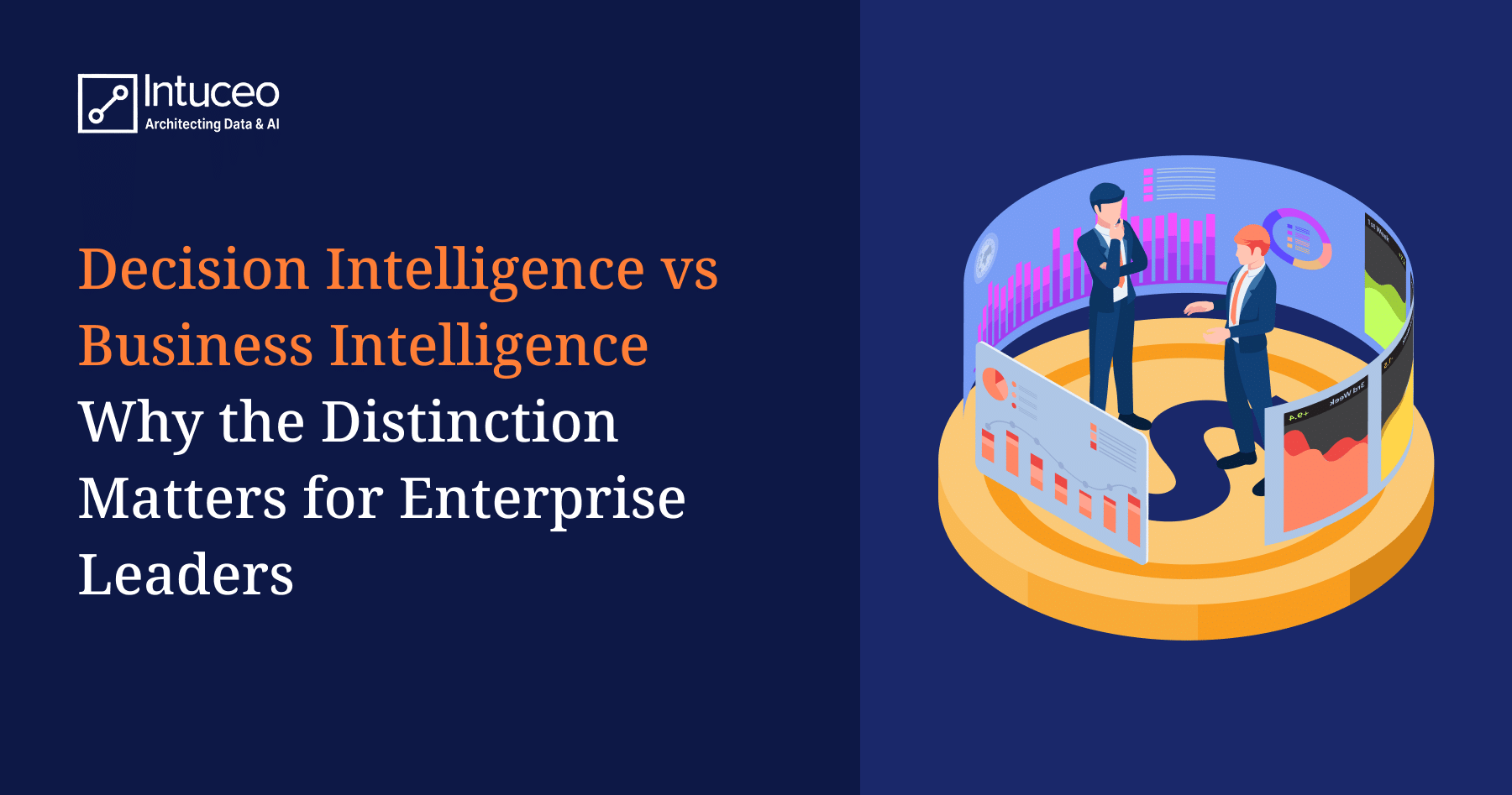
BI tells leaders what is happening across the business. DI concerns what the organization chooses to do about it, how consistently those choices are made, and whether they improve results over time. Treating decision intelligence vs business intelligence in the enterprise as a choice between tools overlooks this shift. The two disciplines are designed around different units of work, and that difference determines how teams, data, and governance are organized.
Business intelligence vs decision intelligence, in short : Business intelligence (BI) reports what is happening through metrics, reports and dashboards. Decision intelligence (DI) designs, supports and improves specific recurring decisions by combining data, predictive models, optimization, business rules and human judgment. It then records each decision and its outcome so the organization can see whether the action worked.
Decision Intelligence vs Business Intelligence: What Is the Difference?
Decision intelligence is the discipline of designing, supporting, and improving specific, recurring business decisions. It brings data, predictive models, optimization, business rules, and human judgment together around one question: given what is known now, which action produces the best outcome within the constraints that apply?
BI is organized around data and the questions people ask of it. Its unit of design is the metric, the report or the dashboard, and it succeeds when those are accurate, timely, and trusted. DI is organized around the decision itself. Its unit of design is a named decision with an owner, a set of permissible actions, known constraints, and a measurable result.
The decision intelligence vs business intelligence comparison below summarizes how that changes the work.
| Business intelligence | Decision intelligence | |
|---|---|---|
| Unit of design | Metric, report or dashboard | A named, recurring decision |
| Core question | What happened, and why? | What should we do, and did it work? |
| Typical output | Visualizations and key performance indicators (KPIs) | Recommended or executed actions with their rationale |
| Who acts | A person interprets the output and decides | A person, a system or both, under defined rules |
| Measure of success | Accuracy, freshness and adoption of reporting | Change in decision outcomes over time |
| Feedback loop | Seldom connected to the choice that followed | Each decision and its outcome captured and fed back |
Existing BI investments remain essential under a decision intelligence program. Governed metrics, certified definitions and the semantic layer that BI teams maintain serve as inputs to decision models, and any inconsistency in those definitions carries directly into the decisions built on them.
What Is a Decision Record, and Why Does Decision Intelligence Depend on It?
A decision record is a structured log of each business decision and what happened after it. A BI data warehouse is designed to reconstruct transactions, such as invoices, shipments, and claims, at whatever level of detail the business requires. It does not capture the decisions made about them: the options considered, the recommendation from the model or analyst, the choice made by the accountable manager, the stated reason, and the result.
DI treats each decision as data.
Consider a bank’s decisions on credit-limit increases: A decision record would hold the inputs available at the time, the model’s recommendation, the policy rule that applied, whether a reviewer overrode the recommendation and why, and the account’s performance over the following twelve months. Within a few review cycles, override patterns would show where the model is miscalibrated, where policy no longer reflects risk appetite, and where reviewers add judgment the model lacks. This feedback loop is the most concrete operational difference between the two disciplines.
When Does a Predictive Score Become an Automated Decision?
A predictive score becomes an automated decision when the people using it routinely treat it as the deciding factor. Treating a predictive score as decision support assumes that the score informs and a person decides.
A December 2023 judgment of the Court of Justice of the European Union (CJEU) shows why that assumption deserves scrutiny. In the SCHUFA case, the Court considered scoring by a credit information agency, a statistical method used to predict behavior such as loan repayment. It held that such scoring must be regarded as an automated individual decision, prohibited in principle under the General Data Protection Regulation (GDPR), in so far as the agency’s clients, such as banks, attribute to it a determining role in granting credit.
The Court’s test was the role the score plays in the credit decision. The governance lesson applies well beyond credit scoring. When a reviewer accepts a score as a matter of routine, the organization has automated that decision in practice, regardless of how its process documentation describes it. DI makes this visible by naming each decision, recording who or what made it, and measuring how often people depart from the system’s recommendation.
Decision Support vs Augmentation vs Automation: Where Does Human Judgment Fit?
Decision intelligence covers a range of operating modes, and choosing among them is a design decision in its own right.
- Decision support : The system presents information and a person decides, which is the mode in which most BI operates.
- Decision augmentation : Augmented decision-making AI recommends an action with its rationale and expected effect, and a person accepts, modifies, or rejects it.
- Decision automation : The system acts within defined guardrails, while people handle exceptions, review samples and adjust the rules.
Where a decision belongs depends on a few attributes: how often it recurs, how reversible it is, the cost of an error and the regulatory exposure attached to it. Replenishment orders for low-value inventory are well suited to automation, a pattern now extending to agentic AI in supply chain operations. Clinical, lending and employment decisions carry legal constraints that shape the design from the start.
Those constraints are explicit : The GDPR gives individuals the right not to be subject to a decision based solely on automated processing, including profiling, that produces legal effects concerning them or similarly significantly affects them. Where such a decision rests on a contract or the individual’s explicit consent, the data controller must put safeguards in place. At a minimum, these include the right to obtain human intervention, to express a point of view and to contest the decision
For high-risk AI systems, Article 14 of the European Union (EU) AI Act requires that the people assigned to oversee them be enabled, as appropriate and proportionate, to do several things, including to :
- Remain aware of automation bias
- Disregard, override, or reverse the system’s output.
- Interrupt the system so it comes to a halt in a safe state.
Decision automation in the enterprise therefore moves human judgment to a different point in the process: setting guardrails, reviewing exceptions, and determining when a decision should return to a person.
What Are the Five Layers of a Decision Intelligence Platform?
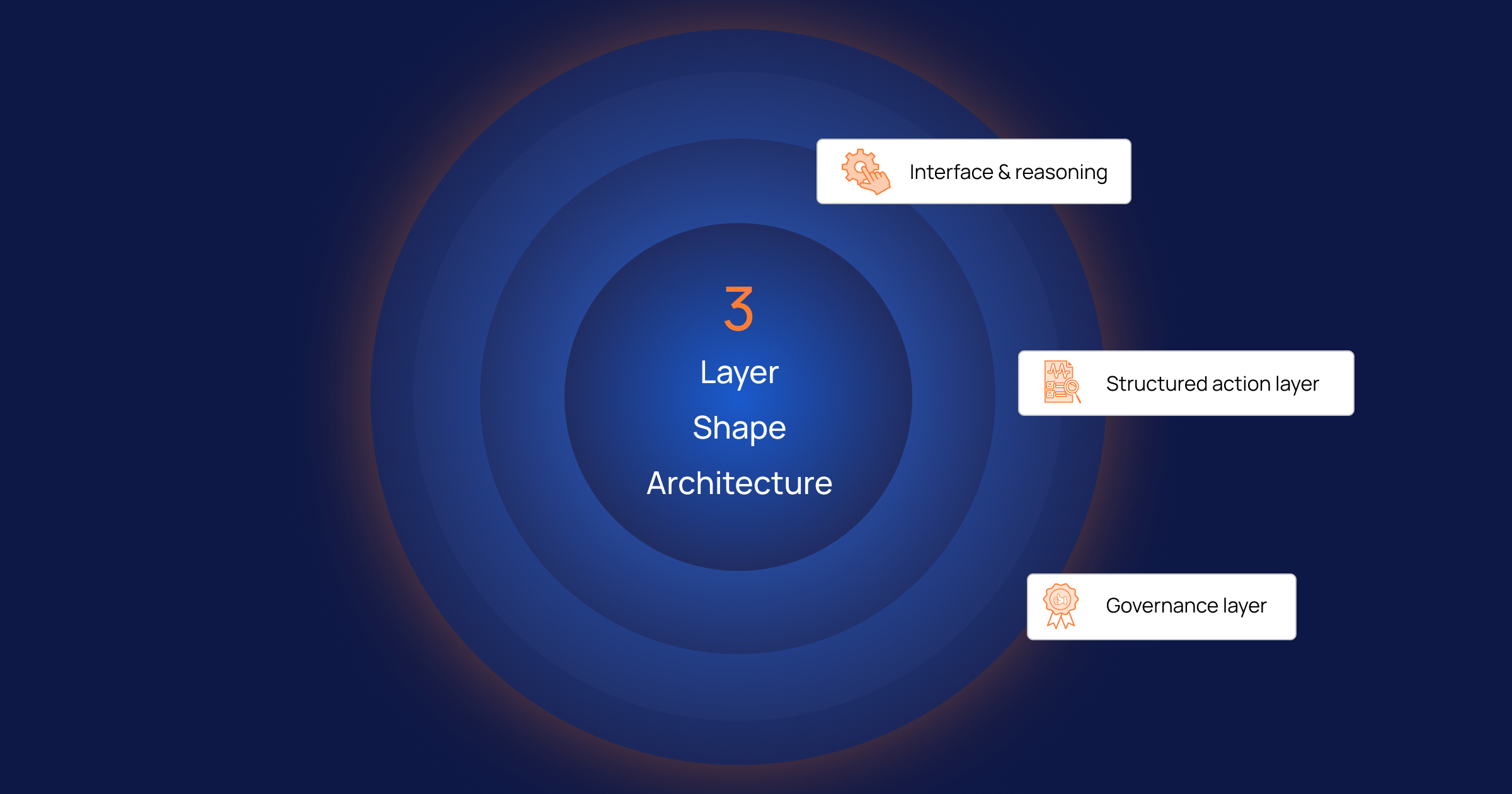
Much of the technology behind DI already exists in enterprise environments. A decision intelligence platform combines five layers around a defined decision, and several of them are likely to be in operation already in some form.
- Governed data and definitions : The certified metrics and semantic models maintained for BI, extended with the decision record.
- Predictive models : Machine learning (ML) models that estimate what is likely to happen, such as default risk or demand.
- Optimization and simulation : The engines behind prescriptive analytics in the enterprise, which search for the best action under constraints such as budget, capacity or policy, and test alternatives before anything is executed.
- Decision models and rules : Explicit logic stating how inputs, predictions, and policies combine into a decision. Decision Model and Notation (DMN), published by the Object Management Group (OMG), is a modeling language and notation for the precise specification of business decisions and business rules. It is designed to work alongside process and case models.
- Language interfaces : Large language models (LLMs) that let users question a recommendation and receive an explanation tied to the underlying data and rules.
The vendors in Gartner’s 2026 Magic Quadrant [1] describe their offerings in different terms. Quantexa, named a Leader, describes its offering as providing a contextual, AI-ready data foundation. [6] o9 Solutions, named a Niche Player in what it calls the inaugural edition, positions its offering as a connected, enterprise-wide system linking strategy, planning and execution. [7] FlexRule, also named a Niche Player, says it models decisions using the DMN open standard and treats those models as the foundation for decision automation and augmentation.[8]
For leaders assessing which decision intelligence platforms suit an enterprise in 2026, this variety is instructive. Suitability depends on the decisions in scope, so evaluation should begin with a short list of named decisions against which each candidate is tested.
How to Build a Decision Intelligence Capability with the DARWIN Framework
Intuceo AI Labs developed the DARWIN™ Framework as a governance structure for AI centers of excellence. Applying the DARWIN framework to enterprise decision intelligence provides five dimensions for structuring the program.
- Data : Certified inputs for each decision, plus a decision record that captures recommendations, choices, overrides and outcomes.
- Architecture : Clear separation between predictive models, decision logic and the systems that execute actions, so each can change without destabilizing the others
- Responsibility : A named owner for every decision, a documented operating mode, and override and escalation rules that satisfy the regulations that apply.
- Workflow : Recommendations delivered inside the systems where the decision is made, such as a claims queue or a planning screen, with the action captured at the same point.
- Infrastructure and security : Latency, access control and audit trails sized to the decision, since a real-time pricing decision and a quarterly capital allocation have very different requirements.
In any decision intelligence framework, the order of implementation matters as much as the dimensions themselves. Start with an inventory of recurring decisions and select two or three that occur often and have a measurable outcome. Instrument the decision record before building new models, run in augmentation mode until override patterns stabilize, and move to automation only where the evidence supports it. If you want a second opinion on where to start, map your first decisions with our team.
How Intuceo Helps Enterprises Move from Business Intelligence to Decision Intelligence
Intuceo is a PhD-led data and AI services firm working with enterprises in healthcare, life sciences, manufacturing, financial services and government. Its decision intelligence practice combines BI with ML layers, so that forecasts, anomaly detection and next-best-action recommendations appear inside the BI tools teams already use. For one life sciences client, Intuceo automated adverse event detection with AI and ML, removing manual review effort and supporting timely FDA submissions.
Intuceo-Ax, the firm’s augmented analytics accelerator, supports conversational analytics, and the iPDLC™ methodology structures AI projects from discovery to deployment.
Identify the decisions worth instrumenting first
Bring two or three recurring decisions your teams make every week. Intuceo’s data scientists will help assess which belong in augmentation or automation, what the decision record should capture, and which data gaps need to be closed first.
Frequently Asked Questions
1.What is decision intelligence and how is it different from business intelligence?
Decision intelligence is the discipline of designing and improving specific business decisions by combining data, predictive models, optimization, business rules, and human judgment. BI reports on the state of the business. DI determines and records what the organization does in response, and measures whether those actions worked. A simple test helps classify an existing asset: if it stays the same whichever action is taken, it belongs to BI; if it changes with the decision and tracks the outcome, it belongs to DI.
2.Can decision intelligence and business intelligence work together?
Yes. Decision intelligence builds on business intelligence rather than replacing it. The governed metrics, certified definitions and semantic layer that BI teams maintain become inputs to decision models, so any inconsistency in BI definitions carries directly into the decisions built on them.
3.Can decision intelligence systems replace human judgment in enterprise operations?
Only partly. For frequent, reversible, low-consequence decisions, systems can make routine decisions within defined guardrails. For decisions that produce legal or similarly significant effects on people, Article 22 of the GDPR restricts decisions based solely on automated processing. Article 14 of the EU AI Act requires human oversight of high-risk AI systems.
One measure worth tracking is the override rate. A rate that keeps climbing suggests the model or policy is out of step with current operating conditions. A rate near zero on a consequential decision can signal automation bias, where reviewers accept recommendations without examining them.
4.What technology powers enterprise decision intelligence platforms?
Beyond the data, prediction, optimization, rules, and language layers, two design choices separate durable implementations from fragile ones. Decision logic should be versioned and deployed independently of predictive models, so that a policy change does not require retraining under a governed MLOps process. Every recommendation should also carry an identifier linking it to the decision record, which makes later audit and outcome analysis possible.
5.How do I build a decision intelligence capability within my organization?
A small cross-functional team is enough to start :
- A business owner accountable for each decision.
- A decision analyst who models the logic and constraints.
- A data scientist for prediction and optimization.
- A risk or compliance partner who approves the operating mode