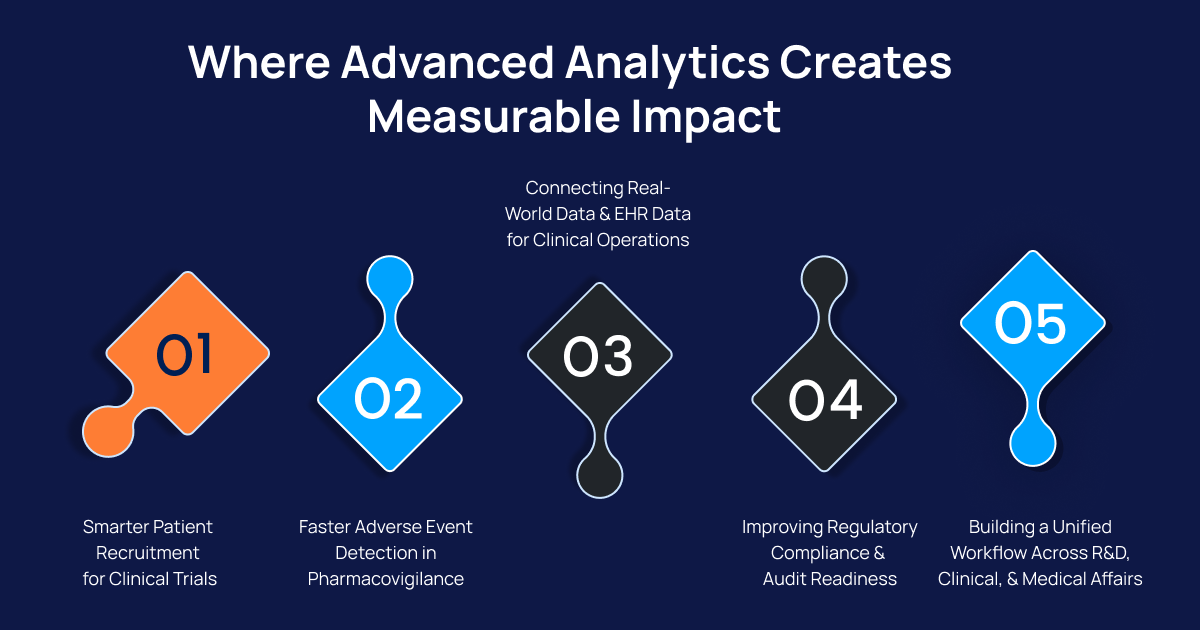
Most pharma and biotech IT estates have already migrated. The major cloud platforms now offer regulated-environment configurations, BAA coverage, and validated reference architectures for clinical, regulatory, and commercial workloads. Raw cloud capacity, however, does not solve the operational problems life sciences teams actually feel: clinical teams still spend a disproportionate share of their time searching for protocol documents, screening patients for trials, and reconciling case report forms. Pharmacovigilance teams process growing volumes of adverse event reports under tight regulatory windows; the U.S. FDA’s FAERS database now contains over 31 million adverse event reports, with intake volumes climbing year over year . Regulatory affairs teams still hand-curate submission narratives across thousands of pages.
A life science cloud platform stores the data and enforces access controls. It does not, by itself, read 12,000-page submissions, triage AE narratives, or match a patient to a trial. That is the work of an augmentative AI layer engineered on top of it.
What "augmentative" actually means in life sciences
An augmentative tool extends a human workflow without replacing the human accountable for the decision. In a regulated context, that distinction matters. Validated systems require traceability, defensible model behavior, and human-in-the-loop checkpoints. Compliant AI tools in life sciences are designed around those constraints rather than against them.
The categories below cover where augmentation produces the strongest signal on a cloud-based life science platform. Not every tool fits every team, but the taxonomy is consistent across pharma, biotech, and medtech.
The seven categories of augmentative tools worth evaluating
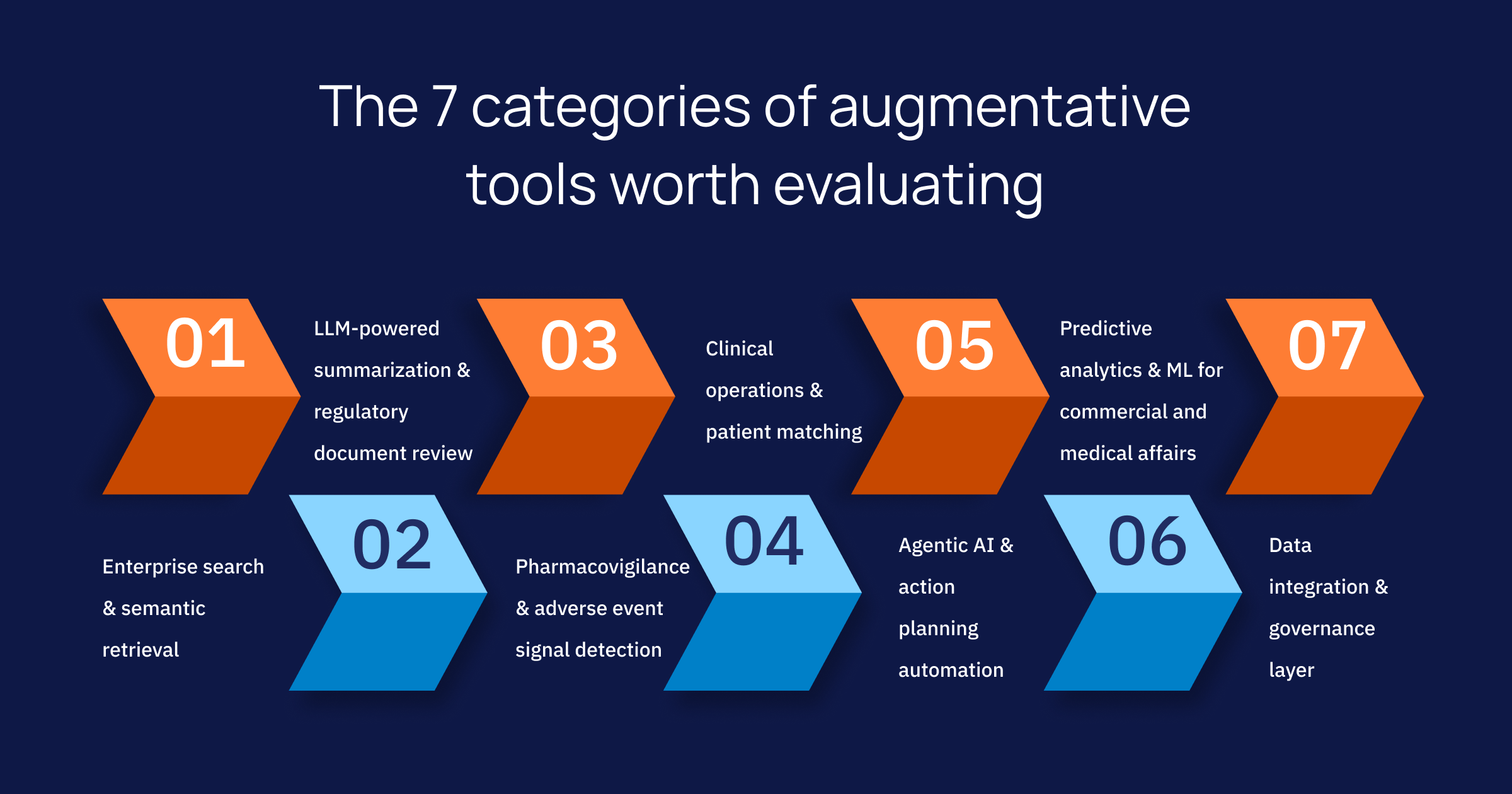
1. Enterprise search and semantic retrieval
Knowledge in a life sciences organization is spread across SharePoint, electronic lab notebooks, LIMS, PLM, regulatory submission repositories, CTMS, and clinical trial archives. Keyword search across these systems consistently misses what scientists and reviewers need. Semantic and vector-based AI search and summarization tools fix the retrieval problem by interpreting intent and surfacing relevant passages across formats. McKinsey estimates that knowledge workers spend up to 1.8 hours per day searching for information . In a 5,000-person R&D organization, that is the productivity equivalent of a mid-sized team.
2. LLM-powered summarization and regulatory document review
Regulatory document review is one of the highest-ROI use cases for generative AI in pharma. Modern LLMs can read protocols, investigator brochures, clinical study reports, and submission packages, then produce structured summaries, gap analyses, and consistency checks. The work that previously took days can be reduced to an hour of human review on top of a machine-generated draft. Done well, this is one of the strongest applications of generative AI for pharma because the outputs feed directly into reviewable artifacts.
3. Pharmacovigilance and adverse event signal detection
While the AE intake volume continues to compound annually, the PV team headcount usually cannot match that pace. Augmentative tools here perform case intake from unstructured text, MedDRA coding suggestions, duplicate detection, and signal triage across product portfolios. The combination of NLP, classification models, and rules-driven validation is where most production deployments have settled.
4. Clinical operations and patient matching
Roughly 80% of clinical trials fail to meet original enrollment timelines, and the cost of a delayed Phase III trial can exceed several million dollars per day for high-value drugs [3]. Clinical workflow automation tools, including patient-trial matching against EHR cohorts, site performance analytics, and protocol deviation prediction, shorten enrollment cycles and surface site-level risk before it triggers protocol amendments. Patient matching engines that combine SNOMED CT, ICD-10, lab results, and free-text physician notes consistently outperform manual eligibility screening.
5. Agentic AI and action planning automation
Agentic AI is the layer above summarization. An agent decomposes a goal into steps, calls the right systems on a life science cloud platform, executes a sequence, and routes exceptions back to a human. In practice: orchestrating a multi-step regulatory query, drafting an AE narrative for QC, or assembling a feasibility packet for a new study. Action planning automation is most valuable where the workflow is well-defined but the data sources are not.
6. Predictive analytics and ML for commercial and medical affairs
On the commercial side, augmentative tools for HCP engagement include next-best-action models, prescriber affinity scoring, and content recommendation engines that integrate with CRMs like Veeva or Salesforce Health Cloud. For patient-facing work, a patient engagement platform can use ML to personalize adherence outreach, predict drop-off risk, and prioritize support program interventions. These tools live inside cloud CRMs but extend them with predictive layers the CRM does not natively provide.
7. Data integration and governance layer
Data integration in life sciences is rarely glamorous, but it is the precondition for every other category to work. Tools that handle entity resolution across master data, lineage tracking for GxP audit, and standardization to CDISC SDTM/ADaM make LLMs and ML models defensible. Without this layer, AI outputs cannot be reproduced in an audit; with it, every downstream model becomes inspection-ready.
How to choose AI tools that integrate with a life science cloud platform
The right shortlist is rarely the most exciting tool. It is the one a regulator will accept and a CIO can operate. The criteria below filter out most consumer-grade GenAI offerings before procurement begins.
| Evaluation lens | What to verify |
|---|---|
| Regulatory fit | Validated against 21 CFR Part 11, EU GMP Annex 11, GxP, and HIPAA. Audit trails on prompts, outputs, and model versions. |
| Data residency & isolation | BAA coverage, private model deployment, no training on customer data, regional data residency for EU/UK/APAC studies. |
| Integration depth | Native connectors to Veeva Vault, Salesforce Health Cloud, AWS HealthLake, Azure Health Data Services, Snowflake, Databricks, EHR FHIR endpoints. |
| Explainability | Citations on every generated answer, traceable retrieval paths, model cards, and documented evaluation on life sciences corpora. |
| Human-in-the-loop design | Review gates, role-based approval, controlled rollback, and the ability to disable autonomous actions in regulated workflows. |
| Total cost of ownership | Inference costs at production volumes, model-update cadence, and the operational overhead of maintaining prompt and retrieval pipelines. |
Where augmentation tends to break
Most failed life sciences AI pilots share three patterns. The tool is deployed without addressing the underlying data integration problem, so outputs are inconsistent. The tool is selected on demo strength rather than validation evidence, and stalls when regulatory affairs reviews it. The tool is treated as a feature rather than a workflow, so adoption never reaches the teams who would benefit. Each is fixable, but only when AI is treated as part of a clinical or regulatory operating model, not as a standalone purchase.
How Intuceo augments your cloud-based life science environment
Intuceo is a PhD-led AI and data analytics consultancy. We engineer the augmentative layer on top of your existing cloud environment, on AWS, Azure, Databricks, Snowflake, and the Veeva and Salesforce Health Cloud stacks. The work is grounded in regulatory-grade delivery, not experimentation. Where a category above maps to a problem your team already feels, we bring accelerators built and hardened across prior life sciences engagements, proven components that shorten deployment so you reach a validated result faster than a build-from-scratch project would allow.
Accelerators we bring to you:
- Neural enterprise search (Intuceo-Ix™) : retrieval across LIMS, PLM, SharePoint, clinical archives, and FDA filings, adapted to your repositories rather than rebuilt from zero.
- Agentic BI (Intuceo-Ax™) : natural-language interrogation of clinical, regulatory, and commercial KPIs.
- Clinical and patient-facing agents (AgentCare AI) : trial matching, AE intake, and care orchestration patterns proven in earlier engagements.
- Adverse event detection (AE Detection) : classification, MedDRA coding suggestions, and signal triage tuned for pharmacovigilance teams.
- Clinical Trial Patient Matching : LangGraph-orchestrated matching with SNOMED CT entity resolution against EHR cohorts.
- iPDLC™ delivery framework : our delivery lifecycle for HIPAA, FISMA, 21 CFR Part 11, and GxP audit-readiness, so validation is built into the engagement rather than bolted on at the end.
Build Your Augmentation Roadmap
The foundation is built; now it’s time to scale. Your data is already on Veeva, AWS, or Salesforce. The gap is the augmentative layer that turns it into faster decisions and automated workflows. Intuceo’s PhD-led team engineers that layer with you, bringing accelerators from prior regulated engagements so you reach a validated, audit-ready result faster than a build-from-scratch effort. Start with a working session on where augmentation pays back first.
Frequently Asked Questions
1.Which AI tools are best for a cloud-based life science platform?
The strongest categories are neural enterprise search, LLM-powered summarization for regulatory document review, AE classification for pharmacovigilance, patient-trial matching, agentic workflow orchestration, predictive ML for commercial and medical affairs, and the data integration layer underneath them. Selection should be driven by which workflow has the most measurable cycle-time or compliance pain, not by which tool has the most impressive demo.
2.Which tools help with compliant AI in pharma and biotech?
Look for vendors that ship with audit trails, validated reference architectures, BAA coverage, and documented evaluation against pharma and biotech corpora. The minimum bar for compliant AI tools in regulated environments is alignment with 21 CFR Part 11, EU GMP Annex 11, GxP, and HIPAA. Tools that cannot produce citations or model lineage on demand should not enter production.
3.What tools help with summarization, search, and action planning in life sciences?
Summarization is best handled by LLMs fine-tuned or grounded against life sciences corpora with retrieval-augmented generation. Search requires semantic and vector retrieval across structured and unstructured repositories. Action planning automation sits on top of both, using agentic frameworks to execute multi-step workflows and surface exceptions to human reviewers.
4.Which AI tools support patient engagement and HCP engagement in life sciences?
On the HCP side, the most common tools are next-best-action engines, content recommenders, and territory analytics layered on Veeva or Salesforce Health Cloud. For patient engagement, a modern patient engagement platform uses adherence prediction, personalized outreach, and intervention prioritization for patient support programs.
5.How do I choose AI tools that integrate with a life science cloud platform?
Start from the workflow, not the tool. Identify the highest-friction process, typically AE intake, regulatory document review, or patient matching, and quantify its cost. Then evaluate two or three tools against the criteria in the table above. Pilot with measurable success criteria validated against your existing cloud-based life science platform, and only scale tools that clear both clinical and compliance review.