Top 6 Generative AI Consulting Firms for Regulated Industries: Life Sciences, Healthcare, and Government

Regulators have begun publishing what they expect from artificial intelligence (AI) used in regulated work. That gives buyers evaluating generative AI (GenAI) consulting firms for regulated industries a concrete standard for comparing partners. The U.S. Food and Drug Administration (FDA) has issued draft guidance on establishing the credibility of AI models used in drug development [1]. In January 2026, the FDA and the European Medicines Agency (EMA) released ten joint principles for good AI practice [2]. For federal buyers, the Federal Risk and Authorization Management Program (FedRAMP) has opened a prioritization track for AI cloud services [3].
These developments change how the best GenAI consulting partners should be judged. Brand recognition and model access no longer distinguish one firm from another. The firms worth shortlisting can do three things:
The six firms below meet that standard in different ways, and none is the right choice for every program.
Quick answer: The leading generative AI consulting firms for regulated industries are Accenture (multi-sector scale), Deloitte (governance and delivery together), Booz Allen Hamilton (defense and air-gapped deployments), Guidehouse (public and commercial healthcare), ZS (pharma commercial and medical affairs), and IQVIA (clinical development). The right fit depends on your sector, your regulator, and where your data must stay.

How Do These Generative AI Consulting Firms Compare?

Firm Strongest sector Distinctive asset Primary consideration
Accenture All three, at scale Federal agentic lab; regulated-industry solutions with Anthropic Model dependency across providers
Deloitte Health and public services Risk advisory paired with delivery Auditor independence limits
Booz Allen Hamilton Defense and intelligence Air-gapped and edge deployment experience Smaller commercial health bench
Guidehouse Government and regulated healthcare AI Center of Excellence with QA and ethics specialists Recency of AI investment
ZS Pharma commercial and medical affairs Agentic MLR and medical affairs suites Less natural fit for GxP and government work
IQVIA Clinical development Agents built close to trial and health data Concentrated vendor dependency

How We Evaluated These GenAI Consulting Firms

The numbering does not imply rank. Figures reported by the firms themselves are labeled as vendor-reported.

The 6 Generative AI Consulting Firms for Regulated Industries and Where Each Fits

1. Accenture: Best for GenAI at Scale Across All Three Sectors

In December 2025, Accenture and Anthropic formed the Accenture Anthropic Business Group. Its initial industry solutions target financial services, life sciences, healthcare, and the public sector [4]. In May 2026, Accenture Federal Services became an OpenAI Implementation Partner for the U.S. federal market. It also opened an agentic lab at its Forge center, which simulates a government agency so teams can design and validate agentic and human-in-the-loop workflows before deployment [5].
Best suited for: enterprises running GenAI programs across several regulated business units, and federal agencies that want to test agentic workflows before an authority to operate (ATO) review.
Weigh carefully: As its Anthropic and OpenAI alliances show, Accenture works with more than one model provider. Ask which model each proposed solution depends on, and how a later switch would affect validation evidence already produced.

2. Deloitte: Best for Governance and Delivery Under One Roof

In October 2025, Deloitte announced it would make Claude available across its global network. It also committed to co-developing solutions with compliance features for regulated industries, including healthcare, life sciences, and public services [6]. For buyers, the advantage is having risk advisory and technology delivery in the same firm. That suits generative AI consulting for healthcare and public services, where AI governance must withstand internal audit and board scrutiny.
Best suited for: health and human services agencies and integrated health systems that want GenAI policy, controls, and delivery designed together.
Weigh carefully: Deloitte states in its own releases that certain services may not be available to attest clients under public accounting rules [7]. If Deloitte provides audit or assurance services to your organization, confirm which services you can engage it for before the request for proposal (RFP) stage.

3. Booz Allen Hamilton: Best for Defense, Intelligence, and Air-Gapped Deployments

In June 2026, Booz Allen announced a partnership with OpenAI focused on defense, intelligence, and critical infrastructure. The partnership gives its engineers access to OpenAI roadmap insights and training resources [8]. The firm also has rare edge-deployment experience. In 2024, it ran a large language model (LLM) on the International Space Station, designed to operate without Earth-bound internet [9]. That experience applies directly to air-gapped and resource-constrained settings, where many classified and field deployments run.
Best suited for: national security, intelligence, and civilian agencies operating under the Federal Information Security Modernization Act (FISMA), particularly where workloads cannot rely on public cloud connectivity.
Weigh carefully: Booz Allen’s center of gravity is federal. Commercial pharma and provider organizations will find a smaller bench of sector specialists.

4. Guidehouse: Best for Programs Spanning Public Health and Commercial Healthcare

In June 2025, Guidehouse committed $1.5 billion over three years to AI initiatives aimed at government and regulated markets, including healthcare [10]. The investment funds an AI Center of Excellence that brings engineering, quality assurance (QA), and ethics specialists together. It also funds AI solutions built for regulated government and commercial sectors. That combination helps when a GenAI use case spans public and private data, as in Medicaid administration or public health reporting.
Best suited for: federal and state health programs, payers, and provider systems that need a generative AI public sector consultant who also has commercial healthcare experience.
Weigh carefully: Much of the AI investment is recent. Ask for production deployments that match your use case, separate from roadmap commitments.

5. ZS: Best for Pharma Commercial and Medical Affairs Workflows

In May 2026, ZS launched ZAIDYN Medical and ZAIDYN Content, agentic application suites for medical affairs and compliant content production. ZS states that its agents run governed workflows with human review, approval, and override at every step. It also reports that ZAIDYN Content has expedited more than 100,000 assets and cut cycle time for personalized and derivative content by over 67% [11]. Both figures are vendor-reported and worth testing in reference calls.
Best suited for: biopharma commercial, medical affairs, and medical, legal, and regulatory (MLR) review teams looking for a life sciences GenAI partner with therapeutic and go-to-market depth.
Weigh carefully: ZS’s published GenAI work centers on commercial and medical functions, so it is a less natural fit for GxP manufacturing, quality systems, or government programs. Clarify which parts of an engagement run on ZS’s own software and what licensing continues after the consulting phase.

6. IQVIA: Best for Clinical Development and Health Data

In June 2025, IQVIA unveiled custom AI agents built with NVIDIA tooling, including NeMo Guardrails to safeguard deployment [12]. Stated use cases include target identification, clinical data review, literature review, market assessment, and healthcare professional (HCP) engagement. In generative AI consulting for life sciences, IQVIA stands out because it already runs clinical research operations and holds large health datasets, which shortens the path from model to trial workflow.
Best suited for: sponsors seeking GxP generative AI consulting close to clinical trials, pharmacovigilance automation, and real-world evidence.
Weigh carefully: Buying data, clinical services, and AI from one provider concentrates dependency. Decide early which models, prompts, and validation records your organization will own; a build vs buy AI framework helps make that call layer by layer.

Where a Specialist GenAI Partner Fits

Disclosure: Intuceo publishes this guide and is not ranked in the list above.
Large integrators suit multi-year, multi-sector programs. Teams that need a focused partner for one regulated workflow often move faster with a specialist. Intuceo is a PhD-led AI consulting firm working across life sciences, healthcare, and the public sector under HIPAA- and FISMA-aligned frameworks and a GSA contract vehicle. Its work includes automating adverse event detection with AI/ML to support timely FDA submissions, and its DARWIN-based AI readiness assessment framework scores an organization across five dimensions before any build begins.

How to Match a GenAI Consulting Partner to Your Regulatory Requirements

A single shortlist rarely serves all three sectors equally, because GenAI consulting for healthcare, pharma, and government is measured against different rules in each.

FDA-Regulated Life Sciences: What to Require

An FDA AI consulting firm should be able to produce a credibility assessment plan tied to a specific context of use. That is the framework FDA’s draft guidance applies to AI outputs that support decisions on safety, effectiveness, or quality [1]. Ask how the firm documents data provenance and monitors model performance after go-live, two disciplines at the core of MLOps in healthcare and pharma. The FDA-EMA principles cover both areas under data governance and life cycle management [2].

Healthcare Under HIPAA: What to Require

A HIPAA-compliant GenAI vendor signs a business associate agreement (BAA) with you. It also holds its own BAAs with every subcontractor that handles protected health information (PHI), including the model provider and hosting provider, so every stage of a HIPAA-compliant data pipeline stays covered. The FDA’s internal GenAI assistant, Elsa, offers a useful benchmark for contract language: the agency states that its models do not train on data submitted by regulated industry [13]. Ask for the same commitment in writing for your PHI.

Federal Government: What to Require

Confirm that the underlying AI service either holds FedRAMP authorization at the required impact level or sits in the prioritization track FedRAMP opened in August 2025. That track admits AI services able to meet FedRAMP 20x authorization requirements within two months of acceptance [3]. In generative AI consulting for the government, a consultant’s experience does not substitute for the authorization status of the service it deploys.

What Questions Should You Ask a Generative AI Consulting Firm?

Want answers to these four questions in writing? Book a briefing with Intuceo’s regulated-industry AI team.

Frequently Asked Questions

Among generative AI consulting firms for regulated industries, sector focus is the clearest dividing line. Life sciences specialists such as ZS and IQVIA concentrate on pharma workflows, from clinical development to commercial and medical affairs. Federal specialists such as Booz Allen concentrate on defense, intelligence, and civilian agencies. Multi-sector firms such as Accenture and Deloitte cover all three at scale. Within any firm offering AI consulting for regulated industries, check that the regulated-industry practice has its own GenAI production references. Industry expertise and GenAI delivery experience often sit in different teams.
Ask for documents, and work from a structured list of questions to ask before hiring an AI consulting firm. A sample subcontractor BAA, a redacted validation summary from a past GxP deployment, and the name of the quality lead who approved it reveal more than any capabilities deck. Generative AI consulting companies with real regulated-industry experience can usually produce these quickly; others tend to send general policy documents.
The strongest partners in AI consulting for life sciences define the context of use before selecting a model, budget for performance monitoring after go-live, and staff regulatory or quality professionals alongside engineers. The FDA-EMA principles call for multidisciplinary expertise covering both the AI technology and its context of use [2]. A team made up only of data scientists is a warning sign.
Yes. Booz Allen, Accenture Federal Services, Deloitte, and Guidehouse all deliver federal programs where FISMA controls apply. The more useful question is whether the firm has taken a GenAI system through an agency ATO, and which FedRAMP-authorized services it built on. Ask for the agency, the impact level, and how long it took to move from pilot to ATO.
GxP generative AI consulting is advisory and engineering work that brings GenAI into processes governed by good practice regulations such as GMP, GCP, and GLP. It covers validation, data integrity, audit trails, and documented human review, so the system can hold up under inspection.
Choose a global integrator when the program spans several regulated business units and needs scale. Choose a specialist when the work centers on one high-value workflow, such as adverse event detection or MLR review, and speed to a validated release matters more than breadth. Many regulated buyers pair the two.
MLOps in Healthcare and Pharma: How Teams Govern Models in Production

A model that classifies adverse event reports or stratifies patient risk becomes a regulated computerized system the day it goes live, with one complication that conventional validation never had to absorb: its performance depends on data it has not seen yet. The records it produces still carry the same integrity, traceability, and privacy obligations as a batch record or a claims file. MLOps in healthcare and pharma is the discipline that keeps those two facts aligned, so that every model in production can be reproduced, explained, and defended at inspection.
Machine learning operations (MLOps) already gives teams the raw mechanics: pipelines, experiment tracking, model registries, and monitoring. This guide covers what healthcare and pharma teams add on top of those mechanics, stage by stage, building on our broader guide to MLOps for regulated industries.
What is MLOps in healthcare and pharma?
MLOps in healthcare and pharma is the practice of running machine learning pipelines so every production model can be reproduced, explained, and defended at inspection. It adds regulated controls to standard MLOps: validated releases, Part 11 audit trails, HIPAA safeguards, and change control that is approved before retraining begins.

Key Takeaways

Which Regulations Apply to MLOps in Healthcare and Pharma?

No single regulation governs machine learning (ML) in healthcare and life sciences. Teams assemble their obligations from records rules, privacy law, the good practice regulations collectively known as GxP (manufacturing, clinical, laboratory, and pharmacovigilance), and artificial intelligence (AI) guidance that is still maturing. The documents below carry the most weight for models in production.
Source Status What it asks of the pipeline
21 CFR Part 11 (Code of Federal Regulations) Binding regulation Validated systems, secure time-stamped audit trails for record creation, modification, and deletion, and change control over systems documentation[1]
Health Insurance Portability and Accountability Act (HIPAA) Security Rule, 45 CFR 164.312 Binding regulation Access control, integrity safeguards, and audit controls that record and examine activity in systems holding electronic protected health information (ePHI)[2]
U.S. Food and Drug Administration (FDA) guidance on AI for drug and biological decision-making, January 2025 Draft, nonbinding A risk-based credibility assessment for a defined context of use, with life cycle maintenance after deployment[3]
FDA and European Medicines Agency (EMA) Guiding Principles of Good AI Practice, January 2026 Joint principles Traceable data provenance in line with GxP, risk-based performance assessment, and scheduled monitoring for issues such as data drift[4]
FDA Predetermined Change Control Plan (PCCP) guidance for AI-enabled device software Final, nonbinding Pre-specified modifications, a protocol to develop, validate, and implement them, and an impact assessment[5]
European Union (EU) Good Manufacturing Practice (GMP) Annex 22, Artificial Intelligence Consultation draft Continuous oversight of AI systems, including change control, performance monitoring, and human review procedures[6]
The practical reading of the table is that Part 11 and HIPAA are enforceable today, while the AI-specific documents describe the evidence inspectors will increasingly expect to see. FDA AI compliance in 2026 therefore means satisfying binding records and privacy rules with evidence organized the way the AI guidance describes it.

How Does FDA’s Context of Use Shape AI Model Validation?

FDA’s draft guidance anchors validation to a defined question and a context of use (COU), then rates model risk on two factors. Model influence is the weight the model’s output carries in the decision relative to other evidence. Decision consequence is the significance of an adverse outcome if that decision turns out to be wrong.[3]
The guidance’s own example of high risk on both counts is a model used to decide which trial participants can skip inpatient monitoring after dosing. A model that ranks literature for a human reviewer would sit far lower, and its credibility plan can be lighter in proportion.
This framing answers how FDA expects AI models to be validated and monitored in clinical settings: through evidence scaled to risk, defined before deployment, and maintained for as long as the model is in use. Operationally, the COU statement, risk rating, and acceptance criteria belong in the model registry as metadata on every version. When an inspector asks why a model was validated the way it was, the answer then travels with the model rather than sitting in a document nobody can locate.

How to Govern MLOps in Healthcare and Pharma, Stage by Stage

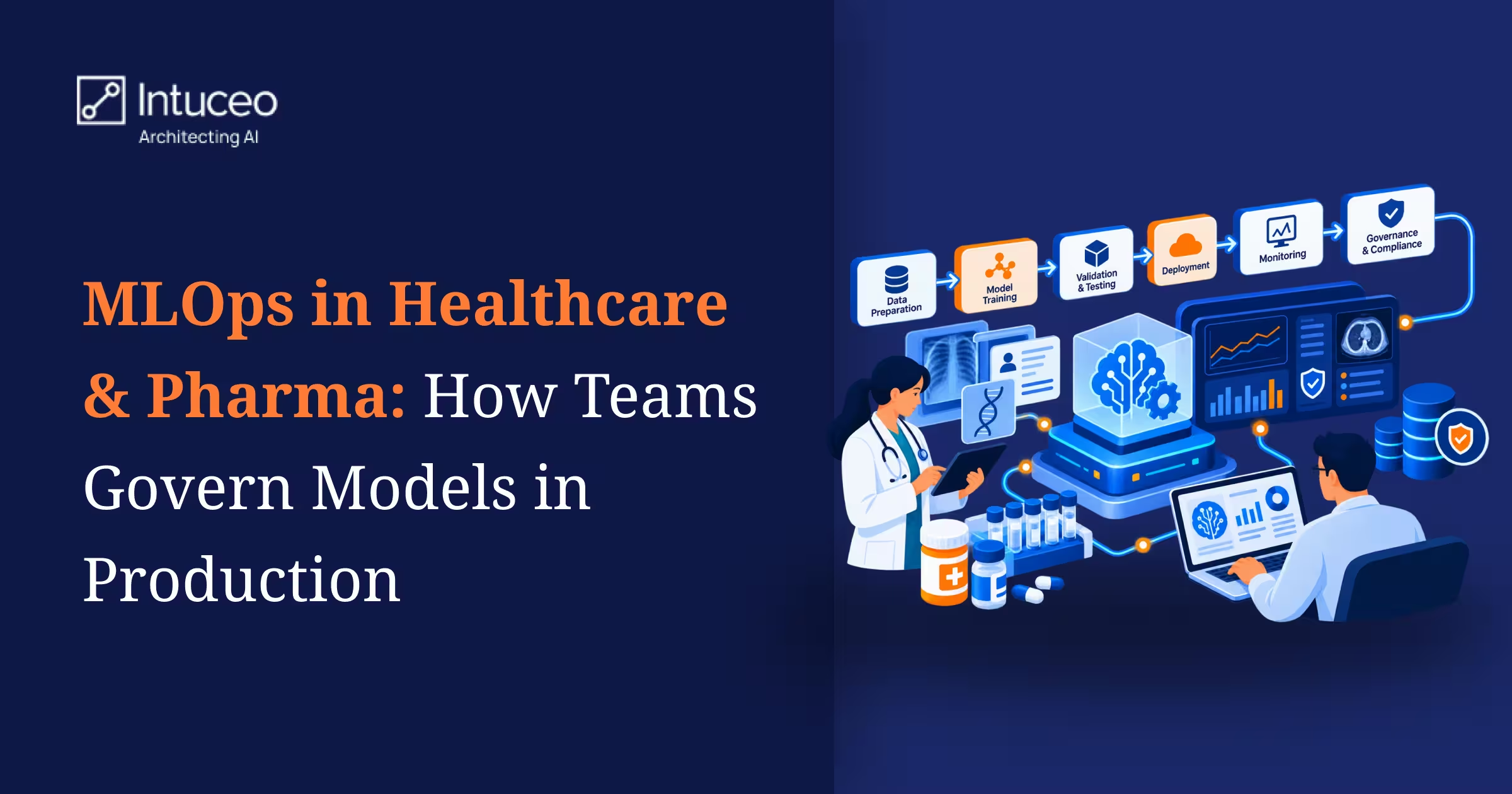
Implementing MLOps in healthcare and pharma comes down to deciding what evidence each stage must produce, then making the pipeline produce it automatically.

How Is MLOps in Healthcare Different From Standard MLOps?

Standard MLOps and its regulated form share the same tooling. The difference is the evidence each step has to leave behind.
Area Standard MLOps MLOps in healthcare and pharma
Data Versioned datasets Immutable, hashed snapshots linked to each model version, with ePHI kept in access-controlled zones and de-identified before experimentation
Validation Metrics reviewed after training Acceptance criteria fixed before training, tested on held-out data, with the report assembled from pipeline metadata
Release Automated promotion to production An approval signature bound to a specific model version, with a Part 11 audit trail of who approved what and when
Monitoring Drift alerts Thresholds set by the COU risk rating; a breach opens a quality investigation with documented root cause
Retraining Scheduled or triggered automatically A retraining protocol or PCCP, approved in advance, covering triggers, data windows, acceptance criteria, and rollback
Accountability The ML team A named owner, risk tier, and review date in a model inventory, with human review of AI outputs that inform regulated decisions

Stage 1: Data Preparation and Provenance

The FDA and EMA principles ask that data provenance, processing steps, and analytical decisions be documented in a traceable, verifiable manner consistent with GxP.[4] In practice, every training set becomes an immutable, hashed snapshot that a model version points to, so retraining on identical data is always possible. A HIPAA-compliant ML pipeline adds two controls at this stage: ePHI stays inside access-controlled zones with logged activity, and data is de-identified before it reaches experimentation environments that have no need for identifiers.

Stage 2: Training and Validation

GxP MLOps for pharma uses the same automation as conventional MLOps, operated under a risk-based quality system so the automation itself generates the evidence. Each training run captures the code commit, container image, parameters, and dataset version without manual entry. Performance is tested against acceptance criteria fixed before training, on held-out data the team did not tune against, and the validation report is assembled from pipeline metadata instead of being written after the fact.

Stage 3: Release and Approval Under Part 11

Promotion from staging to production is where 21 CFR Part 11 AI validation concentrates, starting with validation of the systems involved (§11.10(a)). The promotion is an electronic record: it needs an approval signature bound to a specific model version (§11.70), and an audit trail showing who approved what and when (§11.10(e)). Part 11 also requires change control over systems documentation (§11.10(k)), which in an MLOps setting extends to pipeline definitions and infrastructure code.[1]

Stage 4: Production Monitoring and Drift

Monitoring covers three signals: shifts in input distributions, shifts in output distributions, and realized performance once ground truth arrives, such as adjudicated adverse event cases or confirmed readmissions. In healthcare MLOps, alert thresholds should follow the COU risk rating. A breach opens an investigation under the quality system with documented root cause, which keeps automatic retraining from silently masking a problem. Prediction logs are records in their own right and need retention periods aligned with the underlying regulation.

Stage 5: Change Control and Retraining

Every retrained model is a new version, and the pharma AI model lifecycle depends on deciding in advance how much revalidation each type of change requires. For AI-enabled medical devices, a PCCP lets manufacturers describe planned modifications, the methodology to develop, validate, and implement them, and an assessment of their impact, so pre-authorized changes do not each need a new marketing submission.[5] The draft EU Annex 22 points in the same direction for manufacturing, pairing change control with ongoing performance monitoring.[6] The retraining protocol, covering triggers, data windows, acceptance criteria, and rollback, should be approved before the first deployment rather than drafted during the first incident.

Evidence Each Stage Must Produce

The table below summarizes what the pipeline should generate at each stage, and which requirement drives it.
Stage Evidence the pipeline must produce Main driver
Data preparation Hashed, immutable training data snapshots tied to each model version, logged ePHI access, and de-identified data for experimentation FDA and EMA principles; HIPAA Security Rule
Training and validation Code commit, container image, parameters, and dataset version for every run, plus results against pre-set acceptance criteria GxP risk-based quality system
Release and approval An approval signature bound to the model version, an audit trail of approvals, and change control over pipeline and infrastructure code 21 CFR Part 11
Production monitoring Input, output, and performance monitoring records, investigation records for threshold breaches, and retained prediction logs FDA draft AI guidance; FDA and EMA principles
Change control An approved retraining protocol or PCCP, and revalidation evidence for every new model version FDA PCCP guidance; draft EU Annex 22
Not sure your retraining protocol would hold up at inspection? Book a governance gap review.

Why Is Human Oversight Required for AI in GxP Settings?

In an April 2026 warning letter, FDA stated that when a manufacturer uses AI to help with current good manufacturing practice (CGMP) activities, any output or recommendation from an AI agent must be reviewed and cleared by an authorized human representative of the firm’s quality unit.[7] That case involved AI-drafted specifications and procedures rather than a deployed predictive model, yet the principle carries over directly: accountability for an AI-assisted decision stays with named people.
The FDA and EMA principles reinforce this by asking that performance assessment cover the complete system, including human and AI interaction.[4] For MLOps teams, that translates into review queues for low-confidence outputs, explanations surfaced at the point of review, overrides captured in the audit trail, and override rates tracked as a monitoring signal in their own right. Sound model governance for healthcare AI wraps these controls in a model inventory that records an accountable owner, a risk tier, and a periodic review date for every model in service.

How Intuceo supports governed MLOps

Intuceo is a PhD-led AI, ML, and data analytics services firm whose life sciences work includes Janssen, Ferring Pharmaceuticals, and Bausch & Lomb. Its MLOps engagements build compliance into the pipeline from the first commit, so audit logs, lineage, and validation evidence accumulate through normal operation. Deployed models carry drift monitoring, controlled retraining loops, and interpretability views designed for the reviewers who sign off on outputs.
Explainability, bias checks, and model documentation are reviewed by Intuceo’s PhD-led Board of Science & Innovation, and the iPDLC™ delivery framework places PhD-led quality gates at every transition from development to production. Teams work across MLflow, Kubeflow, and Amazon SageMaker, so governance fits the stack a client already runs instead of forcing a migration.
Running models in production ahead of an inspection or a submission? Get a governance gap review that maps each model to its context of use, audit trail coverage, and change control readiness.

Frequently Asked Questions

Pharma companies govern ML models under Part 11 by first scoping which ML artifacts count as regulated records. FDA’s Part 11 scope and application guidance ties the rule to records that other regulations, known as predicate rules, already require. It also describes enforcement discretion for certain Part 11 requirements, while predicate rule obligations stay fully in force.[8] Pharma teams therefore classify ML artifacts individually. Model outputs that feed a GxP decision, validation reports, release approvals, and training data cited in a submission are typically treated as regulated records. Exploratory notebooks stay outside scope until their results become the basis for a regulated decision.
It looks like a validated computerized system whose validation never fully closes. The International Society for Pharmaceutical Engineering (ISPE) Good Automated Manufacturing Practice (GAMP®) Guide: Artificial Intelligence was published in July 2025 for use alongside GAMP 5 (Second Edition). It covers the AI-enabled system life cycle, the responsibilities of internal and external suppliers, and ongoing monitoring and maintenance.[9] Two practical consequences follow. Cloud ML services used in GxP work need supplier assessment and infrastructure qualification. GxP and non-GxP workspaces should also be kept separate, so exploratory work cannot reach production without passing through change control.
Healthcare organizations keep ML pipelines HIPAA-compliant by de-identifying data, scrubbing identifiers from ML outputs, and holding business associate agreements (BAAs) with vendors. Most start by deciding which de-identification route applies. HIPAA recognizes two: removing a specified list of identifiers, or a formal determination by a qualified expert applying statistical and scientific methods.[10]
Beyond that, the most common leak path in healthcare MLOps is incidental. Identifiers get written into experiment logs, prediction logs, feature store snapshots, or error traces. Most of the gaps teams find in audits close with three steps: scrubbing those outputs, keeping features to the minimum the model needs, and holding BAAs with any vendor that touches ePHI.
A typical pharma MLOps stack has five layers:
Whatever tools you choose, the configured system, including its procedures, access controls, and retention settings, must be validated. That is why tool selection should follow the governance design rather than come before it.
A PCCP lets makers of AI-enabled medical devices pre-specify planned model modifications, the protocol to develop, validate, and implement them, and an assessment of their impact. Once FDA authorizes the plan, changes made within it do not each need a new marketing submission.[5] For MLOps teams, the PCCP becomes the approved rulebook for retraining.

Why Enterprise Search Tools Miss Context in Clinical and Regulatory Documents

Enterprise search in the life sciences promises to unlock critical clinical and regulatory knowledge. The reality is a high-stakes bottleneck. A typical platform might return hundreds of results for a single pharmacovigilance query, only to bury a critical safety signal on page twelve because it cannot distinguish “cardiac toxicity” (a clinical finding) from “cardiac monitor” (a medical device).
The search technically works. The retrieval is functionally useless.
This isn’t just a failure of relevance ranking; it’s an architectural limitation. Clinical trial protocols, regulatory submissions, and safety filings carry a density of synonyms, abbreviations, and context-dependent terminology that standard keyword searches were never built to interpret. When missing a single document means a delayed IND submission or an unreported adverse event, the gap between “searching” and “finding” transitions from a minor IT nuisance into a severe compliance and operational liability.

Why Do Enterprise Search Tools Fail on Clinical Trial Documents?

The root cause is a fundamental mismatch between how these tools work and how clinical knowledge is structured. Traditional enterprise search platforms rely on keyword matching and Boolean logic. They index words, not meaning. When a researcher queries “treatment-emergent adverse events,” the system matches those exact tokens. It does not understand that “TEAEs,” “treatment-related AEs,” or “drug-induced side effects” refer to the same concept.
Clinical and regulatory documents compound this problem in several ways. First, medical terminology is dense with synonyms, abbreviations, and acronymic variations. A single condition like myocardial infarction might appear as “MI,” “heart attack,” “acute coronary syndrome,” or “STEMI” across different documents in the same repository. According to the National Library of Medicine, the UMLS Metathesaurus alone maps over 4.4 million concept names across more than 200 source vocabularies. No keyword index can account for this breadth of terminology without a contextual layer.
Second, regulatory submissions follow rigid structural conventions (ICH CTD format, eCTD modules) where identical terms carry different meanings depending on the section. “Safety” in Module 2.7 (Clinical Summary) refers to patient-level adverse event data. “Safety” in Module 3.2 (Quality) refers to product stability testing. A keyword search treats both identically.

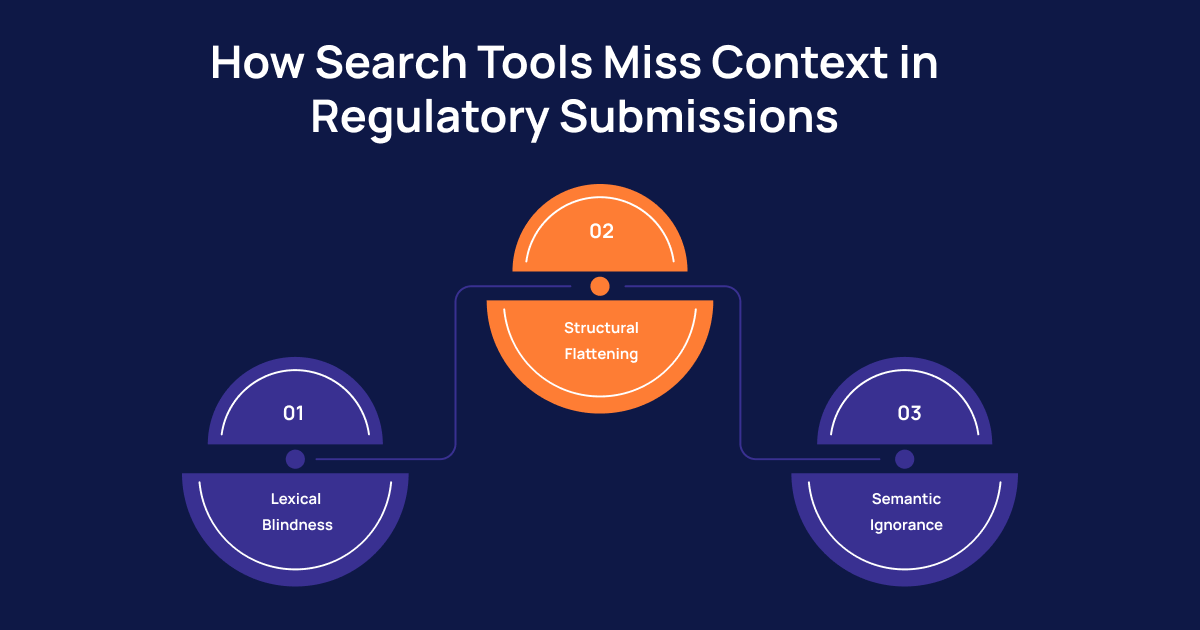
How Search Tools Miss Context in Regulatory Submissions

Context loss in standard regulatory document search occurs at three distinct levels:
How Search Tools Miss Contextin Regulatory Submissions

Why Is Metadata Not Enough for Document Retrieval in Regulated Industries?

A common response to search failures is to invest in better metadata tagging. While metadata improves filtering (by document type, study phase, therapeutic area), it cannot solve the core document retrieval problem for two reasons.
First, the volume and velocity of unstructured data in pharma R&D make comprehensive manual tagging impractical. Today, an estimated 80% to 90% of all enterprise data is unstructured. For a mid-size pharma company managing thousands of clinical study reports, investigator brochures, and post-market surveillance filings, maintaining accurate metadata at scale is a resource drain that never reaches completeness.
Second, metadata captures attributes (author, date, document type) but not meaning. A metadata tag can label a document as “Phase III Clinical Study Report.” It cannot tell you whether that report contains a specific subgroup analysis for patients over 65 with renal impairment. The actual intelligence lives in the unstructured narrative, tables, and appendices within the document.

The Shift from Keyword Search to Semantic Search in Healthcare Documents

Semantic search for pharma represents a foundational shift in how clinical document search operates. Instead of matching tokens, semantic engines use vector embeddings to represent the meaning of queries and document passages in a shared mathematical space. A query for “cardiac safety signals in elderly patients” retrieves passages about “cardiovascular adverse events in geriatric populations” because the underlying meaning vectors are proximate, even though no keywords overlap.
This approach directly addresses the synonym, abbreviation, and contextual challenges that break keyword search. When combined with domain-specific training on medical ontologies (MedDRA, SNOMED CT, WHO-ART), semantic retrieval healthcare systems achieve significantly higher precision and recall on clinical corpora than general-purpose search tools.
RAG for life sciences (Retrieval-Augmented Generation) takes this further. A RAG architecture pairs semantic retrieval with a generative model that can synthesize answers grounded in the retrieved source documents. Instead of returning a list of 2,000 links, the system returns a direct answer: “Cardiac toxicity signals were observed in Study XYZ-301 (Module 5.3.5.3), primarily in patients aged 65+ with pre-existing QTc prolongation. See Table 14.3.1 for incidence rates.” The answer includes traceable citations back to the source, which is critical for GxP compliance and audit readiness.

How Intuceo Solves Contextual Search for Clinical and Regulatory Content

Intuceo’s approach to AI search in healthcare is built on a simple reality: generic enterprise search was never designed for the complexity of regulated content. Through two proprietary, modular engines, Intuceo delivers contextual search for regulated content at scale.

Intuceo-Ix™: Neural Search Intelligence (The Discovery Layer)

Intuceo-Ix™ goes beyond keyword matching to provide Neural Semantic Discovery. It understands the true context of clinical papers, regulatory submissions, FDA filings, and patent documents—reducing information retrieval time by 70%.

Intuceo-Dx™: Document and Vision Intelligence (The Ingestion Layer)

Intuceo-Dx™ addresses the critical upstream problem: converting complex, unstructured clinical documentation into structured, searchable “Gold Records.”

Built for Regulated Environments

Both Ix and Dx are deployable in air-gapped, on-premise, or private cloud environments (IL5/FedRAMP-ready). No proprietary data is used to train public models. This sovereign architecture, combined with compliance alignment for HIPAA, GxP, and 21 CFR Part 11, makes Intuceo’s document intelligence for pharma suitable for the most security-sensitive life sciences organizations.

Conclusion

The gap between what enterprise search tools deliver and what life sciences organizations actually need is not a minor inconvenience. It is a structural problem that affects research velocity, regulatory compliance timelines, and the quality of safety decisions. Keyword matching was built for general corporate content, not for the terminological density, structural complexity, and compliance rigor of clinical trial document retrieval and regulatory document search.
Closing this gap requires a shift to semantic search for life sciences, purpose-built for the domain, deployed in compliant environments, and architected to deliver traceable, contextual answers rather than keyword-matched links. For organizations ready to make that shift, the difference is not incremental. It is the difference between searching for information and actually finding it.

See How Intuceo Transforms Clinical Document Search

Discover how Intuceo-Ix™ and Intuceo-Dx™ reduce information retrieval time by 70% across millions of clinical and regulatory documents, all within HIPAA and GxP-compliant environments.

Frequently Asked Questions

Keyword search matches exact terms in a query against indexed tokens in a document. Semantic search for life sciences uses vector embeddings to match the meaning of a query to the meaning of document passages, enabling accurate retrieval even when the exact words differ. This is critical for medical terminology search, where synonyms, abbreviations, and acronyms are pervasive.
AI-powered semantic retrieval healthcare systems are trained on domain-specific ontologies such as MedDRA, SNOMED CT, and UMLS. This training allows the system to recognize that “MI,” “myocardial infarction,” and “heart attack” refer to the same clinical concept, enabling synonym matching in medical documents that keyword engines cannot achieve.
Most conventional systems do not handle them well. Abbreviations like “AE” (adverse event), “SAE” (serious adverse event), and “TEAE” (treatment-emergent adverse event) are either missed or conflated with unrelated acronyms. Neural search systems trained on life sciences corpora resolve these abbreviations contextually, based on the surrounding text and document type.
Three elements drive improvement: domain-specific model fine-tuning on clinical and regulatory corpora, integration with established medical ontologies for entity resolution, and a RAG for life sciences architecture that grounds every retrieved result in verifiable source documents. This combination ensures both precision and auditability.
Irrelevant results stem from three gaps: lexical ambiguity (the same word meaning different things in different contexts), structural flattening (loss of document hierarchy during indexing), and semantic blindness (inability to interpret negation, temporal qualifiers, and conditional statements). Addressing all three requires moving from token-based to meaning-based information retrieval.

Does Intuceo Offer On-Premise Advanced Analytics for FDA-Regulated Studies?

Pharmaceutical and life sciences organizations generate enormous volumes of sensitive data across clinical trials, pharmacovigilance programs, manufacturing lines, and post-market surveillance. The global pharmacovigilance market alone was valued at USD 9.35 billion in 2025 and is projected to reach USD 31.56 billion by 2034, growing at a CAGR of 14.69%. Yet much of this data is subject to strict regulatory controls, including FDA 21 CFR Part 11, GxP standards, and HIPAA requirements that determine not just how data is analyzed but where it physically resides.
For companies bound by these constraints, the question is not whether analytics can improve outcomes. It is whether the analytics platform can operate inside the organization’s own security perimeter without compromising on capability. That is the core question this post addresses: Does Intuceo support on-premise deployment for regulated life sciences data, and what does that look like in practice?

Why On-Premise Still Matters in FDA-Regulated Environments

Cloud adoption continues to accelerate across healthcare and pharma. Yet on-premise deployment held the largest share (55%) of the pharmaceutical analytics market by deployment mode in 2025. The reasons are practical, not philosophical. FDA-regulated analytics workflows frequently involve patient-level clinical data, adverse event records, and proprietary R&D datasets that organizations are either unwilling or legally unable to move outside their controlled perimeter.
Regulatory mandates like 21 CFR Part 11 require validated electronic record-keeping with immutable audit trails, controlled access, and documented data lineage. In clinical and pharmacovigilance settings, this extends to precise chain-of-custody documentation for every data transformation that feeds into an FDA submission. When the analytics platform resides on-premise or within a private cloud, the organization retains direct control over data residency, encryption, and access governance, factors that simplify audit readiness considerably.
Additionally, the FDA’s recent rollout of its new Adverse Event Monitoring System (AEMS), consolidating FAERS, VAERS, and other legacy databases into a single platform, signals increasing regulatory expectations around real-time reporting and submission accuracy. Organizations that can process, classify, and validate adverse event data internally, before it reaches the FDA, are better positioned to meet these heightened standards.

Intuceo's Approach: Deployment Sovereignty for Regulated Industries

Intuceo positions its architecture around a principle it calls “Deployment Sovereignty.” The concept is straightforward: your data constraints should drive your infrastructure choices, not vendor limitations. Intuceo’s life sciences AI solutions are engineered to deliver equivalent performance across Azure, AWS, GCP, on-premise, or hybrid environments. For defense and public sector clients, Intuceo also supports air-gapped deployments at IL5/FedRAMP levels, a capability that extends directly to life sciences organizations requiring maximum isolation.
This infrastructure flexibility means that a pharma company running a secure analytics platform behind its own firewall gets the same analytical depth as one operating in a managed cloud environment. Intuceo’s proprietary assets, including Intuceo-Ax (augmented analytics), Intuceo-Ix (neural enterprise search), and Intuceo-Dx (document intelligence), are all designed to be deployed within secure, private environments with zero data leakage to external models or public endpoints.

Handling FDA-Compliant Analytics Workflows

Regulatory compliance in life sciences is not a feature to be added after the fact. Intuceo engineers its data infrastructure with what it describes as a “Regulated-by-Design” architecture, meaning compliance is embedded at the platform level rather than layered on top.
In practical terms, this covers several critical areas for compliance data analytics:
Clinical data analytics and trial operations benefit from AI-driven protocol modeling, real-time site performance monitoring, and automated FDA reporting workflows. Intuceo’s patient matching capability uses generative AI to parse complex clinical trial protocols and identify eligible patient cohorts with precision, directly addressing one of the most resource-intensive stages of clinical development.
Pharmacovigilance analytics software capabilities include automated Adverse Event Report (AER) classification and Periodic Safety Master File (PSMF) optimization. Traditional AI models in this space provide binary predictions (adverse event: yes or no) but fail to supply the rationalization that regulators require. Intuceo addresses this with Explainable AI (XAI) frameworks that generate evidence-based rationale alongside each classification, achieving full regulatory fidelity while reclaiming significant expert hours that would otherwise be spent writing manual justifications for AE determinations.
Quality compliance analytics and manufacturing oversight are supported through automated CAPA (Corrective and Preventive Action) root-cause analysis and immutable, audit-ready documentation that satisfies HIPAA, GDPR, and GxP standards simultaneously.

Working with Legacy Systems and Fragmented Data

Most pharma and healthcare organizations operate with a mix of legacy databases, disconnected LIMS, PLM, and EHR systems, and fragmented regulatory filing repositories. Data quality problems at the source directly compromise the reliability of any downstream pharmaceutical data platform.
Intuceo’s data engineering practice addresses this directly. Its orchestration pipelines ingest structured, semi-structured, and unstructured data from legacy on-premise systems and cloud environments alike. Intuceo-Ix, the neural search engine, indexes millions of documents across SharePoint, LIMS, PLM, clinical trial databases, FDA filings, and patent repositories. The firm reports an 800% reduction in time spent on information discovery for R&D knowledge workers, alongside $6M in measured productivity savings for Fortune 500 pharma R&D departments.
This legacy data modernization approach layers intelligence on top of existing infrastructure rather than requiring wholesale migration, activating research data that was previously dormant or inaccessible.

Reducing Manual Effort in Adverse Event Detection and FDA Submissions

The FDA’s transition to the ICH E2B(R3) standard for electronic adverse event submissions, with a full compliance deadline of April 2026, is pushing pharmaceutical companies to fundamentally rethink their pharmacovigilance workflows. Manual case processing, once the industry default, cannot scale to meet real-time reporting expectations.
Intuceo’s adverse event detection AI directly addresses this shift. Its modeling capabilities go beyond surface-level classification to determine whether a complaint constitutes an adverse event, while simultaneously generating the rationalization layer that GxP standards demand. This combination of prediction accuracy and regulatory explainability separates Intuceo’s approach from generic AI tools that produce outputs but cannot justify them to an auditor.
The result is a measurable reduction in expert hours devoted to manual AE review and write-up, freeing pharmacovigilance professionals to focus on safety signal analysis and regulatory strategy.

The PhD-Led Difference in Regulated Environments

Operating in FDA-regulated spaces demands more than technical competence. It requires domain fluency, an understanding of why a specific validation protocol exists, what an auditor will scrutinize, and how a model’s output will be used in a regulatory submission.
Intuceo’s team of 80+ data scientists, led by PhD-level architects, brings specialized experience across life sciences, healthcare, and public sector regulatory environments. With over 100 enterprise-grade engagements completed, the firm has delivered clinical study analytics, manufacturing quality optimization, and knowledge engineering solutions for organizations including Johnson & Johnson, Bausch & Lomb, Janssen Pharma, and Ferring Pharma.
This scientific depth is operationalized through Intuceo’s proprietary iPDLC™ framework, which compresses implementation timelines by up to 4x while maintaining the validation rigor required for GxP-compliant environments.

Considering on-premise or hybrid analytics for your regulated data environment?

Intuceo’s PhD-led engineering teams architect FDA compliance analytics solutions that operate within your security perimeter, with full audit-readiness from Day 1.

Frequently Asked Questions

Intuceo is infrastructure-agnostic. Its solutions are engineered for cloud (Azure, AWS, GCP), on-premise, hybrid, and air-gapped deployments. All proprietary assets, Intuceo-Ax, Intuceo-Ix, and Intuceo-Dx, can operate entirely within a private, firewalled environment with no data exposure to external endpoints.
Yes. Intuceo’s architecture is natively aligned with FDA 21 CFR Part 11, GxP, and HIPAA standards. This includes validated electronic record-keeping, immutable audit trails, end-to-end data lineage, and role-based access controls, all built into the platform rather than added as an afterthought.
Intuceo covers the full life sciences value chain: R&D analytics for pharma, clinical data analytics, manufacturing quality (CAPA, OEE), pharmacovigilance analytics (automated AER classification), and post-market surveillance. Each capability is designed for the specific compliance and data integrity requirements of its domain.
Yes. Intuceo’s data engineering pipelines are built to integrate with legacy LIMS, PLM, EHR, and regulatory filing systems. Its Intuceo-Ix neural search engine can index 5M+ documents across disconnected repositories, enabling healthcare data integration and knowledge discovery without requiring a full-scale migration.
Intuceo implements a “Regulated-by-Design” architecture with automated data profiling, anomaly detection, and stewardship orchestration. Its governance frameworks are pre-vetted for FDA 21 CFR Part 11, HIPAA, FISMA, GxP, GDPR, and SOC 2 Type II. Continuous compliance monitoring and automated audit logging ensure persistent regulatory readiness.