Tuesday Aug 11th, 11 AM EST: Live AI Dream Session: Blueprint your enterprise AI strategy with the DARWIN Framework. Reserve your Spot Claim Free Seat

Reserve your Spot

RAG vs Fine-Tuning: How Enterprise Teams Should Actually Decide

Enterprise teams tend to treat the choice between retrieval and retraining as a purely technical question, then spend weeks debating it before a single use case. In practice, the market has already settled into a clear pattern. Across 600 enterprise technology decision-makers surveyed by Menlo Ventures, Retrieval-Augmented Generation (RAG) reached 51 percent of production deployments, while fine-tuning accounted for just 9 percent.1
That gap reflects what each method is built to do, what it costs to run, and how much control an organization keeps over its own data.
The RAG vs fine-tuning question is less about which is smarter and more about matching the method to the problem in front of you. This guide breaks down where each approach earns its place, why one of them is quietly ruled out for most closed models, and how to make the call without stalling delivery.

What is the difference between fine-tuning and RAG?

Both methods start from the same place: a pretrained Large Language Model (LLM) that is fluent in language but knows nothing specific about your business. They diverge in how they add that missing knowledge.
RAG leaves the model untouched. When a user asks a question, a retrieval system searches a connected knowledge base, usually a vector index built from your documents, pulls the most relevant passages, and places them into the model’s prompt as context. The model then answers using that supplied material. Update the documents, and the answers update with them. Nothing is retrained.
Fine-tuning takes the opposite route. It adjusts the model’s internal weights by training it further on a curated set of examples, teaching it a specific style, format, or task pattern. The knowledge becomes part of the model itself rather than something fetched when a question is asked.
So the short answer to what is the difference between fine-tuning and RAG is a question of where the knowledge lives. RAG keeps it external and current. Fine-tuning bakes it in at a fixed point in time. That single distinction drives almost every practical trade-off that follows.

What RAG is actually good at, and when it is the cheaper, faster answer

RAG’s core strength is grounding. Because the model answers from retrieved source material rather than memory, it can point to where an answer came from and stay current as that material changes. That matters most in fields where being wrong is expensive.
A 2025 study published in JMIR Cancer measured this directly. When Generative Pre-trained Transformer (GPT) models answered cancer-information questions using a curated, authoritative knowledge base through RAG, the hallucination rate fell to between 0 and 6 percent. The same models answering from memory alone, with no retrieval, produced medically harmful or incorrect information in roughly 40 percent of responses.2 The only variable that changed was whether the model was grounded in a trusted source.
RAG is also the faster and cheaper option under a specific set of conditions. It wins when your knowledge changes frequently, because refreshing an index costs far less than retraining a model. It wins when answers must be traceable to a source, which fine-tuning cannot provide. And it wins when you need to move quickly, since RAG works with the strongest available closed models straight away, with no training run required. For most enterprise knowledge tasks, internal search, policy lookup, or customer support grounded in documentation, RAG is the pragmatic default for exactly these reasons.

Why fine-tuning is only feasible for open models, and what that rules out

Here is the constraint many teams discover late. Genuine fine-tuning, the kind that changes a model’s weights and keeps the result under your control, requires access to those weights. The most capable closed models, reached only through an Application Programming Interface (API), do not hand them over.
Some closed providers offer managed fine-tuning services, but these carry conditions that matter in regulated settings. Your training data leaves your environment to reach the provider. You are limited to whichever base models that provider permits. And the tuned model still runs on their systems, not yours. For an organization bound by data residency rules or handling protected health information under the Health Insurance Portability and Accountability Act (HIPAA), that is often a non-starter.
That leaves open-weight models, such as those in the Llama or Mistral families, as the only route to fine-tuning that keeps both the data and the model inside your own environment. Choosing to fine-tune therefore carries a second, unavoidable decision: adopting and running an open model, with the infrastructure and engineering that implies. RAG imposes no such constraint, which is part of why it dominates in practice.

Using RAG and fine-tuning together

Framing this as a binary is the most common mistake. The two methods solve different problems, so the strongest systems often use both.
The pattern is straightforward. Fine-tuning shapes how a model behaves, including the tone it uses, the format it returns, and the domain-specific reasoning it applies. RAG supplies what the model needs to know right now. A model can be fine-tuned to respond in a validated regulatory style and structure, then paired with RAG so every answer is grounded in the latest approved documents.
Research supports the combination. In RAFT (Retrieval-Augmented Fine-Tuning), researchers at the University of California, Berkeley trained models to work with retrieved documents, including learning to ignore irrelevant ones, and found this improved accuracy on domain-specific tasks over either approach used alone.[3] The catch is capability. A hybrid approach needs both machine learning and data engineering skills at the same time, a combination many teams do not have in-house. That is precisely where sequencing the decision, and knowing when to bring in outside help, becomes the real work.

A simple checklist to make this decision

Many teams struggle when they pick a method first and reverse-engineer the justification. The key is to reach a confident answer by working through a handful of questions:
Your answers to these questions will determine the RAG vs fine-tuning decision.

Where this decision gets harder in regulated industries

For organizations in pharmaceuticals, life sciences, healthcare, and the public sector, this decision rarely stops at method selection. It runs straight into data residency, compliance, and the question of how to ground a model in proprietary knowledge without ever exposing that knowledge. This is where a services partner with prior regulated experience changes the calculation.
Intuceo approaches the retrieval side of this problem with accelerators drawn from earlier engagements rather than tools installed from scratch. Intuceo-Ix™, a neural semantic search accelerator, retrieves by meaning rather than keyword across fragmented clinical, engineering, and regulatory documents. Intuceo-Dx™ adds retrieval-augmented extraction over document libraries, letting teams query dense institutional records as if consulting an expert. Both can be configured to run in air-gapped, on-premise, or private-cloud environments, so sensitive data and models stay under the organization’s control, and proprietary information is never used to train outside models. Delivery follows iPDLC™, Intuceo’s proprietary Project Development Life Cycle, with PhD-led quality gates at each step.
The upcoming AI Dream Session extends this into planning. Guided by the DARWIN framework, the session helps teams weigh the infrastructure and security implications of each path, including the hardware sizing and model-protection decisions that separate a working prototype from a production system. The result is a grounded roadmap, not a bet on the newest model.

Deciding between RAG and fine-tuning for a regulated use case?

Bring your specific problem to us and work through the method, the infrastructure, and the compliance constraints with a team that has delivered in regulated environments before.

Frequently Asked Questions

The difference comes down to where the knowledge lives. RAG retrieves relevant documents at query time and feeds them to the model as context, leaving the model unchanged. Fine-tuning retrains the model’s weights on examples so the knowledge or behavior becomes part of the model itself. RAG stays current as documents change; fine-tuning captures a fixed snapshot.
For most enterprise knowledge tasks, yes. Updating a retrieval index costs far less than running a training job, and RAG works immediately with strong closed models, so there is no upfront training cost. Fine-tuning becomes more efficient mainly at very high query volumes on a fixed, stable task.
Yes, and strong systems often do. Fine-tuning is used to fix a model’s tone, format, or task behavior, while RAG supplies current facts and source grounding. The main barrier is capability, since a hybrid setup requires both machine learning and data engineering skills at once.
Fine-tuning that you control requires access to the model’s weights, which access-only closed models do not provide. Managed fine-tuning services exist, but they require sending training data to the provider and running the result on the provider’s systems, which is often unacceptable for regulated data. Keeping data and the model in-house means using an open-weight model.
RAG is usually the safer starting point in regulated industries because it keeps proprietary data external to the model, supports source traceability for audit, and updates without retraining. Fine-tuning still has a role for consistent behavior and format, but in regulated settings it typically requires an open model deployed inside a controlled environment.
Why Enterprise Search Tools Miss Context in Clinical and Regulatory Documents

Enterprise search in the life sciences promises to unlock critical clinical and regulatory knowledge. The reality is a high-stakes bottleneck. A typical platform might return hundreds of results for a single pharmacovigilance query, only to bury a critical safety signal on page twelve because it cannot distinguish “cardiac toxicity” (a clinical finding) from “cardiac monitor” (a medical device).
The search technically works. The retrieval is functionally useless.
This isn’t just a failure of relevance ranking; it’s an architectural limitation. Clinical trial protocols, regulatory submissions, and safety filings carry a density of synonyms, abbreviations, and context-dependent terminology that standard keyword searches were never built to interpret. When missing a single document means a delayed IND submission or an unreported adverse event, the gap between “searching” and “finding” transitions from a minor IT nuisance into a severe compliance and operational liability.

Why Do Enterprise Search Tools Fail on Clinical Trial Documents?

The root cause is a fundamental mismatch between how these tools work and how clinical knowledge is structured. Traditional enterprise search platforms rely on keyword matching and Boolean logic. They index words, not meaning. When a researcher queries “treatment-emergent adverse events,” the system matches those exact tokens. It does not understand that “TEAEs,” “treatment-related AEs,” or “drug-induced side effects” refer to the same concept.
Clinical and regulatory documents compound this problem in several ways. First, medical terminology is dense with synonyms, abbreviations, and acronymic variations. A single condition like myocardial infarction might appear as “MI,” “heart attack,” “acute coronary syndrome,” or “STEMI” across different documents in the same repository. According to the National Library of Medicine, the UMLS Metathesaurus alone maps over 4.4 million concept names across more than 200 source vocabularies. No keyword index can account for this breadth of terminology without a contextual layer.
Second, regulatory submissions follow rigid structural conventions (ICH CTD format, eCTD modules) where identical terms carry different meanings depending on the section. “Safety” in Module 2.7 (Clinical Summary) refers to patient-level adverse event data. “Safety” in Module 3.2 (Quality) refers to product stability testing. A keyword search treats both identically.

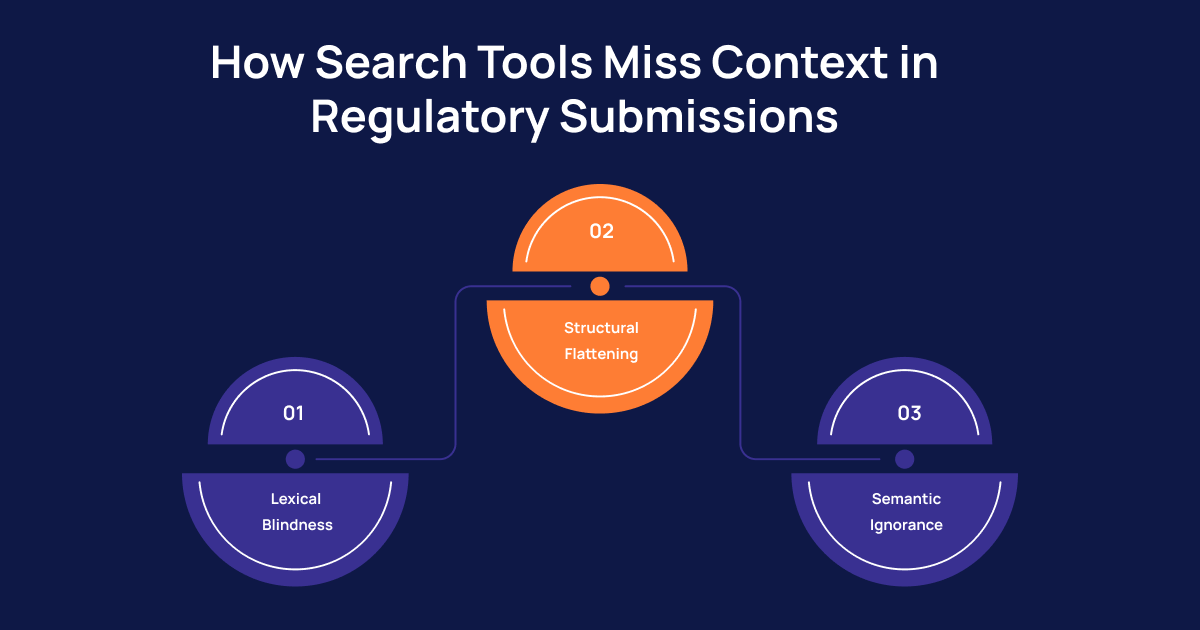
How Search Tools Miss Context in Regulatory Submissions

Context loss in standard regulatory document search occurs at three distinct levels:

Why Is Metadata Not Enough for Document Retrieval in Regulated Industries?

A common response to search failures is to invest in better metadata tagging. While metadata improves filtering (by document type, study phase, therapeutic area), it cannot solve the core document retrieval problem for two reasons.
First, the volume and velocity of unstructured data in pharma R&D make comprehensive manual tagging impractical. Today, an estimated 80% to 90% of all enterprise data is unstructured. For a mid-size pharma company managing thousands of clinical study reports, investigator brochures, and post-market surveillance filings, maintaining accurate metadata at scale is a resource drain that never reaches completeness.
Second, metadata captures attributes (author, date, document type) but not meaning. A metadata tag can label a document as “Phase III Clinical Study Report.” It cannot tell you whether that report contains a specific subgroup analysis for patients over 65 with renal impairment. The actual intelligence lives in the unstructured narrative, tables, and appendices within the document.

The Shift from Keyword Search to Semantic Search in Healthcare Documents

Semantic search for pharma represents a foundational shift in how clinical document search operates. Instead of matching tokens, semantic engines use vector embeddings to represent the meaning of queries and document passages in a shared mathematical space. A query for “cardiac safety signals in elderly patients” retrieves passages about “cardiovascular adverse events in geriatric populations” because the underlying meaning vectors are proximate, even though no keywords overlap.
This approach directly addresses the synonym, abbreviation, and contextual challenges that break keyword search. When combined with domain-specific training on medical ontologies (MedDRA, SNOMED CT, WHO-ART), semantic retrieval healthcare systems achieve significantly higher precision and recall on clinical corpora than general-purpose search tools.
RAG for life sciences (Retrieval-Augmented Generation) takes this further. A RAG architecture pairs semantic retrieval with a generative model that can synthesize answers grounded in the retrieved source documents. Instead of returning a list of 2,000 links, the system returns a direct answer: “Cardiac toxicity signals were observed in Study XYZ-301 (Module 5.3.5.3), primarily in patients aged 65+ with pre-existing QTc prolongation. See Table 14.3.1 for incidence rates.” The answer includes traceable citations back to the source, which is critical for GxP compliance and audit readiness.

How Intuceo Solves Contextual Search for Clinical and Regulatory Content

Intuceo’s approach to AI search in healthcare is built on a simple reality: generic enterprise search was never designed for the complexity of regulated content. Through two proprietary, modular engines, Intuceo delivers contextual search for regulated content at scale.

Intuceo-Ix™: Neural Search Intelligence (The Discovery Layer)

Intuceo-Ix™ goes beyond keyword matching to provide Neural Semantic Discovery. It understands the true context of clinical papers, regulatory submissions, FDA filings, and patent documents—reducing information retrieval time by 70%.

Intuceo-Dx™: Document and Vision Intelligence (The Ingestion Layer)

Intuceo-Dx™ addresses the critical upstream problem: converting complex, unstructured clinical documentation into structured, searchable “Gold Records.”

Built for Regulated Environments

Both Ix and Dx are deployable in air-gapped, on-premise, or private cloud environments (IL5/FedRAMP-ready). No proprietary data is used to train public models. This sovereign architecture, combined with compliance alignment for HIPAA, GxP, and 21 CFR Part 11, makes Intuceo’s document intelligence for pharma suitable for the most security-sensitive life sciences organizations.

Conclusion

The gap between what enterprise search tools deliver and what life sciences organizations actually need is not a minor inconvenience. It is a structural problem that affects research velocity, regulatory compliance timelines, and the quality of safety decisions. Keyword matching was built for general corporate content, not for the terminological density, structural complexity, and compliance rigor of clinical trial document retrieval and regulatory document search.
Closing this gap requires a shift to semantic search for life sciences, purpose-built for the domain, deployed in compliant environments, and architected to deliver traceable, contextual answers rather than keyword-matched links. For organizations ready to make that shift, the difference is not incremental. It is the difference between searching for information and actually finding it.

See How Intuceo Transforms Clinical Document Search

Discover how Intuceo-Ix™ and Intuceo-Dx™ reduce information retrieval time by 70% across millions of clinical and regulatory documents, all within HIPAA and GxP-compliant environments.

Frequently Asked Questions

Keyword search matches exact terms in a query against indexed tokens in a document. Semantic search for life sciences uses vector embeddings to match the meaning of a query to the meaning of document passages, enabling accurate retrieval even when the exact words differ. This is critical for medical terminology search, where synonyms, abbreviations, and acronyms are pervasive.
AI-powered semantic retrieval healthcare systems are trained on domain-specific ontologies such as MedDRA, SNOMED CT, and UMLS. This training allows the system to recognize that “MI,” “myocardial infarction,” and “heart attack” refer to the same clinical concept, enabling synonym matching in medical documents that keyword engines cannot achieve.
Most conventional systems do not handle them well. Abbreviations like “AE” (adverse event), “SAE” (serious adverse event), and “TEAE” (treatment-emergent adverse event) are either missed or conflated with unrelated acronyms. Neural search systems trained on life sciences corpora resolve these abbreviations contextually, based on the surrounding text and document type.
Three elements drive improvement: domain-specific model fine-tuning on clinical and regulatory corpora, integration with established medical ontologies for entity resolution, and a RAG for life sciences architecture that grounds every retrieved result in verifiable source documents. This combination ensures both precision and auditability.
Irrelevant results stem from three gaps: lexical ambiguity (the same word meaning different things in different contexts), structural flattening (loss of document hierarchy during indexing), and semantic blindness (inability to interpret negation, temporal qualifiers, and conditional statements). Addressing all three requires moving from token-based to meaning-based information retrieval.

Does Intuceo Offer On-Premise Advanced Analytics for FDA-Regulated Studies?

Pharmaceutical and life sciences organizations generate enormous volumes of sensitive data across clinical trials, pharmacovigilance programs, manufacturing lines, and post-market surveillance. The global pharmacovigilance market alone was valued at USD 9.35 billion in 2025 and is projected to reach USD 31.56 billion by 2034, growing at a CAGR of 14.69%. Yet much of this data is subject to strict regulatory controls, including FDA 21 CFR Part 11, GxP standards, and HIPAA requirements that determine not just how data is analyzed but where it physically resides.
For companies bound by these constraints, the question is not whether analytics can improve outcomes. It is whether the analytics platform can operate inside the organization’s own security perimeter without compromising on capability. That is the core question this post addresses: Does Intuceo support on-premise deployment for regulated life sciences data, and what does that look like in practice?

Why On-Premise Still Matters in FDA-Regulated Environments

Cloud adoption continues to accelerate across healthcare and pharma. Yet on-premise deployment held the largest share (55%) of the pharmaceutical analytics market by deployment mode in 2025. The reasons are practical, not philosophical. FDA-regulated analytics workflows frequently involve patient-level clinical data, adverse event records, and proprietary R&D datasets that organizations are either unwilling or legally unable to move outside their controlled perimeter.
Regulatory mandates like 21 CFR Part 11 require validated electronic record-keeping with immutable audit trails, controlled access, and documented data lineage. In clinical and pharmacovigilance settings, this extends to precise chain-of-custody documentation for every data transformation that feeds into an FDA submission. When the analytics platform resides on-premise or within a private cloud, the organization retains direct control over data residency, encryption, and access governance, factors that simplify audit readiness considerably.
Additionally, the FDA’s recent rollout of its new Adverse Event Monitoring System (AEMS), consolidating FAERS, VAERS, and other legacy databases into a single platform, signals increasing regulatory expectations around real-time reporting and submission accuracy. Organizations that can process, classify, and validate adverse event data internally, before it reaches the FDA, are better positioned to meet these heightened standards.

Intuceo's Approach: Deployment Sovereignty for Regulated Industries

Intuceo positions its architecture around a principle it calls “Deployment Sovereignty.” The concept is straightforward: your data constraints should drive your infrastructure choices, not vendor limitations. Intuceo’s life sciences AI solutions are engineered to deliver equivalent performance across Azure, AWS, GCP, on-premise, or hybrid environments. For defense and public sector clients, Intuceo also supports air-gapped deployments at IL5/FedRAMP levels, a capability that extends directly to life sciences organizations requiring maximum isolation.
This infrastructure flexibility means that a pharma company running a secure analytics platform behind its own firewall gets the same analytical depth as one operating in a managed cloud environment. Intuceo’s proprietary assets, including Intuceo-Ax (augmented analytics), Intuceo-Ix (neural enterprise search), and Intuceo-Dx (document intelligence), are all designed to be deployed within secure, private environments with zero data leakage to external models or public endpoints.

Handling FDA-Compliant Analytics Workflows

Regulatory compliance in life sciences is not a feature to be added after the fact. Intuceo engineers its data infrastructure with what it describes as a “Regulated-by-Design” architecture, meaning compliance is embedded at the platform level rather than layered on top.
In practical terms, this covers several critical areas for compliance data analytics:
Clinical data analytics and trial operations benefit from AI-driven protocol modeling, real-time site performance monitoring, and automated FDA reporting workflows. Intuceo’s patient matching capability uses generative AI to parse complex clinical trial protocols and identify eligible patient cohorts with precision, directly addressing one of the most resource-intensive stages of clinical development.
Pharmacovigilance analytics software capabilities include automated Adverse Event Report (AER) classification and Periodic Safety Master File (PSMF) optimization. Traditional AI models in this space provide binary predictions (adverse event: yes or no) but fail to supply the rationalization that regulators require. Intuceo addresses this with Explainable AI (XAI) frameworks that generate evidence-based rationale alongside each classification, achieving full regulatory fidelity while reclaiming significant expert hours that would otherwise be spent writing manual justifications for AE determinations.
Quality compliance analytics and manufacturing oversight are supported through automated CAPA (Corrective and Preventive Action) root-cause analysis and immutable, audit-ready documentation that satisfies HIPAA, GDPR, and GxP standards simultaneously.

Working with Legacy Systems and Fragmented Data

Most pharma and healthcare organizations operate with a mix of legacy databases, disconnected LIMS, PLM, and EHR systems, and fragmented regulatory filing repositories. Data quality problems at the source directly compromise the reliability of any downstream pharmaceutical data platform.
Intuceo’s data engineering practice addresses this directly. Its orchestration pipelines ingest structured, semi-structured, and unstructured data from legacy on-premise systems and cloud environments alike. Intuceo-Ix, the neural search engine, indexes millions of documents across SharePoint, LIMS, PLM, clinical trial databases, FDA filings, and patent repositories. The firm reports an 800% reduction in time spent on information discovery for R&D knowledge workers, alongside $6M in measured productivity savings for Fortune 500 pharma R&D departments.
This legacy data modernization approach layers intelligence on top of existing infrastructure rather than requiring wholesale migration, activating research data that was previously dormant or inaccessible.

Reducing Manual Effort in Adverse Event Detection and FDA Submissions

The FDA’s transition to the ICH E2B(R3) standard for electronic adverse event submissions, with a full compliance deadline of April 2026, is pushing pharmaceutical companies to fundamentally rethink their pharmacovigilance workflows. Manual case processing, once the industry default, cannot scale to meet real-time reporting expectations.
Intuceo’s adverse event detection AI directly addresses this shift. Its modeling capabilities go beyond surface-level classification to determine whether a complaint constitutes an adverse event, while simultaneously generating the rationalization layer that GxP standards demand. This combination of prediction accuracy and regulatory explainability separates Intuceo’s approach from generic AI tools that produce outputs but cannot justify them to an auditor.
The result is a measurable reduction in expert hours devoted to manual AE review and write-up, freeing pharmacovigilance professionals to focus on safety signal analysis and regulatory strategy.

The PhD-Led Difference in Regulated Environments

Operating in FDA-regulated spaces demands more than technical competence. It requires domain fluency, an understanding of why a specific validation protocol exists, what an auditor will scrutinize, and how a model’s output will be used in a regulatory submission.
Intuceo’s team of 80+ data scientists, led by PhD-level architects, brings specialized experience across life sciences, healthcare, and public sector regulatory environments. With over 100 enterprise-grade engagements completed, the firm has delivered clinical study analytics, manufacturing quality optimization, and knowledge engineering solutions for organizations including Johnson & Johnson, Bausch & Lomb, Janssen Pharma, and Ferring Pharma.
This scientific depth is operationalized through Intuceo’s proprietary iPDLC™ framework, which compresses implementation timelines by up to 4x while maintaining the validation rigor required for GxP-compliant environments.

Considering on-premise or hybrid analytics for your regulated data environment?

Intuceo’s PhD-led engineering teams architect FDA compliance analytics solutions that operate within your security perimeter, with full audit-readiness from Day 1.

Frequently Asked Questions

Intuceo is infrastructure-agnostic. Its solutions are engineered for cloud (Azure, AWS, GCP), on-premise, hybrid, and air-gapped deployments. All proprietary assets, Intuceo-Ax, Intuceo-Ix, and Intuceo-Dx, can operate entirely within a private, firewalled environment with no data exposure to external endpoints.
Yes. Intuceo’s architecture is natively aligned with FDA 21 CFR Part 11, GxP, and HIPAA standards. This includes validated electronic record-keeping, immutable audit trails, end-to-end data lineage, and role-based access controls, all built into the platform rather than added as an afterthought.
Intuceo covers the full life sciences value chain: R&D analytics for pharma, clinical data analytics, manufacturing quality (CAPA, OEE), pharmacovigilance analytics (automated AER classification), and post-market surveillance. Each capability is designed for the specific compliance and data integrity requirements of its domain.
Yes. Intuceo’s data engineering pipelines are built to integrate with legacy LIMS, PLM, EHR, and regulatory filing systems. Its Intuceo-Ix neural search engine can index 5M+ documents across disconnected repositories, enabling healthcare data integration and knowledge discovery without requiring a full-scale migration.
Intuceo implements a “Regulated-by-Design” architecture with automated data profiling, anomaly detection, and stewardship orchestration. Its governance frameworks are pre-vetted for FDA 21 CFR Part 11, HIPAA, FISMA, GxP, GDPR, and SOC 2 Type II. Continuous compliance monitoring and automated audit logging ensure persistent regulatory readiness.